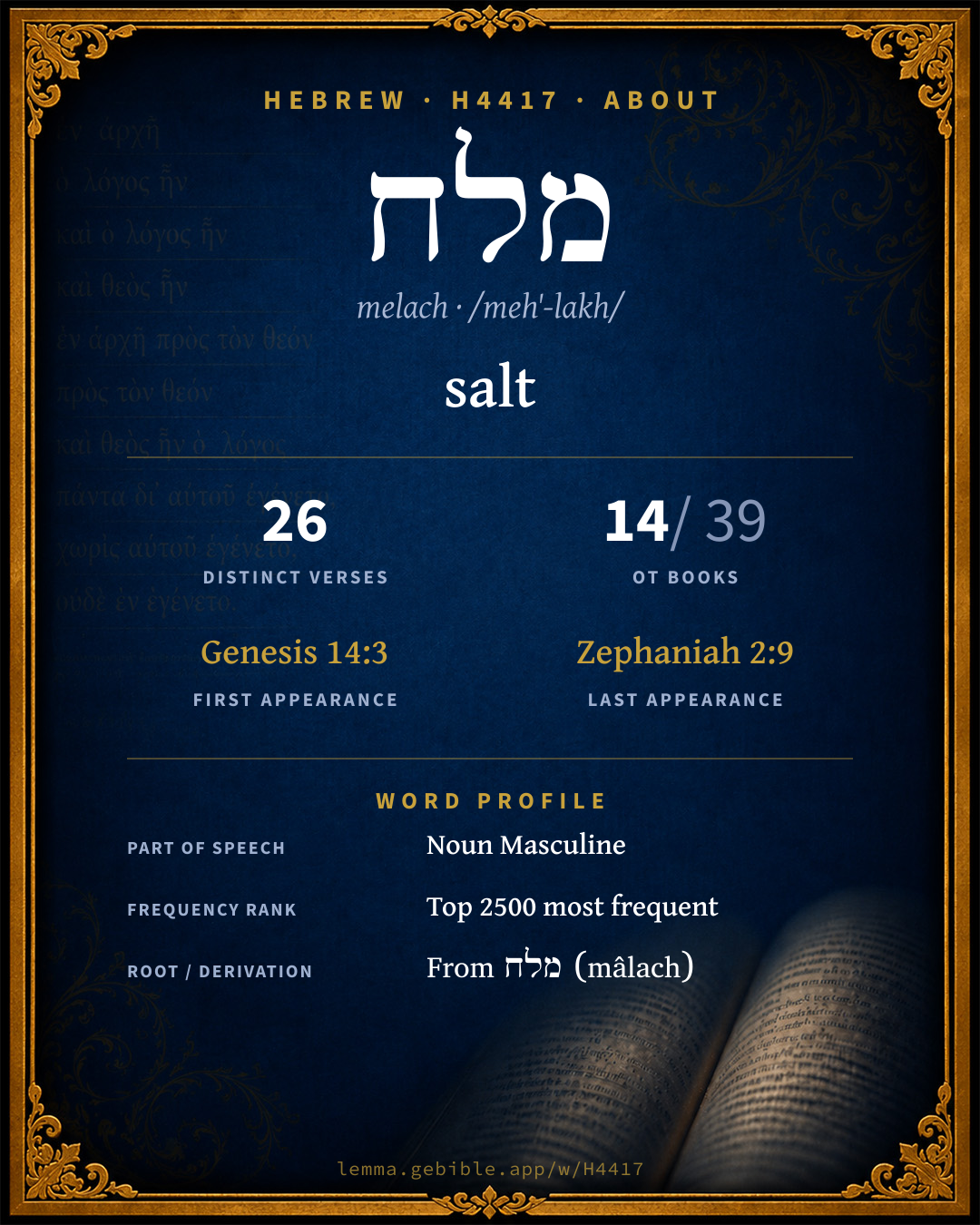
מֶ֫לַח
salt
Full lexicon entry — Brown-Driver-Briggs (BDB)
From Brown-Driver-Briggs (BDB)
Where this word appears
See every Absolute-state word in the Hebrew Bible →
Grammar key — what these labels mean
Part of speech
- Noun
- A naming word — a person, place, thing, or idea.
Noun type
- Common
- A common noun — a general class of person, place, or thing (“king,” “city,” “water”), not a specific name.
- Proper
- A name of a specific person, place, or people (e.g. Abraham, Zion, Israel).
State
- Absolute
- The independent form of a noun, not bound to a following word.
- Construct
- A noun bound to a following noun in a possessive / “of” relationship (the construct chain).
Gender
- Masculine
- Grammatically masculine.
Number
- Singular
- One.
Grammatical forms
- Noun, Common, Masculine, Singular, Absolute 21 times (72%)
- Noun, Proper 6 times (21%)
- Noun, Common, Masculine, Singular, Construct 2 times (7%)
Parsed forms decoded from the imported morphology (morphhb / Westminster Leningrad Codex — WLC text public domain, morphhb tagging CC BY 4.0), counted across 29 parsed occurrences — not distinct verses.
Every verse where H4417 appears — 26 distinct verses across 14 books. Click any verse to open its interlinear word-by-word view. Verse text shown in the World English Bible for context — . Each verse’s Hebrew form is shown with its reference; the English is not keyword-highlighted, since the data carries no word-level English alignment. Use “Compare translations” on any verse to read it across multiple English versions. This concordance covers the Hebrew Bible; Septuagint (Greek Old Testament) occurrences are not indexed here.
Genesis 2 verses
Leviticus 1 verse
Numbers 3 verses
- Numbers 18:19 מֶ֨לַח n c ms cs All the heave-offerings of the holy things, which the children of Israel offer to Yahweh, have I given you, and your sons and your daughters with you, as a portion forever: it is a covenant of salt forever before Yahweh to you and to your seed with you.
- Numbers 34:3 הַ/מֶּ֖לַח ptcl def.art + n c ms then your south quarter shall be from the wilderness of Zin along by the side of Edom, and your south border shall be from the end of the Salt Sea eastward;
- Numbers 34:12 הַ/מֶּ֑לַח ptcl def.art + n c ms and the border shall go down to the Jordan, and the goings out of it shall be at the Salt Sea. This shall be your land according to the borders of it round about.
Deuteronomy 2 verses
- Deuteronomy 3:17 הַ/מֶּ֔לַח ptcl def.art + n c ms the Arabah also, and the Jordan and the border [of it], from Chinnereth even to the sea of the Arabah, the Salt Sea, under the slopes of Pisgah eastward.
- Deuteronomy 29:23 וָ/מֶלַח֮ conj + n c ms [and that] the whole land of it is sulfur, and salt, [and] a burning, [that] it is not sown, nor bears, nor any grass grows therein, like the overthrow of Sodom and Gomorrah, Admah and Zeboiim, which Yahweh overthrew in his anger, and in his wrath:
Joshua 5 verses
- Joshua 3:16 הַ/מֶּ֖לַח ptcl def.art + n c ms that the waters which came down from above stood, and rose up in one heap, a great way off, at Adam, the city that is beside Zarethan; and those that went down toward the sea of the Arabah, even the Salt Sea, were wholly cut off: and the people passed over right against Jericho.
- Joshua 12:3 הַ/מֶּ֨לַח֙ ptcl def.art + n c ms and the Arabah to the sea of Chinneroth, eastward, and to the sea of the Arabah, even the Salt Sea, eastward, the way to Beth-jeshimoth; and on the south, under the slopes of Pisgah:
- Joshua 15:2 הַ/מֶּ֑לַח ptcl def.art + n c ms Their south border was from the uttermost part of the Salt Sea, from the bay that looks southward;
- Joshua 15:5 הַ/מֶּ֔לַח ptcl def.art + n c ms The east border was the Salt Sea, even to the end of the Jordan. The border of the north quarter was from the bay of the sea at the end of the Jordan;
- Joshua 18:19 הַ/מֶּ֨לַח֙ ptcl def.art + n c ms and the border passed along to the side of Beth Hoglah northward; and the goings out of the border were at the north bay of the Salt Sea, at the south end of the Jordan: this was the south border.
Judges 1 verse
2 Samuel 1 verse
2 Kings 3 verses
- 2 Kings 2:20 מֶ֑לַח n c ms He said, Bring me a new jar, and put salt therein. They brought it to him.
- 2 Kings 2:21 מֶ֑לַח n c ms He went forth to the spring of the waters, and cast salt therein, and said, Thus says Yahweh, I have healed these waters; there shall not be from there any more death or miscarrying.
- 2 Kings 14:7 המלח מֶ֨לַח֙ n Proper n Proper He killed of Edom in the Valley of Salt ten thousand, and took Sela by war, and called the name of it Joktheel, to this day.
1 Chronicles 1 verse
2 Chronicles 2 verses
- 2 Chronicles 13:5 מֶֽלַח n c ms Ought you not to know that Yahweh, the God of Israel, gave the kingdom over Israel to David forever, even to him and to his sons by a covenant of salt?
- 2 Chronicles 25:11 הַמֶּ֑לַח n Proper Amaziah took courage, and led forth his people, and went to the Valley of Salt, and struck of the children of Seir ten thousand.
Job 1 verse
Psalms 1 verse
Ezekiel 2 verses
- Ezekiel 43:24 מֶ֔לַח n c ms You shall bring them near before Yahweh, and the priests shall cast salt on them, and they shall offer them up for a burnt offering to Yahweh.
- Ezekiel 47:11 לְ/מֶ֥לַח prep + n c ms But the miry places of it, and the marshes of it, shall not be healed; they shall be given up to salt.
Zephaniah 1 verse
About this entry
At a glance — auto-summarized from this page’s data, not written by a person. Every figure links to its source below. This summary describes the numbers; it doesn’t interpret them.
מלח (melach) is a Hebrew noun most often rendered “salt.” Debuting at Genesis 14:3, it then recurs through the corpus. With 26 verses in 14 books, it is a moderately common word in the Hebrew Bible. From the same root come מלח, מלוח and מלח. For the data behind this summary, explore the sense tree and the renderings breakdown below.
Gloss history
Strong's 1890 vs modern scholarship
About this word
Strong's H4417 catalogs a Hebrew word from the Hebrew Old Testament.
These counts are not copied from any lexicon or concordance. They are computed here, from the morphology-tagged Hebrew Old Testament. What Lemma adds →
- 26
- distinct verses
- The word appears in 26 distinct verses.
- 14 / 39
- OT books
- The word appears in 14 of 39 Old Testament books.
- #1,160
- by frequency
- Top 2500 most frequent Hebrew words (rank 1,160 of 8,640 Hebrew words by occurrence).
View all 26 occurrences in the concordance →
By section of the Old Testament
By traditional corpus
Conventional, traditional groupings — biblical authorship is debated, so this is a traditional corpus grouping, not an authorship claim. Each share is this word’s portion of its verses in that division of the Hebrew canon. Each figure is a share of the word’s 26 distinct verses.
- Prophets (Nevi'im) 13 verses · 50%
- Torah (Pentateuch) 8 verses · 31%
- Writings (Ketuvim) 5 verses · 19%
How translations render this word
Counts come from each version’s own published word-to-Strong’s tagging or interlinear alignment — an approximate guide to how each version renders this word, not a word-level alignment the data otherwise carries. Because each total is that version’s own tagged count, the per-version totals vary from one another and need not match the appearance or distinct-verse counts above. These counts may also differ from a printed concordance because Lemma counts each distinctly tagged rendering and does not collapse phrase taggings into a single head-word total. This is a fixed set of word-tagged versions (KJV, ASV, BSB, ULT) and does not change with the reading translation you choose elsewhere. Each version’s license is shown beside its name below (and on Sources).
- King James Version: Salt 22×
- American Standard Version: Salt 20×
- Berean Standard Bible: Salt 18×
- unfoldingWord Literal Text: Salt 23×, Salt of 2×
King James Version Public Domain
Renders H4417 across 27 tagged occurrences — most commonly:
Plus 5 renderings that appear only once — usually multi-word phrases or single function words the recovered tagging swept in, not distinct renderings. Not rendered by a distinct English word in 1 further occurrence.
American Standard Version Public Domain
Renders H4417 across 26 tagged occurrences — most commonly:
Plus 6 renderings that appear only once — usually multi-word phrases or single function words the recovered tagging swept in, not distinct renderings.
Berean Standard Bible Public Domain
Renders H4417 across 20 tagged occurrences — most commonly:
Plus 2 renderings that appear only once — usually multi-word phrases or single function words the recovered tagging swept in, not distinct renderings. Not rendered by a distinct English word in 8 further occurrences.
unfoldingWord Literal Text CC BY-SA 4.0
Renders H4417 across 28 tagged occurrences — most commonly:
Plus 3 renderings that appear only once — usually multi-word phrases or single function words the recovered tagging swept in, not distinct renderings.
Senses in BDB
The 1 sense BDB distinguishes for this word, in lexicon order (not ranked by frequency or importance). The full entry — with sub-senses — is in the Lexicon Entry tab.
- salt
Word origin
n.m. salt (NH id.; Arabic مِلْحٌ Aramaic ܡܶܠܚܳܐ, מִלְחָא);—מ׳ abs. Gn 19:26 +; cstr. Lv 2:13;—salt for seasoning food Jb 6:6; offering Lv 2:13(×3) cf. Ez 43:24; בְּרִית מֶ֫לַח Nu 18:19 2 Ch 13:5 (cf. Lv 2:13 v. Di); used in purifying waters 2 K 2:20, 21; strewn on site of devoted city Ju 9:45 cf. Zp 2:9 (מִכְרֵה־מ׳) Dt 29:22 (‖ גָּפְרִית); produced in marshes reserved for purpose Ez 47:11; pillar of salt נְצִיב מ׳ Gn 19:26; usually in combin. יָם(־) הַמֶּלַח Gn 14:3 (עֵ֫מֶק הַשִּׂדִּים), Nu 34:3, 12 Dt 3:17 (‖ יָם הָעֲרָבָה), Jos 3:16; 12:3; 15:2, 5; 18:19; also גֵיא־מ׳ 2 S 8:13 2 K 14:7 Qr, ψ 60:2 (title), גֵּיא הַמּ׳ 1 Ch 18:12 2 Ch 25:11; 2 K 14:7 Kt.
— Brown-Driver-Briggs (Oxford 1906, public domain), digitized via Sefaria, supplemented by the OpenScriptures HebrewLexicon (CC BY 4.0). See Sources.
Derived from מלח (mâlach) (H4414) — to salt.
Jastrow Dictionary
A second Hebrew/Aramaic lexicon for comparison, covering Aramaic and post-biblical (Talmudic, Targumic, Midrashic) usage that the biblical-Hebrew BDB does not. Matched by lemma rather than by Strong’s number, so a lemma may carry more than one Jastrow headword (shown separately below), and the entries cover usage well beyond the Bible.
מָלַח
- to salt, brine; esp. (in ritual law) to strew salt on raw meat to resorb its blood. Midd. V, 3 היו מוֹלְחִין עורות וכ׳ they put salt on the hides of sacrifices.—Ḥull. 113ᵃ אלא א"כ מוֹלְחוֹ יפה יפה וכ׳ unless one salts it carefully and washes it thoroughly. Ib. מדיח ומוֹלֵחַ וכ׳ one must first wash the meat, then salt it and again wash it. B. Bath. 74ᵇ ומְלָחָהּ לצדיקים וכ׳ and preserved it in salt for the benefit of the righteous &c. Ḥull. l. c. דג טהור שמְלָחוֹ וכ׳ a clean fish which was salted together with an unclean one; a. fr.—Part. pass. מָלוּחַ (v. מְלִיחַ); pl. מְלוּחִים, מְלוּחִין. Ib. שניהם מ׳ both were salted, opp. תָּפֵל. Yalk. Ps. 887 מ׳ salty secretions.—Y. Taan. IV, 69ᵇ top מיני מ׳ various kinds of salted food. Y. Sabb. I, 3ᶜ bot. מְלוּחֵיהֶן brines prepared by gentiles; a. fr.
- to be strewn with salt. Sifra Vayikra, N’dab., Par. 9, ch. XI שלא הוּמְלְחָה no salt had been put on it.
- same. Part. מְמוּלָּח salted, trnsf. bright. Kidd. 29ᵇ אם היה בנו זריז וממ׳ (Var. וממולא) if his son is eager to learn and bright; [our w. missing in Tosef. Bekh. VI, 10).
מְלַח I
- Targ. Lev. II, 13. Targ. Y. Gen. XXXI, 19.—Sabb. 75ᵇ האי מאן דמ׳ בשרא וכ׳ he who salts raw meat (on the Sabbath) &c. Ḥull. 113ᵃ מ׳ ליה גרמא גרמא salted each piece separately. B. Bath. 74ᵇ לִימְלְחָהּ לנקבה let him preserve in salt the female (Behemoth); a. fr.—Part. pass. מְלִיחַ, מְלִיחָא, pl. מְלִיחֵי. Ib. כוורא מ׳ מעלי fish in salt is good; בשרא מ׳ וכ׳ meat in salt is not.—Ib. ציפרי מ׳ fowls in salt; a. fr.—V. מְלִיחָא.
- to be strewn with salt, be salted. Targ. Ez. XVI, 4.—Ḥull. 112ᵇ. Ib. 97ᵇ אִימְּלִיחוּ וכ׳ were (ritually) salted … with the nervus ischiadicus left therein; a. fr.
מְלַח II
- (denom. of מַלָּח) to row; to balance. Keth. 85ᵃ מְמַלַּח מַלּוּחֵי (not מימלח) rowed the boat (as an act of possession). B. Kam. 117ᵇ מ׳ ביה חד מינייהו (Alf.) one of them tried to keep the boat in balance (against the ass that threatened to upset it); [ed. מַ׳ ליה לחמרא (Var. מלא, v. Rabb. D. S. a. l. note 90) he tried to counterbalance the ass].
מֶלַח
- c. (b. h.; [brittle,] salt. Ker. 6ᵃ; B. Bath. 20ᵇ מ׳ סדומית (sub. ארץ) sea-salt, v. אִסְתְּרוֹקָנִית. Ḥull. 112ᵃ נאכל מחמת מִלְחוֹ is eaten on account of (with) the salt it has absorbed. Keth. 66ᵇ (prov.) מ׳ ממון חֶסֶר וא"ל חסד the salt (means of preservation) of wealth is its diminution (by charitable deeds), and some say ḥesed (benevolence). Gen. R. s. 51 חטאה במ׳ she (Lot’s wife) sinned through salt; הולכת … תנו לי מ׳ מ׳ she went to all her neighbors and said, give me salt for we have guests; a. fr.
מֶלַח ²
- Targ. Lev. II, 13 מַלַח constr. ed. Berl. (Var. מָ׳, מְ׳, v. Berl. Targ. O. II, p. 32; Y. מֶ׳). Targ. II Chr. XIII, 5. Targ. Y. Gen. XIX, 26 (v. Gen. R. s. 51 quot. in preced.); a. fr.—Kidd. 62ᵃ; Ḥull. 113ᵃ, v. גְּלַלְנִיתָא. Bekh. 8ᵇ מ׳ כי סרי וכ׳ when salt becomes unsavory, wherewith do they salt it? B. Bath. 74ᵇ מִלְחָהּ מעלי (differ. vers. in Ms. M., v. Rabb. D. S. a. l. note) as to the female (Behemoth), its brine is more savory. Yeb. 63ᵃ, v. חֲפוּרָה II; a. fr.—Pl. מִלְחֵי, מִי׳. Pes. 8ᵃ בי מ׳ salt-store. Ab. Zar. 33ᵃ שדא חמרא לבי מ׳ דישראל poured wine into a Jew’s salt-store (Rashi: a vessel filled with salt).
מַלָּח
- cmp. meaning of ἅλς a. mariner, sailor. Koh. R. to IX, 8.
מְלִיחַ
- (מָלַח)
- 1. preserved in salt, pickled. Ḥull. 113ᵃ (בשר) מ׳ salted meat, opp. תָּפֵל. Ib. 97ᵇ, a. fr. מ׳ … כרותח what is preserved in salt, is ritually to be considered as if boiled or roasted; a. fr.—[Pl., v. מָלַח.]
- 2. salted relish, dessert. Ber. VI, 7. Ib. 44ᵃ כל סעודה שאין בה מ׳ וכ׳ Ms. M. (ed. מלח, corr. acc.; v. Rabb. D. S. a. l. note) a meal without salted preserves is no meal.
A Dictionary of the Targumim, the Talmud Babli and Yerushalmi, and the Midrashic Literature (Marcus Jastrow; London, Luzac, 1903) — Public Domain. Digitized via Sefaria. Digitized via Sefaria. Full attribution on Sources.
Forms in the corpus
The 18 distinct written forms H4417 takes in the Hebrew Bible, most frequent first — each parse links to that state’s occurrences in the concordance. Hebrew forms include their vowel points and cantillation, so a single lemma takes many written forms.
Same root — word family
Other BDB entries built from the same root as H4417, grouped by Strong’s listed origin. These share a root / origin per the lexicon — not necessarily a shared meaning. Each links to that word’s own entry.
Derives from
Shares the same root
- מלוח mallûwach H4408 mallow
- מלח mᵉlach H4415 to eat salt
- מלח mâlâch H4418 rag
- מלח mallâch H4419 sailor
- מלחה mᵉlêchâh H4420 saltness
Compare all same-root words → Showing 4 of 7 — not the complete family. They share a root, not necessarily a meaning.
Septuagint verse parallels
This word appears in 26 verses that also exist in the Greek Old Testament (Septuagint), out of the 26 Hebrew verses it occurs in. You can read those verses in Greek by switching the Old Testament edition to the Septuagint.
Read these verses in the Septuagint
- Genesis 14:3
- Leviticus 2:13
- Numbers 18:19
- Deuteronomy 3:17
- Joshua 3:16
- Judges 9:45
- 2 Samuel 8:13
- 2 Kings 2:20
- 1 Chronicles 18:12
- 2 Chronicles 13:5
- Job 6:6
- Psalms 60:1
This is a verse-level parallel only — the same verses exist in both the Hebrew and Greek Old Testaments. No word-level Hebrew↔Greek correspondence is claimed: the data carries no such alignment, so no Greek word is shown as this Hebrew word’s translation. Coverage is not total — the Septuagint omits the deuterocanon and renumbers the Psalms, so some Hebrew verses have no direct Greek parallel.