
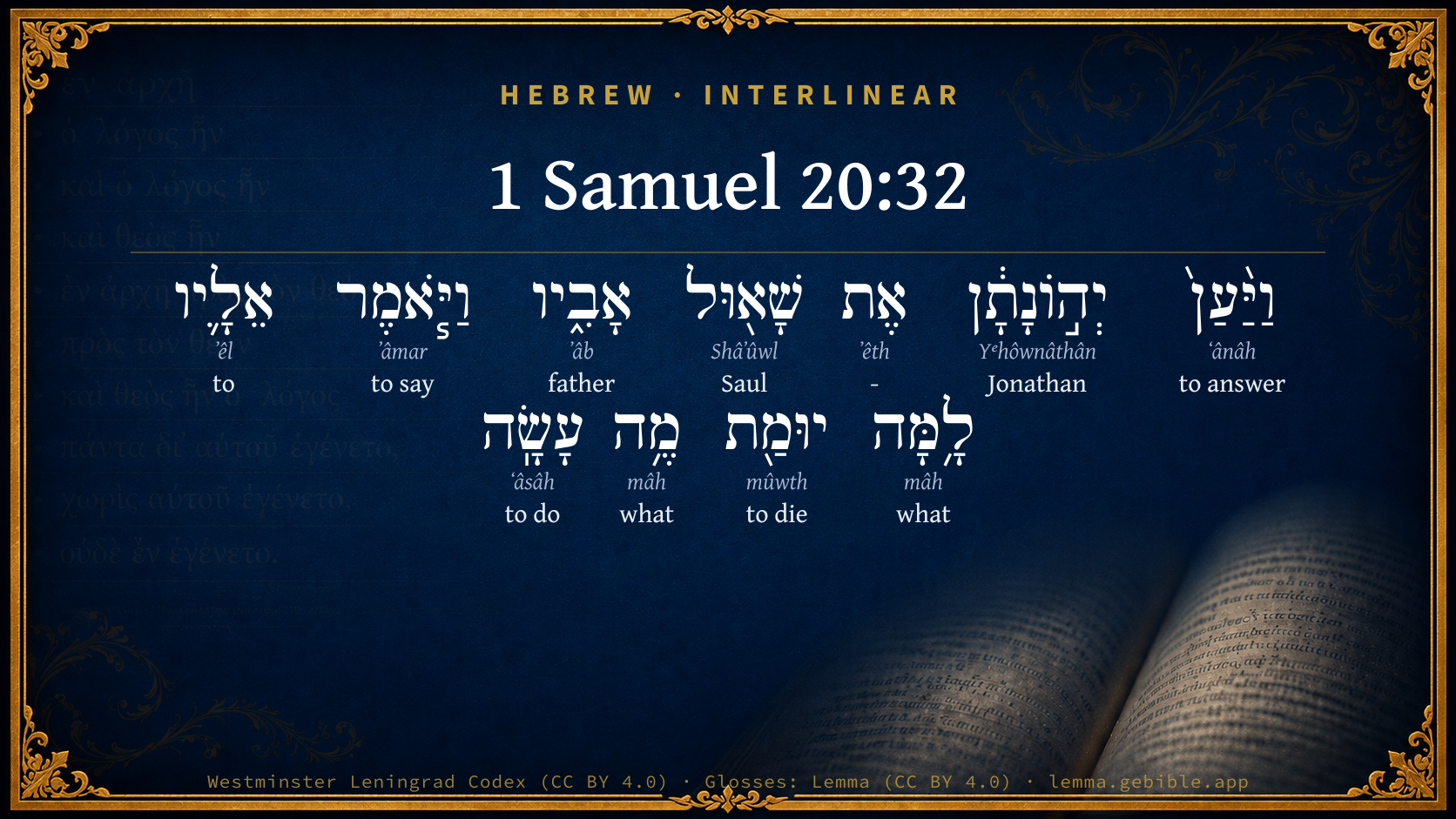
1 Samuel 20:32

Hebrew (Westminster Leningrad Codex) 1 Samuel 20:32 appears in the Hebrew Old Testament. The text above is from the Westminster Leningrad Codex. Each word links to its Strong’s number, a concise gloss, and parsing drawn from the Open Scriptures Hebrew Bible morphology. Click any word for its full Brown-Driver-Briggs (BDB) entry.
Download image
Cite this verse

1 Samuel 20:32 (World English Bible). Public Domain. Lemma interlinear Bible study tool, https://lemma.gebible.app/v/1-samuel/20/32.

Show BibTeX & RIS
BibTeX
RIS
English Translation
Jonathan answered Saul his father, and said to him, "Why should he be put to death? What has he done?"
World English Bible · Public Domain
Download a study sheet

One document with this verse’s original text, its word-by-word gloss line, the meaning frame, cross-references with their text, attributed commentary, and full source and license credits — printable, and it pastes into notes with its structure intact.

This verse Autodidact and up

Study sheet (.html) Plain text (.txt)

A passage Seminary Student

Up to 50 verses in one chapter. A passage sheet keeps up to 6 commentary sources and 12 cross-references per verse, in the order this page ranks them, and says so on the sheet whenever that leaves anything out. Ask for a single verse and you get the Autodidact verse sheet above.

Everything on this page stays free to read, with no account — the sheet is a download of what is already on screen, not access to it.

Want to remove ads? Support Godless Engineer
Compare translations 3

The same verse in 3 English versions, stacked beneath the original-language interlinear above. Click any original word for its lexicon entry.

Each is an independent rendering of the whole verse — the interlinear is not word-aligned to these translations.

Highlighted words mark where these versions differ — a whole-verse word diff, not a word-by-word alignment.

  • World English Bible Public Domain
    Jonathan answered Saul his father, and said to him, "Why should he be put to death? What has he done?"
  • King James Version Public Domain
    And Jonathan answered Saul his father, and said unto him, Wherefore shall he be slain? what hath he done?
  • unfoldingWord Literal Text CC BY-SA 4.0
    And Jonathan answered Saul his father and said to him, “Why should he be killed? What has he done?”

unfoldingWord Literal Text — © unfoldingWord, licensed CC BY-SA 4.0. Word-aligned USFM3 via Door43 (git.door43.org/unfoldingWord/en_ult).

Versions to compare (up to 4)

3 of 4 selected

Show all 18 translations

Every available English version of this verse, each an independent rendering of the whole verse.

  • World English Bible Public Domain
    Jonathan answered Saul his father, and said to him, "Why should he be put to death? What has he done?"
  • Berean Standard Bible Public Domain
    “Why must he be put to death?” Jonathan replied. “What has he done?”
  • Majority Standard Bible Public Domain
    “Why must he be put to death?” Jonathan replied. “What has he done?”
  • King James Version Public Domain
    And Jonathan answered Saul his father, and said unto him, Wherefore shall he be slain? what hath he done?
  • American Standard Version (1901) Public Domain
    And Jonathan answered Saul his father, and said unto him, Wherefore should he be put to death? what hath he done?
  • Revised Version (1885) Public Domain
    And Jonathan answered Saul his father, and said unto him, Wherefore should he be put to death? what hath he done?
  • Geneva Bible (1599) Public Domain
    And Ionathan answered vnto Saul his father, and said vnto him, Wherefore shall he die? what hath he done?
  • Douay-Rheims (1899) Public Domain
    And Jonathan answering Saul his father, said: Why shall he die: what hath he done?
  • Young's Literal Translation Public Domain
    And Jonathan answereth Saul his father, and saith unto him, `Why is he put to death? what hath he done?'
  • Literal Standard Version CC BY-SA 4.0
    And Jonathan answers his father Saul and says to him, “Why is he put to death? What has he done?”
  • Unlocked Literal Bible CC BY-SA 4.0
    Jonathan answered Saul his father, “For what reason should he be put to death? What has he done?”
  • unfoldingWord Literal Text CC BY-SA 4.0
    And Jonathan answered Saul his father and said to him, “Why should he be killed? What has he done?”
  • Darby Bible Public Domain
    And Jonathan answered Saul his father, and said to him, Why should he be put to death? what has he done?
  • World Messianic Bible Public Domain
    Jonathan answered Saul his father, and said to him, “Why should he be put to death? What has he done?”
  • Webster's Bible Public Domain
    And Jonathan answered Saul his father, and said to him, Why shall he be slain? what hath he done?
  • Free Bible Version CC BY-SA 4.0
    “Why does he have to be put to death?” Jonathan asked. “What has he done?”
  • Bible in Basic English Public Domain
    And Jonathan, answering his father Saul, said to him, Why is he to be put to death? What has he done?
  • JPS Tanakh (1917) Public Domain
    And Jonathan answered Saul his father, and said unto him: 'Wherefore should he be put to death? what hath he done?'

Literal Standard Version (2020), Covenant Press — licensed CC BY-SA 4.0. Text via the HelloAO Bible API (eBible.org). Unlocked Literal Bible (unfoldingWord) — licensed CC BY-SA 4.0. Text via the HelloAO Bible API (eBible.org). unfoldingWord Literal Text — © unfoldingWord, licensed CC BY-SA 4.0. Word-aligned USFM3 via Door43 (git.door43.org/unfoldingWord/en_ult). Free Bible Version, Dr. Jonathan Gallagher — licensed CC BY-SA 4.0. Text via the HelloAO Bible API (eBible.org).

Word by word

More ways to search: Search by grammar → Find every occurrence → Compare this word →

Practice this passage: Drill this verse → Learn its vocabulary →

יְה֣וֹנָתָ֔ן
Yᵉhôwnâthân
H3083
“Jonathan”
Noun, Proper
Part of Speech
Noun
Type
Proper
Full BDB Definition

Origin: from H3068 and H5414

TWOT: None

Jonathan or Jehonathan = "Jehovah has given" - a son of king Saul and a friend of David - a son of the high priest Abiathar and the last descendant of Eli of whom we hear - a nephew of David who like David slew a giant of Gath - an uncle of David - one of David's mighty warriors - one of David's treasurers - a scribe in the time of Jeremiah - a Levite and father of Zechariah, a priest who blew the trumpet at the dedication of the wall - a son or descendant of Gershom, the son of Moses, and a priest to the tribe of Dan - a son of Kareah and a brother of Johanan; a Judaite captain after the fall of Jerusalem - another Judaite father of Peleth - father of Ebed in the time of Ezra - son of Asahel in the time of Ezra - a priest of the family of Melicu in the time of Nehemiah - son of Joiada and his successor to the high priesthood in the time of Nehemiah
  1. וַיַּ֨עַן֙ ʻânâh H6030 “and · to answer” Conjunction + Verb, Qal, Sequential Imperfect, 3rd Person, Masculine, Singular
  2. אֶת ʼêth H853 “-” Particle, Direct Object
  3. שָׁא֖וּל Shâʼûwl H7586 “Saul” Noun, Proper
  4. אָבִ֑יו ʼâb H1 “father · his” Noun, Common, Masculine, Singular, Construct + Suffix, Personal, 3rd Person, Masculine, Singular
  5. וַיֹּ֧אמֶר ʼâmar H559 “and · to say” Conjunction + Verb, Qal, Sequential Imperfect, 3rd Person, Masculine, Singular
  6. אֵלָ֛יו ʼêl H413 “to · him” Preposition + Suffix, Personal, 3rd Person, Masculine, Singular
  7. לָ֥מָּה mâh H4100 “to/for · what” Preposition + Particle, Interrogative
  8. יוּמַ֖ת mûwth H4191 “to die” Verb, Hophal, Imperfect, 3rd Person, Masculine, Singular
  9. מֶ֥ה mâh H4100 “what” Particle, Interrogative
  10. עָשָֽׂה ʻâsâh H6213 “to do” Verb, Qal, Perfect, 3rd Person, Masculine, Singular

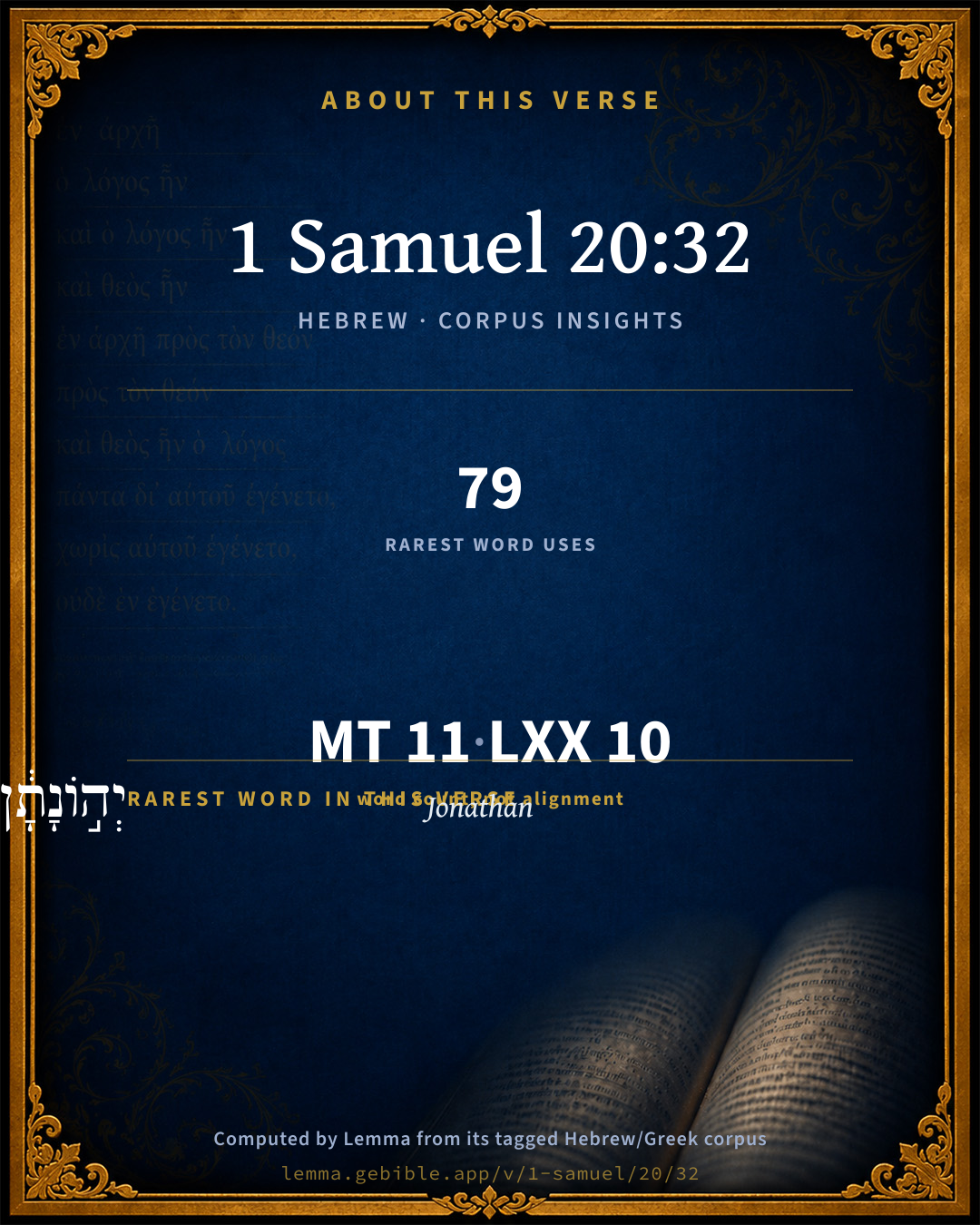
About this verse

These counts appear in no published source. They are computed here, from the morphology-tagged text and Lemma’s own curated glosses. What Lemma adds →

11
words
10
distinct lemmas
Historical
section

Grammatical profile

  • 4 verbs
  • 3 nouns
  • 1 preposition
  • 3 particles

Verb forms

  • וַיַּ֨עַן֙ Qal · Sequential Imperfect
  • וַיֹּ֧אמֶר Qal · Sequential Imperfect
  • יוּמַ֖ת Hophal · Imperfect
  • עָשָֽׂה Qal · Perfect

Repetition

A word recurs within this verse — often emphatic in Hebrew:

  • לָ֥מָּה what H4100 ×2

Hebrew & Septuagint length

In English translation the verse runs 20 words from the Hebrew and 13 from the Septuagint (LXX English) — the Septuagint runs noticeably shorter here. See the side-by-side →

A rough comparison of the two English renderings, which tokenize alike — not a word-level alignment.

Word counts can differ between the Hebrew and the Greek without any difference in meaning — e.g. the Hebrew direct-object marker אֵת has no separate Greek word, and Greek often adds the article ὁ.

In the original languages it is 11 Hebrew tokens and 10 Greek tokens — but the two are counted differently (Hebrew bundles its prefixes and suffixes into one token; the Greek is in lemma form), so that isn’t a like-for-like length.

Cross-references

14

Topical passages linked to 1 Samuel 20:32 in the Treasury of Scripture Knowledge — connected by theme and wording, ordered by reader-vote popularity; previews shown in the World English Bible.

  • Matthew 27:23 But the governor said, "Why? What evil has he done?" But they cried out exceedingly, saying, "Let him be crucified!"
  • 1 Samuel 19:5 for he put his life in his hand, and struck the Philistine, and Yahweh worked a great victory for all Israel: you saw it, and did rejoice; why then will you sin against innocent blood, to kill David without a cause?
  • Genesis 31:36 Jacob was angry, and argued with Laban. Jacob answered Laban, "What is my trespass? What is my sin, that you have hotly pursued after me?
  • Luke 23:22 He said to them the third time, "Why? What evil has this man done? I have found no capital crime in him. I will therefore chastise him and release him."
  • 1 Samuel 18:11 and Saul cast the spear; for he said, I will strike David even to the wall. David avoided out of his presence twice.
  • 1 Samuel 19:10–11 Saul sought to strike David even to the wall with the spear; but he slipped away out of Saul's presence, and he struck the spear into the wall: and David fled, and escaped that night.
  • 1 Samuel 20:7 If he says, 'It is well;' your servant shall have peace: but if he be angry, then know that evil is determined by him.
  • Proverbs 22:24 Don't befriend a hot-tempered man, And don't associate with one who harbors anger:
  • Proverbs 24:11–12 Rescue those who are being led away to death! Indeed, hold back those who are staggering to the slaughter!
  • Proverbs 31:8–9 Open your mouth for the mute, In the cause of all who are left desolate.
  • Ecclesiastes 7:9 Don't be hasty in your spirit to be angry, for anger rests in the bosom of fools.
  • Ecclesiastes 9:3 This is an evil in all that is done under the sun, that there is one event to all: yes also, the heart of the sons of men is full of evil, and madness is in their heart while they live, and after that they go to the dead.
  • Jeremiah 17:9 The heart is deceitful above all things, and it is exceedingly corrupt: who can know it?
  • John 7:51 "Does our law judge a man, unless it first hears from him personally and knows what he does?"

Cross-references courtesy of OpenBible.info (CC BY 4.0).

Hebrew and Greek witnesses Masoretic Hebrew ↔ Greek Septuagint

The same verse in the two great witnesses to the Old Testament, shown verse-for-verse.

Here the Septuagint runs noticeably shorter than the Hebrew — LXX2012 (modern English Septuagint) 13 words vs World English Bible 20. A rough length comparison of the two English translations, not a word-level alignment — read both below.

These are two independent witnesses, not word-aligned to each other, and the Septuagint is shown in lemma (dictionary) form.

Hebrew 1 Samuel 20:32 Masoretic · Westminster Leningrad Codex

וַיַּ֨עַן֙ יְה֣וֹנָתָ֔ן אֶת שָׁא֖וּל אָבִ֑יו וַיֹּ֧אמֶר אֵלָ֛יו לָ֥מָּה יוּמַ֖ת מֶ֥ה עָשָֽׂה

Jonathan answered Saul his father, and said to him, "Why should he be put to death? What has he done?"

World English Bible · Public Domain

Greek LXX 1 Samuel 20:32 Septuagint · lemma form

καί ἀποκρίνω ιωναθαν ὁ σαούλ ἵνα τίς ἀποθνήσκω τίς ποιέω

And Jonathan answered Saul, Why is he to die? What has he done?

LXX2012 (modern English Septuagint) · Public Domain

Hebrew: Westminster Leningrad Codex (CC BY 4.0). Greek: Septuagint (public domain); English from LXX2012 (modern English Septuagint) (Public Domain). How the Septuagint differs from the Hebrew →

Targum (Aramaic paraphrase)

1

The Targum is the ancient Jewish Aramaic paraphrase of the Hebrew Scriptures — an interpretive translation, not the Hebrew text itself. Onkelos (literal) and Pseudo-Jonathan (expansive) render the Torah, and Jonathan the Prophets. Coverage is partial: where no permissively-licensed English translation exists for a verse, only the Aramaic is shown. This is verse-level text, not a word-by-word alignment to the Hebrew.

  1. Targum Jonathan Prophets (Joshua–Malachi)
    וְאָתֵיב יְהוֹנָתָן יַת שָׁאוּל אֲבוּהִי וַאֲמַר לֵיהּ לְמָה יִתְקְטֵיל מָה עֲבָד:

    (no public-domain English translation for this verse)

    Targum Jonathan — Aramaic: “Mikraot Gedolot” (public domain). English: “Sefaria Community Translation” (CC0 1.0 (public-domain dedication)); “London "Chaldee Paraphrase," 1871” (public domain). Text via Sefaria.

Commentary

Notes on 1 Samuel 20:32 from classic Christian and Jewish commentators (each source and its license shown beneath its notes). The classic Christian expositions comment on the surrounding passage and are grouped to its opening verse, so a note may address several verses; the Jewish commentaries on the Tanakh (Rashi and others) are per-verse, so they appear only where the commentator wrote on this verse.

Lemma curates 59 commentaries, every one of them public domain or Creative Commons licensed, each selected and text-cleaned for this edition rather than reprinted as found. About our sources →

Trapp's Complete Commentary

John Trapp

1Sa 20:32 And Jonathan answered Saul his father, and said unto him, Wherefore shall he be slain? what hath he done?

Ver. 32. Wherefore shall he be slain?] Good blood will not belie itself. Nicodemus, faint hearted at first, yet when Christ was likely to be apprehended, stickled for him, and to very good purpose. {Joh 7:50-53}

John Trapp, A Commentary or Exposition upon All the Books of the Old and New Testament (1647–1656) — public domain. Text from a community e-Sword module.

The Biblical Illustrator

Joseph S. Exell

1Sa_20:32-42

And Jonathan answered Saul, his father, and said unto him, Wherefore should he be slain?

Davids friend, Jonathan

There is little friendship in the world, said Lord Bacon. O friendship, wrote the author of Endymion, of all things the most rare; and therefore most rare, because most excellent.

1. Friendship means more than affection. Strange to say, greater friendships exist than in the family circle.

2. Again, friendship is not identical with the religious hope. The well-meaning, but ignorant, have beheaded the saints.

3. But while friendship is by no means involved in the family or the church affection, it yet remains true that the purest religious hope is the basis of the highest friendships. Great deeds are never done by those whose belief cuts off immortality.

I. True friendship is based on righteousness. Friendship is the outgrowth of righteousness. The most hallowed relationships afford no ground for unjust deeds among friends. The childs love for the father is no excuse for wrongdoing at that fathers command.

II. True friendship makes no account of personal danger. The world is slow in learning that there is a greater existence than self.

1. We turn from majorities and minorities to observe that personal comforts and discomforts are no criteria of action. The question is not as to pleasure and pain, but rather as to the highest obligations.

2. The true friend is never afraid of danger. The son may die by the fathers javelin, but Jonathans friendship is true.

III. True friendship rejoices in others prosperity. (Monday Club Sermons.)

The Biblical Illustrator, edited by Joseph S. Exell (c. 1880s–1900s) — public domain. Text from a community e-Sword module.

Geneva Bible (1599)

Geneva Bible translators

For it were too great tyranny to put one to death and not to show the cause why.

Geneva Bible (1599) marginal notes — public domain. Text via Bolls.life.

Ellicott's Commentary for English Readers

(32) And Jonathan answered.—Jonathan, remembering the effect of his quiet, earnest remonstrance on a previous occasion, again tried to deprecate his father’s unreasoning jealous anger, but this time to no purpose. A paroxysm of madness seized Saul, and he grasped the long spear leaning by his side, and with hate and fury in his eye raised the great war weapon to strike down his son.

A Bible Commentary for English Readers, edited by Charles John Ellicott (1878–1897) — public domain. Text from a community e-Sword module.

John Gill's Exposition

And Jonathan answered Saul his, father, and said unto him,.... Making no answer to the charges of perverseness, rebellion, and folly brought against himself, which he bore with patience, but could not bear to hear his dear friend spoken against, and as worthy of death; and therefore in answer to that says:

wherefore shall he be slain? what hath he done? has he attempted to take away thy life? to deprive thee of thy crown? to settle himself upon the throne? what overt act of treason has he been guilty of; that he should die? on the contrary, has he not done many things worthy of immortal honour, for the good of the nation, and the glory of thy reign? and if God has determined the kingdom for him, and anointed him to it, what blame can be laid upon him? nay, should he not be the rather respected and honoured?

John Gill's Exposition of the Whole Bible (1746–1763) — public domain (CC PDM 1.0). Text via the HelloAO Bible API.

The Pulpit Commentary

Vers. 32-34. When Jonathan pleaded mildly for his friend, Saul did not east, but "brandished" (see on 1Sa_18:11) his javelin at him, threatening to smite him. This fierce behaviour of his father filled Jonathan also with anger, and he arose, refused to partake of the meal, and went away in wrath. His indignation was roused not merely at his father having thus brandished his javelin in his face, for he was sitting close to Saul, but because he had cast shameful aspersions upon David in saying that he was a rebel, and deserved death.

The Pulpit Commentary (1880–1919), ed. H.D.M. Spence-Jones & Joseph S. Exell — public domain. Text from a community e-Sword module.

unfoldingWord translationNotes

Door43 World Missions Community

For what reason should he be put to death? What has he done?

Jonathan is trying to get Saul to think carefully about what he is doing. This can be translated as a statement, and the words "should he be put to death" can be translated in active form. AT: "You have no good reason to put him to death. He has done nothing wrong." or "You have no good reason to kill him. He has done nothing wrong." (See: Rhetorical Question)

the second day of the month

This "second" is an ordinal number which refers to two. AT: "the second day of the new moon festival" (See: Ordinal Numbers)

he was grieved over David

This can be stated in active form. AT: "he was grieving over David" (See: Active or Passive)

had dishonored him

Here "him" refers to David.

translationWords

Saul (OT)

spear

David

day

month

dishonor

unfoldingWord translationNotes — © Distant Shores Media and the Door43 World Missions Community, licensed CC BY-SA 4.0. Source: git.door43.org/Door43/en_tn.

Lesson kit

Teaching starters — assembled from the data on this page, not authored interpretation. Every prompt links to the verse data it draws on. Edit before teaching.

1 Samuel, in the Historical, opens this verse with 11 words (10 distinct Hebrew lemmas). Its most distinctive word is Yᵉhôwnâthân (“Jonathan”). The Greek Septuagint runs shorter here. A historical commentator’s framing appears above. Read the whole chapter for the surrounding context.

Discussion questions

  1. How does “Jonathan” (Yᵉhôwnâthân) shape what this verse is saying?
  2. How does Matthew 27:23, which shares this passage’s theme, read alongside this verse?
  3. What does the repetition of “what” (2× in this one verse) do in this verse?
  4. The Septuagint runs shorter here than the Hebrew. What might account for the difference?
  5. These translations render this verse differently. What is at stake in choosing one wording over another?
  6. «וַיַּ֨עַן֙» is a Qal Sequential Imperfect verb. How does that grammatical form shape the action described?
  7. Compare how Trapp's Complete Commentary and The Biblical Illustrator read this verse. Where do they agree or differ?

Things to notice

Reading settings

Reading text

Shown beneath each verse's original-language words.

Old Testament
Old Testament edition

Read the OT as the Masoretic Hebrew (MT) or the Greek Septuagint (LXX).

English shown for the Greek Septuagint (in the Hebrew ↔ Greek comparison).

Comparing translations? Open the Compare panel on any verse page to stack up to four side by side.