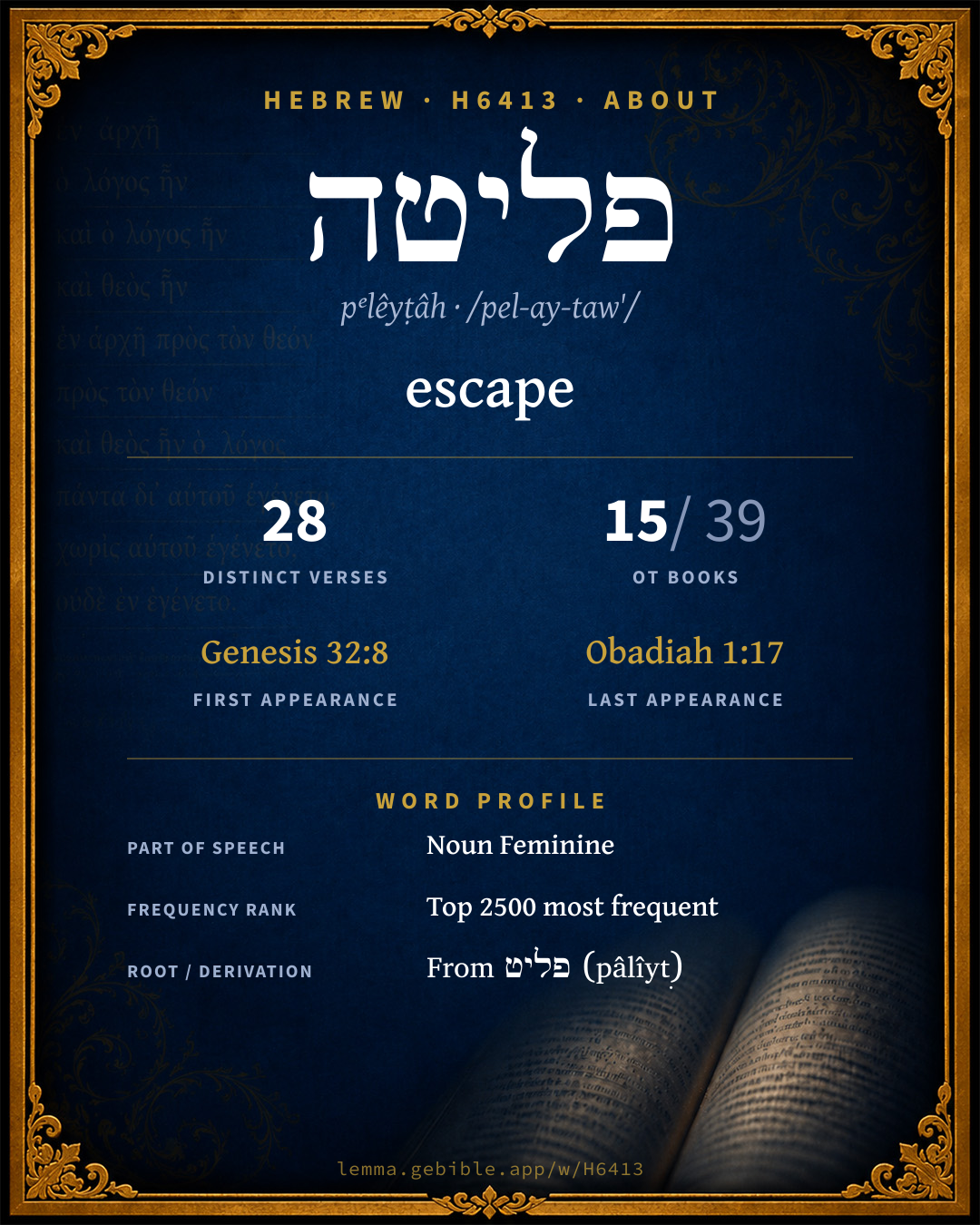
פְּלֵיטָה
escape
‘escape’ is one of 2 main senses fuller range ↓
Full lexicon entry — Brown-Driver-Briggs (BDB)
From Brown-Driver-Briggs (BDB)
Where this word appears
See every Absolute-state word in the Hebrew Bible →
Grammar key — what these labels mean
Part of speech
- Noun
- A naming word — a person, place, thing, or idea.
Noun type
- Common
- A common noun — a general class of person, place, or thing (“king,” “city,” “water”), not a specific name.
State
- Absolute
- The independent form of a noun, not bound to a following word.
- Construct
- A noun bound to a following noun in a possessive / “of” relationship (the construct chain).
Gender
- Feminine
- Grammatically feminine.
Number
- Singular
- One.
Grammatical forms
- Noun, Common, Feminine, Singular, Absolute 23 times (82%)
- Noun, Common, Feminine, Singular, Construct 5 times (18%)
Parsed forms decoded from the imported morphology (morphhb / Westminster Leningrad Codex — WLC text public domain, morphhb tagging CC BY 4.0), counted across 28 parsed occurrences — not distinct verses.
Every verse where H6413 appears — 28 distinct verses across 15 books. Click any verse to open its interlinear word-by-word view. Verse text shown in the World English Bible for context — . Each verse’s Hebrew form is shown with its reference; the English is not keyword-highlighted, since the data carries no word-level English alignment. Use “Compare translations” on any verse to read it across multiple English versions. This concordance covers the Hebrew Bible; Septuagint (Greek Old Testament) occurrences are not indexed here.
Genesis 2 verses
Exodus 1 verse
Judges 1 verse
2 Samuel 1 verse
2 Kings 2 verses
- 2 Kings 19:30 פְּלֵיטַ֧ת n c fs cs The remnant that has escaped of the house of Judah shall again take root downward, and bear fruit upward.
- 2 Kings 19:31 וּ/פְלֵיטָ֖ה conj + n c fs For out of Jerusalem shall go forth a remnant, and out of Mount Zion those who shall escape: the zeal of Yahweh shall perform this.
1 Chronicles 1 verse
2 Chronicles 3 verses
- 2 Chronicles 12:7 לִ/פְלֵיטָ֔ה prep + n c fs When Yahweh saw that they humbled themselves, the word of Yahweh came to Shemaiah, saying, They have humbled themselves: I will not destroy them; but I will grant them some deliverance, and my wrath shall not be poured out on Jerusalem by the hand of Shishak.
- 2 Chronicles 20:24 פְּלֵיטָֽה n c fs When Judah came to the watch-tower of the wilderness, they looked at the multitude; and, behold, they were dead bodies fallen to the earth, and there were none who escaped.
- 2 Chronicles 30:6 הַ/פְּלֵיטָ֔ה ptcl def.art + n c fs So the posts went with the letters from the king and his princes throughout all Israel and Judah, and according to the commandment of the king, saying, You children of Israel, turn again to Yahweh, the God of Abraham, Isaac, and Israel, that he may return to the remnant that have escaped of you out of the hand of the kings of Assyria.
Ezra 4 verses
- Ezra 9:8 פְּלֵיטָ֔ה n c fs Now for a little moment grace has been shown from Yahweh our God, to leave us a remnant to escape, and to give us a nail in his holy place, that our God may lighten our eyes, and give us a little reviving in our bondage.
- Ezra 9:13 פְּלֵיטָ֖ה n c fs After all that is come on us for our evil deeds, and for our great guilt, seeing that you our God have punished us less than our iniquities deserve, and have given us such a remnant,
- Ezra 9:14 וּ/פְלֵיטָֽה conj + n c fs shall we again break your commandments, and join in affinity with the peoples that do these abominations? would not you be angry with us until you had consumed us, so that there should be no remnant, nor any to escape?
- Ezra 9:15 פְלֵיטָ֖ה n c fs Yahweh, the God of Israel, you are righteous; for we are left a remnant that is escaped, as it is this day: behold, we are before you in our guiltiness; for none can stand before you because of this.
Nehemiah 1 verse
Isaiah 5 verses
- Isaiah 4:2 לִ/פְלֵיטַ֖ת prep + n c fs cs In that day, Yahweh's branch will be beautiful and glorious, and the fruit of the land will be the beauty and glory of the survivors of Israel.
- Isaiah 10:20 וּ/פְלֵיטַ֣ת conj + n c fs cs It shall come to pass in that day, that the remnant of Israel, and those who are escaped of the house of Jacob, shall no more again lean on him who struck them, but shall lean on Yahweh, the Holy One of Israel, in truth.
- Isaiah 15:9 לִ/פְלֵיטַ֤ת prep + n c fs cs For the waters of Dimon are full of blood; for I will bring yet more on Dimon, a lion on them of Moab that escape, and on the remnant of the land.
- Isaiah 37:31 פְּלֵיטַ֧ת n c fs cs The remnant that is escaped of the house of Judah shall again take root downward, and bear fruit upward.
- Isaiah 37:32 וּ/פְלֵיטָ֖ה conj + n c fs For out of Jerusalem shall go forth a remnant, and out of Mount Zion those who shall escape. The zeal of Yahweh of Hosts will perform this.
Jeremiah 2 verses
- Jeremiah 25:35 וּ/פְלֵיטָ֖ה conj + n c fs The shepherds shall have no way to flee, nor the principal of the flock to escape.
- Jeremiah 50:29 פְּלֵטָ֔ה n c fs Call together the archers against Babylon, all those who bend the bow; encamp against her round about; let none of it escape: recompense her according to her work; according to all that she has done, do to her; for she has been proud against Yahweh, against the Holy One of Israel.
Ezekiel 1 verse
Daniel 1 verse
Joel 2 verses
- Joel 2:3 פְּלֵיטָ֖ה n c fs A fire devours before them, And behind them, a flame burns. The land is as the garden of Eden before them, And behind them, a desolate wilderness. Yes, and no one has escaped them.
- Joel 2:32 פְלֵיטָ֗ה n c fs It will happen that whoever will call on the name of Yahweh shall be saved; For in Mount Zion and in Jerusalem there will be those who escape, As Yahweh has said, And among the remnant, those whom Yahweh calls.
Obadiah 1 verse
About this entry
At a glance — auto-summarized from this page’s data, not written by a person. Every figure links to its source below. This summary describes the numbers; it doesn’t interpret them.
The Hebrew noun פליטה centers on the idea of “escape.” First canonically at Genesis 32:8, it enters the text early. It turns up in 28 verses across 15 books, a moderately common footprint. Its meaning spans more than one sense — see its full sense range. For the data behind this summary, explore the sense tree and the renderings breakdown below.
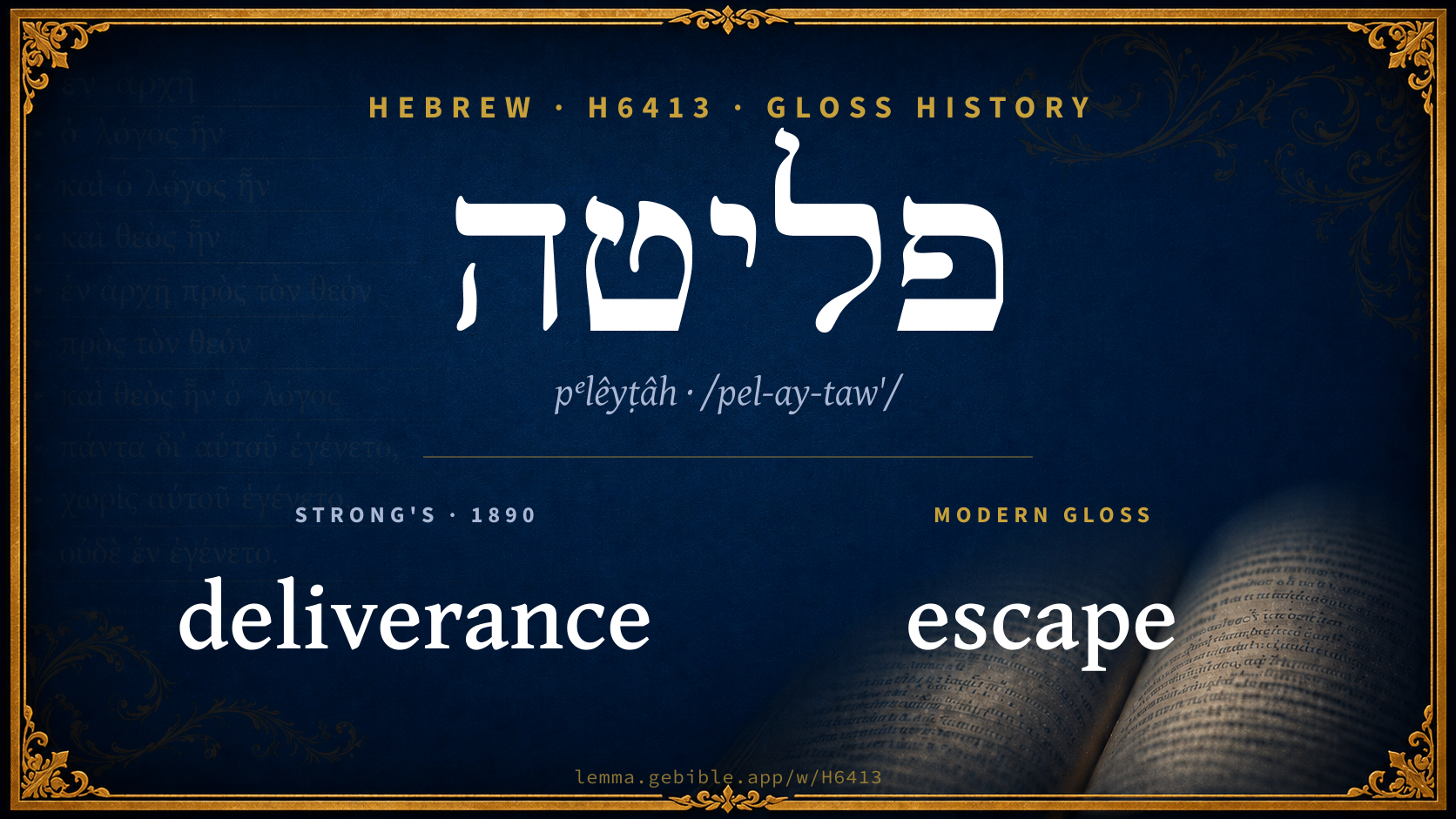
Gloss history
Strong's 1890 vs modern scholarship
About this word
Strong's H6413 catalogs a Hebrew word from the Hebrew Old Testament.
These counts are not copied from any lexicon or concordance. They are computed here, from the morphology-tagged Hebrew Old Testament. What Lemma adds →
- 28
- distinct verses
- The word appears in 28 distinct verses.
- 15 / 39
- OT books
- The word appears in 15 of 39 Old Testament books.
- #1,190
- by frequency
- Top 2500 most frequent Hebrew words (rank 1,190 of 8,640 Hebrew words by occurrence).
View all 28 occurrences in the concordance →
Most concentrated in
- Isaiah 5 verses 18%
- Ezra 4 verses 14%
- 2 Chronicles 3 verses 11%
By section of the Old Testament
By traditional corpus
Conventional, traditional groupings — biblical authorship is debated, so this is a traditional corpus grouping, not an authorship claim. Each share is this word’s portion of its verses in that division of the Hebrew canon. Each figure is a share of the word’s 28 distinct verses.
- Prophets (Nevi'im) 15 verses · 54%
- Writings (Ketuvim) 10 verses · 36%
- Torah (Pentateuch) 3 verses · 11%
How translations render this word
Counts come from each version’s own published word-to-Strong’s tagging or interlinear alignment — an approximate guide to how each version renders this word, not a word-level alignment the data otherwise carries. Because each total is that version’s own tagged count, the per-version totals vary from one another and need not match the appearance or distinct-verse counts above. These counts may also differ from a printed concordance because Lemma counts each distinctly tagged rendering and does not collapse phrase taggings into a single head-word total. This is a fixed set of word-tagged versions (KJV, ASV, BSB, ULT) and does not change with the reading translation you choose elsewhere. Each version’s license is shown beside its name below (and on Sources).
- King James Version: Deliverance 3×, Is escaped 3×, Are escaped 2×
- American Standard Version: Is escaped 4×, Are escaped 3×, Deliverance 2×
- Berean Standard Bible: Remnant 6×, Survivors 5×, Deliverance 4×
- unfoldingWord Literal Text: Escape 9×, Survivors 4×, Escape of 3×
King James Version Public Domain
Renders H6413 across 28 tagged occurrences — most commonly:
Plus 16 renderings that appear only once — usually multi-word phrases or single function words the recovered tagging swept in, not distinct renderings.
American Standard Version Public Domain
Renders H6413 across 28 tagged occurrences — most commonly:
Plus 13 renderings that appear only once — usually multi-word phrases or single function words the recovered tagging swept in, not distinct renderings.
Berean Standard Bible Public Domain
Renders H6413 across 28 tagged occurrences — most commonly:
Plus 7 renderings that appear only once — usually multi-word phrases or single function words the recovered tagging swept in, not distinct renderings.
unfoldingWord Literal Text CC BY-SA 4.0
Renders H6413 across 30 tagged occurrences — most commonly:
Plus 4 renderings that appear only once — usually multi-word phrases or single function words the recovered tagging swept in, not distinct renderings.
Senses in the full BDB
What do BDB’s symbols mean?
BDB uses these scholarly abbreviations:
| Symbol | Meaning |
|---|---|
| 𝔊 | the Septuagint (the ancient Greek translation, LXX) |
| 𝔙 | the Vulgate (the Latin translation) |
| 𝔖 | the Syriac version (the Peshitta) |
| 𝔗 | the Targum (the Aramaic translation) |
| ψ | the Psalms |
| √ | root (the underlying root or stem) |
| ‖ | parallel passage (a synonymous or contrasted parallel) |
| † | the dagger: every passage where the word occurs is cited |
The 5 senses and sub-senses the full Brown-Driver-Briggs lexicon distinguishes for this word, in lexicon order (not ranked by frequency), with BDB’s own verbatim wording and sub-sense lettering. Shown in Hebrew script with BDB’s own scholarly abbreviations. The condensed entry is in the Lexicon Entry tab. See also the Forms in the corpus table below.
- 1. escape, deliverance Gn 45:7 (E) Je 25:35. e.g. Genesis 45:7
- 2. elsewhere prob. always escaped remnant:
- a. of green things (from locusts) Ex 10:5 (J) Jo 2:3. e.g. Exodus 10:5
- b. of pers. Gn 32:9 (J) Ju 21:17 Is 15:9 Je 50:29 1 Ch 4:43 2 Ch 12:7; 20:24; 30:6 Ezr 9:8; Dn 11:42; + מִפְּנֵי 2 S 15:14. e.g. Genesis 32:9
- c. specif. of those of Judah escaped from Assyrian 2 K 19:30, 31 (+ מִן) = Is 37:31, 32, cf. Is 10:20; from Bab. Ne 1:2 Ezr 9:13, 14, 15, cf. Ez 14:22; after י׳’s future judgment Is 4:2; Ob 17; Jo 3:5. e.g. 2 Kings 19:30
Senses from the full Brown-Driver-Briggs lexicon (Brown, Driver, Briggs; Oxford 1906 — public domain), digitized via Sefaria, supplemented by the OpenScriptures HebrewLexicon (CC BY 4.0). Full attribution on Sources.
Word origin
n.f. escape (on form cf.> BaNB 144, 166);—abs. פ׳ Gn 32:9 +, פְּלֵטָה Ex 10:5 +; cstr. פְּלֵיטַת 2 K 19:30 +;—
— Brown-Driver-Briggs (Oxford 1906, public domain), digitized via Sefaria, supplemented by the OpenScriptures HebrewLexicon (CC BY 4.0). See Sources.
Derived from פליט (pâlîyṭ) (H6412) — fugitive.
Jastrow Dictionary
A second Hebrew/Aramaic lexicon for comparison, covering Aramaic and post-biblical (Talmudic, Targumic, Midrashic) usage that the biblical-Hebrew BDB does not. Matched by lemma rather than by Strong’s number, so a lemma may carry more than one Jastrow headword (shown separately below), and the entries cover usage well beyond the Bible.
פליטה
- , Y. Taan. IV, 68ᵇ top, v. פְּלִיפָּא
פְּלֵיטָה
- escape, safety; remnant. Gen. R. s. 76 [read:] אע"פ שנשארו לפ׳ הֱיוּ מתענין עליהן וכ׳ (v. Yalk. ib. 131) although they (in the diaspora) have been allowed to escape (from the persecutions in Palestine), yet fast (and pray) for them &c. Gen. R. s. 38 נשתיירה מהן פ׳ a remnant of them was left; a. e.
A Dictionary of the Targumim, the Talmud Babli and Yerushalmi, and the Midrashic Literature (Marcus Jastrow; London, Luzac, 1903) — Public Domain. Digitized via Sefaria. Digitized via Sefaria. Full attribution on Sources.
Forms in the corpus
The 20 distinct written forms H6413 takes in the Hebrew Bible, most frequent first — each parse links to that state’s occurrences in the concordance. Hebrew forms include their vowel points and cantillation, so a single lemma takes many written forms.
Septuagint verse parallels
This word appears in 24 verses that also exist in the Greek Old Testament (Septuagint), out of the 28 Hebrew verses it occurs in. You can read those verses in Greek by switching the Old Testament edition to the Septuagint.
Read these verses in the Septuagint
- Genesis 32:8
- Exodus 10:5
- Judges 21:17
- 2 Samuel 15:14
- 2 Kings 19:30
- 1 Chronicles 4:43
- 2 Chronicles 12:7
- Ezra 9:8
- Isaiah 4:2
- Ezekiel 14:22
- Daniel 11:42
- Joel 2:3
This is a verse-level parallel only — the same verses exist in both the Hebrew and Greek Old Testaments. No word-level Hebrew↔Greek correspondence is claimed: the data carries no such alignment, so no Greek word is shown as this Hebrew word’s translation. Coverage is not total — the Septuagint omits the deuterocanon and renumbers the Psalms, so some Hebrew verses have no direct Greek parallel.