Ezekiel 26:5

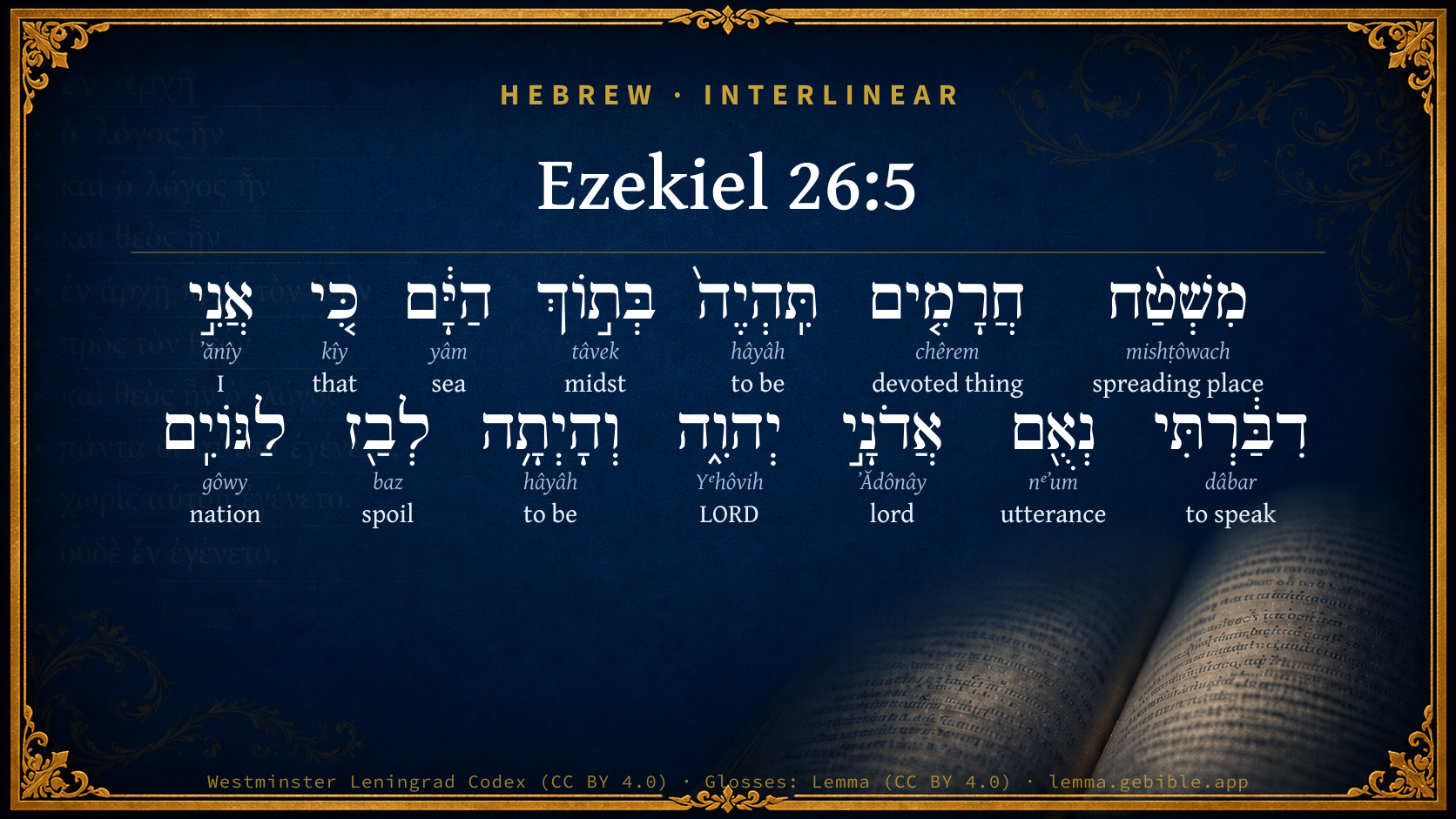
Hebrew (Westminster Leningrad Codex) Ezekiel 26:5 appears in the Hebrew Old Testament. The text above is from the Westminster Leningrad Codex. Each word links to its Strong’s number, a concise gloss, and parsing drawn from the Open Scriptures Hebrew Bible morphology. Click any word for its full Brown-Driver-Briggs (BDB) entry.
Download image
Cite this verse

Ezekiel 26:5 (World English Bible). Public Domain. Lemma interlinear Bible study tool, https://lemma.gebible.app/v/ezekiel/26/5.

Show BibTeX & RIS
BibTeX
RIS
English Translation
She shall be a place for the spreading of nets in the midst of the sea; for I have spoken it, says the Lord Yahweh; and she shall become a spoil to the nations.
World English Bible · Public Domain
Highlights
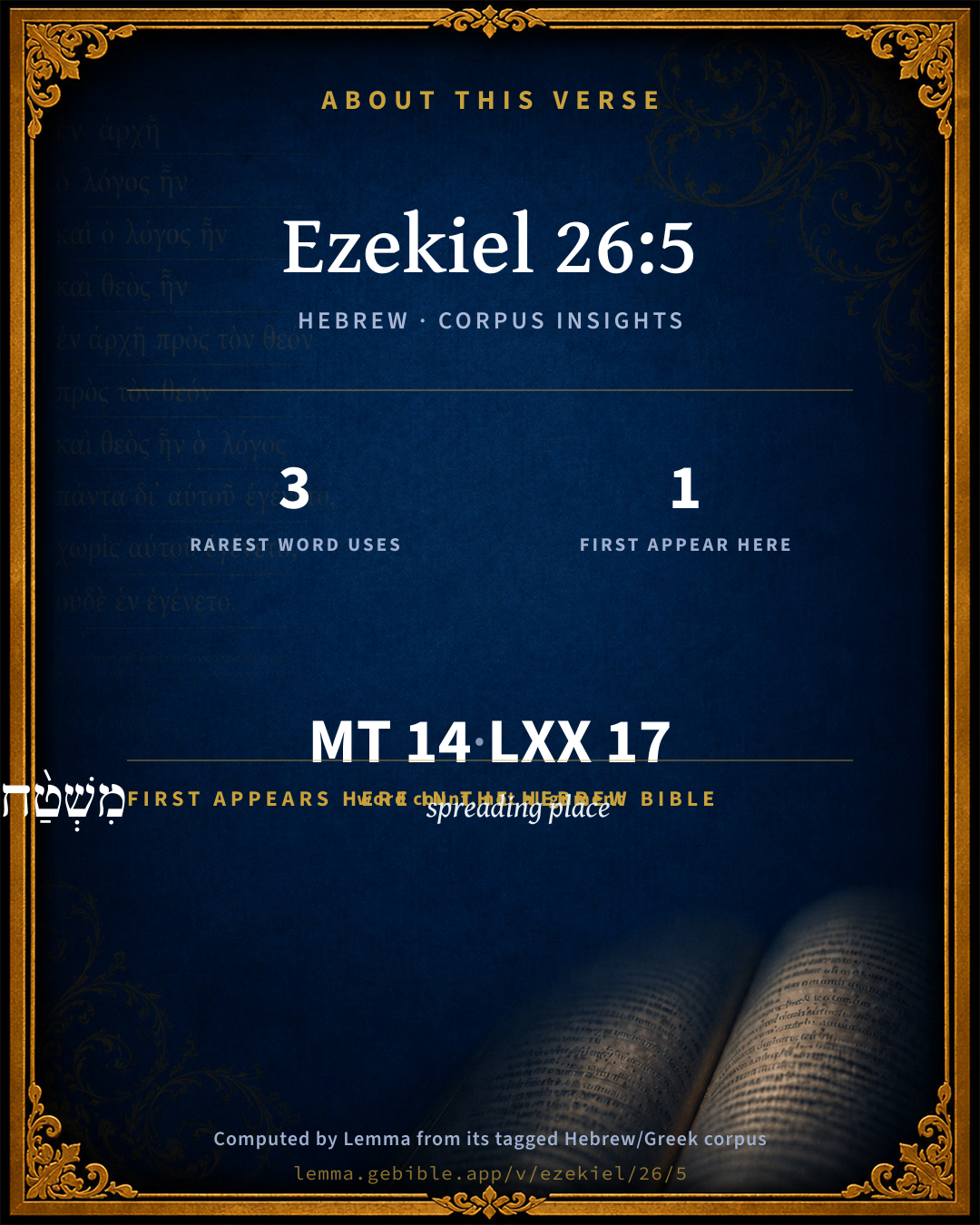
  • 1 first appearance in the Hebrew Bible
Full analysis ↓
Download a study sheet

One document with this verse’s original text, its word-by-word gloss line, the meaning frame, cross-references with their text, attributed commentary, and full source and license credits — printable, and it pastes into notes with its structure intact.

This verse Autodidact and up

Study sheet (.html) Plain text (.txt)

A passage Seminary Student

Up to 50 verses in one chapter. A passage sheet keeps up to 6 commentary sources and 12 cross-references per verse, in the order this page ranks them, and says so on the sheet whenever that leaves anything out. Ask for a single verse and you get the Autodidact verse sheet above.

Everything on this page stays free to read, with no account — the sheet is a download of what is already on screen, not access to it.

Want to remove ads? Support Godless Engineer
Compare translations 3

The same verse in 3 English versions, stacked beneath the original-language interlinear above. Click any original word for its lexicon entry.

Each is an independent rendering of the whole verse — the interlinear is not word-aligned to these translations.

Highlighted words mark where these versions differ — a whole-verse word diff, not a word-by-word alignment.

  • World English Bible Public Domain
    She shall be a place for the spreading of nets in the midst of the sea; for I have spoken it, says the Lord Yahweh; and she shall become a spoil to the nations.
  • King James Version Public Domain
    It shall be a place for the spreading of nets in the midst of the sea: for I have spoken it, saith the Lord GOD: and it shall become a spoil to the nations.
  • unfoldingWord Literal Text CC BY-SA 4.0
    She will become a place for nets to dry out in the midst of the sea, since I have declared it—this is the Lord Yahweh’s declaration—and she will become plunder for the nations.

unfoldingWord Literal Text — © unfoldingWord, licensed CC BY-SA 4.0. Word-aligned USFM3 via Door43 (git.door43.org/unfoldingWord/en_ult).

Versions to compare (up to 4)

3 of 4 selected

Show all 18 translations

Every available English version of this verse, each an independent rendering of the whole verse.

  • World English Bible Public Domain
    She shall be a place for the spreading of nets in the midst of the sea; for I have spoken it, says the Lord Yahweh; and she shall become a spoil to the nations.
  • Berean Standard Bible Public Domain
    She will become a place to spread nets in the sea, for I have spoken, declares the Lord GOD. She will become plunder for the nations,
  • Majority Standard Bible Public Domain
    She will become a place to spread nets in the sea, for I have spoken, declares the Lord GOD. She will become plunder for the nations,
  • King James Version Public Domain
    It shall be a place for the spreading of nets in the midst of the sea: for I have spoken it, saith the Lord GOD: and it shall become a spoil to the nations.
  • American Standard Version (1901) Public Domain
    She shall be a place for the spreading of nets in the midst of the sea; for I have spoken it, saith the Lord Jehovah; and she shall become a spoil to the nations.
  • Revised Version (1885) Public Domain
    She shall be a place for the spreading of nets in the midst of the sea; for I have spoken it, saith the Lord GOD: and she shall become a spoil to the nations.
  • Geneva Bible (1599) Public Domain
    Thou shalt be for the spreading of nettes in the middes of the sea: for I haue spoken it, sayth the Lord God, and it shalbe a spoile to ye nations.
  • Douay-Rheims (1899) Public Domain
    She shall be a drying place for nets in the midst of the sea, because I have spoken it, saith the Lord God: and she shall be a spoil to the nations.
  • Young's Literal Translation Public Domain
    A spreading place of nets she is in the midst of the sea, For I -- I have spoken -- an affirmation of the Lord Jehovah, And she hath been for a spoil to nations.
  • Literal Standard Version CC BY-SA 4.0
    She is a spreading place of nets in the midst of the sea, || For I have spoken,” || A declaration of Lord YHWH, || “And she has been for a spoil to nations.
  • Unlocked Literal Bible CC BY-SA 4.0
    She will become a place for nets to dry out in the midst of the sea, since I have declared it—this is the Lord Yahweh's declaration—and she will become plunder for the nations.
  • unfoldingWord Literal Text CC BY-SA 4.0
    She will become a place for nets to dry out in the midst of the sea, since I have declared it—this is the Lord Yahweh’s declaration—and she will become plunder for the nations.
  • Darby Bible Public Domain
    She shall be [a place] for the spreading of nets in the midst of the sea; for I have spoken [it], saith the Lord Jehovah; and she shall become a spoil for the nations.
  • World Messianic Bible Public Domain
    She will be a place for the spreading of nets in the middle of the sea; for I have spoken it,’ says the Lord GOD. ‘She will become plunder for the nations.
  • Webster's Bible Public Domain
    It shall be a place for the spreading of nets in the midst of the sea: for I have spoken it, saith the Lord GOD: and it shall become a spoil to the nations.
  • Free Bible Version CC BY-SA 4.0
    Out there in the sea she will be just a place for fishermen to spread their nets. I have spoken, declares the Lord God. Other nations will come and loot her,
  • Bible in Basic English Public Domain
    She will be a place for the stretching out of nets in the middle of the sea; for I have said it, says the Lord: and her goods will be given over to the nations.
  • JPS Tanakh (1917) Public Domain
    She shall be a place for the spreading of nets in the midst of the sea; for I have spoken it, saith the Lord GOD; and she shall become a spoil to the nations.

Literal Standard Version (2020), Covenant Press — licensed CC BY-SA 4.0. Text via the HelloAO Bible API (eBible.org). Unlocked Literal Bible (unfoldingWord) — licensed CC BY-SA 4.0. Text via the HelloAO Bible API (eBible.org). unfoldingWord Literal Text — © unfoldingWord, licensed CC BY-SA 4.0. Word-aligned USFM3 via Door43 (git.door43.org/unfoldingWord/en_ult). Free Bible Version, Dr. Jonathan Gallagher — licensed CC BY-SA 4.0. Text via the HelloAO Bible API (eBible.org).

Word by word

More ways to search: Search by grammar → Find every occurrence → Compare this word →

Practice this passage: Drill this verse → Learn its vocabulary →

מִשְׁטַ֨ח
mishṭôwach
H4894
“spreading place of”
Noun, Common, Masculine, Singular, Construct
Part of Speech
Noun
Type
Common
Gender
Masculine
Number
Singular
State
Construct
Full BDB Definition

Origin: from H7849

TWOT: 2372b

spreading place
  1. חֲרָמִ֤ים chêrem H2764 “devoted things” Noun, Common, Masculine, Plural, Absolute
  2. תִּֽהְיֶה֙ hâyâh H1961 “to be” Verb, Qal, Imperfect, 3rd Person, Feminine, Singular
  3. בְּת֣וֹךְ tâvek H8432 “in/at · midst of” Preposition + Noun, Common, Masculine, Singular, Construct
  4. הַיָּ֔ם yâm H3220 “the · sea” Particle, Definite Article + Noun, Common, Masculine, Singular, Absolute
  5. כִּ֚י kîy H3588 “that” Conjunction
  6. אֲנִ֣י ʼănîy H589 “I” Pronoun, Personal, 1st Person, Common, Singular
  7. דִבַּ֔רְתִּי dâbar H1696 “to speak” Verb, Piel, Perfect, 1st Person, Common, Singular
  8. נְאֻ֖ם nᵉʼum H5002 “utterance of” Noun, Common, Masculine, Singular, Construct
  9. אֲדֹנָ֣י ʼĂdônây H136 “Lord · my” Noun, Common, Masculine, Plural, Construct + Suffix, Personal, 1st Person, Common, Singular
  10. יְהוִ֑ה Yᵉhôvih H3069 “LORD” Noun, Proper
  11. וְהָיְתָ֥ה hâyâh H1961 “and · to be” Conjunction + Verb, Qal, Sequential Perfect, 3rd Person, Feminine, Singular
  12. לְבַ֖ז baz H957 “to/for · spoil” Preposition + Noun, Common, Masculine, Singular, Absolute
  13. לַגּוֹיִֽם gôwy H1471 “to/for the · nations” Preposition, Determined + Noun, Common, Masculine, Plural, Absolute

About this verse

These counts appear in no published source. They are computed here, from the morphology-tagged text and Lemma’s own curated glosses. What Lemma adds →

14
words
13
distinct lemmas
Prophets
section

Notable vocabulary

The rarest word here is מִשְׁטַ֨ח spreading place H4894 — appearing just 3 times in the whole Hebrew Bible.

First appearance in Scripture

This word makes its first canonical appearance in the Hebrew Bible here:

  • מִשְׁטַ֨ח spreading place H4894

Shared distinctive vocabulary

מִשְׁטַ֨ח spreading place H4894 occurs in 3 verses of the Hebrew Bible. Also found in:

Grammatical profile

  • 3 verbs
  • 9 nouns
  • 1 pronoun
  • 1 conjunction

Verb forms

  • תִּֽהְיֶה֙ Qal · Imperfect
  • דִבַּ֔רְתִּי Piel · Perfect
  • וְהָיְתָ֥ה Qal · Sequential Perfect

Repetition

A word recurs within this verse — often emphatic in Hebrew:

  • תִּֽהְיֶה֙ to be H1961 ×2

Hebrew & Septuagint length

In English translation the verse runs 34 words from the Hebrew and 31 from the Septuagint (LXX English) — closely comparable.

A rough comparison of the two English renderings, which tokenize alike — not a word-level alignment.

Word counts can differ between the Hebrew and the Greek without any difference in meaning — e.g. the Hebrew direct-object marker אֵת has no separate Greek word, and Greek often adds the article ὁ.

In the original languages it is 14 Hebrew tokens and 17 Greek tokens — but the two are counted differently (Hebrew bundles its prefixes and suffixes into one token; the Greek is in lemma form), so that isn’t a like-for-like length.

Cross-references

6

Topical passages linked to Ezekiel 26:5 in the Treasury of Scripture Knowledge — connected by theme and wording, ordered by reader-vote popularity; previews shown in the World English Bible.

  • Ezekiel 29:19 Therefore thus says the Lord Yahweh: Behold, I will give the land of Egypt to Nebuchadrezzar king of Babylon; and he shall carry off her multitude, and take her spoil, and take her prey; and it shall be the wages for his army.
  • Ezekiel 25:7 therefore, behold, I have stretched out my hand on you, and will deliver you for a spoil to the nations; and I will cut you off from the peoples, and I will cause you to perish out of the countries: I will destroy you; and you shall know that I am Yahweh.
  • Ezekiel 26:19 For thus says the Lord Yahweh: When I shall make you a desolate city, like the cities that are not inhabited; when I shall bring up the deep on you, and the great waters shall cover you;
  • Ezekiel 27:32 In their wailing they shall take up a lamentation for you, and lament over you, [saying], Who is there like Tyre, like her who is brought to silence in the midst of the sea?
  • Ezekiel 47:10 It shall happen, that fishermen shall stand by it: from En Gedi even to En Eglaim shall be a place for the spreading of nets; their fish shall be after their kinds, as the fish of the great sea, exceeding many.
  • Ezekiel 26:14 I will make you a bare rock; you shall be a place for the spreading of nets; you shall be built no more: for I Yahweh have spoken it, says the Lord Yahweh.

Cross-references courtesy of OpenBible.info (CC BY 4.0).

Hebrew and Greek witnesses Masoretic Hebrew ↔ Greek Septuagint

The same verse in the two great witnesses to the Old Testament, shown verse-for-verse.

These are two independent witnesses, not word-aligned to each other, and the Septuagint is shown in lemma (dictionary) form.

Hebrew Ezekiel 26:5 Masoretic · Westminster Leningrad Codex

מִשְׁטַ֨ח חֲרָמִ֤ים תִּֽהְיֶה֙ בְּת֣וֹךְ הַיָּ֔ם כִּ֚י אֲנִ֣י דִבַּ֔רְתִּי נְאֻ֖ם אֲדֹנָ֣י יְהוִ֑ה וְהָיְתָ֥ה לְבַ֖ז לַגּוֹיִֽם

She shall be a place for the spreading of nets in the midst of the sea; for I have spoken it, says the Lord Yahweh; and she shall become a spoil to the nations.

World English Bible · Public Domain

Greek LXX Ezekiel 26:5 Septuagint · lemma form

ψυγμός σαγήνη εἰμί ἐν μέσος θάλασσα ὅτι ἐγώ λαλέω λέγω κύριος καί εἰμί εἰς προνομή ὁ ἔθνος

She shall be in the midst of the sea a place for repairing nets: for I have spoken it, says the Lord: and it shall be a spoil for the nations.

LXX2012 (modern English Septuagint) · Public Domain

Hebrew: Westminster Leningrad Codex (CC BY 4.0). Greek: Septuagint (public domain); English from LXX2012 (modern English Septuagint) (Public Domain). How the Septuagint differs from the Hebrew →

Targum (Aramaic paraphrase)

1

The Targum is the ancient Jewish Aramaic paraphrase of the Hebrew Scriptures — an interpretive translation, not the Hebrew text itself. Onkelos (literal) and Pseudo-Jonathan (expansive) render the Torah, and Jonathan the Prophets. Coverage is partial: where no permissively-licensed English translation exists for a verse, only the Aramaic is shown. This is verse-level text, not a word-by-word alignment to the Hebrew.

  1. Targum Jonathan Prophets (Joshua–Malachi)
    מִשְׁטַח צַיָדִין תְּהֵי בְּגוֹ יַמָא אֲרֵי אֲנָא גְזָרֵית בְּמֵימְרִי אֲמַר יְיָ אֱלֹהִים וּתְהֵי לְבִזָא לְעַמְמַיָא:

    (no public-domain English translation for this verse)

    Targum Jonathan — Aramaic: “Mikraot Gedolot” (public domain). English: “Sefaria Community Translation” (CC0 1.0 (public-domain dedication)); “London "Chaldee Paraphrase," 1871” (public domain). Text via Sefaria.

Commentary

Notes on Ezekiel 26:5 from classic Christian and Jewish commentators (each source and its license shown beneath its notes). The classic Christian expositions comment on the surrounding passage and are grouped to its opening verse, so a note may address several verses; the Jewish commentaries on the Tanakh (Rashi and others) are per-verse, so they appear only where the commentator wrote on this verse.

Lemma curates 59 commentaries, every one of them public domain or Creative Commons licensed, each selected and text-cleaned for this edition rather than reprinted as found. About our sources →

Trapp's Complete Commentary

John Trapp

Eze 26:5 It shall be [a place for] the spreading of nets in the midst of the sea: for I have spoken [it], saith the Lord GOD: and it shall become a spoil to the nations.

Ver. 5. It shall be a place for the spreading of nets.] Of fishers’ nets, hung up in the sun to be dried. The prophets usually fetch their comparisons from things the people were most acquainted with and accustomed to as here. Let ministers now do the like.

John Trapp, A Commentary or Exposition upon All the Books of the Old and New Testament (1647–1656) — public domain. Text from a community e-Sword module.

Jamieson, Fausset & Brown

Robert Jamieson, A. R. Fausset & David Brown

in the midst of the sea--plainly referring to New Tyre (Eze 27:32).

Jamieson, Fausset & Brown — Commentary Critical and Explanatory on the Whole Bible (1871) — public domain (CC PDM 1.0). Text via the HelloAO Bible API.

Adam Clarke's Commentary

Verse 5. A place for the spreading of nets] A place for the habitation of some poor fishermen, who spent the fishing season there, and were accustomed to dry their nets upon the rocks. See on Eze 26:11.

Adam Clarke's Commentary on the Bible (1810–1826) — public domain. Text from a community e-Sword/MySword module.

Ellicott's Commentary for English Readers

(5) The spreading of nets.—Such has been the chief use of insular Tyre for ages, and although a miserable village of 3,000 people has sprung up, chiefly within the present century, upon a part of its site, other parts have still no more important use. The Tyre upon the mainland has so utterly disappeared that even its site cannot be exactly identified.

A Bible Commentary for English Readers, edited by Charles John Ellicott (1878–1897) — public domain. Text from a community e-Sword module.

The Cambridge Bible for Schools and Colleges

gen. ed. J. J. S. Perowne

5. The threat is repeated Eze_26:14.

The Cambridge Bible for Schools and Colleges (gen. ed. J. J. S. Perowne; Cambridge University Press, 1878–1918) — public domain. Text from a community e-Sword module.

John Gill's Exposition

It shall be a place for the spreading of nets in the midst of the sea,.... Where only fishermen would be seen washing their nets, and then spreading them upon this rock, where Tyre stood, to dry them and this has been confirmed by travellers, who have seen fishermen spreading and drying their nets, and having no other habitations on it but the huts of these men. Huetius (c) relates, that he remembered one Hadrian Parvillarius, a Jesuit, a candid and learned man, particularly in the Arabic language, who lived ten years in Syria; and to have heard him say, that when he saw the ruins of Tyre, its rocks to the sea, and scattered stones on the shore, and made clean smooth by the sun, waves, and wind, and only used for drying fishermen's nets, it brought to his mind this passage of the prophet; as it did to Mr. Maundrell (d) when on the spot, a few years ago; who says,

"you see nothing here but a mere Babel of broken walls, pillars, vaults, &c. there being not so much as one entire house left; its present inhabitants are only a few poor wretches, harbouring themselves in the vaults, and subsisting chiefly upon fishing; who seem to be preserved in this place by divine Providence, as a visible argument how God has fulfilled his word concerning Tyre, viz. "that it should be as the top of a rock", &c.'':

so Dr. Shaw (e) says, this port, small as it at present, is choked up to that degree with sand and rubbish, that the boats of these poor fishermen, who now and then visit this once renowned emporium and "dry their nets upon its rocks and ruins", can with great difficulty only be admitted:

for I have spoken it, saith the Lord God; and therefore it should certainly come to pass, as it has:

and it shall become a spoil to the nations; the army of many nations, that besieged it for thirteen years under Nebuchadnezzar.

(c) Evangel. Demonstrat. prop. 6. p. 328. (d) Journey from Aleppo to Jerusalem, p. 48, 49. Ed. 7. (e) Travels, p. 273. Ed. 2.

John Gill's Exposition of the Whole Bible (1746–1763) — public domain (CC PDM 1.0). Text via the HelloAO Bible API.

Haydock's Catholic Bible Commentary

Sea. St. Jerome explains this of New Tyre; Marsham of the Old. To reconcile the different texts, we only need to suppose that both cities were connected by a road thrown up in the sea by Hiram, and repaired by Nabuchodonosor with great labour, (chap. xxix. 18.) after it had been destroyed by the inhabitants of New Tyre, when they saw the old city on the continent fall a prey. (St. Jerome) (Calmet)

George Leo Haydock (1774–1849), Haydock's Catholic Family Bible and Commentary, 1859 edition — public domain. Excludes Psalms (Douay-Rheims chapter numbering differs from Protestant) and Deuterocanonical books (Catholic canon only).

Matthew Poole's English Annotations

As barren sandy islets in the midst of the sea, good for nothing but to dry fishermen’s nets, shalt thou be. A spoil; a prey: though the contexture of the words place this after its being made so bare and poor, yet we are to observe, that these last words give us account how this poverty and barrenness shall come upon thy rich city; the nations shall spoil her with thirteen years’ long siege, interruption of trade, living on the quick stock, and finally taken on surrender. To the nations; Babylonians, and their confederates, who made the Tyrians pay the reckoning.

Matthew Poole's English Annotations on the Holy Bible (1683–1685) — public domain. Text from a community e-Sword/MySword module.

Whedon's Commentary on the Bible

Daniel D. Whedon

5. A place for the spreading of nets (also Eze_26:14) — The prophecy is that the merchant city of the world, the London of ancient times, shall lose its position and population and sink to the insignificance of a fishing village. When spoken, these words seemed as absurd as Macaulay’s suggestion concerning the forgotten ruins of London bridge; but they have been literally fulfilled.

Daniel D. Whedon (gen. ed.), Commentary on the Old and New Testaments (1874–1909) — public domain. Text from a community e-Sword module.

The Pulpit Commentary

It shall be a place for the spreading of nets, etc. The prediction is repeated in Ver. 14, and after many chances and changes, apparent revival followed by another period of decay, the present condition of Tyre strikingly corresponds with it. The travelers of the seventeenth and eighteenth centuries report that "its inhabitants are only a few poor wretches that harbor in vaults and subsist upon fishing" (Mandrell, in 1697); that the number of those inhabitants was "only ten, Turks and Christians" (Hasselquist, in 1751); that there were, a little later on, "fifty or sixty poor faro nee (Volney, in 1766). During the present century there has been a partial revival, and Porter, in 1858, estimates its population at from three to four thousand. The present state of its harbor, as compared with that of Beyrout, is against any future expansion of its commerce ("Dict. Bible," s.v. "Tyre").

The Pulpit Commentary (1880–1919), ed. H.D.M. Spence-Jones & Joseph S. Exell — public domain. Text from a community e-Sword module.

unfoldingWord translationNotes

Door43 World Missions Community

Connecting Statement:

Yahweh continues to give Ezekiel his message to Tyre.

She will become

The city of Tyre is spoken of here as if it were a woman. AT: "Tyre will become" or "It will become" (See: Personification)

a place for nets to dry out in the midst of the sea

Part of Tyre was an island. This expression is a metonym for the results of Tyre's destruction. AT: "an empty island used for drying fishing nets" or "a deserted island where people dry out their fishing nets" (See: Metonymy)

this is the Lord Yahweh's declaration

Yahweh speaks of himself by name to express the certainty of what he is declaring. See how you translated this in Ezekiel 5:11. AT: "this is what the Lord Yahweh has declared" or "this is what I, the Lord Yahweh, have declared" (See: First, Second, or Third Person)

she will become plunder for the nations

"Plunder" means things that people steal or take by force. Here Tyre becoming plunder represents its wealth being carried off by other nations. AT: "the armies of the nations will take away every valuable thing from Tyre" (See: Metonymy)

Her daughters who are in the fields will be slaughtered by the swords

This can be stated in active form. AT: "The enemy armies will slaughter with swords her daughters who are in the fields" (See: Active or Passive)

Her daughters who are in the fields

Possible meanings are 1) "Her daughters" were the young women of Tyre who were working in the fields or 2) "Her daughters" is a metonym for nearby towns and villages on the mainland that supported the main city of Tyre. AT: "Her daughter communities who are on the mainland" (See: Metonymy)

know that I am Yahweh

When Yahweh says that people will know that he is Yahweh, he is implying that they will know that he is the one true God who has supreme authority and power. See how you translated this in Ezekiel 6:7. AT: "understand that I am Yahweh, the one true God" or "realize that I, Yahweh, have supreme power and authority" (See: Assumed Knowledge and Implicit Information)

translationWords

declare

sword

know

unfoldingWord translationNotes — © Distant Shores Media and the Door43 World Missions Community, licensed CC BY-SA 4.0. Source: git.door43.org/Door43/en_tn.

Rashi

Rabbi Shlomo Yitzchaki (Rashi)

a place to spread out nets On the rock the fishermen will spread out their fishing nets, to dry them.

Rashi on the Tanakh — English translations: “The Judaica Press complete Tanach with Rashi, translated by A. J. Rosenberg” (CC BY 4.0); “Pentateuch with Rashi's commentary by M. Rosenbaum and A.M. Silbermann, 1929-1934” (public domain); “The Metsudah Tanach series, Lakewood, N.J” (CC BY 4.0); and “The Book of Joshua, Metsudah Publications, 1997” (CC BY 4.0). Text via Sefaria.

Lesson kit

Teaching starters — assembled from the data on this page, not authored interpretation. Every prompt links to the verse data it draws on. Edit before teaching.

Ezekiel, in the Prophets, opens this verse with 14 words (13 distinct Hebrew lemmas). Its most distinctive word is mishṭôwach (“spreading place”). A historical commentator’s framing appears above. Read the whole chapter for the surrounding context.

Discussion questions

  1. The word mishṭôwach carries the sense “spreading place.” How does it shape the verse?
  2. The word “spreading place” first appears here in Scripture. What is being introduced at this debut?
  3. Ezekiel 26:14 shares the word «spreading place» with this verse. How do the two illuminate each other?
  4. “to be” occurs 2× in this one verse. What is the effect of the repetition?
  5. These translations render this verse differently. What is at stake in choosing one wording over another?
  6. The verb «תִּֽהְיֶה֙» is Qal Imperfect. How does its form color the action?
  7. Reading how Trapp's Complete Commentary and Jamieson, Fausset & Brown read this verse, where do the two commentators agree and where do they part?

Things to notice

Reading settings

Reading text

Shown beneath each verse's original-language words.

Old Testament
Old Testament edition

Read the OT as the Masoretic Hebrew (MT) or the Greek Septuagint (LXX).

English shown for the Greek Septuagint (in the Hebrew ↔ Greek comparison).

Comparing translations? Open the Compare panel on any verse page to stack up to four side by side.