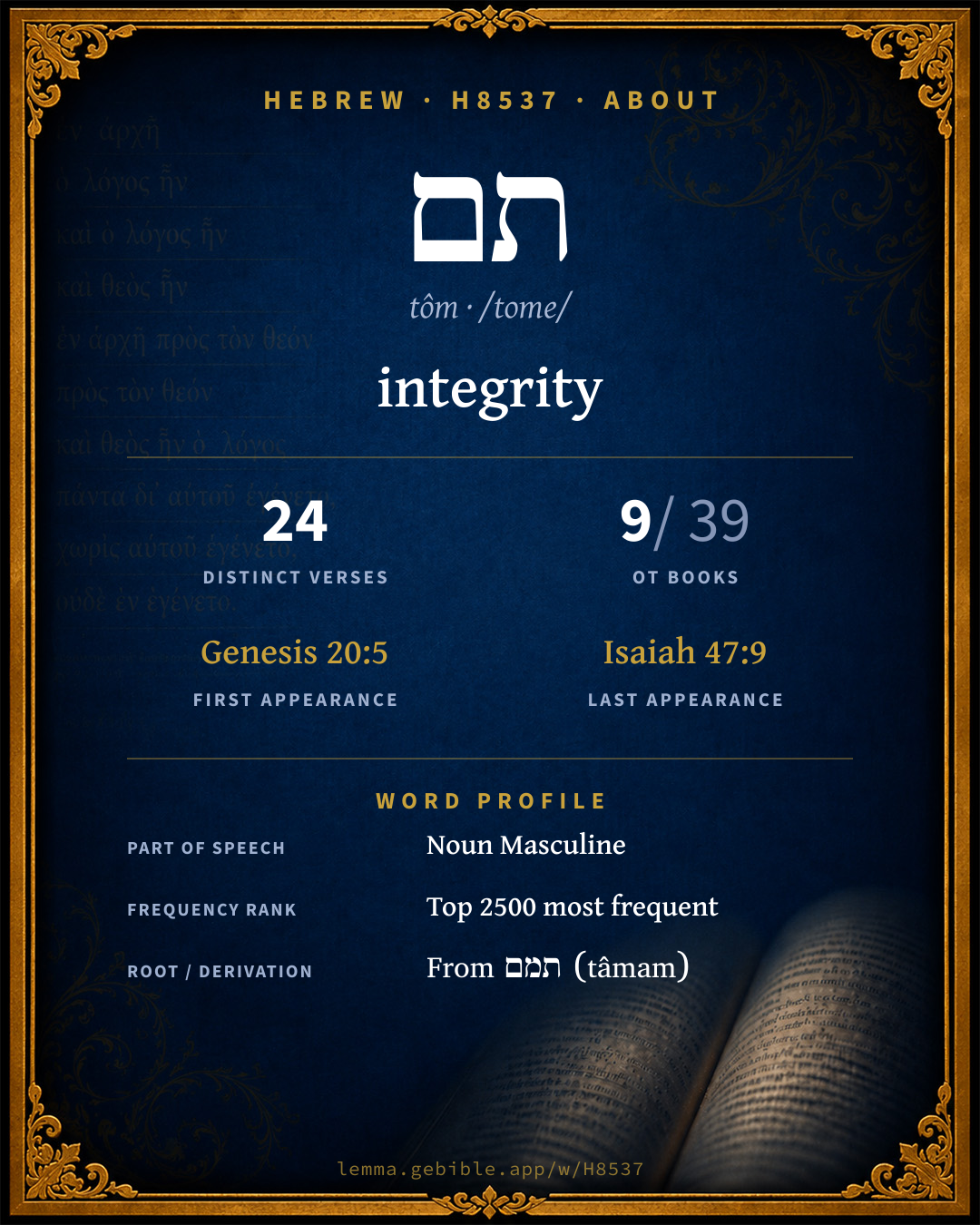
תֹּם
integrity
‘integrity’ is one of 4 main senses fuller range ↓
Full lexicon entry — Brown-Driver-Briggs (BDB)
From Brown-Driver-Briggs (BDB)
Where this word appears
See every Construct-state word in the Hebrew Bible →
Grammar key — what these labels mean
Part of speech
- Noun
- A naming word — a person, place, thing, or idea.
- Verb
- An action or state-of-being word.
Noun type
- Common
- A common noun — a general class of person, place, or thing (“king,” “city,” “water”), not a specific name.
Stem
- Qal
- The basic, simple active stem — the plain form of the verb (“he wrote”).
Form
- Infinitive Construct
- A bound verbal noun, frequently with prepositions (“to write / in writing”).
State
- Construct
- A noun bound to a following noun in a possessive / “of” relationship (the construct chain).
- Absolute
- The independent form of a noun, not bound to a following word.
Gender
- Masculine
- Grammatically masculine.
Number
- Singular
- One.
4 verses where H8537 appears in the Construct state in the Book of Proverbs. Filtered view — show all forms. Click any verse to open its interlinear word-by-word view. Verse text shown in the World English Bible for context — . Each verse’s Hebrew form is shown with its reference; the English is not keyword-highlighted, since the data carries no word-level English alignment. Use “Compare translations” on any verse to read it across multiple English versions. This concordance covers the Hebrew Bible; Septuagint (Greek Old Testament) occurrences are not indexed here.
Proverbs
- Proverbs 13:6 תָּם n c ms cs Righteousness guards the way of integrity, But wickedness overthrows the sinner.
- Proverbs 19:1 בְּ/תֻמּ֑/וֹ prep + n c ms cs + sfx pers 3ms Better is the poor who walks in his integrity Than he who is perverse in his lips and is a fool.
- Proverbs 20:7 בְּ/תֻמּ֣/וֹ prep + n c ms cs + sfx pers 3ms A righteous man walks in integrity. Blessed are his children after him.
- Proverbs 28:6 בְּ/תֻמּ֑/וֹ prep + n c ms cs + sfx pers 3ms Better is the poor who walks in his integrity, Than he who is perverse in his ways, and he is rich.
About this entry
At a glance — auto-summarized from this page’s data, not written by a person. Every figure links to its source below. This summary describes the numbers; it doesn’t interpret them.
תם (tôm) is a Hebrew noun most often rendered “integrity.” Not a single-sense word: explore its full sense range. Spanning 24 verses in 9 books, it ranks among the uncommon words of the Hebrew Bible. Psalms dominates its distribution — 7 of 24 verses. Scripture first uses it in Genesis 20:5. For the data behind this summary, explore the sense tree and the renderings breakdown below.
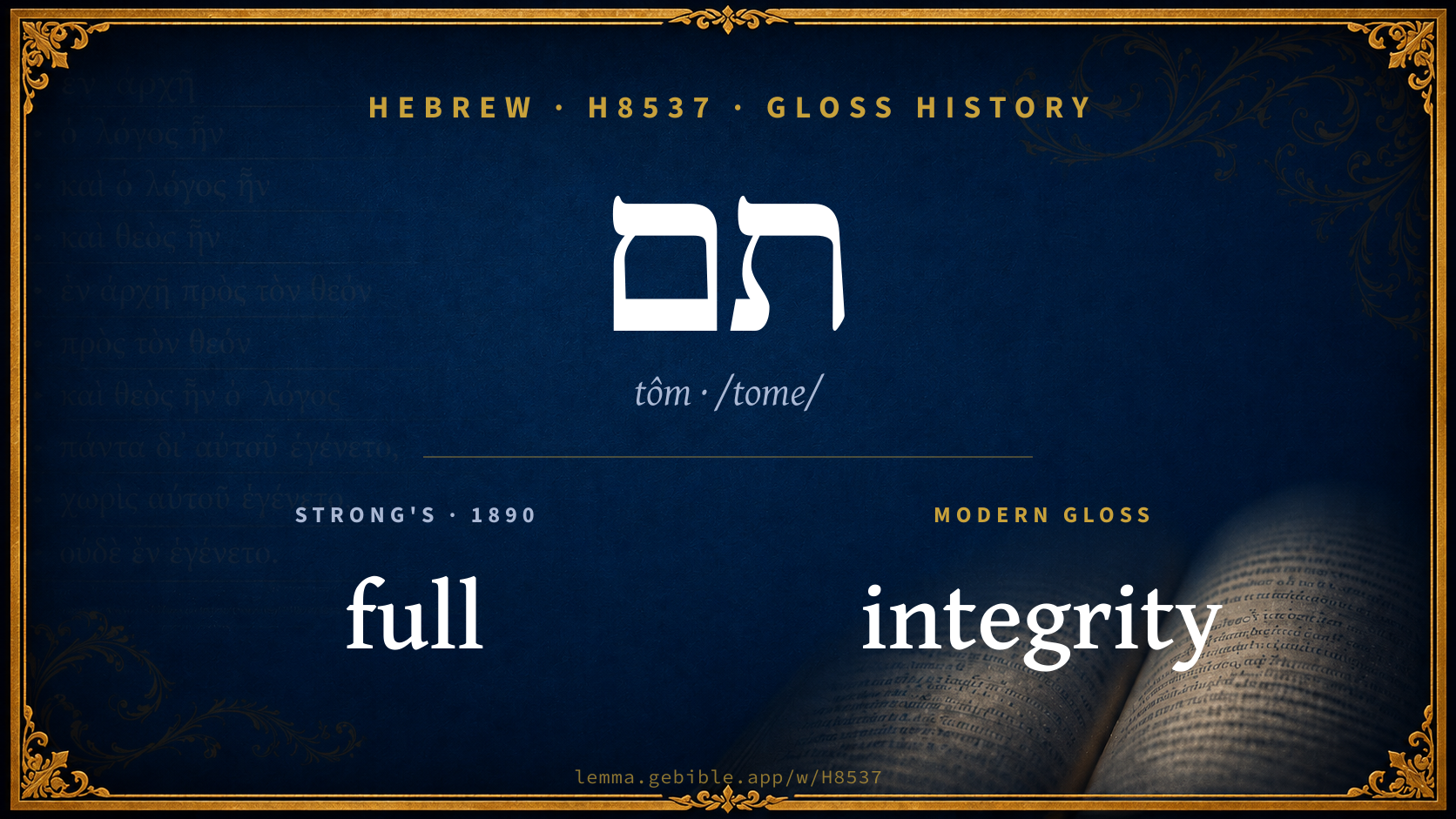
Gloss history
Strong's 1890 vs modern scholarship
About this word
Strong's H8537 catalogs a Hebrew word from the Hebrew Old Testament.
These counts are not copied from any lexicon or concordance. They are computed here, from the morphology-tagged Hebrew Old Testament. What Lemma adds →
- 24
- distinct verses
- The word appears in 24 distinct verses.
- 9 / 39
- OT books
- The word appears in 9 of 39 Old Testament books.
- #1,327
- by frequency
- Top 2500 most frequent Hebrew words (rank 1,327 of 8,640 Hebrew words by occurrence).
View all 24 occurrences in the concordance →
By section of the Old Testament
By traditional corpus
Conventional, traditional groupings — biblical authorship is debated, so this is a traditional corpus grouping, not an authorship claim. Each share is this word’s portion of its verses in that division of the Hebrew canon. Each figure is a share of the word’s 24 distinct verses.
- Writings (Ketuvim) 17 verses · 71%
- Prophets (Nevi'im) 4 verses · 17%
- Torah (Pentateuch) 3 verses · 13%
How translations render this word
Counts come from each version’s own published word-to-Strong’s tagging or interlinear alignment — an approximate guide to how each version renders this word, not a word-level alignment the data otherwise carries. Because each total is that version’s own tagged count, the per-version totals vary from one another and need not match the appearance or distinct-verse counts above. These counts may also differ from a printed concordance because Lemma counts each distinctly tagged rendering and does not collapse phrase taggings into a single head-word total. This is a fixed set of word-tagged versions (KJV, ASV, BSB, ULT) and does not change with the reading translation you choose elsewhere. Each version’s license is shown beside its name below (and on Sources).
- King James Version: Integrity 8×, Uprightly 2×, Uprightness 2×
- American Standard Version: Integrity 8×, Venture 2×
- Berean Standard Bible: Integrity 13×, Without taking special aim 2×
- unfoldingWord Literal Text: Integrity 10×, Integrity of 4×, Innocence 3×
King James Version Public Domain
Renders H8537 across 23 tagged occurrences — most commonly:
Plus 9 renderings that appear only once — usually multi-word phrases or single function words the recovered tagging swept in, not distinct renderings.
American Standard Version Public Domain
Renders H8537 across 21 tagged occurrences — most commonly:
Plus 11 renderings that appear only once — usually multi-word phrases or single function words the recovered tagging swept in, not distinct renderings.
Berean Standard Bible Public Domain
Renders H8537 across 22 tagged occurrences — most commonly:
Plus 7 renderings that appear only once — usually multi-word phrases or single function words the recovered tagging swept in, not distinct renderings. Not rendered by a distinct English word in 1 further occurrence.
unfoldingWord Literal Text CC BY-SA 4.0
Renders H8537 across 27 tagged occurrences — most commonly:
Plus 10 renderings that appear only once — usually multi-word phrases or single function words the recovered tagging swept in, not distinct renderings.
Senses in the full BDB
What do BDB’s symbols mean?
BDB uses these scholarly abbreviations:
| Symbol | Meaning |
|---|---|
| 𝔊 | the Septuagint (the ancient Greek translation, LXX) |
| 𝔙 | the Vulgate (the Latin translation) |
| 𝔖 | the Syriac version (the Peshitta) |
| 𝔗 | the Targum (the Aramaic translation) |
| ψ | the Psalms |
| √ | root (the underlying root or stem) |
| ‖ | parallel passage (a synonymous or contrasted parallel) |
| † | the dagger: every passage where the word occurs is cited |
The 4 senses and sub-senses the full Brown-Driver-Briggs lexicon distinguishes for this word, in lexicon order (not ranked by frequency), with BDB’s own verbatim wording and sub-sense lettering. Shown in Hebrew script with BDB’s own scholarly abbreviations. The condensed entry is in the Lexicon Entry tab. See also the Forms in the corpus table below.
- 1. completeness, fulness: כְּתֻמָּם Is 47:9 2 בְּעֶצֶם תֻּמּוֹ Jb 21:23 in his very completeness. e.g. Isaiah 47:9
- 2. innocence, simplicity: הלכים לתמם 2 S 15:11; מָשַׁךְ בַּקֶּשֶׁת לְתֻמּוֹ 1 K 22:34 = 2 Ch 18:33, i.e. without definite aim. e.g. 2 Samuel 15:11
- 3. integrity: תֹּם לֵבָב integrity of mind Gn 20:5, 6 (E), 1 K 9:4 ψ 78:72; 101:2; תָּם־דֶּרֶךְ Pr 13:6; Jb 4:6; (הת)הלך בַּתֹּם Pr 10:9, בְּתֻמּוֹ 19:1; 20:7; 28:6, בְּתֻמִּי ψ 26:1, 11; הֹלְכֵי תֹם Pr 2:7; תֹּם רָישֶׁר ψ 25:21; בְּתֻמִּי 41:13; כְּתֻמִּי 7:9; מָעוֹז לַתֹּם Pr 10:29. e.g. Genesis 20:5
- 4. תֻּמִּים in אוּרִים וְתֻמִּים (meaning dub., v., אורים) Dt 33:8, Ex 28:30 (P) Lv 8:8 (P), Ezr 2:63 = Ne 7:65; + 1 S 14:41 (for תָּמִים) We Dr Bu HPS; also Ho 3:4 (for תרפים) CheJQ, July 1899, 564 and 4:5 (תֻּמֶּ֑יךָ for אִמֶּ֑ךָ) RubenJQ, April 1899, 44 Che l.c.. e.g. Deuteronomy 33:8
Senses from the full Brown-Driver-Briggs lexicon (Brown, Driver, Briggs; Oxford 1906 — public domain), digitized via Sefaria, supplemented by the OpenScriptures HebrewLexicon (CC BY 4.0). Full attribution on Sources.
Word origin
n.[m.] completeness, integrity;—תֹּם abs. Pr 10:29 +; cstr. Jb 4:6 ψ 78:72, cstr. also תָּם־ Pr 13:6 + 4 times; sf. תֻּמִּי ψ 26:1 + 11 times sf.; pl. תֻּמִּים Ex 28:30 + 3 times; sf. תֻּמֶּיךָ Dt 33:8;—
— Brown-Driver-Briggs (Oxford 1906, public domain), digitized via Sefaria, supplemented by the OpenScriptures HebrewLexicon (CC BY 4.0). See Sources.
Derived from תמם (tâmam) (H8552) — to be complete.
Jastrow Dictionary
A second Hebrew/Aramaic lexicon for comparison, covering Aramaic and post-biblical (Talmudic, Targumic, Midrashic) usage that the biblical-Hebrew BDB does not. Matched by lemma rather than by Strong’s number, so a lemma may carry more than one Jastrow headword (shown separately below), and the entries cover usage well beyond the Bible.
תָּם I
- 1. perfect, unblemished. Tem. 7ᵇ (opp. בעל מום); B. Kam. 12ᵇ; (Maas. Sh. I, 2 תָּמִים); a. fr.—Fem. תַּמָּה. Sabb. 103ᵇ, v. כְּתִיבָה. Succ. 37ᵃ, v. לְקִיחָה. Tanḥ. Emor 18 (ref. to ול̇ק̇ח̇ת̇ם̇, Lev. XXIII, 40) בל̇ק̇יח̇ה ת̇מ̇ה וכ׳ by a real (honest) purchase: thou darest not steal (a Lulab), and stand with it (before God) &c.; a. e. e.g. Leviticus 23:40
- 2. simple, innocent, artless. Mekh. Bo, s. 18 ארבעה … ואחד תם וכ׳ there are four characters in children (as regards their attitude towards religious ceremonies): one is wise, and one is simple &c.; (Yalk. Ex. 225 טיפש); a. e.
- 3. (law) an innocuous animal, one that did injury for the first time, or before warning had been given, opp. מוּעָד (v. Ex. XXI, 28-36). B. Kam. I, 4 התם משלם וכ׳ the tam pays half-damage from the sale of its own body. Ib. II, 4 איזה הוא תם … משיחזור וכ׳ when is an animal called tam?… When it shows its regret for three days, i.e. when it has done an injury and does not repeat it for three days afterwards; ib. (another opin.) ותם כל שיהו וכ׳ tam is one which does not gore when children touch it; a. v. fr.—Pl. תַּמִּים, תַּמִּין. Ib. I, 4 חמשה ת׳ וכ׳ there are five classes of tammin, i.e. an animal is considered a tam with regard to five classes of damages (so as to require legal warning): with regard to goring, striking &c.; a. e. e.g. Exodus 21:28
תָּם II
- = h. שָׁם, there, esp. (in Talmud Babli) in Palestine. Ḥull. 59ᵇ (in Hebr. dict.) שלחו מִתָּם וכ׳ they sent word from Palestine: the practice is in agreement with &c. Bets. 4ᵇ; a. fr.—V. הָתָם, תַּמָּן.
תֹּם
- , v. תֹּום
A Dictionary of the Targumim, the Talmud Babli and Yerushalmi, and the Midrashic Literature (Marcus Jastrow; London, Luzac, 1903) — Public Domain. Digitized via Sefaria. Digitized via Sefaria. Full attribution on Sources.
Forms in the corpus
The 20 distinct written forms H8537 takes in the Hebrew Bible, most frequent first — each parse links to that state’s occurrences in the concordance. Hebrew forms include their vowel points and cantillation, so a single lemma takes many written forms.
Same root — word family
Other BDB entries built from the same root as H8537, grouped by Strong’s listed origin. These share a root / origin per the lexicon — not necessarily a shared meaning. Each links to that word’s own entry.
Derives from
Shares the same root
Derived from this word
Proper names from this root
People and places named from this root — a name, not an additional meaning of the word.
Compare all same-root words → Showing 4 of 7 — not the complete family. 1 of the same-root words is a proper name (a person or place). They share a root, not necessarily a meaning.
Septuagint verse parallels
This word appears in 21 verses that also exist in the Greek Old Testament (Septuagint), out of the 24 Hebrew verses it occurs in. You can read those verses in Greek by switching the Old Testament edition to the Septuagint.
Read these verses in the Septuagint
- Genesis 20:5
- Leviticus 25:29
- 2 Samuel 15:11
- 1 Kings 9:4
- 2 Chronicles 18:33
- Job 4:6
- Psalms 7:8
- Proverbs 2:7
- Isaiah 47:9
This is a verse-level parallel only — the same verses exist in both the Hebrew and Greek Old Testaments. No word-level Hebrew↔Greek correspondence is claimed: the data carries no such alignment, so no Greek word is shown as this Hebrew word’s translation. Coverage is not total — the Septuagint omits the deuterocanon and renumbers the Psalms, so some Hebrew verses have no direct Greek parallel.