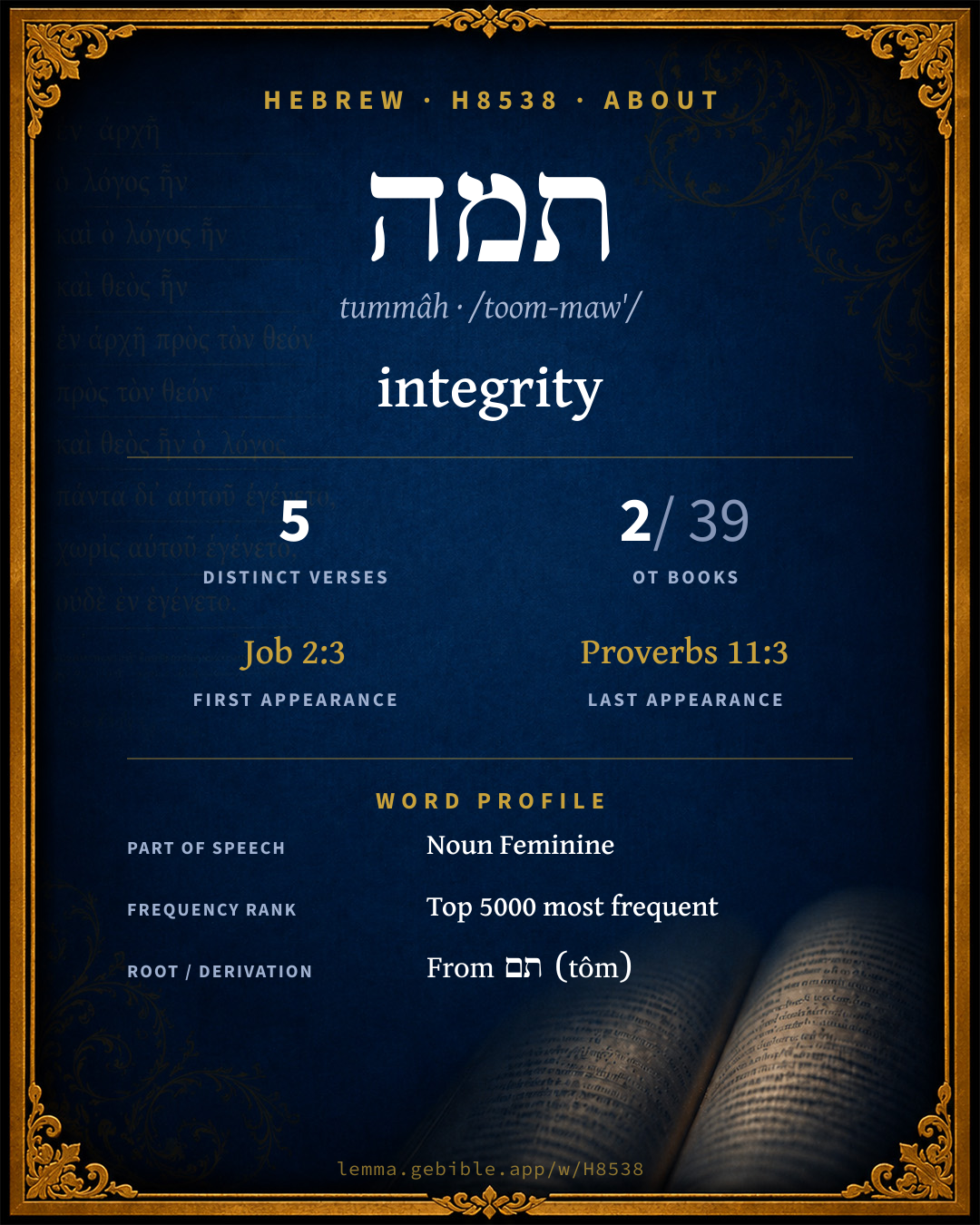
תֻּמָּה
integrity
Full lexicon entry — Brown-Driver-Briggs (BDB)
From Brown-Driver-Briggs (BDB)
Where this word appears
Grammar key — what these labels mean
Part of speech
- Noun
- A naming word — a person, place, thing, or idea.
Noun type
- Common
- A common noun — a general class of person, place, or thing (“king,” “city,” “water”), not a specific name.
State
- Construct
- A noun bound to a following noun in a possessive / “of” relationship (the construct chain).
Gender
- Feminine
- Grammatically feminine.
Number
- Singular
- One.
Every verse where H8538 appears — 5 distinct verses across 2 books. Click any verse to open its interlinear word-by-word view. Verse text shown in the World English Bible for context — . Each verse’s Hebrew form is shown with its reference; the English is not keyword-highlighted, since the data carries no word-level English alignment. Use “Compare translations” on any verse to read it across multiple English versions. This concordance covers the Hebrew Bible; Septuagint (Greek Old Testament) occurrences are not indexed here.
Job 4 verses
- Job 2:3 בְּ/תֻמָּת֔/וֹ prep + n c fs cs + sfx pers 3ms Yahweh said to Satan, "Have you considered my servant Job? For there is none like him in the earth, a blameless and an upright man, one who fears God, and turns away from evil. He still maintains his integrity, although you incited me against him, to ruin him without cause."
- Job 2:9 בְּ/תֻמָּתֶ֑/ךָ prep + n c fs cs + sfx pers 2ms Then his wife said to him, "Do you still maintain your integrity? Renounce God, and die."
- Job 27:5 תֻּמָּתִ֣/י n c fs cs + sfx pers 1cs Far be it from me that I should justify you. Until I die I will not put away my integrity from me.
- Job 31:6 תֻּמָּתִֽ/י n c fs cs + sfx pers 1cs (Let me be weighed in an even balance, That God may know my integrity);
Proverbs 1 verse
About this entry
At a glance — auto-summarized from this page’s data, not written by a person. Every figure links to its source below. This summary describes the numbers; it doesn’t interpret them.
“integrity” is the headline sense of the Hebrew noun תמה (tummâh). A scarce word — 5 verses in all of the Hebrew Bible. More than three-quarters of its appearances fall in Job. First canonically at Job 2:3, it enters the text early. Related forms include תם and תמים. See the sense tree, 5-verse concordance, and the renderings breakdown below.
Gloss history
Strong's 1890 vs modern scholarship
About this word
Strong's H8538 catalogs a Hebrew word from the Hebrew Old Testament.
These counts are not copied from any lexicon or concordance. They are computed here, from the morphology-tagged Hebrew Old Testament. What Lemma adds →
- 5
- distinct verses
- The word appears in 5 distinct verses.
- 2 / 39
- OT books
- The word appears in 2 of 39 Old Testament books.
- #3,337
- by frequency
- Top 5000 most frequent Hebrew words (rank 3,337 of 8,640 Hebrew words by occurrence).
View all 5 occurrences in the concordance →
By traditional corpus
Conventional, traditional groupings — biblical authorship is debated, so this is a traditional corpus grouping, not an authorship claim. Each share is this word’s portion of its verses in that division of the Hebrew canon. Each figure is a share of the word’s 5 distinct verses.
- Writings (Ketuvim) 5 verses · 100%
How translations render this word
Counts come from each version’s own published word-to-Strong’s tagging or interlinear alignment — an approximate guide to how each version renders this word, not a word-level alignment the data otherwise carries. Because each total is that version’s own tagged count, the per-version totals vary from one another and need not match the appearance or distinct-verse counts above. These counts may also differ from a printed concordance because Lemma counts each distinctly tagged rendering and does not collapse phrase taggings into a single head-word total. This is a fixed set of word-tagged versions (KJV, ASV, BSB, ULT) and does not change with the reading translation you choose elsewhere. Each version’s license is shown beside its name below (and on Sources).
- King James Version: Integrity 5×
- American Standard Version: Integrity 3×
- Berean Standard Bible: Integrity 5×
- unfoldingWord Literal Text: Integrity 4×
King James Version Public Domain
Renders H8538 across 5 tagged occurrences — most commonly:
American Standard Version Public Domain
Renders H8538 across 5 tagged occurrences — most commonly:
Plus 2 renderings that appear only once — usually multi-word phrases or single function words the recovered tagging swept in, not distinct renderings.
Berean Standard Bible Public Domain
Renders H8538 across 5 tagged occurrences — most commonly:
unfoldingWord Literal Text CC BY-SA 4.0
Renders H8538 across 5 tagged occurrences — most commonly:
Plus 1 rendering that appears only once — usually multi-word phrases or single function words the recovered tagging swept in, not distinct renderings.
Senses in BDB
The 1 sense BDB distinguishes for this word, in lexicon order (not ranked by frequency or importance). The full entry — with sub-senses — is in the Lexicon Entry tab.
- integrity
Word origin
Derived from תם (tôm) (H8537) — integrity.
Jastrow Dictionary
A second Hebrew/Aramaic lexicon for comparison, covering Aramaic and post-biblical (Talmudic, Targumic, Midrashic) usage that the biblical-Hebrew BDB does not. Matched by lemma rather than by Strong’s number, so a lemma may carry more than one Jastrow headword (shown separately below), and the entries cover usage well beyond the Bible.
תָּמַהּ
- [to stand still,] to be astonished, amazed; to wonder; to be undecided. Pesik. R. addit., s. 1 והבריות תֹּומְהִים לומר וכ׳ and men wondered, saying, is such a thing possible? Ib. על דור המגדל אתם תֹּומְהִין וכ׳ you wonder at what occurred to the generation of the tower: has not such a thing occurred &c.? Yalk. Ex. 166 וַיִתְמְהוּ תמיהא גדולה מאד and they wondered exceedingly. Pesik. Haḥod., p. 43ᵃ היה … יושב ותָמֵהַּ בלבו וכ׳ Abraham sat and was undecided in his heart, saying, which shall I choose?; Gen. R. s. 44. Gen. R. s. 12 מלך … ועמד לו תָּמֵיהַּ a king that rebuked his servant, and he stood there confounded. Ib. תמיה אני איך וכ׳ I wonder how great men … could disagree on &c. Yeb. 96ᵇ תמיה אני אם לא וכ׳ I should wonder, if this synagogue did not become an idolatrous temple. Arakh. 16ᵇ תְּמִיהַנִי יש וכ׳ I wonder if there is in this generation &c. Pes. VI, 2 אל תִּתְמֵהּ על אלו do not wonder at that Y. ib. 33ᵇ bot. תמיהני היאך וכ׳ I wonder how R. El. could accept such an answer. Yalk. Ex. 202 תְּמַהּ על עצמה היאך וכ׳ wonder at the very thing, why should leavened matter be forbidden &c.; Pes. 28ᵇ תמה על עצמך (corr. acc.); a. fr.
- 1. same. Gen. R. s. 98 על אלו אתם מַתְמִיהִין you wonder at that? if you were to see היה לכם … להַתְמִיהַּ יותר (not להתמה) you would wonder still more. Pesik. R. s. 28 מַתְמִיהִין (not מתמהין); a. e.
- 2. to create astonishment, act strangely. Men. 40ᵃ אינו אלא מן המַתְמִיהִין is one of those who make people wonder at their strange conduct; (Ms. M. המוּתְמָהִין Hof. of those wondered at).
- 3. to love miracles, invent miracles. Yalk. Num. 764 אף אתה מן המַתְמִיהִים art thou, too, of the inventors of miracles?
- to be wondered at, v. supra.
תְּמַהּ
- , l) to wonder &c. Targ. Gen. XLIII, 33. Targ. Y. ib. XVII, 17 (h. text ויצחק). Targ. Y. I ib. XVIII, 12 (II חייכ׳). Targ. Y. ib. 15. Targ. Ez. XXXII, 10; a. e.—Part. תְּמִיהַּ; f. תְּמִיהָא. Targ. II Esth. I, 2 ת׳ ומַתְמְהָא.—V. אֶתְמְהָא.—2) to be astonishing. Gen. R. s. 94 אמר לי … והיא תַמְהָא the elder of the Jews told me something, and that is astonishing; [perh. to be read תִּמְהָא, v. תֵּימַהּ].
- 1. same. Targ. II Esth. l. c. Ib. מַתְמְהִין (some ed. מִתַּמְהִין, Ithpe.); a. e.
- 2. to express astonishment, query. Zeb. 113ᵃ אַתְמוּהֵי מַתְמַהּ קרא the text (Ez. XXII, 24) expresses a query: thou, land of Israel! art thou not cleansed &c.? e.g. Ezekiel 22:24
תֵּמַהּ
- , v. תֵּימַהּ
A Dictionary of the Targumim, the Talmud Babli and Yerushalmi, and the Midrashic Literature (Marcus Jastrow; London, Luzac, 1903) — Public Domain. Digitized via Sefaria. Digitized via Sefaria. Full attribution on Sources.
Forms in the corpus
The 5 distinct written forms H8538 takes in the Hebrew Bible, most frequent first — each parse links to that state’s occurrences in the concordance. Hebrew forms include their vowel points and cantillation, so a single lemma takes many written forms.
| Form | Parsing | Example | Uses |
|---|---|---|---|
| בְּ/תֻמָּת֔/וֹ | Noun, Common, Feminine, Singular, Construct | Job 2:3 | 1 |
| בְּ/תֻמָּתֶ֑/ךָ | Noun, Common, Feminine, Singular, Construct | Job 2:9 | 1 |
| תֻּמַּ֣ת | Noun, Common, Feminine, Singular, Construct | Proverbs 11:3 | 1 |
| תֻּמָּתִ֣/י | Noun, Common, Feminine, Singular, Construct | Job 27:5 | 1 |
| תֻּמָּתִֽ/י | Noun, Common, Feminine, Singular, Construct | Job 31:6 | 1 |
Same root — word family
Other BDB entries built from the same root as H8538, grouped by Strong’s listed origin. These share a root / origin per the lexicon — not necessarily a shared meaning. Each links to that word’s own entry.
Derives from
Proper names from this root
People and places named from this root — a name, not an additional meaning of the word.
Compare all same-root words → 1 of the same-root words is a proper name (a person or place). They share a root, not necessarily a meaning.
Septuagint verse parallels
This word appears in 5 verses that also exist in the Greek Old Testament (Septuagint), out of the 5 Hebrew verses it occurs in. You can read those verses in Greek by switching the Old Testament edition to the Septuagint.
Read these verses in the Septuagint
This is a verse-level parallel only — the same verses exist in both the Hebrew and Greek Old Testaments. No word-level Hebrew↔Greek correspondence is claimed: the data carries no such alignment, so no Greek word is shown as this Hebrew word’s translation. Coverage is not total — the Septuagint omits the deuterocanon and renumbers the Psalms, so some Hebrew verses have no direct Greek parallel.