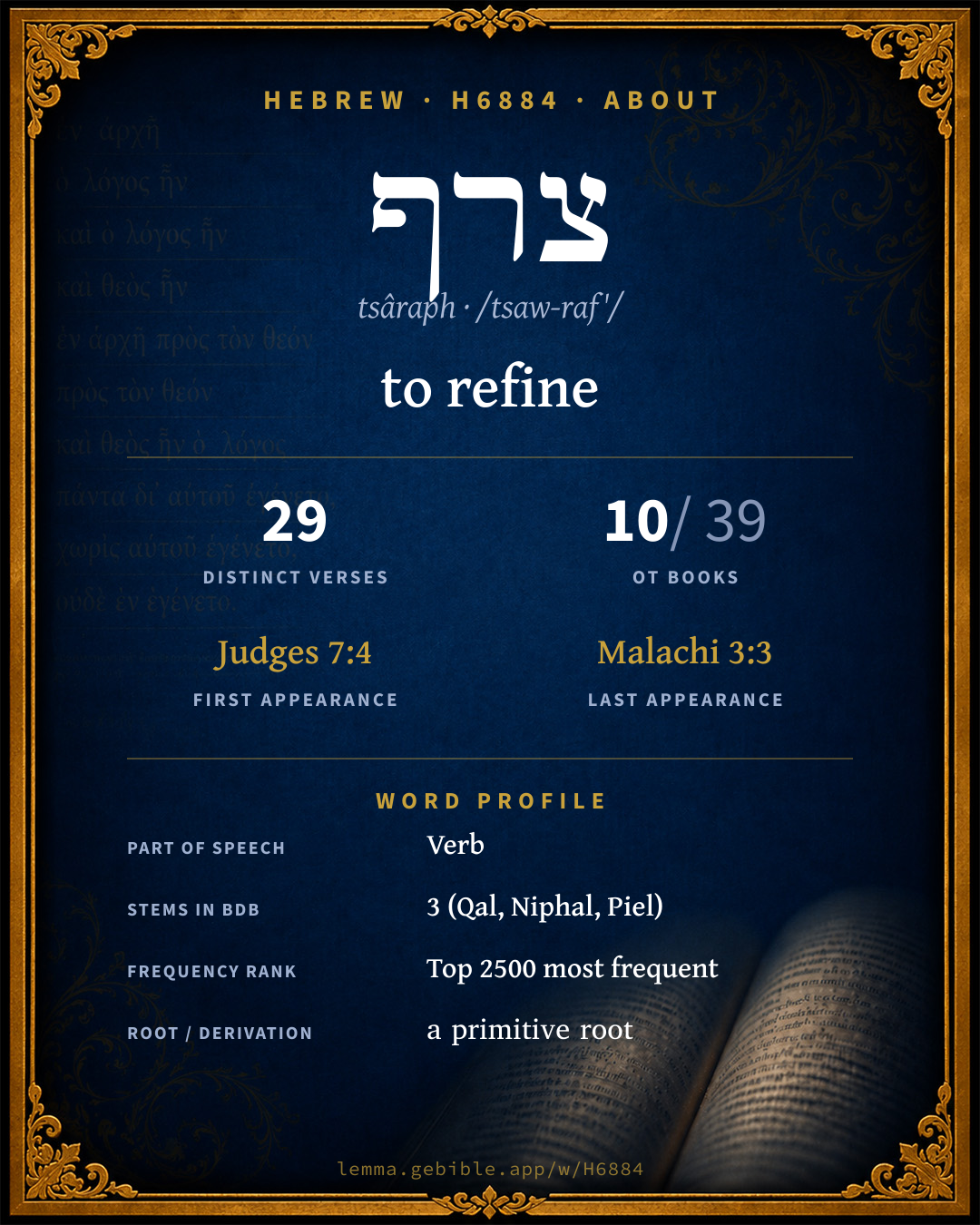
צָרַף
to refine
‘to refine’ is one of 3 main senses fuller range ↓
Full lexicon entry — Brown-Driver-Briggs (BDB)
From Brown-Driver-Briggs (BDB)
Where this word appears
Grammar key — what these labels mean
Part of speech
- Verb
- An action or state-of-being word.
Stem
- Qal
- The basic, simple active stem — the plain form of the verb (“he wrote”). Here: ‘smelt’
- Piel
- An intensive or resultative active stem.
- Niphal
- Usually the simple passive or reflexive of the Qal (“he was written”).
Form
- Participle Active
- A verbal adjective expressing ongoing or characteristic action (“writing / one who writes”).
- Participle Passive
- A verbal adjective expressing action received (“written”).
- Infinitive Construct
- A bound verbal noun, frequently with prepositions (“to write / in writing”).
- Imperative
- A direct command (“write!”).
- Imperfect
- An incomplete, ongoing, or future action (“he will / would write”).
- Sequential Perfect
- A perfect with prefixed waw continuing a preceding imperfect or command (waw-consecutive perfect).
- Infinitive Absolute
- An unbound verbal noun, often intensifying or standing in for a finite verb.
- Perfect
- A completed action or state — Hebrew marks aspect (completeness) more than strict tense (“he wrote”).
State
- Absolute
- The independent form of a noun, not bound to a following word.
- Construct
- A noun bound to a following noun in a possessive / “of” relationship (the construct chain).
Person
- 2nd Person
- The one addressed (“you”).
- 3rd Person
- The one spoken about (“he / she / it / they”).
- 1st Person
- The speaker (“I / we”).
Gender
- Masculine
- Grammatically masculine.
- Feminine
- Grammatically feminine.
- Common
- Either gender — not distinguished for this form.
Number
- Singular
- One.
- Plural
- More than one (in Hebrew, generally three or more).
Every verse where H6884 appears in the Book of Proverbs — 2 distinct verses. Click any verse to open its interlinear word-by-word view. Verse text shown in the World English Bible for context — . Each verse’s Hebrew form is shown with its reference; the English is not keyword-highlighted, since the data carries no word-level English alignment. Use “Compare translations” on any verse to read it across multiple English versions. This concordance covers the Hebrew Bible; Septuagint (Greek Old Testament) occurrences are not indexed here.
Proverbs
About this entry
At a glance — auto-summarized from this page’s data, not written by a person. Every figure links to its source below. This summary describes the numbers; it doesn’t interpret them.
The Hebrew verb צרף centers on the idea of “to refine.” First canonically at Judges 7:4, it enters the text early. It turns up in 29 verses across 10 books, a moderately common footprint. Different stems carry different senses — BDB groups them under 3 stems, among them Qal and Niphal. It clusters with מצרף, צרפי and צרפת under a shared root. For the data behind this summary, explore the sense tree and the renderings breakdown below.
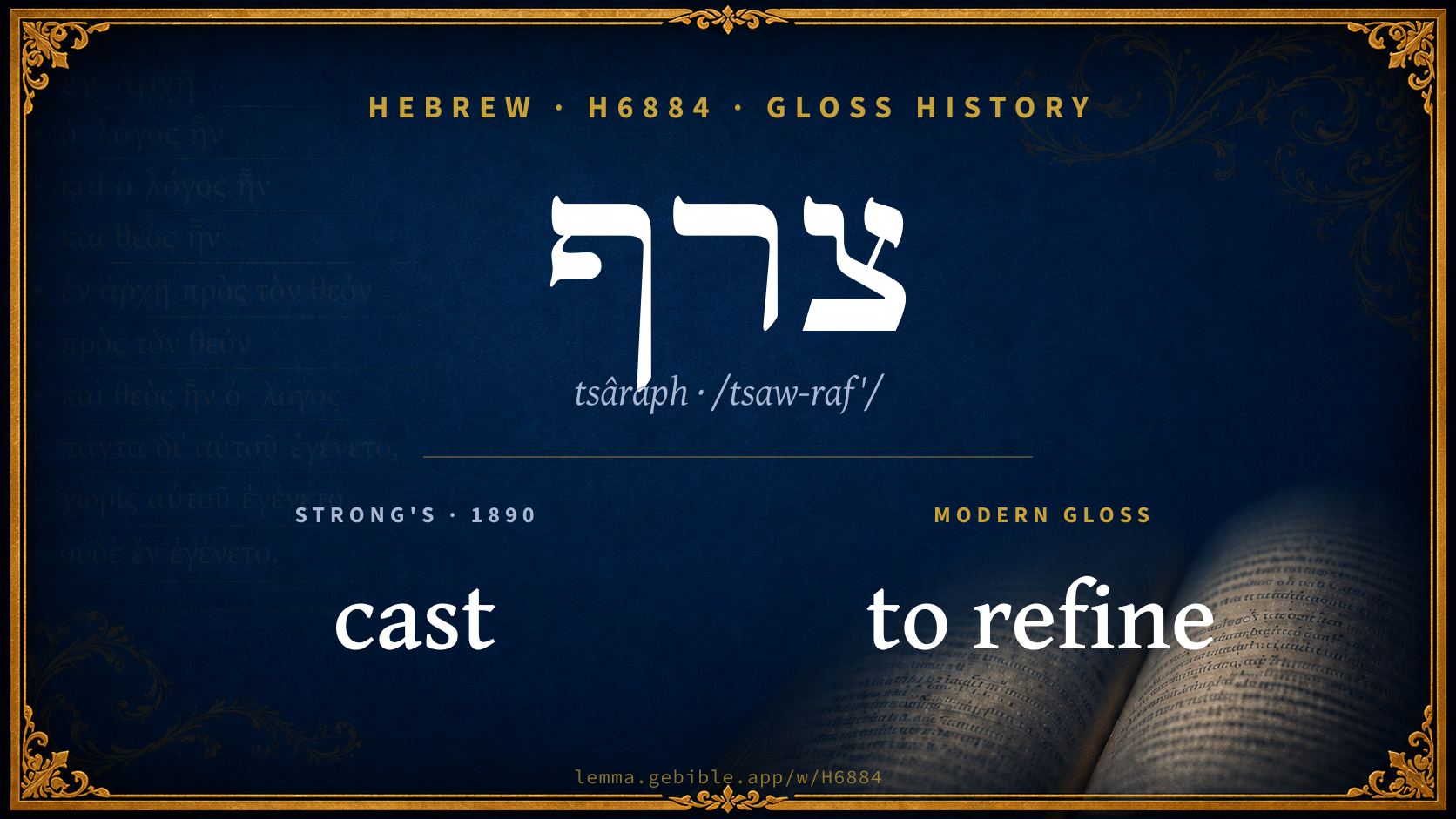
Gloss history
Strong's 1890 vs modern scholarship
About this word
Strong's H6884 catalogs a Hebrew word from the Hebrew Old Testament.
These counts are not copied from any lexicon or concordance. They are computed here, from the morphology-tagged Hebrew Old Testament. What Lemma adds →
- 29
- distinct verses
- The word appears in 29 distinct verses.
- 10 / 39
- OT books
- The word appears in 10 of 39 Old Testament books.
- #1,041
- by frequency
- Top 2500 most frequent Hebrew words (rank 1,041 of 8,640 Hebrew words by occurrence).
View all 29 occurrences in the concordance →
By section of the Old Testament
By traditional corpus
Conventional, traditional groupings — biblical authorship is debated, so this is a traditional corpus grouping, not an authorship claim. Each share is this word’s portion of its verses in that division of the Hebrew canon. Each figure is a share of the word’s 29 distinct verses.
- Prophets (Nevi'im) 16 verses · 55%
- Writings (Ketuvim) 13 verses · 45%
How translations render this word
Counts come from each version’s own published word-to-Strong’s tagging or interlinear alignment — an approximate guide to how each version renders this word, not a word-level alignment the data otherwise carries. Because each total is that version’s own tagged count, the per-version totals vary from one another and need not match the appearance or distinct-verse counts above. These counts may also differ from a printed concordance because Lemma counts each distinctly tagged rendering and does not collapse phrase taggings into a single head-word total. This is a fixed set of word-tagged versions (KJV, ASV, BSB, ULT) and does not change with the reading translation you choose elsewhere. Each version’s license is shown beside its name below (and on Sources).
- King James Version: Founder 3×, Goldsmith 3×, Is tried 3×
- American Standard Version: Goldsmith 3×, Is tried 3×, Behold 2×
- Berean Standard Bible: Goldsmith 5×, Is flawless 3×, I will refine them 2×
- unfoldingWord Literal Text: Is refined 4×, Metalworker 4×, Refiner 3×
King James Version Public Domain
Renders H6884 across 33 tagged occurrences — most commonly:
Plus 13 renderings that appear only once — usually multi-word phrases or single function words the recovered tagging swept in, not distinct renderings.
American Standard Version Public Domain
Renders H6884 across 32 tagged occurrences — most commonly:
Plus 18 renderings that appear only once — usually multi-word phrases or single function words the recovered tagging swept in, not distinct renderings.
Berean Standard Bible Public Domain
Renders H6884 across 30 tagged occurrences — most commonly:
Plus 16 renderings that appear only once — usually multi-word phrases or single function words the recovered tagging swept in, not distinct renderings. Not rendered by a distinct English word in 3 further occurrences.
unfoldingWord Literal Text CC BY-SA 4.0
Renders H6884 across 32 tagged occurrences — most commonly:
Plus 17 renderings that appear only once — usually multi-word phrases or single function words the recovered tagging swept in, not distinct renderings.
7 senses and sub-senses in the full BDB
Hebrew verbs can shift meaning by stem (binyan): Qal is the basic action, Niphal is often passive or reflexive, Piel often intensifies or makes it factitive, and Hiphil is typically causative. The senses below are grouped under the stem BDB assigns to each.
What do BDB’s symbols mean?
BDB uses these scholarly abbreviations:
| Symbol | Meaning |
|---|---|
| 𝔊 | the Septuagint (the ancient Greek translation, LXX) |
| 𝔙 | the Vulgate (the Latin translation) |
| 𝔖 | the Syriac version (the Peshitta) |
| 𝔗 | the Targum (the Aramaic translation) |
| ψ | the Psalms |
| √ | root (the underlying root or stem) |
| ‖ | parallel passage (a synonymous or contrasted parallel) |
| † | the dagger: every passage where the word occurs is cited |
The 7 senses and sub-senses the full Brown-Driver-Briggs lexicon distinguishes for this word, in lexicon order (not ranked by frequency), with BDB’s own verbatim wording and sub-sense lettering. Shown in Hebrew script with BDB’s own scholarly abbreviations. The condensed entry is in the Lexicon Entry tab. See also the Forms in the corpus table below.
Qal
- Pf. 3 ms. צ׳ Je 6:29, sf. צְרָפָ֑תְהוּ ψ 105:19; 2 ms. sf. צְרַפְתָּנִי ψ 17:3, etc.; Impf. 1 s. אֶצְרֹף Is 1:25, sf. אֶצְרְפֶנּוּ Ju 7:4; Imv. ms. צרופה ψ 26:2 Kt, צָרְפָה Qr; Inf. abs. צָרוֹף Je 6:29; cstr. לִצְרוֹף Dn 11:35, etc.; Pt. act. sf. צוֹרְפָם Je 9:6, etc.; pass. צָרוּף ψ 12:7, etc.;— e.g. Jeremiah 6:29
- 1. smelt, refine: Je 6:29(×2) in vain hath he smelted continually (inf. abs.; fig. of purifying people); so smelt away Is 1:25 (acc. of dross; fig.); of silver Zc 13:9 ψ 66:10, כֶּסֶף צָרוּף בַּעֲלִיל 12:7 (all sim.); of אִמְרַת י׳ ψ 18:31 = 2 S 22:31, ψ 119:140 Pr 30:5 (אִמְרַת אֱלוֹהַּ); refine (men, by trials) Dn 11:35 (+ לְבָרֵר, לַלְבֵּן). e.g. Jeremiah 6:29
- 2. test Ju 7:4 I will test them (the warriors) for thee (י׳ subj.);—perhaps also v 3 (v. I. צפר); more gen., of י׳’s testing, trying (the hearts of) men (often ‖ בָּחַן) Je 9:6; Is 48:10; Zc 13:9 ψ 17:3; 26:2; 66:10. e.g. Judges 7:4
- 3. test (& prove true) a man (subj. י׳’s saying) ψ 105:19. e.g. Psalms 105:19
- 4. Pt. act. as n. smelter, refiner, hence = goldsmith Ju 17:4; Je 10:9, 14; 51:17; Is 40:19(×2) (but perhaps del. vb, cf. Du Che Marti), 41:7; 46:6 Pr 25:4; as a guild Ne 3:8, 32. e.g. Judges 17:4
Niphal
- Impf. 3 mpl. יִצָּֽרְפוּ Dn 12:10 many shall be refined (by suffering; + יִתְבָּֽרְרוּ, יִתְלַבְּנוּ). e.g. Daniel 12:10
Piel
- Pt. מְצָרֵף as n. a refiner, כְּאֵשׁ מ׳ Mal 3:2 (sim. of י׳), cf. מְ׳ alone v 3 (+ מְטַהֵר כֶּסֶף). e.g. Malachi 3:2
Senses from the full Brown-Driver-Briggs lexicon (Brown, Driver, Briggs; Oxford 1906 — public domain), digitized via Sefaria, supplemented by the OpenScriptures HebrewLexicon (CC BY 4.0). Full attribution on Sources.
Word origin
vb. smelt, refine, test (NH id.; Ph. מצרף smelter: Assyrian ṣurrupu, refined, ṣarpu, silver, naṣraptu, crucible; Arabic صِرْفٌ is pure, unmixed (especially of wine);* very doubtful is Sab. צדף silver, money, cf. MordtmHim. Inschr. pp. 14, 29 CIS iv, No. 291, l. 1);—
— Brown-Driver-Briggs (Oxford 1906, public domain), digitized via Sefaria, supplemented by the OpenScriptures HebrewLexicon (CC BY 4.0). See Sources.
Origin: a primitive root
Jastrow Dictionary
A second Hebrew/Aramaic lexicon for comparison, covering Aramaic and post-biblical (Talmudic, Targumic, Midrashic) usage that the biblical-Hebrew BDB does not. Matched by lemma rather than by Strong’s number, so a lemma may carry more than one Jastrow headword (shown separately below), and the entries cover usage well beyond the Bible.
צָרַף
- [to press, shrink,]
- 1. to smelt, melt; trnsf. to refine, purify, try. Y. Keth. VII, end, 31ᵈ; Tosef. Keth. VII, 11 צוֹרֵף נחשת, v. infra. Yoma 72ᵇ (ref. to Ps. XVIII, 31) זכה משמחתו … צוֹרַפְתּוֹ if he deserves well, she (the Torah) cheers him; if not, she smelts him (through trials); צורפתו לחיים she steels him for life; צורפתו למיתה she smelts him for death. Yalk. Ex. 391 דרשתי … צָרַפְתִּי ובחנתי וכ׳ I studied and searched, refined and tested &c.; a. fr. e.g. Psalms 18:31
- 2. to tighten, harden. Yoma l. c., v. supra. Y. Yeb. XVI, 15ᵈ top שצְרָפַתּוֹ Var., v. צָפַד.
- 3. to change, v. infra.
- 1. to smelt. Keth. VII, 10 (among the occupations to which a wife may object) מְצָרֵף נחושת, expl. ib. 77ᵃ חשלי דודי, v. חַשְׁלָא; anoth. opin. מחתך נחושת וכ׳, v. חָתַךְ; Tosef. ib. l. c. זה מתיך וכ׳ he that casts bronze.—Trnsf. to refine. Gen. R. s. 44 (ref. to צרופה, Ps. XVIII, 31) לא נתנו המצות אלא לצָרֵף וכ׳ the (ceremonial) laws have been given for the purpose of refining (disciplining) men through them. Ib. שצֵרְפוֹ הקב"ה וכ׳ (Abraham) whom the Lord tried in the furnace of fire. Ib. (ref. to צֹרֵף, Is. XLI, 7) זה אברהם שצרפו וכ׳ that means Abraham, whom the Lord tried &c.; (Yalk. Is. 313 שנִצְרַף, Nif.). e.g. Psalms 18:31
- 2. to tighten, harden. Makhsh. V, 7 המוליך … לצָרְפָהּ if one takes a ship out to sea for the sake of tightening it; מוציא מסמר … לצָרְפוֹ if one takes a (glowing) nail in the rain for the sake of hardening it; Tosef. ib. II, 16 בשביל לצוֹרְפוֹ. Tosef. Kel. B. Kam. III, 13 צֵרְפָן אפי׳ וכ׳ (or צְרָפָן) if he hardened (baked) them (the earthen vessels) even in a peat fire. Bets. 32ᵃ משיְצָרְפוֹ בכבשן (Ms. M. משישרפו) from the time be baked it in the kiln. B. Mets. 84ᵃ (of iron weapons) משיְצָרְפֵם בכבשן when he has hardened them in the furnace, v. צִחְצֵחַ; a. e.
- 3. [to melt together, weld,] to combine, join. Maasr. II, 5 ואם צֵרַף (Y. ed. צירף) if he combined (ate them together). Y. Pes. III, 30ᵃ top שני … אין הבית מְצָרף if two pieces (of leavened matter), each half the size of an olive, are in the same room, the room does not join them (so as to be counted one olive-size); if in one vessel, הכלי מצרף the vessel joins them. Kidd. 40ᵃ, a. e. מְצָרְפָהּ למעשה, v. מַחֲשָׁבָה; a. fr.
- 4. to change small for large coin, opp. פָּרַט. Maas. Sh. IV, 2 כמות … שהוא מצרף as the banker counts when he gives small change for large coins, not as he counts when giving large coins for small change; Tosef. ib. III, 3 המְצָרֵיף … שמצריף ed. Zuck. (Var. המצרף … מצטרף) if one buys a gold Denar for coins designated for second tithes, he must count as the banker would when selling small change, not as he would, when buying large change. Shek. II, 1 מְצָרְפִין, v. דַּרְכּוֹן. Y. B. Mets. IV, end, 9ᵈ לצוֹרְפָהּ … מְצָרְפָהּ ביפה if he wants to change the defective coin to be spent in Jerusalem, he must exchange it as if it were of full value (v. Bab. B. Mets. 52ᵇ); a. fr.—Sifré Deut. 48 אחד מצרף דינר ואוכלו ואחד מצ׳ דינר ומניחו one gathers a gold Denar and spends it, and another changes his accumulation for a gold Denar and puts it away; Yalk. ib. 873, v. סָגַל.
- 1. to be smelted, tried. Yalk. Is. 313, v. supra. Midr. Till. to Ps. CXIX, 81 כבר נִצְרַפְנוּ we have already been tried.
- 2. to be hardened. Kel. IV, 4 משיִצָרְפוּ בכבשן when they have been baked in the kiln; Tosef. Kel. B. Kam. III, 13 משיִצְטָרְפוּ.
- 1. same, v. supra.—2)
- to be joined, combined, counted in. Naz. 35ᵇ, a. e. אין היתר מִצְטָרֵף לאיסור a permitted thing is not to be joined to a forbidden thing, i.e. if one ate simultaneously, one half of the legal size each, of a permitted and of a forbidden thing, the two must not be counted together to make up the legal size. Ib. 4ᵃ מִצְטָרְפִים זה עם זה they are counted together. Ib. VI, 1. Ber. 47ᵇ תשעה ועבד מִצְטָרְפִין nine freemen and one slave may be combined (to make up the requisite number of ten for prayers). Ib. שנים ושבת מצט׳ two persons (at meal) and the Sabbath may be combined (count for three persons); שני ת"ח … מצט׳ two scholars (at meal) who are engaged in discussion are counted as three. Mikv. III, 4 מצט׳ are combined to make up the legally required quantity of water; a. fr.—Tosef. Maas. Sh. III, 3, v. supra.
צְרַף I
- 1. to smelt, refine, try. Targ. Jer. IX, 6. Targ. Is. LIII, 10; a. fr.—Part. pass. צְרִיף; f. צְרִיפָא &c. Targ. Prov. XXX, 5.—
- *2. to contract, sponge (cloth).—Part. pass. as ab. Snh. 44ᵃ סרבלא צ׳ Ms. F. (v. Rabb. D. S. a. l. note 3; ed. דצריפא) a sponged cloak (Rashi: dyed with alum, v. צְרִיפְתָּא); v., however, צְרִיפָא 2.
- 3. to combine, join. Targ. Y. II, Gen. XV, 1; Num. XXIV, 24. e.g. Numbers 24:24
- 1. to smelt, refine. Targ. Mal. III, 3.—Trnsf. to torment (v. P. Sm. s. v. 3446). Targ. Prov. XXV, 20.
- 2. to join, attach. Y. Nidd. II, end, 50ᵇ ולא הוה מְצָרֵף לון עימיה and never joined them to himself (invited them to a consultation); חד זמן צָרְפוֹן עימיה once he did invite them; בגין כן צָרְפִיתְכוֹן (not צריפתכון) therefore I invited you; a. e.—B. Mets. 53ᵃ, v. infra.—Part. pass. מְצָרַף. Sot. 17ᵃ האי מצ׳ והאי לא מצ׳ in the word אִשָּׁה the Alef and Shin (אֵשׁ fire) are joined, in אִישׁ, they are not joined (separated by י; Rashi: מִיצְּרִיף Ithpe.).
- 3. (denom. of צְרִיפְתָּא) to mix earth with alum. Part. pass. as ab. Ab. Zar. 33ᵇ דמְצָרְפֵי ובלעי they (the earthen vessels) contain alum and therefore absorb more.
- 1. to be joined, to join. Targ. Y. I Gen. XV, 1; Num. XXIV, 24.—B. Mets. 53ᵃ ונִצְטַרְפִינְהוּ (Rashi ונִיצְרַף; Ms. M. ונִצְרוֹף; Ms. H. ונְצָרֵיף; Ms. F. ונִצִטְרַף) let them (the two kinds of coins) be joined (and treated as one mass; Rashi a. Mss.: let him join them); דאורייתא … לא מִצְטָרְפֵי things forbidden as sacred by Biblical law and things forbidden by rabbinical law cannot be combined (Ms. H. לא מְצָרְפִינָן we dare not combine). Succ. 19ᵃ מי … דאִיצְטָרוּפֵי מצטרף וכ׳ is there anything that may be joined (to make up the legal size) which in itself is not fit? Ber. 47ᵃ מאי דעתך לאיצטרופי בהדן do you expect to be counted with us (as the third person for saying grace)? Yoma 74ᵃ חזי לאיצטרופי fit to be added (to make up the legal quantity); a. fr.—Sot. 17ᵃ, v. supra. e.g. Numbers 24:24
צְרַף II
- (preced.) junction; (adv.) in immediate succession. Y. Pes. III, 30ᵃ top טחן ליה צ׳ ground his flour for the Passover without interruption (without waiting for the millstones to cool off).
A Dictionary of the Targumim, the Talmud Babli and Yerushalmi, and the Midrashic Literature (Marcus Jastrow; London, Luzac, 1903) — Public Domain. Digitized via Sefaria. Digitized via Sefaria. Full attribution on Sources.
Forms in the corpus
The 33 distinct written forms H6884 takes in the Hebrew Bible, most frequent first — each parse links to that stem’s occurrences in the concordance. Hebrew forms include their vowel points and cantillation, so a single lemma takes many written forms.
Same root — word family
Other BDB entries built from the same root as H6884, grouped by Strong’s listed origin. These share a root / origin per the lexicon — not necessarily a shared meaning. Each links to that word’s own entry.
Derived from this word
Proper names from this root
People and places named from this root — a name, not an additional meaning of the word.
Compare all same-root words → 1 of the same-root words is a proper name (a person or place). They share a root, not necessarily a meaning.
Septuagint verse parallels
This word appears in 24 verses that also exist in the Greek Old Testament (Septuagint), out of the 29 Hebrew verses it occurs in. You can read those verses in Greek by switching the Old Testament edition to the Septuagint.
Read these verses in the Septuagint
- Judges 7:4
- 2 Samuel 22:31
- Psalms 12:6
- Proverbs 25:4
- Isaiah 1:25
- Jeremiah 6:29
- Daniel 11:35
- Zechariah 13:9
- Malachi 3:2
This is a verse-level parallel only — the same verses exist in both the Hebrew and Greek Old Testaments. No word-level Hebrew↔Greek correspondence is claimed: the data carries no such alignment, so no Greek word is shown as this Hebrew word’s translation. Coverage is not total — the Septuagint omits the deuterocanon and renumbers the Psalms, so some Hebrew verses have no direct Greek parallel.