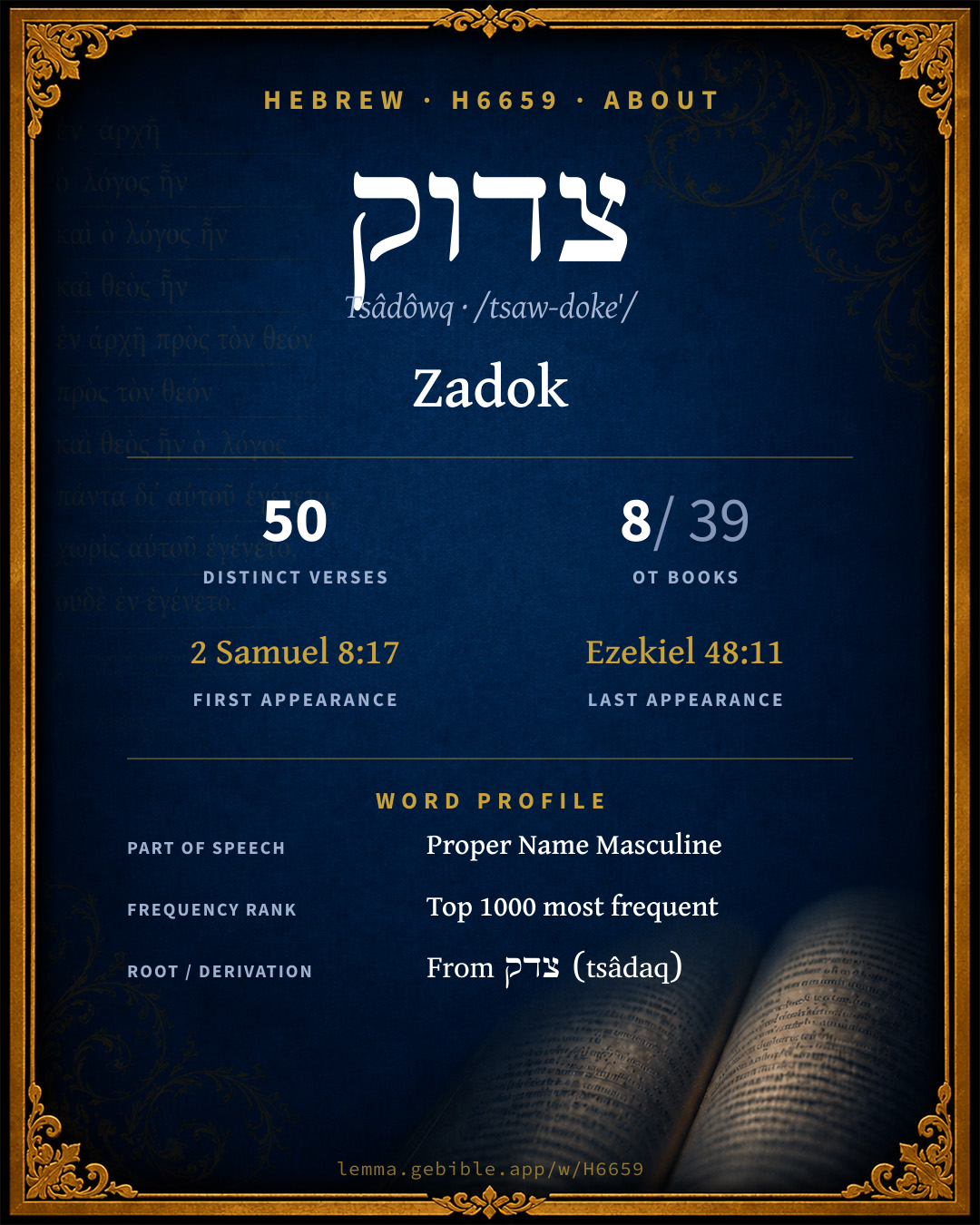
צָדוֹק
Zadok
BDB lists 9 entries for ‘Zadok’ fuller range ↓
Full lexicon entry — Brown-Driver-Briggs (BDB)
From Brown-Driver-Briggs (BDB)
Where this word appears
Grammar key — what these labels mean
Part of speech
- Noun
- A naming word — a person, place, thing, or idea.
Noun type
- Proper
- A name of a specific person, place, or people (e.g. Abraham, Zion, Israel).
Every verse where H6659 appears in the Book of 2 Chronicles — 2 distinct verses. Click any verse to open its interlinear word-by-word view. Verse text shown in the World English Bible for context — . Each verse’s Hebrew form is shown with its reference; the English is not keyword-highlighted, since the data carries no word-level English alignment. Use “Compare translations” on any verse to read it across multiple English versions. This concordance covers the Hebrew Bible; Septuagint (Greek Old Testament) occurrences are not indexed here.
2 Chronicles
- 2 Chronicles 27:1 צָדֽוֹק n Proper Jotham was twenty-five years old when he began to reign; and he reigned sixteen years in Jerusalem: and his mother's name was Jerushah the daughter of Zadok.
- 2 Chronicles 31:10 צָד֑וֹק n Proper Azariah the chief priest, of the house of Zadok, answered him and said, Since [the people] began to bring the offerings into the house of Yahweh, we have eaten and had enough, and have left plenty: for Yahweh has blessed his people; and that which is left is this great store.
About this entry
At a glance — auto-summarized from this page’s data, not written by a person. Every figure links to its source below. This summary describes the numbers; it doesn’t interpret them.
צדוק — transliterated Tsâdôwq — is a Hebrew name carrying the sense “Zadok.” Its earliest occurrence is 2 Samuel 8:17. It appears 50 verses across 8 books of the Hebrew Bible, among its moderately common vocabulary. More than a quarter of its appearances fall in 2 Samuel. See 50-verse concordance and the renderings breakdown below.
Gloss history
Strong's 1890 vs modern scholarship
About this word
Strong's H6659 catalogs a Hebrew word from the Hebrew Old Testament.
These counts are not copied from any lexicon or concordance. They are computed here, from the morphology-tagged Hebrew Old Testament. What Lemma adds →
- 50
- distinct verses
- The word appears in 50 distinct verses.
- 8 / 39
- OT books
- The word appears in 8 of 39 Old Testament books.
- #709
- by frequency
- Top 1000 most frequent Hebrew words (rank 709 of 8,640 Hebrew words by occurrence).
View all 50 occurrences in the concordance →
Most concentrated in
- 2 Samuel 13 verses 26%
- 1 Chronicles 13 verses 26%
- 1 Kings 11 verses 22%
By section of the Old Testament
By traditional corpus
Conventional, traditional groupings — biblical authorship is debated, so this is a traditional corpus grouping, not an authorship claim. Each share is this word’s portion of its verses in that division of the Hebrew canon. Each figure is a share of the word’s 50 distinct verses.
- Prophets (Nevi'im) 29 verses · 58%
- Writings (Ketuvim) 21 verses · 42%
How translations render this word
Counts come from each version’s own published word-to-Strong’s tagging or interlinear alignment — an approximate guide to how each version renders this word, not a word-level alignment the data otherwise carries. Because each total is that version’s own tagged count, the per-version totals vary from one another and need not match the appearance or distinct-verse counts above. These counts may also differ from a printed concordance because Lemma counts each distinctly tagged rendering and does not collapse phrase taggings into a single head-word total. This is a fixed set of word-tagged versions (KJV, ASV, BSB, ULT) and does not change with the reading translation you choose elsewhere. Each version’s license is shown beside its name below (and on Sources).
- King James Version: Zadok 48×
- American Standard Version: Zadok 49×
- Berean Standard Bible: Zadok 51×
- unfoldingWord Literal Text: Zadok 53×
King James Version Public Domain
Renders H6659 across 53 tagged occurrences — most commonly:
Plus 5 renderings that appear only once — usually multi-word phrases or single function words the recovered tagging swept in, not distinct renderings.
American Standard Version Public Domain
Renders H6659 across 53 tagged occurrences — most commonly:
Plus 4 renderings that appear only once — usually multi-word phrases or single function words the recovered tagging swept in, not distinct renderings.
Berean Standard Bible Public Domain
Renders H6659 across 52 tagged occurrences — most commonly:
Plus 1 rendering that appears only once — usually multi-word phrases or single function words the recovered tagging swept in, not distinct renderings. Not rendered by a distinct English word in 1 further occurrence.
unfoldingWord Literal Text CC BY-SA 4.0
Renders H6659 across 53 tagged occurrences — most commonly:
10 senses and sub-senses in the full BDB
What do BDB’s symbols mean?
BDB uses these scholarly abbreviations:
| Symbol | Meaning |
|---|---|
| 𝔊 | the Septuagint (the ancient Greek translation, LXX) |
| 𝔙 | the Vulgate (the Latin translation) |
| 𝔖 | the Syriac version (the Peshitta) |
| 𝔗 | the Targum (the Aramaic translation) |
| ψ | the Psalms |
| √ | root (the underlying root or stem) |
| ‖ | parallel passage (a synonymous or contrasted parallel) |
| † | the dagger: every passage where the word occurs is cited |
The 10 senses and sub-senses the full Brown-Driver-Briggs lexicon distinguishes for this word, in lexicon order (not ranked by frequency), with BDB’s own verbatim wording and sub-sense lettering. Shown in Hebrew script with BDB’s own scholarly abbreviations. The condensed entry is in the Lexicon Entry tab. See also the Forms in the corpus table below.
- 1. 48 priests:
- a. David’s time 2 S 8:17 = 1 Ch 18:16, 2 S 15:24, 25 + 23 times S K Ch, + (Sol.’s time) 1 K 2:35 = 1 Ch 29:22, 1 K 4:2, 4; ancestor of בְּנֵי צָדוֹק Ez 40:46; 44:15; 48:11, זֶרַע צ׳ 43:19, בֵּית צ׳ 2 Ch 31:10; descendant of Eleazar 1 Ch 5:34(×2) + 5 times Ch. e.g. 2 Samuel 8:17
- b. 1 Ch 5:38(×2), poss. = e.g. 1 Chronicles 5:38
- c. 1 Ch 9:11; Ne 11:11. e.g. 1 Chronicles 9:11
- 2. father-in-law of Uzziah 2 K 15:33 = 2 Ch 27:1. e.g. 2 Kings 15:33
- 3. two wall-builders:
- a. Ne 3:4. e.g. Nehemiah 3:4
- b. v 29; perhaps = e.g. Nehemiah 3:29
- c. 10:22, and e.g. Nehemiah 10:22
- d. צ׳ הַסּוֹפֵר 13:13. e.g. Nehemiah 13:13
Senses from the full Brown-Driver-Briggs lexicon (Brown, Driver, Briggs; Oxford 1906 — public domain), digitized via Sefaria, supplemented by the OpenScriptures HebrewLexicon (CC BY 4.0). Full attribution on Sources.
Word origin
and (1 K 1:26) צָדֹק54 n.pr.m. (just, righteous; cf. Sab. n.pr. צדק CIS iv, No. 287, 1. 2. 11. 15 etc., DHMHof museum. No. 32);—Σαδωκ, Σαδδουκ (cf. LagBN 225 ff.):—
— Brown-Driver-Briggs (Oxford 1906, public domain), digitized via Sefaria, supplemented by the OpenScriptures HebrewLexicon (CC BY 4.0). See Sources.
Derived from צדק (tsâdaq) (H6663) — to be righteous.
Jastrow Dictionary
A second Hebrew/Aramaic lexicon for comparison, covering Aramaic and post-biblical (Talmudic, Targumic, Midrashic) usage that the biblical-Hebrew BDB does not. Matched by lemma rather than by Strong’s number, so a lemma may carry more than one Jastrow headword (shown separately below), and the entries cover usage well beyond the Bible.
צִדּוּק
- , v. צִידּוּק
צָדוֹק
- (b. h.) pr. n. m. Zadok, 1) the high priest under David and Solomon.
- 1. the high priest under David and Solomon. Yoma 73ᵇ; Sot. 48ᵇ. Snh. 21ᵃ מה צ׳ מחצה וכ׳ as Z. (the high priest) takes one half of the show-bread &c. Koh. R. to I, 4 (ref. to I Chr. VI, 34) ללמדך אילו היה אהרן … צ׳ היה וכ׳ to teach thee that if Aaron and his sons had been alive (in David’s days), Z. would have been their superior in his time; a. e. e.g. 1 Chronicles 6:34
- 2. Z., an alleged disciple of Antigonos of Sokho, and founder of the sect of the Sadducees. Ab. d’R. N. ch. V.—3) R. Z., a Tannai, contemporary with the destruction of the Temple. Gitt. 56ᵃ, sq. Yoma 23ᵃ. Ab. IV, 5; a. fr.—V. Fr. Darkhé, p. 70 sq.
A Dictionary of the Targumim, the Talmud Babli and Yerushalmi, and the Midrashic Literature (Marcus Jastrow; London, Luzac, 1903) — Public Domain. Digitized via Sefaria. Digitized via Sefaria. Full attribution on Sources.
Forms in the corpus
The 22 distinct written forms H6659 takes in the Hebrew Bible, most frequent first — each parse links to that state’s occurrences in the concordance. Hebrew forms include their vowel points and cantillation, so a single lemma takes many written forms.
| Form | Parsing | Example | Uses |
|---|---|---|---|
| וְ/צָד֣וֹק | Noun, Proper | 1 Chronicles 24:6 | 4 |
| צָד֖וֹק | Noun, Proper | Ezra 7:2 | 4 |
| צָד֗וֹק | Noun, Proper | Ezekiel 40:46 | 4 |
| צָד֣וֹק | Noun, Proper | 1 Chronicles 16:39 | 4 |
| צָד֨וֹק | Noun, Proper | 1 Kings 1:34 | 4 |
| וְ/צָד֥וֹק | Noun, Proper | 1 Chronicles 12:28 | 3 |
| צָד֔וֹק | Noun, Proper | Ezekiel 48:11 | 3 |
| צָד֥וֹק | Noun, Proper | 1 Chronicles 6:53 | 3 |
| צָדֽוֹק | Noun, Proper | 1 Chronicles 27:17 | 3 |
| וְ/צָד֖וֹק | Noun, Proper | 1 Chronicles 6:8 | 2 |
| וְ/צָד֧וֹק | Noun, Proper | 1 Chronicles 18:16 | 2 |
| לְ/צָד֔וֹק | Noun, Proper | 2 Samuel 15:25 | 2 |
| לְ/צָד֥וֹק | Noun, Proper | 1 Chronicles 15:11 | 2 |
| צָד֑וֹק | Noun, Proper | 2 Chronicles 31:10 | 2 |
| צָד֜וֹק | Noun, Proper | Ezekiel 43:19 | 2 |
| צָד֤וֹק | Noun, Proper | 1 Kings 2:35 | 2 |
| צָדוֹק֙ | Noun, Proper | 2 Samuel 18:19 | 2 |
| וְ/צָדוֹק֙ | Noun, Proper | 1 Chronicles 24:3 | 1 |
| וּ/לְ/צָד֖וֹק | Noun, Proper | 1 Chronicles 29:22 | 1 |
| וּ/לְ/צָדֹ֨ק | Noun, Proper | 1 Kings 1:26 | 1 |
| לְ/צָד֤וֹק | Noun, Proper | 1 Kings 1:32 | 1 |
| צָד֧וֹק | Noun, Proper | 2 Samuel 15:29 | 1 |
Same root — word family
Other BDB entries built from the same root as H6659, grouped by Strong’s listed origin. These share a root / origin per the lexicon — not necessarily a shared meaning. Each links to that word’s own entry.
Derives from
Shares the same root
Proper names from this root
People and places named from this root — a name, not an additional meaning of the word.
Compare all same-root words → Showing 4 of 6 — not the complete family. 1 of the same-root words is a proper name (a person or place). They share a root, not necessarily a meaning.
Bible dictionary
Public-domain dictionary articles matched to this entry by name (Zadok). A biblical name can be shared by more than one person or place, so an article may treat several.
Easton's Bible Dictionary · M. G. Easton, 1897
Righteous. (1.) A son of Ahitub, of the line of Eleazer (2 Sam. 8:17; 1 Chr. 24:3), high priest in the time of David (2 Sam. 20:25) and Solomon (1 Kings 4:4). He is first mentioned as coming to take part with David at Hebron (1 Chr. 12:27, 28). He was probably on this account made ruler over the Aaronites (27:17). Zadok and Abiathar acted as high priests on several important occasions (1 Chr. 15:11; 2 Sam. 15:24-29, 35, 36); but when Adonijah endeavoured to secure the throne, Abiathar went with him, and therefore Solomon "thrust him out from being high priest," and Zadok, remaining faithful to David, became high priest alone (1 Kings 2:27, 35; 1 Chr. 29:22). In him the line of Phinehas resumed the dignity, and held it till the fall of Jerusalem. He was succeeded in his sacred office by his son Azariah (1 Kings 4:2; comp. 1 Chr. 6:3-9).
(2.) The father of Jerusha, who was wife of King Uzziah, and mother of King Jotham (2 Kings 15:33; 2 Chr. 27:1).
(3.) "The scribe" set over the treasuries of the temple by Nehemiah along with a priest and a Levite (Neh. 13:13).
(4.) The sons of Baana, one of those who assisted in rebuilding the wall of Jerusalem (Neh. 3:4).
Smith's Bible Dictionary · William Smith, 1863
(just).
+ Son of Ahitub and one of the two chief priests in the time of David, Abiathar being the other. Zadok was of the house of Eleazar the son of Aaron, (1 Chronicles 24:3) and eleventh in descent from Aaron. (1 Chronicles 12:28) He joined David at Hebron after Saul's death, (1 Chronicles 12:28) and thenceforth his fidelity to David was inviolable. When Absalom revolted and David fled from Jerusalem, Zadok and all the Levites bearing the ark accompanied him. When Absalom was dead, Zadok and Abiathar were the persons who persuaded the elders of Judah to invite David to return. (2 Samuel 19:11) When Adonijah, in David's old age, set up for king, and had persuaded Joab, and Abiathar the priest, to join his party, Zadok was unmoved, and was employed by David to anoint Solomon to be king in his room. (1 Kings 1:34) For this fidelity he was rewarded by Solomon who "thrust out Abiathar from being priest unto the Lord," and "put in Zadok the priest" in his room. (1 Kings 2:27,35) From this time, however, we hear little of him. Zadok and Abiathar were of nearly equal dignity. (2 Samuel 15:35,36; 19:11) The duties of the office were divided, Zadok ministered before the tabernacle at Gibeon, (1 Chronicles 16:39) Abiathar had the care of the ark at Jerusalem. + According to the genealogy of the high priests in (1 Chronicles 6:12) there was a second Zadok, son of a second Ahitub son of Amariah, about the time of King Ahaziah. It is probable that no such person as this second Zadok ever existed, but that the insertion of the two names is a copyist's error. + Father of Jerushah, the wife of King Uzziah and mother of King Jotham. (2 Kings 15:33; 2 Chronicles 27:1) + Son of Baana, and 5. Son of Immer, persons who repaired a portion of the wall in Nehemiah's time. (Nehemiah 3:4,29) + In (1 Chronicles 9:11) and Nehe 11:11 Mention is made, in a genealogy, of Zadok, the son of Meraioth, the son of Ahitub; but it can hardly be doubtful that Meraioth is inserted by the error of a copyist, and that Zadok the son of Ahitub is meant.
Hitchcock's Bible Names Dictionary · Roswell D. Hitchcock, 1869
just; justified
Classic public-domain reference works; full attribution on Sources.
Septuagint verse parallels
This word appears in 45 verses that also exist in the Greek Old Testament (Septuagint), out of the 50 Hebrew verses it occurs in. You can read those verses in Greek by switching the Old Testament edition to the Septuagint.
Read these verses in the Septuagint
This is a verse-level parallel only — the same verses exist in both the Hebrew and Greek Old Testaments. No word-level Hebrew↔Greek correspondence is claimed: the data carries no such alignment, so no Greek word is shown as this Hebrew word’s translation. Coverage is not total — the Septuagint omits the deuterocanon and renumbers the Psalms, so some Hebrew verses have no direct Greek parallel.