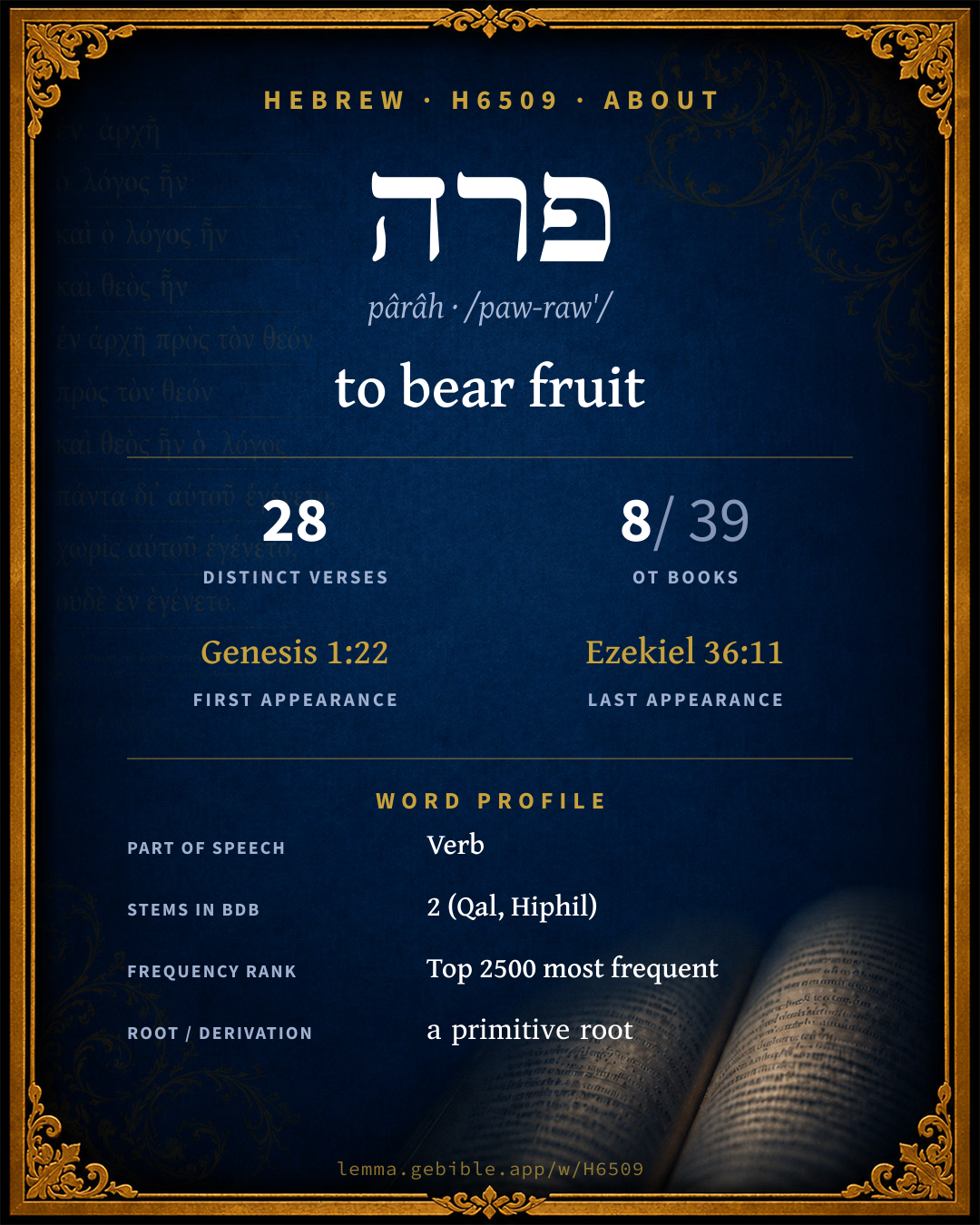
פָּרָה
to bear fruit
also: be fruitful, branch off fuller range ↓
Full lexicon entry — Brown-Driver-Briggs (BDB)
From Brown-Driver-Briggs (BDB)
Where this word appears
See every Qal verb in the Hebrew Bible →
Grammar key — what these labels mean
Part of speech
- Verb
- An action or state-of-being word.
Stem
- Qal
- The basic, simple active stem — the plain form of the verb (“he wrote”). Here: ‘of men and animals’
- Hiphil
- The causative active stem (“he caused / brought about”). Here: ‘in P’
Form
- Participle Active
- A verbal adjective expressing ongoing or characteristic action (“writing / one who writes”).
- Imperative
- A direct command (“write!”).
- Sequential Perfect
- A perfect with prefixed waw continuing a preceding imperfect or command (waw-consecutive perfect).
- Jussive
- A third- or second-person volitional form expressing wish or command (“let him write”).
- Sequential Imperfect
- An imperfect with prefixed waw — the standard past-narrative form (waw-consecutive imperfect).
- Imperfect
- An incomplete, ongoing, or future action (“he will / would write”).
- Perfect
- A completed action or state — Hebrew marks aspect (completeness) more than strict tense (“he wrote”).
State
- Absolute
- The independent form of a noun, not bound to a following word.
- Construct
- A noun bound to a following noun in a possessive / “of” relationship (the construct chain).
Person
- 2nd Person
- The one addressed (“you”).
- 1st Person
- The speaker (“I / we”).
- 3rd Person
- The one spoken about (“he / she / it / they”).
Gender
- Feminine
- Grammatically feminine.
- Masculine
- Grammatically masculine.
- Common
- Either gender — not distinguished for this form.
Number
- Singular
- One.
- Plural
- More than one (in Hebrew, generally three or more).
7 distinct verses where H6509 appears in the Hiphil stem, across 3 books. Filtered view — show all forms. Click any verse to open its interlinear word-by-word view. Verse text shown in the World English Bible for context — . Each verse’s Hebrew form is shown with its reference; the English is not keyword-highlighted, since the data carries no word-level English alignment. Use “Compare translations” on any verse to read it across multiple English versions. This concordance covers the Hebrew Bible; Septuagint (Greek Old Testament) occurrences are not indexed here.
Genesis 5 verses
- Genesis 17:6 וְ/הִפְרֵתִ֤י conj + Hiphil wpf 1cs I will make you exceeding fruitful, and I will make nations of you. Kings will come out of you.
- Genesis 17:20 וְ/הִפְרֵיתִ֥י conj + Hiphil wpf 1cs As for Ishmael, I have heard you. Behold, I have blessed him, and will make him fruitful, and will multiply him exceedingly. He will become the father of twelve princes, and I will make him a great nation.
- Genesis 28:3 וְ/יַפְרְ/ךָ֖ conj + Hiphil juss 3ms + sfx pers 2ms May God Almighty bless you, and make you fruitful, and multiply you, that you may be a company of peoples,
- Genesis 41:52 הִפְרַ֥/נִי Hiphil pf 3ms + sfx pers 1cs The name of the second, he called Ephraim: "For God has made me fruitful in the land of my affliction."
- Genesis 48:4 מַפְרְ/ךָ֙ Hiphil ptcp.act ms cs + sfx pers 2ms and said to me, 'Behold, I will make you fruitful, and multiply you, and I will make of you a company of peoples, and will give this land to your seed after you for an everlasting possession.'
Leviticus 1 verse
Psalms 1 verse
About this entry
At a glance — auto-summarized from this page’s data, not written by a person. Every figure links to its source below. This summary describes the numbers; it doesn’t interpret them.
פרה — transliterated pârâh — is a Hebrew verb carrying the sense “to bear fruit.” More than half of its appearances fall in Genesis. It appears 28 verses across 8 books of the Hebrew Bible, among its moderately common vocabulary. Its earliest occurrence is Genesis 1:22. As a verb its force shifts by stem, across 2 stems (Qal, Hiphil, and more). Each statement above links to its evidence; the full detail follows below.
Gloss history
Strong's 1890 vs modern scholarship
About this word
Strong's H6509 catalogs a Hebrew word from the Hebrew Old Testament.
These counts are not copied from any lexicon or concordance. They are computed here, from the morphology-tagged Hebrew Old Testament. What Lemma adds →
- 28
- distinct verses
- The word appears in 28 distinct verses.
- 8 / 39
- OT books
- The word appears in 8 of 39 Old Testament books.
- #1,160
- by frequency
- Top 2500 most frequent Hebrew words (rank 1,160 of 8,640 Hebrew words by occurrence).
View all 28 occurrences in the concordance →
By section of the Old Testament
By traditional corpus
Conventional, traditional groupings — biblical authorship is debated, so this is a traditional corpus grouping, not an authorship claim. Each share is this word’s portion of its verses in that division of the Hebrew canon. Each figure is a share of the word’s 28 distinct verses.
- Torah (Pentateuch) 18 verses · 64%
- Prophets (Nevi'im) 8 verses · 29%
- Writings (Ketuvim) 2 verses · 7%
How translations render this word
Counts come from each version’s own published word-to-Strong’s tagging or interlinear alignment — an approximate guide to how each version renders this word, not a word-level alignment the data otherwise carries. Because each total is that version’s own tagged count, the per-version totals vary from one another and need not match the appearance or distinct-verse counts above. These counts may also differ from a printed concordance because Lemma counts each distinctly tagged rendering and does not collapse phrase taggings into a single head-word total. This is a fixed set of word-tagged versions (KJV, ASV, BSB, ULT) and does not change with the reading translation you choose elsewhere. Each version’s license is shown beside its name below (and on Sources).
BDB lists this Strong’s number as 4 distinct words (homographs). Each count above pools all of them and is not split by sense — see the Senses section below. A low-frequency rendering may belong to a different one of those words, not the primary meaning.
- King James Version†: Be fruitful 5×, Fruitful 3×
- American Standard Version†: Fruitful 4×, Be fruitful 3×, Thee 2×
- Berean Standard Bible†: Be fruitful 7×, Fruitful 6×, Make you fruitful 2×
- unfoldingWord Literal Text†: Be fruitful 7×, Fruitful 5×, Bearing fruit 2×
King James Version Public Domain
Renders H6509 across 30† tagged occurrences — most commonly:
Plus 22 renderings that appear only once — usually multi-word phrases or single function words the recovered tagging swept in, not distinct renderings.
American Standard Version Public Domain
Renders H6509 across 30† tagged occurrences — most commonly:
Plus 17 renderings that appear only once — usually multi-word phrases or single function words the recovered tagging swept in, not distinct renderings.
Berean Standard Bible Public Domain
Renders H6509 across 29† tagged occurrences — most commonly:
Plus 14 renderings that appear only once — usually multi-word phrases or single function words the recovered tagging swept in, not distinct renderings.
unfoldingWord Literal Text CC BY-SA 4.0
Renders H6509 across 35† tagged occurrences — most commonly:
Plus 15 renderings that appear only once — usually multi-word phrases or single function words the recovered tagging swept in, not distinct renderings.
7 senses and sub-senses in the full BDB
Hebrew verbs can shift meaning by stem (binyan): Qal is the basic action, Niphal is often passive or reflexive, Piel often intensifies or makes it factitive, and Hiphil is typically causative. The senses below are grouped under the stem BDB assigns to each.
What do BDB’s symbols mean?
BDB uses these scholarly abbreviations:
| Symbol | Meaning |
|---|---|
| 𝔊 | the Septuagint (the ancient Greek translation, LXX) |
| 𝔙 | the Vulgate (the Latin translation) |
| 𝔖 | the Syriac version (the Peshitta) |
| 𝔗 | the Targum (the Aramaic translation) |
| ψ | the Psalms |
| √ | root (the underlying root or stem) |
| ‖ | parallel passage (a synonymous or contrasted parallel) |
| † | the dagger: every passage where the word occurs is cited |
The 7 senses and sub-senses the full Brown-Driver-Briggs lexicon distinguishes for this word, in lexicon order (not ranked by frequency), with BDB’s own verbatim wording and sub-sense lettering. Shown in Hebrew script with BDB’s own scholarly abbreviations. The condensed entry is in the Lexicon Entry tab. See also the Forms in the corpus table below.
פרה I bear fruit, be fruitful (NH = BH 1, פְּרִי = BH
Qal
- Pf. 3 pl. פָּרוּ Ex 1:7; 1 pl. consec. וּפָרִינוּ Gn 26:22, etc.; Impf. 3 ms. יִפְרֶה Is 11:1, etc.; Imv. ms. פְּרֵה Gn 35:11, mpl. פְּרוּ 1:22 +; Pt. act. פֹּרֶה Dt 29:17, f. פֹּרִיָּה Ez 19:10 Is 17:6, פֹּרָת (Ges§ 80 g; for *פֹּרַיַת LagBN 81) Gn 49:22(×2);— e.g. Exodus 1:7
- 1. of men and animals, Ex 23:30 (E) Gn 26:22 (J); especially + רבה Je 3:16; 23:3 Ez 36:11; Gn 35:11; 47:27 (P), and שָׁרַץ (P) Gn 8:17; 9:7; Ex 1:7, פְּרוּ וּרְבוּ וּמִלְאוּ וגו׳ Gn 1:22, 28; 9:1. e.g. Exodus 23:30
- 2. of vine, גֶּפֶן פֹּרִיָּה Is 32:12 fruitful vine, so ψ 128:3 (sim. of wife); cf. (in fig. of Isr.) Ez 19:10; in Mess. prediction Is 11:1 a shoot from his [Jesse’s] roots shall bear fruit; c. acc. שֹׁרֶשׁ פ׳ רֹאשׁ fig., Dt 29:17 a root bearing gall (as its fruit); יִפְרוּ יֶשַׁע Is 45:8 is dub., read perhaps 3 fs. תֵּפֶר let earth be fruitful in salvation (Oort al.); Pt. f., as subst., הַפֹּרִיָּה the fruit-bearer, poet. for tree, Is 17:6 (cf. [סָעִיף] 2); so בֵּן פֹּרָת Gn 49:22(×2) Joseph is son of a fruit-bearer, i.e. a fruitful bough. e.g. Isaiah 32:12
Hiphil
- 1. cause to bear fruit, 2. make fruitful, subj. י׳, c. acc. of man or people:
- 1. Pf. 3 ms. sf. הִפְרַנִי Gn 41:52 (E). e.g. Genesis 41:52
- 2. in P, וְהִפְרֵתִ֫י Gn 17:6, 20 (-רֵיתֵ֫י), + הִרְבָּה Lv 26:9 (H); Impf. 3 ms. juss. יַפְרְךָ וְיַרְבְּךָ Gn 28:3, וַיֶּפֶר ψ 105:24; Pt. הִנְנִי מַפְרְךָ וְהִרְבִּיתִךָ Gn 48:4 e.g. Genesis 17:6
- 3. shew fruitfulness, bear fruit (Ges§ 53 c, d, g): Impf. 3 ms. יַפְרִיא Ho 13:15 (as if from פרא). e.g. Hosea 13:15
פרה II heifer, cow
פרה III loc. in Benj., הַפּ׳ Jos 18
Senses from the full Brown-Driver-Briggs lexicon (Brown, Driver, Briggs; Oxford 1906 — public domain), digitized via Sefaria, supplemented by the OpenScriptures HebrewLexicon (CC BY 4.0). Full attribution on Sources.
Word origin
I. vb. bear fruit, be fruitful (NH = BH 1, פְּרִי = BH; Ph. פר fruit; Ethiopic ፈርየ: ፈረየ: blossom, bear fruit; Assyrian pirʾu, posterity; cf. also 𝔗 פֵּירָא, Syriac ܦܶܐܪܳܐ fruit, and BaZMG xii (1887), 604);—
III. n.f. heifer, cow;—abs. פ׳ Is 11:7 +; sf. פָּרָתוֹ Jb 21:10; pl. פָּרוֹת Gn 32:16 +, פָּרֹת 41:26; cstr. פָּרוֹת Am 4:1;—as gift Gn 32:16; in Pharaoh’s dream 41:2, 3(×2) + 8 times 41; drawing cart 1 S 6:7, 12, 14 + פ׳ עָלוֹת v 7, 10 cows giving suck, milch cows; פ׳ calving Jb 21:10, grazing Is 11:7; פ׳ אֲדֻמָּה red heifer Nu 19:2, cf. v 5, 6, 9, 10; sim. of stubbornness Ho 4:16; פָּרוֹת הַבָּשָׁן Am 4:1, fig. of luxurious women.
IV. n.pr.loc. in Benj., הַפּ׳ Jos 18:23, Φαρα, Αφρα.
— Brown-Driver-Briggs (Oxford 1906, public domain), digitized via Sefaria, supplemented by the OpenScriptures HebrewLexicon (CC BY 4.0). See Sources.
Origin: a primitive root
Jastrow Dictionary
A second Hebrew/Aramaic lexicon for comparison, covering Aramaic and post-biblical (Talmudic, Targumic, Midrashic) usage that the biblical-Hebrew BDB does not. Matched by lemma rather than by Strong’s number, so a lemma may carry more than one Jastrow headword (shown separately below), and the entries cover usage well beyond the Bible.
פָּרָה I
- cow, v. פָּר.
פָּרָה II
- to be fruitful, v. פרי.
פָּרָה III
- , v. פָּרָא II
פרי
- [to break through,] to grow, increase, be fruitful. Gitt. 57ᵃ כלומר פְּרוּ ורבו וכ׳ intimating, ‘multiply and increase like chickens’. Num. R. s. 11 את פְּרֵה ורבה לגוי גדול be thou fruitful and grow to be a great nation. Ib. כל מה … היה פָּרֶה ורבה whatever existed in the Temple grew and increased (v. פַּרְוַיִם). Ḥag. 16ᵃ פָּרִין ורבין כבני אדם they increase by propagation like human beings. Ḥull. 92ᵃ (ref. to כפרחת, Gen. XL, 10) הגיע לִפְרוֹת ולרבות … the time has come for Israel to grow and increase (as a nation); a. fr. e.g. Genesis 40:10
- 1. to cause to grow, make fruitful. Ber. 40ᵃ דגים קטנים מַפְרִין ומרבין ומברין כל גופו וכ׳ (Ms. M. מפרין ומרבין גופו וכ׳) small fish make fruitful (increase the sexual vigor) and strengthen the whole body of man; ib. 57ᵇ מפרין ומברין (Ms. M. מפרין ומרבין); Ab. Zar. 29ᵃ מפרין ומרבין (read: ומַבְרִין); a. e.—[
- 2. to increase the rent above the original stipulation in consideration of a loan, v. פָּרַז. B. Mets. V, 5 (69ᵇ) מפרין על שדהו ואין חוששין וכ׳ Ar. (Y. ed. ואין חושש—which indicates that מפרין is singular, fr. פָּרַן q. v.).]
A Dictionary of the Targumim, the Talmud Babli and Yerushalmi, and the Midrashic Literature (Marcus Jastrow; London, Luzac, 1903) — Public Domain. Digitized via Sefaria. Digitized via Sefaria. Full attribution on Sources.
Forms in the corpus
The 26 distinct written forms H6509 takes in the Hebrew Bible, most frequent first — each parse links to that stem’s occurrences in the concordance. Hebrew forms include their vowel points and cantillation, so a single lemma takes many written forms.
Same root — word family
Other BDB entries built from the same root as H6509, grouped by Strong’s listed origin. These share a root / origin per the lexicon — not necessarily a shared meaning. Each links to that word’s own entry.
Derived from this word
Proper names from this root
People and places named from this root — a name, not an additional meaning of the word.
Compare all same-root words → 1 of the same-root words is a proper name (a person or place). They share a root, not necessarily a meaning.
Septuagint verse parallels
This word appears in 28 verses that also exist in the Greek Old Testament (Septuagint), out of the 28 Hebrew verses it occurs in. You can read those verses in Greek by switching the Old Testament edition to the Septuagint.
Read these verses in the Septuagint
- Genesis 1:22
- Exodus 1:7
- Leviticus 26:9
- Deuteronomy 29:18
- Psalms 105:24
- Isaiah 11:1
- Jeremiah 3:16
- Ezekiel 19:10
This is a verse-level parallel only — the same verses exist in both the Hebrew and Greek Old Testaments. No word-level Hebrew↔Greek correspondence is claimed: the data carries no such alignment, so no Greek word is shown as this Hebrew word’s translation. Coverage is not total — the Septuagint omits the deuterocanon and renumbers the Psalms, so some Hebrew verses have no direct Greek parallel.