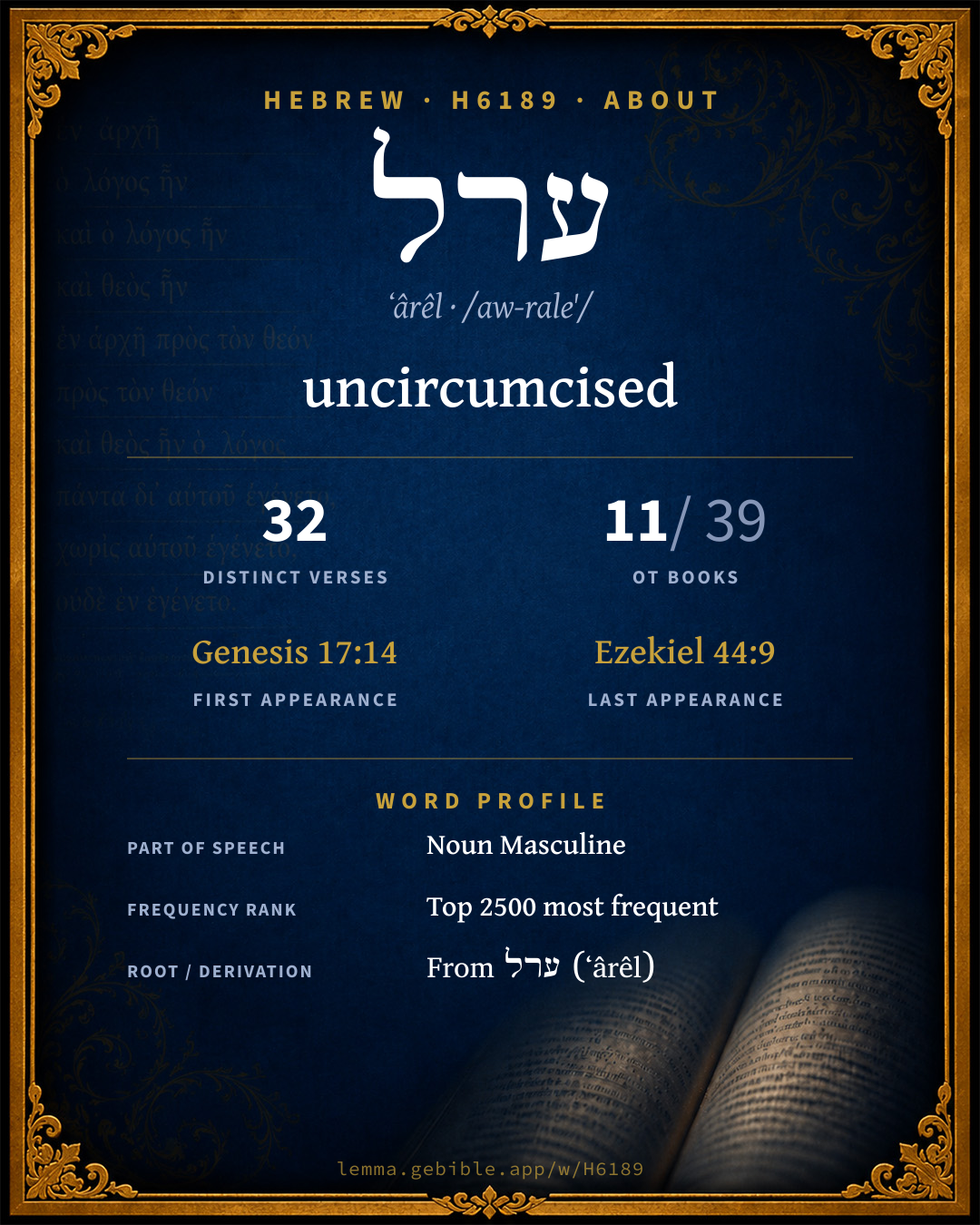
עָרֵל
uncircumcised
Full lexicon entry — Brown-Driver-Briggs (BDB)
From Brown-Driver-Briggs (BDB)
Where this word appears
See every Absolute-state word in the Hebrew Bible →
Grammar key — what these labels mean
Part of speech
- Adjective
- A word that describes or qualifies a noun.
State
- Absolute
- The independent form of a noun, not bound to a following word.
- Construct
- A noun bound to a following noun in a possessive / “of” relationship (the construct chain).
Gender
- Masculine
- Grammatically masculine.
- Feminine
- Grammatically feminine.
Number
- Plural
- More than one (in Hebrew, generally three or more).
- Singular
- One.
5 distinct verses where H6189 appears in the Construct state, across 3 books. Filtered view — show all forms. Click any verse to open its interlinear word-by-word view. Verse text shown in the World English Bible for context — . Each verse’s Hebrew form is shown with its reference; the English is not keyword-highlighted, since the data carries no word-level English alignment. Use “Compare translations” on any verse to read it across multiple English versions. This concordance covers the Hebrew Bible; Septuagint (Greek Old Testament) occurrences are not indexed here.
Exodus 2 verses
- Exodus 6:12 עֲרַ֥ל adj Adjective ms cs Moses spoke before Yahweh, saying, "Behold, the children of Israel haven't listened to me. How then shall Pharaoh listen to me, who am of uncircumcised lips?"
- Exodus 6:30 עֲרַ֣ל adj Adjective ms cs Moses said before Yahweh, "Behold, I am of uncircumcised lips, and how shall Pharaoh listen to me?"
Jeremiah 1 verse
Ezekiel 2 verses
- Ezekiel 44:7 עַרְלֵי וְ/עַרְלֵ֣י adj Adjective mp cs conj + Adjective Adjective mp cs in that you have brought in foreigners, uncircumcised in heart and uncircumcised in flesh, to be in my sanctuary, to profane it, even my house, when you offer my bread, the fat and the blood, and they have broken my covenant, [to add] to all your abominations.
- Ezekiel 44:9 עֶ֤רֶל וְ/עֶ֣רֶל adj Adjective ms cs conj + Adjective Adjective ms cs Thus says the Lord Yahweh, No foreigner, uncircumcised in heart and uncircumcised in flesh, shall enter into my sanctuary, of any foreigners who are among the children of Israel.
About this entry
At a glance — auto-summarized from this page’s data, not written by a person. Every figure links to its source below. This summary describes the numbers; it doesn’t interpret them.
The Hebrew noun ערל centers on the idea of “uncircumcised.” Its earliest occurrence is Genesis 17:14. It turns up in 32 verses across 11 books, a moderately common footprint. The word gravitates to Ezekiel (44%), then 1 Samuel and Exodus. It shares a root with ערל and ערלה. Dig into 32-verse concordance and the renderings breakdown below.
Gloss history
Strong's 1890 vs modern scholarship
About this word
Strong's H6189 catalogs a Hebrew word from the Hebrew Old Testament.
These counts are not copied from any lexicon or concordance. They are computed here, from the morphology-tagged Hebrew Old Testament. What Lemma adds →
- 32
- distinct verses
- The word appears in 32 distinct verses.
- 11 / 39
- OT books
- The word appears in 11 of 39 Old Testament books.
- #1,023
- by frequency
- Top 2500 most frequent Hebrew words (rank 1,023 of 8,640 Hebrew words by occurrence).
View all 32 occurrences in the concordance →
By section of the Old Testament
By traditional corpus
Conventional, traditional groupings — biblical authorship is debated, so this is a traditional corpus grouping, not an authorship claim. Each share is this word’s portion of its verses in that division of the Hebrew canon. Each figure is a share of the word’s 32 distinct verses.
- Prophets (Nevi'im) 25 verses · 78%
- Torah (Pentateuch) 6 verses · 19%
- Writings (Ketuvim) 1 verse · 3%
How translations render this word
Counts come from each version’s own published word-to-Strong’s tagging or interlinear alignment — an approximate guide to how each version renders this word, not a word-level alignment the data otherwise carries. Because each total is that version’s own tagged count, the per-version totals vary from one another and need not match the appearance or distinct-verse counts above. These counts may also differ from a printed concordance because Lemma counts each distinctly tagged rendering and does not collapse phrase taggings into a single head-word total. This is a fixed set of word-tagged versions (KJV, ASV, BSB, ULT) and does not change with the reading translation you choose elsewhere. Each version’s license is shown beside its name below (and on Sources).
- King James Version: Uncircumcised 21×, All of them uncircumcised 2×, Are uncircumcised 2×
- American Standard Version: Uncircumcised 20×, Are uncircumcised 2×
- Berean Standard Bible: Uncircumcised 19×, Uncircumcised men 3×, Am unskilled 2×
- unfoldingWord Literal Text: Uncircumcised 28×, Are uncircumcised 3×, Ones 2×
King James Version Public Domain
Renders H6189 across 35 tagged occurrences — most commonly:
Plus 10 renderings that appear only once — usually multi-word phrases or single function words the recovered tagging swept in, not distinct renderings.
American Standard Version Public Domain
Renders H6189 across 35 tagged occurrences — most commonly:
Plus 13 renderings that appear only once — usually multi-word phrases or single function words the recovered tagging swept in, not distinct renderings.
Berean Standard Bible Public Domain
Renders H6189 across 32 tagged occurrences — most commonly:
Plus 6 renderings that appear only once — usually multi-word phrases or single function words the recovered tagging swept in, not distinct renderings. Not rendered by a distinct English word in 3 further occurrences.
unfoldingWord Literal Text CC BY-SA 4.0
Renders H6189 across 38 tagged occurrences — most commonly:
Plus 5 renderings that appear only once — usually multi-word phrases or single function words the recovered tagging swept in, not distinct renderings.
Senses in BDB
The 1 sense BDB distinguishes for this word, in lexicon order (not ranked by frequency or importance). The full entry — with sub-senses — is in the Lexicon Entry tab.
- uncircumcised, having foreskin
Word origin
adj. having foreskin, i.e. uncircumcised;—ע׳ Ex 12:48 + 5 times; cstr. עֶ֫רֶל Ez 44:9(×2); עֲרַל Ex 6:12, 30; f. עֲרֵלָה Je 6:10; pl. עֲרֵלִים Lv 19:23 + 20 times; cstr. עַרְלֵי Je 9:25 + 2 times;—uncircumcised person Ex 12:48; Jos 5:7 (P), Philistines Ju 14:3; 15:18; 1 S 14:6; 17:26, 36; 31:4; 2 S 1:20; 1 Ch 10:4; of other nations Is 52:1; Je 9:25, especially as slain Ez 28:10; 31:18; 32:19 + 9 times 32; in v 27 read מֵעוֹלָם so Hi and most (v. on meaning Toy 31:18); עָרֵל זָכֶר uncircumcised male Gn 17:14 (P); ע׳ בָּשָׂר Ez 44:7, 9 uncircumcised of flesh; fig. of fruit trees Lv 19:23 (cf. [עָרַל] supr.); ע׳ שְׂפָתַיִם fig. of incapacity to speak Ex 6:12, 30; of character, ע׳ לב Je 9:25; Ez 44:7, 9, cf. לִבָבָם הֶעָרֵל Lv 26:41 (H), עֲרֵלָה אָזְנָם Je 6:10 their ear is uncircumcised (unreceptive).
— Brown-Driver-Briggs (Oxford 1906, public domain), digitized via Sefaria, supplemented by the OpenScriptures HebrewLexicon (CC BY 4.0). See Sources.
Derived from ערל (ʻârêl) (H6188) — to remain uncircumcised.
Jastrow Dictionary
A second Hebrew/Aramaic lexicon for comparison, covering Aramaic and post-biblical (Talmudic, Targumic, Midrashic) usage that the biblical-Hebrew BDB does not. Matched by lemma rather than by Strong’s number, so a lemma may carry more than one Jastrow headword (shown separately below), and the entries cover usage well beyond the Bible.
עָרַל
- (denom. of עָרְלָה) to sheathe, cover. Y. Orl. III, beg. 62ᵈ (ref. to Lev. XIX, 23) אית תניי תני בעוֹרֵל את פריו one Tannai explains that it refers to that which covers the fruit (peel, shell &c.); דבר שהוא עורל את פריו ופריו עוֹרְלוֹ that which covers the fruit (peel), and that which the fruit covers (kernel); Y. Maasr. IV, end, 51ᶜ דבר שעורל את פריו.—[In b. h. עָרַל to treat as ‘Orlah, to remove.] e.g. Leviticus 19:23
עָרֵל
- v. עָרְלָה) [covered,] uncircumcised; gentile. Mekh. Bo s. 15 (ref. to Ex. XII, 43) אבל ישראל ע׳ שומע וכ׳ I might deduce from this that an uncircumcised Israelite may pertake of the Passover lamb; Pes. 96ᵃ אבל ע׳ דלבו לשמים but an uncircumcised Israelite whose heart is directed towards heaven (and who remained uncircumcised, because his older brothers had died from circumcision). Yeb. VIII, 1 הע׳ וכל וכ׳ an uncircumcised priest, and all unclean persons must not eat T’rumah. Tosef. Ḥull. I, 1 אפי׳ ע׳ even an uncircumcised Israelite; Ḥull. 5ᵃ האי ע׳ היכי וכ׳ what is meant by this ʿarel? Do you mean an Israelite whose brothers died from circumcision? Pes. 92ᵃ ע׳ נכרי an uncircumcised gentile (a proselyte that was circumcised on the eve of Passover); ע׳ ישראל an Israelite that was circumcised on the eve of Passover; a. fr.—[Y. Shebi. VII, end, 37ᶜ חוץ מן הערל, read: העֲדָל.]—Pl. עֲרֵלִים. Mekh. l. c. עבדים ע׳ (not וע׳) uncircumcised slaves. Ned. III, 11 קונם … לע׳ מותר בעַרְלֵי ישראל he who vows that he will not receive any benefits from uncircumcised persons, is permitted benefits from uncircumcised Israelites, and forbidden benefits from circumcised gentiles (the word ʿărelim being meant only for non-Jews; v. עָרְלָה); a. fr. e.g. Exodus 12:43
עָרֵל ²
- Targ. Deut. XXVIII, 43 (h. text הגר). Targ. Ex. XII, 48 (Y. עַרְלָאֵי, read: עַרְלַאי); a. fr.—Pl. עֲרֵלִין, עַרְלִין, עַרְלַיָּא, עַרְלָאִין. Targ. Josh. V, 7 (ed. Lag. עֲרילִ׳). Targ. Jer. IX, 24, sq. Targ. Esth. I, 5; a. e.
A Dictionary of the Targumim, the Talmud Babli and Yerushalmi, and the Midrashic Literature (Marcus Jastrow; London, Luzac, 1903) — Public Domain. Digitized via Sefaria. Digitized via Sefaria. Full attribution on Sources.
Forms in the corpus
The 29 distinct written forms H6189 takes in the Hebrew Bible, most frequent first — each parse links to that state’s occurrences in the concordance. Hebrew forms include their vowel points and cantillation, so a single lemma takes many written forms.
Same root — word family
Other BDB entries built from the same root as H6189, grouped by Strong’s listed origin. These share a root / origin per the lexicon — not necessarily a shared meaning. Each links to that word’s own entry.
Derives from
Derived from this word
Compare all same-root words → They share a root, not necessarily a meaning.
Septuagint verse parallels
This word appears in 29 verses that also exist in the Greek Old Testament (Septuagint), out of the 32 Hebrew verses it occurs in. You can read those verses in Greek by switching the Old Testament edition to the Septuagint.
Read these verses in the Septuagint
- Genesis 17:14
- Exodus 6:12
- Leviticus 19:23
- Joshua 5:7
- Judges 14:3
- 1 Samuel 14:6
- 2 Samuel 1:20
- 1 Chronicles 10:4
- Isaiah 52:1
- Jeremiah 6:10
- Ezekiel 28:10
This is a verse-level parallel only — the same verses exist in both the Hebrew and Greek Old Testaments. No word-level Hebrew↔Greek correspondence is claimed: the data carries no such alignment, so no Greek word is shown as this Hebrew word’s translation. Coverage is not total — the Septuagint omits the deuterocanon and renumbers the Psalms, so some Hebrew verses have no direct Greek parallel.