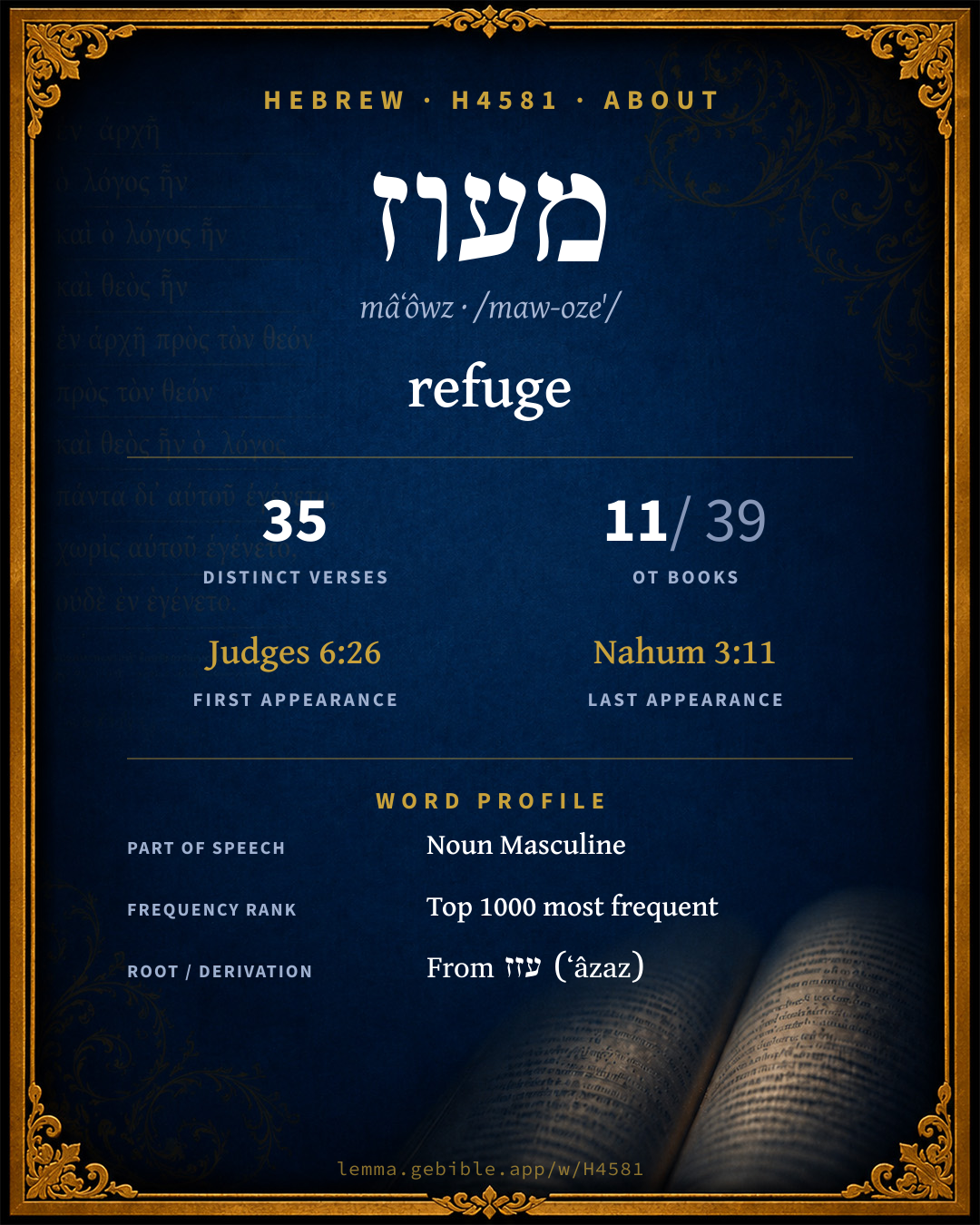
מָעוֹז
refuge
also: protection, stronghold fuller range ↓
Full lexicon entry — Brown-Driver-Briggs (BDB)
From Brown-Driver-Briggs (BDB)
Where this word appears
Grammar key — what these labels mean
Part of speech
- Noun
- A naming word — a person, place, thing, or idea.
Noun type
- Common
- A common noun — a general class of person, place, or thing (“king,” “city,” “water”), not a specific name.
State
- Construct
- A noun bound to a following noun in a possessive / “of” relationship (the construct chain).
- Absolute
- The independent form of a noun, not bound to a following word.
Gender
- Masculine
- Grammatically masculine.
Number
- Singular
- One.
- Plural
- More than one (in Hebrew, generally three or more).
Every verse where H4581 appears in the Book of Ezekiel — 2 distinct verses. Click any verse to open its interlinear word-by-word view. Verse text shown in the World English Bible for context — . Each verse’s Hebrew form is shown with its reference; the English is not keyword-highlighted, since the data carries no word-level English alignment. Use “Compare translations” on any verse to read it across multiple English versions. This concordance covers the Hebrew Bible; Septuagint (Greek Old Testament) occurrences are not indexed here.
Ezekiel
- Ezekiel 24:25 מָ֣עוּזָּ֔/ם n c ms cs + sfx pers 3mp You, son of man, shall it not be in the day when I take from them their strength, the joy of their glory, the desire of their eyes, and that whereupon they set their heart, their sons and their daughters,
- Ezekiel 30:15 מָע֣וֹז n c ms cs I will pour my wrath on Sin, the stronghold of Egypt; and I will cut off the multitude of No.
About this entry
At a glance — auto-summarized from this page’s data, not written by a person. Every figure links to its source below. This summary describes the numbers; it doesn’t interpret them.
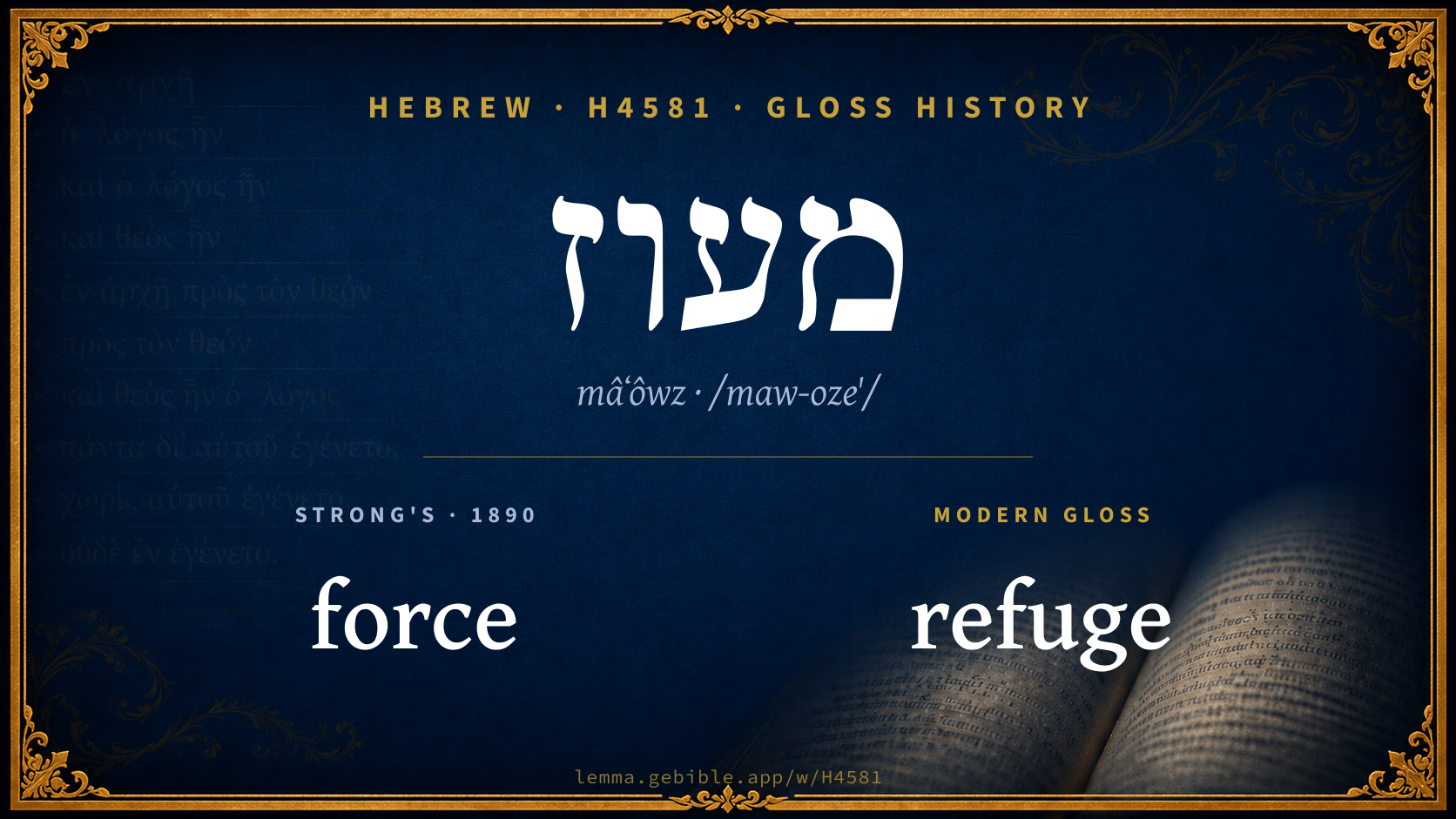
The Hebrew noun מעוז centers on the idea of “refuge.” Where the King James Version says “strength,” newer translations reach for “stronghold” (Berean Standard Bible) and “refuge” (unfoldingWord Literal Text); the renderings breakdown has the detail. The Hebrew Bible uses it across 35 verses — moderately common. Psalms dominates its distribution — 9 of 35 verses. Beyond “refuge” it also covers “protection” and “stronghold” — see its full sense range. Dig into 35-verse concordance and the renderings breakdown below.
Gloss history
Strong's 1890 vs modern scholarship
About this word
Strong's H4581 catalogs a Hebrew word from the Hebrew Old Testament.
These counts are not copied from any lexicon or concordance. They are computed here, from the morphology-tagged Hebrew Old Testament. What Lemma adds →
- 35
- distinct verses
- The word appears in 35 distinct verses.
- 11 / 39
- OT books
- The word appears in 11 of 39 Old Testament books.
- #967
- by frequency
- Top 1000 most frequent Hebrew words (rank 967 of 8,640 Hebrew words by occurrence).
View all 35 occurrences in the concordance →
By section of the Old Testament
By traditional corpus
Conventional, traditional groupings — biblical authorship is debated, so this is a traditional corpus grouping, not an authorship claim. Each share is this word’s portion of its verses in that division of the Hebrew canon. Each figure is a share of the word’s 35 distinct verses.
- Writings (Ketuvim) 18 verses · 51%
- Prophets (Nevi'im) 17 verses · 49%
How translations render this word
Counts come from each version’s own published word-to-Strong’s tagging or interlinear alignment — an approximate guide to how each version renders this word, not a word-level alignment the data otherwise carries. Because each total is that version’s own tagged count, the per-version totals vary from one another and need not match the appearance or distinct-verse counts above. These counts may also differ from a printed concordance because Lemma counts each distinctly tagged rendering and does not collapse phrase taggings into a single head-word total. This is a fixed set of word-tagged versions (KJV, ASV, BSB, ULT) and does not change with the reading translation you choose elsewhere. Each version’s license is shown beside its name below (and on Sources).
BDB lists this Strong’s number as 2 distinct words (homographs). Each count above pools all of them and is not split by sense — see the Senses section below. A low-frequency rendering may belong to a different one of those words, not the primary meaning.
- King James Version†: Strength 13×, Fortress 3×, Is the strength 3×
- American Standard Version†: Stronghold 8×, Strength 5×, Fortress 3×
- Berean Standard Bible†: Stronghold 9×, Refuge 6×, Fortress 4×
- unfoldingWord Literal Text†: Refuge 7×, Stronghold 7×, Fortress 5×
King James Version Public Domain
Renders H4581 across 37† tagged occurrences — most commonly:
Plus 18 renderings that appear only once — usually multi-word phrases or single function words the recovered tagging swept in, not distinct renderings.
American Standard Version Public Domain
Renders H4581 across 36† tagged occurrences — most commonly:
Plus 18 renderings that appear only once — usually multi-word phrases or single function words the recovered tagging swept in, not distinct renderings.
Berean Standard Bible Public Domain
Renders H4581 across 35† tagged occurrences — most commonly:
Plus 11 renderings that appear only once — usually multi-word phrases or single function words the recovered tagging swept in, not distinct renderings. Not rendered by a distinct English word in 1 further occurrence.
unfoldingWord Literal Text CC BY-SA 4.0
Renders H4581 across 37† tagged occurrences — most commonly:
Plus 11 renderings that appear only once — usually multi-word phrases or single function words the recovered tagging swept in, not distinct renderings.
Senses in the full BDB
What do BDB’s symbols mean?
BDB uses these scholarly abbreviations:
| Symbol | Meaning |
|---|---|
| 𝔊 | the Septuagint (the ancient Greek translation, LXX) |
| 𝔙 | the Vulgate (the Latin translation) |
| 𝔖 | the Syriac version (the Peshitta) |
| 𝔗 | the Targum (the Aramaic translation) |
| ψ | the Psalms |
| √ | root (the underlying root or stem) |
| ‖ | parallel passage (a synonymous or contrasted parallel) |
| † | the dagger: every passage where the word occurs is cited |
The 4 senses and sub-senses the full Brown-Driver-Briggs lexicon distinguishes for this word, in lexicon order (not ranked by frequency), with BDB’s own verbatim wording and sub-sense lettering. Shown in Hebrew script with BDB’s own scholarly abbreviations. The condensed entry is in the Lexicon Entry tab. See also the Forms in the corpus table below.
- 1. lit. place of safety 2 S 22:33, hence (c. collat. idea of strength, as if from עזז) = fastness Ju 6:26; Is 23:11, 14 (in v 14 (CheHeb. Hpt. proposes מְחוֹזְכֶם your city), Ez 24:25; 30:15; Dn 11:7, 10, 19, הַמִּקְדָּשׁ הַמּ׳ v 31, מִבְצְרֵי מָעֻזִּים v 39; מ׳ הַיָּם i.e. harbour Is 23:4, but del. Ol Du CheHpt.; מ׳ מֵאוֹיֵב Na 3:11; cf. עָרֵי מ׳ Is 17:9. e.g. 2 Samuel 22:33
- 2.
- a. fig., of God (י׳) as refuge Na 1:7 ψ 27:1; 31:5; 37:39; 52:9; Is 25:4(×2); Jo 4:16, י׳ עֻזִּי וּמָעֻזִּי וּמְנוּסִי Je 16:19, מ׳ יְשׁוּעוֹת מְשִׁיחוֹ ψ 28:8 (‖ עָז־); so צוּר מ׳ Is 17:10 ψ 31:3, אֱלֹהֵי מ׳ 43:2; also יַחֲזֵק בְּמָעֻוִּי Is 27:5 let him lay hold of my refuge (me as refuge); cf. חֶדְוַת י׳ הִיא מָעֻזְּכֶם Ne 8:10, מ׳ לַתֹּם דֶּרֶךְ י׳ Pr 10:29. e.g. Nahum 1:7
- b. of a heathen god, אֱלוֹהַּ מָעֻזִּים Dn 11:38 (read מְחֹזִים cities Che Is 23:1 Heb. Hpt.). e.g. Daniel 11:38
- 3. fig. of human protection, מ׳ פַּרְעֹה Is 30:2, 3 (both ‖ צֵל מִצְרַיִם); אֶפְרַיִם מ׳ רֹאשִׁי ψ 60:9 = 108:9, i.e. my helmet; also (of angel) Dn 11:1 (‖ מַחֲזִיק). e.g. Isaiah 30:2
Senses from the full Brown-Driver-Briggs lexicon (Brown, Driver, Briggs; Oxford 1906 — public domain), digitized via Sefaria, supplemented by the OpenScriptures HebrewLexicon (CC BY 4.0). Full attribution on Sources.
Word origin
n.m. Ju 6:26 place or means of safety, protection (MT sfs. as if from עזז, but prob. erron., cf. BuhlLex 13 Ges§ 85 k);—מ׳ abs. Ju 6:26 +, cstr. Is 30:2 +; sf. מָעוּזִי 2 S 22:33 (but read הַמְּאַזְּרֵנִי as ‖ ψ 18:33), מָעוּזִּי ψ 31:5 +, מָעֻזּי Is 27:5 +, מָעוּזּוֹ ψ 52:9 +, מָעֻזֹּה Dn 11:10, etc. (read proposes מְעוֹזִי, etc.); pl. מָעֻזִּים v 38, 39, sf. מָעֻזְּנֶיהָ Is 23:11, read מָעֻזֶּיהָ (Ges§ 20 o CheHeb. Hpt. al.; del. d. f. in all, v. supr.);—
— Brown-Driver-Briggs (Oxford 1906, public domain), digitized via Sefaria, supplemented by the OpenScriptures HebrewLexicon (CC BY 4.0). See Sources.
Derived from עזז (ʻâzaz) (H5810) — to be strong.
Forms in the corpus
The 31 distinct written forms H4581 takes in the Hebrew Bible, most frequent first — each parse links to that state’s occurrences in the concordance. Hebrew forms include their vowel points and cantillation, so a single lemma takes many written forms.
Same root — word family
Other BDB entries built from the same root as H4581, grouped by Strong’s listed origin. These share a root / origin per the lexicon — not necessarily a shared meaning. Each links to that word’s own entry.
Derives from
Shares the same root
- עז ʻaz H5794 strong
- עז ʻêz H5795 female goat
- עז ʻôz H5797 strength
- עזוז ʻĕzûwz H5807 might
- עזוז ʻizzûwz H5808 mighty
Proper names from this root
People and places named from this root — a name, not an additional meaning of the word.
Compare all same-root words → Showing 4 of 10 — not the complete family. 3 of the same-root words are proper names (people or places). They share a root, not necessarily a meaning.
Septuagint verse parallels
This word appears in 32 verses that also exist in the Greek Old Testament (Septuagint), out of the 35 Hebrew verses it occurs in. You can read those verses in Greek by switching the Old Testament edition to the Septuagint.
Read these verses in the Septuagint
- Judges 6:26
- 2 Samuel 22:33
- Psalms 27:1
- Proverbs 10:29
- Isaiah 17:9
- Jeremiah 16:19
- Ezekiel 24:25
- Daniel 11:1
- Nahum 1:7
This is a verse-level parallel only — the same verses exist in both the Hebrew and Greek Old Testaments. No word-level Hebrew↔Greek correspondence is claimed: the data carries no such alignment, so no Greek word is shown as this Hebrew word’s translation. Coverage is not total — the Septuagint omits the deuterocanon and renumbers the Psalms, so some Hebrew verses have no direct Greek parallel.