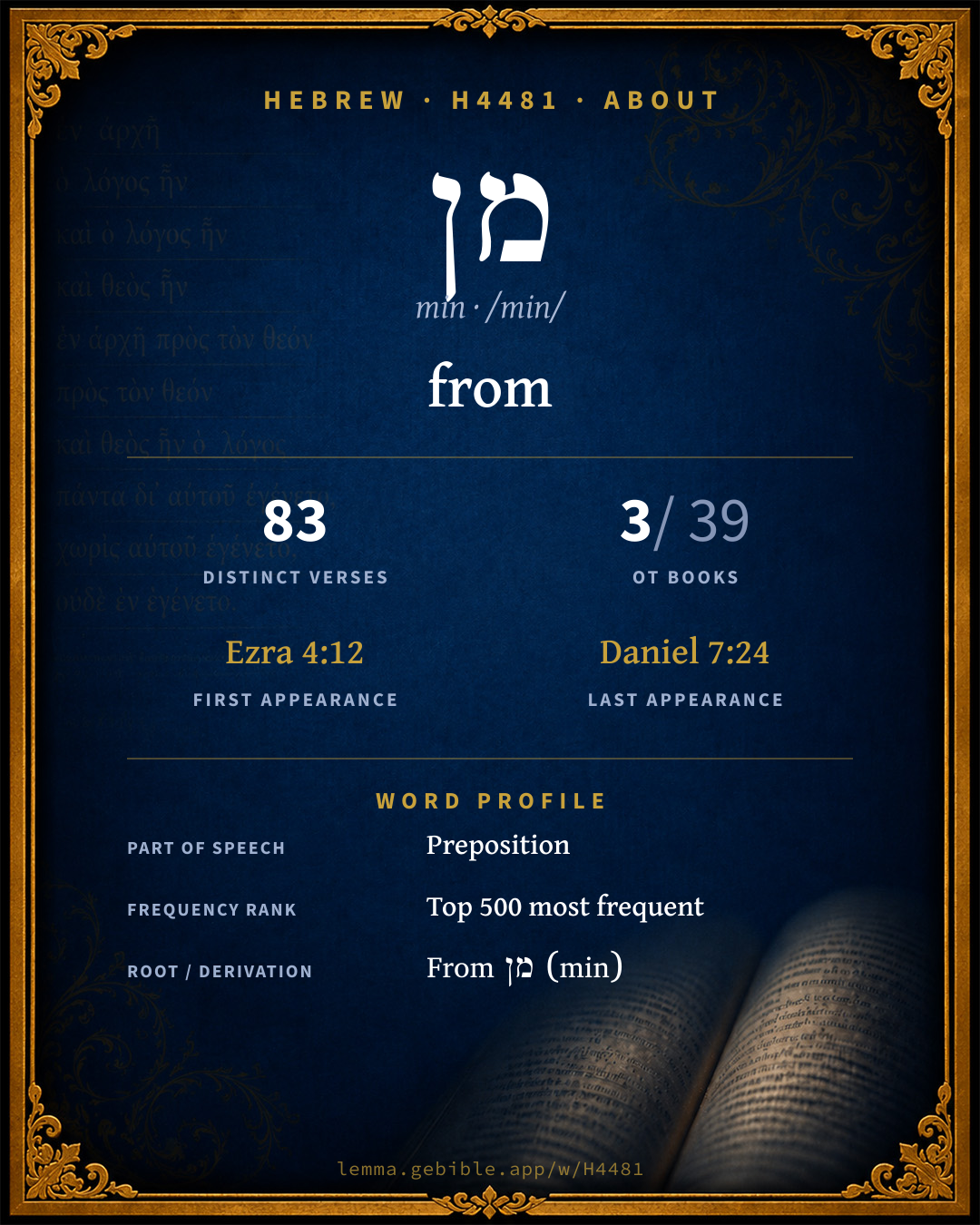
מִן
from
also: out of, by, by reason of, at fuller range ↓
Full lexicon entry — Brown-Driver-Briggs (BDB)
From Brown-Driver-Briggs (BDB)
Where this word appears
Grammar key — what these labels mean
Part of speech
- Preposition
- A relational word (e.g. “in,” “to,” “from”) governing a noun.
- Conjunction
- A joining word (e.g. “and,” “but”) linking words or clauses.
Noun type
- Common
- A common noun — a general class of person, place, or thing (“king,” “city,” “water”), not a specific name.
State
- Construct
- A noun bound to a following noun in a possessive / “of” relationship (the construct chain).
Gender
- Masculine
- Grammatically masculine.
Number
- Plural
- More than one (in Hebrew, generally three or more).
Every verse where H4481 appears in the Book of Jeremiah — 1 distinct verse. Click any verse to open its interlinear word-by-word view. Verse text shown in the World English Bible for context — . Each verse’s Hebrew form is shown with its reference; the English is not keyword-highlighted, since the data carries no word-level English alignment. Use “Compare translations” on any verse to read it across multiple English versions. This concordance covers the Hebrew Bible; Septuagint (Greek Old Testament) occurrences are not indexed here.
Jeremiah
About this entry
At a glance — auto-summarized from this page’s data, not written by a person. Every figure links to its source below. This summary describes the numbers; it doesn’t interpret them.
At its core, מן (min) means “from.” The word gravitates to Daniel (73%), then Ezra and Jeremiah. It appears 83 verses across 3 books of the Hebrew Bible, among its moderately common vocabulary. First canonically at Ezra 4:12, it enters the text early. Not a single-sense word, it carries 5 senses, among them “out of”, “by”, and “by reason of”. Each statement above links to its evidence; the full detail follows below.
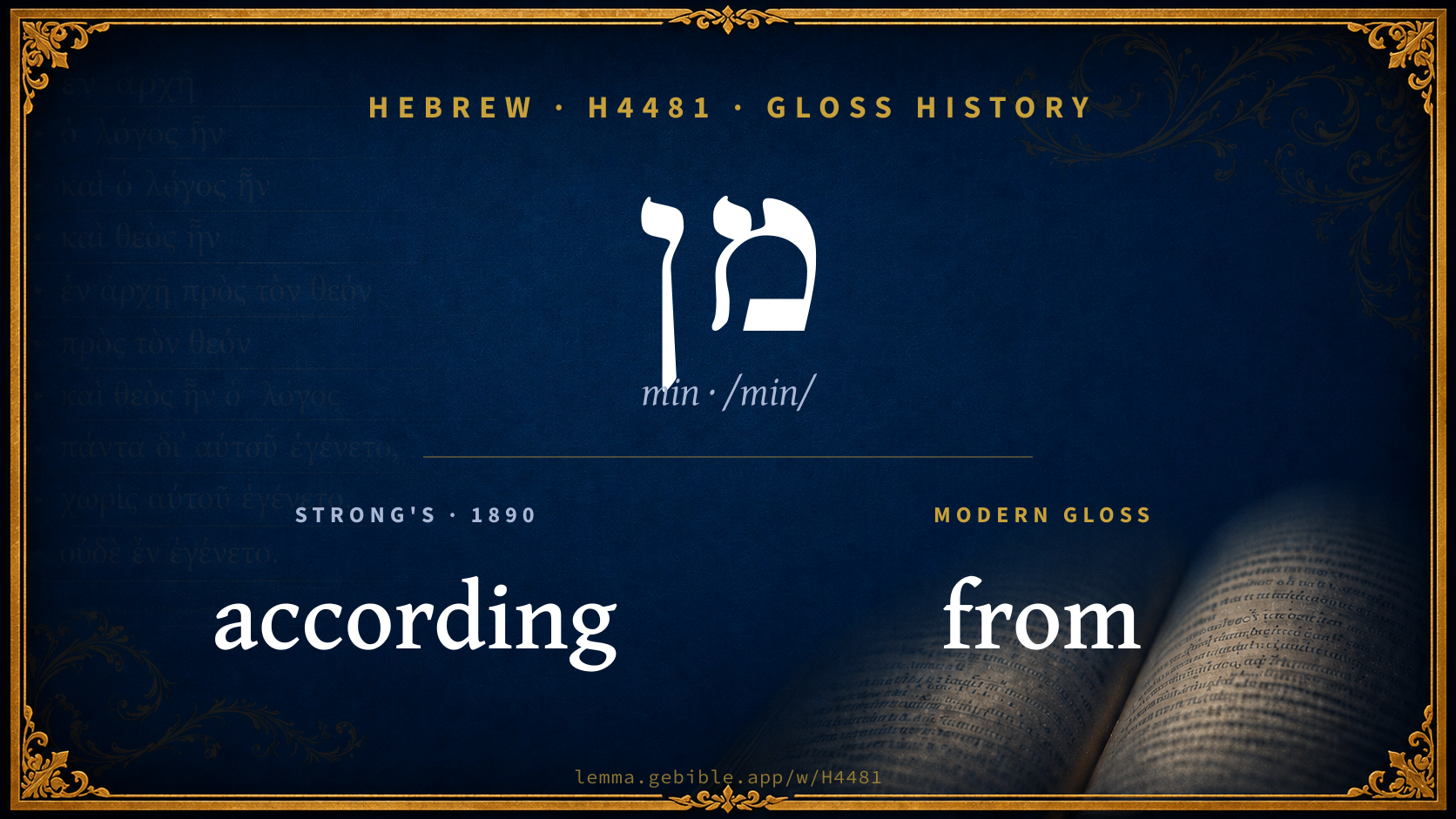
Gloss history
Strong's 1890 vs modern scholarship
About this word
Strong's H4481 catalogs a Hebrew word from the Hebrew Old Testament.
These counts are not copied from any lexicon or concordance. They are computed here, from the morphology-tagged Hebrew Old Testament. What Lemma adds →
- 83
- distinct verses
- The word appears in 83 distinct verses.
- 3 / 39
- OT books
- The word appears in 3 of 39 Old Testament books.
- #377
- by frequency
- Top 500 most frequent Hebrew words (rank 377 of 8,640 Hebrew words by occurrence).
View all 83 occurrences in the concordance →
By section of the Old Testament
By traditional corpus
Conventional, traditional groupings — biblical authorship is debated, so this is a traditional corpus grouping, not an authorship claim. Each share is this word’s portion of its verses in that division of the Hebrew canon. Each figure is a share of the word’s 83 distinct verses.
- Writings (Ketuvim) 82 verses · 99%
- Prophets (Nevi'im) 1 verse · 1%
How translations render this word
Counts come from each version’s own published word-to-Strong’s tagging or interlinear alignment — an approximate guide to how each version renders this word, not a word-level alignment the data otherwise carries. Because each total is that version’s own tagged count, the per-version totals vary from one another and need not match the appearance or distinct-verse counts above. These counts may also differ from a printed concordance because Lemma counts each distinctly tagged rendering and does not collapse phrase taggings into a single head-word total. This is a fixed set of word-tagged versions (KJV, ASV, BSB, ULT) and does not change with the reading translation you choose elsewhere. Each version’s license is shown beside its name below (and on Sources).
- King James Version: Of 30×, From 26×, I 5×
- American Standard Version: Of 31×, From 25×, Thee 6×
- Berean Standard Bible: From 41×, Of 10×, Before 3×
- unfoldingWord Literal Text: From 36×, Of 17×, Me 9×
King James Version Public Domain
Renders H4481 across 111 tagged occurrences — most commonly:
Plus 24 renderings that appear only once — usually multi-word phrases or single function words the recovered tagging swept in, not distinct renderings. Not rendered by a distinct English word in 2 further occurrences.
American Standard Version Public Domain
Renders H4481 across 113 tagged occurrences — most commonly:
Plus 25 renderings that appear only once — usually multi-word phrases or single function words the recovered tagging swept in, not distinct renderings.
Berean Standard Bible Public Domain
Renders H4481 across 85 tagged occurrences — most commonly:
Plus 21 renderings that appear only once — usually multi-word phrases or single function words the recovered tagging swept in, not distinct renderings. Not rendered by a distinct English word in 22 further occurrences.
unfoldingWord Literal Text CC BY-SA 4.0
Renders H4481 across 112 tagged occurrences — most commonly:
Plus 25 renderings that appear only once — usually multi-word phrases or single function words the recovered tagging swept in, not distinct renderings.
Senses in BDB
The 5 senses BDB distinguishes for this word, in lexicon order (not ranked by frequency or importance). The full entry — with sub-senses — is in the Lexicon Entry tab.
- from, out of, by, by reason of, at, more than
- from, out of (of place)
- from, by, as a result of, by reason of, at, according to
- from (of time)
- beyond, more than (in comparisons)
Word origin
מִן prep. from, out of, by, by reason of, at, more then
— Brown-Driver-Briggs (Oxford 1906, public domain), digitized via Sefaria, supplemented by the OpenScriptures HebrewLexicon (CC BY 4.0). See Sources.
Derived from מן (min) (H4480) — from.
Jastrow Dictionary
A second Hebrew/Aramaic lexicon for comparison, covering Aramaic and post-biblical (Talmudic, Targumic, Midrashic) usage that the biblical-Hebrew BDB does not. Matched by lemma rather than by Strong’s number, so a lemma may carry more than one Jastrow headword (shown separately below), and the entries cover usage well beyond the Bible.
מִן
- (b. h.) from, of; more (or less) than. Ab. Zar. 18ᵃ מן השמים ירחמו from heaven they will have mercy (on me), i.e. I trust in God. Sabb. 21ᵇ המהדרין מן המהדרין v. הָדַר.—מן המובחר, v. בָּחַר; מן המומחה, v. מוּמְחֶה.—Tem. 28ᵃ מן הבהמה להוציא וכ׳ ‘of the cattle’ (Lev. I, 2) intimates the exclusion of &c.; a. v. fr.—Prefix מִ־, מָי־, מֵ־, מֵי־ q. v.—מִנַּיִן, מִנַּיִין, מִינַּיִין (= b. h. מֵאַיִן, v. אַיִן) whence?, whence is it proven?—Yoma 32ᵃ מ׳ לחמש וכ׳ whence is derived the regulation about five immersions &c.? Ib. ומ׳ שכל טבילה וכ׳ and whence is the rule derived that each immersion requires &c.? Ib. 44ᵃ אין לי אלא … מ׳ this would prove to me only in favor of …, whence do you derive that the same applies to …?; a. v. fr. e.g. Leviticus 1:2
מִן ²
- Targ. Gen. I, 2; a. v. fr.—With suffixes of pers. pron. מִנִּי, מִי׳ from me; מִנָּךְ, מִי׳ from thee; מִנֵּיה, מִי׳ from him, it &c. Ib. XXII, 12. Ib. III, 3; a. fr.—Y. Ber. II, 5ᵃ bot. מן הן דסלק to where he had come from. Sabb. 80ᵇ מן דיליה דא ליה this came to him from his own doing. Sot. 40ᵃ ומאי נפקא ליך מִינָּהּ and what difference does it make? מִנִּי ומִנֵּיה יתקלס וכ׳ through myself and him the Most High is exalted. B. Kam. 18ᵃ קאזיל מיניה מיניה it was lost through its (the chicken’s) action alone. Y. Peah VII, 20ᵇ מיניה וביה הוא (the sweetness) is entirely its own (no honey has been added). Snh. 39ᵇ, v. אִבָּא; a. fr.—לא כולא מיניה, לא כל כמיניה it is not at all in his power; v. כּוֹלָא.—מן ד־ from the time that, after; from the fact that; when; because. Lam. R. to II, 2 מן דאכלון after they had eaten; a. v. fr.; v. מִדְּ־.
מָן I
- portion, food. Num. R. s. 12 (play on א̇ר̇ג̇מ̇ן̇) the sun שיצרו הקב"ה לארוג מן וכ׳ whom the Lord has created to weave (ripen) food for creatures; ואין מן אלא פירות וכ׳ man means fruits and food (with ref. to וימן, Dan. I, 5).—Esp. מָּן(הַ) the manna of the desert. Ex. R. s. 25. Tanḥ. B’shall. 20; Mekh. ib., Vayassa, s. 2 אוכלי המן those eating manna (not troubling themselves about to-morrow). Yoma 75ᵃ; a. fr. e.g. Daniel 1:5
מַן I
- (a day’s) support. Succ. 39ᵇ בכדי מן for as much only as is needed for the day. Ib. דהאי מ׳ וכ׳ that man means support, v. preced.—Esp. מַנָּא the manna. Targ. Ex. XVI, 31. Targ. Y. ib. 27; a. e. (some ed. מָנָא).
מַן
- who?, what?, v. מַאן. Targ. Gen. XXIV, 23. Ib. XXXIII, 8 (ed. Berl. מָא; oth. ed. מאן); a. fr.—Emphatic. (מָנָא) מְנָא. Targ. Ps. XXXIX, 5. Targ. Prov. IV, 19; a. fr.
מָן III
- thing, vessel, garment; coulter, v. מָאן.
A Dictionary of the Targumim, the Talmud Babli and Yerushalmi, and the Midrashic Literature (Marcus Jastrow; London, Luzac, 1903) — Public Domain. Digitized via Sefaria. Digitized via Sefaria. Full attribution on Sources.
Forms in the corpus
The 29 distinct written forms H4481 takes in the Hebrew Bible, most frequent first — each parse links to that state’s occurrences in the concordance. Hebrew forms include their vowel points and cantillation, so a single lemma takes many written forms.
| Form | Parsing | Example | Uses |
|---|---|---|---|
| מִן | Preposition | Daniel 2:6 | 73 |
| וּ/מִן | Preposition | Daniel 2:41 | 8 |
| וּ/מִנִּ/י֮ | Preposition | Ezra 4:19 | 3 |
| ו/מנ/הון | Preposition | Daniel 2:33 | 3 |
| מנ/הון | Preposition | Daniel 2:33 | 3 |
| וּ/מִנְּ/הֵ֣ין | Preposition | Daniel 2:41 | 2 |
| מִנָּ֣/ךְ | Preposition | Daniel 6:7 | 2 |
| וּ/מִ/נִּי֮ | Preposition | Daniel 3:29 | 1 |
| וּ/מִנְּ/הֵ֖ין | Preposition | Daniel 2:33 | 1 |
| וּ/מִנִּ/י֙ | Preposition | Daniel 4:6 | 1 |
| וּ/מִנֵּ֖/הּ | Preposition | Daniel 4:12 | 1 |
| וּ/מִנַּ֖/הּ | Preposition | Daniel 2:42 | 1 |
| וּ֠/מִנִּ/י | Preposition | Ezra 7:21 | 1 |
| מִנְּ/ה֑וֹן | Preposition | Daniel 6:2 | 1 |
| מִנְּ/הֵ֞ן | Preposition | Daniel 2:41 | 1 |
| מִנְּ/הֵ֥ין | Preposition | Daniel 2:42 | 1 |
| מִנְּ/הֵין֙ | Preposition | Daniel 2:33 | 1 |
| מִנְּ/הוֹן֙ | Preposition | Daniel 6:2 | 1 |
| מִנִּ/י֮ | Preposition | Ezra 7:13 | 1 |
| מִנִּ֖/י | Preposition | Ezra 4:21 | 1 |
| מִנִּ֣/י | Preposition | Daniel 2:5 | 1 |
| מִנִּ֥/י | Preposition | Daniel 2:8 | 1 |
| מִנֵּ֑/הּ | Preposition | Ezra 7:26 | 1 |
| מִנֵּ֖/הּ | Preposition | Daniel 7:16 | 1 |
| מִנֵּֽ/הּ | Preposition | Daniel 5:20 | 1 |
| מִנַּ/הּ֙ | Preposition | Daniel 7:24 | 1 |
| מִנָּ֑/ךְ | Preposition | Daniel 2:39 | 1 |
| מִנָּ֔/ךְ | Preposition | Daniel 2:23 | 1 |
| מִנָּֽ/ךְ | Preposition | Daniel 4:31 | 1 |
Same root — word family
Other BDB entries built from the same root as H4481, grouped by Strong’s listed origin. These share a root / origin per the lexicon — not necessarily a shared meaning. Each links to that word’s own entry.
Derives from
Proper names from this root
People and places named from this root — a name, not an additional meaning of the word.
Compare all same-root words → 1 of the same-root words is a proper name (a person or place). They share a root, not necessarily a meaning.
Septuagint verse parallels
This word appears in 77 verses that also exist in the Greek Old Testament (Septuagint), out of the 83 Hebrew verses it occurs in. You can read those verses in Greek by switching the Old Testament edition to the Septuagint.
Read these verses in the Septuagint
This is a verse-level parallel only — the same verses exist in both the Hebrew and Greek Old Testaments. No word-level Hebrew↔Greek correspondence is claimed: the data carries no such alignment, so no Greek word is shown as this Hebrew word’s translation. Coverage is not total — the Septuagint omits the deuterocanon and renumbers the Psalms, so some Hebrew verses have no direct Greek parallel.