
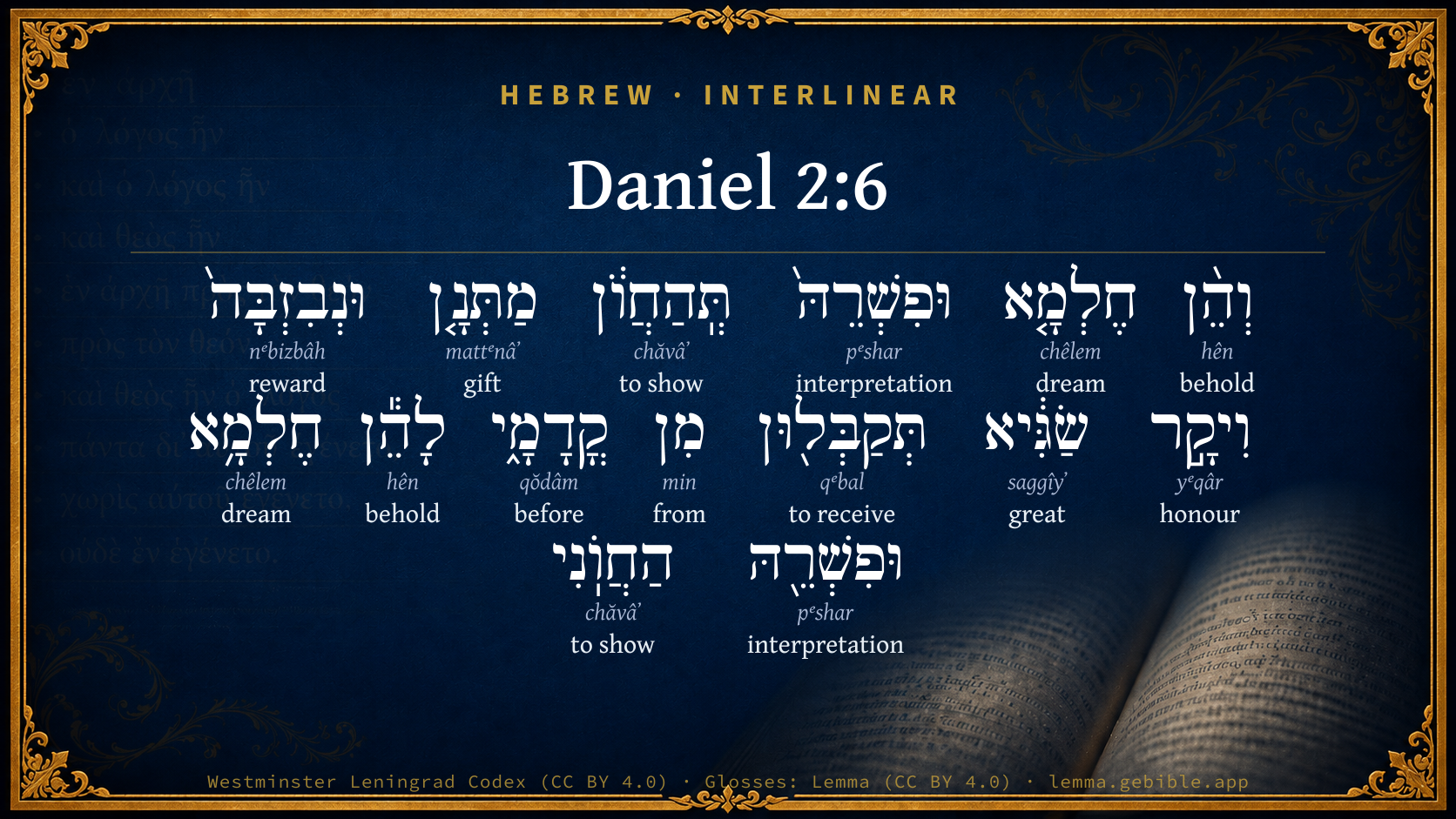
Daniel 2:6

Hebrew (Westminster Leningrad Codex) Daniel 2:6 appears in the Hebrew Old Testament. The text above is from the Westminster Leningrad Codex. Each word links to its Strong’s number, a concise gloss, and parsing drawn from the Open Scriptures Hebrew Bible morphology. Click any word for its full Brown-Driver-Briggs (BDB) entry.
Download image
Cite this verse

Daniel 2:6 (World English Bible). Public Domain. Lemma interlinear Bible study tool, https://lemma.gebible.app/v/daniel/2/6.

Show BibTeX & RIS
BibTeX
RIS
English Translation
But if you show the dream and the interpretation of it, you shall receive of me gifts and rewards and great honor: therefore show me the dream and the interpretation of it.
World English Bible · Public Domain
Highlights
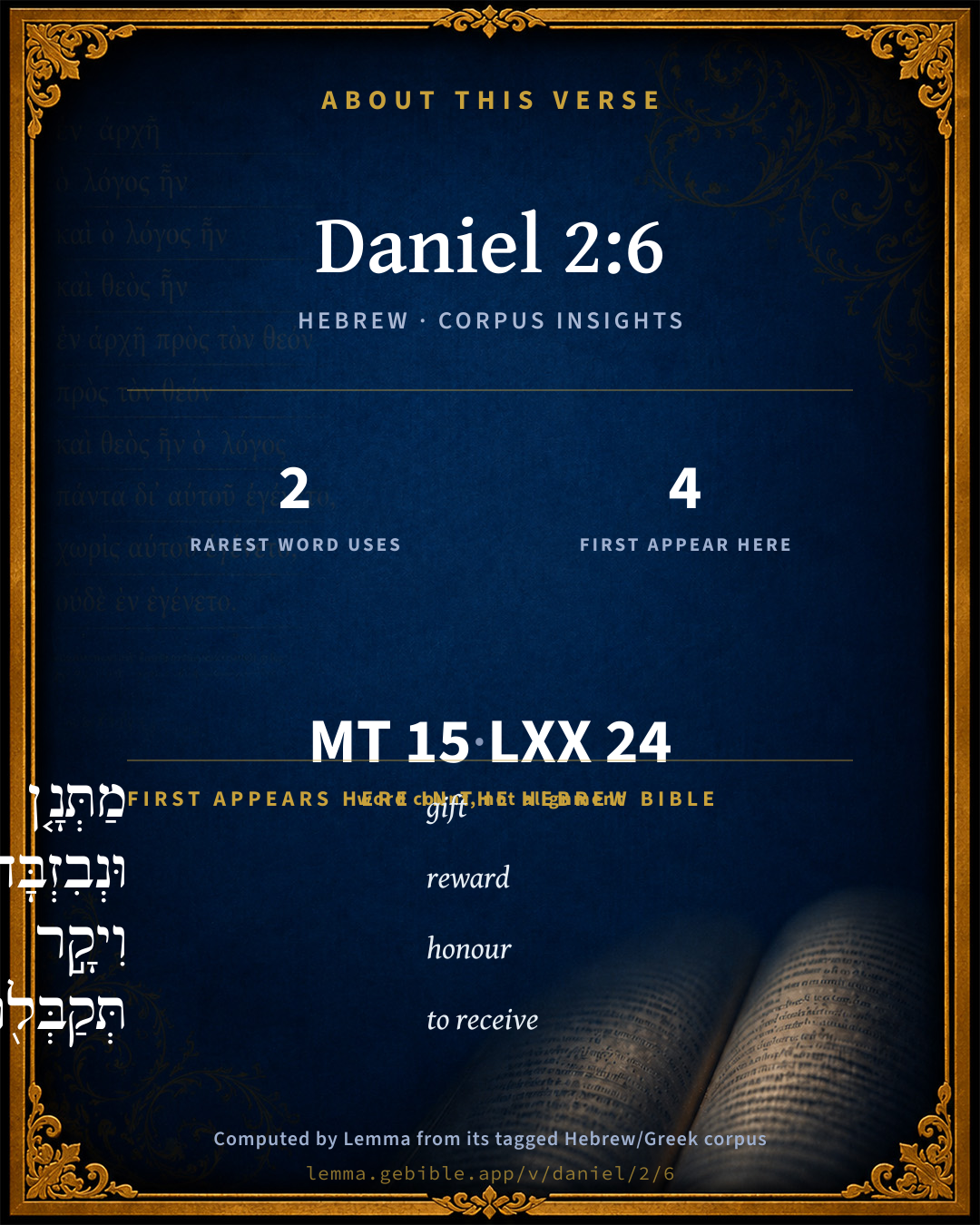
  • 4 first appearances in the Hebrew Bible
Full analysis ↓
Download a study sheet

One document with this verse’s original text, its word-by-word gloss line, the meaning frame, cross-references with their text, attributed commentary, and full source and license credits — printable, and it pastes into notes with its structure intact.

This verse Autodidact and up

Study sheet (.html) Plain text (.txt)

A passage Seminary Student

Up to 50 verses in one chapter. A passage sheet keeps up to 6 commentary sources and 12 cross-references per verse, in the order this page ranks them, and says so on the sheet whenever that leaves anything out. Ask for a single verse and you get the Autodidact verse sheet above.

Everything on this page stays free to read, with no account — the sheet is a download of what is already on screen, not access to it.

Want to remove ads? Support Godless Engineer
Compare translations 3

The same verse in 3 English versions, stacked beneath the original-language interlinear above. Click any original word for its lexicon entry.

Each is an independent rendering of the whole verse — the interlinear is not word-aligned to these translations.

Highlighted words mark where these versions differ — a whole-verse word diff, not a word-by-word alignment.

  • World English Bible Public Domain
    But if you show the dream and the interpretation of it, you shall receive of me gifts and rewards and great honor: therefore show me the dream and the interpretation of it.
  • King James Version Public Domain
    But if ye shew the dream, and the interpretation thereof, ye shall receive of me gifts and rewards and great honour: therefore shew me the dream, and the interpretation thereof.
  • unfoldingWord Literal Text CC BY-SA 4.0
    But if you show the dream and its interpretation, you will receive gifts from me, a reward, and great honor. Therefore show me the dream and its interpretation.”

unfoldingWord Literal Text — © unfoldingWord, licensed CC BY-SA 4.0. Word-aligned USFM3 via Door43 (git.door43.org/unfoldingWord/en_ult).

Versions to compare (up to 4)

3 of 4 selected

Show all 18 translations

Every available English version of this verse, each an independent rendering of the whole verse.

  • World English Bible Public Domain
    But if you show the dream and the interpretation of it, you shall receive of me gifts and rewards and great honor: therefore show me the dream and the interpretation of it.
  • Berean Standard Bible Public Domain
    But if you tell me the dream and its interpretation, you will receive from me gifts and rewards and great honor. So tell me the dream and its interpretation.”
  • Majority Standard Bible Public Domain
    But if you tell me the dream and its interpretation, you will receive from me gifts and rewards and great honor. So tell me the dream and its interpretation.”
  • King James Version Public Domain
    But if ye shew the dream, and the interpretation thereof, ye shall receive of me gifts and rewards and great honour: therefore shew me the dream, and the interpretation thereof.
  • American Standard Version (1901) Public Domain
    But if ye show the dream and the interpretation thereof, ye shall receive of me gifts and rewards and great honor: therefore show me the dream and the interpretation thereof.
  • Revised Version (1885) Public Domain
    But if ye shew the dream and the interpretation thereof, ye shall receive of me gifts and rewards and great honour: therefore shew me the dream and the interpretation thereof.
  • Geneva Bible (1599) Public Domain
    But if yee declare the dreame and the interpretation thereof, ye shall receyue of me gifts and rewardes, and great honour: therefore shewe me the dreame and the interpretation of it.
  • Douay-Rheims (1899) Public Domain
    But if you tell the dream, and the meaning of it, you shall receive of me rewards, and gifts, and great honour: therefore tell me the dream, and the interpretation thereof.
  • Young's Literal Translation Public Domain
    and if the dream and its interpretation ye do shew, gifts, and fee, and great glory ye receive from before me, therefore the dream and its interpretation shew ye me.'
  • Literal Standard Version CC BY-SA 4.0
    and if the dream and its interpretation you show, gifts, and fee, and great glory you receive from before me, therefore the dream and its interpretation you show me.”
  • Unlocked Literal Bible CC BY-SA 4.0
    But if you will tell me the dream and its meaning, you will receive gifts from me, a reward, and great honor. So tell to me the dream and its meaning.”
  • unfoldingWord Literal Text CC BY-SA 4.0
    But if you show the dream and its interpretation, you will receive gifts from me, a reward, and great honor. Therefore show me the dream and its interpretation.”
  • Darby Bible Public Domain
    But if ye shew the dream and its interpretation, ye shall receive of me gifts and rewards and great honour; therefore shew me the dream and its interpretation.
  • World Messianic Bible Public Domain
    But if you show the dream and its interpretation, you will receive from me gifts, rewards, and great honor. Therefore show me the dream and its interpretation.”
  • Webster's Bible Public Domain
    But if ye shall show the dream, and the interpretation of it, ye shall receive of me gifts and rewards and great honor: therefore show me the dream, and the interpretation of it.
  • Free Bible Version CC BY-SA 4.0
    But if you can tell me the dream and its meaning you will receive from me gifts, rewards, and great honor. So tell me the dream and what it means!”
  • Bible in Basic English Public Domain
    But if you make clear the dream and the sense of it, you will have from me offerings and rewards and great honour: so make clear to me the dream and the sense of it.
  • JPS Tanakh (1917) Public Domain
    But if ye declare the dream and the interpretation thereof, ye shall receive of me gifts and rewards and great honour; only declare unto me the dream and the interpretation thereof.'

Literal Standard Version (2020), Covenant Press — licensed CC BY-SA 4.0. Text via the HelloAO Bible API (eBible.org). Unlocked Literal Bible (unfoldingWord) — licensed CC BY-SA 4.0. Text via the HelloAO Bible API (eBible.org). unfoldingWord Literal Text — © unfoldingWord, licensed CC BY-SA 4.0. Word-aligned USFM3 via Door43 (git.door43.org/unfoldingWord/en_ult). Free Bible Version, Dr. Jonathan Gallagher — licensed CC BY-SA 4.0. Text via the HelloAO Bible API (eBible.org).

Word by word

More ways to search: Search by grammar → Find every occurrence → Compare this word →

Practice this passage: Drill this verse → Learn its vocabulary →

וּנְבִזְבָּה֙
nᵉbizbâh
H5023
“and · reward”
Adjective, C + Noun, Common, Feminine, Singular, Absolute
Part of Speech
Adjective + Noun
Type
Common
Gender
Feminine
Number
Singular
State
Absolute
Full BDB Definition

Origin: of uncertain derivation

TWOT: 2844

reward
  1. וְהֵ֨ן hên H2006 “and · behold” Adjective, C + Particle, Demonstrative
  2. חֶלְמָ֤א chêlem H2493 “dream · the” Adjective, N, Common + Particle, Definite Article
  3. וּפִשְׁרֵהּ֙ pᵉshar H6591 “and · interpretation · his” Adjective, C + Noun, Common, Masculine, Singular, Construct + Suffix, Personal, 3rd Person, Masculine, Singular
  4. תְּֽהַחֲוֺ֔ן chăvâʼ H2324 “to show” Adjective, V
  5. מַתְּנָ֤ן mattᵉnâʼ H4978 “gifts” Adjective, N, Common
  6. וִיקָ֣ר yᵉqâr H3367 “and · honour” Adjective, C + Noun, Common, Masculine, Singular, Absolute
  7. שַׂגִּ֔יא saggîyʼ H7690 “great” Adjective, A
  8. תְּקַבְּל֖וּן qᵉbal H6902 “to receive” Adjective, V
  9. מִן min H4481 “from” Adjective, R
  10. קֳדָמָ֑י qŏdâm H6925 “before · me” Adjective, R + Suffix, Personal, 1st Person, Common, Singular
  11. לָהֵ֕ן hên H2006 “behold” Adjective, C
  12. חֶלְמָ֥א chêlem H2493 “dream · the” Adjective, N, Common + Particle, Definite Article
  13. וּפִשְׁרֵ֖הּ pᵉshar H6591 “and · interpretation · his” Adjective, C + Noun, Common, Masculine, Singular, Construct + Suffix, Personal, 3rd Person, Masculine, Singular
  14. הַחֲוֺֽנִי chăvâʼ H2324 “show · me” Adjective, V + Suffix, Personal, 1st Person, Common, Singular

About this verse

These counts appear in no published source. They are computed here, from the morphology-tagged text and Lemma’s own curated glosses. What Lemma adds →

15
words
11
distinct lemmas
Prophets
section

Notable vocabulary

The rarest word here is וּנְבִזְבָּה֙ reward H5023 — appearing just 2 times in the whole Hebrew Bible.

First appearance in Scripture

These words make their first canonical appearance in the Hebrew Bible here:

  • מַתְּנָ֤ן gift H4978
  • וּנְבִזְבָּה֙ reward H5023
  • וִיקָ֣ר honour H3367
  • תְּקַבְּל֖וּן to receive H6902

Shared distinctive vocabulary

וּנְבִזְבָּה֙ reward H5023 occurs in 2 verses of the Hebrew Bible. Also found in:

Grammatical profile

  • 4 nouns
  • 8 adjectives
  • 3 particles

Repetition

Words recur within this verse — often emphatic in Hebrew:

  • וְהֵ֨ן behold H2006 ×2
  • חֶלְמָ֤א dream H2493 ×2
  • וּפִשְׁרֵהּ֙ interpretation H6591 ×2
  • תְּֽהַחֲוֺ֔ן to show H2324 ×2

Hebrew & Septuagint length

In English translation the verse runs 32 words from the Hebrew and 33 from the Septuagint (LXX English) — closely comparable.

A rough comparison of the two English renderings, which tokenize alike — not a word-level alignment.

Word counts can differ between the Hebrew and the Greek without any difference in meaning — e.g. the Hebrew direct-object marker אֵת has no separate Greek word, and Greek often adds the article ὁ.

In the original languages it is 15 Hebrew tokens and 24 Greek tokens — but the two are counted differently (Hebrew bundles its prefixes and suffixes into one token; the Greek is in lemma form), so that isn’t a like-for-like length.

Cross-references

8

Topical passages linked to Daniel 2:6 in the Treasury of Scripture Knowledge — connected by theme and wording, ordered by reader-vote popularity; previews shown in the World English Bible.

  • Daniel 5:7 The king cried aloud to bring in the enchanters, the Chaldeans, and the soothsayers. The king spoke and said to the wise men of Babylon, Whoever shall read this writing, and show me the interpretation of it, shall be clothed with purple, and have a chain of gold about his neck, and shall be the third ruler in the kingdom.
  • Daniel 2:48 Then the king made Daniel great, and gave him many great gifts, and made him to rule over the whole province of Babylon, and to be chief governor over all the wise men of Babylon.
  • Daniel 5:29 Then commanded Belshazzar, and they clothed Daniel with purple, and put a chain of gold about his neck, and made proclamation concerning him, that he should be the third ruler in the kingdom.
  • Numbers 22:7 The elders of Moab and the elders of Midian departed with the rewards of divination in their hand; and they came to Balaam, and spoke to him the words of Balak.
  • Numbers 22:17 for I will promote you to very great honor, and whatever you say to me I will do. Please come therefore, and curse this people for me.
  • Numbers 22:37 Balak said to Balaam, Didn't I earnestly send to you to call you? why didn't you come to me? am I not able indeed to promote you to honor?
  • Numbers 24:11 Therefore now flee you to your place: I thought to promote you to great honor; but, behold, Yahweh has kept you back from honor.
  • Daniel 5:16–17 But I have heard of you, that you can give interpretations, and dissolve doubts; now if you can read the writing, and make known to me the interpretation of it, you shall be clothed with purple, and have a chain of gold about your neck, and shall be the third ruler in the kingdom.

Cross-references courtesy of OpenBible.info (CC BY 4.0).

Hebrew and Greek witnesses Masoretic Hebrew ↔ Greek Septuagint

The same verse in the two great witnesses to the Old Testament, shown verse-for-verse.

These are two independent witnesses, not word-aligned to each other, and the Septuagint is shown in lemma (dictionary) form.

Hebrew Daniel 2:6 Masoretic · Westminster Leningrad Codex

וְהֵ֨ן חֶלְמָ֤א וּפִשְׁרֵהּ֙ תְּֽהַחֲוֺ֔ן מַתְּנָ֤ן וּנְבִזְבָּה֙ וִיקָ֣ר שַׂגִּ֔יא תְּקַבְּל֖וּן מִן קֳדָמָ֑י לָהֵ֕ן חֶלְמָ֥א וּפִשְׁרֵ֖הּ הַחֲוֺֽנִי

But if you show the dream and the interpretation of it, you shall receive of me gifts and rewards and great honor: therefore show me the dream and the interpretation of it.

World English Bible · Public Domain

Greek LXX Daniel 2:6 Septuagint · lemma form

ἐάν δέ ὁ ἐνύπνιον διασαφέω ἐγώ καί ὁ οὗτος σύγκρισις ἀναἀγγέλλω λαμβάνω δόμα παντοῖος καί δοξάζω ὑπό ἐγώ δηλόω ἐγώ ὁ ἐνύπνιον καί κρίνω

But if you⌃ make known to me the dream, and the interpretation thereof, you⌃ shall receive of me gifts and presents and much honor: only tell me the dream, and the interpretation thereof.

LXX2012 (modern English Septuagint) · Public Domain

On this verse, The Pulpit Commentary discusses the Septuagint’s reading. Read the note in Commentary ↓

Hebrew: Westminster Leningrad Codex (CC BY 4.0). Greek: Septuagint (public domain); English from LXX2012 (modern English Septuagint) (Public Domain). How the Septuagint differs from the Hebrew →

Commentary

Notes on Daniel 2:6 from classic Christian and Jewish commentators (each source and its license shown beneath its notes). The classic Christian expositions comment on the surrounding passage and are grouped to its opening verse, so a note may address several verses; the Jewish commentaries on the Tanakh (Rashi and others) are per-verse, so they appear only where the commentator wrote on this verse.

Lemma curates 59 commentaries, every one of them public domain or Creative Commons licensed, each selected and text-cleaned for this edition rather than reprinted as found. About our sources →

Trapp's Complete Commentary

John Trapp

Dan 2:6 But if ye shew the dream, and the interpretation thereof, ye shall receive of me gifts and rewards and great honour: therefore shew me the dream, and the interpretation thereof.

Ver. 6. He shall receive of me gifts and reward.] This was what they gaped after, but missed, and therefore out of envy called not Daniel and his companions, as some think, lest they should share with them.

And great honour.] Great learning deserveth great honour. Aeneas Sylvius was wont to say that popular men should esteem it as silver, noblemen as gold, princes prize it as pearls.

John Trapp, A Commentary or Exposition upon All the Books of the Old and New Testament (1647–1656) — public domain. Text from a community e-Sword module.

Ibn Ezra

Rabbi Abraham ibn Ezra

[Daniel 2:6] V'hen... u'nevizbah (וְהֵן... וּנְבִזְבָּה - But if... and presents/rewards): U'nevizbah [Means] a gift (minchah - מִנְחָה) and a present (doron - דּוֹרוֹן).

Ibn Ezra on the Tanakh — English translations: “Sefaria Community Translation” (CC0 1.0 (public-domain dedication)); “Yalkut, Sifsei Chachomim Chumash, Metsudah Publications, 2009” (CC BY 4.0); and “Commentary of Ibn Ezra on Isaiah - trans. by M. Friedlander, 1873” (public domain). Text via Sefaria.

Jamieson, Fausset & Brown

Robert Jamieson, A. R. Fausset & David Brown

rewards--literally, "presents poured out in lavish profusion."

Jamieson, Fausset & Brown — Commentary Critical and Explanatory on the Whole Bible (1871) — public domain (CC PDM 1.0). Text via the HelloAO Bible API.

John Calvin's Commentaries

Here the king, on the other hand, desires to entice them by the hope of gain, to apply themselves to narrate his dream. He had already attempted to strike them with horror, that even if they are unwilling he may wrest the narration of the dream from them, as well as its interpretation. Meanwhile, if they could be induced by flattery, he tries this argument upon them; for he promises a gift, and reward, and honor, that is, he promises a large remuneration if they narrated his dream, and were faithful interpreters. Hence we gather, what all history declares, that the Magi made a gain of their predictions and guesses. The wise men of the Indies, being frugal and austere in their manner of living, were not wholly devoted to gain; for they are known to have lived without any need of either money, or furniture, or anything else. They were content with roots, and had no need of clothing, slept upon the ground, and were thus free from avarice. But the Chaldeans, we know, ran hither and thither to obtain money from the simple and credulous. Hence the king here speaks according to custom when he promises a large reward. We must remark here, how the Chaldeans scattered their prophecies for the sake of gain; and when knowledge is rendered saleable, it is sure to be adulterated with many faults. As when Paul speaks of corruptors of the Gospel, he says, — they trafficked in it, (2 Corinthians 2:7,) because when a profit is made, as we have previously said, even honorable teachers must necessarily degenerate and pervert all sincerity by their lying. For where avarice reigns, there is flattery, servile obsequiousness, and cunning of all kinds, while truth is utterly extinguished. Whence it is not surprising if the Chaldeans were so inclined to deceit, as it became natural to them through the pursuit of gain and the lust for wealth. Some honest teachers may receive support from the public treasury; but, as we have said, when any one is drawn aside by lucre, he must necessarily pervert and deprave all purity of doctrine. And from this passage we gather, further, the anxiety of the king, as he had no wish to spare expense, if by this means he could click the interpretation of his dream from the Chaldeans; all the while he is furiously angry with them, because he does not obtain what the offered reward ought to procure. It now follows —

John Calvin's Commentaries (1540-1563) — public domain. Text from the Calvin Translation Society English edition (1840s-50s) via the Christian Classics Ethereal Library (ccel.org). Calvin's coverage is partial (roughly two-thirds of the Bible); uncommented books and verses are honest gaps, never fabricated. The 19th-century editor's footnotes and remarks are omitted so the notes are faithfully Calvin's own voice.

Ellicott's Commentary for English Readers

(6) Rewards.—A word of uncertain meaning. It occurs again Dan_5:17, and probably is correctly rendered.

A Bible Commentary for English Readers, edited by Charles John Ellicott (1878–1897) — public domain. Text from a community e-Sword module.

The Cambridge Bible for Schools and Colleges

gen. ed. J. J. S. Perowne

6. shew (twice)] declare. So Dan_2:7; Dan_2:9-11; Dan_2:16; Dan_2:24; Dan_2:27; Dan_4:2; Dan_5:7; Dan_5:12; Dan_5:15.

rewards] A rare word, probably of Persian origin (according to Andreas, in the Glossary in Marti’s Gramm. der Bibl.-Aram. Sprache, properly, tribute, present), found otherwise only in Dan_5:17, where it stands in a similar context.

The Cambridge Bible for Schools and Colleges (gen. ed. J. J. S. Perowne; Cambridge University Press, 1878–1918) — public domain. Text from a community e-Sword module.

John Gill's Exposition

But if ye show the dream, and the interpretation thereof,.... Which he was extremely intent upon to know; and therefore makes use of every way to obtain it, first by threatenings, to terrify, and next by promises, to allure:

ye shall receive of me gifts, and rewards, and great honour; gold, silver, jewels, rich apparel, houses, lands, and great promotion to some of the highest places of honour, trust, and profit, in the kingdom, as Daniel afterwards had:

therefore show me the dream, and the interpretation thereof; at once, directly, without any more ado; for the king was impatient of it.

John Gill's Exposition of the Whole Bible (1746–1763) — public domain (CC PDM 1.0). Text via the HelloAO Bible API.

Albert Barnes' Notes on the Bible

But if ye show the dream - If you show what the dream was.

And the interpretation thereof - What it signifies. That is, they were so to state the dream that Nebuchadnezzar would recognize it; and they were to give such an explanation of it as would commend itself to his mind as the true one. On this last point he would doubtless rely much on their supposed wisdom in performing this duty, but it would seem clear, also, that it was necessary that the interpretation should be seen to be a “fair” interpretation, or such as would be “fairly” implied in the dream. Thus, when Daniel made known the interpretation, he saw at once that it met all the features of the dream, and he admitted it to be correct. So also when Daniel explained the handwriting on the wall to Belshazzar, he admitted the justness of it, and loaded him with honors, Dan 5:29. So when Joseph explained the dreams of Pharaoh, he at once saw the appropriateness of the explanation, and admitted it to be correct Gen 41:39-45; and so in the case above referred to (notes on Dan 2:2), of Astyages respecting the dreams of his daughter (Herod. 1, cvii.; cviii.), he at once saw that the interpretation of the dreams proposed by the Magi accorded with the dreams, and took his measures accordingly.

Ye shall receive of me gifts, and rewards, and great honor - Intending to appeal to their highest hopes to induce them, if possible, to disclose the meaning of the dream. He specifics no particular rewards, but makes the promise general; and the evident meaning is, that, in such a case, he would bestow what it became a monarch like him to give. That the usual rewards in such a case were such as were adapted to stimulate to the most vigorous exertions of their powers, may be seen from the honor which he conferred on Daniel when he made known the dream Dan 2:48, and from the rewards which Belshazzar conferred on Daniel for making known the interpretation of the writing on the wall Dan 5:29 : “Then commanded Belshazzar, and they clothed Daniel with scarlet, and put a chain of gold about his neck, and made a proclamation concerning him, that he should be the third ruler in the kingdom.” Compare Est 5:11; Est 6:7-9.

Albert Barnes' Notes on the Bible (1834–1885) — public domain. Text from a community e-Sword/MySword module.

Matthew Poole's English Annotations

As I threatened you with death for not doing, I promise you rewards and honour if ye perform it. This is in the power of princes, as they think, but all this would not do; therefore they are still where they were, they answered the king again.

Matthew Poole's English Annotations on the Holy Bible (1683–1685) — public domain. Text from a community e-Sword/MySword module.

Whedon's Commentary on the Bible

Daniel D. Whedon

6-9. Gifts are promised to anyone who can tell the dream and its meaning, while the strong affirmation of the magicians that they could give a true interpretation if they only knew what the dream was is characterized as lying and corrupt words used simply with the desire to “buy the time” and postpone punishment for their false pretenses until perhaps the king might relent, or a more lucky day for them should come. But the king affirms that he will not relent; the threat which had gone forth from him was irrevocable, and if they failed to do what he demanded there was but one decree or law for them — the sentence, or punishment, of death.

Daniel D. Whedon (gen. ed.), Commentary on the Old and New Testaments (1874–1909) — public domain. Text from a community e-Sword module.

The Pulpit Commentary

But if ye show the dream, and the interpretation thereof, ye shall receive of me gifts and rewards and great honour: therefore show me the dream, and the interpretation thereof. The Septuagint Version is "If ye will show me the dream, and tell me its interpretation, ye shall receive every sort (pantoia) of gifts, and be honoured by me: show me the dream, and judge." There are indications of differences in the text, which are considered below. Theodotion agrees with the Massoretic in its rendering of this verse. The Peshitta also manifests no serious difference. All these older ver sions render it doubtful whether nebizba was part of the original text. But if ye show the dream, and the interpretation thereof, ye shall receive of me gifts and rewards a n d great honour. Ewald would conjoin with this verse the latter part of the verse preceding, with considerable justification. Like the latter part of the previous verse, it is to be taken as the summation of a long argument, in which threats anti promises would bear a large part, probably both heightening as they failed to produce tire effect required of making the soothsayers reproduce to Nebuchadnezzar his dream. Now the acme is reached on the one hand, a death of torture and infamy is threatened; on the other band, in the verse before us, "gifts, rewards, and great honour." The king is eager to have his dream interpreted, but he has taken his stand before he will listen to the interpretation, they must afford him evidence that they can interpret correctly this dream, by reproducing it to him. One of the words here has been used by Berthohlt as evidence that the Book of Daniel originated in the days of the Maccabees, when Greek was largely spoken. The word translated reward" in our version is nebizba; this, it was argued by Bertholdt, is nomisma, m becoming b a not infrequent commutation. In support of this, if we take nomisma as meaning "coined money," this would make a distinction between this word and matnan, the more ordinary word for "a girt. " Jephet-ibn-Ali translates in accordance with this meaning: "I will give you raiment and dinars," he makes Nebuchadnezzar say. Yet this view is now abandoned by all critics, and however many alleged Greek words are found in Daniel, this is never now brought forward as one of them. Lexicographers are practically unanimous in rejecting this derivation. There are two other derivations, one making it a palpel form of the zwb with a n pre-formative which was Gesenius"s view in his "Thesaurus." He later abandoned this view, and maintained that it was connected with some Persian root. Winer maintains the former of these views, and Furst the latter. As a Persian word, it is supposed to prove the late date of Daniel. It does seem somewhat strange logic to argue, from the presence of Persian words in a document, that therefore it was written late in the Greek period. The prior question presents itself Is the word Persian, Greek, or Aramaic, really a part of the original text of Daniel? In regard to this the Septuagint Version is of importance. Its rendering of this clause is, as we have seen, "But if ye shall show me the dream, and tell me the interpretation thereof, ye shall receive all manner of gifts, and shall be honoured by me." This interpretation implies a different text the word nebizba disappears from the text altogether, for no one would translate it pantoia; evidently the translator had before him some combination of col, "all." The combination matnan nebizba occurs in the Targum in Jer_40:5, therefore, had it been present, the translator would have been aware of its meaning. Theodotion renders it dwrea) If the phrase occurred elsewhere, there would easily be a motive to introduce the word nebizba, but there seems none to substitute for it another word altogether; certainly k and n are not unfrequently confounded, and a defective l might be read as a b. It would not be difficult to reproduce a Hebrew sentence, the rendering of which would require pantoia. This much is clear nebizba was not before the Septuagint translator. It is further to be observed that the Septuagint translator has had before him, not the noun yeqar, "honour," but the verb in the passive or ethpael. These, however, are not all the points where the Septuagintal text must have differed from the text we have received from the Massoretes. The adjective sagi," great," occurs in the Authorized Version, but is not represented in the Septuagint. The order of the Greek words suggests a different order in the original Aramaic. Other things being equal, the strutter a reading, the more likely it is to be the original reading. It is clear that this advantage is with the Septuagint reading. If there were any likelihood of certain words being omitted from any probable cause as homoioteleuton, it would be different. On the other hand, the addition of a kind which is frequently seen, the more recent word nebizba is put alongside its more ancient equivalents. In the other case, the adjective sagi, "great," is inserted, as frequently happens, with a view of heightening the effect. Another explanation may be suggested. We know the Aramaic docquets on the back of the contract tablets are written in a script resembling Phoenician characters. If the original manuscripts were written at the date assigned by tradition, then it would be written in this style of letter. In it we find that and m were liable to be mistaken, as also; and g; we should then have n (minni), "from me," as a possible reading which had been rot, read by some Palestinian scribe into ygc (sagi), great," and the a added to complete the word. The case is only a familiar case of doublets. When we have further ymdqAmi, "from me," the change of the preceding is thus in a sense necessitated. This may be regarded as an indication of age, as the square character had begun at least a century before Christ (Driver," Samuel," p. 21.). This leaves but little time for modifications and blunders of penmanship between this and the critical date of Daniel. The latter clause of this verse shows us another variation between the Massoretic text and that lying behind the Septuagint. The Massoretic recension is well represented in the Authorized Version. Therefore show me the dream, and the interpretation thereof. The version of the Septuagint indicates a different reading, and has a different point, "Declare to me the dream, and judge." According to the Massoretic reading, the king merely repeats his demands, the only reference to the preceding promises and threatenings being in the conjunction hel; (lahen), "therefore." Whereas the main reference of the clause, according to the Septuagint, is to the immediately preceding promises, "Show me the dream, and judge if I will do as I have said." Another supposition possible is that there has been a transposition. In the very next verse hwj (hevah) is represented by krinw in that case it may mean "interpret," the rendering then would be, "Show me the dream and interpret," and represent some part of the verb r only there is the awkwardness of using the same word as equivalent to two different Aramaic words in contiguous verses. The difference is not of great importance; the king is eager to get the magicians to tell him his dream and its interpretation, but, having commenced the experiment as to their powers, he will not allow himself to be driven from it. Before leaving this verse, we must note the presence of certain signs of old date in the Aramaic of the passage. First, the word hen, "if," is not used in the Targums; it is not in Levy"s Dictionary; neither Gesenius nor Furst gives any non-Biblical reference for the use of the word In the same way, its derivative hel; (lahen), "therefore," is equally peculiar to Biblical Aramaic. Particles are good notes of age, as they are less liable to change than nouns substantive.

The Pulpit Commentary (1880–1919), ed. H.D.M. Spence-Jones & Joseph S. Exell — public domain. Text from a community e-Sword module.

Rashi

Rabbi Shlomo Yitzchaki (Rashi)

But if [as translated,] But if.

and lavish presents [as translated,] presents.

but [as translated,] but.

tell me [as translated,] tell me.

Rashi on the Tanakh — English translations: “The Judaica Press complete Tanach with Rashi, translated by A. J. Rosenberg” (CC BY 4.0); “Pentateuch with Rashi's commentary by M. Rosenbaum and A.M. Silbermann, 1929-1934” (public domain); “The Metsudah Tanach series, Lakewood, N.J” (CC BY 4.0); and “The Book of Joshua, Metsudah Publications, 1997” (CC BY 4.0). Text via Sefaria.

Lesson kit

Teaching starters — assembled from the data on this page, not authored interpretation. Every prompt links to the verse data it draws on. Edit before teaching.

Daniel, in the Prophets, opens this verse with 15 words (11 distinct Hebrew lemmas). Its most distinctive word is nᵉbizbâh (“reward”). A historical commentator’s framing appears above. Read the whole chapter for the surrounding context.

Discussion questions

  1. What does “reward” (nᵉbizbâh) contribute to the verse as a whole?
  2. 4 words make their first appearance in Scripture here. What does this debut establish?
  3. How does Daniel 5:17, which shares the word «reward», read alongside this verse?
  4. What does the repetition of “behold” (2× in this one verse) do in this verse?
  5. These translations render this verse differently. What is at stake in choosing one wording over another?
  6. Compare how Trapp's Complete Commentary and Ibn Ezra read this verse. Where do they agree or differ?

Things to notice

Reading settings

Reading text

Shown beneath each verse's original-language words.

Old Testament
Old Testament edition

Read the OT as the Masoretic Hebrew (MT) or the Greek Septuagint (LXX).

English shown for the Greek Septuagint (in the Hebrew ↔ Greek comparison).

Comparing translations? Open the Compare panel on any verse page to stack up to four side by side.