
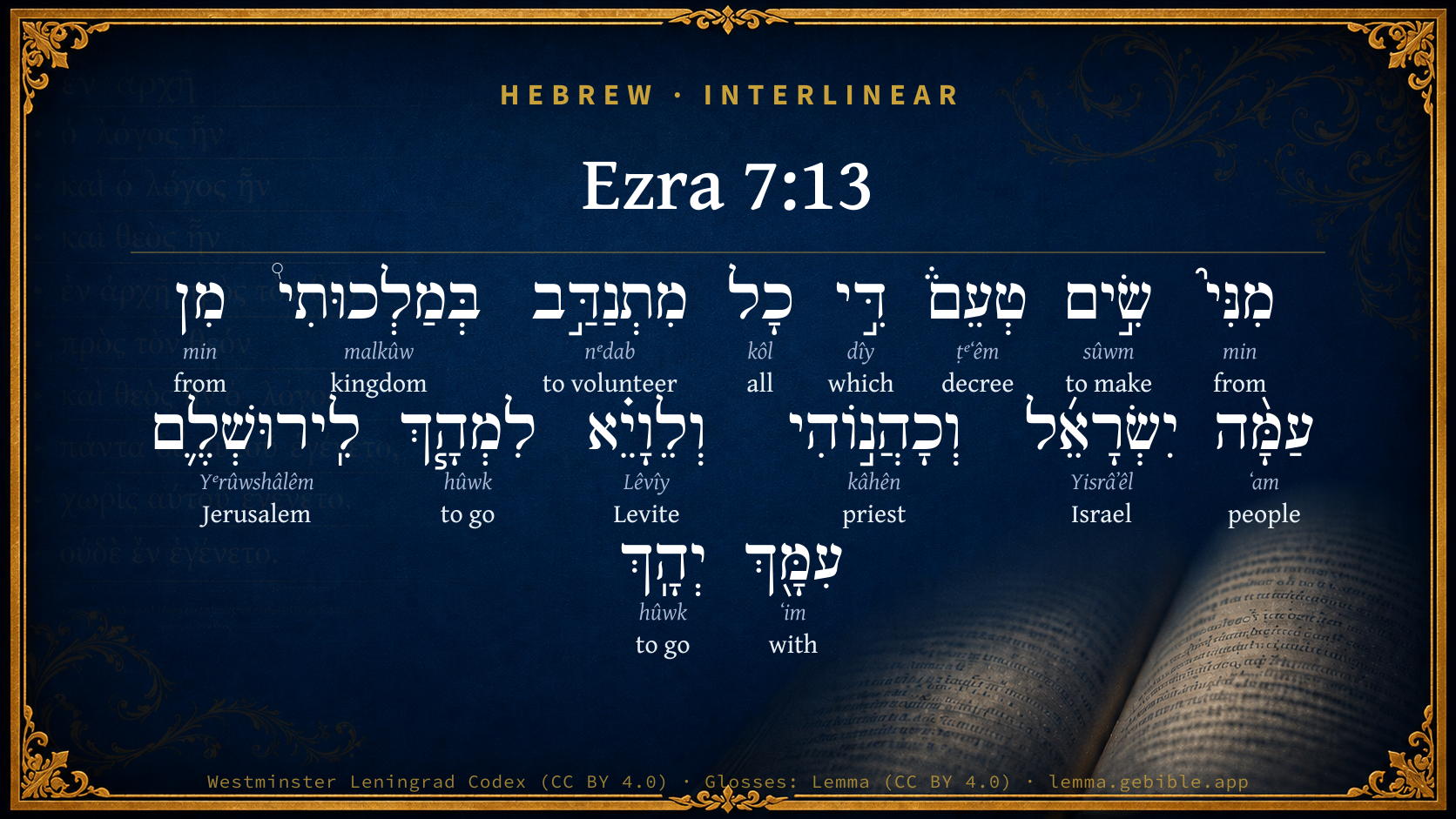
Ezra 7:13

Hebrew (Westminster Leningrad Codex) Ezra 7:13 appears in the Hebrew Old Testament. The text above is from the Westminster Leningrad Codex. Each word links to its Strong’s number, a concise gloss, and parsing drawn from the Open Scriptures Hebrew Bible morphology. Click any word for its full Brown-Driver-Briggs (BDB) entry.
Download image
Cite this verse

Ezra 7:13 (World English Bible). Public Domain. Lemma interlinear Bible study tool, https://lemma.gebible.app/v/ezra/7/13.

Show BibTeX & RIS
BibTeX
RIS
English Translation
I make a decree, that all those of the people of Israel, and their priests and the Levites, in my realm, who are minded of their own free will to go to Jerusalem, go with you.
World English Bible · Public Domain
Highlights
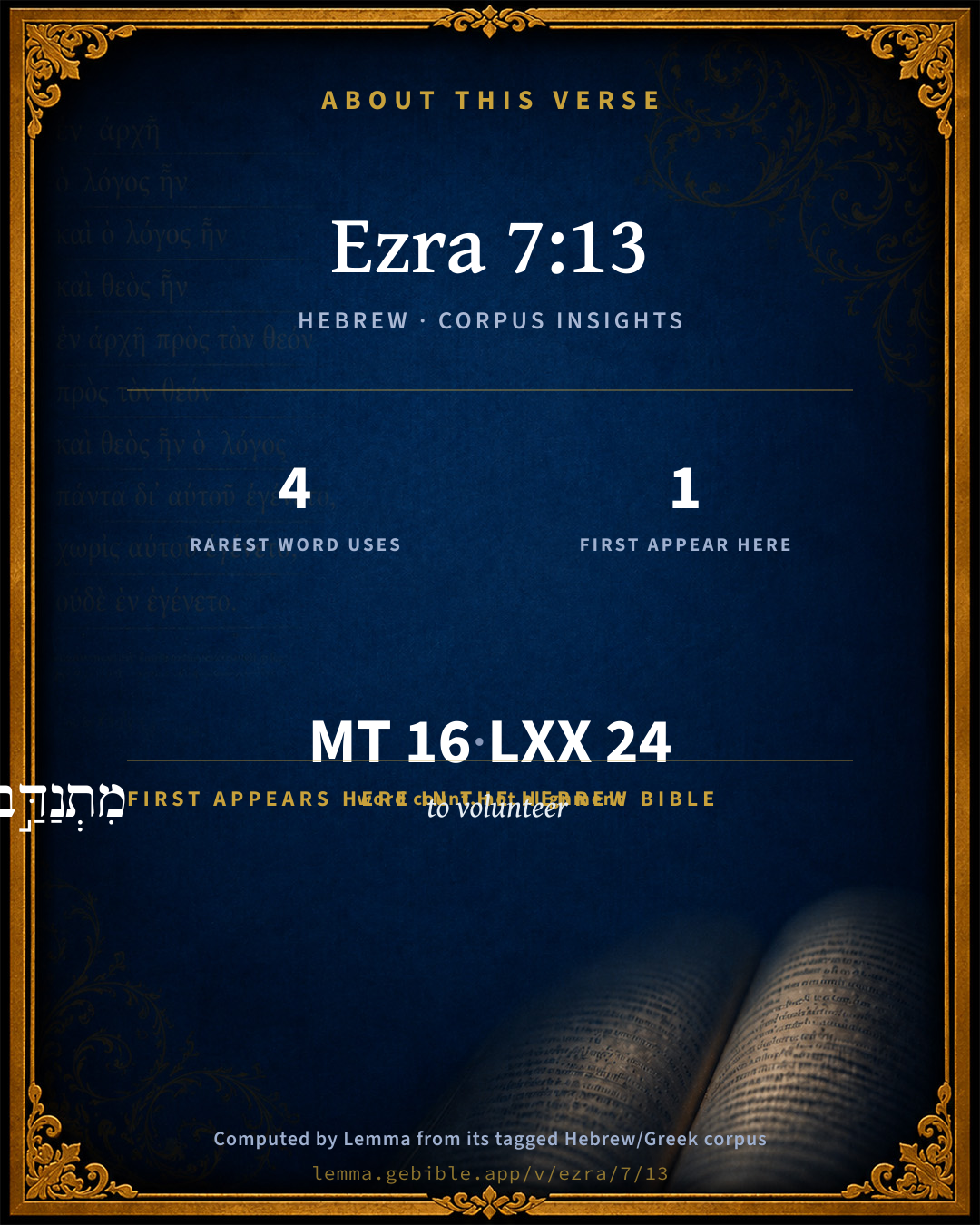
  • 1 first appearance in the Hebrew Bible
Full analysis ↓
Download a study sheet

One document with this verse’s original text, its word-by-word gloss line, the meaning frame, cross-references with their text, attributed commentary, and full source and license credits — printable, and it pastes into notes with its structure intact.

This verse Autodidact and up

Study sheet (.html) Plain text (.txt)

A passage Seminary Student

Up to 50 verses in one chapter. A passage sheet keeps up to 6 commentary sources and 12 cross-references per verse, in the order this page ranks them, and says so on the sheet whenever that leaves anything out. Ask for a single verse and you get the Autodidact verse sheet above.

Everything on this page stays free to read, with no account — the sheet is a download of what is already on screen, not access to it.

Want to remove ads? Support Godless Engineer
Compare translations 3

The same verse in 3 English versions, stacked beneath the original-language interlinear above. Click any original word for its lexicon entry.

Each is an independent rendering of the whole verse — the interlinear is not word-aligned to these translations.

Highlighted words mark where these versions differ — a whole-verse word diff, not a word-by-word alignment.

  • World English Bible Public Domain
    I make a decree, that all those of the people of Israel, and their priests and the Levites, in my realm, who are minded of their own free will to go to Jerusalem, go with you.
  • King James Version Public Domain
    I make a decree, that all they of the people of Israel, and of his priests and Levites, in my realm, which are minded of their own freewill to go up to Jerusalem, go with thee.
  • unfoldingWord Literal Text CC BY-SA 4.0
    from me is set a decree that everyone in my kingdom who freely offers to go to Jerusalem with you, from the people ‘Israel’ and its priests and the Levites, may go.

unfoldingWord Literal Text — © unfoldingWord, licensed CC BY-SA 4.0. Word-aligned USFM3 via Door43 (git.door43.org/unfoldingWord/en_ult).

Versions to compare (up to 4)

3 of 4 selected

Show all 18 translations

Every available English version of this verse, each an independent rendering of the whole verse.

  • World English Bible Public Domain
    I make a decree, that all those of the people of Israel, and their priests and the Levites, in my realm, who are minded of their own free will to go to Jerusalem, go with you.
  • Berean Standard Bible Public Domain
    I hereby decree that any volunteers among the Israelites in my kingdom, including the priests and Levites, may go up with you to Jerusalem.
  • Majority Standard Bible Public Domain
    I hereby decree that any volunteers among the Israelites in my kingdom, including the priests and Levites, may go up with you to Jerusalem.
  • King James Version Public Domain
    I make a decree, that all they of the people of Israel, and of his priests and Levites, in my realm, which are minded of their own freewill to go up to Jerusalem, go with thee.
  • American Standard Version (1901) Public Domain
    I make a decree, that all they of the people of Israel, and their priests and the Levites, in my realm, that are minded of their own free will to go to Jerusalem, go with thee.
  • Revised Version (1885) Public Domain
    I make a decree, that all they of the people of Israel, and their priests and the Levites, in my realm, which are minded of their own free will to go to Jerusalem, go with thee.
  • Geneva Bible (1599) Public Domain
    I haue giuen commandement, that euery one, that is willing in my kingdome of the people of Israel, and of the Priestes, and Leuites to goe to Ierusalem with thee, shall goe.
  • Douay-Rheims (1899) Public Domain
    It is decreed by me, that all they of the people of Israel, and of the priests and of the Levites in my realm, that are minded to go into Jerusalem, should go with thee.
  • Young's Literal Translation Public Domain
    By me hath been made a decree that every one who is willing, in my kingdom, of the people of Israel and of its priests and Levites, to go to Jerusalem with thee, doth go;
  • Literal Standard Version CC BY-SA 4.0
    By me has been made a decree that everyone who is willing, in my kingdom, of the people of Israel and of its priests and Levites, to go to Jerusalem with you, go;
  • Unlocked Literal Bible CC BY-SA 4.0
    I am ordering that anyone from Israel in my kingdom along with their priests and Levites who desires to go to Jerusalem, may go with you.
  • unfoldingWord Literal Text CC BY-SA 4.0
    from me is set a decree that everyone in my kingdom who freely offers to go to Jerusalem with you, from the people ‘Israel’ and its priests and the Levites, may go.
  • Darby Bible Public Domain
    I have given orders that all they of the people of Israel, and of their priests and the Levites, in my realm, who are disposed to go to Jerusalem, go with thee.
  • World Messianic Bible Public Domain
    I make a decree that all those of the people of Israel and their priests and the Levites in my realm, who intend of their own free will to go to Jerusalem, go with you.
  • Webster's Bible Public Domain
    I make a decree, that all they of the people of Israel, and of his priests and Levites, in my realm, who are disposed of their own free will to go to Jerusalem, go with thee.
  • Free Bible Version CC BY-SA 4.0
    I hereby issue this decree: Any of the people of Israel or their priests or Levites in my kingdom who voluntarily decide to go to Jerusalem with you may do so.
  • Bible in Basic English Public Domain
    And now it is my order that all those of the people of Israel, and their priests and Levites in my kingdom, who are ready and have a desire to go to Jerusalem, are to go with you.
  • JPS Tanakh (1917) Public Domain
    I make a decree, that all they of the people of Israel, and their priests and the Levites, in my realm, that are minded of their own free will to go with thee to Jerusalem, go.

Literal Standard Version (2020), Covenant Press — licensed CC BY-SA 4.0. Text via the HelloAO Bible API (eBible.org). Unlocked Literal Bible (unfoldingWord) — licensed CC BY-SA 4.0. Text via the HelloAO Bible API (eBible.org). unfoldingWord Literal Text — © unfoldingWord, licensed CC BY-SA 4.0. Word-aligned USFM3 via Door43 (git.door43.org/unfoldingWord/en_ult). Free Bible Version, Dr. Jonathan Gallagher — licensed CC BY-SA 4.0. Text via the HelloAO Bible API (eBible.org).

Word by word

More ways to search: Search by grammar → Find every occurrence → Compare this word →

Practice this passage: Drill this verse → Learn its vocabulary →

מִתְנַדַּ֣ב
nᵉdab
H5069
“volunteering”
Adjective, V
Part of Speech
Adjective
Full BDB Definition

Origin: corresponding to H5068

TWOT: 2848

to volunteer, offer freely - (Ithpael) - to volunteer - to give freely, offer freely
  1. מִנִּי֮ min H4481 “from · me” Adjective, R + Suffix, Personal, 1st Person, Common, Singular
  2. שִׂ֣ים sûwm H7761 “to make” Adjective, V, Plural
  3. טְעֵם֒ ṭᵉʻêm H2942 “decree” Adjective, N, Common
  4. דִּ֣י dîy H1768 “which” Adjective, T
  5. כָל kôl H3606 “all of” Adjective, N, Common
  6. בְּמַלְכוּתִי֩ malkûw H4437 “in/at · kingdom · my” Adjective, R + Noun, Common, Feminine, Singular, Construct + Suffix, Personal, 1st Person, Common, Singular
  7. מִן min H4481 “from” Adjective, R
  8. עַמָּ֨ה ʻam H5972 “people · the” Adjective, N, Common + Particle, Definite Article
  9. יִשְׂרָאֵ֜ל Yisrâʼêl H3479 “Israel” Adjective, N
  10. וְכָהֲנ֣וֹהִי kâhên H3549 “and · priests · his” Adjective, C + Noun, Common, Masculine, Plural, Construct + Suffix, Personal, 3rd Person, Masculine, Singular
  11. וְלֵוָיֵ֗א Lêvîy H3879 “and · Levites · the” Adjective, C + Noun, Gentilic, Masculine, Plural, Determined + Particle, Definite Article
  12. לִמְהָ֧ךְ hûwk H1946 “to go” Adjective, R + Verb, Qal, Infinitive Construct
  13. לִֽירוּשְׁלֶ֛ם Yᵉrûwshâlêm H3390 “to/for · Jerusalem” Adjective, R + Noun, Proper
  14. עִמָּ֖ךְ ʻim H5974 “with · you” Adjective, R + Suffix, Personal, 2nd Person, Masculine, Singular
  15. יְהָֽךְ hûwk H1946 “to go” Adjective, V

About this verse

These counts appear in no published source. They are computed here, from the morphology-tagged text and Lemma’s own curated glosses. What Lemma adds →

16
words
14
distinct lemmas
Historical
section

Notable vocabulary

The rarest word here is מִתְנַדַּ֣ב to volunteer H5069 — appearing just 4 times in the whole Hebrew Bible.

First appearance in Scripture

This word makes its first canonical appearance in the Hebrew Bible here:

  • מִתְנַדַּ֣ב to volunteer H5069

Shared distinctive vocabulary

מִתְנַדַּ֣ב to volunteer H5069 occurs in 3 verses of the Hebrew Bible. Also found in:

Grammatical profile

  • 1 verb
  • 3 nouns
  • 10 adjectives
  • 2 particles

Verb forms

  • לִמְהָ֧ךְ Qal · Infinitive Construct

Repetition

Words recur within this verse — often emphatic in Hebrew:

  • לִמְהָ֧ךְ to go H1946 ×2
  • מִנִּי֮ from H4481 ×2

Hebrew & Septuagint length

In English translation the verse runs 36 words from the Hebrew and 36 from the Septuagint (LXX English) — the same length.

A rough comparison of the two English renderings, which tokenize alike — not a word-level alignment.

Word counts can differ between the Hebrew and the Greek without any difference in meaning — e.g. the Hebrew direct-object marker אֵת has no separate Greek word, and Greek often adds the article ὁ.

In the original languages it is 16 Hebrew tokens and 24 Greek tokens — but the two are counted differently (Hebrew bundles its prefixes and suffixes into one token; the Greek is in lemma form), so that isn’t a like-for-like length.

Cross-references

10

Topical passages linked to Ezra 7:13 in the Treasury of Scripture Knowledge — connected by theme and wording, ordered by reader-vote popularity; previews shown in the World English Bible.

  • Ezra 6:1 Then Darius the king made a decree, and search was made in the house of the archives, where the treasures were laid up in Babylon.
  • 2 Chronicles 30:5 So they established a decree to make proclamation throughout all Israel, from Beersheba even to Dan, that they should come to keep the Passover to Yahweh, the God of Israel, at Jerusalem: for they had not kept it in great numbers in such sort as it is written.
  • Ezra 1:3 Whoever there is among you of all his people, his God be with him, and let him go up to Jerusalem, which is in Judah, and build the house of Yahweh, the God of Israel (he is God), which is in Jerusalem.
  • Ezra 5:13 But in the first year of Cyrus king of Babylon, Cyrus the king made a decree to build this house of God.
  • Esther 3:15 The posts went forth in haste by the king's commandment, and the decree was given out in Shushan the palace. The king and Haman sat down to drink; but the city of Shushan was perplexed.
  • Esther 9:14 The king commanded it so to be done: and a decree was given out in Shushan; and they hanged Haman's ten sons.
  • Psalms 110:3 Your people offer themselves willingly in the day of your power, in holy array. Out of the womb of the morning, you have the dew of your youth.
  • Psalms 148:6 He has also established them forever and ever. He has made a decree which will not pass away.
  • Philippians 2:13 For it is God who works in you both to will and to work, for his good pleasure.
  • Revelation 22:17 The Spirit and the bride say, "Come!" He who hears, let him say, "Come!" He who is thirsty, let him come. He who desires, let him take the water of life freely.

Cross-references courtesy of OpenBible.info (CC BY 4.0).

Hebrew and Greek witnesses Masoretic Hebrew ↔ Greek Septuagint

The same verse in the two great witnesses to the Old Testament, shown verse-for-verse.

These are two independent witnesses, not word-aligned to each other, and the Septuagint is shown in lemma (dictionary) form.

Hebrew Ezra 7:13 Masoretic · Westminster Leningrad Codex

מִנִּי֮ שִׂ֣ים טְעֵם֒ דִּ֣י כָל מִתְנַדַּ֣ב בְּמַלְכוּתִי֩ מִן עַמָּ֨ה יִשְׂרָאֵ֜ל וְכָהֲנ֣וֹהִי וְלֵוָיֵ֗א לִמְהָ֧ךְ לִֽירוּשְׁלֶ֛ם עִמָּ֖ךְ יְהָֽךְ

I make a decree, that all those of the people of Israel, and their priests and the Levites, in my realm, who are minded of their own free will to go to Jerusalem, go with you.

World English Bible · Public Domain

Greek LXX Ezra 7:13 Septuagint · lemma form

ἀπό ἐγώ τίθημι γνώμη ὅτι πᾶς ὁ ἑκουσιάζομαι ἐν βασιλεία ἐγώ ἀπό λαός ἰσραήλ καί ἱερεύς καί λευείτης πορεύομαι εἰς ἰερουσαλήμ μετά σύ πορεύομαι

A decree is made by me, that every one who is willing in my kingdom of the people of Israel, and of the priests and Levites, to go to Jerusalem, be permitted to go with you.

LXX2012 (modern English Septuagint) · Public Domain

In the Septuagint this is one book — Esdras B (2 Esdras): Ezra is chapters 1–10, Nehemiah 11–23.

Hebrew: Westminster Leningrad Codex (CC BY 4.0). Greek: Septuagint (public domain); English from LXX2012 (modern English Septuagint) (Public Domain). How the Septuagint differs from the Hebrew →

Commentary

Notes on Ezra 7:13 from classic Christian and Jewish commentators (each source and its license shown beneath its notes). The classic Christian expositions comment on the surrounding passage and are grouped to its opening verse, so a note may address several verses; the Jewish commentaries on the Tanakh (Rashi and others) are per-verse, so they appear only where the commentator wrote on this verse.

Lemma curates 59 commentaries, every one of them public domain or Creative Commons licensed, each selected and text-cleaned for this edition rather than reprinted as found. About our sources →

Trapp's Complete Commentary

John Trapp

Ezr 7:13 I make a decree, that all they of the people of Israel, and [of] his priests and Levites, in my realm, which are minded of their own freewill to go up to Jerusalem, go with thee.

Ver. 13. And of his priests] sc. The God of heaven’s priests, Ezr 7:12, and therefore honoured and respected by this great monarch; so was Samuel by Saul, Jaddus by Alexander the Great; the Bards (anciently) here in Albion by the greatest commanders.

Which are minded of their own freewill] He would compel none; neither doth Almighty God. His people are all volunteers, Psa 110:3 Isa 56:6; he finds them not so, but makes them so; and accounts that Virtus nolentium nulla est. Lex voluntaries quaerit The courage of the unwilling is nothing. The law seeks volunteers. (Ambrose in Psa 1:1-6). God accepts a freewill offering, and commands us to come off roundly and readily in his service.

John Trapp, A Commentary or Exposition upon All the Books of the Old and New Testament (1647–1656) — public domain. Text from a community e-Sword module.

Geneva Bible (1599)

Geneva Bible translators

Which remained as yet in Babylon and had not returned with Zerubbabel.

Geneva Bible (1599) marginal notes — public domain. Text via Bolls.life.

Adam Clarke's Commentary

Verse 13. Their own free-will] None shall be forced either to go or to stay. He who loves his God will avail himself of this favourable opportunity.

Adam Clarke's Commentary on the Bible (1810–1826) — public domain. Text from a community e-Sword/MySword module.

The Cambridge Bible for Schools and Colleges

gen. ed. J. J. S. Perowne

13. Permission to Jews to return with Ezra to Jerusalem.

I make a decree] The same phrase as in Ezr_4:19, Ezr_6:8; Ezr_6:11.

all they of the people of Israel] Cf. Cyrus’s decree Ezr_1:3 ‘Whosoever there is among all his people’. Here, by the side of ‘the priests and Levites’, the expression, as in Ezr_7:27, should be compared with Ezr_2:2.

of his priests] R.V. their priests, i.e. the priests of the people.

The Cambridge Bible for Schools and Colleges (gen. ed. J. J. S. Perowne; Cambridge University Press, 1878–1918) — public domain. Text from a community e-Sword module.

John Gill's Exposition

Forasmuch as thou art sent of the king, and of his seven counsellors,.... Such a number the kings of Persia used to have from the times of Darius Hystaspis, who was chosen out of seven nobles to be king, and ever after the Persian kings had seven counsellors privileged, as those nobles were, Est 1:14, and Ezra had the honour to be sent with a commission from this king and his seven counsellors:

to inquire concerning Judah and Jerusalem; the inhabitants thereof, whether they had knowledge of and behaved

according to the law of thy God which is in thine hand; a copy of which he had with him, and was very expert in and conversant with, and could readily and at once pass judgment whether they acted according to it or not.

John Gill's Exposition of the Whole Bible (1746–1763) — public domain (CC PDM 1.0). Text via the HelloAO Bible API.

The Pulpit Commentary

All they of the people of Israel. The decree of Artaxerxes is as wide in its terms as the proclamation of Cyrus, (Ezr_1:3) and gives permission not to the Jews only, but to all Israelites of whatever tribe, to accompany Ezra to Jerusalem. That Israelites of all the tribes actually went up to Jerusalem on the occasion seems indicated by the "twelve bullocks for all Israel," which those who returned with Ezra offered on their arrival to the "God of Israel". (see Ezr_8:35)

The Pulpit Commentary (1880–1919), ed. H.D.M. Spence-Jones & Joseph S. Exell — public domain. Text from a community e-Sword module.

Rashi

Rabbi Shlomo Yitzchaki (Rashi)

An order is issued by me The authorization emanates from me that whoever of Israel, of the priests, or of the Levites, whose heart prompts him to go to Jerusalem, may go with you.

Rashi on the Tanakh — English translations: “The Judaica Press complete Tanach with Rashi, translated by A. J. Rosenberg” (CC BY 4.0); “Pentateuch with Rashi's commentary by M. Rosenbaum and A.M. Silbermann, 1929-1934” (public domain); “The Metsudah Tanach series, Lakewood, N.J” (CC BY 4.0); and “The Book of Joshua, Metsudah Publications, 1997” (CC BY 4.0). Text via Sefaria.

Lesson kit

Teaching starters — assembled from the data on this page, not authored interpretation. Every prompt links to the verse data it draws on. Edit before teaching.

Ezra, in the Historical, opens this verse with 16 words (14 distinct Hebrew lemmas). Its most distinctive word is nᵉdab (“to volunteer”). A historical commentator’s framing appears above. Read the whole chapter for the surrounding context.

Discussion questions

  1. The word nᵉdab carries the sense “to volunteer.” How does it shape the verse?
  2. This is the first place “to volunteer” appears in Scripture (first appears here). What does its debut here establish?
  3. How does Ezra 7:15, which shares the word «to volunteer», read alongside this verse?
  4. What does the repetition of “to go” (2× in this one verse) do in this verse?
  5. The translations on this page render this verse differently — a whole-verse word diff, not a word-by-word alignment. What might account for the different wordings?
  6. «לִמְהָ֧ךְ» is a Qal Infinitive Construct verb. How does that grammatical form shape the action described?
  7. Compare how Trapp's Complete Commentary and Geneva Bible (1599) read this verse. Where do they agree or differ?

Things to notice

Reading settings

Reading text

Shown beneath each verse's original-language words.

Old Testament
Old Testament edition

Read the OT as the Masoretic Hebrew (MT) or the Greek Septuagint (LXX).

English shown for the Greek Septuagint (in the Hebrew ↔ Greek comparison).

Comparing translations? Open the Compare panel on any verse page to stack up to four side by side.