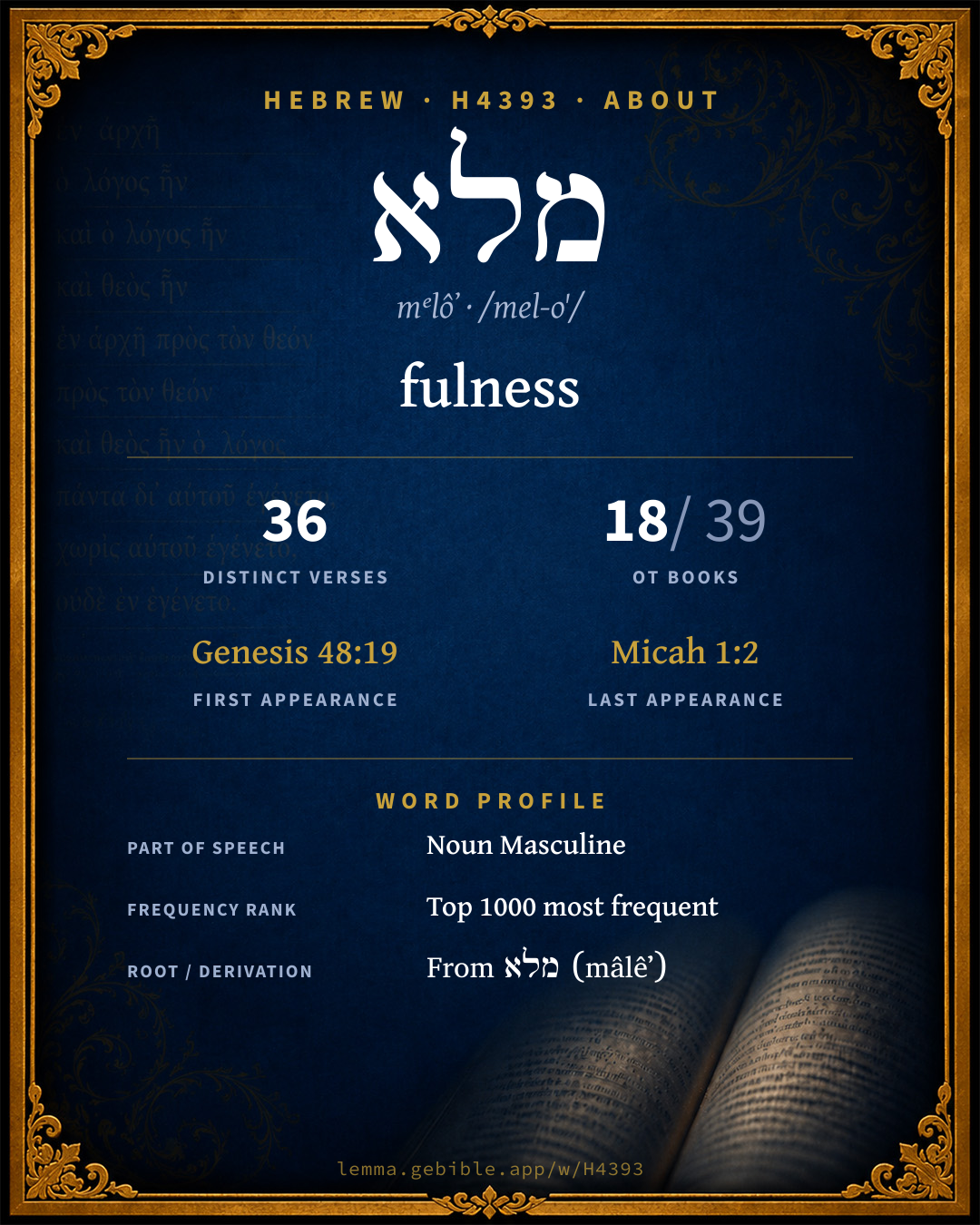
מְלֹא
fulness
‘fulness’ is one of 5 main senses fuller range ↓
Full lexicon entry — Brown-Driver-Briggs (BDB)
From Brown-Driver-Briggs (BDB)
Where this word appears
Grammar key — what these labels mean
Part of speech
- Noun
- A naming word — a person, place, thing, or idea.
Noun type
- Common
- A common noun — a general class of person, place, or thing (“king,” “city,” “water”), not a specific name.
State
- Construct
- A noun bound to a following noun in a possessive / “of” relationship (the construct chain).
- Absolute
- The independent form of a noun, not bound to a following word.
Gender
- Masculine
- Grammatically masculine.
Number
- Singular
- One.
Every verse where H4393 appears in the Book of 2 Kings — 1 distinct verse. Click any verse to open its interlinear word-by-word view. Verse text shown in the World English Bible for context — . Each verse’s Hebrew form is shown with its reference; the English is not keyword-highlighted, since the data carries no word-level English alignment. Use “Compare translations” on any verse to read it across multiple English versions. This concordance covers the Hebrew Bible; Septuagint (Greek Old Testament) occurrences are not indexed here.
2 Kings
About this entry
At a glance — auto-summarized from this page’s data, not written by a person. Every figure links to its source below. This summary describes the numbers; it doesn’t interpret them.
The Hebrew noun מלא centers on the idea of “fulness.” Where the King James Version says “full,” newer translations reach for “everything in it” (Berean Standard Bible) and “fullness” (unfoldingWord Literal Text); the renderings breakdown has the detail. It appears 36 verses across 18 books of the Hebrew Bible, among its moderately common vocabulary. Debuting at Genesis 48:19, it then recurs through the corpus. The lexicon spreads it across several senses; see its full sense range. Dig into 36-verse concordance and the renderings breakdown below.
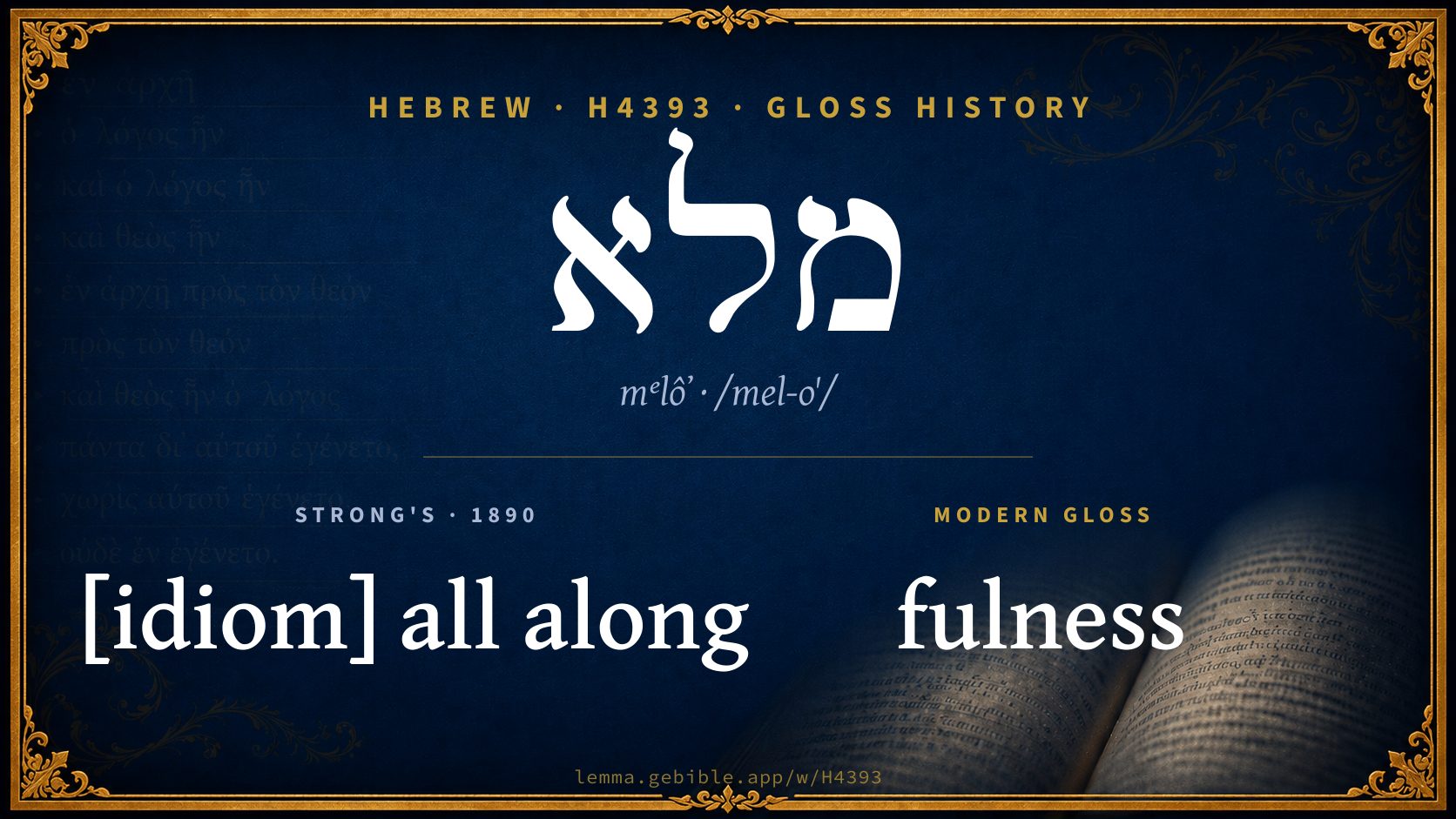
Gloss history
Strong's 1890 vs modern scholarship
About this word
Strong's H4393 catalogs a Hebrew word from the Hebrew Old Testament.
These counts are not copied from any lexicon or concordance. They are computed here, from the morphology-tagged Hebrew Old Testament. What Lemma adds →
- 36
- distinct verses
- The word appears in 36 distinct verses.
- 18 / 39
- OT books
- The word appears in 18 of 39 Old Testament books.
- #947
- by frequency
- Top 1000 most frequent Hebrew words (rank 947 of 8,640 Hebrew words by occurrence).
View all 36 occurrences in the concordance →
By section of the Old Testament
By traditional corpus
Conventional, traditional groupings — biblical authorship is debated, so this is a traditional corpus grouping, not an authorship claim. Each share is this word’s portion of its verses in that division of the Hebrew canon. Each figure is a share of the word’s 36 distinct verses.
- Prophets (Nevi'im) 19 verses · 53%
- Torah (Pentateuch) 10 verses · 28%
- Writings (Ketuvim) 7 verses · 19%
How translations render this word
Counts come from each version’s own published word-to-Strong’s tagging or interlinear alignment — an approximate guide to how each version renders this word, not a word-level alignment the data otherwise carries. Because each total is that version’s own tagged count, the per-version totals vary from one another and need not match the appearance or distinct-verse counts above. These counts may also differ from a printed concordance because Lemma counts each distinctly tagged rendering and does not collapse phrase taggings into a single head-word total. This is a fixed set of word-tagged versions (KJV, ASV, BSB, ULT) and does not change with the reading translation you choose elsewhere. Each version’s license is shown beside its name below (and on Sources).
- King James Version: Full 8×, Fulness 7×, All that is therein 6×
- American Standard Version: Full 6×, All that is therein 4×, Fulness 4×
- Berean Standard Bible: Everything in it 6×, All that fills it 4×, Full 3×
- unfoldingWord Literal Text: Fullness 13×, Fullness of 13×, Full 2×
King James Version Public Domain
Renders H4393 across 35 tagged occurrences — most commonly:
Plus 10 renderings that appear only once — usually multi-word phrases or single function words the recovered tagging swept in, not distinct renderings. Not rendered by a distinct English word in 2 further occurrences.
American Standard Version Public Domain
Renders H4393 across 35 tagged occurrences — most commonly:
Plus 17 renderings that appear only once — usually multi-word phrases or single function words the recovered tagging swept in, not distinct renderings.
Berean Standard Bible Public Domain
Renders H4393 across 33 tagged occurrences — most commonly:
Plus 14 renderings that appear only once — usually multi-word phrases or single function words the recovered tagging swept in, not distinct renderings. Not rendered by a distinct English word in 4 further occurrences.
unfoldingWord Literal Text CC BY-SA 4.0
Renders H4393 across 37 tagged occurrences — most commonly:
Plus 7 renderings that appear only once — usually multi-word phrases or single function words the recovered tagging swept in, not distinct renderings.
Senses in the full BDB
What do BDB’s symbols mean?
BDB uses these scholarly abbreviations:
| Symbol | Meaning |
|---|---|
| 𝔊 | the Septuagint (the ancient Greek translation, LXX) |
| 𝔙 | the Vulgate (the Latin translation) |
| 𝔖 | the Syriac version (the Peshitta) |
| 𝔗 | the Targum (the Aramaic translation) |
| ψ | the Psalms |
| √ | root (the underlying root or stem) |
| ‖ | parallel passage (a synonymous or contrasted parallel) |
| † | the dagger: every passage where the word occurs is cited |
The 4 senses and sub-senses the full Brown-Driver-Briggs lexicon distinguishes for this word, in lexicon order (not ranked by frequency), with BDB’s own verbatim wording and sub-sense lettering. Shown in Hebrew script with BDB’s own scholarly abbreviations. The condensed entry is in the Lexicon Entry tab. See also the Forms in the corpus table below.
- 1. fulness of hand (= handful) Ec 4:6(×2) sq. acc. mat. מ׳ חָפְנֵיכֶם פִּיחַ Ex 9:8 cf. Lv 16:12 1 K 17:12; so homer-full of manna; Ex 16:33 cf. Lv 16:12 Nu 22:18; 24:13 Ju 6:38; simil. מְלֹא בִגְדוֹ 2 K 4:39; rarely sq. מִן Lv 2:2; 5:12, cf. Ex 16:32 (but read perhaps מִלְאוּ so 𝔊 Sam. v. Di). e.g. Ecclesiastes 4:6
- 2. mass of shepherds Is 31:4 (in sim.); multitude of nations Gn 48:19 (cf. Arabic مَلَأٌ Qor 2:247 al.) e.g. Isaiah 31:4
- 3. fulness = that which fills, entire contents, of אֶרֶץ Dt 33:16 ψ 24:1 Is 6:3; 8:8; 34:1 Mi 1:2 Je 8:16; 47:2 Ez 12:19; 19:7; 30:12; 32:15; תֵּבֵל ψ 50:12; 89:12; יָם Is 42:10 1 Ch 16:32 ψ 96:11; 98:7; עִיר Am 6:8. e.g. Deuteronomy 33:16
- 4. phrases:—מ׳ קוֹמָתוֹ = at full length 1 S 28:20; full line, or portion מ׳ הַחֶ֫בֶל 2 S 8:2; מ׳ הַקָּנֶה Ez 41:8 full rod (reed). e.g. 1 Samuel 28:20
Senses from the full Brown-Driver-Briggs lexicon (Brown, Driver, Briggs; Oxford 1906 — public domain), digitized via Sefaria, supplemented by the OpenScriptures HebrewLexicon (CC BY 4.0). Full attribution on Sources.
Word origin
[מְלוֹא] n.m. Is 31:4 fulness, that which fills (Arabic مِلْأٌ Lane 2729);—מ׳ cstr. Gn 48:19 + 19 times; מְלוֹ Ez 41:8; sf. מְלוֹאוֹ Is 42:10 + 3 times; מְלוֹאָהּ Dt 33:16 + 12 times;—
— Brown-Driver-Briggs (Oxford 1906, public domain), digitized via Sefaria, supplemented by the OpenScriptures HebrewLexicon (CC BY 4.0). See Sources.
Derived from מלא (mâlêʼ) (H4390) — to fill.
Jastrow Dictionary
A second Hebrew/Aramaic lexicon for comparison, covering Aramaic and post-biblical (Talmudic, Targumic, Midrashic) usage that the biblical-Hebrew BDB does not. Matched by lemma rather than by Strong’s number, so a lemma may carry more than one Jastrow headword (shown separately below), and the entries cover usage well beyond the Bible.
מִלָּא
- , v. מִלְּתָא a. מִלָּה.
מָלֵא I
- (b. h.) to be full, v. מָלֵא II.—Tosef. Dem. V, 24 היאך מְלָאֲךָ ליבך how could thy heart be so full of thyself, i.e. how daredst thou?
- to fill, to draw (water). Erub. VIII, 6 אין מְמַלְּאִין וכ׳ (Y. ed. מְמַלִּין) you must not draw water out of it on the Sabbath. B. Bath. 162ᵇ מִילְּאֵהוּ בקרובים if he filled the vacant space on the document with the signatures of relatives; Gitt. 87ᵇ. Hor. 11ᵇ ממלא מקום אבותיו הוה he was filling his ancestors’ place, was a direct successor; a. fr.
- to be filled. Ber. 3ᵇ; 59ᵃ אין הבור מִתְמַלֵּא וכ׳, v. חוּלְיָא I. Y. Succ. III, end, 54ᵃ עד שיִתְמַלֵּא זקנו until he has a full beard. Y. Ber. IX, 13ᵈ bot. הִתְמַלְּאִי דינרי זהב be full of gold denars; והיתה מתְמַלְּאָה and it became filled with &c. Gen. R. s. 33 הִתְסַלְּאוּ רחמים אלו על אלו be merciful to one another. Ib. ראיתי … והִתְמַלֵּאתִי עליה רחמים I saw her in distress and was filled with pity for her; a. fr.
מְלָא
- v. מְלֵי
מָלֵא II
- (b. h.) full. Ab. IV, 20 יש … מ׳ ישן many a new vessel is full of old wine (many a young man is full of wisdom). Meg. 6ᵃ (ref. to Ez. XXVI, 2) אם מ׳ זו חרבה זו when one (of the two cities, Jerusalem and Caesarea) is full, the other is waste; a. fr.—Esp. a full month, of thirty days. Bekh. 58ᵃ זימנין מ׳ וכ׳ at times (in some years) it is full, at times defective, v. חָסֵר; a. fr.—Pl. מְלֵאִים, מְלֵאִין, מְלֵי׳; f. מְלֵאוֹת, מְלֵי׳. Ber. 57ᵃ; Erub. 19ᵃ, a. e. מ׳ מצות כרמון are full of good deeds as a pomegranate (is full of seeds); a. fr.—[מְלֵאָה as a noun, v. מְלֵיאָה.] e.g. Ezekiel 26:2
מְלֹא
- ch., v. מְלוֹא
מְלוֹא
- fulness, contents. Mikv. III, 1, sq. עד שיצא ממנו מְלוֹאוֹ ועוד until a quantity equal to its original contents and something besides have run off. Y. Succ. I, 51ᵈ top אכסדרה שנפרצה במְלוֹאָהּ וכ׳ an exedra which is (on one side) entirely open towards the public road. Ib. bot. כמְלוֹאוֹ של דלי as far as the bucket is let down into the water (for filling it). Ḥull. II, 3 אם יש בסכין מְלֹא צואר if the slaughtering knife has the length of the width of the neck. Kidd. 33ᵃ מ׳ עיניו as far as his eye can reach. Sabb. 30ᵃ, a. e. כמ׳ נימא as much as a hair’s breadth. Sifré Num. 160 (expl. אבן יד, Num. XXXV, 17) מ׳ יד as large as the grasp of the hand; a. fr.—[Tosef. Ohol. XVII, 3 מ׳ טימיא, v. לָטוֹמְיָא.] e.g. Numbers 35:17
מְלוֹא ²
- Targ. Y. Num. XXXV, 17. Targ. O. Deut. XXXIII, 16 (Y. ומַלְיָהּ, v. מַלְיָא II); a. e.—Ab. Zar. 29ᵃ מ׳ חמש אצבעתיה as much as one can pinch with five fingers; מ׳ אצבעיה … ומ׳ וכ׳ as much as one can pinch with thumb and little finger; a. e.
מְלֵי
- 1. to be full. Targ. Josh. III, 15; a. fr.; v. next art. Ab. Zar. 28ᵃ דלא מָלוּ תִילתא, v. תִּילְתָּא; a. e.
- 2. to fill. Targ. Gen. I, 22. Targ. Deut. VI, 11 (O. ed. Vienna מַלֵּ׳ Pa.); a. fr.—Part. מָלֵי; f. מַלְּיָא; pl. מָלָן; מַלְיָאתָא, מַלְיָיתָא. Ib. O. XXIX, 10. Targ. Josh. IX, 21 (ed. Wil. מְלָן). Targ. Gen. XXIV, 11; a. fr.
- 1. to fill. Targ. Jer. XIII, 13; a. fr.—Lev. R. s. 21 מַלּוֹי קולתיך fill thy vessel; Pesik. Aḥăré, p. 176ᵇ; Yalk. Lev. 571 מלתי (read: מַלְּאִי); Keth. 62ᵇ מַלִּי. Ab. Zar. 29ᵃ ומַלְּיֵיה מיא and fill it with water. Taan. 29ᵃ; Shebu. 10ᵃ; Pes. 77ᵃ תמוז … מַלּוּיֵי מַלְּיוּהָ they made the Tammuz of that year a full month (of thirty days); a. e.
- 2. to complement, compensate, replace. Targ. O. Gen. II, 21 ומַלִי ed. Berl. (ed. Amst. ומְ׳, corr. acc.).—B. Mets. 105ᵃ טרח ומַלְּיֵיה he took pains to make up for the loss. Ib. טרחת ומַלְּיָיתֵיה וכ׳ Ms. M. (ed. למַלָּיוּתֵיה) thou didst take pains to make up &c.; a. e.—[
- 3. מ׳ על לבא to comfort. Targ. O. Gen. XXXIV, 3 ed. Berl. (v. Berl. Mass., p. 27); v., however, Kidd. 50ᵃ, quot. s. v. מְלַל II.]
- to be filled, full. Targ. Gen. VI, 13. Targ. Ex. XL, 34 א׳ ית וכ׳ (filled); a. fr.
A Dictionary of the Targumim, the Talmud Babli and Yerushalmi, and the Midrashic Literature (Marcus Jastrow; London, Luzac, 1903) — Public Domain. Digitized via Sefaria. Digitized via Sefaria. Full attribution on Sources.
Forms in the corpus
The 23 distinct written forms H4393 takes in the Hebrew Bible, most frequent first — each parse links to that state’s occurrences in the concordance. Hebrew forms include their vowel points and cantillation, so a single lemma takes many written forms.
Same root — word family
Other BDB entries built from the same root as H4393, grouped by Strong’s listed origin. These share a root / origin per the lexicon — not necessarily a shared meaning. Each links to that word’s own entry.
Derives from
Shares the same root
- מלא mᵉlâʼ H4391 to fill
- מלא mâlêʼ H4392 full
- מלא milluʼ H4394 installation
- מלאת millêʼth H4402 fulness
Proper names from this root
People and places named from this root — a name, not an additional meaning of the word.
Compare all same-root words → Showing 4 of 8 — not the complete family. 2 of the same-root words are proper names (people or places). They share a root, not necessarily a meaning.
Septuagint verse parallels
This word appears in 36 verses that also exist in the Greek Old Testament (Septuagint), out of the 36 Hebrew verses it occurs in. You can read those verses in Greek by switching the Old Testament edition to the Septuagint.
Read these verses in the Septuagint
- Genesis 48:19
- Exodus 9:8
- Leviticus 2:2
- Numbers 22:18
- Deuteronomy 33:16
- Judges 6:38
- 1 Samuel 28:20
- 2 Samuel 8:2
- 1 Kings 17:12
- 2 Kings 4:39
- 1 Chronicles 16:32
- Psalms 24:1
This is a verse-level parallel only — the same verses exist in both the Hebrew and Greek Old Testaments. No word-level Hebrew↔Greek correspondence is claimed: the data carries no such alignment, so no Greek word is shown as this Hebrew word’s translation. Coverage is not total — the Septuagint omits the deuterocanon and renumbers the Psalms, so some Hebrew verses have no direct Greek parallel.