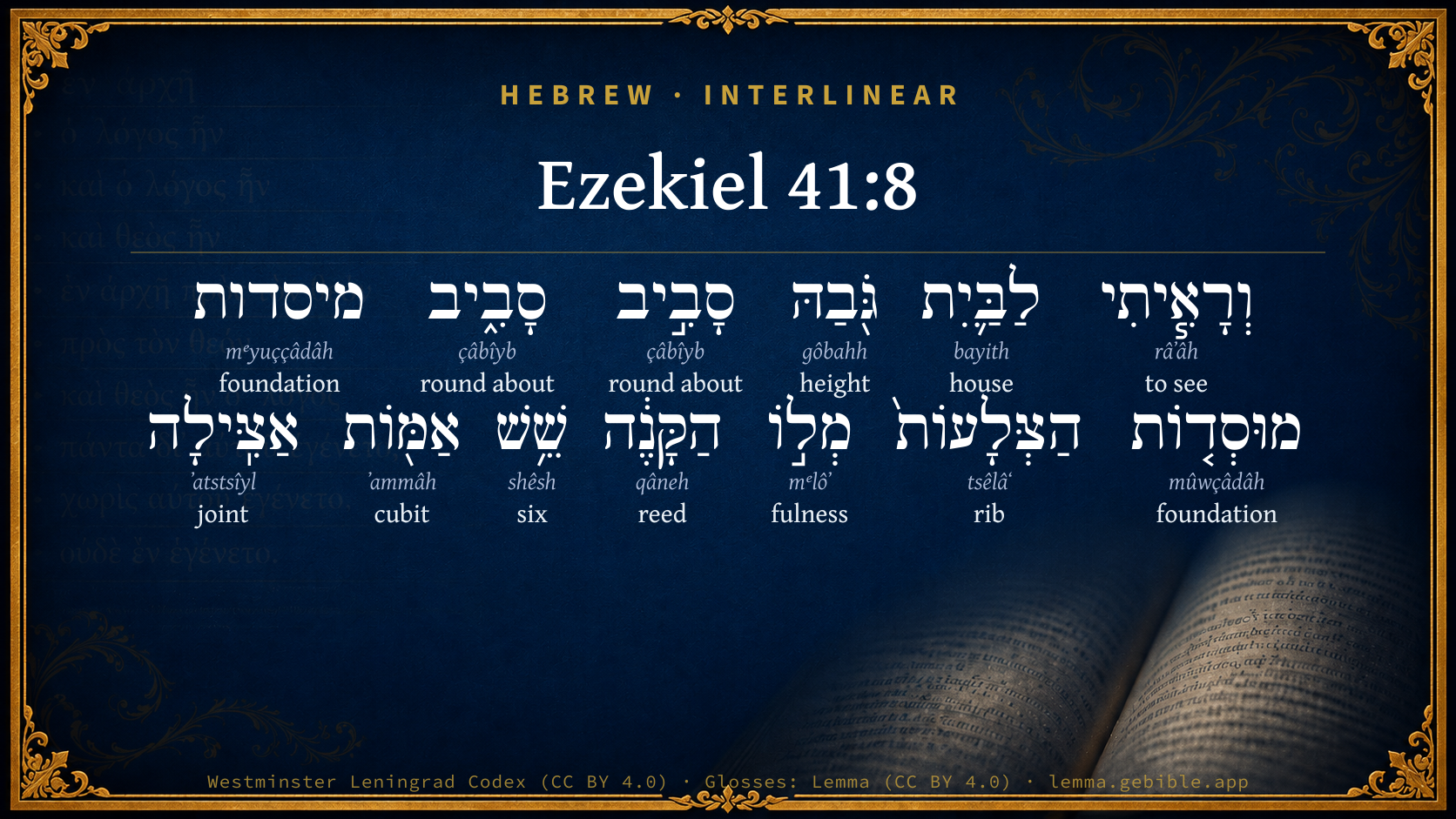
Ezekiel 41:8

Hebrew (Westminster Leningrad Codex) Ezekiel 41:8 appears in the Hebrew Old Testament. The text above is from the Westminster Leningrad Codex. Each word links to its Strong’s number, a concise gloss, and parsing drawn from the Open Scriptures Hebrew Bible morphology. Click any word for its full Brown-Driver-Briggs (BDB) entry.
Download image
Cite this verse

Ezekiel 41:8 (World English Bible). Public Domain. Lemma interlinear Bible study tool, https://lemma.gebible.app/v/ezekiel/41/8.

Show BibTeX & RIS
BibTeX
RIS
English Translation
I saw also that the house had a raised base round about: the foundations of the side-chambers were a full reed of six great cubits.
World English Bible · Public Domain
Highlights
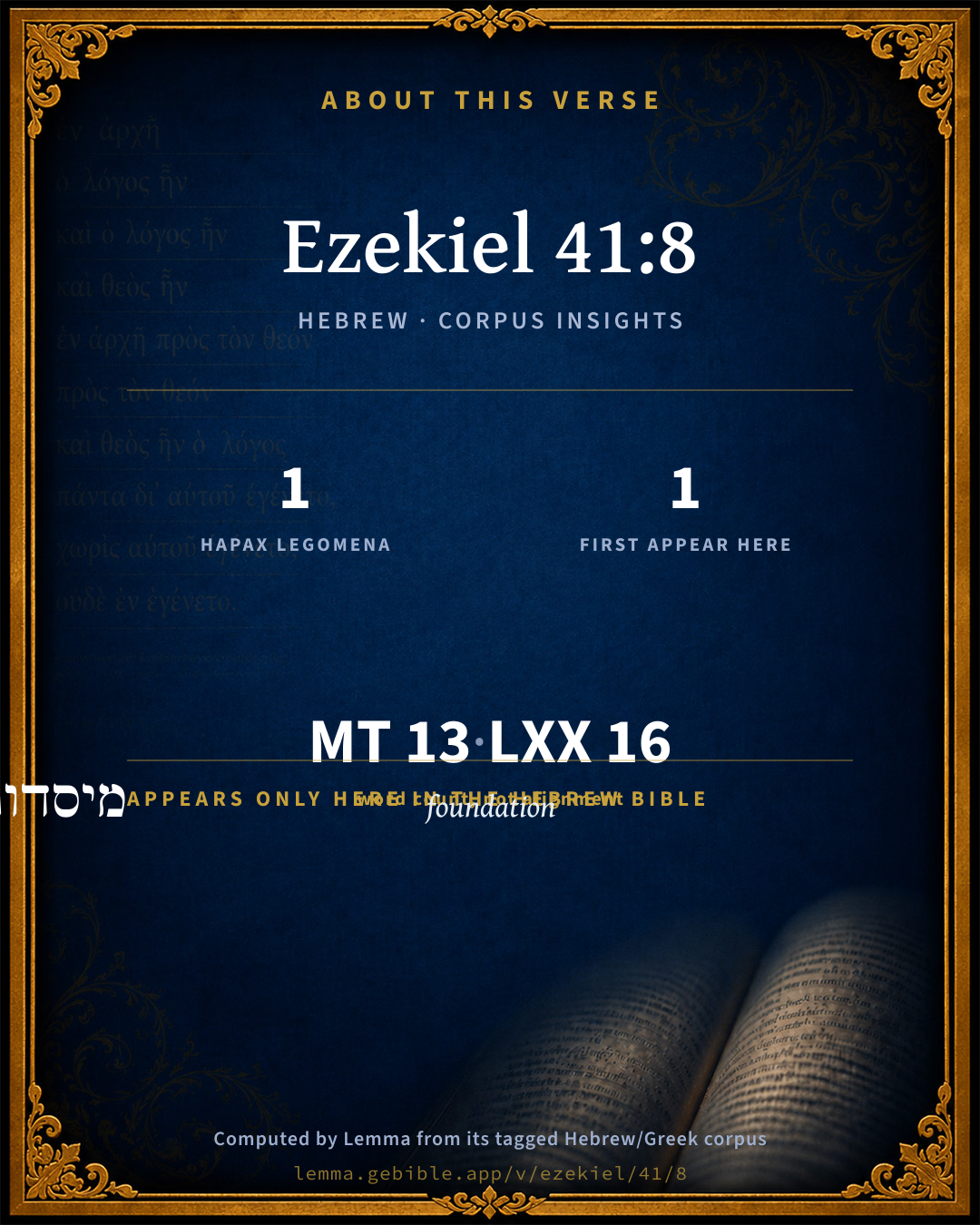
  • 1 hapax legomenon — only here in the Hebrew Bible
  • 1 first appearance in the Hebrew Bible
Full analysis ↓
Download a study sheet

One document with this verse’s original text, its word-by-word gloss line, the meaning frame, cross-references with their text, attributed commentary, and full source and license credits — printable, and it pastes into notes with its structure intact.

This verse Autodidact and up

Study sheet (.html) Plain text (.txt)

A passage Seminary Student

Up to 50 verses in one chapter. A passage sheet keeps up to 6 commentary sources and 12 cross-references per verse, in the order this page ranks them, and says so on the sheet whenever that leaves anything out. Ask for a single verse and you get the Autodidact verse sheet above.

Everything on this page stays free to read, with no account — the sheet is a download of what is already on screen, not access to it.

Want to remove ads? Support Godless Engineer
Compare translations 3

The same verse in 3 English versions, stacked beneath the original-language interlinear above. Click any original word for its lexicon entry.

Each is an independent rendering of the whole verse — the interlinear is not word-aligned to these translations.

Highlighted words mark where these versions differ — a whole-verse word diff, not a word-by-word alignment.

  • World English Bible Public Domain
    I saw also that the house had a raised base round about: the foundations of the side-chambers were a full reed of six great cubits.
  • King James Version Public Domain
    I saw also the height of the house round about: the foundations of the side chambers were a full reed of six great cubits.
  • unfoldingWord Literal Text CC BY-SA 4.0
    Then I saw a raised part all around the house, the foundation for the side chambers; it measured a full stick in height—six cubits.

unfoldingWord Literal Text — © unfoldingWord, licensed CC BY-SA 4.0. Word-aligned USFM3 via Door43 (git.door43.org/unfoldingWord/en_ult).

Versions to compare (up to 4)

3 of 4 selected

Show all 18 translations

Every available English version of this verse, each an independent rendering of the whole verse.

  • World English Bible Public Domain
    I saw also that the house had a raised base round about: the foundations of the side-chambers were a full reed of six great cubits.
  • Berean Standard Bible Public Domain
    I saw that the temple had a raised base all around it, forming the foundation of the side rooms. It was the full length of a rod, six long cubits.
  • Majority Standard Bible Public Domain
    I saw that the temple had a raised base all around it, forming the foundation of the side rooms. It was the full length of a rod, six long cubits.
  • King James Version Public Domain
    I saw also the height of the house round about: the foundations of the side chambers were a full reed of six great cubits.
  • American Standard Version (1901) Public Domain
    I saw also that the house had a raised basement round about: the foundations of the side-chambers were a full reed of six great cubits.
  • Revised Version (1885) Public Domain
    I saw also that the house had a raised basement round about: the foundations of the side-chambers were a full reed of six great cubits.
  • Geneva Bible (1599) Public Domain
    I sawe also the house hie rounde about: the foundations of the chambers were a full reede of fixe great cubites.
  • Douay-Rheims (1899) Public Domain
    And I saw in the house the height round about, the foundations of the side chambers which were the measure of a reed the space of six cubits:
  • Young's Literal Translation Public Domain
    And I have looked at the house, the height all round about: the foundations of the side-chambers `are' the fulness of the reed, six cubits by the joining.
  • Literal Standard Version CC BY-SA 4.0
    And I have looked at the height all around the house: the foundations of the side-chambers [are] the fullness of the reed, six cubits by the joining.
  • Unlocked Literal Bible CC BY-SA 4.0
    Then I saw a raised part all around the house, the foundation for the side chambers; it measured a full stick in height—six cubits.
  • unfoldingWord Literal Text CC BY-SA 4.0
    Then I saw a raised part all around the house, the foundation for the side chambers; it measured a full stick in height—six cubits.
  • Darby Bible Public Domain
    And I saw that the house had an elevation round about: the foundations of the side-chambers, a full reed, six cubits to the joint.
  • World Messianic Bible Public Domain
    I saw also that the house had a raised base all around. The foundations of the side rooms were a full reed of six great cubits.
  • Webster's Bible Public Domain
    I saw also the hight of the house around: the foundations of the side-chambers were a full reed of six great cubits.
  • Free Bible Version CC BY-SA 4.0
    I saw that the Temple was on a raised platform that surrounded it. This was the foundation for the side rooms. Its height was the complete length of a measuring rod, six long cubits.
  • Bible in Basic English Public Domain
    And I saw that the house had a stone floor all round; the bases of the side-rooms were a full rod of six great cubits high.
  • JPS Tanakh (1917) Public Domain
    I saw also that the house had a raised basement round about; the foundations of the side-chambers were a full reed of six cubits to the joining.

Literal Standard Version (2020), Covenant Press — licensed CC BY-SA 4.0. Text via the HelloAO Bible API (eBible.org). Unlocked Literal Bible (unfoldingWord) — licensed CC BY-SA 4.0. Text via the HelloAO Bible API (eBible.org). unfoldingWord Literal Text — © unfoldingWord, licensed CC BY-SA 4.0. Word-aligned USFM3 via Door43 (git.door43.org/unfoldingWord/en_ult). Free Bible Version, Dr. Jonathan Gallagher — licensed CC BY-SA 4.0. Text via the HelloAO Bible API (eBible.org).

Word by word

More ways to search: Search by grammar → Find every occurrence → Compare this word →

Practice this passage: Drill this verse → Learn its vocabulary →

מיסדות
mᵉyuççâdâh
H4328
“foundations of”
Noun, Common, Feminine, Plural, Construct
Part of Speech
Noun
Type
Common
Gender
Feminine
Number
Plural
State
Construct
Full BDB Definition

Origin: properly, fem. pass. participle of H3245

TWOT: 875

to be founded, be laid - foundation (participle)
  1. וְרָאִ֧יתִי râʼâh H7200 “and · to see” Conjunction + Verb, Qal, Perfect, 1st Person, Common, Singular
  2. לַבַּ֛יִת bayith H1004 “to/for the · house” Preposition, Determined + Noun, Common, Masculine, Singular, Absolute
  3. גֹּ֖בַהּ gôbahh H1363 “height” Noun, Common, Masculine, Singular, Absolute
  4. סָבִ֣יב çâbîyb H5439 “round about” Noun, Common, Both, Singular, Absolute
  5. סָבִ֑יב çâbîyb H5439 “round about” Noun, Common, Both, Singular, Absolute
  6. מוּסְד֤וֹת mûwçâdâh H4145 “foundations of” Noun, Common, Feminine, Plural, Construct
  7. הַצְּלָעוֹת֙ tsêlâʻ H6763 “the · ribs” Particle, Definite Article + Noun, Common, Both, Plural, Absolute
  8. מְל֣וֹ mᵉlôʼ H4393 “fulness of” Noun, Common, Masculine, Singular, Construct
  9. הַקָּנֶ֔ה qâneh H7070 “the · reed” Particle, Definite Article + Noun, Common, Masculine, Singular, Absolute
  10. שֵׁ֥שׁ shêsh H8337 “six” Adjective, Cardinal number, Feminine, Singular, Absolute
  11. אַמּ֖וֹת ʼammâh H520 “cubits” Noun, Common, Feminine, Plural, Absolute
  12. אַצִּֽילָה ʼatstsîyl H679 “joint” Noun, Common, Feminine, Singular, Absolute

About this verse

These counts appear in no published source. They are computed here, from the morphology-tagged text and Lemma’s own curated glosses. What Lemma adds →

13
words
12
distinct lemmas
Prophets
section

Notable vocabulary

1 hapax legomenon — a word that appears only here in the entire Hebrew Bible:

  • מיסדות foundation H4328

First appearance in Scripture

This word makes its first canonical appearance in the Hebrew Bible here:

  • מיסדות foundation H4328

Shared distinctive vocabulary

מוּסְד֤וֹת foundation H4145 occurs in 2 verses of the Hebrew Bible. Also found in:

Grammatical profile

  • 1 verb
  • 11 nouns
  • 1 adjective

Verb forms

  • וְרָאִ֧יתִי Qal · Perfect

Repetition

A word recurs within this verse — often emphatic in Hebrew:

  • סָבִ֣יב round about H5439 ×2

Hebrew & Septuagint length

In English translation the verse runs 25 words from the Hebrew and 23 from the Septuagint (LXX English) — closely comparable.

A rough comparison of the two English renderings, which tokenize alike — not a word-level alignment.

Word counts can differ between the Hebrew and the Greek without any difference in meaning — e.g. the Hebrew direct-object marker אֵת has no separate Greek word, and Greek often adds the article ὁ.

In the original languages it is 13 Hebrew tokens and 16 Greek tokens — but the two are counted differently (Hebrew bundles its prefixes and suffixes into one token; the Greek is in lemma form), so that isn’t a like-for-like length.

Cross-references

2

Topical passages linked to Ezekiel 41:8 in the Treasury of Scripture Knowledge — connected by theme and wording, ordered by reader-vote popularity; previews shown in the World English Bible.

  • Ezekiel 40:5 Behold, a wall on the outside of the house round about, and in the man's hand a measuring reed six cubits long, of a cubit and a handbreadth each: so he measured the thickness of the building, one reed; and the height, one reed.
  • Revelation 21:16 The city lies foursquare, and its length is as great as its breadth. He measured the city with the reed, Twelve thousand twelve stadia. Its length, breadth, and height are equal.

Cross-references courtesy of OpenBible.info (CC BY 4.0).

Hebrew and Greek witnesses Masoretic Hebrew ↔ Greek Septuagint

The same verse in the two great witnesses to the Old Testament, shown verse-for-verse.

These are two independent witnesses, not word-aligned to each other, and the Septuagint is shown in lemma (dictionary) form.

Hebrew Ezekiel 41:8 Masoretic · Westminster Leningrad Codex

וְרָאִ֧יתִי לַבַּ֛יִת גֹּ֖בַהּ סָבִ֣יב סָבִ֑יב מיסדות מוּסְד֤וֹת הַצְּלָעוֹת֙ מְל֣וֹ הַקָּנֶ֔ה שֵׁ֥שׁ אַמּ֖וֹת אַצִּֽילָה

I saw also that the house had a raised base round about: the foundations of the side-chambers were a full reed of six great cubits.

World English Bible · Public Domain

Greek LXX Ezekiel 41:8 Septuagint · lemma form

καί ὁ θραελ ὁ οἶκος ὕψος κύκλος διάστημα ὁ πλευρά ἴσος ὁ κάλαμος πῆχυς ἕξ διάστημα

And as for the height of the house round about, each space between the sides was equal to a reed of six cubits;

LXX2012 (modern English Septuagint) · Public Domain

On this verse, The Cambridge Bible for Schools and Colleges discusses the Septuagint’s reading. Read the note in Commentary ↓

Hebrew: Westminster Leningrad Codex (CC BY 4.0). Greek: Septuagint (public domain); English from LXX2012 (modern English Septuagint) (Public Domain). How the Septuagint differs from the Hebrew →

Targum (Aramaic paraphrase)

1

The Targum is the ancient Jewish Aramaic paraphrase of the Hebrew Scriptures — an interpretive translation, not the Hebrew text itself. Onkelos (literal) and Pseudo-Jonathan (expansive) render the Torah, and Jonathan the Prophets. Coverage is partial: where no permissively-licensed English translation exists for a verse, only the Aramaic is shown. This is verse-level text, not a word-by-word alignment to the Hebrew.

  1. Targum Jonathan Prophets (Joshua–Malachi)
    וַחֲזֵית לְבֵיתָא רוּמָא סְחוֹר סְחוֹר מְשַׁכְלְלָן מְחִיצַיָא מִשְׁחַת קָנַיָא שִׁית אַמִין רֶוַח:

    (no public-domain English translation for this verse)

    Targum Jonathan — Aramaic: “Mikraot Gedolot” (public domain). English: “Sefaria Community Translation” (CC0 1.0 (public-domain dedication)); “London "Chaldee Paraphrase," 1871” (public domain). Text via Sefaria.

Commentary

Notes on Ezekiel 41:8 from classic Christian and Jewish commentators (each source and its license shown beneath its notes). The classic Christian expositions comment on the surrounding passage and are grouped to its opening verse, so a note may address several verses; the Jewish commentaries on the Tanakh (Rashi and others) are per-verse, so they appear only where the commentator wrote on this verse.

Lemma curates 59 commentaries, every one of them public domain or Creative Commons licensed, each selected and text-cleaned for this edition rather than reprinted as found. About our sources →

The Cambridge Bible for Schools and Colleges

gen. ed. J. J. S. Perowne

8. I saw also] An uncommon form; usually it is said, and there appeared, which LXX. probably read here[13]. For “height” (gobah) probably “raised pavement” (gabbah, Gabbatha, Joh_19:13) should be read (cf. footnote)—and the house appeared as having a raised pavement round about, lit. there appeared (belonging) to the house &c., cf. ch. Eze_10:8. All that was seen of the platform was the passage of 5 cubits round about the building (Eze_41:11). “House” includes both the temple proper and the side-chambers. This is supplemented by saying that the foundations of the side-chambers were 6 cubits high—of course house and side-chambers were on the same level.

[13] The curious word in LXX. καὶ τὸ θραὲλ appears a transliteration of this reading with following prep. l attached, ותרא ל (fem. apoc. Impf. niph.); cf. for form and construction ch. Eze_10:8; and for short final vowel the spelling Abimael, Gen_10:28. Therefore a fem. noun should be read as subj. (gabbah).

six great cubits] as R.V., marg., six cubits to the joint, or angle, i.e. probably to the point where the vertical line of the height of the platform cut the level of the court. The words cannot be a description of the kind of cubit, nor, since the foundations are being described, can there be any reference to the height within of the side-chambers or to the point of junction of one story with another.

8–11. The raised platform upon which the house and the side-chambers stood

The house and the annexe stood on a platform raised a full reed, or 6 cubits above the level of the inner court (Eze_41:8). The platform was reached in front of the house by a flight of so steps (Eze_40:49) from the court. The outside wall of the annexe was 5 cubits thick (Eze_41:9). A space of 5 cubits of the platform remained unoccupied by the buildings (Eze_41:11), Fig. 2, E. Then came a free space of 20 cubits running round the platform (Eze_41:10), Fig. 3, H. Finally came other buildings in the inner court, one behind the house on the W. (Eze_41:15), Fig. 3, K; and others on both sides of it, N. and S. (Eze_42:1 seq.), Fig. 3, GG´.

The Cambridge Bible for Schools and Colleges (gen. ed. J. J. S. Perowne; Cambridge University Press, 1878–1918) — public domain. Text from a community e-Sword module.

Trapp's Complete Commentary

John Trapp

Eze 41:8 I saw also the height of the house round about: the foundations of the side chambers [were] a full reed of six great cubits.

Ver. 8. The foundations.] Plus rei quam ostentationis habebant, {a} The good soul rather seeks to be good, than seems to be so.

{a} Oecolamp.

John Trapp, A Commentary or Exposition upon All the Books of the Old and New Testament (1647–1656) — public domain. Text from a community e-Sword module.

Jamieson, Fausset & Brown

Robert Jamieson, A. R. Fausset & David Brown

foundations . . . six . . . cubits--the substructure, on which the foundations rested, was a full reed of six cubits.

great--literally, "to the extremity" or root, namely, of the hand [HENDERSON]. "To the joining," or point, where the foundation of one chamber ceased and another began [FAIRBAIRN].

Jamieson, Fausset & Brown — Commentary Critical and Explanatory on the Whole Bible (1871) — public domain (CC PDM 1.0). Text via the HelloAO Bible API.

Ellicott's Commentary for English Readers

(8) I saw also the height of the house.—This does not mean the height of the house itself, which is nowhere stated. The words are, literally, I saw for the house a height (i.e., an elevation) round about, and the meaning of this is explained in what follows. The Temple, as has been already said (Eze_40:49), was entered by a flight of steps leading up to the porch, and was therefore on a higher level than the court. We are now told that the side chambers had a foundation of six cubits. Whether this “foundation” of the Temple and the side chambers was built of masonry, or, as is more probable, was a sort of basement to contain cisterns and storage rooms, we are not told; but it probably extended, under the name of “the place that was left” (Eze_41:9; Eze_41:11), five cubits beyond the outer wall of the chambers, forming a platform from which they were entered.

Six great cubits.—Literally, six cubits to the joint, or to the armpit, for the word has both significations. It is plain that a cubit of a different length, measured to the armpit, cannot be intended, both because no such cubit is known to have been in use at any time, and because Ezekiel in Eze_40:5 has already fixed the length of the cubit he uses. The sense of joint is therefore to be taken, and this applied architecturally can only mean the point at which one part of the building joins another; here, the point where the superstructure meets the foundation, or, as we should say, “six cubits to the water-table.”

A Bible Commentary for English Readers, edited by Charles John Ellicott (1878–1897) — public domain. Text from a community e-Sword module.

John Gill's Exposition

I saw also the height of the house round about,.... Not of the temple itself, but of the chambers, and the three stories of them, which went round about it; and particularly the height of the highest storey, which yet is not given: it could not be so high as the temple itself; for then there would have been no room for windows to let in light into it:

the foundations of the side chambers were a full reed of six great cubits; not of the lowest storey of them, for that was but four cubits broad, Eze 41:5, nor of the middlemost, which was five; but of the uppermost, which was six; and these were cubits of the largest size, a hand's breadth larger than the common cubit, and made one full reed, or three yards and a half; see Eze 40:5, these foundations signify the same as the twelve foundations of the wall of the New Jerusalem; and which are no other than the one foundation Christ, ministerially laid by his twelve apostles; and who is the only foundation of his church and people, and is a sure one, Rev 21:14.

John Gill's Exposition of the Whole Bible (1746–1763) — public domain (CC PDM 1.0). Text via the HelloAO Bible API.

Albert Barnes' Notes on the Bible

The foundations of the side chambers - Therefore the height of the side-chambers from the floor was six cubits there being three stories, which corresponds sufficiently with the twenty cubits which was the height of the temple. “A great cubit” is probably an architectural term to denote the line of junction between two stories, which would be that of the ceiling of the lower and the floor of the upper story.

Albert Barnes' Notes on the Bible (1834–1885) — public domain. Text from a community e-Sword/MySword module.

Matthew Poole's English Annotations

Of the house; of the chambers, or the three stories of them; it is not the temple. The lowest chamber had properly a foundation laid on the earth, but the floor of the middle and highest story must be accounted here a foundation; so from the ground to the ceiling of the first room was six great cubits; from the first beams, joists, and boards to the second; six great cubits; and from the third floor to the roof of the chamber, a like number: to which if we add one cubit for thickness of each of the three roofs or floors, you have twenty-one cubits for height, ten yards and half high.

Matthew Poole's English Annotations on the Holy Bible (1683–1685) — public domain. Text from a community e-Sword/MySword module.

The Pulpit Commentary

Verse 8 explains that "the house" did not stand upon the level ground, but, like many temple buildings in antiquity (see Schurer, in Riehm"s "Handworterbuch," art. "Tern. pel Salerno"), upon a height or, raised basement (Revised Version)round about, which agrees with the statement in Eze_40:49 that the temple was approached by means of a stair. In consequence of this, the foundations of the side chambers were a full reed of six great cubits; or, of six cubits to the joining (Revised Version) "six cubits to the story" (Ewald); literally, six cubits to the armpit. This can hardly mean six cubits each equal to the distance from the elbow to the wrist, which would be a new definition of the length of the reed; but as Havernick and Kliefoth propose, must be taken as an architectural term indicative of the point where one portion of the building joined on to another. Accordingly, by most interpreters the six cubits are considered to be a statement of the height of the ceiling above the floor in each story, which would give an elevation of eighteen cubits for the three stories; but probably they mark only the height of the temple and side chamber basis above the ground. Kliefoth includes both views, and obtains an altitude of twenty-four cubits from the ground to the temple roof.

The Pulpit Commentary (1880–1919), ed. H.D.M. Spence-Jones & Joseph S. Exell — public domain. Text from a community e-Sword module.

John Wesley's Explanatory Notes

The foundations - The lowest chamber had properly a foundation laid on the earth, but the floor of the middle, and highest story must be accounted here a foundation; so from the ground to the ceiling of the first room, was six great cubits; from the first to the second, six great cubits; and from the third floor to the roof of the chamber, a like number; to which add we one cubit for thickness of each of the three floors, you have twenty-one cubits for height, ten yards and a half high.

John Wesley, Explanatory Notes Upon the Whole Bible (1754–1765) — public domain. Text via the GEBible commentary corpus.

unfoldingWord translationNotes

Door43 World Missions Community

a raised part

a platform

chambers

small rooms

a full stick

Translate "stick" as in Ezekiel 40:5.

cubits

Each long cubit was about 54 centimeters. See how you translated this in Ezekiel 40:05. (See: Biblical Distance)

six cubits

about 3.2 meters (See: Biblical Distance)

five cubits

about 2.7 meters (See: Biblical Distance)

translationWords

sanctuary

unfoldingWord translationNotes — © Distant Shores Media and the Door43 World Missions Community, licensed CC BY-SA 4.0. Source: git.door43.org/Door43/en_tn.

Rashi

Rabbi Shlomo Yitzchaki (Rashi)

And I saw that the House had a height He does not delineate its measurement, but we learn in Tractate Middoth (4:6): “with a height of one hundred cubits.”

the foundations of the cells were the full length of a rod The foundation of the cells was the full length of a rod.

six cubits was its span [Heb. אַצִילָה.] Jonathan renders: span. [The part] of the foundation of the stone wall within the earth was six cubits wide, but [the part] above the earth was five cubits wide, as is delineated in this section in the following verse.

Rashi on the Tanakh — English translations: “The Judaica Press complete Tanach with Rashi, translated by A. J. Rosenberg” (CC BY 4.0); “Pentateuch with Rashi's commentary by M. Rosenbaum and A.M. Silbermann, 1929-1934” (public domain); “The Metsudah Tanach series, Lakewood, N.J” (CC BY 4.0); and “The Book of Joshua, Metsudah Publications, 1997” (CC BY 4.0). Text via Sefaria.

Lesson kit

Teaching starters — assembled from the data on this page, not authored interpretation. Every prompt links to the verse data it draws on. Edit before teaching.

Ezekiel, in the Prophets, opens this verse with 13 words (12 distinct Hebrew lemmas). Its most distinctive word is mᵉyuççâdâh (“foundation”). A historical commentator’s framing appears above. Read the whole chapter for the surrounding context.

Discussion questions

  1. What does “foundation” (mᵉyuççâdâh) contribute to the verse as a whole?
  2. This verse holds 1 word here found nowhere else in the Hebrew Bible. What might the rare word draw attention to?
  3. The word “foundation” first appears here in Scripture. What is being introduced at this debut?
  4. Isaiah 30:32 shares the word «foundation» with this verse. How do the two illuminate each other?
  5. “round about” occurs 2× in this one verse. What is the effect of the repetition?
  6. These translations render this verse differently; the difference is in the English rendering, not the original. What questions does that raise?
  7. The verb «וְרָאִ֧יתִי» is Qal Perfect. How does its form color the action?
  8. Reading how The Cambridge Bible for Schools and Colleges and Trapp's Complete Commentary read this verse, where do the two commentators agree and where do they part?

Things to notice

  • 1 word in this verse appears nowhere else in the Hebrew Bible.
  • 1 word makes its first canonical appearance in Scripture here.
  • This verse counts 13 Hebrew ↔ 16 Greek words.
  • These translations choose different wording for 21 words in this verse.
  • “round about” occurs 2× in this single verse.

Reading settings

Reading text

Shown beneath each verse's original-language words.

Old Testament
Old Testament edition

Read the OT as the Masoretic Hebrew (MT) or the Greek Septuagint (LXX).

English shown for the Greek Septuagint (in the Hebrew ↔ Greek comparison).

Comparing translations? Open the Compare panel on any verse page to stack up to four side by side.