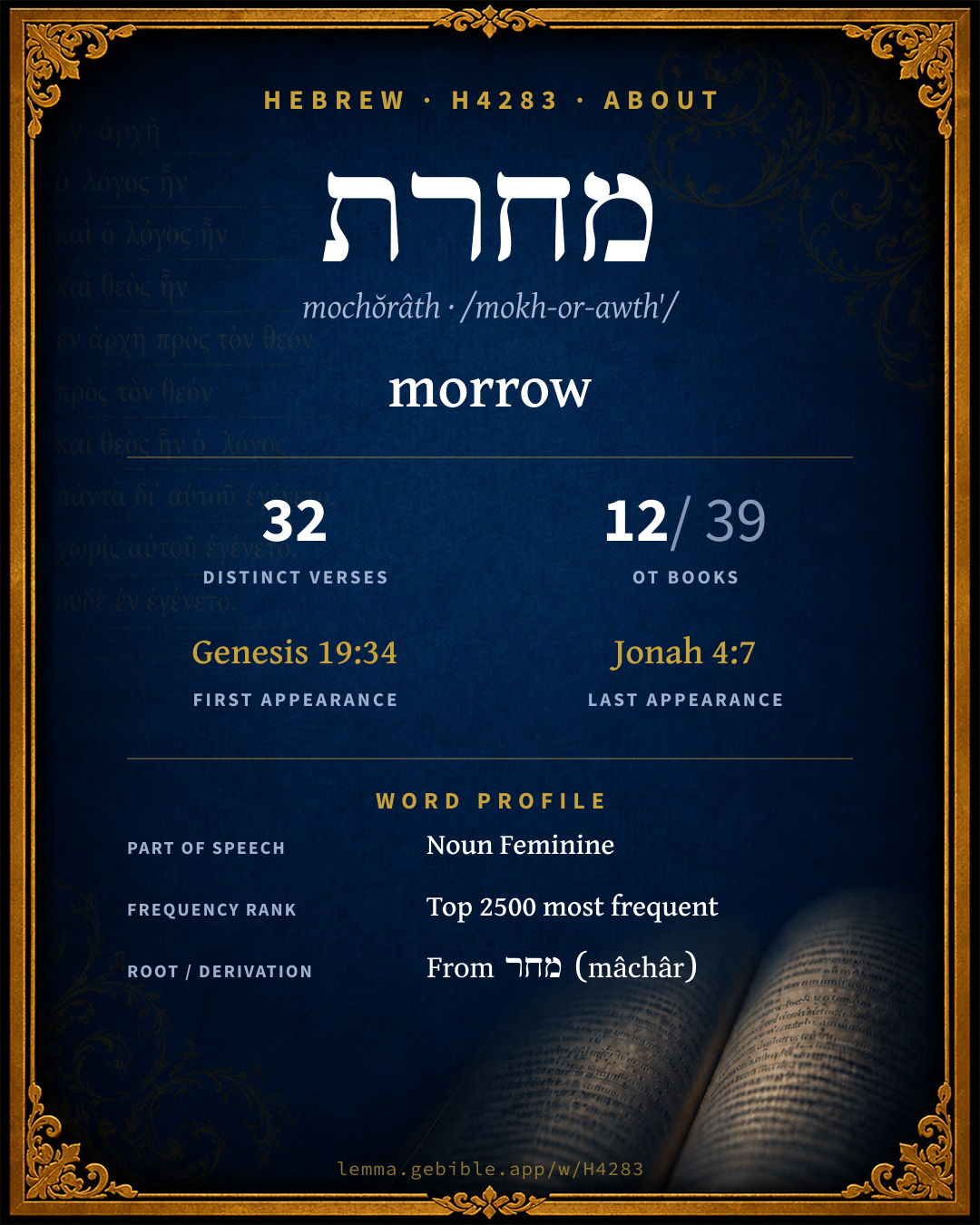
מׇחֳרָת
morrow
Full lexicon entry — Brown-Driver-Briggs (BDB)
From Brown-Driver-Briggs (BDB)
Where this word appears
See every Absolute-state word in the Hebrew Bible →
Grammar key — what these labels mean
Noun type
- Common
- A common noun — a general class of person, place, or thing (“king,” “city,” “water”), not a specific name.
State
- Absolute
- The independent form of a noun, not bound to a following word.
- Construct
- A noun bound to a following noun in a possessive / “of” relationship (the construct chain).
Gender
- Feminine
- Grammatically feminine.
Number
- Singular
- One.
Grammatical forms
- Noun, Common, Feminine, Singular, Absolute 24 times (75%)
- Noun, Common, Feminine, Singular, Construct 8 times (25%)
Parsed forms decoded from the imported morphology (morphhb / Westminster Leningrad Codex — WLC text public domain, morphhb tagging CC BY 4.0), counted across 32 parsed occurrences — not distinct verses.
Every verse where H4283 appears — 32 distinct verses across 12 books. Click any verse to open its interlinear word-by-word view. Verse text shown in the World English Bible for context — . Each verse’s Hebrew form is shown with its reference; the English is not keyword-highlighted, since the data carries no word-level English alignment. Use “Compare translations” on any verse to read it across multiple English versions. This concordance covers the Hebrew Bible; Septuagint (Greek Old Testament) occurrences are not indexed here.
Genesis 1 verse
Exodus 4 verses
- Exodus 9:6 מִֽ/מָּחֳרָ֔ת prep + n c fs Yahweh did that thing on the next day; and all the cattle of Egypt died, but of the cattle of the children of Israel, not one died.
- Exodus 18:13 מִֽ/מָּחֳרָ֔ת prep + n c fs It happened on the next day, that Moses sat to judge the people, and the people stood around Moses from the morning to the evening.
- Exodus 32:6 מִֽ/מָּחֳרָ֔ת prep + n c fs They rose up early on the next day, and offered burnt offerings, and brought peace-offerings; and the people sat down to eat and to drink, and rose up to play.
- Exodus 32:30 מִֽ/מָּחֳרָ֔ת prep + n c fs It happened on the next day, that Moses said to the people, "You have sinned a great sin. Now I will go up to Yahweh. Perhaps I shall make atonement for your sin."
Leviticus 5 verses
- Leviticus 7:16 וּ/מִֽ/מָּחֳרָ֔ת conj + prep + n c fs "'But if the sacrifice of his offering is a vow, or a freewill offering, it shall be eaten on the day that he offers his sacrifice; and on the next day what remains of it shall be eaten:
- Leviticus 19:6 וּ/מִֽ/מָּחֳרָ֑ת conj + prep + n c fs It shall be eaten the same day you offer it, and on the next day: and if anything remains until the third day, it shall be burned with fire.
- Leviticus 23:11 מִֽ/מָּחֳרַת֙ prep + n c fs cs and he shall wave the sheaf before Yahweh, to be accepted for you. On the next day after the Sabbath the priest shall wave it.
- Leviticus 23:15 מִ/מָּחֳרַ֣ת prep + n c fs cs "'You shall count from the next day after the Sabbath, from the day that you brought the sheaf of the wave offering; seven Sabbaths shall be completed:
- Leviticus 23:16 מִֽ/מָּחֳרַ֤ת prep + n c fs cs even to the next day after the seventh Sabbath you shall number fifty days; and you shall offer a new meal offering to Yahweh.
Numbers 4 verses
- Numbers 11:32 הַֽ/מָּחֳרָ֗ת ptcl def.art + n c fs The people rose up all that day, and all the night, and all the next day, and gathered the quails: he who gathered least gathered ten homers: and they spread them all abroad for themselves round about the camp.
- Numbers 16:41 מִֽ/מָּחֳרָ֔ת prep + n c fs But on the next day all the congregation of the children of Israel murmured against Moses and against Aaron, saying, You have killed the people of Yahweh.
- Numbers 17:8 מִֽ/מָּחֳרָ֗ת prep + n c fs It happened on the next day, that Moses went into the tent of the testimony; and, behold, the rod of Aaron for the house of Levi was budded, and put forth buds, and produced blossoms, and bore ripe almonds.
- Numbers 33:3 מִֽ/מָּחֳרַ֣ת prep + n c fs cs They traveled from Rameses in the first month, on the fifteenth day of the first month; on the next day after the Passover the children of Israel went out with a high hand in the sight of all the Egyptians,
Joshua 2 verses
- Joshua 5:11 מִ/מָּֽחֳרַ֥ת prep + n c fs cs They ate of the produce of the land on the next day after the Passover, unleavened cakes and parched grain, in the same day.
- Joshua 5:12 מִֽ/מָּחֳרָ֗ת prep + n c fs The manna ceased on the next day, after they had eaten of the produce of the land; neither had the children of Israel manna any more; but they ate of the fruit of the land of Canaan that year.
Judges 3 verses
- Judges 6:38 מִֽ/מָּחֳרָ֔ת prep + n c fs It was so; for he rose up early on the next day, and pressed the fleece together, and wrung the dew out of the fleece, a bowl full of water.
- Judges 9:42 מִֽ/מָּחֳרָ֔ת prep + n c fs It happened on the next day, that the people went out into the field; and they told Abimelech.
- Judges 21:4 מִֽ/מָּחֳרָ֔ת prep + n c fs It happened on the next day that the people rose early, and built there an altar, and offered burnt offerings and peace-offerings.
1 Samuel 7 verses
- 1 Samuel 5:3 מִֽ/מָּחֳרָ֔ת prep + n c fs When they of Ashdod arose early on the next day, behold, Dagon was fallen on his face to the ground before the ark of Yahweh. They took Dagon, and set him in his place again.
- 1 Samuel 5:4 מִֽ/מָּחֳרָת֒ prep + n c fs When they arose early on the next day morning, behold, Dagon was fallen on his face to the ground before the ark of Yahweh; and the head of Dagon and both the palms of his hands [lay] cut off on the threshold; only [the stump of] Dagon was left to him.
- 1 Samuel 11:11 מִֽ/מָּחֳרָ֗ת prep + n c fs It was so on the next day, that Saul put the people in three companies; and they came into the midst of the camp in the morning watch, and struck the Ammonites until the heat of the day: and it happened, that those who remained were scattered, so that no two of them were left together.
- 1 Samuel 18:10 מִֽ/מָּחֳרָ֗ת prep + n c fs It happened on the next day, that an evil spirit from God came mightily on Saul, and he prophesied in the midst of the house: and David played with his hand, as he did day by day. Saul had his spear in his hand;
- 1 Samuel 20:27 מִֽ/מָּחֳרַ֤ת prep + n c fs cs It happened on the next day after the new moon, [which was] the second [day], that David's place was empty: and Saul said to Jonathan his son, Why doesn't the son of Jesse come to meat, neither yesterday, nor today?
- 1 Samuel 30:17 לְ/מָֽחֳרָתָ֑/ם prep + n c fs cs + sfx pers 3mp David struck them from the twilight even to the evening of the next day: and there not a man of them escaped, except four hundred young men, who rode on camels and fled.
- 1 Samuel 31:8 מִֽ/מָּחֳרָ֔ת prep + n c fs It happened on the next day, when the Philistines came to strip the slain, that they found Saul and his three sons fallen on Mount Gilboa.
2 Samuel 1 verse
2 Kings 1 verse
1 Chronicles 2 verses
- 1 Chronicles 10:8 מִֽ/מָּחֳרָ֔ת prep + n c fs It happened on the next day, when the Philistines came to strip the slain, that they found Saul and his sons fallen on Mount Gilboa.
- 1 Chronicles 29:21 לְֽ/מָחֳרַת֮ prep + n c fs cs They sacrificed sacrifices to Yahweh, and offered burnt offerings to Yahweh, on the next day after that day, even one thousand bulls, one thousand rams, and one thousand lambs, with their drink-offerings, and sacrifices in abundance for all Israel,
Jeremiah 1 verse
Jonah 1 verse
About this entry
At a glance — auto-summarized from this page’s data, not written by a person. Every figure links to its source below. This summary describes the numbers; it doesn’t interpret them.
At its core, מחרת (mochŏrâth) means “morrow.” Older and newer Bibles part ways — “morrow” in the King James Version, “next day” (Berean Standard Bible) in modern versions. See the renderings breakdown. It appears 32 verses across 12 books of the Hebrew Bible, among its moderately common vocabulary. Scripture first uses it in Genesis 19:34. Dig into 32-verse concordance and the renderings breakdown below.
Gloss history
Strong's 1890 vs modern scholarship
About this word
Strong's H4283 catalogs a Hebrew word from the Hebrew Old Testament.
These counts are not copied from any lexicon or concordance. They are computed here, from the morphology-tagged Hebrew Old Testament. What Lemma adds →
- 32
- distinct verses
- The word appears in 32 distinct verses.
- 12 / 39
- OT books
- The word appears in 12 of 39 Old Testament books.
- #1,086
- by frequency
- Top 2500 most frequent Hebrew words (rank 1,086 of 8,640 Hebrew words by occurrence).
View all 32 occurrences in the concordance →
By section of the Old Testament
By traditional corpus
Conventional, traditional groupings — biblical authorship is debated, so this is a traditional corpus grouping, not an authorship claim. Each share is this word’s portion of its verses in that division of the Hebrew canon. Each figure is a share of the word’s 32 distinct verses.
- Prophets (Nevi'im) 16 verses · 50%
- Torah (Pentateuch) 14 verses · 44%
- Writings (Ketuvim) 2 verses · 6%
How translations render this word
Counts come from each version’s own published word-to-Strong’s tagging or interlinear alignment — an approximate guide to how each version renders this word, not a word-level alignment the data otherwise carries. Because each total is that version’s own tagged count, the per-version totals vary from one another and need not match the appearance or distinct-verse counts above. These counts may also differ from a printed concordance because Lemma counts each distinctly tagged rendering and does not collapse phrase taggings into a single head-word total. This is a fixed set of word-tagged versions (KJV, ASV, BSB, ULT) and does not change with the reading translation you choose elsewhere. Each version’s license is shown beside its name below (and on Sources).
- King James Version: Morrow 14×, Came to pass on the morrow 11×, Next day 2×
- American Standard Version: Came to pass on the morrow 12×, Morrow 12×, Next day 2×
- Berean Standard Bible: Next day 19×, Day after 6×, Next 3×
- unfoldingWord Literal Text: Next day 21×, Day after 4×, Morrow of 3×
King James Version Public Domain
Renders H4283 across 32 tagged occurrences — most commonly:
Plus 5 renderings that appear only once — usually multi-word phrases or single function words the recovered tagging swept in, not distinct renderings.
American Standard Version Public Domain
Renders H4283 across 33 tagged occurrences — most commonly:
Plus 7 renderings that appear only once — usually multi-word phrases or single function words the recovered tagging swept in, not distinct renderings.
Berean Standard Bible Public Domain
Renders H4283 across 32 tagged occurrences — most commonly:
Plus 2 renderings that appear only once — usually multi-word phrases or single function words the recovered tagging swept in, not distinct renderings.
unfoldingWord Literal Text CC BY-SA 4.0
Renders H4283 across 32 tagged occurrences — most commonly:
Plus 4 renderings that appear only once — usually multi-word phrases or single function words the recovered tagging swept in, not distinct renderings.
Senses in BDB
The 1 sense BDB distinguishes for this word, in lexicon order (not ranked by frequency or importance). The full entry — with sub-senses — is in the Lexicon Entry tab.
- the morrow, the day after
Word origin
מָחֳרָת n.f. the morrow (the day following a past day)
— Brown-Driver-Briggs (Oxford 1906, public domain), digitized via Sefaria, supplemented by the OpenScriptures HebrewLexicon (CC BY 4.0). See Sources.
Derived from מחר (mâchâr) (H4279) — tomorrow.
Jastrow Dictionary
A second Hebrew/Aramaic lexicon for comparison, covering Aramaic and post-biblical (Talmudic, Targumic, Midrashic) usage that the biblical-Hebrew BDB does not. Matched by lemma rather than by Strong’s number, so a lemma may carry more than one Jastrow headword (shown separately below), and the entries cover usage well beyond the Bible.
מָחֳרָת
- , v. מָחָר
A Dictionary of the Targumim, the Talmud Babli and Yerushalmi, and the Midrashic Literature (Marcus Jastrow; London, Luzac, 1903) — Public Domain. Digitized via Sefaria. Digitized via Sefaria. Full attribution on Sources.
Forms in the corpus
The 15 distinct written forms H4283 takes in the Hebrew Bible, most frequent first — each parse links to that state’s occurrences in the concordance. Hebrew forms include their vowel points and cantillation, so a single lemma takes many written forms.
Septuagint verse parallels
This word appears in 31 verses that also exist in the Greek Old Testament (Septuagint), out of the 32 Hebrew verses it occurs in. You can read those verses in Greek by switching the Old Testament edition to the Septuagint.
Read these verses in the Septuagint
- Genesis 19:34
- Exodus 9:6
- Leviticus 7:16
- Numbers 11:32
- Joshua 5:11
- Judges 6:38
- 1 Samuel 5:3
- 2 Samuel 11:12
- 2 Kings 8:15
- 1 Chronicles 10:8
- Jeremiah 20:3
- Jonah 4:7
This is a verse-level parallel only — the same verses exist in both the Hebrew and Greek Old Testaments. No word-level Hebrew↔Greek correspondence is claimed: the data carries no such alignment, so no Greek word is shown as this Hebrew word’s translation. Coverage is not total — the Septuagint omits the deuterocanon and renumbers the Psalms, so some Hebrew verses have no direct Greek parallel.