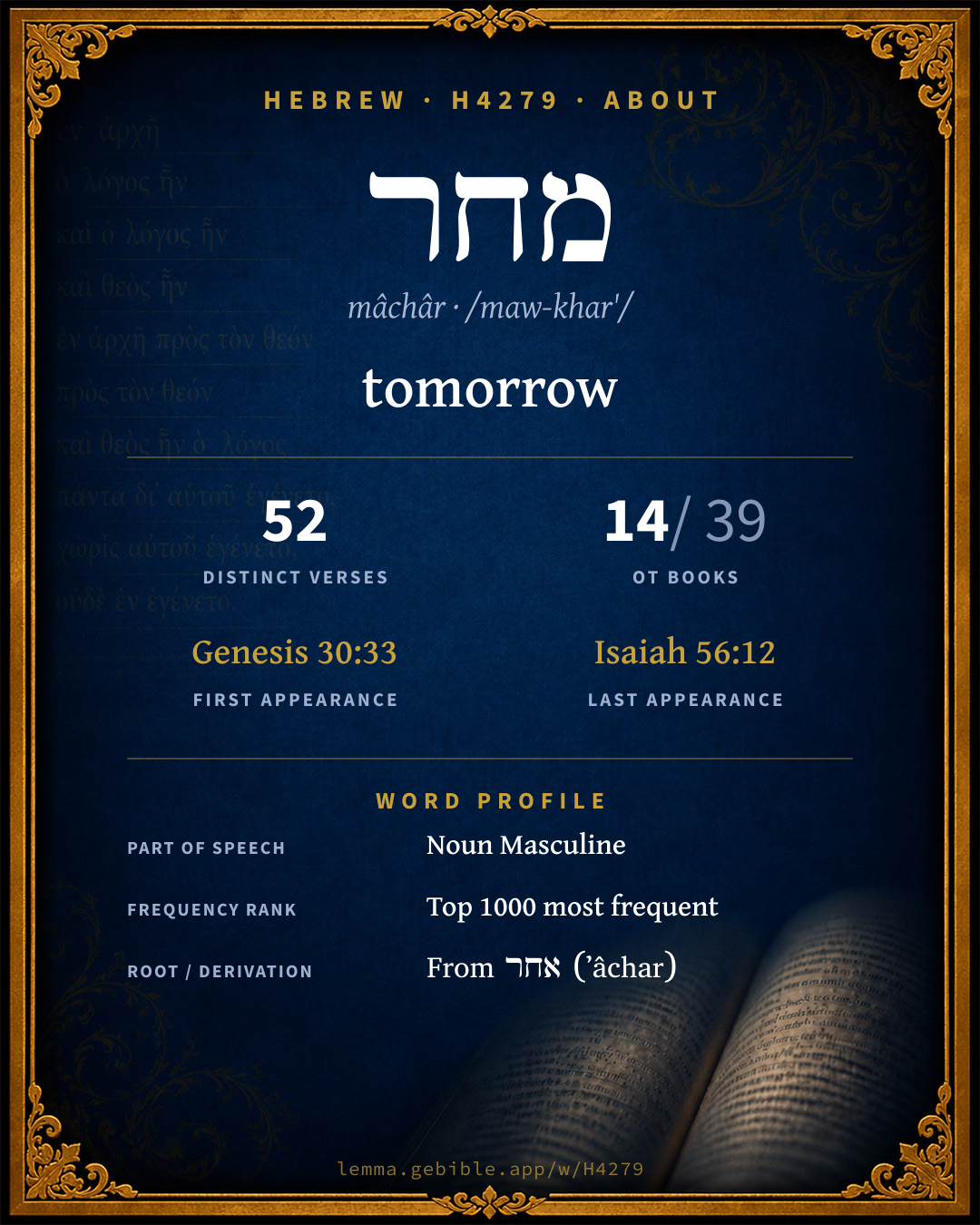
מָחָר
tomorrow
‘tomorrow’ is one of 3 main senses fuller range ↓
Full lexicon entry — Brown-Driver-Briggs (BDB)
From Brown-Driver-Briggs (BDB)
Where this word appears
Grammar key — what these labels mean
Part of speech
- Noun
- A naming word — a person, place, thing, or idea.
Noun type
- Common
- A common noun — a general class of person, place, or thing (“king,” “city,” “water”), not a specific name.
State
- Absolute
- The independent form of a noun, not bound to a following word.
Gender
- Masculine
- Grammatically masculine.
Number
- Singular
- One.
Every verse where H4279 appears in the Book of 2 Samuel — 1 distinct verse. Click any verse to open its interlinear word-by-word view. Verse text shown in the World English Bible for context — . Each verse’s Hebrew form is shown with its reference; the English is not keyword-highlighted, since the data carries no word-level English alignment. Use “Compare translations” on any verse to read it across multiple English versions. This concordance covers the Hebrew Bible; Septuagint (Greek Old Testament) occurrences are not indexed here.
2 Samuel
About this entry
At a glance — auto-summarized from this page’s data, not written by a person. Every figure links to its source below. This summary describes the numbers; it doesn’t interpret them.
“tomorrow” is the headline sense of the Hebrew noun מחר (mâchâr). Translators differ — “morrow” in the King James Version, then “tomorrow” (Berean Standard Bible), as the renderings breakdown shows. With 52 verses in 14 books, it is a moderately common word in the Hebrew Bible. First canonically at Genesis 30:33, it enters the text early. Its meaning spans more than one sense — see its full sense range. See the sense tree, 52-verse concordance, and the renderings breakdown below.
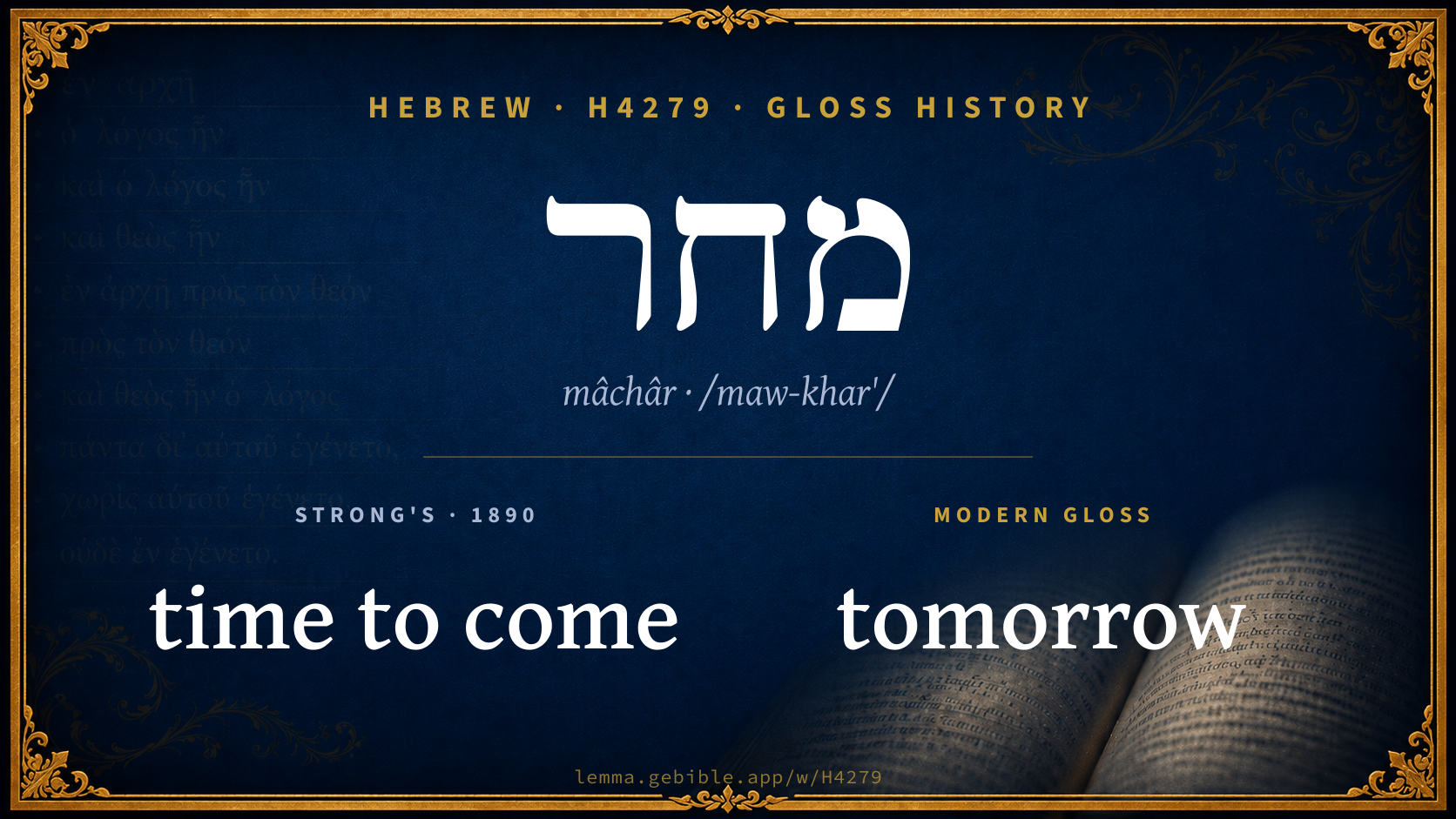
Gloss history
Strong's 1890 vs modern scholarship
About this word
Strong's H4279 catalogs a Hebrew word from the Hebrew Old Testament.
These counts are not copied from any lexicon or concordance. They are computed here, from the morphology-tagged Hebrew Old Testament. What Lemma adds →
- 52
- distinct verses
- The word appears in 52 distinct verses.
- 14 / 39
- OT books
- The word appears in 14 of 39 Old Testament books.
- #718
- by frequency
- Top 1000 most frequent Hebrew words (rank 718 of 8,640 Hebrew words by occurrence).
View all 52 occurrences in the concordance →
By section of the Old Testament
By traditional corpus
Conventional, traditional groupings — biblical authorship is debated, so this is a traditional corpus grouping, not an authorship claim. Each share is this word’s portion of its verses in that division of the Hebrew canon. Each figure is a share of the word’s 52 distinct verses.
- Prophets (Nevi'im) 28 verses · 54%
- Torah (Pentateuch) 17 verses · 33%
- Writings (Ketuvim) 7 verses · 13%
How translations render this word
Counts come from each version’s own published word-to-Strong’s tagging or interlinear alignment — an approximate guide to how each version renders this word, not a word-level alignment the data otherwise carries. Because each total is that version’s own tagged count, the per-version totals vary from one another and need not match the appearance or distinct-verse counts above. These counts may also differ from a printed concordance because Lemma counts each distinctly tagged rendering and does not collapse phrase taggings into a single head-word total. This is a fixed set of word-tagged versions (KJV, ASV, BSB, ULT) and does not change with the reading translation you choose elsewhere. Each version’s license is shown beside its name below (and on Sources).
- King James Version: Morrow 33×, Time to come 4×, Behold to morrow 3×
- American Standard Version: To-morrow 27×, Time to come 4×, Behold 3×
- Berean Standard Bible: Tomorrow 42×, Future 6×
- unfoldingWord Literal Text: Tomorrow 48×
King James Version Public Domain
Renders H4279 across 52 tagged occurrences — most commonly:
Plus 8 renderings that appear only once — usually multi-word phrases or single function words the recovered tagging swept in, not distinct renderings.
American Standard Version Public Domain
Renders H4279 across 54 tagged occurrences — most commonly:
Plus 16 renderings that appear only once — usually multi-word phrases or single function words the recovered tagging swept in, not distinct renderings.
Berean Standard Bible Public Domain
Renders H4279 across 49 tagged occurrences — most commonly:
Plus 1 rendering that appears only once — usually multi-word phrases or single function words the recovered tagging swept in, not distinct renderings. Not rendered by a distinct English word in 3 further occurrences.
unfoldingWord Literal Text CC BY-SA 4.0
Renders H4279 across 52 tagged occurrences — most commonly:
Plus 4 renderings that appear only once — usually multi-word phrases or single function words the recovered tagging swept in, not distinct renderings.
Senses in the full BDB
What do BDB’s symbols mean?
BDB uses these scholarly abbreviations:
| Symbol | Meaning |
|---|---|
| 𝔊 | the Septuagint (the ancient Greek translation, LXX) |
| 𝔙 | the Vulgate (the Latin translation) |
| 𝔖 | the Syriac version (the Peshitta) |
| 𝔗 | the Targum (the Aramaic translation) |
| ψ | the Psalms |
| √ | root (the underlying root or stem) |
| ‖ | parallel passage (a synonymous or contrasted parallel) |
| † | the dagger: every passage where the word occurs is cited |
The 4 senses and sub-senses the full Brown-Driver-Briggs lexicon distinguishes for this word, in lexicon order (not ranked by frequency), with BDB’s own verbatim wording and sub-sense lettering. Shown in Hebrew script with BDB’s own scholarly abbreviations. The condensed entry is in the Lexicon Entry tab. See also the Forms in the corpus table below.
- 1. to-morrow (the day following the present day),
- a. as subst. Ex 16:23 שַׁבָּתוֹן שַׁבַּת קֹדֶשׁ לְי׳ מָחָר to-morrow is a sabbath, etc., 1 S 20:5 חֹדֶשׁ מָחָר to-morrow is the new moon, v 18; in יוֹם מָחָר †Gn 30:33 Pr 27:1 Is 56:12; in the idiom. phr. כָּעֵת מָחָר at the like of the time, (being) to-morrow, = about to-morrow (v. כְּ 1 a) †Ex 9:18 1 S 9:16; 20:12 1 K 19:2; 20:6 2 K 7:1, 18; 10:6; and in לְמָחָר †Ex 8:19 לְמָחָר יִהְיֶה הָאֹת הַזֶּה, = for, against, to-morrow, Ex 8:6 Nu 11:18 Jos 7:13 Est 5:12. e.g. Exodus 16:23
- b. as adv. acc. Ex 8:25; 9:5 מָחָר יַעֲשֶׂה י׳ הַדָּבָר הָזֶּה, 10:4 הִנְנִי מֵבִיא מָחָר אַרְבֶּה, 17:9; 32:5 Nu 14:25 1 S 11:9 etc., Jos 11:6 מָחָר כָּעֵת הַזֹּאת; opp. to הַיּוֹם Ex 19:10 הַיּוֹם וּמָחָר Jos 22:18 2 S 11:12a; rhetorically, Is 22:13 כִּי מָחָר נָמוּת. e.g. Exodus 8:25
- 2. = in future time, Ex 13:14 כִּי יִשְׁאָֽלְךָ בִנְךָ מָחָר לֵאמֹר = Dt 6:20, Jos 4:6, 21; 22:24, 27, 28; so בְּיוֹם מָחָר Gn 30:33. e.g. Exodus 13:14
Senses from the full Brown-Driver-Briggs lexicon (Brown, Driver, Briggs; Oxford 1906 — public domain), digitized via Sefaria, supplemented by the OpenScriptures HebrewLexicon (CC BY 4.0). Full attribution on Sources.
Word origin
n.m., used often as adv., to-morrow, in time to come (Aramaic מְחַר, ܡܚܰܪ; prob. properly time in front, Köii. 263, cf. √, and Assyrian maḫru, front, often of time, though always of former time, of old, DlHWB 402):—
— Brown-Driver-Briggs (Oxford 1906, public domain), digitized via Sefaria, supplemented by the OpenScriptures HebrewLexicon (CC BY 4.0). See Sources.
Derived from אחר (ʼâchar) (H309) — to delay.
Jastrow Dictionary
A second Hebrew/Aramaic lexicon for comparison, covering Aramaic and post-biblical (Talmudic, Targumic, Midrashic) usage that the biblical-Hebrew BDB does not. Matched by lemma rather than by Strong’s number, so a lemma may carry more than one Jastrow headword (shown separately below), and the entries cover usage well beyond the Bible.
מָחָר
- (b. h.; = מאחר; אָחַר) next day, future day. Mekh. Bo. 18 יש מ׳ עכשיו וכ׳ there is a maḥar which means now (the next day), and there is a maḥar which means some future time; Yalk. Ex. 225.—Ber. 28ᵃ למ׳ אני ואתה וכ׳ to-morrow I and you &c. Sot. 48ᵇ כל מי … מה אוכל למ׳ וכ׳ he who has bread in his basket and says, what shall I have to eat to-morrow? &c.—Y. Gitt. II, 44ᵃ bot. הוא לילה הוא למ׳ וכ׳ it makes no difference whether the same night or the next day or after some time; a. fr.—מָחֳרָת f., constr. מָחֲרַת. Men. 65ᵇ ממ׳ השבת מ׳ יו"ט ‘the morrow of the Sabbath’ (Lev. XXIII, 11) means the day after the first day of the Festival (Passover). Ib. או אינו אלא למ׳ שבת בראשית may it not mean the morrow after the regular weekly Sabbath?; a. e.—מָחֳרָתַיִם day after to-morrow. Midr. Till. to Ps. XII ולמ׳ נלך וכ׳ and the day after to-morrow we shall go &c. e.g. Leviticus 23:11
מְחַר
- Targ. Ex. XVII, 9. Targ. Prov. XXVII, 1 דְּלִמְ׳; a. fr.—Lev. R. s. 34 למ׳ לית היא הכא to-morrow she (the soul) is no more here. Y. Gitt. II, 44ᵇ top מחרא דמחר the day after to-morrow; a. e.
A Dictionary of the Targumim, the Talmud Babli and Yerushalmi, and the Midrashic Literature (Marcus Jastrow; London, Luzac, 1903) — Public Domain. Digitized via Sefaria. Digitized via Sefaria. Full attribution on Sources.
Forms in the corpus
The 18 distinct written forms H4279 takes in the Hebrew Bible, most frequent first — each parse links to that state’s occurrences in the concordance. Hebrew forms include their vowel points and cantillation, so a single lemma takes many written forms.
| Form | Parsing | Example | Uses |
|---|---|---|---|
| מָחָר֙ | Noun, Common, Masculine, Singular, Absolute | 1 Kings 19:2 | 9 |
| מָחָ֖ר | Noun, Common, Masculine, Singular, Absolute | Deuteronomy 6:20 | 7 |
| מָחָ֗ר | Noun, Common, Masculine, Singular, Absolute | Esther 9:13 | 7 |
| מָחָ֔ר | Noun, Common, Masculine, Singular, Absolute | Exodus 9:18 | 6 |
| מָחָ֑ר | Noun, Common, Masculine, Singular, Absolute | Exodus 8:29 | 4 |
| מָחָֽר | Noun, Common, Masculine, Singular, Absolute | Exodus 32:5 | 3 |
| וּ/מָחָ֕ר | Noun, Common, Masculine, Singular, Absolute | 1 Samuel 28:19 | 2 |
| וּ/מָחָ֥ר | Noun, Common, Masculine, Singular, Absolute | Esther 5:8 | 2 |
| לְ/מָחָ֑ר | Noun, Common, Masculine, Singular, Absolute | Exodus 8:10 | 2 |
| מָחָ֛ר | Noun, Common, Masculine, Singular, Absolute | Exodus 10:4 | 2 |
| וּ/מָחָ֑ר | Noun, Common, Masculine, Singular, Absolute | Exodus 19:10 | 1 |
| וּ/מָחָ֣ר | Noun, Common, Masculine, Singular, Absolute | 2 Samuel 11:12 | 1 |
| לְ/מָחָ֛ר | Noun, Common, Masculine, Singular, Absolute | Esther 5:12 | 1 |
| לְ/מָחָ֥ר | Noun, Common, Masculine, Singular, Absolute | Exodus 8:23 | 1 |
| לְ/מָחָר֮ | Noun, Common, Masculine, Singular, Absolute | Numbers 11:18 | 1 |
| מָחָ֞ר | Noun, Common, Masculine, Singular, Absolute | Joshua 11:6 | 1 |
| מָחָ֡ר | Noun, Common, Masculine, Singular, Absolute | 1 Samuel 9:16 | 1 |
| מָחָ֣ר | Noun, Common, Masculine, Singular, Absolute | 1 Samuel 20:18 | 1 |
Same root — word family
Other BDB entries built from the same root as H4279, grouped by Strong’s listed origin. These share a root / origin per the lexicon — not necessarily a shared meaning. Each links to that word’s own entry.
Derives from
Shares the same root
Derived from this word
Compare all same-root words → Showing 4 of 6 — not the complete family. They share a root, not necessarily a meaning.
Septuagint verse parallels
This word appears in 50 verses that also exist in the Greek Old Testament (Septuagint), out of the 52 Hebrew verses it occurs in. You can read those verses in Greek by switching the Old Testament edition to the Septuagint.
Read these verses in the Septuagint
- Genesis 30:33
- Exodus 8:10
- Numbers 11:18
- Deuteronomy 6:20
- Joshua 3:5
- Judges 19:9
- 1 Samuel 9:16
- 2 Samuel 11:12
- 1 Kings 19:2
- 2 Kings 6:28
- 2 Chronicles 20:16
- Esther 5:8
This is a verse-level parallel only — the same verses exist in both the Hebrew and Greek Old Testaments. No word-level Hebrew↔Greek correspondence is claimed: the data carries no such alignment, so no Greek word is shown as this Hebrew word’s translation. Coverage is not total — the Septuagint omits the deuterocanon and renumbers the Psalms, so some Hebrew verses have no direct Greek parallel.