
1 Samuel 28:19

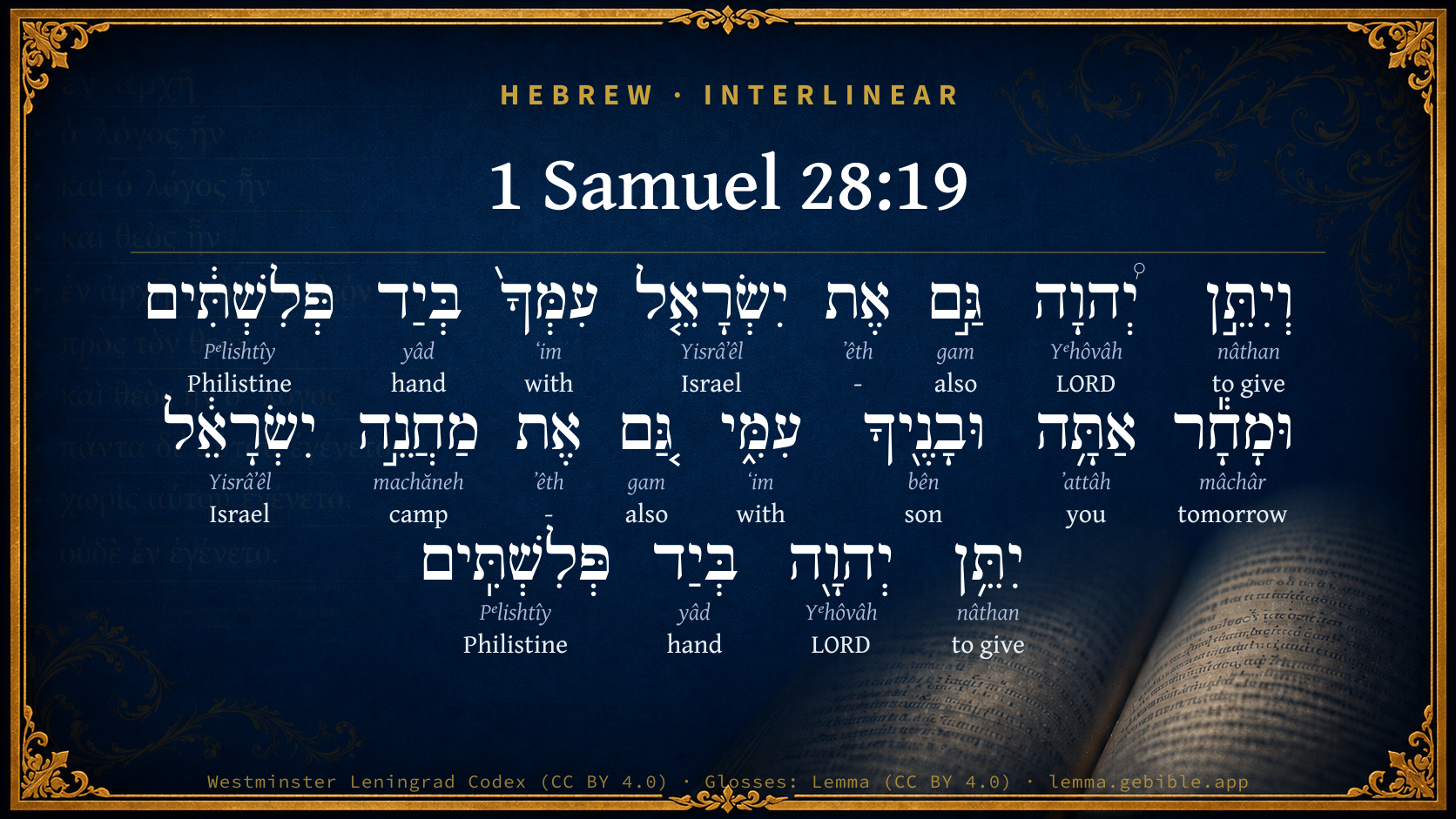
Hebrew (Westminster Leningrad Codex) 1 Samuel 28:19 appears in the Hebrew Old Testament. The text above is from the Westminster Leningrad Codex. Each word links to its Strong’s number, a concise gloss, and parsing drawn from the Open Scriptures Hebrew Bible morphology. Click any word for its full Brown-Driver-Briggs (BDB) entry.
Download image
Cite this verse

1 Samuel 28:19 (World English Bible). Public Domain. Lemma interlinear Bible study tool, https://lemma.gebible.app/v/1-samuel/28/19.

Show BibTeX & RIS
BibTeX
RIS
English Translation
Moreover Yahweh will deliver Israel also with you into the hand of the Philistines; and tomorrow shall you and your sons be with me: Yahweh will deliver the host of Israel also into the hand of the Philistines.
World English Bible · Public Domain
Download a study sheet

One document with this verse’s original text, its word-by-word gloss line, the meaning frame, cross-references with their text, attributed commentary, and full source and license credits — printable, and it pastes into notes with its structure intact.

This verse Autodidact and up

Study sheet (.html) Plain text (.txt)

A passage Seminary Student

Up to 50 verses in one chapter. A passage sheet keeps up to 6 commentary sources and 12 cross-references per verse, in the order this page ranks them, and says so on the sheet whenever that leaves anything out. Ask for a single verse and you get the Autodidact verse sheet above.

Everything on this page stays free to read, with no account — the sheet is a download of what is already on screen, not access to it.

Want to remove ads? Support Godless Engineer
Compare translations 3

The same verse in 3 English versions, stacked beneath the original-language interlinear above. Click any original word for its lexicon entry.

Each is an independent rendering of the whole verse — the interlinear is not word-aligned to these translations.

Highlighted words mark where these versions differ — a whole-verse word diff, not a word-by-word alignment.

  • World English Bible Public Domain
    Moreover Yahweh will deliver Israel also with you into the hand of the Philistines; and tomorrow shall you and your sons be with me: Yahweh will deliver the host of Israel also into the hand of the Philistines.
  • King James Version Public Domain
    Moreover the LORD will also deliver Israel with thee into the hand of the Philistines: and to morrow shalt thou and thy sons be with me: the LORD also shall deliver the host of Israel into the hand of the Philistines.
  • unfoldingWord Literal Text CC BY-SA 4.0
    And Yahweh will also give Israel with you into the hand of the Philistines, and tomorrow you and your sons with me. Yahweh will also give the camp of Israel into the hand of the Philistines.”

unfoldingWord Literal Text — © unfoldingWord, licensed CC BY-SA 4.0. Word-aligned USFM3 via Door43 (git.door43.org/unfoldingWord/en_ult).

Versions to compare (up to 4)

3 of 4 selected

Show all 18 translations

Every available English version of this verse, each an independent rendering of the whole verse.

  • World English Bible Public Domain
    Moreover Yahweh will deliver Israel also with you into the hand of the Philistines; and tomorrow shall you and your sons be with me: Yahweh will deliver the host of Israel also into the hand of the Philistines.
  • Berean Standard Bible Public Domain
    Moreover, the LORD will deliver Israel with you into the hand of the Philistines, and tomorrow you and your sons will be with me. And the LORD will deliver the army of Israel into the hand of the Philistines.”
  • Majority Standard Bible Public Domain
    Moreover, the LORD will deliver Israel with you into the hand of the Philistines, and tomorrow you and your sons will be with me. And the LORD will deliver the army of Israel into the hand of the Philistines.”
  • King James Version Public Domain
    Moreover the LORD will also deliver Israel with thee into the hand of the Philistines: and to morrow shalt thou and thy sons be with me: the LORD also shall deliver the host of Israel into the hand of the Philistines.
  • American Standard Version (1901) Public Domain
    Moreover Jehovah will deliver Israel also with thee into the hand of the Philistines; and to-morrow shalt thou and thy sons be with me: Jehovah will deliver the host of Israel also into the hand of the Philistines.
  • Revised Version (1885) Public Domain
    Moreover the LORD will deliver Israel also with thee into the hand of the Philistines: and tomorrow shalt thou and thy sons be with me: the LORD shall deliver the host of Israel also into the hand of the Philistines.
  • Geneva Bible (1599) Public Domain
    Moreouer the Lord wil deliuer Israel with thee into the handes of the Philistims: and to morowe shalt thou and thy sonnes be with me, and the Lord shall giue the hoste of Israel into the handes of the Philistims.
  • Douay-Rheims (1899) Public Domain
    And the Lord also will deliver Israel with thee into the hands of the Philistines: and to morrow thou and thy sons shall be with me: and the Lord will also deliver the army of Israel into the hands of the Philistines.
  • Young's Literal Translation Public Domain
    yea, Jehovah giveth also Israel with thee into the hand of the Philistines, and tomorrow thou and thy sons `are' with me; also the camp of Israel doth Jehovah give into the hand of the Philistines.'
  • Literal Standard Version CC BY-SA 4.0
    indeed, YHWH also gives Israel into the hand of the Philistines with you, and tomorrow you and your sons [are] with me; YHWH also gives the camp of Israel into the hand of the Philistines.”
  • Unlocked Literal Bible CC BY-SA 4.0
    Yahweh will give Israel along with you into the hand of the Philistines, and tomorrow you and your sons will be with me. Yahweh will also give the army of Israel into the hand of the Philistines.”
  • unfoldingWord Literal Text CC BY-SA 4.0
    And Yahweh will also give Israel with you into the hand of the Philistines, and tomorrow you and your sons with me. Yahweh will also give the camp of Israel into the hand of the Philistines.”
  • Darby Bible Public Domain
    And Jehovah will also give Israel with thee into the hand of the Philistines; and to-morrow shalt thou and thy sons be with me; the army of Israel also will Jehovah give into the hand of the Philistines.
  • World Messianic Bible Public Domain
    Moreover the LORD will deliver Israel also with you into the hand of the Philistines; and tomorrow you and your sons will be with me. The LORD will deliver the army of Israel also into the hand of the Philistines.”
  • Webster's Bible Public Domain
    Moreover, the LORD will also deliver Israel with thee into the hand of the Philistines: and to-morrow shalt thou and thy sons be with me: the LORD also shall deliver the host of Israel into the hand of the Philistines.
  • Free Bible Version CC BY-SA 4.0
    The Lord will hand over Israel and you yourself to the Philistines. Tomorrow you and your sons will die and be with me. The Lord will also hand over the Israelite army to the Philistines.”
  • Bible in Basic English Public Domain
    And more than this, the Lord will give Israel up with you into the hands of the Philistines: and tomorrow you and your sons will be with me: and the Lord will give up the army of Israel into the hands of the Philistines.
  • JPS Tanakh (1917) Public Domain
    Moreover the LORD will deliver Israel also with thee into the hand of the Philistines; and to-morrow shalt thou and thy sons be with me; the LORD will deliver the host of Israel also into the hand of the Philistines.'

Literal Standard Version (2020), Covenant Press — licensed CC BY-SA 4.0. Text via the HelloAO Bible API (eBible.org). Unlocked Literal Bible (unfoldingWord) — licensed CC BY-SA 4.0. Text via the HelloAO Bible API (eBible.org). unfoldingWord Literal Text — © unfoldingWord, licensed CC BY-SA 4.0. Word-aligned USFM3 via Door43 (git.door43.org/unfoldingWord/en_ult). Free Bible Version, Dr. Jonathan Gallagher — licensed CC BY-SA 4.0. Text via the HelloAO Bible API (eBible.org).

Word by word

More ways to search: Search by grammar → Find every occurrence → Compare this word →

Practice this passage: Drill this verse → Learn its vocabulary →

וּמָחָ֕ר
mâchâr
H4279
“and · tomorrow”
Conjunction + Noun, Common, Masculine, Singular, Absolute
Part of Speech
Conjunction + Noun
Type
Common
Gender
Masculine
Number
Singular
State
Absolute
Full BDB Definition

Origin: probably from H309

TWOT: 1185a

tomorrow, in time to come, in the future - tomorrow (as the day following the present day) - in future time
  1. וְיִתֵּ֣ן nâthan H5414 “and · to give” Conjunction + Verb, Qal, Imperfect, 3rd Person, Masculine, Singular
  2. יְ֠הוָה Yᵉhôvâh H3068 “LORD” Noun, Proper
  3. גַּ֣ם gam H1571 “also” Particle, Accusative
  4. אֶת ʼêth H853 “-” Particle, Direct Object
  5. יִשְׂרָאֵ֤ל Yisrâʼêl H3478 “Israel” Noun, Proper
  6. עִמְּךָ֙ ʻim H5973 “with · you” Preposition + Suffix, Personal, 2nd Person, Masculine, Singular
  7. בְּיַד yâd H3027 “in/at · hand of” Preposition + Noun, Common, Both, Singular, Construct
  8. פְּלִשְׁתִּ֔ים Pᵉlishtîy H6430 “Philistines” Noun, Gentilic, Masculine, Plural, Absolute
  9. אַתָּ֥ה ʼattâh H859 “you” Pronoun, Personal, 2nd Person, Masculine, Singular
  10. וּבָנֶ֖יךָ bên H1121 “and · sons · your” Conjunction + Noun, Common, Masculine, Plural, Construct + Suffix, Personal, 2nd Person, Masculine, Singular
  11. עִמִּ֑י ʻim H5973 “with · me” Preposition + Suffix, Personal, 1st Person, Common, Singular
  12. גַּ֚ם gam H1571 “also” Particle, Accusative
  13. אֶת ʼêth H853 “-” Particle, Direct Object
  14. מַחֲנֵ֣ה machăneh H4264 “camp of” Noun, Common, Both, Singular, Construct
  15. יִשְׂרָאֵ֔ל Yisrâʼêl H3478 “Israel” Noun, Proper
  16. יִתֵּ֥ן nâthan H5414 “to give” Verb, Qal, Imperfect, 3rd Person, Masculine, Singular
  17. יְהוָ֖ה Yᵉhôvâh H3068 “LORD” Noun, Proper
  18. בְּיַד yâd H3027 “in/at · hand of” Preposition + Noun, Common, Both, Singular, Construct
  19. פְּלִשְׁתִּֽים Pᵉlishtîy H6430 “Philistines” Noun, Gentilic, Masculine, Plural, Absolute

About this verse

These counts appear in no published source. They are computed here, from the morphology-tagged text and Lemma’s own curated glosses. What Lemma adds →

20
words
12
distinct lemmas
Historical
section

Shared distinctive vocabulary

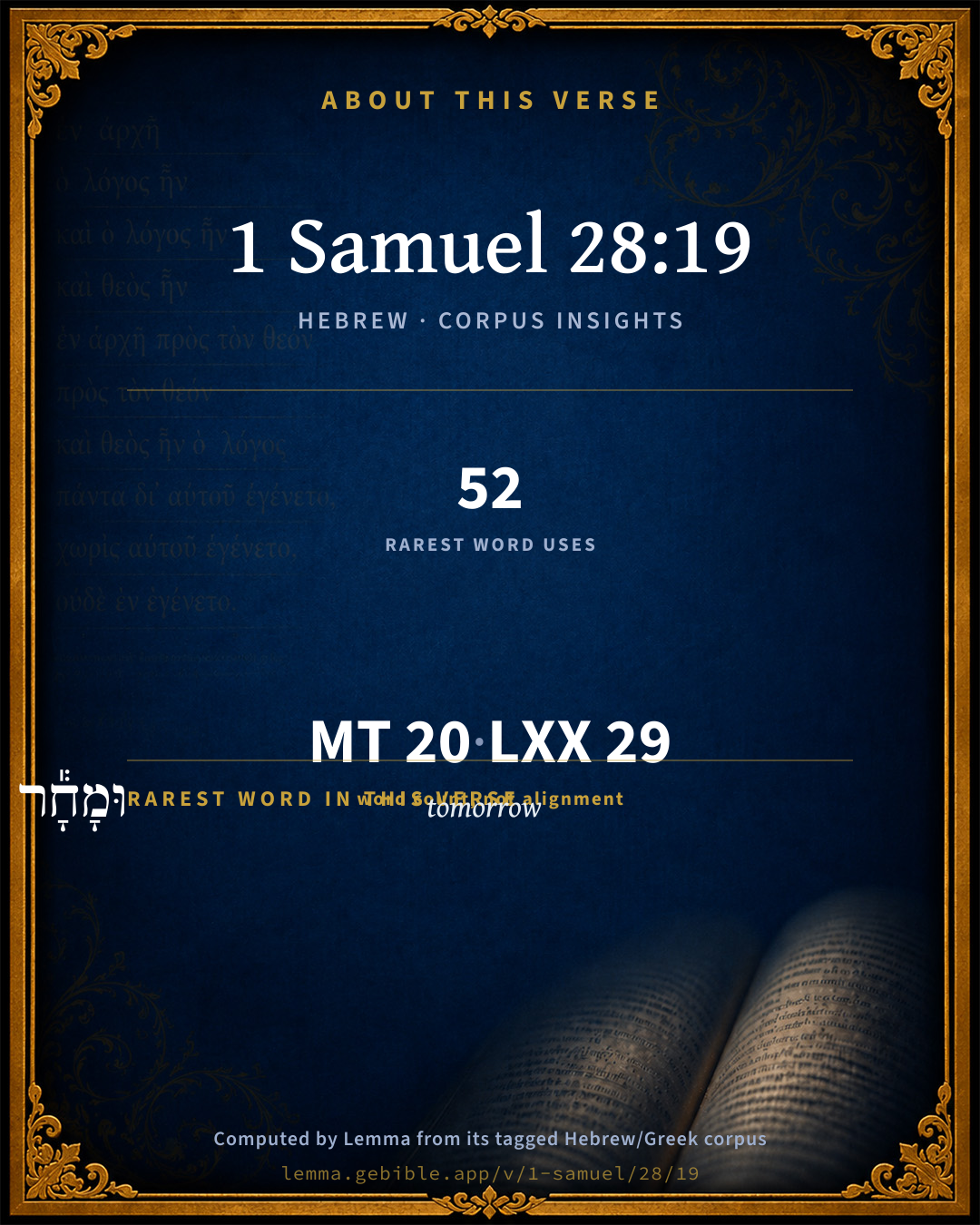
וּמָחָ֕ר tomorrow H4279 occurs in 52 verses of the Hebrew Bible. Also found in:

Grammatical profile

  • 2 verbs
  • 11 nouns
  • 1 pronoun
  • 2 prepositions
  • 4 particles

Verb forms

  • וְיִתֵּ֣ן Qal · Imperfect
  • יִתֵּ֥ן Qal · Imperfect

Repetition

Words recur within this verse — often emphatic in Hebrew:

  • וְיִתֵּ֣ן to give H5414 ×2
  • יְ֠הוָה LORD H3068 ×2
  • גַּ֣ם also H1571 ×2
  • יִשְׂרָאֵ֤ל Israel H3478 ×2
  • בְּיַד hand H3027 ×2
  • פְּלִשְׁתִּ֔ים Philistine H6430 ×2
  • עִמְּךָ֙ with H5973 ×2

Hebrew & Septuagint length

In English translation the verse runs 38 words from the Hebrew and 39 from the Septuagint (LXX English) — closely comparable.

A rough comparison of the two English renderings, which tokenize alike — not a word-level alignment.

Word counts can differ between the Hebrew and the Greek without any difference in meaning — e.g. the Hebrew direct-object marker אֵת has no separate Greek word, and Greek often adds the article ὁ.

In the original languages it is 20 Hebrew tokens and 29 Greek tokens — but the two are counted differently (Hebrew bundles its prefixes and suffixes into one token; the Greek is in lemma form), so that isn’t a like-for-like length.

Cross-references

10

Topical passages linked to 1 Samuel 28:19 in the Treasury of Scripture Knowledge — connected by theme and wording, ordered by reader-vote popularity; previews shown in the World English Bible.

  • Exodus 9:18 Behold, tomorrow about this time I will cause it to rain a very grievous hail, such as has not been in Egypt since the day it was founded even until now.
  • 1 Samuel 12:25 But if you shall still do wickedly, you shall be consumed, both you and your king."
  • 1 Samuel 31:1–6 Now the Philistines fought against Israel: and the men of Israel fled from before the Philistines, and fell down slain on Mount Gilboa.
  • 1 Kings 22:20 Yahweh said, Who shall entice Ahab, that he may go up and fall at Ramoth-gilead? One said on this manner; and another said on that manner.
  • 1 Kings 22:28 Micaiah said, If you return at all in peace, Yahweh has not spoken by me. He said, Hear, you peoples, all of you.
  • Jeremiah 28:16–17 Therefore thus says Yahweh, Behold, I will send you away from off the surface of the earth: this year you shall die, because you have spoken rebellion against Yahweh.
  • Matthew 26:24 The Son of Man goes, even as it is written of him, but woe to that man through whom the Son of Man is betrayed! It would be better for that man if he had not been born."
  • Acts 5:5 Ananias, hearing these words, fell down and died. Great fear came on all who heard these things.
  • Acts 5:9–10 But Peter asked her, "How is it that you have agreed together to tempt the Spirit of the Lord? Behold, the feet of those who have buried your husband are at the door, and they will carry you out."
  • Daniel 5:25–28 This is the writing that was inscribed: MENE, MENE, TEKEL, UPHARSIN.

Cross-references courtesy of OpenBible.info (CC BY 4.0).

Hebrew and Greek witnesses Masoretic Hebrew ↔ Greek Septuagint

The same verse in the two great witnesses to the Old Testament, shown verse-for-verse.

These are two independent witnesses, not word-aligned to each other, and the Septuagint is shown in lemma (dictionary) form.

Hebrew 1 Samuel 28:19 Masoretic · Westminster Leningrad Codex

וְיִתֵּ֣ן יְ֠הוָה גַּ֣ם אֶת יִשְׂרָאֵ֤ל עִמְּךָ֙ בְּיַד פְּלִשְׁתִּ֔ים וּמָחָ֕ר אַתָּ֥ה וּבָנֶ֖יךָ עִמִּ֑י גַּ֚ם אֶת מַחֲנֵ֣ה יִשְׂרָאֵ֔ל יִתֵּ֥ן יְהוָ֖ה בְּיַד פְּלִשְׁתִּֽים

Moreover Yahweh will deliver Israel also with you into the hand of the Philistines; and tomorrow shall you and your sons be with me: Yahweh will deliver the host of Israel also into the hand of the Philistines.

World English Bible · Public Domain

Greek LXX 1 Samuel 28:19 Septuagint · lemma form

καί παραδίδωμι κύριος ὁ ἰσραήλ μετά σύ εἰς χείρ ἀλλόφυλος καί αὔριον σύ καί ὁ υἱός σύ μετά σύ πίπτω καί ὁ παρεμβολή ἰσραήλ δίδωμι κύριος εἰς χείρ ἀλλόφυλος

And the Lord shall deliver Israel with you into the hands of the Philistines, and to-morrow you and your sons with you shall fall, and the Lord shall deliver the army of Israel into the hands of the Philistines.

LXX2012 (modern English Septuagint) · Public Domain

Hebrew: Westminster Leningrad Codex (CC BY 4.0). Greek: Septuagint (public domain); English from LXX2012 (modern English Septuagint) (Public Domain). How the Septuagint differs from the Hebrew →

Targum (Aramaic paraphrase)

1

The Targum is the ancient Jewish Aramaic paraphrase of the Hebrew Scriptures — an interpretive translation, not the Hebrew text itself. Onkelos (literal) and Pseudo-Jonathan (expansive) render the Torah, and Jonathan the Prophets. Coverage is partial: where no permissively-licensed English translation exists for a verse, only the Aramaic is shown. This is verse-level text, not a word-by-word alignment to the Hebrew.

  1. Targum Jonathan Prophets (Joshua–Malachi)
    וְיִמְסַר יְיָ אַף יַת יִשְׂרָאֵל עִמָךְ בִּידָא דִפְלִשְׁתָּאֵי וּמְחַר אַתְּ וּבְנָךְ עִמִי אַף יַת מַשְׁרִיתָא דְיִשְׂרָאֵל יִמְסַר יְיָ בִּידָא דִפְלִשְׁתָּאֵי:

    (no public-domain English translation for this verse)

    Targum Jonathan — Aramaic: “Mikraot Gedolot” (public domain). English: “Sefaria Community Translation” (CC0 1.0 (public-domain dedication)); “London "Chaldee Paraphrase," 1871” (public domain). Text via Sefaria.

Commentary

Notes on 1 Samuel 28:19 from classic Christian and Jewish commentators (each source and its license shown beneath its notes). The classic Christian expositions comment on the surrounding passage and are grouped to its opening verse, so a note may address several verses; the Jewish commentaries on the Tanakh (Rashi and others) are per-verse, so they appear only where the commentator wrote on this verse.

Lemma curates 59 commentaries, every one of them public domain or Creative Commons licensed, each selected and text-cleaned for this edition rather than reprinted as found. About our sources →

Trapp's Complete Commentary

John Trapp

1Sa 28:19 Moreover the LORD will also deliver Israel with thee into the hand of the Philistines: and to morrow [shalt] thou and thy sons [be] with me: the LORD also shall deliver the host of Israel into the hand of the Philistines.

Ver. 19. Moreover the Lord will also.] See how Satan layeth load enough upon this already despairing wretch, that he may hurry him to hell: as afterwards he did the Gergesenes’ swine into the sea headlong. Till men have sinned, Satan is a parasite; when they have sinned, he is a tyrant. What careth he to flatter any more, when he hath what he would!

And tomorrow.] That is, Shortly hence, as Exo 13:14 Mat 6:24.

Shalt thou and thy sons be with me,] i.e., In the state of the dead. Hereby also this old deceiver would persuade Saul that the souls of all men, as well good as bad, go to the same place: seeking thereby to blot out of him all knowledge and apprehension of eternal life.

The Lord also shall deliver.] This the devil could not certainly foretell, though he might gather much, and give a shrewd guess, unless he had it by revelation from God, as 1Ki 22:21-22.

John Trapp, A Commentary or Exposition upon All the Books of the Old and New Testament (1647–1656) — public domain. Text from a community e-Sword module.

Joseph Benson's Commentary

1Sa 28:19. Moreover, the Lord will also deliver, &c. — Samuel here predicts three things: 1st, That the Lord would deliver Israel, with Saul, into the hand of the Philistines. 2d, That Saul and his sons (namely, the three that were with him in the camp) should be with him, that is, should, like him, be in the state of the dead, or another world. 3d, That this should take place on the morrow. Now as no evil spirit or impostor of any kind could possibly know these particulars, which were all exactly accomplished next day, nor even Samuel himself, unless he had been divinely inspired with the knowledge of them, it is surprising that any person should imagine that this appearance of Samuel was either a human or diabolical imposture; for it is evident it could only proceed from the omniscient God. And if we consider the whole attentively, we may see a peculiar propriety in it. When Samuel denounced God’s judgments upon Saul he was clad in a mantle, which Saul tore on that occasion. He now came to repeat and to ratify the sentence then denounced; and, to strike him with fuller conviction, he appears in the same dress, the same mantle, in which he denounced that sentence. And since he now again denounced a rending of the kingdom from Saul’s posterity, why may we not presume that the mantle showed now the same rent which was the emblem of that rending? Is it irrational to suppose that when he spoke of this he held up the mantle and pointed to the rent? It is well known the prophets were men of much action in their speaking, and often illustrated their predictions by emblems. It may be observed further, that although Samuel in his lifetime often reproved Saul for his guilt, and told him that God had given away his kingdom from him for that guilt; yet he never told him to whom, nor when the sentence should be executed upon him. How proper, then, to raise from the dead the same prophet who predicted that sentence, to confirm it; to tell him that the kingdom should be taken from him that day; and to name the very person to whom it should be given; to show by whom, and where, and how the sentence should be executed; and that the execution of it was instant, and should be deferred no longer. Was not this an occasion worthy of the divine interposition? The son of Sirach, who probably had as much wisdom, penetration, and piety, as any critic that came after him, is clearly of opinion with the sacred historian, that it was Samuel himself who foretold the fate of Saul and his house in this interview. And it is no ill presumption that his judgment was also that of the Jewish Church upon this head. It has been a question with some, whether the Jews had any belief in the immortality of the soul? This history is a full decision upon that point, and perhaps the establishment of that truth upon the foot of sensible evidence, was not the lowest end of Samuel’s appearance upon this occasion. See Delaney.

Joseph Benson's Commentary on the Old and New Testaments (1811–1818) — public domain. Text from a community e-Sword module.

Tyndale Open Study Notes

Tyndale Open Resources

28:19 here with me: In Sheol, the abode of the dead (cp. 2:6, “the grave”; see also Num 16:30-33; Job 17:1-16; Ps 49:11; Rev 1:18).

Tyndale Open Study Notes — © Tyndale Open Resources, licensed CC BY-SA 4.0. Text via the HelloAO Bible API.

Geneva Bible (1599)

Geneva Bible translators

Ye shall be dead, 1 Sam. 31:6.

Geneva Bible (1599) marginal notes — public domain. Text via Bolls.life.

Adam Clarke's Commentary

Verse 19. To-morrow shalt thou and thy sons be with me] What an awful message! In the course of the ensuing day thou shalt be slain, thy three sons shall be slain, and the armies of Israel shall be delivered into the hands of the Philistines! Can any person read this, properly considering the situation of this unfortunate monarch, the triumph of the enemies of God, and the speedy ruin in which the godlike Jonathan is about to be involved, without feeling the keenest anguish of heart?

But Samuel says, "He and his sons should be with him." Does not this mean that they were to go to paradise? I suppose it means no more than that they should all die. Yet the paraphrase of the Rev. C. Wesley is beautiful: -

"What do these solemn words portend?

A ray of hope when life shall end.

Thou and thy sons, though slain, shall be

To-morrow in repose with me.

Not in a state of hellish pain,

If Saul with Samuel do remain:

Not in a state of damn'd despair,

If loving Jonathan be there."

Saul had committed the sin unto death - the sin to be visited with a violent death, while the mercy of God was extended to the soul. Thus say my faith, my hope, and my charity; and doth not the mercy of God say the same?

Adam Clarke's Commentary on the Bible (1810–1826) — public domain. Text from a community e-Sword/MySword module.

Ellicott's Commentary for English Readers

(19) Moreover the Lord will also deliver Israel . . . into the hands of the Philistines.—Three crushing judgments, which were to come directly upon Saul, are contained in the prophet’s words related in this 19th verse. (a) The utter defeat of the army of Israel. (b) The violent death of Saul himself and his two sons in the course of the impending fight. (c) The sacking of the Israelitish camp, which was to follow the defeat, and which would terribly augment the horrors and disasters of the rout of the king’s army.

“This overthrow of the people was to heighten Saul’s misery, when he saw the people plunged with him into ruin through his sin.”—O. von Gerlach.

To morrow shalt thou and thy sons be with me.—The Hebrew word here rendered “to morrow,” machar, need not signify “the next day,” but some near future time. In saying “thou shalt be with me,” Samuel does not pronounce Saul’s final condemnation, for he had no mission to do so, but rather draws him by his tenderness to a better mind. He uses a mild and charitable expression, applicable to all, good and bad, “Thou shalt be as I am: no longer among the living.” In the vision of the world of spirits, revealed to us by our blessed Lord, the souls of Dives and Lazarus may be said to be together in the abode of the departed spirits, for Dives saw Lazarus, and conversed with Abraham, though there was a gulf fixed between them. “If Samuel had said to Saul, ‘Thou shalt be among the damned,’ he would have crushed him with a weight of despair, and have hardened him in his impenitence; but by using this gentler expression, he mildly exhorted him to repentance. While there was life there was hope: the door was still open.”—Bishop Wordsworth.

“Shalt thou be with me” does not refer to an equality in bliss, but to a like condition of death.—St. Augustine. Augustine here means that to-morrow Saul would be “a shade,” like to what Samuel then was; he says, however, nothing respecting Saul’s enjoying bliss like that which he (Samuel) was doubtless then enjoying.

The host.—“Host” here should be rendered camp. The meaning, then, of the whole verse would be: first, there would be a total defeat of the royal army; secondly, Saul and his sons would fall; thirdly, the rout would be followed by the sack of the camp of Israel, and its attendant horrors.

A Bible Commentary for English Readers, edited by Charles John Ellicott (1878–1897) — public domain. Text from a community e-Sword module.

The Cambridge Bible for Schools and Colleges

gen. ed. J. J. S. Perowne

19. will also deliver Israel] Will deliver Israel also. The guilt of the king involves the nation also in punishment. In this clause the impending disaster is foretold generally; in the second and third clauses it is further defined as the death of the king and the defeat of the army.

with me] In Sheôl or Hades, the abode of departed spirits of righteous and wicked alike. Cp. Job_3:17; 2Sa_12:23.

The Cambridge Bible for Schools and Colleges (gen. ed. J. J. S. Perowne; Cambridge University Press, 1878–1918) — public domain. Text from a community e-Sword module.

John Gill's Exposition

Moreover, the Lord will also deliver Israel with thee into the hands of the Philistines,.... Not a word of comfort does he speak unto him, it being the business of this foul spirit to drive him to despair by the permission of God; had he been the true Samuel, he would have directed him to have altered his course of life, and especially his behaviour toward David, and advised him in those difficulties to send for him, who might have been of singular use unto him; he would have exhorted him to repentance for his sins, and humiliation before God on account of them, and given him hope on this that God would appear for him, and work deliverance, as he had done; but instead of this tells him, that he and his army would be delivered into the hands of the Philistines, which he might make a shrewd guess at, and venture to say from the circumstances of things, and the situation Saul and his people were in; the armies of the Philistines were very numerous, and those of Israel comparatively weak; Saul was quite dispirited, and God had forsaken him:

and tomorrow shalt thou and thy sons be with me; which if understood in what sense it may, seems to be a lie of the devil, and at best an ambiguous expression, such as he has been wont to give in the Heathen oracles; if he meant this of himself as an evil spirit, it could not be true of Saul and all his sons, that they should be with him in hell, especially of Jonathan who appears throughout the whole of his life to have been a good man; if he would have it understood of him as representing Samuel, and of their being with him in heaven, it must be a great stretch of charity to believe it true of Saul, so wicked a man, and who died in the act of suicide; though the Jews (k), some of them, understand it in this sense, that his sins were pardoned, and he was saved; and if it is taken in the sense of being in the state of the dead, and in the earth, from whence he is said to ascend, and where the body of Samuel was, which seems to be the best sense that is put upon the phrase, "with me"; yet this was not true, if he meant it of all the sons of Saul, as the expression seems to suggest; for there were Ishbosheth, and his two sons by Rizpah, which survived him; nor was it true of Saul and his sons that they were cut off, and that they died the next day; for the battle was not fought till several days after this, see Sa1 28:23; if it should be said, that "tomorrow" signifies some future time, and not strictly the next day, this shows the ambiguity of the expression used, and the insignificance of it to the present purpose; for who knew not that Saul and his sons would die some time or another?

the Lord also shall deliver the host of Israel into the hand of the Philistines; which is only a repetition of what is said in the first clause.

(k) T. Bab. Beracot, fol. 12. 2.

John Gill's Exposition of the Whole Bible (1746–1763) — public domain (CC PDM 1.0). Text via the HelloAO Bible API.

Albert Barnes' Notes on the Bible

Rather, “will deliver Israel also.” Saul had not only brought ruin upon his own house but upon Israel also; and when Saul and Jonathan fell the camp (not “host”) would be plundered by the conquerors 1Sa 31:8; 2Sa 1:10.

Albert Barnes' Notes on the Bible (1834–1885) — public domain. Text from a community e-Sword/MySword module.

Haydock's Catholic Bible Commentary

To-morrow. Usher supposes some days afterwards. But all might take place the day after this was spoken. (Calmet) --- Sons, except Isboseth, who enjoyed, for a time, part of his father’s kingdom. (Haydock) --- With me. That is, in the state of the dead, and in another world, though not in the same place. (Challoner) --- Saul was guilty of suicide, so that he could not be with Samuel in happiness, (chap. xxxi. 4. Tirinus) though he was in the other world. (Worthington) --- See St. Augustine, ad Simp. ii. 3.; Cura pro mort. c. xv.; St. Justin Martyr, Dial.; Origen, &c.

George Leo Haydock (1774–1849), Haydock's Catholic Family Bible and Commentary, 1859 edition — public domain. Excludes Psalms (Douay-Rheims chapter numbering differs from Protestant) and Deuterocanonical books (Catholic canon only).

Matthew Poole's English Annotations

With me, i.e. in the state of the dead; and so it was true both of Saul and Jonathan. Or, in the state of rest; for though thou shalt suffer here for thy sin, yet after death thou shalt be happy, as dying in the Lord’s quarrel: so the devil’s design might be to flatter Saul into an opinion of his own future happiness, and to take him off from all serious thoughts and cares about it. And it is here observable, that as it was the manner of the heathen oracles to answer ambiguously, the better to save his credit in case of mistake; (the devil himself not being certain of future events, but only conjecturing at what was most likely;) so doth this counterfeit Samuel here. For, as concerning the time, he says

to-morrow; which he understood indifferently for the very next day, or for some short time after. And, as concerning the condition,

thou shalt be with me; which may be understood either of a good condition, if understood as spoken in the person of Samuel; or of a bad condition, if understood as spoken by an evil spirit; or at least indefinitely of a dead condition, be it good or evil; which last he foresaw by circumstances to be very likely.

Matthew Poole's English Annotations on the Holy Bible (1683–1685) — public domain. Text from a community e-Sword/MySword module.

Whedon's Commentary on the Bible

Daniel D. Whedon

19. The Lord will also deliver Israel with thee into the hand of the Philistines: and to-morrow shalt thou and thy sons be with me — To take these words as a revelation from Samuel involves the evangelical interpreter in the dilemma expressed by Charles Wesley:

What do these solemn words portend?

A ray of hope when life shall end.

“Thou and thy sons, though slain, shall be

To-morrow in repose with me.”

Not in a state of hellish pain,

If Saul with Samuel do remain;

Not in a state of dark despair,

If loving Jonathan be there.

But if Saul, Samuel, and the “loving Jonathan” find after death the same abode, what matters it that “Saul died for his transgressions,” and especially for the crime of inquiring of a necromancer? See 1Ch_10:13. Universalism may then well comfort the incorrigible sinner, and assure him of immediate “repose” after death with the saints in light!! Such theology may do for the witch of Endor, but not for the holy Samuel. Beholding Saul’s despair and terror, the witch knew that the Philistines had every probability of victory in the approaching battle, and that warriors like Saul and his sons would not be likely to survive defeat. We have, therefore, no evidence of a supernatural communication here. It ought to be noted that there is no evidence outside of this verse that the disastrous battle of Mount Gilboa was fought and Saul slain on the morrow after this interview with the witch. Here she herself, perhaps, made a blunder, for very possibly several days elapsed before the fatal battle in which Saul and his sons were slain.

Daniel D. Whedon (gen. ed.), Commentary on the Old and New Testaments (1874–1909) — public domain. Text from a community e-Sword module.

John Wesley's Explanatory Notes

Tomorrow shalt thou and thy sons be with me: "What do these solemn words portend? A gleam of hope when life shall end. Thou and thy sons, tho' slain shall be Tomorrow in repose with me. Not in a state of health or pain If Saul with Samuel doth remain; Not in a state of damn'd despair, If loving Jonathan is there." Tho' these words may only mean, ye shall surely die, without any reference to the state of their souls after death. See note on "chap. xxxi, 8"

John Wesley, Explanatory Notes Upon the Whole Bible (1754–1765) — public domain. Text via the GEBible commentary corpus.

Rashi

Rabbi Shlomo Yitzchaki (Rashi)

You and your sons will be with me. In my abode.

Rashi on the Tanakh — English translations: “The Judaica Press complete Tanach with Rashi, translated by A. J. Rosenberg” (CC BY 4.0); “Pentateuch with Rashi's commentary by M. Rosenbaum and A.M. Silbermann, 1929-1934” (public domain); “The Metsudah Tanach series, Lakewood, N.J” (CC BY 4.0); and “The Book of Joshua, Metsudah Publications, 1997” (CC BY 4.0). Text via Sefaria.

Lesson kit

Teaching starters — assembled from the data on this page, not authored interpretation. Every prompt links to the verse data it draws on. Edit before teaching.

1 Samuel, in the Historical, opens this verse with 20 words (12 distinct Hebrew lemmas). Its most distinctive word is mâchâr (“tomorrow”). A historical commentator’s framing appears above. Read the whole chapter for the surrounding context.

Discussion questions

  1. What does “tomorrow” (mâchâr) contribute to the verse as a whole?
  2. Genesis 30:33 shares the word «tomorrow» with this verse. How do the two illuminate each other?
  3. “to give” occurs 2× in this one verse. What is the effect of the repetition?
  4. The translations on this page render this verse differently — a whole-verse word diff, not a word-by-word alignment. What might account for the different wordings?
  5. The verb «וְיִתֵּ֣ן» is Qal Imperfect. How does its form color the action?
  6. Reading how Trapp's Complete Commentary and Joseph Benson's Commentary read this verse, where do the two commentators agree and where do they part?

Things to notice

Reading settings

Reading text

Shown beneath each verse's original-language words.

Old Testament
Old Testament edition

Read the OT as the Masoretic Hebrew (MT) or the Greek Septuagint (LXX).

English shown for the Greek Septuagint (in the Hebrew ↔ Greek comparison).

Comparing translations? Open the Compare panel on any verse page to stack up to four side by side.