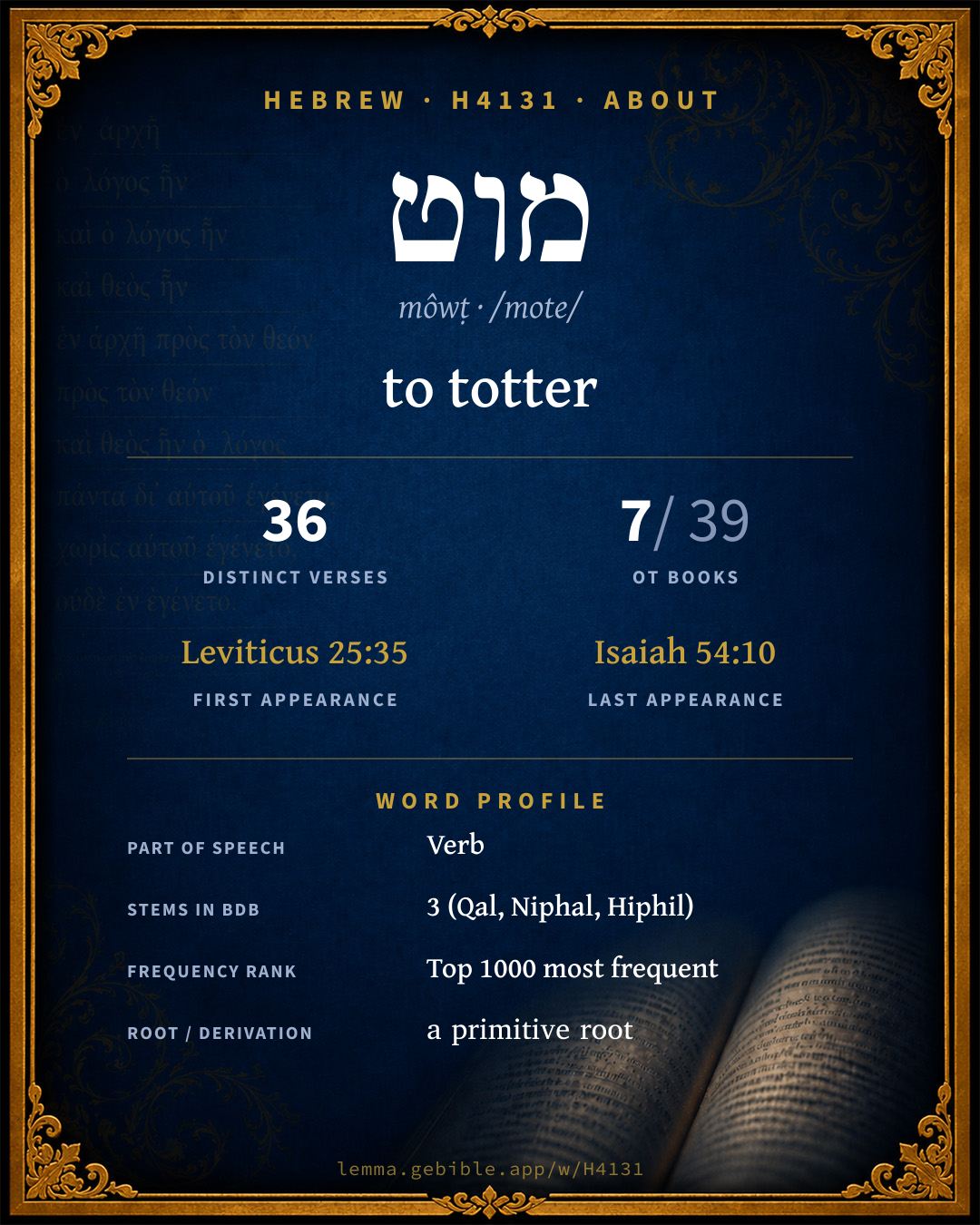
מוֹט
to totter
also: shake, slip fuller range ↓
Full lexicon entry — Brown-Driver-Briggs (BDB)
From Brown-Driver-Briggs (BDB)
Where this word appears
See every Niphal verb in the Hebrew Bible →
Grammar key — what these labels mean
Part of speech
- Verb
- An action or state-of-being word.
Stem
- Niphal
- Usually the simple passive or reflexive of the Qal (“he was written”).
- Qal
- The basic, simple active stem — the plain form of the verb (“he wrote”).
- Hiphil
- The causative active stem (“he caused / brought about”).
- Hithpolel
- The reflexive counterpart of the Polel.
Form
- Imperfect
- An incomplete, ongoing, or future action (“he will / would write”).
- Perfect
- A completed action or state — Hebrew marks aspect (completeness) more than strict tense (“he wrote”).
- Infinitive Construct
- A bound verbal noun, frequently with prepositions (“to write / in writing”).
- Sequential Perfect
- A perfect with prefixed waw continuing a preceding imperfect or command (waw-consecutive perfect).
- Participle Active
- A verbal adjective expressing ongoing or characteristic action (“writing / one who writes”).
- Jussive
- A third- or second-person volitional form expressing wish or command (“let him write”).
- Infinitive Absolute
- An unbound verbal noun, often intensifying or standing in for a finite verb.
State
- Absolute
- The independent form of a noun, not bound to a following word.
Person
- 3rd Person
- The one spoken about (“he / she / it / they”).
- 1st Person
- The speaker (“I / we”).
Gender
- Masculine
- Grammatically masculine.
- Common
- Either gender — not distinguished for this form.
- Feminine
- Grammatically feminine.
Number
- Singular
- One.
- Plural
- More than one (in Hebrew, generally three or more).
Every verse where H4131 appears in the Book of Psalms — 24 distinct verses. Click any verse to open its interlinear word-by-word view. Verse text shown in the World English Bible for context — . Each verse’s Hebrew form is shown with its reference; the English is not keyword-highlighted, since the data carries no word-level English alignment. Use “Compare translations” on any verse to read it across multiple English versions. This concordance covers the Hebrew Bible; Septuagint (Greek Old Testament) occurrences are not indexed here.
Psalms
- Psalms 10:6 אֶמּ֑וֹט Niphal impf 1cs He says in his heart, "I shall not be shaken; For generations I shall have no trouble."
- Psalms 13:4 אֶמּֽוֹט Niphal impf 1cs Lest my enemy say, "I have prevailed against him;" Lest my adversaries rejoice when I fall.
- Psalms 15:5 יִמּ֣וֹט Niphal impf 3ms He who doesn't lend out his money for usury, Nor take a bribe against the innocent. He who does these things shall never be shaken.
- Psalms 16:8 אֶמּֽוֹט Niphal impf 1cs I have set Yahweh always before me. Because he is at my right hand, I shall not be moved.
- Psalms 17:5 נָמ֥וֹטּוּ Niphal pf 3cp My steps have held fast to your paths, My feet have not slipped.
- Psalms 21:7 יִמּֽוֹט Niphal impf 3ms For the king trusts in Yahweh. Through the loving kindness of the Most High, he shall not be moved.
- Psalms 30:6 אֶמּ֥וֹט Niphal impf 1cs As for me, I said in my prosperity, "I shall never be moved."
- Psalms 38:16 בְּ/מ֥וֹט prep + Qal inf.cs For I said, "Don't let them gloat over me, Or exalt themselves over me when my foot slips."
- Psalms 46:2 וּ/בְ/מ֥וֹט conj + prep + Qal inf.cs Therefore we won't be afraid, though the earth changes, Though the mountains are shaken into the heart of the seas;
- Psalms 46:5 תִּמּ֑וֹט Niphal impf 3fs God is in her midst. She shall not be moved. God will help her at dawn.
- Psalms 46:6 מָ֣טוּ Qal pf 3cp The nations raged. The kingdoms were moved. He lifted his voice, and the earth melted.
- Psalms 55:3 יָמִ֥יטוּ Hiphil impf 3mp Because of the voice of the enemy, Because of the oppression of the wicked. For they bring suffering on me. In anger they hold a grudge against me.
- Psalms 55:22 מ֗וֹט Qal inf.cs Cast your burden on Yahweh, and he will sustain you. He will never allow the righteous to be moved.
- Psalms 60:2 מָֽטָה Qal pf 3fs You have made the land tremble. You have torn it. Mend its fractures, For it quakes.
- Psalms 62:2 אֶמּ֥וֹט Niphal impf 1cs He alone is my rock and my salvation, my fortress-- I will never be greatly shaken.
- Psalms 62:6 אֶמּֽוֹט Niphal impf 1cs He alone is my rock and my salvation, my fortress. I will not be shaken.
- Psalms 82:5 יִ֝מּ֗וֹטוּ Niphal impf 3mp They don't know, neither do they understand. They walk back and forth in darkness. All the foundations of the earth are shaken.
- Psalms 93:1 תִּמּֽוֹט Niphal impf 3fs Yahweh reigns! He is clothed with majesty! Yahweh is armed with strength. The world also is established. It can't be moved.
- Psalms 94:18 מָ֣טָה Qal pf 3fs When I said, "My foot is slipping!" Your loving kindness, Yahweh, held me up.
- Psalms 96:10 תִּמּ֑וֹט Niphal impf 3fs Say among the nations, "Yahweh reigns." The world is also established. It can't be moved. He will judge the peoples with equity.
- Psalms 104:5 תִּ֝מּ֗וֹט Niphal impf 3fs He laid the foundations of the earth, That it should not be moved forever.
- Psalms 112:6 יִמּ֑וֹט Niphal impf 3ms For he will never be shaken. The righteous will be remembered forever.
- Psalms 125:1 יִ֝מּ֗וֹט Niphal impf 3ms Those who trust in Yahweh are as Mount Zion, Which can't be moved, but remains forever.
- Psalms 140:10 ימיטו יִמּ֥וֹטוּ Hiphil juss 3mp Niphal impf 3mp Let burning coals fall on them. Let them be thrown into the fire, Into miry pits, from where they never rise.
About this entry
At a glance — auto-summarized from this page’s data, not written by a person. Every figure links to its source below. This summary describes the numbers; it doesn’t interpret them.
“to totter” is the headline sense of the Hebrew verb מוט (môwṭ). More than two-thirds of its appearances fall in Psalms. The Hebrew Bible uses it across 36 verses — moderately common. First canonically at Leviticus 25:35, it enters the text early. The verb spans 3 stems, from Qal to Niphal. The sections below give every sense, occurrence, and version rendering.
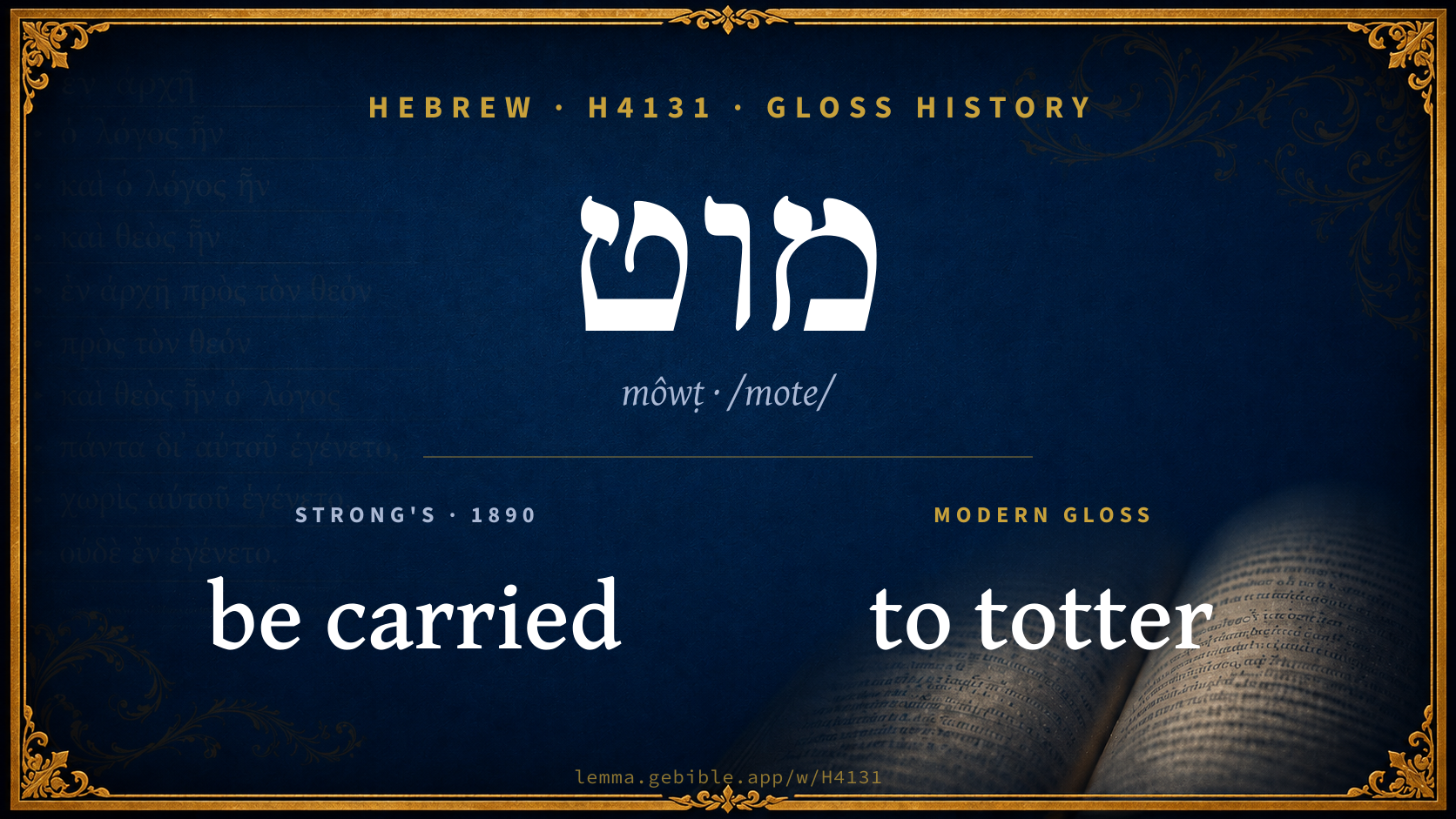
Gloss history
Strong's 1890 vs modern scholarship
About this word
Strong's H4131 catalogs a Hebrew word from the Hebrew Old Testament.
These counts are not copied from any lexicon or concordance. They are computed here, from the morphology-tagged Hebrew Old Testament. What Lemma adds →
- 36
- distinct verses
- The word appears in 36 distinct verses.
- 7 / 39
- OT books
- The word appears in 7 of 39 Old Testament books.
- #922
- by frequency
- Top 1000 most frequent Hebrew words (rank 922 of 8,640 Hebrew words by occurrence).
View all 36 occurrences in the concordance →
By section of the Old Testament
By traditional corpus
Conventional, traditional groupings — biblical authorship is debated, so this is a traditional corpus grouping, not an authorship claim. Each share is this word’s portion of its verses in that division of the Hebrew canon. Each figure is a share of the word’s 36 distinct verses.
- Writings (Ketuvim) 30 verses · 83%
- Prophets (Nevi'im) 4 verses · 11%
- Torah (Pentateuch) 2 verses · 6%
How translations render this word
Counts come from each version’s own published word-to-Strong’s tagging or interlinear alignment — an approximate guide to how each version renders this word, not a word-level alignment the data otherwise carries. Because each total is that version’s own tagged count, the per-version totals vary from one another and need not match the appearance or distinct-verse counts above. These counts may also differ from a printed concordance because Lemma counts each distinctly tagged rendering and does not collapse phrase taggings into a single head-word total. This is a fixed set of word-tagged versions (KJV, ASV, BSB, ULT) and does not change with the reading translation you choose elsewhere. Each version’s license is shown beside its name below (and on Sources).
BDB lists this Strong’s number as 2 distinct words (homographs). Each count above pools all of them and is not split by sense — see the Senses section below. A low-frequency rendering may belong to a different one of those words, not the primary meaning.
- King James Version†: Be moved 3×, Be removed 3×, I shall not be moved 3×
- American Standard Version†: Be moved 4×, Cannot be moved 4×, Be removed 3×
- Berean Standard Bible†: Be shaken 9×, Be moved 7×
- unfoldingWord Literal Text†: Be shaken 11×, Will 8×, Be moved 6×
King James Version Public Domain
Renders H4131 across 38† tagged occurrences — most commonly:
Plus 24 renderings that appear only once — usually multi-word phrases or single function words the recovered tagging swept in, not distinct renderings. Not rendered by a distinct English word in 1 further occurrence.
American Standard Version Public Domain
Renders H4131 across 38† tagged occurrences — most commonly:
Plus 21 renderings that appear only once — usually multi-word phrases or single function words the recovered tagging swept in, not distinct renderings.
Berean Standard Bible Public Domain
Renders H4131 across 36† tagged occurrences — most commonly:
Plus 20 renderings that appear only once — usually multi-word phrases or single function words the recovered tagging swept in, not distinct renderings. Not rendered by a distinct English word in 2 further occurrences.
unfoldingWord Literal Text CC BY-SA 4.0
Renders H4131 across 61† tagged occurrences — most commonly:
Plus 25 renderings that appear only once — usually multi-word phrases or single function words the recovered tagging swept in, not distinct renderings.
Senses in the full BDB
Hebrew verbs can shift meaning by stem (binyan): Qal is the basic action, Niphal is often passive or reflexive, Piel often intensifies or makes it factitive, and Hiphil is typically causative. The senses below are grouped under the stem BDB assigns to each.
What do BDB’s symbols mean?
BDB uses these scholarly abbreviations:
| Symbol | Meaning |
|---|---|
| 𝔊 | the Septuagint (the ancient Greek translation, LXX) |
| 𝔙 | the Vulgate (the Latin translation) |
| 𝔖 | the Syriac version (the Peshitta) |
| 𝔗 | the Targum (the Aramaic translation) |
| ψ | the Psalms |
| √ | root (the underlying root or stem) |
| ‖ | parallel passage (a synonymous or contrasted parallel) |
| † | the dagger: every passage where the word occurs is cited |
The 6 senses and sub-senses the full Brown-Driver-Briggs lexicon distinguishes for this word, in lexicon order (not ranked by frequency), with BDB’s own verbatim wording and sub-sense lettering. Shown in Hebrew script with BDB’s own scholarly abbreviations. The condensed entry is in the Lexicon Entry tab. See also the Forms in the corpus table below.
מוט I totter, shake, slip (usually poet.) (NH id., der. species
Qal
- Pf. 3 fs. מָ֫טָה ψ 60:4 + 2 times; 3 pl. מָ֫טוּ ψ 46:7; Impf. 3 fs. תָּמוּט Dt 32:35; Is 54:10; 3 fpl. תְּמוּטֶינָה Is 54:10; Inf. cstr. מוֹט ψ 38:17; 46:3; abs. id. Is 24:19; Pt. מָט Pr 25:26; pl. מָטִים Pr 24:11;—totter, slip, subj. רֶגֶל (fig. of insecurity) Dt 32:35 ψ 38:17; 94:18: cf. (without רֶגֶל) Pr 24:11 מ׳ לַהֶרֶג; מ׳ לִפְנֵי־רָשָׁע 25:26; shake, intr., subj. יָד Lv 25:35 (H; of feebleness); subj. גְּבָעוֹת Is 54:10 (‖ מוּשׁ); מ׳ הָרִים בְּלֵב יַמִּים ψ 46:3 (‖ הֵמִיר, cf. מור) (both symb. of extreme insecurity); cf. subj. בְּרִית Is 54:10; subj. מַמְלָכוֹת ψ 46:7; subj. אֶרֶץ (= land) ψ 60:4; cf. Is 24:19 (v. sub Hithp.) e.g. Psalms 60:4
Niphal
- Pf. 3 pl. נָמ֫וֹטוּ ψ 17:5; Impf. יִמּוֹט ψ 15:5 + 8 times, etc.;—all poet., mostly c. neg. (בַּל 13 times; לֹא 6 times), be shaken, moved, overthrown, of idols Is 40:20; 41:7; of scales of crocodile Jb 41:15; of תֵּבֵל 1 Ch 16:30 = ψ 93:1; 96:10; of אֶרֶץ ψ 104:5; of הַר־צִיּוֹן ψ 125:1, cf. 46:6; fig. of general disorder (no neg.), subj. מוֹסְדֵי אֶרֶץ ψ 82:5; often of (un)righteous, as secure, ψ (10:6) 15:5; 16:8; 21:8; 30:7; 62:3, 7; 112:6 Pr 10:30; 12:3 (subj. שֹׁרֶשׁ צַדִּיקִים); cf. (without neg.) ψ 13:5; 140:11 Qr (so appar. 𝔊 AV RV; but meaning of Niph. not suitable; Kt Hiph. q.v.); fig. of steadfast obedience (subj. פְּעָמַי) ψ 17:5. e.g. Psalms 17:5
Hiphil
- Impf. 3 mpl. יָמִ֫יטוּ ψ 55:4; 140:11 Kt (Qr Niph.);—dislodge, let fall, drop יָמִיטוּ עָלַי אָ֫וֶן ψ 55:4; cf. וימיטו עֲלֵיהֶם גֶּחָלִים 140:11 Kt, and may they drop coals upon them, De al.; יַמְטִיר (Hup Gr Bae Dr), wh. Bi Che insert. Hithpoʿl. Pf. 3 fs. מוֹט הִתְמוֹטְטָה Is 24:19 be greatly shaken (subj. אֶרֶץ, in judgment of י׳; ‖ רעע, פרר, Hithp.) e.g. Psalms 55:4
מוט II [m.] shaking, pole, bar of yoke
- 1. a shaking, tottering (c. neg., of security) לֹא־יִתֵּן מ׳ לַצַּדִּיק ψ 55:23; לֹא נָתַן לַמּ׳ רַגְלֵנוּ ψ 66:9, cf. 121:3. e.g. Psalms 55:23
- 2. pole, or bar for carrying (named from springing motion) Nu 4:10, 12 cf. especially 13:23. e.g. Numbers 4:10
- 3. bar of yoke Na 1:13 (אֶשְׁבֹּר מֹטֵהוּ מֵעָלַיִךְ), fig. of oppression. Cf. following. e.g. Nahum 1:13
Senses from the full Brown-Driver-Briggs lexicon (Brown, Driver, Briggs; Oxford 1906 — public domain), digitized via Sefaria, supplemented by the OpenScriptures HebrewLexicon (CC BY 4.0). Full attribution on Sources.
Word origin
I. vb. totter, shake, slip (usually poet.) (NH id., der. species; Aramaic ܡܳܛ, מוּט; Arabic مَاطَ (med. י) remove, retire; deviate from right course; repel, push, thrust; Ethiopic ሜጠ turn; Assyrian maṭû is dwindle, diminish, grow weak DlHWB 405; > denom. from מוט pole, bar DlProl. 184 GerberVerb. denom. 195 f., cf. Buhl);—
II. n.[m.] shaking, pole, bar of yoke;—abs. מ׳ Nu 4:10 + 5 times; sf. מֹטֵ֫הוּ Na 1:13;—
— Brown-Driver-Briggs (Oxford 1906, public domain), digitized via Sefaria, supplemented by the OpenScriptures HebrewLexicon (CC BY 4.0). See Sources.
Origin: a primitive root
Jastrow Dictionary
A second Hebrew/Aramaic lexicon for comparison, covering Aramaic and post-biblical (Talmudic, Targumic, Midrashic) usage that the biblical-Hebrew BDB does not. Matched by lemma rather than by Strong’s number, so a lemma may carry more than one Jastrow headword (shown separately below), and the entries cover usage well beyond the Bible.
מוּט
- (b. h.) to incline, waver, decline; to give way, bend. Y. Snh. X, 27ᵈ bot., v. infra. Tanḥ. B’har 1 כשתָּמוּט ידם לפני וכ׳ when their power shall sink before Nebuchadnezzar. Tanḥ. Vayishl. 3 (ref. to Prov. XXV, 26) כשמָט לפני וכ׳ when he bends (humiliates himself) before the wicked; Gen. R. s. 75 א"א לצדיק לָמוּט וכ׳ (Yalk. Gen. 130 לִימּוֹט) it is impossible to the righteous to bend &c.; a. e. e.g. Proverbs 25:26
- to be shaken, bent. Yalk. l. c., v. supra.
- to bend, to shake. Zab. III, 3 כל שאינה יכולה להָמִיט באדם (not בה אדם) (Asheri להָסִיט, v. סוּט) a ship which has no staggering effect on man. Gen. R. l. c. מֵמִיט עצמו וכ׳ humbles himself.
- , Nithpol. נִתְמוֹטֵט to be declining; to sink. Y. Snh. X, 27ᵈ bot.; Yalk. Is. 338 (ref. to Is. LIV, 10) אם ראית זכות אבות שמָטָה … שנִתְמוֹטְטָה וכ׳ when thou seest the merit of the fathers decline and that of the mothers sink, go and cling to grace; Lev. R. s. 36, end שנִתְמֹטְטָה.—Y. l. c. 28ᵇ והיו מִתְמוֹטְטִין והולכין they sank deeper and deeper (into poverty). B. Mets. 71ᵃ נכסיו מתמוטטין (Ms. M. מתמעטין) his wealth will be reduced; Yalk. Ps. 665 מִתְמוֹטֵט he will sink. B. Mets. l. c. הללו מתמ׳ וכ׳ (Ms. R. 2 מוֹטְטִין, v. Rabb. D. S. a. l. notes 2—4) these sink and rise again &c.; Yalk. l. c. e.g. Isaiah 54:10
מוּט ²
- Targ. Lev. XXV, 35. Targ. Y. Deut. XXXII, 35; a. fr.
- to balance, weigh. Pesik. B’shall., p. 82ᵃ באמטיתא דאֲמִיטוּן (אִתְּמִיט) אִיתְּמֵט להון with the balances with which they weighed, weighing was done to them; v. מוֹטָה.
- to be weighed, v. supra (v. Bub. a. l. note 42).
- to sink, waver, be reduced. Targ. Ps. XCIV, 18; a. fr.—B. Mets. 71ᵃ דלא מוזפי ומִתְמוֹטְטֵי Ms. R. (v. Rabb. D. S. a. l. note 4) who lend not on interest and yet become poor.
מוֹט
- preced.) balancing pole, staff. Bets. III, 3 (25ᵃ) לא … במ׳ במוטה (Y. ed. במטה, v. Rabb. D. S. a. l. note 4) he must not bring it to town on a staff or on a barrow. Sot. 34ᵃ (ref. to Num. XIII, 23) ממשמע שנאמר במ׳ וכ׳ it being said ‘on a staff’, do I not know that it was carried by two persons?—Pl. מוֹטוֹת. Ib., v. טוּרְטִינִי. Tosef. Ohol. VII, 1, v. נִדְבָּךְ; a. e. e.g. Numbers 13:23
A Dictionary of the Targumim, the Talmud Babli and Yerushalmi, and the Midrashic Literature (Marcus Jastrow; London, Luzac, 1903) — Public Domain. Digitized via Sefaria. Digitized via Sefaria. Full attribution on Sources.
Forms in the corpus
The 29 distinct written forms H4131 takes in the Hebrew Bible, most frequent first — each parse links to that stem’s occurrences in the concordance. Hebrew forms include their vowel points and cantillation, so a single lemma takes many written forms.
Same root — word family
Other BDB entries built from the same root as H4131, grouped by Strong’s listed origin. These share a root / origin per the lexicon — not necessarily a shared meaning. Each links to that word’s own entry.
Derived from this word
Compare all same-root words → They share a root, not necessarily a meaning.
Septuagint verse parallels
This word appears in 33 verses that also exist in the Greek Old Testament (Septuagint), out of the 36 Hebrew verses it occurs in. You can read those verses in Greek by switching the Old Testament edition to the Septuagint.
Read these verses in the Septuagint
- Leviticus 25:35
- Deuteronomy 32:35
- 1 Chronicles 16:30
- Job 41:23
- Psalms 10:6
- Proverbs 10:30
- Isaiah 24:19
This is a verse-level parallel only — the same verses exist in both the Hebrew and Greek Old Testaments. No word-level Hebrew↔Greek correspondence is claimed: the data carries no such alignment, so no Greek word is shown as this Hebrew word’s translation. Coverage is not total — the Septuagint omits the deuterocanon and renumbers the Psalms, so some Hebrew verses have no direct Greek parallel.