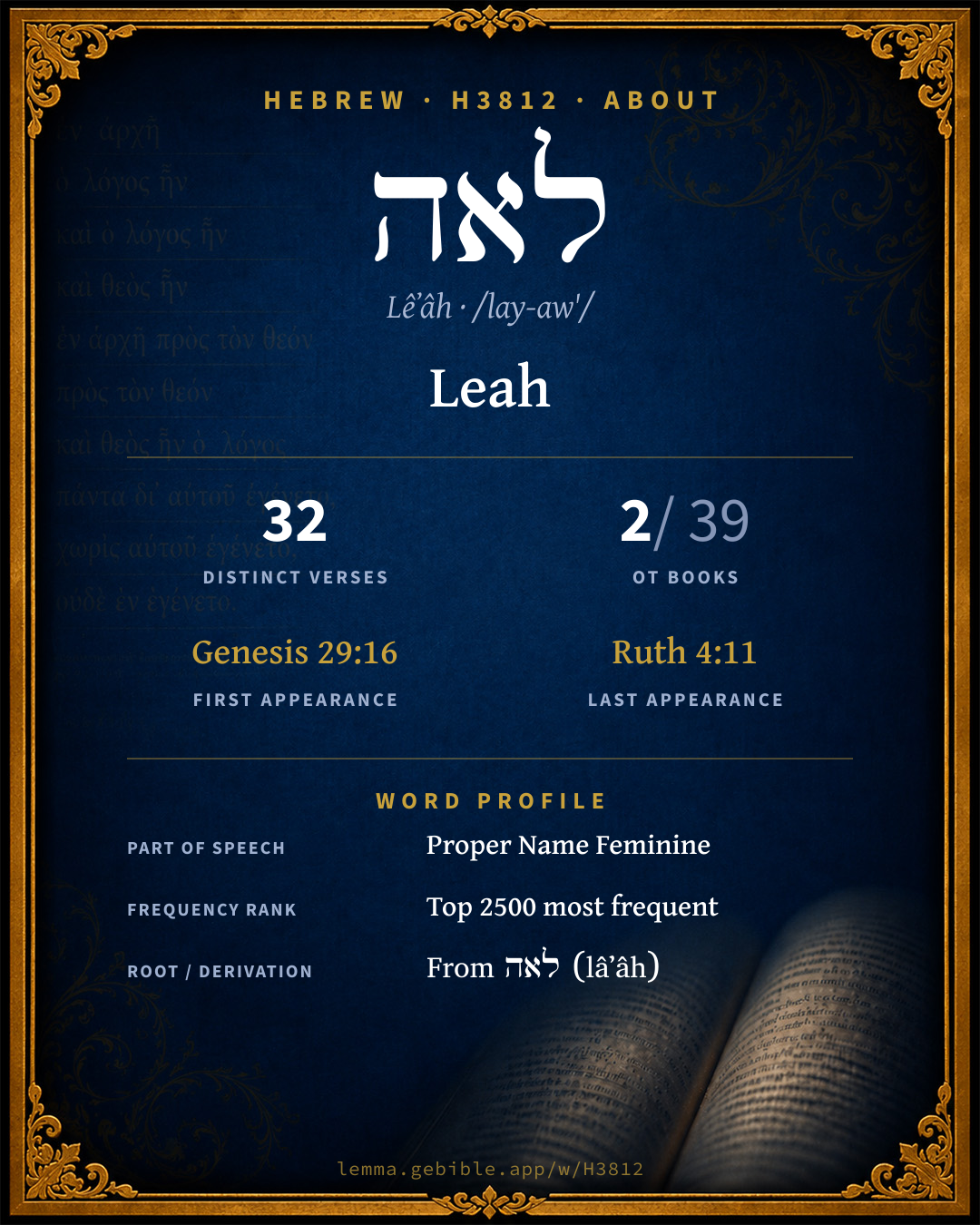
לֵאָה
Leah
BDB lists 2 entries for ‘Leah’ fuller range ↓
Full lexicon entry — Brown-Driver-Briggs (BDB)
From Brown-Driver-Briggs (BDB)
Where this word appears
Grammar key — what these labels mean
Part of speech
- Noun
- A naming word — a person, place, thing, or idea.
Noun type
- Proper
- A name of a specific person, place, or people (e.g. Abraham, Zion, Israel).
Every verse where H3812 appears — 32 distinct verses across 2 books. Click any verse to open its interlinear word-by-word view. Verse text shown in the World English Bible for context — . Each verse’s Hebrew form is shown with its reference; the English is not keyword-highlighted, since the data carries no word-level English alignment. Use “Compare translations” on any verse to read it across multiple English versions. This concordance covers the Hebrew Bible; Septuagint (Greek Old Testament) occurrences are not indexed here.
Genesis 31 verses
- Genesis 29:16 לֵאָ֔ה n Proper Laban had two daughters. The name of the elder was Leah, and the name of the younger was Rachel.
- Genesis 29:17 לֵאָ֖ה n Proper Leah's eyes were weak, but Rachel was beautiful and well favored.
- Genesis 29:23 לֵאָ֣ה n Proper It happened in the evening, that he took Leah his daughter, and brought her to him. He went in to her.
- Genesis 29:24 לְ/לֵאָ֥ה prep + n Proper Laban gave Zilpah his handmaid to his daughter Leah for a handmaid.
- Genesis 29:25 לֵאָ֑ה n Proper It happened in the morning that, behold, it was Leah. He said to Laban, "What is this you have done to me? Didn't I serve with you for Rachel? Why then have you deceived me?"
- Genesis 29:30 מִ/לֵּאָ֑ה prep + n Proper He went in also to Rachel, and he loved also Rachel more than Leah, and served with him yet seven other years.
- Genesis 29:31 לֵאָ֔ה n Proper Yahweh saw that Leah was hated, and he opened her womb, but Rachel was barren.
- Genesis 29:32 לֵאָה֙ n Proper Leah conceived, and bore a son, and she named him Reuben. For she said, "Because Yahweh has looked at my affliction. For now my husband will love me."
- Genesis 30:9 לֵאָ֔ה n Proper When Leah saw that she had finished bearing, she took Zilpah, her handmaid, and gave her to Jacob as a wife.
- Genesis 30:10 לֵאָ֖ה n Proper Zilpah, Leah's handmaid, bore Jacob a son.
- Genesis 30:11 לֵאָ֖ה n Proper Leah said, "How fortunate!" She named him Gad.
- Genesis 30:12 לֵאָ֔ה n Proper Zilpah, Leah's handmaid, bore Jacob a second son.
- Genesis 30:13 לֵאָ֔ה n Proper Leah said, "Happy am I, for the daughters will call me happy." She named him Asher.
- Genesis 30:14 לֵאָ֖ה לֵאָ֔ה n Proper n Proper Reuben went in the days of wheat harvest, and found mandrakes in the field, and brought them to his mother, Leah. Then Rachel said to Leah, "Please give me some of your son's mandrakes."
- Genesis 30:16 לֵאָ֜ה n Proper Jacob came from the field in the evening, and Leah went out to meet him, and said, "You must come in to me; for I have surely hired you with my son's mandrakes." He lay with her that night.
- Genesis 30:17 לֵאָ֑ה n Proper God listened to Leah, and she conceived, and bore Jacob a fifth son.
- Genesis 30:18 לֵאָ֗ה n Proper Leah said, "God has given me my hire, because I gave my handmaid to my husband." She named him Issachar.
- Genesis 30:19 לֵאָ֔ה n Proper Leah conceived again, and bore a sixth son to Jacob.
- Genesis 30:20 לֵאָ֗ה n Proper Leah said, "God has endowed me with a good dowry. Now my husband will live with me, because I have borne him six sons." She named him Zebulun.
- Genesis 31:4 וּ/לְ/לֵאָ֑ה conj + prep + n Proper Jacob sent and called Rachel and Leah to the field to his flock,
- Genesis 31:14 וְ/לֵאָ֔ה conj + n Proper Rachel and Leah answered him, "Is there yet any portion or inheritance for us in our father's house?
- Genesis 31:33 לֵאָ֗ה לֵאָ֔ה n Proper n Proper Laban went into Jacob's tent, into Leah's tent, and into the tent of the two maid-servants; but he didn't find them. He went out of Leah's tent, and entered into Rachel's tent.
- Genesis 33:1 לֵאָה֙ n Proper Jacob lifted up his eyes, and looked, and, behold, Esau was coming, and with him four hundred men. He divided the children between Leah, Rachel, and to the two handmaids.
- Genesis 33:2 לֵאָ֤ה n Proper He put the handmaids and their children in front, Leah and her children after, and Rachel and Joseph at the rear.
- Genesis 33:7 לֵאָ֛ה n Proper Leah also and her children came near, and bowed themselves. After them, Joseph came near with Rachel, and they bowed themselves.
- Genesis 34:1 לֵאָ֔ה n Proper Dinah, the daughter of Leah, whom she bore to Jacob, went out to see the daughters of the land.
- Genesis 35:23 לֵאָ֔ה n Proper The sons of Leah: Reuben (Jacob's firstborn), Simeon, Levi, Judah, Issachar, and Zebulun.
- Genesis 35:26 לֵאָ֖ה n Proper The sons of Zilpah (Leah's handmaid): Gad and Asher. These are the sons of Jacob, who were born to him in Paddan Aram.
- Genesis 46:15 לֵאָ֗ה n Proper These are the sons of Leah, whom she bore to Jacob in Paddan Aram, with his daughter Dinah. All the souls of his sons and his daughters were thirty-three.
- Genesis 46:18 לְ/לֵאָ֣ה prep + n Proper These are the sons of Zilpah, whom Laban gave to Leah, his daughter, and these she bore to Jacob, even sixteen souls.
- Genesis 49:31 לֵאָֽה n Proper There they buried Abraham and Sarah, his wife. There they buried Isaac and Rebekah, his wife, and there I buried Leah:
Ruth 1 verse
About this entry
At a glance — auto-summarized from this page’s data, not written by a person. Every figure links to its source below. This summary describes the numbers; it doesn’t interpret them.
“Leah” is the headline sense of the Hebrew name לאה (Lêʼâh). More than three-quarters of its appearances fall in Genesis. It appears 32 verses across 2 books of the Hebrew Bible, among its moderately common vocabulary. Scripture first uses it in Genesis 29:16. The sections below give every occurrence and version rendering.
Gloss history
Strong's 1890 vs modern scholarship
About this word
Strong's H3812 catalogs a Hebrew word from the Hebrew Old Testament.
These counts are not copied from any lexicon or concordance. They are computed here, from the morphology-tagged Hebrew Old Testament. What Lemma adds →
- 32
- distinct verses
- The word appears in 32 distinct verses.
- 2 / 39
- OT books
- The word appears in 2 of 39 Old Testament books.
- #1,041
- by frequency
- Top 2500 most frequent Hebrew words (rank 1,041 of 8,640 Hebrew words by occurrence).
View all 32 occurrences in the concordance →
By traditional corpus
Conventional, traditional groupings — biblical authorship is debated, so this is a traditional corpus grouping, not an authorship claim. Each share is this word’s portion of its verses in that division of the Hebrew canon. Each figure is a share of the word’s 32 distinct verses.
- Torah (Pentateuch) 31 verses · 97%
- Writings (Ketuvim) 1 verse · 3%
How translations render this word
Counts come from each version’s own published word-to-Strong’s tagging or interlinear alignment — an approximate guide to how each version renders this word, not a word-level alignment the data otherwise carries. Because each total is that version’s own tagged count, the per-version totals vary from one another and need not match the appearance or distinct-verse counts above. These counts may also differ from a printed concordance because Lemma counts each distinctly tagged rendering and does not collapse phrase taggings into a single head-word total. This is a fixed set of word-tagged versions (KJV, ASV, BSB, ULT) and does not change with the reading translation you choose elsewhere. Each version’s license is shown beside its name below (and on Sources).
- King James Version: Leah 25×, Leah's 5×
- American Standard Version: Leah 29×
- Berean Standard Bible: Leah 24×, Leah’s 5×
- unfoldingWord Literal Text: Leah 31×, Was leah 2×
King James Version Public Domain
Renders H3812 across 34 tagged occurrences — most commonly:
Plus 4 renderings that appear only once — usually multi-word phrases or single function words the recovered tagging swept in, not distinct renderings.
American Standard Version Public Domain
Renders H3812 across 34 tagged occurrences — most commonly:
Plus 5 renderings that appear only once — usually multi-word phrases or single function words the recovered tagging swept in, not distinct renderings.
Berean Standard Bible Public Domain
Renders H3812 across 32 tagged occurrences — most commonly:
Plus 3 renderings that appear only once — usually multi-word phrases or single function words the recovered tagging swept in, not distinct renderings. Not rendered by a distinct English word in 2 further occurrences.
unfoldingWord Literal Text CC BY-SA 4.0
Renders H3812 across 35 tagged occurrences — most commonly:
Plus 2 renderings that appear only once — usually multi-word phrases or single function words the recovered tagging swept in, not distinct renderings.
Senses in BDB
The 2 senses BDB distinguishes for this word, in lexicon order (not ranked by frequency or importance). The full entry — with sub-senses — is in the Lexicon Entry tab.
- Leah = "weary"
- daughter of Laban, first wife of Jacob, and mother of Reuben, Simeon, Levi, Judah, Issachar, Zebulun, and Dinah
Word origin
n.pr.f. Leah, elder daughter of Laban, and wife of Jacob (perhaps = wild-cow, Arabic لَأًى, (لَأٓةٌ) [cf. רָחֵל ewe], DlProl. 80 RSK 219 and (doubtfully) Nö ZMG xl. 1886, 167; also Gray Heb. Names, 96; others, as HptGGN 1883, 100 comp. Assyrian li’at, in sense mistress; on poss. relation of לֵאָה to לֵוִי v. לֵוִי);—mother of Reuben, Simeon, Levi, Judah, Issachar, Zebulun and Dinah; Gn 29:16, 17, 23, 24, 25, 30, 31, 32 (cf. vv 33, 34, 35) 30:9 + 15 times Gn 31, 32; 33:1, 2, 7; 34:1; 35:23, 26; 46:15, 18; 49:31; Ru 4:11; 𝔊 Λ(ε)ια.
— Brown-Driver-Briggs (Oxford 1906, public domain), digitized via Sefaria, supplemented by the OpenScriptures HebrewLexicon (CC BY 4.0). See Sources.
Derived from לאה (lâʼâh) (H3811) — to be weary.
Jastrow Dictionary
A second Hebrew/Aramaic lexicon for comparison, covering Aramaic and post-biblical (Talmudic, Targumic, Midrashic) usage that the biblical-Hebrew BDB does not. Matched by lemma rather than by Strong’s number, so a lemma may carry more than one Jastrow headword (shown separately below), and the entries cover usage well beyond the Bible.
לָאָה
- , v. לאי
לאי
- (b. h.) to labor (in vain); to be tired. Gen. R. s. 50 (expl. וילאו, Gen. XIX, 11), v. next w. e.g. Genesis 19:11
- to be exhausted. B. Kam. 82ᵃ; a. e.
A Dictionary of the Targumim, the Talmud Babli and Yerushalmi, and the Midrashic Literature (Marcus Jastrow; London, Luzac, 1903) — Public Domain. Digitized via Sefaria. Digitized via Sefaria. Full attribution on Sources.
Forms in the corpus
The 16 distinct written forms H3812 takes in the Hebrew Bible, most frequent first — each parse links to that state’s occurrences in the concordance. Hebrew forms include their vowel points and cantillation, so a single lemma takes many written forms.
| Form | Parsing | Example | Uses |
|---|---|---|---|
| לֵאָ֔ה | Noun, Proper | Genesis 29:16 | 10 |
| לֵאָ֖ה | Noun, Proper | Genesis 29:17 | 5 |
| לֵאָ֗ה | Noun, Proper | Genesis 30:18 | 4 |
| לֵאָ֑ה | Noun, Proper | Genesis 29:25 | 2 |
| לֵאָה֙ | Noun, Proper | Genesis 29:32 | 2 |
| וְ/לֵאָ֔ה | Noun, Proper | Genesis 31:14 | 1 |
| וּ/כְ/לֵאָה֙ | Noun, Proper | Ruth 4:11 | 1 |
| וּ/לְ/לֵאָ֑ה | Noun, Proper | Genesis 31:4 | 1 |
| לְ/לֵאָ֣ה | Noun, Proper | Genesis 46:18 | 1 |
| לְ/לֵאָ֥ה | Noun, Proper | Genesis 29:24 | 1 |
| לֵאָ֛ה | Noun, Proper | Genesis 33:7 | 1 |
| לֵאָ֜ה | Noun, Proper | Genesis 30:16 | 1 |
| לֵאָ֣ה | Noun, Proper | Genesis 29:23 | 1 |
| לֵאָ֤ה | Noun, Proper | Genesis 33:2 | 1 |
| לֵאָֽה | Noun, Proper | Genesis 49:31 | 1 |
| מִ/לֵּאָ֑ה | Noun, Proper | Genesis 29:30 | 1 |
Same root — word family
Other BDB entries built from the same root as H3812, grouped by Strong’s listed origin. These share a root / origin per the lexicon — not necessarily a shared meaning. Each links to that word’s own entry.
Derives from
Shares the same root
Compare all same-root words → They share a root, not necessarily a meaning.
Bible dictionary
Public-domain dictionary articles matched to this entry by name (Leah). A biblical name can be shared by more than one person or place, so an article may treat several.
Easton's Bible Dictionary · M. G. Easton, 1897
Weary, the eldest daughter of Laban, and sister of Rachel (Gen. 29:16). Jacob took her to wife through a deceit of her father (Gen. 29:23). She was "tender-eyed" (17). She bore to Jacob six sons (32-35), also one daughter, Dinah (30:21). She accompanied Jacob into Canaan, and died there before the time of the going down into Egypt (Gen. 31), and was buried in the cave of Machpelah (49:31).
Smith's Bible Dictionary · William Smith, 1863
(wearied), the daughter of Laban. (Genesis 29:16) The dullness or weakness of her eyes was so notable that it is mentioned as a contrast to the beautiful form and appearance of her younger sister Rachel. Her father took advantage of the opportunity which the local marriage rite afforded to pass her off in her sister's stead on the unconscious bridegroom, and excused himself to Jacob by alleging that the custom of the country forbade the younger sister to be given first in marriage. Jacob's preference of Rachel grew into hatred of Leah after he had married both sisters. Leah, however, bore to him in quick succession Reuben, Simeon, Levi, Judah, then Issachar, Zebulun and Dinah, before Rachel had a child. She died some time after Jacob reached the south country in which his father Isaac lived. She was buried in the family grave in Machpelah, near Hebron. (Genesis 49:31) (B.C. about 1720.)
Hitchcock's Bible Names Dictionary · Roswell D. Hitchcock, 1869
weary; tired
Classic public-domain reference works; full attribution on Sources.
Septuagint verse parallels
This word appears in 32 verses that also exist in the Greek Old Testament (Septuagint), out of the 32 Hebrew verses it occurs in. You can read those verses in Greek by switching the Old Testament edition to the Septuagint.
Read these verses in the Septuagint
This is a verse-level parallel only — the same verses exist in both the Hebrew and Greek Old Testaments. No word-level Hebrew↔Greek correspondence is claimed: the data carries no such alignment, so no Greek word is shown as this Hebrew word’s translation. Coverage is not total — the Septuagint omits the deuterocanon and renumbers the Psalms, so some Hebrew verses have no direct Greek parallel.