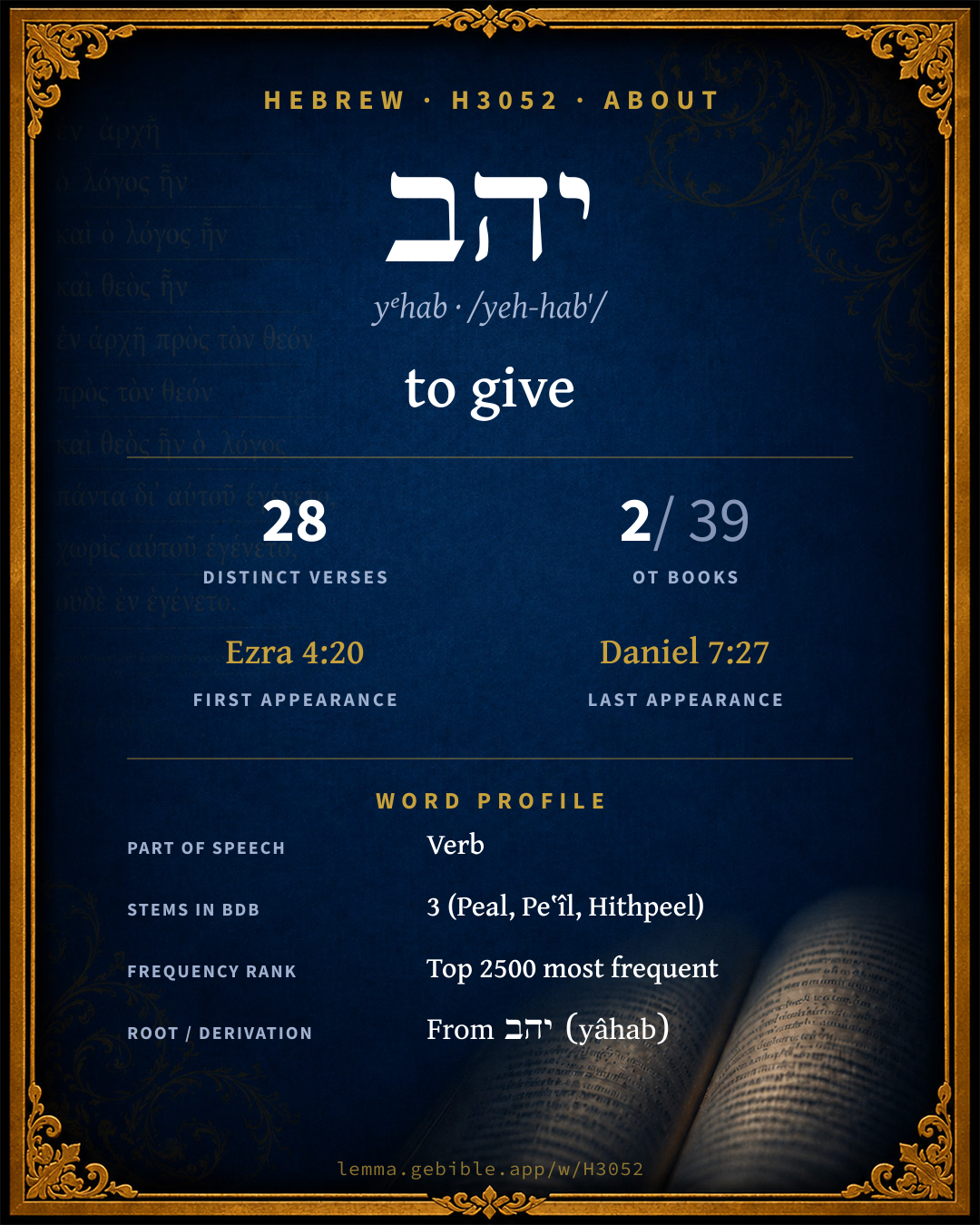
יְהַב
to give
‘to give’ is one of 5 main senses fuller range ↓
Full lexicon entry — Brown-Driver-Briggs (BDB)
From Brown-Driver-Briggs (BDB)
Where this word appears
See every Qal verb in the Hebrew Bible →
Grammar key — what these labels mean
Part of speech
- Verb
- An action or state-of-being word.
Stem
- Qal
- The basic, simple active stem — the plain form of the verb (“he wrote”).
- Qal Passive
- An archaic passive of the Qal, preserved in a few forms.
Form
- Perfect
- A completed action or state — Hebrew marks aspect (completeness) more than strict tense (“he wrote”).
- Participle Passive
- A verbal adjective expressing action received (“written”).
- Imperfect
- An incomplete, ongoing, or future action (“he will / would write”).
- Participle Active
- A verbal adjective expressing ongoing or characteristic action (“writing / one who writes”).
- Imperative
- A direct command (“write!”).
State
- Absolute
- The independent form of a noun, not bound to a following word.
Person
- 3rd Person
- The one spoken about (“he / she / it / they”).
- 2nd Person
- The one addressed (“you”).
Gender
- Masculine
- Grammatically masculine.
- Feminine
- Grammatically feminine.
Number
- Singular
- One.
- Plural
- More than one (in Hebrew, generally three or more).
Every verse where H3052 appears in the Book of Daniel — 20 distinct verses. Click any verse to open its interlinear word-by-word view. Verse text shown in the World English Bible for context — . Each verse’s Hebrew form is shown with its reference; the English is not keyword-highlighted, since the data carries no word-level English alignment. Use “Compare translations” on any verse to read it across multiple English versions. This concordance covers the Hebrew Bible; Septuagint (Greek Old Testament) occurrences are not indexed here.
Daniel
- Daniel 2:21 יָהֵ֤ב Qal ptcp.act ms He changes the times and the seasons; he removes kings, and sets up kings; he gives wisdom to the wise, and knowledge to those who have understanding;
- Daniel 2:23 יְהַ֣בְתְּ Qal pf 2ms I thank you, and praise you, you God of my fathers, who have given me wisdom and might, and have now made known to me what we desired of you; for you have made known to us the king's matter.
- Daniel 2:37 יְהַב Qal pf 3ms You, O king, are king of kings, to whom the God of heaven has given the kingdom, the power, and the strength, and the glory;
- Daniel 2:38 יְהַ֣ב Qal pf 3ms and wherever the children of men dwell, the animals of the field and the birds of the sky has he given into your hand, and has made you to rule over them all: you are the head of gold.
- Daniel 2:48 יְהַב Qal pf 3ms Then the king made Daniel great, and gave him many great gifts, and made him to rule over the whole province of Babylon, and to be chief governor over all the wise men of Babylon.
- Daniel 3:28 וִ/יהַ֣בוּ conj + Qal pf 3mp Nebuchadnezzar spoke and said, Blessed be the God of Shadrach, Meshach, and Abednego, who has sent his angel, and delivered his servants who trusted in him, and have changed the king's word, and have yielded their bodies, that they might not serve nor worship any god, except their own God.
- Daniel 4:16 יִתְיְהִ֣ב Hothpaal impf 3ms let his heart be changed from man's, and let a animal's heart be given to him; and let seven times pass over him.
- Daniel 5:17 הַ֑ב Qal impv 2ms Then Daniel answered before the king, Let your gifts be to yourself, and give your rewards to another; nevertheless I will read the writing to the king, and make known to him the interpretation.
- Daniel 5:18 יְהַ֖ב Qal impf 3ms You king, the Most High God gave Nebuchadnezzar your father the kingdom, and greatness, and glory, and majesty:
- Daniel 5:19 יְהַב Qal pf 3ms and because of the greatness that he gave him, all the peoples, nations, and languages trembled and feared before him: whom he would he killed, and whom he would he kept alive; and whom he would he raised up, and whom he would he put down.
- Daniel 5:28 וִ/יהִיבַ֖ת conj + Qal Passive pf 3fs PERES; your kingdom is divided, and given to the Medes and Persians.
- Daniel 6:2 יָהֲבִ֤ין Qal ptcp.act mp and over them three presidents, of whom Daniel was one; that these satraps might give account to them, and that the king should have no damage.
- Daniel 7:4 יְהִ֥יב Qal Passive pf 3ms The first was like a lion, and had eagle's wings: I saw until the wings of it were plucked, and it was lifted up from the earth, and made to stand on two feet as a man; and a man's heart was given to it.
- Daniel 7:6 יְהִ֥יב Qal Passive pf 3ms After this I saw, and, behold, another, like a leopard, which had on its back four wings of a bird; the animal had also four heads; and dominion was given to it.
- Daniel 7:11 וִ/יהִיבַ֖ת conj + Qal Passive pf 3fs I saw at that time because of the voice of the great words which the horn spoke; I saw even until the animal was slain, and its body destroyed, and it was given to be burned with fire.
- Daniel 7:12 יְהִ֥יבַת Qal Passive pf 3fs As for the rest of the animals, their dominion was taken away: yet their lives were prolonged for a season and a time.
- Daniel 7:14 יְהִ֤יב Qal Passive pf 3ms There was given him dominion, and glory, and a kingdom, that all the peoples, nations, and languages should serve him: his dominion is an everlasting dominion, which shall not pass away, and his kingdom that which shall not be destroyed.
- Daniel 7:22 יְהִ֔ב Qal Passive pf 3ms until the ancient of days came, and judgment was given to the saints of the Most High, and the time came that the saints possessed the kingdom.
- Daniel 7:25 וְ/יִתְיַהֲב֣וּן conj + Hothpaal impf 3mp He shall speak words against the Most High, and shall wear out the saints of the Most High; and he shall think to change the times and the law; and they shall be given into his hand until a time and times and half a time.
- Daniel 7:27 יְהִיבַ֕ת Qal Passive pf 3fs The kingdom and the dominion, and the greatness of the kingdoms under the whole the sky, shall be given to the people of the saints of the Most High: his kingdom is an everlasting kingdom, and all dominions shall serve and obey him.
About this entry
At a glance — auto-summarized from this page’s data, not written by a person. Every figure links to its source below. This summary describes the numbers; it doesn’t interpret them.
The Hebrew verb יהב centers on the idea of “to give.” Daniel dominates its distribution — 20 of 28 verses. The Hebrew Bible uses it across 28 verses — moderately common. Its earliest occurrence is Ezra 4:20. Different stems carry different senses — BDB groups them under 3 stems, among them Peal and Pe‛îl. Dig into 28-verse concordance and the renderings breakdown below.
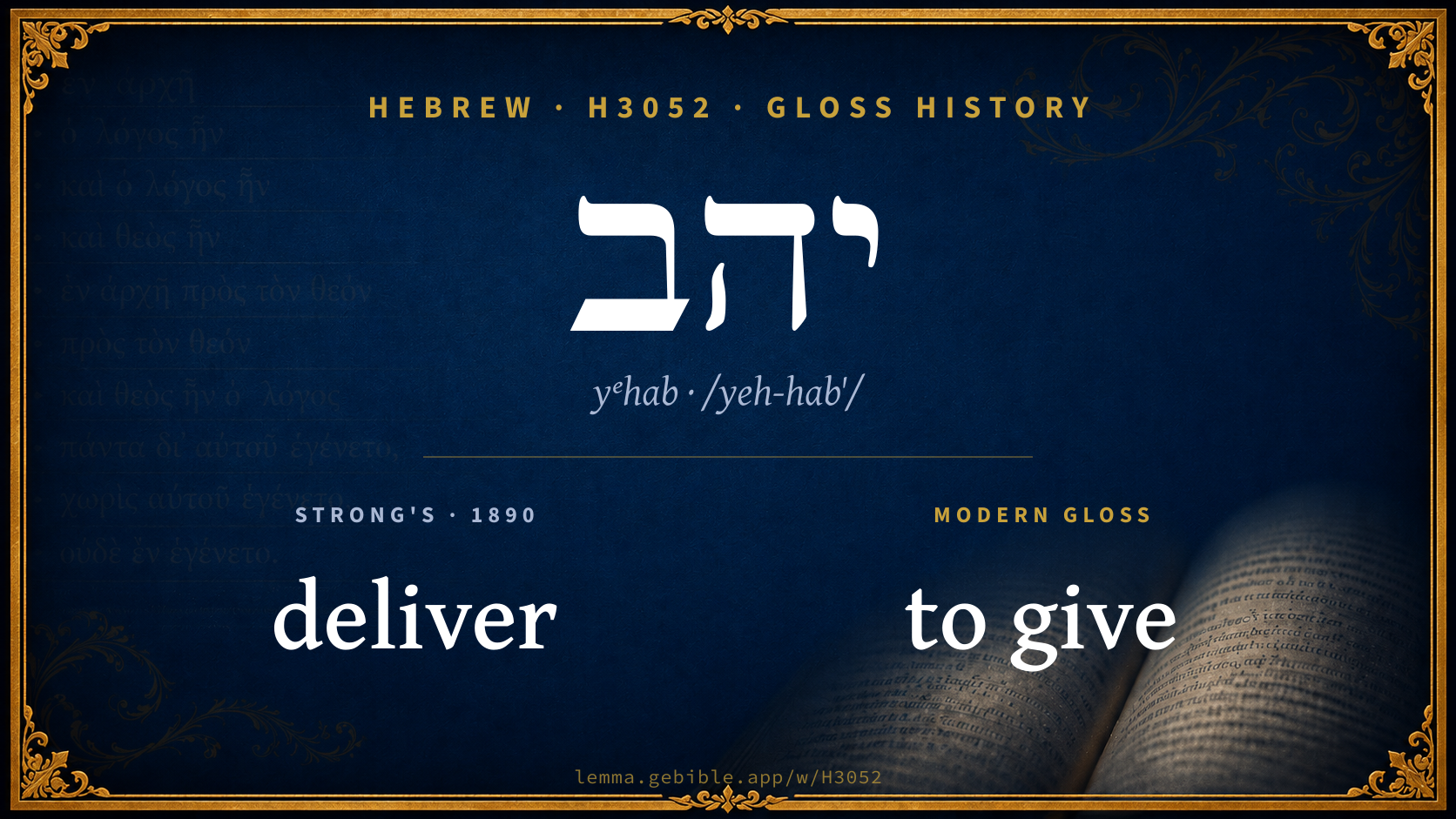
Gloss history
Strong's 1890 vs modern scholarship
About this word
Strong's H3052 catalogs a Hebrew word from the Hebrew Old Testament.
These counts are not copied from any lexicon or concordance. They are computed here, from the morphology-tagged Hebrew Old Testament. What Lemma adds →
- 28
- distinct verses
- The word appears in 28 distinct verses.
- 2 / 39
- OT books
- The word appears in 2 of 39 Old Testament books.
- #1,190
- by frequency
- Top 2500 most frequent Hebrew words (rank 1,190 of 8,640 Hebrew words by occurrence).
View all 28 occurrences in the concordance →
By traditional corpus
Conventional, traditional groupings — biblical authorship is debated, so this is a traditional corpus grouping, not an authorship claim. Each share is this word’s portion of its verses in that division of the Hebrew canon. Each figure is a share of the word’s 28 distinct verses.
- Writings (Ketuvim) 28 verses · 100%
How translations render this word
Counts come from each version’s own published word-to-Strong’s tagging or interlinear alignment — an approximate guide to how each version renders this word, not a word-level alignment the data otherwise carries. Because each total is that version’s own tagged count, the per-version totals vary from one another and need not match the appearance or distinct-verse counts above. These counts may also differ from a printed concordance because Lemma counts each distinctly tagged rendering and does not collapse phrase taggings into a single head-word total. This is a fixed set of word-tagged versions (KJV, ASV, BSB, ULT) and does not change with the reading translation you choose elsewhere. Each version’s license is shown beside its name below (and on Sources).
- King James Version: Given 4×, Was given 4×, Be given 2×
- American Standard Version: Given 3×, Was given 3×, Be given 2×
- Berean Standard Bible: Gave 3×, Given 3×, Will be given 2×
- unfoldingWord Literal Text: Was given 6×, Given 3×, Be given 2×
King James Version Public Domain
Renders H3052 across 28 tagged occurrences — most commonly:
Plus 14 renderings that appear only once — usually multi-word phrases or single function words the recovered tagging swept in, not distinct renderings.
American Standard Version Public Domain
Renders H3052 across 28 tagged occurrences — most commonly:
Plus 14 renderings that appear only once — usually multi-word phrases or single function words the recovered tagging swept in, not distinct renderings.
Berean Standard Bible Public Domain
Renders H3052 across 26 tagged occurrences — most commonly:
Plus 18 renderings that appear only once — usually multi-word phrases or single function words the recovered tagging swept in, not distinct renderings. Not rendered by a distinct English word in 2 further occurrences.
unfoldingWord Literal Text CC BY-SA 4.0
Renders H3052 across 30 tagged occurrences — most commonly:
Plus 11 renderings that appear only once — usually multi-word phrases or single function words the recovered tagging swept in, not distinct renderings.
Senses in the full BDB
Hebrew verbs can shift meaning by stem (binyan): Qal is the basic action, Niphal is often passive or reflexive, Piel often intensifies or makes it factitive, and Hiphil is typically causative. The senses below are grouped under the stem BDB assigns to each. This entry also uses Peal (the basic Aramaic stem, parallel to Qal), Peil (the passive Aramaic stem), and Hithpeel (the reflexive or passive Aramaic stem).
What do BDB’s symbols mean?
BDB uses these scholarly abbreviations:
| Symbol | Meaning |
|---|---|
| 𝔊 | the Septuagint (the ancient Greek translation, LXX) |
| 𝔙 | the Vulgate (the Latin translation) |
| 𝔖 | the Syriac version (the Peshitta) |
| 𝔗 | the Targum (the Aramaic translation) |
| ψ | the Psalms |
| √ | root (the underlying root or stem) |
| ‖ | parallel passage (a synonymous or contrasted parallel) |
| † | the dagger: every passage where the word occurs is cited |
The 5 senses and sub-senses the full Brown-Driver-Briggs lexicon distinguishes for this word, in lexicon order (not ranked by frequency), with BDB’s own verbatim wording and sub-sense lettering. Shown in Hebrew script with BDB’s own scholarly abbreviations. The condensed entry is in the Lexicon Entry tab. See also the Forms in the corpus table below.
Peal
- 1. give
- 2. place, lay foundations
Pe‛îl
- , be given
Hithpeel
- 1. be given
- 2. be paid, of cost
Senses from the full Brown-Driver-Briggs lexicon (Brown, Driver, Briggs; Oxford 1906 — public domain), digitized via Sefaria, supplemented by the OpenScriptures HebrewLexicon (CC BY 4.0). Full attribution on Sources.
Word origin
Derived from יהב (yâhab) (H3051) — to give.
Jastrow Dictionary
A second Hebrew/Aramaic lexicon for comparison, covering Aramaic and post-biblical (Talmudic, Targumic, Midrashic) usage that the biblical-Hebrew BDB does not. Matched by lemma rather than by Strong’s number, so a lemma may carry more than one Jastrow headword (shown separately below), and the entries cover usage well beyond the Bible.
יְהַב
- to give. Targ. Gen. III, 12. Targ. Job III, 19 יֵיהַב Ms. (ed. יָהִיב, ed. Wil. יְהִיב); a. fr.—Part. pass. יְהִיב. Targ. Num. III, 9; a. fr.—Imperative הַב. Targ. Gen. XXX, 26; a. fr.—Y. Ber. VIII, 11ᵇ bot., a. fr. י׳ ליה מילא gave him assurance of safety. Ib. יהב את פלגא (read as:) Y. Naz. V, end, 54ᵇ הב וכ׳ give thou half of it. Ib. [read:] אמר דיֵיבִין ליה יַהֲבוּ ליה ואכל he ordered that they give him (to eat); they gave him, and he ate. Kidd. 9ᵃ אי יהבינא לך וכ׳ (read: יַהֲבִינָהּ) if I give it to thee, wilt thou be betrothed unto me? Said she הָבָהּ מֵיהֲבָהּ give it; כל הבה מיהבה וכ׳ all such phrases as ‘give it’, mean nothing (do not mean assent to the proposal); a. v. fr.—נסב וי׳ (h. = נשא ונתן) to deal. Cant. R. to III, 6. Y. Shebi. VII, 37ᶜ top; a. e.—Lev. R. s. 19, v. infra.—2) to put, place. Targ. Ex. XVI, 33; a. fr.—Y. Keth. XII, 35ᵃ bot. אין אנן יַהֲבִין ליה נֵיהֲבֵיה וכ׳ if we put him (his coffin) anywhere, we must put him with R. &c.; a. fr.
- to be given. Targ. Is. IX, 5. Targ. Ex. V, 16; a. fr.—Kidd. 7ᵃ משום דא׳ למחילה because it (money or money’s worth) may be given away without consideration; v. נָתַן.—[Lev. R. s. 19 … תתיהב דיהבת וכ׳, read: תִּתְיַתַּב … דיַתְּבַת, v. יְתֵב I.]
A Dictionary of the Targumim, the Talmud Babli and Yerushalmi, and the Midrashic Literature (Marcus Jastrow; London, Luzac, 1903) — Public Domain. Digitized via Sefaria. Digitized via Sefaria. Full attribution on Sources.
Forms in the corpus
The 22 distinct written forms H3052 takes in the Hebrew Bible, most frequent first — each parse links to that stem’s occurrences in the concordance. Hebrew forms include their vowel points and cantillation, so a single lemma takes many written forms.
Same root — word family
Other BDB entries built from the same root as H3052, grouped by Strong’s listed origin. These share a root / origin per the lexicon — not necessarily a shared meaning. Each links to that word’s own entry.
Derives from
Shares the same root
Compare all same-root words → They share a root, not necessarily a meaning.
Septuagint verse parallels
This word appears in 27 verses that also exist in the Greek Old Testament (Septuagint), out of the 28 Hebrew verses it occurs in. You can read those verses in Greek by switching the Old Testament edition to the Septuagint.
Read these verses in the Septuagint
This is a verse-level parallel only — the same verses exist in both the Hebrew and Greek Old Testaments. No word-level Hebrew↔Greek correspondence is claimed: the data carries no such alignment, so no Greek word is shown as this Hebrew word’s translation. Coverage is not total — the Septuagint omits the deuterocanon and renumbers the Psalms, so some Hebrew verses have no direct Greek parallel.