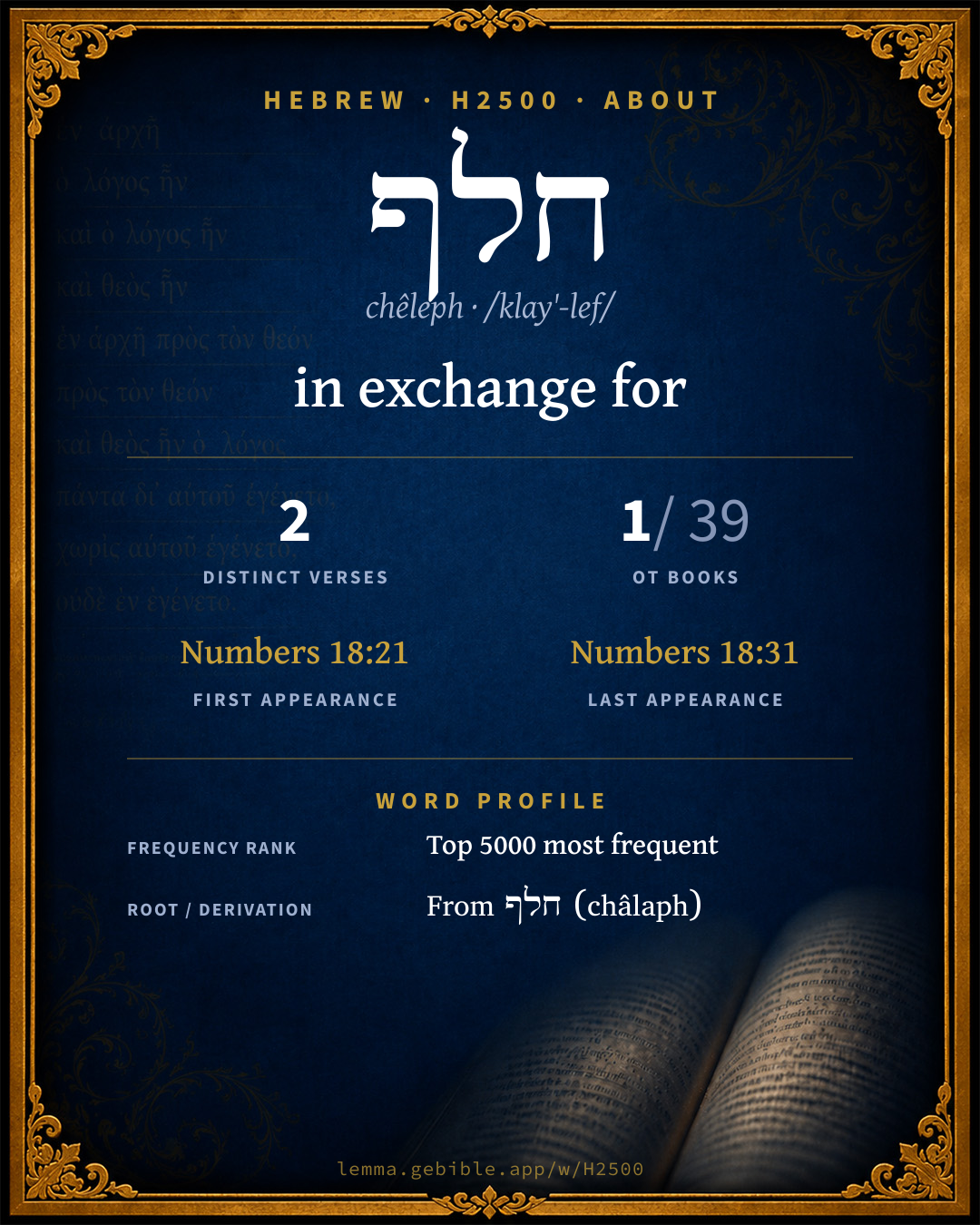
חֵ֫לֶף
in exchange for
‘in exchange for’ is one of 2 main senses fuller range ↓
Full lexicon entry — Brown-Driver-Briggs (BDB)
From Brown-Driver-Briggs (BDB)
Where this word appears
Grammar key — what these labels mean
Part of speech
- Preposition
- A relational word (e.g. “in,” “to,” “from”) governing a noun.
Every verse where H2500 appears — 2 distinct verses across 1 book. Click any verse to open its interlinear word-by-word view. Verse text shown in the World English Bible for context — . Each verse’s Hebrew form is shown with its reference; the English is not keyword-highlighted, since the data carries no word-level English alignment. Use “Compare translations” on any verse to read it across multiple English versions. This concordance covers the Hebrew Bible; Septuagint (Greek Old Testament) occurrences are not indexed here.
Numbers 2 verses
- Numbers 18:21 חֵ֤לֶף prep To the children of Levi, behold, I have given all the tithe in Israel for an inheritance, in return for their service which they serve, even the service of the tent of meeting.
- Numbers 18:31 חֵ֥לֶף prep You shall eat it in every place, you and your households: for it is your reward in return for your service in the tent of meeting.
About this entry
At a glance — auto-summarized from this page’s data, not written by a person. Every figure links to its source below. This summary describes the numbers; it doesn’t interpret them.
חלף — transliterated chêleph — is a Hebrew word carrying the sense “in exchange for.” It occurs a mere 2 verses across Scripture. More than three-quarters of its appearances fall in Numbers. Debuting at Numbers 18:21, it then recurs through the corpus. BDB distinguishes 2 senses for it. See the sense tree, 2-verse concordance, and the renderings breakdown below.
Gloss history
Strong's 1890 vs modern scholarship

About this word
Strong's H2500 catalogs a Hebrew word from the Hebrew Old Testament.
These counts are not copied from any lexicon or concordance. They are computed here, from the morphology-tagged Hebrew Old Testament. What Lemma adds →
- 2
- distinct verses
- The word appears in 2 distinct verses.
- 1 / 39
- OT books
- The word appears in 1 of 39 Old Testament books.
- #4,807
- by frequency
- Top 5000 most frequent Hebrew words (rank 4,807 of 8,640 Hebrew words by occurrence).
View all 2 occurrences in the concordance →
Most concentrated in
- Numbers 2 verses 100%
By section of the Old Testament
By traditional corpus
Conventional, traditional groupings — biblical authorship is debated, so this is a traditional corpus grouping, not an authorship claim. Each share is this word’s portion of its verses in that division of the Hebrew canon. Each figure is a share of the word’s 2 distinct verses.
- Torah (Pentateuch) 2 verses · 100%
How translations render this word
Counts come from each version’s own published word-to-Strong’s tagging or interlinear alignment — an approximate guide to how each version renders this word, not a word-level alignment the data otherwise carries. Because each total is that version’s own tagged count, the per-version totals vary from one another and need not match the appearance or distinct-verse counts above. These counts may also differ from a printed concordance because Lemma counts each distinctly tagged rendering and does not collapse phrase taggings into a single head-word total. This is a fixed set of word-tagged versions (KJV, ASV, BSB, ULT) and does not change with the reading translation you choose elsewhere. Each version’s license is shown beside its name below (and on Sources).
BDB lists this Strong’s number as 2 distinct words (homographs). Each count above pools all of them and is not split by sense — see the Senses section below. A low-frequency rendering may belong to a different one of those words, not the primary meaning.
- King James Version†: For 2×
- American Standard Version†: Return for 2×
- Berean Standard Bible†: For 1×, Return for 1×
- unfoldingWord Literal Text†: Exchange for 2×
King James Version Public Domain
Renders H2500 across 2† tagged occurrences — most commonly:
American Standard Version Public Domain
Renders H2500 across 3† tagged occurrences — most commonly:
Plus 1 rendering that appears only once — usually multi-word phrases or single function words the recovered tagging swept in, not distinct renderings.
Berean Standard Bible Public Domain
Renders H2500 across 2† tagged occurrences — most commonly:
unfoldingWord Literal Text CC BY-SA 4.0
Renders H2500 across 2† tagged occurrences — most commonly:
Senses in the full BDB
What do BDB’s symbols mean?
BDB uses these scholarly abbreviations:
| Symbol | Meaning |
|---|---|
| 𝔊 | the Septuagint (the ancient Greek translation, LXX) |
| 𝔙 | the Vulgate (the Latin translation) |
| 𝔖 | the Syriac version (the Peshitta) |
| 𝔗 | the Targum (the Aramaic translation) |
| ψ | the Psalms |
| √ | root (the underlying root or stem) |
| ‖ | parallel passage (a synonymous or contrasted parallel) |
| † | the dagger: every passage where the word occurs is cited |
The 0 senses and sub-senses the full Brown-Driver-Briggs lexicon distinguishes for this word, in lexicon order (not ranked by frequency), with BDB’s own verbatim wording and sub-sense lettering. Shown in Hebrew script with BDB’s own scholarly abbreviations. The condensed entry is in the Lexicon Entry tab. See also the Forms in the corpus table below.
חלף I [m.] exchange, only cstr., as prep. in return for (so חֲלַף, ܚܠܳܦ, common in Aramaic e.g. Gn 4
חלף II loc. in Naphtali, site unknown Jos 19
Senses from the full Brown-Driver-Briggs lexicon (Brown, Driver, Briggs; Oxford 1906 — public domain), digitized via Sefaria, supplemented by the OpenScriptures HebrewLexicon (CC BY 4.0). Full attribution on Sources.
Word origin
I. n.[m.] exchange, only cstr., as prep. in return for (so חֲלַף, ܚܠܳܦ, common in Aramaic e.g. Gn 4:23 𝔗 𝔖 for Heb. תַּחַת)—ח׳ עֲבֹדֶתֶם (עֲבֹדַתְכֶם) Nu 18:21, 31 (both P).
II. n.pr.loc. in Naphtali, site unknown Jos 19:33.
— Brown-Driver-Briggs (Oxford 1906, public domain), digitized via Sefaria, supplemented by the OpenScriptures HebrewLexicon (CC BY 4.0). See Sources.
Derived from חלף (châlaph) (H2498) — to pass through.
Jastrow Dictionary
A second Hebrew/Aramaic lexicon for comparison, covering Aramaic and post-biblical (Talmudic, Targumic, Midrashic) usage that the biblical-Hebrew BDB does not. Matched by lemma rather than by Strong’s number, so a lemma may carry more than one Jastrow headword (shown separately below), and the entries cover usage well beyond the Bible.
חָלַף
- [to be smooth, glistening, sharp-edged,]
- 1. to cut. Denom. חַלִּיף, חֵילֶף.
- 2. (cmp גּוּז) to pass by, be gone. Num. R. s. 10 (ref. to חלוף, Prov. XXXI, 8) שח׳ והלך וכ׳ of him who passed away and went &c. e.g. Proverbs 31:8
- 3. to change, exchange. Y. Ber. II, 5ᶜ top נַחֲלוֹף את וכ׳ let us change our meeting-place. Dem. III, 5 חשודה לַחֲלוֹף (Y. ed. לחַלֵּף, Pi.) suspected of exchanging (the provision in her trust). Ib. 6 לח׳ את המתקלקל to replace what has been spoiled; a. fr.
- same. Yalk. Gen. 148 מי מְחַלְּפוֹ who will replace him? (v. חֲלִיפִין). Dem. III, 5, v. supra; a. e.
- 1. to exchange, barter. B. Mets. VIII, 4 המַחֲלִיף פרה ב־ if one exchanges a cow for an ass.—Dem. l. c. חשודה להַחֲלִיף, v. supra; Ḥull. 6ᵇ חשודה מַחֲלֶפֶת; a. fr.
- 2. to drive young shoots, to grow again. Erub. 100ᵇ; a. e., v. גֶּזַע. Pesik. R. s. 11 מַחֲלִיף וכ׳, v. גָּזַז.
- 3. to change; to reverse. Erub. 9ᵃ ובלבד שלא יַחֲלִיפוּ provided they do not change carriers. Sabb. 8ᵇ; a. fr.—Erub. 99ᵃ לעולם לא תַחֲלִיף it is not necessary to reverse (the authorities; Bets. 3ᵇ, a. e. תיפוך, v. אֲפַךְ).—Part. pass. מוּחֲלָף, f. מוּחֲלֶפֶת. Ib. מ׳ השיטה the statement must be reversed (the authorities for the two opinions must be exchanged); Bets. 3ᵃ
- 4. to be ambiguous, to equivocate. Snh. 92ᵃ; a. e. כל המחליף וכ׳ he who equivocates in his speech, is like an idolater.
- , Nithpa. נִתְחַלֵּף
- 1. to be exchanged, mixed up. Y. Pes. VI, 33ᶜ bot. דבר שאין דרכו (לֵחָלֵף) לִיתְחַלֵּף a thing which is not likely to be exchanged (by mistake); ib. להִתְחַלֵּיף; ib.ᵈ top. Ab. Zar. 17ᵇ מעות … נִתְחַלְּפוּ לי וכ׳ money set aside for Purim was mixed up with money &c. Nidd. 52ᵃ ונִתְחַלְּפָה לך וכ׳ and thou madest a mistake between Iyob and oyeb; B. Bath. 16ᵃ ונתחלף. Ib. לא נ׳ לי I make no mistake; a. e.
- 2. to change (in appearance). Pesik. R. s. 29 (—30—30) נִתְחַלַּפְתֶּם מן הרעב you have changed (beyond recognition) through starvation; יש לכם להִתְחַלֵּף וכ׳ you will change through plenty. Yalk. Gen. 133 מאיזה שם אני מִתְחַלֵּף (prob. לאיזה) what name I may be ordered to assume in turn.
- 3. to be succeeded, relieved, transferred. Lev. R. s. 23, end נתח׳ המלך the king has been succeeded (displaced; Num. R. s. 9, beg. מת וכ׳). Yalk. Deut. 813 כיון שנ׳ וכ׳ when the governor was recalled and another &c. Num. R. s. 5, beg. להִתְחַלֵּף מעבודה וכ׳ to be transferred from one service to another. Y. Taan. II, beg. 65ᵃ היו מִתְחַלְּפִין עליה took turns in guarding it.
חֲלַף I
- , to pass by, be gone. Targ. Cant. II, 11. Targ. Job IX, 11. Ib. 26; a. e.
- 1. to pass repeatedly, promenade. Kidd. 12ᵇ ח׳ אבבא וכ׳ went up and down in front of the house of his father-in-law (to attract the attention of his mother-in-law).
- 2. to exchange. Targ. O. Lev. XXVII, 10; a. e.—Ḥull. 6ᵇ חַלּוּפֵי מבעיא so much the more may she be suspected of exchanging (substituting something of her own). Meg. 7ᵇ מְחַלְּפֵי וכ׳ (v. Rabb. D. S. a. l. note 8; some ed. מִיחַ׳ Ithpa.) used to exchange their meals (on Purim).—Part. pass. f. מְחַלְּפָא. Y. Peah IV, 18ᵈ bot., a. e. מח׳ שיטתיה, v. preced. Hif.
- same. Targ. O. l. c.; a. e.
- to be exchanged; to change; to disappear. Targ. Ps. XC, 5; a. fr.—Gen. R. s. 78, beg. מִתְחַלְּפִין change their names. Ḥull. l. c. ולאִיחַלּוּפֵי לא וכ׳ Rashi (ed. לחַלּוּפֵי) and do we not apprehend an exchange?—Meg. l. c., v. supra.—B. Mets. 59ᵇ, v. חָסֵר II.
חִלֶף I
- (preced. wds.)
- 1. shoot.—Pl. חֲלָפִים, constr. הֶלְפֵי, חֶילְ׳. Bets. 3ᵇ; Yeb. 81ᵇ; Zeb. 72ᵇ ח׳ תרדין the young shoots of beet growing out of the root; Orl. III, 7 Ms. M. (ed. חוֹלְפוֹת; Y. ed. חִילְפּוֹת); Tosef. Ter. V, 10 חֲלִיפוֹת ed. Zuck. (Var. חילפות); Ukts. I, 4 חִלְפּוֹת. V. חֲלִיפִין, חֲלִיפָה.
- 2. rush, v. חֵילֶף.
חֵלֶף II
- (preced. wds.) reversion. Y. Sabb. VII, 9ᶜ או ח׳ is not perhaps the reverse the case?
חֶלֶף
- (b. h.) Ḥelef, a place in Naftali. Y. Meg. I, 70ᵃ bot. (ref. to Josh. XIX, 33) מחלף ח׳ me-Helef is (the present) Ḥ. Y. Erub. II, 20ᵃ top ר׳ … בהורי ח׳ וכ׳ R. Jerem. taught at Ḥ. &c. e.g. Joshua 19:33
חֲלַף II
- st. constr. (חלף) in place of, instead. Targ. Ex. XXI, 24; a. fr.—Sabb. 129ᵃ נפשא ח׳ נפשא life for life (meat is required after bloodletting), סומקא ח׳ סומקא red (wine) for red (blood).—Pl. חֲלָפֵי, with suffix חֲלָפוֹי in his place. Targ. Prov. XI, 8 Ms. (ed. תחותוהי, ed. Lag. both words).—חֲלַף סִדְרָא f. (an adaptation of κλεψύδρα) [change of order,] clepsydra, a water clock used in courts of justice for measuring the time given for argument. Gen. R. s. 49 (not סרדה); Yalk. ib. 83.
A Dictionary of the Targumim, the Talmud Babli and Yerushalmi, and the Midrashic Literature (Marcus Jastrow; London, Luzac, 1903) — Public Domain. Digitized via Sefaria. Digitized via Sefaria. Full attribution on Sources.
Forms in the corpus
The 2 distinct written forms H2500 takes in the Hebrew Bible, most frequent first — each parse links to that state’s occurrences in the concordance. Hebrew forms include their vowel points and cantillation, so a single lemma takes many written forms.
| Form | Parsing | Example | Uses |
|---|---|---|---|
| חֵ֤לֶף | Preposition | Numbers 18:21 | 1 |
| חֵ֥לֶף | Preposition | Numbers 18:31 | 1 |
Same root — word family
Other BDB entries built from the same root as H2500, grouped by Strong’s listed origin. These share a root / origin per the lexicon — not necessarily a shared meaning. Each links to that word’s own entry.
Derives from
Shares the same root
- חלוף chălôwph H2475 destruction
- חליפה chălîyphâh H2487 change
- חלף chălaph H2499 to pass over
- מחלף machălâph H4252 knife
- מחלפה machlâphâh H4253 braid
Proper names from this root
People and places named from this root — a name, not an additional meaning of the word.
Compare all same-root words → Showing 4 of 8 — not the complete family. 1 of the same-root words is a proper name (a person or place). They share a root, not necessarily a meaning.
Septuagint verse parallels
This word appears in 2 verses that also exist in the Greek Old Testament (Septuagint), out of the 2 Hebrew verses it occurs in. You can read those verses in Greek by switching the Old Testament edition to the Septuagint.
Read these verses in the Septuagint
This is a verse-level parallel only — the same verses exist in both the Hebrew and Greek Old Testaments. No word-level Hebrew↔Greek correspondence is claimed: the data carries no such alignment, so no Greek word is shown as this Hebrew word’s translation. Coverage is not total — the Septuagint omits the deuterocanon and renumbers the Psalms, so some Hebrew verses have no direct Greek parallel.