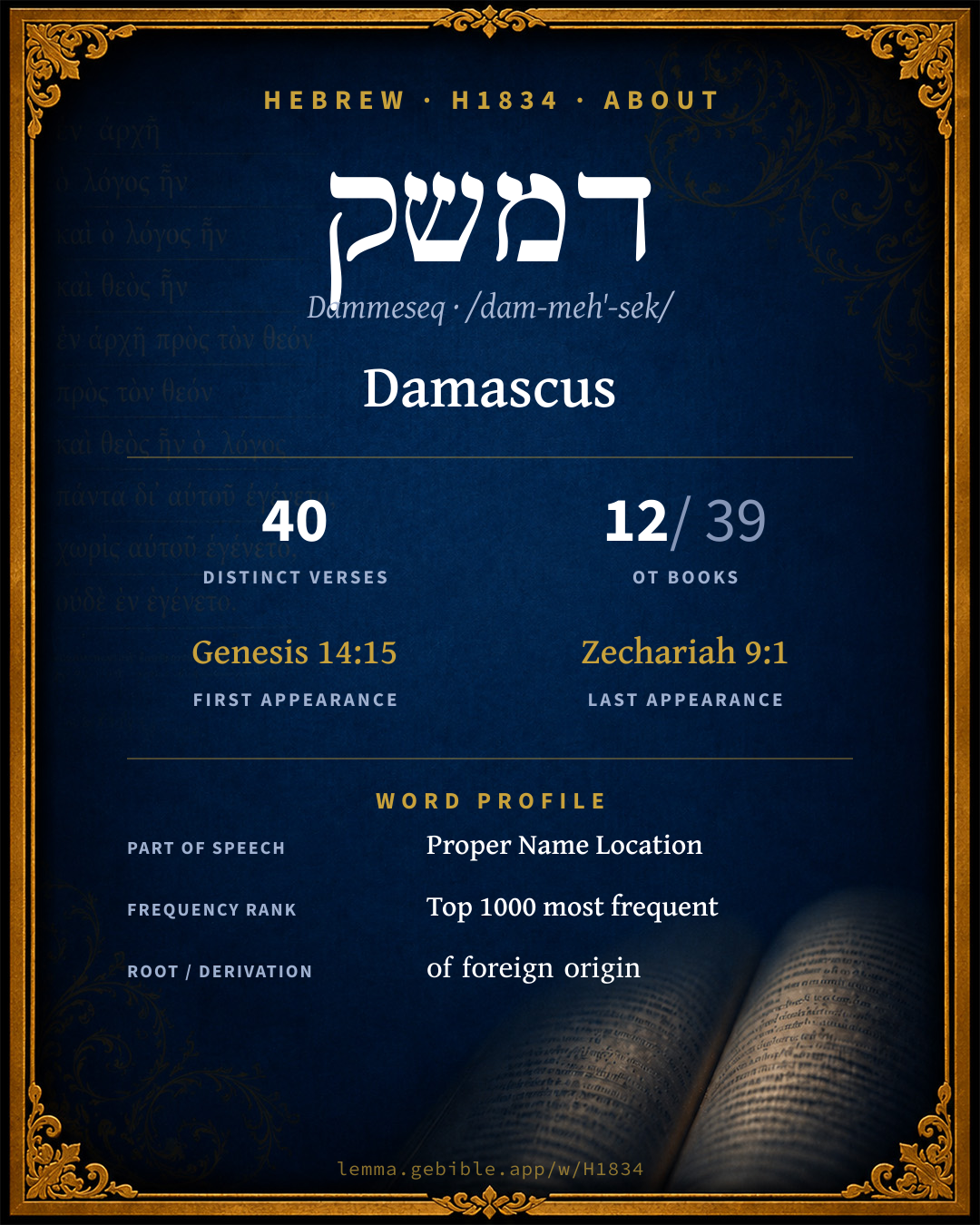
דַּמֶּ֫שֶׂק
Damascus
BDB lists 2 entries for ‘Damascus’ fuller range ↓
Full lexicon entry — Brown-Driver-Briggs (BDB)
From Brown-Driver-Briggs (BDB)
Where this word appears
Grammar key — what these labels mean
Part of speech
- Noun
- A naming word — a person, place, thing, or idea.
Noun type
- Proper
- A name of a specific person, place, or people (e.g. Abraham, Zion, Israel).
Every verse where H1834 appears in the Book of 2 Chronicles — 4 distinct verses. Click any verse to open its interlinear word-by-word view. Verse text shown in the World English Bible for context — . Each verse’s Hebrew form is shown with its reference; the English is not keyword-highlighted, since the data carries no word-level English alignment. Use “Compare translations” on any verse to read it across multiple English versions. This concordance covers the Hebrew Bible; Septuagint (Greek Old Testament) occurrences are not indexed here.
2 Chronicles
- 2 Chronicles 16:2 בְּ/דַרְמֶ֖שֶׂק prep + n Proper Then Asa brought out silver and gold out of the treasures of the house of Yahweh and of the king's house, and sent to Ben Hadad king of Syria, who lived at Damascus, saying,
- 2 Chronicles 24:23 דַּרְמָֽשֶׂק n Proper It happened at the end of the year, that the army of the Syrians came up against him: and they came to Judah and Jerusalem, and destroyed all the princes of the people from among the people, and sent all the spoil of them to the king of Damascus.
- 2 Chronicles 28:5 דַּרְמָ֑שֶׂק n Proper Therefore Yahweh his God delivered him into the hand of the king of Syria; and they struck him, and carried away of his a great multitude of captives, and brought them to Damascus. He was also delivered into the hand of the king of Israel, who struck him with a great slaughter.
- 2 Chronicles 28:23 דַרְמֶשֶׂק֮ n Proper For he sacrificed to the gods of Damascus, which struck him; and he said, Because the gods of the kings of Syria helped them, [therefore] will I sacrifice to them, that they may help me. But they were the ruin of him, and of all Israel.
About this entry
At a glance — auto-summarized from this page’s data, not written by a person. Every figure links to its source below. This summary describes the numbers; it doesn’t interpret them.
“Damascus” is the headline sense of the Hebrew name דמשק (Dammeseq). First canonically at Genesis 14:15, it enters the text early. With 40 verses in 12 books, it is a moderately common word in the Hebrew Bible. The sections below give every occurrence and version rendering.
Gloss history
Strong's 1890 vs modern scholarship
About this word
Strong's H1834 catalogs a Hebrew word from the Hebrew Old Testament.
These counts are not copied from any lexicon or concordance. They are computed here, from the morphology-tagged Hebrew Old Testament. What Lemma adds →
- 40
- distinct verses
- The word appears in 40 distinct verses.
- 12 / 39
- OT books
- The word appears in 12 of 39 Old Testament books.
- #810
- by frequency
- Top 1000 most frequent Hebrew words (rank 810 of 8,640 Hebrew words by occurrence).
View all 40 occurrences in the concordance →
By section of the Old Testament
By traditional corpus
Conventional, traditional groupings — biblical authorship is debated, so this is a traditional corpus grouping, not an authorship claim. Each share is this word’s portion of its verses in that division of the Hebrew canon. Each figure is a share of the word’s 40 distinct verses.
- Prophets (Nevi'im) 31 verses · 78%
- Writings (Ketuvim) 7 verses · 18%
- Torah (Pentateuch) 2 verses · 5%
How translations render this word
Counts come from each version’s own published word-to-Strong’s tagging or interlinear alignment — an approximate guide to how each version renders this word, not a word-level alignment the data otherwise carries. Because each total is that version’s own tagged count, the per-version totals vary from one another and need not match the appearance or distinct-verse counts above. These counts may also differ from a printed concordance because Lemma counts each distinctly tagged rendering and does not collapse phrase taggings into a single head-word total. This is a fixed set of word-tagged versions (KJV, ASV, BSB, ULT) and does not change with the reading translation you choose elsewhere. Each version’s license is shown beside its name below (and on Sources).
BDB lists this Strong’s number as 2 distinct words (homographs). Each count above pools all of them and is not split by sense — see the Senses section below. A low-frequency rendering may belong to a different one of those words, not the primary meaning.
- King James Version†: Damascus 38×
- American Standard Version†: Damascus 36×
- Berean Standard Bible†: Damascus 38×
- unfoldingWord Literal Text†: Damascus 38×
King James Version Public Domain
Renders H1834 across 44† tagged occurrences — most commonly:
Plus 6 renderings that appear only once — usually multi-word phrases or single function words the recovered tagging swept in, not distinct renderings. Not rendered by a distinct English word in 1 further occurrence.
American Standard Version Public Domain
Renders H1834 across 43† tagged occurrences — most commonly:
Plus 7 renderings that appear only once — usually multi-word phrases or single function words the recovered tagging swept in, not distinct renderings.
Berean Standard Bible Public Domain
Renders H1834 across 43† tagged occurrences — most commonly:
Plus 5 renderings that appear only once — usually multi-word phrases or single function words the recovered tagging swept in, not distinct renderings. Not rendered by a distinct English word in 2 further occurrences.
unfoldingWord Literal Text CC BY-SA 4.0
Renders H1834 across 42† tagged occurrences — most commonly:
Plus 4 renderings that appear only once — usually multi-word phrases or single function words the recovered tagging swept in, not distinct renderings.
Senses in BDB
The 2 senses BDB distinguishes for this word, in lexicon order (not ranked by frequency or importance). The full entry — with sub-senses — is in the Lexicon Entry tab.
- Damascus = "silent is the sackcloth weaver"
- an ancient trading city…
Word origin
n.pr.loc. Damascus (Assyrian Dimašḳi, Dimasḳi, DlPa 280 SchrCOT Gn 15, 2 & ABK 323 Jäger BAS ii. 281 f.; Arabic دَمِشْقُ, دِمِشْقُ; Aramaic 𝔗 Onk, etc. דמשק, Ps-Jon דרמשק; ܕܰܪܡܣܘܽܩ )—דַּמֶּשֶׂק 1 K 11:24 + 28 times; דַּמָּ֑שֶׂק Gn 14:15 + 8 times; דַּרְמֶשֶׂק 1 Ch 18:5 + 3 times Ch; דַּרְמָ֑שֶׂק 2 Ch 24:23; 28:5, דּוּמֶּשֶׂק 2 K 16:10; דְּמֶשֶׁק Am 3:12 v. foll., Vrss. דַּמֶּשֶׂק;—ancient Aramaean city, situated lat. 33° 30ˊ N., long. 36° 15ˊ E., in plain E. of Hermon & SE. of Anti-Lebanon; on the Nahr Baradâ (Gk. Chrysorrhoas); mod. Dimishḳ & Esh-Sham, RobBR iii. 440 ff. BdPal 307; Damascus Gn 14:15; Am 5:27; 1 K 11:24(×2) 2 K 14:28; Ct 7:5; so also prob. Gn 15:2 (perhaps gloss cf. Di), (&Am 3:12 v. foll.); a trading-centre Ez 27:18; as capital & residence of king of Aram 1 K 15:18 = 2 Ch 16:2, cf. 1 K 20:34; 2 K 16:9, 10(×2), 11(×2), 12; 2 Ch 28:5; Is 7:8(×2); 8:4; 10:9 (cf. PetersHbr April 1885, 242) 17:1(×2), 3; Je 49:23, 24, 27; including also surrounding territory Ez 47:16, 17 cf. v 18; 48:1, v. מִדְבַּ֫רָה ד׳ 1 K 19:15; נַהֲרוֹת ד׳ 2 K 5:12; = kingdom Am 1:3, 5 cf. Zc 9:1; once (late) מֶלֶךְ ד׳ 2 Ch 24:23; note, also אֲרַם ד׳ 2 S 8:5, 6 = 1 Ch 18:5, 6; further אֱלֹהֵי ד׳ 2 Ch 28:23 (‖ אֱלֹהֵי מַלְכֵי אֲרָם).
— Brown-Driver-Briggs (Oxford 1906, public domain), digitized via Sefaria, supplemented by the OpenScriptures HebrewLexicon (CC BY 4.0). See Sources.
Origin: of foreign origin
Jastrow Dictionary
A second Hebrew/Aramaic lexicon for comparison, covering Aramaic and post-biblical (Talmudic, Targumic, Midrashic) usage that the biblical-Hebrew BDB does not. Matched by lemma rather than by Strong’s number, so a lemma may carry more than one Jastrow headword (shown separately below), and the entries cover usage well beyond the Bible.
דַּמֶּשֶׂק
- (b. h.) pr. n. pl. Damascus. Targ. O. Gen. XIV, 15 (Y. I דַּרְמָשֶׂק). Targ. Is. XVII, 1; a. fr.—Sifré Deut. 1 שאני מד׳ I (R. José b. Durmaskith) am from D., v. דּוּרְמַסְקִית; a. fr.
A Dictionary of the Targumim, the Talmud Babli and Yerushalmi, and the Midrashic Literature (Marcus Jastrow; London, Luzac, 1903) — Public Domain. Digitized via Sefaria. Digitized via Sefaria. Full attribution on Sources.
Forms in the corpus
The 33 distinct written forms H1834 takes in the Hebrew Bible, most frequent first — each parse links to that state’s occurrences in the concordance. Hebrew forms include their vowel points and cantillation, so a single lemma takes many written forms.
| Form | Parsing | Example | Uses |
|---|---|---|---|
| דַּמֶּ֔שֶׂק | Noun, Proper | Amos 1:5 | 8 |
| דַמֶּ֨שֶׂק֙ | Noun, Proper | 1 Kings 11:24 | 2 |
| דַּמֶּ֗שֶׂק | Noun, Proper | 2 Kings 5:12 | 2 |
| דַּמֶּ֧שֶׂק | Noun, Proper | Ezekiel 27:18 | 2 |
| דַּמָּ֑שֶׂק | Noun, Proper | Isaiah 17:1 | 2 |
| דַּרְמֶ֔שֶׂק | Noun, Proper | 1 Chronicles 18:5 | 2 |
| בְ/דַמֶּ֨שֶׂק֙ | Noun, Proper | 1 Kings 20:34 | 1 |
| בְּ/דַמֶּ֖שֶׂק | Noun, Proper | 1 Kings 15:18 | 1 |
| בְּ/דַמָּ֑שֶׂק | Noun, Proper | 2 Kings 16:10 | 1 |
| בְּ/דַמָּֽשֶׂק | Noun, Proper | 1 Kings 11:24 | 1 |
| בְּ/דַרְמֶ֖שֶׂק | Noun, Proper | 2 Chronicles 16:2 | 1 |
| דַמֶּ֔שֶׂק | Noun, Proper | Amos 1:3 | 1 |
| דַמֶּ֛שֶׂק | Noun, Proper | Jeremiah 49:24 | 1 |
| דַמָּ֑שֶׂק | Noun, Proper | 1 Kings 19:15 | 1 |
| דַמָּֽשֶׂק | Noun, Proper | Song of Solomon 7:4 | 1 |
| דַרְמֶשֶׂק֮ | Noun, Proper | 2 Chronicles 28:23 | 1 |
| דַּמֶּ֖שֶׂק | Noun, Proper | Isaiah 7:8 | 1 |
| דַּמֶּ֤שֶׂק | Noun, Proper | Ezekiel 48:1 | 1 |
| דַּמֶּ֥שֶׂק | Noun, Proper | Genesis 15:2 | 1 |
| דַּמֶּ֨שֶׂק֙ | Noun, Proper | 2 Kings 16:9 | 1 |
| דַּמֶּשֶׂק֩ | Noun, Proper | Ezekiel 47:18 | 1 |
| דַּרְמָ֑שֶׂק | Noun, Proper | 2 Chronicles 28:5 | 1 |
| דַּרְמָֽשֶׂק | Noun, Proper | 2 Chronicles 24:23 | 1 |
| דּוּמֶּ֔שֶׂק | Noun, Proper | 2 Kings 16:10 | 1 |
| וְ/דַמֶּ֖שֶׂק | Noun, Proper | Zechariah 9:1 | 1 |
| כְ/דַמֶּ֖שֶׂק | Noun, Proper | Isaiah 10:9 | 1 |
| לְ/דַמֶּ֗שֶׂק | Noun, Proper | Jeremiah 49:23 | 1 |
| לְ/דַמָּ֑שֶׂק | Noun, Proper | Amos 5:27 | 1 |
| לְ/דַמָּֽשֶׂק | Noun, Proper | Genesis 14:15 | 1 |
| מִ/דַּמֶּ֔שֶׂק | Noun, Proper | 2 Kings 16:12 | 1 |
| מִ/דַּמֶּ֖שֶׂק | Noun, Proper | Isaiah 17:3 | 1 |
| מִ/דַּמֶּ֗שֶׂק | Noun, Proper | 2 Kings 16:11 | 1 |
| מִ/דַּמָּֽשֶׂק | Noun, Proper | 2 Kings 16:11 | 1 |
Same root — word family
Other BDB entries built from the same root as H1834, grouped by Strong’s listed origin. These share a root / origin per the lexicon — not necessarily a shared meaning. Each links to that word’s own entry.
Derived from this word
Proper names from this root
People and places named from this root — a name, not an additional meaning of the word.
Compare all same-root words → 1 of the same-root words is a proper name (a person or place). They share a root, not necessarily a meaning.
Bible dictionary
Public-domain dictionary articles matched to this entry by name (Damascus). A biblical name can be shared by more than one person or place, so an article may treat several.
Easton's Bible Dictionary · M. G. Easton, 1897
Activity, the most ancient of Oriental cities; the capital of Syria (Isa. 7:8; 17:3); situated about 133 miles to the north of Jerusalem. Its modern name is Esh-Sham; i.e., "the East."
The situation of this city is said to be the most beautiful of all Western Asia. It is mentioned among the conquests of the Egyptian king Thothmes III. (B.C. 1500), and in the Amarna tablets (B.C. 1400).
It is first mentioned in Scripture in connection with Abraham's victory over the confederate kings under Chedorlaomer (Gen. 14:15). It was the native place of Abraham's steward (15:2). It is not again noticed till the time of David, when "the Syrians of Damascus came to succour Hadadezer" (q.v.), 2 Sam. 8:5; 1 Chr. 18:5. In the reign of Solomon, Rezon became leader of a band who revolted from Hadadezer (1 Kings 11:23), and betaking themselves to Damascus, settled there and made their leader king. There was a long war, with varying success, between the Israelites and Syrians, who at a later period became allies of Israel against Judah (2 Kings 15:37).
The Syrians were at length subdued by the Assyrians, the city of Damascus was taken and destroyed, and the inhabitants carried captive into Assyria (2 Kings 16:7-9; comp. Isa. 7:8). In this, prophecy was fulfilled (Isa. 17:1; Amos 1:4; Jer. 49:24). The kingdom of Syria remained a province of Assyria till the capture of Nineveh by the Medes (B.C. 625), when it fell under the conquerors. After passing through various vicissitudes, Syria was invaded by the Romans (B.C. 64), and Damascus became the seat of the government of the province. In A.D. 37 Aretas, the king of Arabia, became master of Damascus, having driven back Herod Antipas.
This city is memorable as the scene of Saul's conversion (Acts 9:1-25). The street called "Straight," in which Judas lived, in whose house Saul was found by Ananias, is known by the name Sultany, or "Queen's Street." It is the principal street of the city. Paul visited Damascus again on his return from Arabia (Gal. 1:16, 17). Christianity was planted here as a centre (Acts 9:20), from which it spread to the surrounding regions.
In A.D. 634 Damascus was conquered by the growing Mohammedan power. In A.D. 1516 it fell under the dominion of the Turks, its present rulers. It is now the largest city in Asiatic Turkey. Christianity has again found a firm footing within its walls.
Smith's Bible Dictionary · William Smith, 1863
one of the most ancient and most important of the cities of Syria. It is situated 130 miles northeast of Jerusalem, in a plain of vast size and of extreme fertility, which lies east of the great chain of Anti-Libanus, on the edge of the desert. This fertile plain, which is nearly circular and about 30 miles in diameter, is due to the river Barada, which is probably the "Abana" of Scripture. Two other streams the Wady Helbon upon the north and the Awaj, which flows direct from Hermon upon the south, increase the fertility of the Damascene plain, and contend for the honor of representing the "Pharpar" of Scripture. According to Josephus, Damascus was founded by Uz grandson of Shem. It is first mentioned in Scripture in connection with Abraham, (Genesis 14:15) whose steward was a native of the place. (Genesis 15:2) At one time david became complete master of the whole territory, which he garrisoned with israelites. (2 Samuel 8:5,6) It was in league with Baasha, king of Israel against Asa, (1 Kings 15:19; 2 Chronicles 16:3) and afterwards in league with Asa against Baasha. (1 Kings 15:20) Under Ahaz it was taken by Tiglath-pileser, (2 Kings 16:7,8,9) the kingdom of Damascus brought to an end, and the city itself destroyed, the inhabitants being carried captive into Assyria. (2 Kings 16:9) comp. Isai 7:8 and Amos 1:5 Afterwards it passed successively under the dominion of the Assyrians, Babylonians, Persians, Macedonians, Romans and Saracens, and was at last captured by the Turks in 1516 A.D. Here the apostle Paul was converted and preached the gospel. (Acts 9:1-25) Damascus has always been a great centre for trade. Its present population is from 100,000 to 150,000. It has a delightful climate. Certain localities are shown as the site of those scriptural events which specially interest us in its history. Queen's Street, which runs straight through the city from east to west, may be the street called Straight. (Acts 9:11) The house of Judas and that of Ananias are shown, but little confidence can be placed in any of these traditions.
Hitchcock's Bible Names Dictionary · Roswell D. Hitchcock, 1869
a sack full of blood; the similitude of burning
Classic public-domain reference works; full attribution on Sources.
Septuagint verse parallels
This word appears in 35 verses that also exist in the Greek Old Testament (Septuagint), out of the 40 Hebrew verses it occurs in. You can read those verses in Greek by switching the Old Testament edition to the Septuagint.
Read these verses in the Septuagint
- Genesis 14:15
- 2 Samuel 8:5
- 1 Kings 15:18
- 2 Kings 5:12
- 1 Chronicles 18:5
- 2 Chronicles 16:2
- Song of Solomon 7:4
- Isaiah 7:8
- Ezekiel 27:18
- Amos 1:3
- Zechariah 9:1
This is a verse-level parallel only — the same verses exist in both the Hebrew and Greek Old Testaments. No word-level Hebrew↔Greek correspondence is claimed: the data carries no such alignment, so no Greek word is shown as this Hebrew word’s translation. Coverage is not total — the Septuagint omits the deuterocanon and renumbers the Psalms, so some Hebrew verses have no direct Greek parallel.