
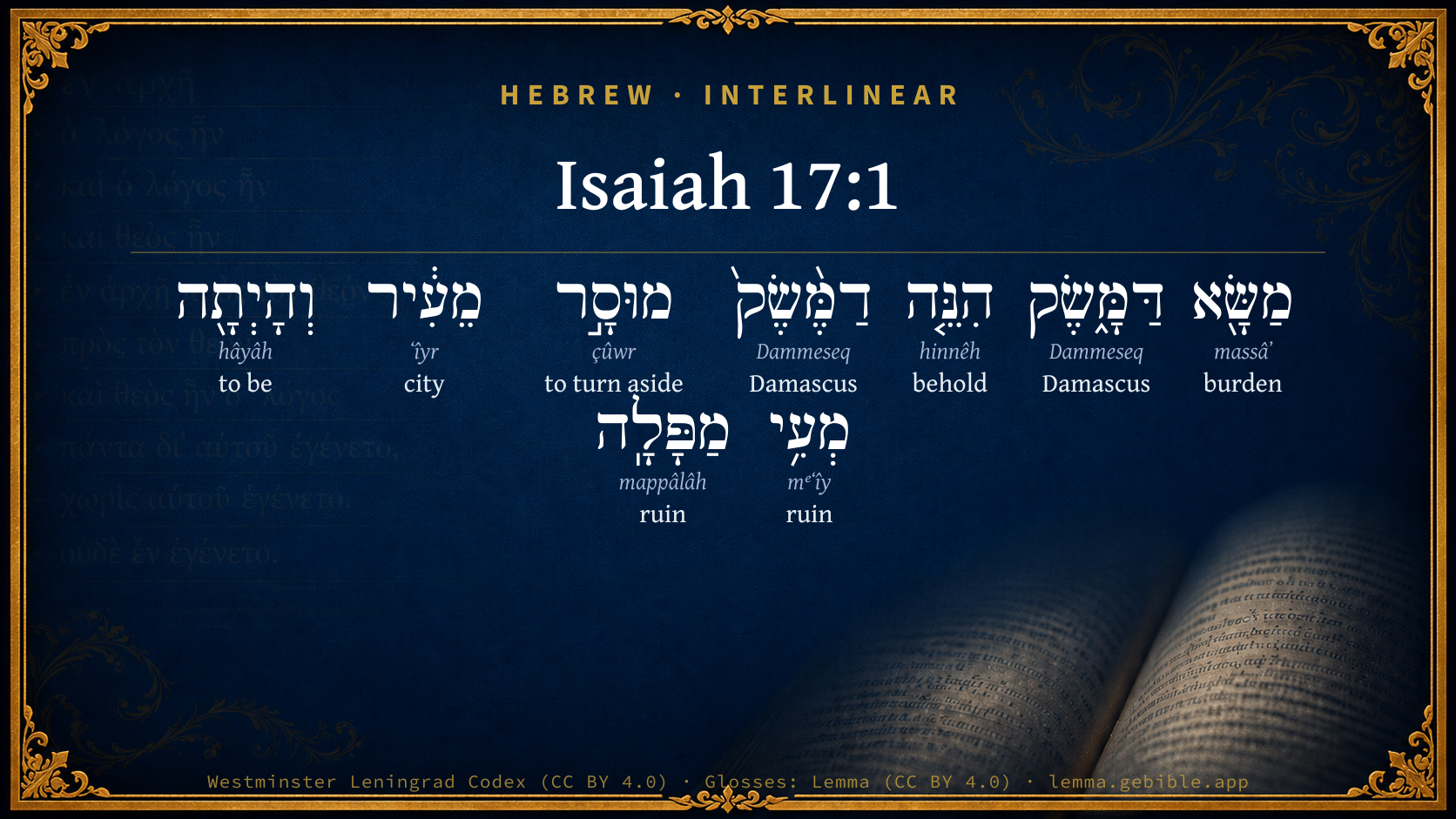
Isaiah 17:1

Hebrew (Westminster Leningrad Codex) Isaiah 17:1 appears in the Hebrew Old Testament. The text above is from the Westminster Leningrad Codex. Each word links to its Strong’s number, a concise gloss, and parsing drawn from the Open Scriptures Hebrew Bible morphology. Click any word for its full Brown-Driver-Briggs (BDB) entry.
Download image
Cite this verse

Isaiah 17:1 (World English Bible). Public Domain. Lemma interlinear Bible study tool, https://lemma.gebible.app/v/isaiah/17/1.

Show BibTeX & RIS
BibTeX
RIS
English Translation
The burden of Damascus. Behold, Damascus is taken away from being a city, and it shall be a ruinous heap.
World English Bible · Public Domain
Highlights
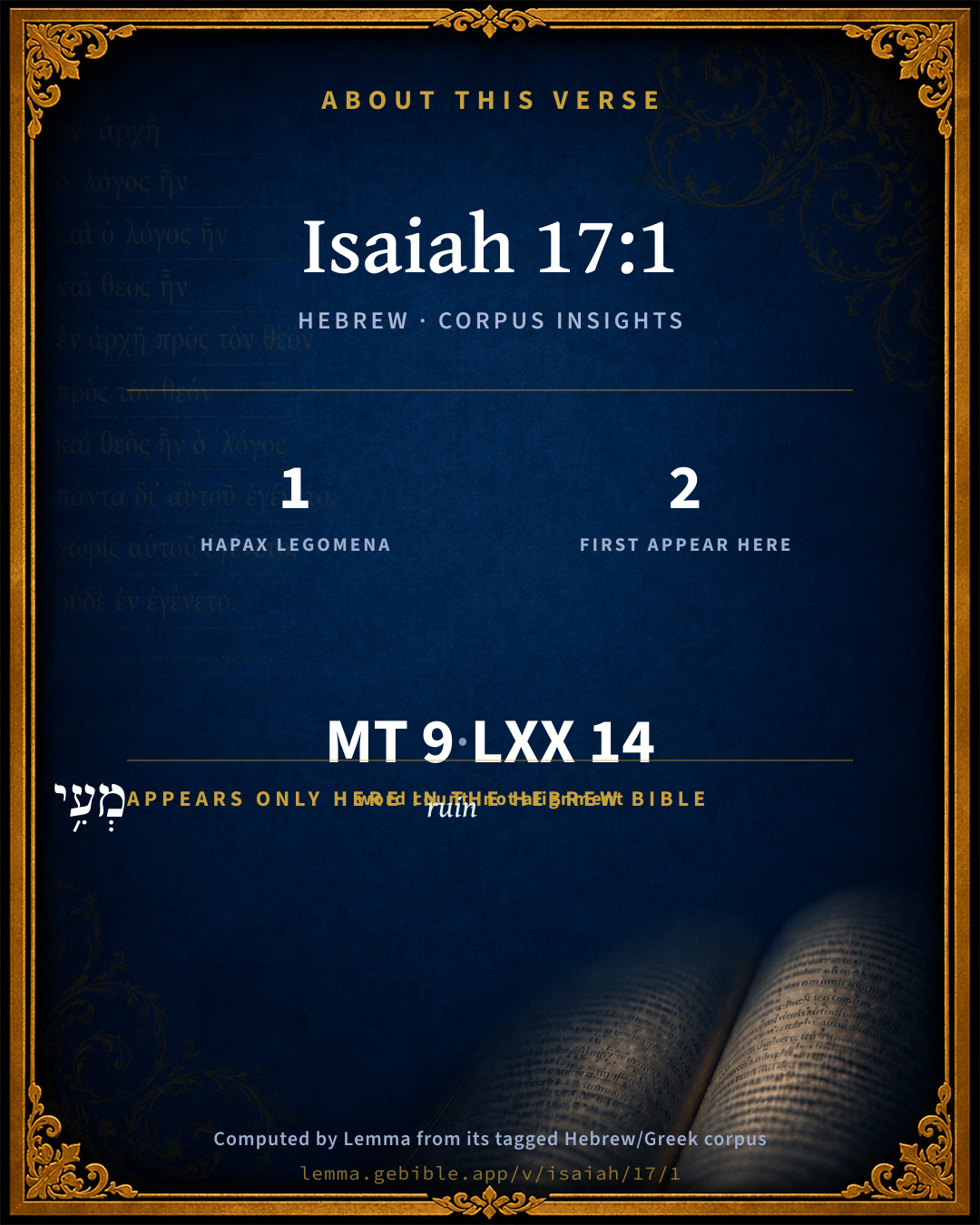
  • 1 hapax legomenon — only here in the Hebrew Bible
  • 2 first appearances in the Hebrew Bible
Full analysis ↓
Download a study sheet

One document with this verse’s original text, its word-by-word gloss line, the meaning frame, cross-references with their text, attributed commentary, and full source and license credits — printable, and it pastes into notes with its structure intact.

This verse Autodidact and up

Study sheet (.html) Plain text (.txt)

A passage Seminary Student

Up to 50 verses in one chapter. A passage sheet keeps up to 6 commentary sources and 12 cross-references per verse, in the order this page ranks them, and says so on the sheet whenever that leaves anything out. Ask for a single verse and you get the Autodidact verse sheet above.

Everything on this page stays free to read, with no account — the sheet is a download of what is already on screen, not access to it.

Want to remove ads? Support Godless Engineer
Compare translations 3

The same verse in 3 English versions, stacked beneath the original-language interlinear above. Click any original word for its lexicon entry.

Each is an independent rendering of the whole verse — the interlinear is not word-aligned to these translations.

Highlighted words mark where these versions differ — a whole-verse word diff, not a word-by-word alignment.

  • World English Bible Public Domain
    The burden of Damascus. Behold, Damascus is taken away from being a city, and it shall be a ruinous heap.
  • King James Version Public Domain
    The burden of Damascus. Behold, Damascus is taken away from being a city, and it shall be a ruinous heap.
  • unfoldingWord Literal Text CC BY-SA 4.0
    The burden of Damascus. “Behold Damascus, being removed from a city, and it will be a heap of ruin.

unfoldingWord Literal Text — © unfoldingWord, licensed CC BY-SA 4.0. Word-aligned USFM3 via Door43 (git.door43.org/unfoldingWord/en_ult).

Versions to compare (up to 4)

3 of 4 selected

Show all 18 translations

Every available English version of this verse, each an independent rendering of the whole verse.

  • World English Bible Public Domain
    The burden of Damascus. Behold, Damascus is taken away from being a city, and it shall be a ruinous heap.
  • Berean Standard Bible Public Domain
    This is the burden against Damascus: “Behold, Damascus is no longer a city; it has become a heap of ruins.
  • Majority Standard Bible Public Domain
    This is the burden against Damascus: “Behold, Damascus is no longer a city; it has become a heap of ruins.
  • King James Version Public Domain
    The burden of Damascus. Behold, Damascus is taken away from being a city, and it shall be a ruinous heap.
  • American Standard Version (1901) Public Domain
    The burden of Damascus. Behold, Damascus is taken away from being a city, and it shall be a ruinous heap.
  • Revised Version (1885) Public Domain
    The burden of Damascus. Behold, Damascus is taken away from being a city, and it shall be a ruinous heap.
  • Geneva Bible (1599) Public Domain
    The burden of Damascus. Beholde, Damascus is taken away from being a citie, for it shall be a ruinous heape.
  • Douay-Rheims (1899) Public Domain
    The burden of Damascus. Behold Damascus shall cease to be a city, and shall be as a ruinous heap of stones.
  • Young's Literal Translation Public Domain
    The burden of Damascus. Lo, Damascus is taken away from `being' a city, And it hath been a heap -- a ruin.
  • Literal Standard Version CC BY-SA 4.0
    The burden of Damascus. Behold, Damascus is taken away from [being] a city, || And it has been a heap—a ruin.
  • Unlocked Literal Bible CC BY-SA 4.0
    A declaration about Damascus.
  • unfoldingWord Literal Text CC BY-SA 4.0
    The burden of Damascus. “Behold Damascus, being removed from a city, and it will be a heap of ruin.
  • Darby Bible Public Domain
    The burden of Damascus. Behold, Damascus is taken away from [being] a city, and it shall be a ruinous heap.
  • World Messianic Bible Public Domain
    The burden of Damascus. “Behold, Damascus is taken away from being a city, and it will be a ruinous heap.
  • Webster's Bible Public Domain
    The burden of Damascus. Behold, Damascus is taken away from being a city, and it shall be a ruinous heap.
  • Free Bible Version CC BY-SA 4.0
    A message about Damascus. Look, Damascus will cease to exist as a city. Instead it will become a pile of ruins.
  • Bible in Basic English Public Domain
    The word about Damascus. See, they have made Damascus a town no longer; it has become a waste place.
  • JPS Tanakh (1917) Public Domain
    The burden of Damascus. Behold, Damascus is taken away from being a city, and it shall be a ruinous heap.

Literal Standard Version (2020), Covenant Press — licensed CC BY-SA 4.0. Text via the HelloAO Bible API (eBible.org). Unlocked Literal Bible (unfoldingWord) — licensed CC BY-SA 4.0. Text via the HelloAO Bible API (eBible.org). unfoldingWord Literal Text — © unfoldingWord, licensed CC BY-SA 4.0. Word-aligned USFM3 via Door43 (git.door43.org/unfoldingWord/en_ult). Free Bible Version, Dr. Jonathan Gallagher — licensed CC BY-SA 4.0. Text via the HelloAO Bible API (eBible.org).

Word by word

More ways to search: Search by grammar → Find every occurrence → Compare this word →

Practice this passage: Drill this verse → Learn its vocabulary →

About this verse

These counts appear in no published source. They are computed here, from the morphology-tagged text and Lemma’s own curated glosses. What Lemma adds →

9
words
8
distinct lemmas
Prophets
section

Notable vocabulary

1 hapax legomenon — a word that appears only here in the entire Hebrew Bible:

  • מְעִ֥י ruin H4596

First appearance in Scripture

These words make their first canonical appearance in the Hebrew Bible here:

  • מְעִ֥י ruin H4596
  • מַפָּלָֽה ruin H4654

Shared distinctive vocabulary

מַפָּלָֽה ruin H4654 occurs in 3 verses of the Hebrew Bible. Also found in:

Grammatical profile

  • 2 verbs
  • 6 nouns
  • 1 particle

Verb forms

  • מוּסָ֣ר Hophal · Participle Passive
  • וְהָיְתָ֖ה Qal · Sequential Perfect

Repetition

A word recurs within this verse — often emphatic in Hebrew:

  • דַּמָּ֑שֶׂק Damascus H1834 ×2

Hebrew & Septuagint length

In English translation the verse runs 20 words from the Hebrew and 18 from the Septuagint (LXX English) — closely comparable.

A rough comparison of the two English renderings, which tokenize alike — not a word-level alignment.

Word counts can differ between the Hebrew and the Greek without any difference in meaning — e.g. the Hebrew direct-object marker אֵת has no separate Greek word, and Greek often adds the article ὁ.

In the original languages it is 9 Hebrew tokens and 14 Greek tokens — but the two are counted differently (Hebrew bundles its prefixes and suffixes into one token; the Greek is in lemma form), so that isn’t a like-for-like length.

Cross-references

22

Topical passages linked to Isaiah 17:1 in the Treasury of Scripture Knowledge — connected by theme and wording, ordered by reader-vote popularity; previews shown in the World English Bible.

  • Amos 1:3–5 Thus says Yahweh: "For three transgressions of Damascus, yes, for four, I will not turn away its punishment; Because they have threshed Gilead with threshing instruments of iron;
  • Zechariah 9:1 An oracle. The word of Yahweh is against the land of Hadrach, And will rest upon Damascus; For the eye of man And of all the tribes of Israel is toward Yahweh;
  • Isaiah 25:2 For you have made of a city a heap, of a fortified city a ruin, a palace of strangers to be no city; it shall never be built.
  • Genesis 14:15 He divided himself against them by night, he and his servants, and struck them, and pursued them to Hobah, which is on the left hand of Damascus.
  • Isaiah 7:8 For the head of Syria is Damascus, and the head of Damascus is Rezin; and within sixty-five years Ephraim shall be broken in pieces, so that it shall not be a people;
  • Jeremiah 49:2 Therefore, behold, the days come, says Yahweh, that I will cause an alarm of war to be heard against Rabbah of the children of Ammon; and it shall become a desolate heap, and her daughters shall be burned with fire: then shall Israel possess those who did possess him, says Yahweh.
  • Jeremiah 49:23–27 Of Damascus. Hamath is confounded, and Arpad; for they have heard evil news, they are melted away: there is sorrow on the sea; it can't be quiet.
  • Micah 1:6 Therefore I will make Samaria like a rubble heap of the field, Like places for planting vineyards; And I will pour down its stones into the valley, And I will uncover its foundations.
  • Acts 9:2 and asked for letters from him to the synagogues of Damascus, that if he found any who were of the Way, whether men or women, he might bring them bound to Jerusalem.
  • Genesis 15:2 Abram said, "Lord Yahweh, what will you give me, seeing I go childless, and he who will inherit my estate is Eliezer of Damascus?"
  • 2 Kings 16:9 The king of Assyria listened to him; and the king of Assyria went up against Damascus, and took it, and carried [the people of] it captive to Kir, and killed Rezin.
  • 2 Chronicles 28:5 Therefore Yahweh his God delivered him into the hand of the king of Syria; and they struck him, and carried away of his a great multitude of captives, and brought them to Damascus. He was also delivered into the hand of the king of Israel, who struck him with a great slaughter.
  • 2 Chronicles 28:23 For he sacrificed to the gods of Damascus, which struck him; and he said, Because the gods of the kings of Syria helped them, [therefore] will I sacrifice to them, that they may help me. But they were the ruin of him, and of all Israel.
  • Isaiah 8:4 For before the child shall have knowledge to cry, My father, and, My mother, the riches of Damascus and the spoil of Samaria shall be carried away before the king of Assyria.
  • Isaiah 10:9 Isn't Calno as Carchemish? Isn't Hamath as Arpad? Isn't Samaria as Damascus?
  • Isaiah 13:1 The burden of Babylon, which Isaiah the son of Amoz did see.
  • Isaiah 15:1 The burden of Moab. For in a night Ar of Moab is laid waste, [and] brought to nothing; for in a night Kir of Moab is laid waste, [and] brought to nothing.
  • Isaiah 19:1 The burden of Egypt. Behold, Yahweh rides on a swift cloud, and comes to Egypt: and the idols of Egypt shall tremble at his presence; and the heart of Egypt shall melt in the midst of it.
  • Isaiah 37:26 Have you not heard how I have done it long ago, and formed it of ancient times? now have I brought it to pass, that it should be your to lay waste fortified cities into ruinous heaps.
  • Micah 3:12 Therefore Zion for your sake will be plowed like a field, And Jerusalem will become heaps of rubble, And the mountain of the temple like the high places of a forest.
  • 1 Kings 11:24 He gathered men to him, and became captain over a troop, when David killed them [of Zobah]: and they went to Damascus, and lived therein, and reigned in Damascus.
  • 1 Chronicles 18:5 When the Syrians of Damascus came to help Hadarezer king of Zobah, David struck of the Syrians twenty-two thousand men.

Cross-references courtesy of OpenBible.info (CC BY 4.0).

Hebrew and Greek witnesses Masoretic Hebrew ↔ Greek Septuagint

The same verse in the two great witnesses to the Old Testament, shown verse-for-verse.

These are two independent witnesses, not word-aligned to each other, and the Septuagint is shown in lemma (dictionary) form.

Hebrew Isaiah 17:1 Masoretic · Westminster Leningrad Codex

מַשָּׂ֖א דַּמָּ֑שֶׂק הִנֵּ֤ה דַמֶּ֨שֶׂק֙ מוּסָ֣ר מֵעִ֔יר וְהָיְתָ֖ה מְעִ֥י מַפָּלָֽה

The burden of Damascus. Behold, Damascus is taken away from being a city, and it shall be a ruinous heap.

World English Bible · Public Domain

Greek LXX Isaiah 17:1 Septuagint · lemma form

ὁ ῥῆμα ὁ κατά δαμασκός ἰδού δαμασκός αἴρω ἀπό πόλις καί εἰμί εἰς πτῶσις

THE WORD AGAINST DAMASCUS. Behold, Damascus shall be taken away from among cities, and shall become a ruin;

LXX2012 (modern English Septuagint) · Public Domain

On this verse, Adam Clarke's Commentary discusses the Septuagint’s reading. Read the note in Commentary ↓

Hebrew: Westminster Leningrad Codex (CC BY 4.0). Greek: Septuagint (public domain); English from LXX2012 (modern English Septuagint) (Public Domain). How the Septuagint differs from the Hebrew →

Targum (Aramaic paraphrase)

1

The Targum is the ancient Jewish Aramaic paraphrase of the Hebrew Scriptures — an interpretive translation, not the Hebrew text itself. Onkelos (literal) and Pseudo-Jonathan (expansive) render the Torah, and Jonathan the Prophets. Coverage is partial: where no permissively-licensed English translation exists for a verse, only the Aramaic is shown. This is verse-level text, not a word-by-word alignment to the Hebrew.

  1. Targum Jonathan Prophets (Joshua–Malachi)
    מַטֵל כַּס דִלְוָט לְאַשְׁקָאָה יַת דַמֶשֶׂק הָא דַמֶשֶׂק מִתְעַדְיָא מִמַלְכוּ וּתְהֵי לִכְרַךְ מְחַמְרָא:

    The Burden Of The Cup Of Cursing To Give Damascus To Drink. Behold, Damascus is removed, so as to be no more a kingdom: and it shall be as a city laid waste.

    Targum Jonathan — Aramaic: “Mikraot Gedolot” (public domain). English: “Sefaria Community Translation” (CC0 1.0 (public-domain dedication)); “London "Chaldee Paraphrase," 1871” (public domain). Text via Sefaria.

Commentary

Notes on Isaiah 17:1 from classic Christian and Jewish commentators (each source and its license shown beneath its notes). The classic Christian expositions comment on the surrounding passage and are grouped to its opening verse, so a note may address several verses; the Jewish commentaries on the Tanakh (Rashi and others) are per-verse, so they appear only where the commentator wrote on this verse.

Lemma curates 59 commentaries, every one of them public domain or Creative Commons licensed, each selected and text-cleaned for this edition rather than reprinted as found. About our sources →

Matthew Henry's Commentary

We have here the burden of Damascus; the Chaldee paraphrase reads it, The burden of the cup of the curse to drink to Damascus in; and, the ten tribes being in alliance, they must expect to pledge Damascus in this cup of trembling that is to go round. 1. Damascus itself, the head city of Syria, must be destroyed; the houses, it is likely, will be burnt, as least the walls, and gates, and fortifications demolished, and the inhabitants carried away captive, so that for the present it is taken away from being a city, and is reduced not only to a village, but to a ruinous heap, Isa 17:1. Such desolating work as this does sin make with cities. 2. The country towns are abandoned by their inhabitants, frightened or forced away by the invaders: The cities of Aroer (a province of Syria so called) are forsaken (Isa 17:2); the conquered dare not dwell in them, and the conquerors have no occasion for them, nor did they seize them for want, but wantonness; so that the places which should be for men to live in are for flocks to lie down in, which they may do, and none will disturb nor dislodge them. Stately houses are converted into sheep-cotes. It is strange that great conquerors should pride themselves in being common enemies to mankind. But, how unrighteous soever they are, God is righteous in causing those cities to spue out their inhabitants, who by their wickedness had made themselves vile; it is better that flocks should lie down there than that they should harbour such as are in open rebellion against God and virtue. 3. The strongholds of Israel, the kingdom of the ten tribes, will be brought to ruin: The fortress shall cease from Ephraim (Isa 17:3), that in Samaria, and all the rest. They had joined with Syria in invading Judah very unnaturally; and now those that had been partakers in sin should be made partakers in ruin, and justly. When the fortress shall cease from Ephraim, by which Israel will be weakened, the kingdom will cease from Damascus, by which Syria will be ruined. The Syrians were the ring-leaders in that confederacy against Judah, and therefore they are punished first and sorest; and, because they boasted of their alliance with Israel, now that Israel is weakened they are upbraided with those boasts: "The remnant of Syria shall be as the glory of the children of Israel; those few that remain of the Syrians shall be in as mean and despicable a condition as the children of Israel are, and the glory of Israel shall be no relief or reputation to them." Sinful confederacies will be no strength, no stay, to the confederates, when God's judgments come upon them. See here what the glory of Jacob is when God contends with him, and what little reason Syria will have to be proud of resembling the glory of Jacob. (1.) It is wasted like a man in a consumption, Isa 17:4. The glory of Jacob was their numbers, that they were as the sand of the sea for multitude; but this glory shall be made thin, when many are cut off, and few left. Then the fatness of their flesh, which was their pride and security, shall was lean, and the body of the people shall become a perfect skeleton, nothing but skin and bones. Israel died of a lingering disease; the kingdom of the ten tribes wasted gradually; God was to them as a moth, Hos 5:12. Such is all the glory of this world: it soon withers, and is made thin; but thee is a far more exceeding and external weight of glory designed for the spiritual seed of Jacob, which is not subject to any such decay - fatness of God's house, which will not wax lean. (2.) It is all gathered and carried away by the Assyrian army, as the corn is carried out of the field by the husbandmen, Isa 17:5. The corn is the glory of the fields (Psa 65:13); but, when it is reaped and gone, where is the glory? The people had by their sins made themselves ripe for ruin, and their glory was as quickly, as easily, as justly, and as irresistibly, cut down and taken away, as the corn is out of the field by the husbandman. God's judgments are compared to the thrusting in of the sickle when the harvest is ripe, Rev 14:15. And the victorious army, like the careful husbandmen in the valley of Rephaim, where the corn was extraordinary, would not, if they could help it, leave an ear behind, would lose nothing that they could lay their hands on.

Matthew Henry's Commentary on the Whole Bible (1708–1710) — public domain (CC PDM 1.0). Text via the HelloAO Bible API.

Trapp's Complete Commentary

John Trapp

Isa 17:1 The burden of Damascus. Behold, Damascus is taken away from [being] a city, and it shall be a ruinous heap.

Ver. 1. The burden of Damascus.] See Isa 13:1.

Of Damascus.] That is, of the kingdom of Syria, the head city whereof was Damascus; and it was destroyed by Shalmaneser five or six years after this burdenous prophecy; the like whereunto, see Isa 49:23 Amo 1:2 Zec 9:1. It had been taken before by Tiglathpileser, {2Ki 15:29} and hath been rebuilded since, {Act 9:2 2Co 11:32} being at this day a noble city of the East - civitas laetitiae et laudabilis, as Jeremiah calleth it. {Jer 49:24-25}

And it shall be a ruinous heap.] It was so till re-edified, and inhabited by a new people.

John Trapp, A Commentary or Exposition upon All the Books of the Old and New Testament (1647–1656) — public domain. Text from a community e-Sword module.

The Biblical Illustrator

Joseph S. Exell

Isa_17:1-5

The burden of Damascus . . . The fortress also shall cease from Ephraim

The oracle concerning Damascus and Israel

The curse pronounced upon it [Damascene-Syria] falls also upon the kingdom of Israel, because it has allied itself with the heathen Damascus against their brethren in the south and the Davidic kingdom.

From the reign of Hezekiah we are here carried back to the reign of Ahaz, and indeed back far beyond the death year of Ahaz (Isa_14:28) to the boundary line of the reigns of Jotham and Ahaz, soon after the conclusion of the league which aimed at Judahs destruction, by which revenge was taken for the similar league of Asa with Benhadad against Israel (1Ki_15:9). When Isaiah incorporated this oracle in his collection, its threats against the kingdoms of Damascus and Israel had long been fulfilled. Assyria had punished both of them, and Assyria had also been punished, as the fourth strophe (verses 12-14) of the oracle sets forth. The oracle, therefore, stands here on account of its universal contents, which are instructive for all time. (F. Delitzsch.)

The fall of Damascus

When cities do not pray they go down. (J. Parker, D. D.)

The loss of faculty as a judgment

It is possible for a man to moralise about the fate of a city, and forget that the principle of the text is aimed at all life. Life poorly handled means loss of life; faculty fallen into desuetude means faculty fallen into death. (J. Parker, D. D.)

The cities of Aroer

The cities of Aroer represent the land to the east of the Jordan, in which the judgment on Israel, executed by Tiglath-Pileser, began. There were, in fact, two Aroers; an old Amorite Aroer, which fell to the tribe of Reuben, situated on the Amon (Deu_2:36; Deu_3:12, and elsewhere); and an old Ammonite Aroer, which fell to the tribe of Gad--Aroer before Rabba (Rabbath Ammon, Jos_13:25). The site of the ruins of the former is Arair, on the high northern bank of the Mugib; the situation of the latter has not yet been ascertained with certainty. The cities of Aroer are these two Aroers along with the cities on the east of Jordan like them, just as the Orions in Isa_13:10, are Orion and stars like it. (F. Delitzsch, D. D.)

The Biblical Illustrator, edited by Joseph S. Exell (c. 1880s–1900s) — public domain. Text from a community e-Sword module.

Joseph Benson's Commentary

Isa 17:1. The burden of Damascus — Both of that city and kingdom. But though “this prophecy, by its title, should relate only to Damascus, is full of much concerns, and more largely treats of, the kingdom of Samaria and the Israelites, confederated with Damascus and the Syrians against the kingdom of Judah.” It is the fourth discourse of the second book of Isaiah’s prophecies, and “was delivered probably soon after the prophecies of the seventh and eighth chapters, in the beginning of the reign of Ahaz. And it was fulfilled by Tiglath-pileser’s taking Damascus, and carrying the people captives to Kir, (2Ki 16:9,) and overrunning great part of the kingdom of Israel, and carrying a great number of the Israelites also captives to Assyria: and still more fully in regard to Israel, by the conquest of the kingdom, and the captivity of the people, effected a few years after by Shalmaneser:” see 2Ki 17:3, and Bishop Lowth. Behold Damascus is taken away from being a city — It was, however, afterward rebuilt, and prophesied against by Jeremiah, (Jer 49:23,) and by Zec 9:1.

Joseph Benson's Commentary on the Old and New Testaments (1811–1818) — public domain. Text from a community e-Sword module.

Keil & Delitzsch

C. F. Keil & F. Delitzsch

The first turn: "Behold, Damascus must (be taken) away out of the number of the cities, and will be a heap of fallen ruins. The cities of Aroer are forsaken, they are given up to flocks, they lie there without any one scaring them away. And the fortress of Ephraim is abolished, and the kingdom of Damascus; and it happens to those that are left of Aram as to the glory of the sons of Israel, saith Jehovah of hosts." "Behold," etc.: hinnēh followed by a participle indicates here, as it does everywhere else, something very near at hand. Damascus is removed מעיר (= עיר מהיות, cf., Kg1 15:13), i.e., out of the sphere of existence as a city. It becomes מעי, a heap of ruins. The word is used intentionally instead of עי, to sound as much as possible like מעיר: a mutilated city, so to speak. It is just the same with Israel, which has made itself an appendage of Damascus. The "cities of Aroer" (gen. appos. Ges. 114, 3) represent the land to the east of the Jordan: there the judgment upon Israel (executed by Tiglath-pileser) first began. There were two Aroers: an old Amoritish city allotted to the tribe of Reuben, viz., "Aroer on the Arnon" (Deu 2:36; Deu 3:12, etc.); and an old Ammonitish one, allotted to the tribe of Gad, viz., "Aroer before Rabbah" (Rabbath, Ammon, Jos 13:25). The ruins of the former are Arair, on the lofty northern bank of the Mugib; but the situation of the latter has not yet been determined with certainty (see Comm. on Jos 13:25). The "cities of Aroer" are these two Aroers, and the rest of the cities similar to it on the east of the Jordan; just as "the Orions" in Isa 13:10 are Orion and other similar stars. We meet here again with a significant play upon the sound in the expression ‛ârē ‛Aro‛ēr (cities of Aroer): the name of Aroer was ominous, and what its name indicated would happen to the cities in its circuit. ערער means "to lay bare," to pull down (Jer 51:58); and ערער, ערירי signifies a stark-naked condition, a state of desolation and solitude. After Isa 17:1 has threatened Damascus in particular, and Isa 17:2 has done the same to Israel, Isa 17:3 comprehends them both. Ephraim loses the fortified cities which once served it as defences, and Damascus loses its rank as a kingdom. Those that are left of Aram, who do not fall in the war, become like the proud citizens of the kingdom of Israel, i.e., they are carried away into captivity. All this was fulfilled under Tiglath-pileser. The accentuation connects ארם שׁאר (the remnant of Aram) with the first half of the verse; but the meaning remains the same, as the subject to יהיוּ is in any case the Aramaeans.

Keil & Delitzsch — Biblical Commentary on the Old Testament (1861–1891) — public domain (CC PDM 1.0). Text via the HelloAO Bible API. (Old Testament only.)

Lange's Commentary on the Holy Scriptures

3. AGAINST SYRIA-EPHRAIM AND ETHIOPIA-EGYPT

Isaiah 17-20

The prophecies contained in Isaiah 17-20. have this much in common, that they are directed against two double nations. For as here Syria and Ephraim belong together, so there Ethiopia and Egypt. Thus in the north and south the gaze of the Prophet falls on a double nation, and in each case the remoter nation is the more heterogeneous. Then all these prophecies point to the future of Assyria. But they do so in a very different sense. In Isaiah 17, Assyria appears as instrument for accomplishing the judgment on the neighboring enemy of Judah, Syria and Israel. But immediately thereafter (Isa_17:12-14) destruction is announced against Assyria itself, so that 17 can conclude with the words: “This is the portion of them that spoil us and the lot of them that rob us.” But Assyria threatened not merely Judah and its next neighbors. The terror of it went further: it extended into distant lands. To these belonged also Ethiopia. Therefore on this account the Prophet announces to Ethiopia, too, the impending danger proceeding from Assyria. And this announcement could so much the more find a place here as the Prophet at the same time had to announce the putting aside of this danger by the same overthrow of the Assyrians that (Isa_17:12-14) he holds up to view as the delivering event for Judah. Thus the Prophet in so far points away to a future of Assyria which is to it fatal, and on that account for Judah full of comfort. Hence these chapters involve the warning to fear neither Syria-Ephraim nor Assyria. We can say therefore, that the contents of Isaiah 17. correspond to the contents of the first and third part of the prophetic-cycle 7–12. For we find here everything that is set forth in extenso Isa_7:1 to Isa_9:6, and then again Isa_10:5 to Isa_11:16, given compactly in the brief space of one chapter. Regarding the period of their composition, we must ascribe 17 and 18 to the same time. For in both Assyria is spoken of in the same sense, i.e., the overthrow of Assyria is held up to view in both, and not the victory as in 19 and 20. But then in both passages this overthrow is spoken of in such a way that one sees the lines of perspective of both pictures of the future meet in the historical event that is described Isa_37:36 sqq. To this is added what Drechsler calls attention to, that chapter 18. has no superscription, but appears with its הוי, “woe,” to join on to the “woe” of Isa_17:12. Drechsler, indeed, urges the unity too strongly (in his Commentary, and Stud. u. Krit., 1847, p. 857 sqq.). Yet one don’t see why the Prophet should have set just Ethiopia parallel with Judah. This is only conceivable if chapter 18 was not conceived ad hoc, but was put here only as a parallel actually existing and, according to the reference of Isa_17:5-6, a fitting parallel. But, as already said, the two passages, as regards their origin, belong to one period. And inasmuch as, according to Isa_17:1-3, Damascus and Ephraim still stood intact, we must ascribe both chapters 17, 18, to the beginning of the reign of Ahaz, the time to which chapters Isa_7:1 to Isa_9:6 owe their origin. We would then have in our chapters a proof that Isaiah, at that time not only foresaw the significance of Assyria as an instrument of punishment, but also its destruction.

Chapters 19 and 20, also treat of the future of Assyria, but in the opposite sense: for chapter 19, holds up to the view of Egypt its destruction. Who will be the instrument of this destruction is not said. It is known only from Isa 17:16, 17 that it is the God of Israel that causes the ruin to fall on Egypt. But when, now, Isa 17:23 sqq., the view is displayed in the still more remote future of the most intimate friendship between Egypt and Assyria, and great salvation for both, so it results, by force of the contrast implied, that Assyria must previously have been the enemy and destroyer of Egypt. And this, then, is said in express words in chapter 20, which is related to chapter 19, as an explanatory sequel. Evidently, therefore, chapters 19, 20, involve for Judah the warning that confederacy with Egypt is of no avail against Assyria. The Lord has given Egypt inevitably into the hand of Assyria in the immediate future. From this we recognize that these chapters must have been written at a time when Judah needed such a warning against false reliance on the protection of Egypt against the danger that threatened on the side of Assyria. Such was the case in the time of Hezekiah. We learn from 28–32, that an “Egyptian policy” was the great theocratic error of the reign of Hezekiah. Moreover the date given Isa_20:1 (see comment in loc.), according to the Assyrian monuments, refers us to the year 711, the 17th year of Hezekiah, for the beginning, and Isa_20:3 to the year 708, as the period of the conclusion, and of the prophetic indication of that typical transaction. According to that, chapter 20 cannot have been written before the year 708 b. c., and the words, “and fought against Ashdod and took it,” Isa_17:1 b are, relatively, indeed, but not absolutely considered, an historical anticipation.

But our chapters have still a further peculiarity in common. That is to say, with exception of chapter 20, they are all of them comprehensive surveys, while chapter 20, as already said, only more nearly determines a chief point left indistinct in chapter 19. For the Prophet comprehends here, as in one look, the entire future of all the nations mentioned in these chapters, down into the remotest Messianic time, where all shall belong to the kingdom of peace that the Messiah shall found. Israel (and by implication Syria, comp. on “as the glory,” etc. Isa_17:3, and “a man,” Isa_17:7), Judah, Ethiopia, Egypt, Assyria, all of them shall with one accord serve the Lord, and in equal measure enjoy His blessing. Connected therewith is the fact that these chapters (20 excepted, for the reason given) form a total by themselves, in that they sketch, prophetic fashion, in grand brevity, a panorama of the future history of the nations in question. But as regards the relation of this second element, the Messianic to the first, the Assyrian, it must be observed that the former in chapters 18, 19, forms quite normally the conclusion. But in 17, the Assyrian element forms the conclusion, and indeed it is joined on in a loose and unconnected way. In Isa_17:9-11, the cause of the fall described Isa_17:4-6 is assigned in only an incidental way, so that the Messianic element (Isa_17:7-8) has, so to speak, a subsequent endorser in this reason assigned. Yet this style of adding the reason after describing the event has many examples. But the words Isa_17:12-14 certainly give the impression of being a later addition, yet one that in any case proceeds from the Prophet himself. Without this addition there would be wanting to 17, one of the two elements that characterize chapters 17–20. With it, chapter 17 not only becomes homogeneous with the following chapters, but also it becomes complete in itself (comp. Isa_17:14 b), and receives a bridge that unites it with chap. 18.

We may group the four chapters in the following fashion:—

a)     Prophecies that give warning not to be afraid either of Syria-Ephraim, or Assyria (17, 18).

α. Damascus and Ephraim mow and in time to come (18).

β. Ethiopia now and in time to come (18).

b)     Prophecies that give warning not to trust to false help against Assyria (19, 20).

α. Egypt now and in time to come (19).

β. The Assyrian captivity of Egypt (20).

__________________

a) Prophecies that give warning not to be afraid either of Syria-Ephraim or Assyria

Isa 17, 18

α) DAMASCUS AND EPHRAIM NOW AND IN TIME TO COME

17

א) The destruction of Damascus and Ephraim

Isa_17:1-3

1          The Burden of Damascus.

Behold, Damascus is taken away from being a city,

And it shall be a ruinous heap.

2     The cities of Aroer are forsaken:

They shall be for flocks,

1Which shall lie down and none shall make them afraid.

3     The fortress also shall cease from Ephraim,

And the kingdom from Damascus, and the remnant of Syria:

They shall be as the glory of the children of Israel,

Saith the Lord of hosts.

TEXTUAL AND GRAMMATICAL

Isa_17:1. In this verse the m sound predominates in a way not to be mistaken.—The participle מוּסָר occurs again 1Sa_21:7.—The construction with מִן as e.g. וַיִּמְאָ‍ֽסְךָ מִמֶּלֶךְ 1Sa_15:23.—מְעִי is chosen for the sake of the paronomasia with מֵעִיר. It stands only here for the elsewhere usual עִי. [Imitated in Naegelsbach’s translation by: “verworfen als Stadt und wird eine Trummers tatat.—Tr.].—Also מַפָּלָה (of the same meaning as מַפֵּלָה Isa_23:13; Isa_25:2; and partly מַפֶּלֶת Eze_26:15; Eze_26:18, and often) occurs only here.

Isa_17:2, In this verse there occurs no m sound excepting מ in the last word. On the other hand the r, hissing and dental sounds predominate.—It is debatable whether ערי ע‍׳‍ is equivalent to בְּנוֹת ע׳ (compare עָרֵי חֶשְׁבּוֹן Jos_13:17) or is to be construed as appositional genitive. I would not against the former of these explanations oppose what Gesenius (Thes. pag, 1074, comp. 1005) cites against himself, that Aroer was no metropolis. For even if it were not the capital of a land, it might still be the central point of a number of smaller cities or villages.—עזבות is = derelictae, desertae (Isa_17:9; Isa_6:12; Jer_4:29).—רבץ ואין מחריד is a form of speech borrowed from Job (Job_11:19) and reproduced later by Zephaniah (Isa_3:13).

Isa_17:3. Notice the alliteration of the first half of the verse. As שְׁאָר is not ceteri, but reliqui, I regard it as more accurate to connect ושׁאר ארם with what follows than with what precedes.

EXEGETICAL AND CRITICAL

1. The Prophet makes the Syrian capital his starting point, announcing to it first that it will be reduced to a place of ruin (Isa_17:1). From there he turns to the territory of Israel, and traverses first east Jordan Israel to its extremest point (Isa_17:2), then passes over to west Jordan, and thence returns back to Damascus (Isa_17:3). Thus he describes a circuit, carries the destruction over Gilead to Ephraim and thence back to Damascus so that thus Ephraim becomes as Damascus and Damascus as Ephraim; thus both, as they are politically closely united, appear joined in a common ruin.

2. The burden of Damascus—heap.

Isa_17:1. מַשָּׂא דמשׂק, “Burden of Damascus,” is in so far an inexact expression as chap. 17 does not merely treat of a judgment against Damascus, but of a judgment upon Ephraim and Assyria. But the expression seems to be chosen for the sake of conformity with the other sections of the collection, chapters 13–23. But it must not here be construed in the sense of giving the contents; it is a simple nota, a mere designation to distinguish and mark a beginning. As regards the fulfilment, we see from Isa_8:4 that Isaiah sees the time near at hand when the plunder of Damascus shall be carried before the king of Assyria, and according to Isa_10:9 this capture has already resulted. Schrader (Die Keilinschriften und das A. T., p. 150 sq. u. 152 sq.) imparts from Layard’s inscriptions (London, 1851, Fol.), an inscription that is unfortunately somewhat obliterated, but is still plain enough to make known that Tiglath-Pileser, by means of an expedition lasting two years (according to Schrader, they were the years 733 and 732 B. C.; according to the list of regents, the thirteenth and fourteenth year of this king), destroyed the kingdom of Damascus. The inscription reads: “. … whose number cannot be numbered. … I caused to be beheaded;. … of (Bin) hadar, the palace of the father of Rezin (Ra-sun-ni, Ra-sun-nu) of Damascus, (situated on) inaccessible mountains. … I besieged, captured; 8000 inhabitants together with their property; Mitinti of Ascalon. … I led forth into captivity; five hundred (and eighteen, according to Smith) cities from sixteen districts of the Damascus land I desolated like a heap of rubbish.” But it is of course to be noticed that this catastrophe was only a temporary one. For Jer_49:23-27 and Eze_27:18 knew Damascus again as a city existing in their time. On the whole Damascus is almost the only one of all the cities of biblical antiquity that flourishes still down to the present day.

3. The cities of Aroer—afraid.

Isa_17:2. Three cities of Old Testament mention are called by the name Aroer: 1) a city in Judah (1Sa_30:28) which cannot by any means be meant here; 2) a city in the tribe of Gad, which according to Jos_13:25 (comp. Jdg_11:33) lay “before Rabbah; 3) a city in the tribe of Reuben, situated on the north bank of the Arnon (Deu_2:36; Jos_12:2; Jos_13:9; Jos_13:16; Jdg_11:26; 2Ki_10:33, and often). But if the Prophet meant only one of the two Aroers, then we miss an element that is of importance in the connection of thought of our passage. Are both Aroers meant, then the Southern one, on the bank of Arnon, must be one of them. But in that case the words “cities of Arnon” involve the sense: the entire east Jordan territory. But also the etymological primary sense (עַרְעָר = nudus, “bare,” עֲרִירִי inops, “poor”) recommended the mention of the name of these cities. So that it thus seems to have been chosen for a threefold reason (see Text. and Gram.). From Damascus the judgment of God moves southward like a tempest or a hail cloud through Gilead to rebound from the mountain chain of Abarim and be deflected thereby westward across the Jordan into the territory of Ephraim. Thus all Gilead becomes unfitted for human habitation. Only herds of animals stop there, that can repose without fear of disturbance.—The occupation of a region by herds is also in other places named as the sign of a desert condition: Isa_17:10; Zep_2:14, and often.

[In regard to “cities of Aroer,” J. A. A. says: “It is now commonly agreed that the place meant is the northern Aroer, east of Jordan, and that its cities are the towns around it, and perhaps dependent on it.”]

4. The fortress—of hosts.

Isa_17:3. The Prophet now takes Ephraim and Syria together. Of the former shall be done away all מִבְצָר (collective, “all defense”). Thereby the cities of Ephraim also cease to be cities (Isa_17:1). For in that no longer patriarchal but warlike time and region, whatever was without wall was a village. Comp. עִיר מִבְצָר “fenced cities,” opposed to כָּפָר or כֹּפֶר “hamlet, village,” 1Sa_6:18, and often. As, therefore, “The fortress ceases from Ephraim,” (‍‍נשׁבת מ׳ מא׳, recalls מוסר מעיר “rejected as city,” Isa_17:1), the end returns to the beginning, and with the following words “the kingdom of Damascus,” the Prophet actually arrives back in Damascus, whence he started out, so that he has thus described a circuit. With what art the Prophet intimates that not only Ephraim becomes as Damascus (by the נשׁבת מבצר), but also Damascus as Ephraim! Are the cities of Ephraim and Damascus become villages, then Damascus can neither maintain its ancient rank as a royal city, nor the cities of Ephraim their ancient glory Both must fall and go to ruin. “As the glory of the children of Israel” must, of course, be intended in the first place ironically. Ephraim had joined itself closely with Syria to the great terror of Judah (Isa_7:2; Isa_8:12). Isaiah shows here how this close political coalition will turn to their destruction, engulfing them in one common ruin. But when Isa_17:4 sqq. it is seen what will be the fate of the glory of Jacob, viz.: that it will return from the fallen estate of remoteness from God to the glory of nearness to God, then it will not appear an error if in “the remnant of Syria” is seen an allusion to “the remnant of Israel,” and in the likeness of name an intimation of a likeness of destiny that is to be hoped for: Comp. on אָדָם “a man,” Isa_17:7.

[In regard to the ironical and sarcastic meaning attached to the expression “the glory of Israel,” a notion as old as Jerome, J. A. A. says “it seems to mean simply what is left of their former glory.”]

Footnotes:

[1]And they shall lie down and there shall be no one making them afraid.

Lange's Commentary on the Holy Scriptures (Critical, Doctrinal, and Homiletical), ed. John Peter Lange, English translation edited by Philip Schaff (1864–1880) — public domain. Text from a community e-Sword module.

The Annotated Bible

Arno C. Gaebelein

CHAPTER 17

The Burden of Damascus and Judgment upon Ephraim

1. Damascus to be a ruinous heap (Isa 17:1-3) 2. Judgment upon Ephraim (Isa 17:4-11) 3. Woe to the enemies of Israel (Isa 17:12-14) Damascus was the ancient city of Syria, mentioned for the first time in Gen 15:1-21. Syria and Ephraim had made common cause against the house of David. Tiglath-pileser, King of Assyria, executed the judgment upon Damascus and made of it a ruinous heap. But the judgment is also future. And the enemies of Israel, which trouble His people, will be troubled “in that day.” It is a solemn word with which this chapter closes, “This is the portion of them that spoil us, and the lot of them that rob us.”

Arno C. Gaebelein, The Annotated Bible (1913–1922) — public domain. Text from a community e-Sword module.

Tyndale Open Study Notes

Tyndale Open Resources

17:1–20:6 This section contains prophecies of judgment against Damascus, Israel, Ethiopia, and Egypt. The scene moves from the crisis of 734 BC (the alliance of Syria and Israel—see study note on 7:1-25) to the Assyrian crisis in 701 BC (see chs 36–37).

17:1 Damascus, the ringleader in the alliance of Syria and Israel against Judah, fell when the Assyrian king Tiglath-pileser III invaded in 732 BC.

Tyndale Open Study Notes — © Tyndale Open Resources, licensed CC BY-SA 4.0. Text via the HelloAO Bible API.

Geneva Bible (1599)

Geneva Bible translators

Read Isa. 13:1.

The chief city of Syria.

Geneva Bible (1599) marginal notes — public domain. Text via Bolls.life.

Adam Clarke's Commentary

CHAPTER XVII

Judgments of God upon Damascus, 1-3;

and upon Israel, 4-6.

Good effects of these judgments on the small remnant or

gleaning that should escape them, 7, 8.

The same judgments represented in other but stronger terms,

and imputed to irreligion and neglect of God, 9-11.

The remaining verses are a distinct prophecy, a beautiful

detached piece, worked up with the greatest elegance,

sublimity, and propriety; and forming a noble description of

the formidable invasion and sudden overthrow of Sennacherib,

exactly suitable to the event, 12-14.

This prophecy by its title should relate only to Damascus; but it full as much concerns, and more largely treats of, the kingdom of Samaria and the Israelites, confederated with Damascus and the Syrians against the kingdom of Judah. It was delivered probably soon after the prophecies of the seventh and eighth chapters, in the beginning of the reign of Ahaz; and was fulfilled by Tiglath-pileser's taking Damascus, and carrying the people captives to Kir, (2Kg 16:9,) and overrunning great part of the kingdom of Israel, and carrying a great number of the Israelites also captives to Assyria; and still more fully in regard to Israel, by the conquest of the kingdom, and the captivity of the people, effected a few years after by Shalmaneser. - L.

NOTES ON CHAP. XVII

Verse 1. The burden of Damascus.] Which is, according to the common version, The cities of Aroer are forsaken. It has already been observed by the learned prelate that the prophecy, as it relates to Damascus, was executed in the beginning of the reign of Ahaz, probably about the third year. If we credit Midrash, the Damascenes were the most extensive and flagrant of all idolaters. "There were in Damascus three hundred and sixty-five streets, in each of these was an idol, and each idol had his peculiar day of worship; so that the whole were worshipped in the course of the year." This, or any thing like this, was a sufficient reason for this city's destruction.

A ruinous heap] For מעי mei, "a ruinous heap," the Septuagint reads לעי lei, "for a ruin," the Vulgate כעי kei, "as a ruin." I follow the former.

Adam Clarke's Commentary on the Bible (1810–1826) — public domain. Text from a community e-Sword/MySword module.

Ellicott's Commentary for English Readers

XVII.

(1) The burden of Damascus.—Syria, it will be remembered, had been “confederate with Ephraim,” i.e., with the kingdom of Israel, against Judah in the reign of Ahaz, and the prophet had then foretold its overthrow by Assyria (Isa_7:1-16). In 2Ki_16:9, 2 Chron. 28:29, we have a partial fulfilment of that prediction. Writing probably early in the reign of Hezekiah, Isaiah now looks forward to a further fulfilment in the future.

Damascus is taken away from being a city . . .—The words emphasise the result of the Assyrian invasion. The city of ancient days (Gen_15:2) should lose glory and be no more worthy of the name; struck out, as it were, from the list of the great cities of the world.

The cities of Aroer are forsaken.—The LXX. and other versions seem to have followed a different text, and give, “The cities are forsaken for ever.” Taking Aroer as the right reading, we note that there were two cities of the name, one in the tribe of Reuben (Deu_2:36; Deu_3:12), afterwards in the possession of Moab (Jer_48:19), and the other in that of Gad, near Rabbah of Ammon (Num_32:34; Jos_13:25; 2Sa_24:5). The present passage seems to imply a closer connection with Damascus. and therefore a more northern position than that of either of these cities. The latter of the two Just named may, however, have been in alliance with Damascus, and so have shared its fate during the Assyrian invasion. Possibly it may have been chosen for special mention on account of the significance of its name (“laid bare”) as ominous of utter ruin. The picture of the “flocks” wandering through the streets of the city reminds us of that of Babylon in Isa_13:21.

The fortress also shall cease from Ephraim.—The alliance of the two kingdoms is still prominent in Isaiah’s thoughts. Both shall fall, he predicts, together; and, with a stern, grave irony, he paints the downfall of “the remnant of Syria.” It shall be “as the glory of the children of Israel,” i.e., shall be fleeting and transient as that had been proved to be. There is, perhaps, a special reference to Hos_9:11, “Ephraim, their glory shall fly away like a bird.”

A Bible Commentary for English Readers, edited by Charles John Ellicott (1878–1897) — public domain. Text from a community e-Sword module.

The Cambridge Bible for Schools and Colleges

gen. ed. J. J. S. Perowne

1. The burden of Damascus] See on ch. Isa_13:1. The title explains why the prophecy was included amongst those against foreign nations, but is not quite accurate as a description of its contents. The overthrow of Damascus, although mentioned first, is but an incident of the humiliation of its ally Ephraim, which is the principal theme of the oracle.

a ruinous heap] The words in Heb. are in apposition; one of them is an anomalous formation, is wanting in the LXX., and is rejected by some critics as possibly a dittography.

1–3. The fate of Damascus.

The Cambridge Bible for Schools and Colleges (gen. ed. J. J. S. Perowne; Cambridge University Press, 1878–1918) — public domain. Text from a community e-Sword module.

John Gill's Exposition

The burden of Damascus,.... A heavy and grievous prophecy, concerning the destruction of it; the Arabic version is,

"the prophecy of Isaiah concerning Damascus;''

and the Targum is,

"the burden of the cup of cursing to give Damascus to drink.''

Behold, Damascus is taken away from being a city; a kingdom, as the Targum; it was the head of one, but now its walls were demolished, its houses pulled down, and its inhabitants carried captive; this was done by Tilgathpilneser king of Assyria, Kg2 16:9 it had been a very ancient city, see Gen 15:2 and the head of the kingdom of Syria, Isa 7:8, and though it underwent this calamity, it was rebuilt again, and was a city of great fame, when destroyed by Nebuchadnezzar, Jer 49:24 after which it was raised up again, and was in being in the apostle's time, and still is, Act 9:22, Co2 11:32.

and it shall be a ruinous heap; or a heap of stones, as the Targum and Kimchi interpret it. A "behold" is prefixed to the whole, as being very wonderful and remarkable, unthought of, and unexpected.

John Gill's Exposition of the Whole Bible (1746–1763) — public domain (CC PDM 1.0). Text via the HelloAO Bible API.

Albert Barnes' Notes on the Bible

The burden of Damascus - The oracle indicating calamity or destruction to Damascus (see the note at Isa 13:1). “Damascus is taken away.” That is, it shall be destroyed. It was represented to the prophet in vision as destroyed (see the note at Isa 1:1).

And it shall be a ruinous heap - See Isa 35:2. This took place under the kings of Assyria, and particularly under Tiglath-pileser. This was in the fourth year of Ahaz 2Ki 16:9.

Albert Barnes' Notes on the Bible (1834–1885) — public domain. Text from a community e-Sword/MySword module.

Haydock's Catholic Bible Commentary

Damascus. When it was taken by Theglathphalassar, or rather by Sennacherib, chap. x. 8. It was again ruined by Nabuchodonosor, Jeremias xlix. 24. But after the first taking, it never regained its power. Magni nominis umbra. (Calmet)

George Leo Haydock (1774–1849), Haydock's Catholic Family Bible and Commentary, 1859 edition — public domain. Excludes Psalms (Douay-Rheims chapter numbering differs from Protestant) and Deuterocanonical books (Catholic canon only).

Matthew Poole's English Annotations

The burden of Damascus; both of that city and kingdom, as appears from Isa 17:2,3.

It shall be a ruinous heap: this was fulfilled by Tiglath-pileser, 2Ki 16:9, although afterwards it was re-edified and possessed by another sort of inhabitants.

Matthew Poole's English Annotations on the Holy Bible (1683–1685) — public domain. Text from a community e-Sword/MySword module.

Dummelow's Commentary on the Holy Bible

J. R. Dummelow

Judgment on Syeia and Israel

This section is headed,' oracle concerning Damascus,' but its subject is in fact wider; it treats of the impending ruin not only of Syria, but also of Ephraim, i.e. the kingdom of Israel (Isa_17:3). This connexion of Ephraim with Syria is best explained by the alliance of the two kingdoms against Judah (Isa_7:1-2). Isaiah here teaches (as in Isa_7:16; Isa_8:4) that they will both be completely overthrown, an anticipation which was literally fulfilled (Isa_10:9; 2Ki_15:29; 2Ki_16:9). The date of this prophecy would thus be subsequent to the formation of the Syro-Ephraimite alliance (i.e. the reign of Jotham in Judah, 2Ki_15:37), and some time before the capture of Damascus by the Assyrians (732 b.c.).

1-3. The imminent ruin of Damascus, in which Israel also will be involved.

4-6. The state to which Israel will be reduced figuratively set forth.

7, 8. The spiritual effect of the chastisement.

9-11. The cause of it—desertion of Jehovah for foreign deities, who cannot help in the day of calamity.

1. Burden] see on Isa_13:1.

2. The cities of Aroer] This Aroer is probably the one in Gad (Jos_13:25), and the reference is to the cities belonging to the kingdom of Israel on the E. of Jordan. Some ancient versions, however, read, 'the cities are forsaken for ever.'

3. And the remnant, etc.] RM 'and the remnant of Syria shall be as,' etc. As the glory] explained in Isa_13:4-6, where it is shown that the glory of Israel shall pass away.

4-6. By three separate figures the gloomy prospects of Israel are set forth: (a) that of an emaciated body, Isa_17:4; (b) that of a harvest field that is reaped, Isa_17:5; (c) that of vines or olives when the fruit is gathered, Isa_17:6. The teaching is characteristic of Isaiah, for the figures imply that for Israel, as for Judah (Isa_4:3; Isa_6:13; Isa_7:3) there shall be a remnant.

5. As he that gathereth] RV 'as when one gleaneth.'

Valley of Rephaim] SW. of Jerusalem (Jos_15:8).

8. Groves] Heb. Asherim (RV). These were symbols of the Canaanite goddess Asherah. The symbol seems to have been a pole, treetrunk, or carved pillar (Deu_16:21; 2Ki_21:7), erected near an altar (Jdg_6:25). Images] RV 'sun-images,' pillars dedicated to the sun-god.

9. As a forsaken, etc.] RV 'as the forsaken places in the wood and on the mountain top, which were forsaken from before the children of Israel.' LXX, however, reads, 'forsaken places of the Amorites and the Hivites which were forsaken,' etc. The sense is that Israel shall be punished with a desolation like that which the former inhabitants experienced at the hands of the Israelites.

10. Rock] a title of Jehovah (Isa_30:29; Deu_32:4). Shalt thou plant.. shalt set] RV 'plantest.. settest.' This is a metaphor of the foreign worships so carefully introduced.

J. R. Dummelow, A Commentary on the Holy Bible (Macmillan, 1909) — public domain. Text from a community e-Sword module.

Whedon's Commentary on the Bible

Daniel D. Whedon

1. Burden — An oracle, a declaration, or a conviction moving to utter a threat. See Isa_13:1. Later critical scholars reject this phrase here, as added by copyists.

Damascus is taken away — It shall be or is destroyed; its name shall be or is erased from the list of cities. It did become ruined by Tiglath-pileser about B.C. 739; then by Shalmaneser, B.C. 723.

Daniel D. Whedon (gen. ed.), Commentary on the Old and New Testaments (1874–1909) — public domain. Text from a community e-Sword module.

The Pulpit Commentary

Vers. 1-3. THE BURDEN OF DAMASCUS. The eye of the prophet travels northwards from Moab, and, passing over Ammon as an enemy of small account, rests once more upon Damascus, already threatened in Isa_7:1-9, and probably already partially punished. Damascus is seen once more in alliance with Ephraim (ver. 3), and the two are joined with a new power, Aroer (ver. 2), which possesses several "cities." Woe is denounced on all the three powers: desolation on Damascus and Aroer; on Damascus and Ephraim, the complete loss of the last shadow of independence. The Assyrian inscriptions point out, as the probable date of the prophecy, the commencement of Sargun"s reign about B.C. 722 or 721.

Damascus is taken away from being a city. According to Vitringa, Damascus has been destroyed oftener than any other town; but it has a wonderful power of rising again from its ashes. Probably a destruction by Sargon is here intended ("Records of the Past," vol. 9. p. 6).

HOMILIES BY E. JOHNSON Vers. 1-8. Damascus and Israel.

The present oracle bids us turn to a different scene to the famed city and territory of Damascus. It lies in the vast rich plain east of Mount Antilibanus, on the border of the desert. Through the plain flows the river Barada, probably the Abaca in which Naaman delighted. "In the midst of the plain lies at your feet the vast lake or island of deep verdure walnuts and apricots waving above, corn and grass below; and in the midst of the mass of foliage rises, striking its white arms of streets hither and thither, and its white minarets above the trees which embosom them, the city of Damascus. On the right towers the snowy height of Hermon, overlooking the whole scene. Close behind are the sterile limestone mountains, so that you stand literally between the living and the dead" (Stanley). The river turns what would otherwise be a desert into a rich garden, full of walnuts, pomegranates, figs, plums, apricots, citrons, pears, and apples.

I HISTORY OF DAMASCUS. There were traditions of Abraham lingering from early times about the city. Eliezer of Damascus was his steward. (Gen_15:2) But the history is a blank till the time of David. He, being at war with Hadadezer, King of Zobah, encountered Syrians of Damascus, who came to succor his foe, and slew of them twenty-two thousand men. He then garrisoned the whole land with Israelites. (2Sa_8:5, 6 1Ch_18:5) From Solomon"s time we have hints of enmity between Damascus, whose king appears to have been titularly designated "Hadad," and Israel; also of Rezin, from Zobah. (1Ki_11:23 1Ki_15:19 2Ch_16:3) The fourth Hadad, with thirty-two subject kings, marched against Ahab, and laid siege to Samaria. (1Ki_20:1) In the end, the invader became-subject to Ahab. (1Ki_20:13-34) Three years later, Ahab was defeated and slain in his attempt on Ramoth-gilead. (1Ki_22:1-4, 1Ki_22:15-37) The Syrians of Damascus were encouraged to a second invasion of Israel, and a second siege of Samaria, which was raised in a panic. (2Ki_7:6, 2Ki_7:7) A new page of history opens with the succession of Hazael to the rule of Damascus, and the struggle against the Assyrians. Probably the dread of the latter led to an alliance between Israel and Damascus a century later. The march of Rezin of Damascus and Pekah of Israel against Jerusalem brings us within the scope of Israel"s view. (Isa_7:1-6 2Ki_16:5) Ahaz placed himself under the protection of Assyria; Rezin was slain, his kingdom brought to an end, and Damascus destroyed, its people being carried captive to Assyria. (2Ki_16:9; cf. Isa_7:8 Amo_1:5)

II THE PROPHET"S DESCRIPTION OF ITS FATE. The fair city will be effaced from the number of those that exist, and will become a heap of fallen ruins. And Israel, which has hung her fortunes on those of Damascus, will share her fate. The very sound of the word Aroer, reminding of the nature of bareness, nakedness, had an ill omen. The strong places of Ephraim, i.e. of Israel, are laid low, and Damascus ceases to exist as a kingdom. And the Aramaeans who do not fall in battle are carried away captive. The fate of Damascus is as pathetic as that of a distressed woman. Cities were in ancient thought generally seen under the ideal of the woman, their beauty as her beauty, their sorrows as hers. Damascus waxes feeble and turns to flee, and fear seizes on her; anguish and sorrow have taken her, as a woman in travail. "The city of praise is gone, the city of my joy!" exclaims Jeremiah. (Jer_49:24, Jer_49:25) Cities have been as lamps of life along the pathway of humanity and religion. Within them science has given birth to her noblest discoveries. Behind their walls freedom has fought its noblest battles. They have stood on the surface of the earth like breakwaters, rolling back or turning aside the swelling tide of oppression. Cities indeed have been the cradle of human liberty. I bless God for cities" (Guthrie).

III AFFLICTION OF ISRAEL AND HER REPENTANCE. (Vers. 4-8.)

1. Images of national decay. The glory of Jacob wastes, the fat of his flesh grows thin. Necessary and constant in thought is the connection between the flourishing of a land and the blessing of God, the withdrawal of his blessing and the withering of its fruits, the failure of the supply of food. We must believe in this connection without hastily presuming, as superstition does, to detect the exact sin which has called down the displeasure of God. Our poet Tennyson, in some dark pictures of superstition in his "Queen Mary," represents the queen as saying that" God is hard upon the people" because the nobles would not give the Church lands back. And when she exclaims on the "harvestless autumn, horrible agues, plague," the king replies"The blood and sweat of heretics at the stake Is God"s best dew upon the barren field.

Such are the reasonings of bigotry and fanaticism. Then only do we make the proper application of the lessons of suffering, when we visit our own errors with self-chastisement, and stir up the neglected gift, the forgotten talent, in ourselves. Another image is that of the field of corn falling before the mower. Israel is ripe for judgment, as the field of corn for the reaper. On the broad vale of Rephaim, sloping down to Bethlehem, only an ear or two will be seen scattered here and there. That vale may be viewed as symbolic of the great world, and that reaping as prophetic of the day of judgment, when on the white cloud sits one like the Son of man, having a golden crown on his bead, and in his hand a sharp sickle; and another angel comes out of the temple, and cries with a loud voice to him that sits on the cloud, Thrust in thy sickle, and reap: for the time is come for thee to reap; for the harvest of the earth is ripe". (Re 14) Few will escape the judgment, and yet a few there will be. At the olive-beating, when it seems, at a superficial glance, that the tree is quite stripped, there nevertheless remain two or three berries high up at the top; four, five on each of its branches.

2. Redemption of the remnant. This word, "The remnant shall return," is the standing word of promise and of hope for Israel. It contains the law of Israel"s history." The ring is gone, but the finger remains; the tree is felled, but the root-stump may yet send out suckers; kern the bared harvest-field some gleanings may yet be gathered. And so Israel stands as the type of human life. All is not lost while conscience remains, while will may still exert its energy against evil, and in the reformation of the habits. But there must be this reformation, which begins with a looking up to God. The state of the soul depends on the direction of its gaze. We look where we love, and our looking may produce love. Much has Scripture to say on the moral effect of vision. Sometimes it is equivalent to enjoying: What man is he that will see good?" And as we do not willingly bend our eyes and keep them fixed upon sights which strike pain to the feelings, the prayer, "Turn away mine eyes from beholding iniquity," is equivalent to the prayer that we may have no relish in evil ways. In the days of repentance men will took up to their Creator. It is when we turn our eyes from our Maker and fix them exclusively on the creature that we forget our dependence. "It is he that hath made us, and not we ourselves;" this is the thought which expresses the foundation of all reverence, the duty of all worship and obedience. As all idolatry means loss of self-respect, so regard to the great and glorious Creator reflects itself in veneration for the nature he has given us, the image of his own. And he is the Holy One of Israel. In every family, every congregation, every state, there must be an existing ideal of righteousness, of truth, of purity. Such ideals are the shadows of the personality of the holy God. If they pass away from the faith and religious imagination of a people, they fall into sensuality and materialism. The first step, then, towards a better life is to look away from self, and from the evil associations which have grown into one"s habits, or into which one has grown, to God as the Supreme and the Holy. Looking up to God will mean looking away from idols. "He will not look to the altars, the work of his hands; and what his fingers have made he will not regard, neither the groves nor the images." True religion alone can drive out superstition. Science has not and cannot do it. Men must either be superstitious or religious; for the imaginative faculty demands, and will have, nourishment. The great prophets of Israel, training men"s minds to look up to the great spiritual Source of man and of nature, have taught us lessons that can never become obsolete. But the heathen idolatry referred to should be more closely considered. J.

HOMILIES BY W. CLARKSON Vers. 1-6. Reduction.

In the spoliation and consequent decrepitude of Damascus and Samaria we have a picture of

I A NATION DENUDED OF ITS POWER. Under the judgments of Jehovah the proud city of Damascus becomes a "ruinous heap" (ver. 1), the populous towns are pasturage of herds and flocks (ver. 2), the strong places are reduced to utter weakness like the departed glory of Israel (ver. 3); under his judgment Ephraim also shall waste away, shall be as barren as the reaped corn-field, shall be reduced miserably like the tree on whose uppermost branches only a few thin berries can be discovered (vers. 4-6).

Under the action of God"s righteous laws, the strong nation is thus reduced by sin, from power to weakness, from pride to humiliation, from wealth to poverty, from populousness to depopulation. And it is always sin which is the true account of the reduction. Violence may be the immediate cause of overthrow, but violence only succeeds when corruption has brought enfeeblement and decline. Greece fell, not by the Roman sword, but by its own inherent weakness. The fall of Rome was due, not to the might of the barbarians, but to the corruption which sapped it of its strength, and thinned the ranks of its citizens. If England falls at some future day, it will not be because some European power has become irresistible, but because luxury will have bred corruption, and corruption have laid it open to the weapon of its foes. Its fatness will become thin, its strength will be seen only on its uppermost boughs; it will fall a prey to the first strong adversary that assails it.

II A CHURCH BEREFT OF ITS BEAUTY AND ITS INFLUENCE. Churches do not, usually, suffer loss by the hand of violence. But, by sins of their own, they are often painfully reduced, so that they are as a man whose "fatness has waxed thin," as the field of corn that has been cut, as a tree stripped of its goodly fruit, with nothing left but "two or three berries in the top of the uttermost bough." The enemies which work this waste, which bring this pitiful reduction, are these.

1. Discord within the ranks.

2. The spirit of worldliness, robbing of devotion and therefore of strength.

3. Unbelief, acting as a cancer that cuts off all spiritual nourishment.

4. Inactivity, begetting selfishness of aim, and causing the Church to miss that noble exercise which is the source and spring of all moral vigor. The Church that would not be thus wretchedly reduced must sedulously shun these sources of reduction; that one which has to lament its wasted condition must "repent, and do the first works," and the field shall yet be covered with the precious grain, the tree with its clusters of fruit.

III THE INDIVIDUAL MAN DEPRIVED OF HIS POSITION OR HIS STRENGTH. individual instances, the words of the text find illustration.

1. When the proud, godless man is brought down from his high position; when of all in which he gloried nothing but a few berries on the topmost boughs are left. Let youth shrink from entering on a course which will certainly have this pitiful end; let those who are pursuing it abandon it at the very earliest hour.

2. When death (the penalty of sin) intimates its approach, when the leanness and fruitlessness of death are apparent, then let a man ask whether there is life in its fullness and fruitfulness awaiting him on the other shore. C.

HOMILIES BY R. TUCK Ver. 1. The mission of Syria.

Discernment of this mission, so far as it bears upon Israel, and carries religious lessons for all the generations, depends on our understanding the history of the times. Two nations, distant from each other, contended for the country which lay between them. Egypt and Assyria both wanted to be universal world-powers. Had the kingdom of David been kept together, it might have effectively resisted both; but when separated under Jeroboam, and encouraged to cherish rival interests, the southern portion naturally inclined to ally with Egypt, and the northern as naturally allied with Syria to resist the encroachments of Assyria. To the view of a prophet of the southern kingdom, Syria was the ringleader of a confederacy against Judah, and so against Jehovah and the Jehovah-worship. And to such a Jehovah-prophet, Syria was the agent in tempting the northern kingdom of Israel to forsake even its show of allegiance to Jehovah, and throw in its interest altogether with idolatrous nations. That is the point on which we now dwell. God carries on his work of grace by means of temptations as well as by means of trials; our testings of faith, virtue, and obedience are just as truly within the overrulings of God as are our afflictions and our cares. This is taught us in the prologue to the Book of Job, where Satan, the tempter, is represented as appearing among the "sons of God," and receiving Divine commissions. Syria may stand for the associations and circumstances which tested the allegiance of Israel to Jehovah; and so for the relationships and conditions of our life, which bring out and prove what really is in our hearts towards the God of our fathers. It is true that God tempts no man in the sense of maliciously enticing him to do evil. It is also true that God tempts every man in the sense of placing him in circumstances under which, while he may fail and fall, he may be confirmed and established in goodness. This view is strikingly supported by a passage Deu_13:2, Deu_13:3. The prophet who uses his gift to persuade men to forsake the Lord God is to be rejected, for by such a prophet "the Lord your God proveth you, to know whether ye love the Lord your God with all your heart and with all your soul." All such tempters, whether they be individuals, classes, or nations, come at last under Divine judgments, as Syria did. Syria tempted Israel

I BY THE ATTRACTIONS OF ITS WEALTH. Damascus was one of the wealthiest of ancient cities, and situated so as to be an important center of trade. The attraction it proved to Israel may be illustrated by its influence on the luxurious and aesthetical king, Ahaz. Associations of wealthy companions are often serious enticements to youths. The entree of wealthy society makes many a family live beyond its means. The swiftly growing wealth of some business men excites others to grasp at wealth by questionable means.

II BY THE ATTRACTIONS OF ITS IDOLATRY. Wealth enabled the expressions and forms of Syrian idolatry to take refined and artistic shapes. These tended to hide the abominations which attend on all idolatrous systems. So, it may be shown in relation to modern times, infidelity offers itself in the garb of advanced knowledge, and immorality appears in the guise of exciting pleasure. Syrian idolatry would have presented but feeble temptation if it had looked as repulsive as it really was. And still we are so often "drawn away and enticed," because Satan can appear to us as an angel of light. Illustrate by the well-known picture "The Pursuit of Pleasure." If Pleasure were not such a lovely siren form, surely the foolish host would not thus vainly pursue her. The practical skill of life is shown in the detection of what a thing is, no matter in what form it may appear.

III BY THE ATTRACTIONS OF ITS ALLIANCE. Which seemed to offer security for Israel from the foe which was becoming so dangerously strong. But it was soon proved that Syria was unable to protect itself. Its position exposed it. Its wealth attracted the invader. It was but an arm of flesh, and was powerless when the evil day came. It took Israel away from allegiance to Jehovah and trust in him, and brought on that kingdom, the curse of him who trusteth in man, and maketh flesh his arm. As a general application, observe that untried character and untested piety are of little worth. No man can hope to receive the crown of life, save as he is tempted, tried, and proved. That crown belongs only to those who "stand in the evil day. R.T.

The Pulpit Commentary (1880–1919), ed. H.D.M. Spence-Jones & Joseph S. Exell — public domain. Text from a community e-Sword module.

John Wesley's Explanatory Notes

Damascus, Samaria, Israel, and their cities, to be ruined by the Assyrians, ver. 1-5. A remnant shall consider and repent, ver. 6-8. The rest plagued for their impiety, ver. 9-11. The woe of Israel's enemies, ver. 12-14.

Damascus - Both of that city and kingdom. A heap - This was fulfilled by Tiglath-pilneser, 2 Kings xvi, 9, although afterwards it was re-edified.

John Wesley, Explanatory Notes Upon the Whole Bible (1754–1765) — public domain. Text via the GEBible commentary corpus.

J. A. Alexander on Isaiah

Joseph Addison Alexander

“The Burden of Damascus. Behold, Damascus is removed from (being) a city, and is a heap, a ruin.” For the meaning of burden, see above, on Isa 13:1. The title is equivalent to saying, ‘I have a threatening to announce against Damascus.’ The idiomatic phrase removed from a city means removed from (the state or condition of) a city, or, from (being) a city. Compare Isa 7:8, and 1Sa 15:26. Some regard this and the next two verses as a description of the past, and infer that the prophecy is subsequent in date to the conquest of Damascus and Syria. But as the form of expression leaves this undetermined, it is better to regard the whole as a prediction. Damascus is still the most flourishing city in Western Asia. It is also one of the most ancient. It is here mentioned as the capital of a kingdom, called Syria of Damascus to distinguish it from other Syrian principalities, and founded in the reign of David by Rezon (1Ki 1:23-24). It was commonly at war with Israel, particularly during the reign of Benhadad and Hazael, so that a three years’ peace is recorded as a long one (1Ki 22:1). Under Rezin, its last king, Syria joined with Ephraim against Judah, during which confederacy, (i.e., in the first years of the reign of Ahaz), this prophecy was probably uttered. Damascus appears to have experienced more vicissitudes than any other ancient city except Jerusalem. After the desolation here predicted it was again rebuilt, and again destroyed by Nebuchadnezzar, notwithstanding which it reappears in the New Testament as a flourishing city and a seat of government. In the verse before us, the reference may be chiefly to its downfall as a royal residence.

Joseph Addison Alexander, The Prophecies of Isaiah (1846–1847; New York: Scribner, 1870–1878) — public domain. Text from a community e-Sword module.

Scofield Reference Notes

C. I. Scofield

burden of Damascus

As in the burden of Moab, there was doubtless a near fulfilment in Sennacherib’s approaching invasion, but Is 17:12-14 as evidently look forward to the final invasion and battle. ("Armageddon," Rev 16:14 (See Scofield "Rev 19:17") Cf. Isa 10:26-34.

The Scofield Reference Bible (1917 edition), notes by C. I. Scofield — public domain. Text from a community e-Sword module.

Kretzmann's Popular Commentary

Paul E. Kretzmann

Damascus and Ephraim Threatened

v. 1. The burden of Damascus, the capital of Syria being mentioned first because it was at the head of the league which Israel had joined as a strong ally. Even during the reign of Ahaz the Assyrian ruler Tiglath-pileser had carried away the people of Damascus to Kir, 2Ki 16:9; but now a further overthrow is foretold: Behold, Damascus is taken away from being a city, no longer to be found in the number of cities, and it shall be a ruinous heap, in a catastrophe of destruction which, for the time being, left the city deserted, although it afterward recovered.

v. 2. The cities of Aroer, the two cities of this name in the country east of the Jordan, with the towns under their jurisdiction, are forsaken; they shall be for flocks, an open pasturage, which shall lie dawn, and none shall make them afraid, there being no one there to drive them off. The prophecy is now extended to include the northern kingdom.

v. 3. The fortress also shall cease from Ephraim, since its fortified cities would be taken, and the kingdom from Damascus and the remnant of Syria, so that both of them would no longer rank as independent nations; they, that is, those who are left of Syria, shall be as the glory of the children of Israel, to be led into captivity, saith the Lord of hosts, the mighty ruler of the heavenly armies.

v. 4. And in that day it shall come to pass that the glory of Jacob, especially the kingdom of Ephraim and all who relied upon it, shall be made thin, be weakened and pine away, and the fatness of his mesh shall wax lean, the picture being that of a man rapidly falling away under the influence of a severe fever. The power and wealth which both kingdoms had once more gained under the reign of Jeroboam II and Uzziah melted away to almost nothing.

v. 5. And it shall be as when the harvestman gathereth the corn and reapeth the ears with his arm, literally, "and his arm reapeth the ears"; and it shall be as he that gathereth ears in the Valley of Rephaim, the fertile plain southwest of Jerusalem, toward the country of the Philistines. Cf 2Sa 5:18-22. The picture is that of a farmer going into a field of grain and gathering an armful of stalks with his left hand, while he cuts off the grain below with a sickle in his right hand.

v. 6. Yet gleaning grapes shall be left in it; in the land of Israel, as the shaking of an olive-tree, two or three berries in the top of the uppermost bough, four or five in the outmost fruitful branches thereof, saith the Lord God of Israel. In harvesting olives, the trees were first shaken, whereupon a few berries within reach were knocked down with sticks, but those which hung in the tree-tops, beyond reach, remained hanging. Thus only a few poor inhabitants would be left in Israel.

v. 7. At that day shall a man look to his Maker, instead of trusting in fortresses and in the strength of man’s arm, as heretofore, and his eyes shall have respect to the Holy One of Israel, for the small remnant of Israel and also of Judah, the spiritual Israel, returned to the true God and His worship.

v. 8. And he shall not look to the altars, the work of his hands, which the children of Israel had formerly devoted to idolatry, neither shall respect that which his fingers have made, either the groves, the Asherah-idols picturing one of the Semitic goddesses, very often identified with Venus, or the images, those of Baal, the sun-god, so that all the hosts of heaven were included in this idol-worship. Cf 2Ki 21:7; 2Ki 23:5. It is the mercy of the Lord which preserves at least a remnant of people everywhere, in the midst of an almost universal apostasy, like brands snatched from the burning.

Paul E. Kretzmann, Popular Commentary of the Bible (1921–1924) — public domain. Text from a community e-Sword module.

unfoldingWord translationNotes

Door43 World Missions Community

about Damascus

Damascus is the name of a city. See how you translated this in Isaiah 7:8. (See: How to Translate Names)

The cities of Aroer will be abandoned

This can be stated in active form. "All the people will abandon the cities of Aroer" (See: Active or Passive and How to Translate Names)

no one will frighten them

The word "them" refers to the sheep.

Fortified cities will disappear from Ephraim

Ephraim was the largest tribe in Israel. Here it represents the entire northern kingdom of Israel. AT: "Strong cities will disappear from Israel" (See: Synecdoche)

will disappear

This does not mean that they will vanish, but that the cities will be destroyed.

the kingdom from Damascus

The words "will disappear" are understood from the previous phrase. Damascus was where the king of Aram ruled from. The kingdom disappearing represents the king no longer having royal power. AT: "the kingdom will disappear from Damascus" or "there will be no royal power in Damascus" (See: Ellipsis and Metonymy)

Aram

Aram is the name of a nation. See how you translated this in Isaiah 7:1. (See: How to Translate Names)

they will be like the glory of the people of Israel

Since the people of Israel were no longer glorious, this meant that the remnant of Aram would no longer be glorious. AT: "they will no longer have glory, just like the people of Israel" or "I will bring shame on them as I did the people of Israel" (See: Irony)

this is the declaration of Yahweh of hosts

Yahweh speaks of himself by name to express the certainty of what he is declaring. Translate as in Isaiah 14:22. AT: "this is what Yahweh of hosts has declared" or "this is what I, Yahweh of hosts, have declared" (See: First, Second, or Third Person)

translationWords

declare

Damascus

ruin

flocks

Ephraim

kingdom

remnant

Aram

glory

Yahweh of hosts

unfoldingWord translationNotes — © Distant Shores Media and the Door43 World Missions Community, licensed CC BY-SA 4.0. Source: git.door43.org/Door43/en_tn.

Rashi

Rabbi Shlomo Yitzchaki (Rashi)

I shall be removed from being a city [The Hebrew denotes] an expression of removing.

removed from a city from being a city.

a depth Heb. מְעִי, an expression of lowness and depth, like the depth of the seas (כִּמְעוֹת).

Rashi on the Tanakh — English translations: “The Judaica Press complete Tanach with Rashi, translated by A. J. Rosenberg” (CC BY 4.0); “Pentateuch with Rashi's commentary by M. Rosenbaum and A.M. Silbermann, 1929-1934” (public domain); “The Metsudah Tanach series, Lakewood, N.J” (CC BY 4.0); and “The Book of Joshua, Metsudah Publications, 1997” (CC BY 4.0). Text via Sefaria.

Ibn Ezra

Rabbi Abraham ibn Ezra

מוסר Taken away. Comp. הסיר He took away (18:5).

דמשק מוסר מעיר Damascus is taken away from being a city. Join מוסר with the feminine noun דמשק, although it has a masculine form. More correctly, however, דמשק may be taken as equal to עם דמשק the people of Damascus, especially since in the phrase which follows, the feminine והיתה and she will be, is used.

מעי Heap. Comp. לעיים to heaps (Ps. 79:1); the מ is not radical.

Ibn Ezra on the Tanakh — English translations: “Sefaria Community Translation” (CC0 1.0 (public-domain dedication)); “Yalkut, Sifsei Chachomim Chumash, Metsudah Publications, 2009” (CC BY 4.0); and “Commentary of Ibn Ezra on Isaiah - trans. by M. Friedlander, 1873” (public domain). Text via Sefaria.

Lesson kit

Teaching starters — assembled from the data on this page, not authored interpretation. Every prompt links to the verse data it draws on. Edit before teaching.

Isaiah, in the Prophets, opens this verse with 9 words (8 distinct Hebrew lemmas). Its most distinctive word is mᵉʻîy (“ruin”). A historical commentator’s framing appears above. Read the whole chapter for the surrounding context.

Discussion questions

  1. How does “ruin” (mᵉʻîy) shape what this verse is saying?
  2. This verse holds 1 word here found nowhere else in the Hebrew Bible. What might the rare word draw attention to?
  3. 2 words here appear for the first time in Scripture. What is being introduced at this debut?
  4. Isaiah 23:13 shares the word «ruin» with this verse. How do the two illuminate each other?
  5. “Damascus” occurs 2× in this one verse. What is the effect of the repetition?
  6. These translations render this verse differently. What is at stake in choosing one wording over another?
  7. The verb «מוּסָ֣ר» is Hophal Participle Passive. How does its form color the action?
  8. Reading how Matthew Henry's Commentary and Trapp's Complete Commentary read this verse, where do the two commentators agree and where do they part?

Things to notice

  • 1 word in this verse appears nowhere else in the Hebrew Bible.
  • 2 words make their first canonical appearance in Scripture here.
  • This verse counts 9 Hebrew ↔ 14 Greek words.
  • These translations choose different wording for 7 words in this verse.
  • “Damascus” occurs 2× in this single verse.

Reading settings

Reading text

Shown beneath each verse's original-language words.

Old Testament
Old Testament edition

Read the OT as the Masoretic Hebrew (MT) or the Greek Septuagint (LXX).

English shown for the Greek Septuagint (in the Hebrew ↔ Greek comparison).

Comparing translations? Open the Compare panel on any verse page to stack up to four side by side.