
2 Kings 16:11

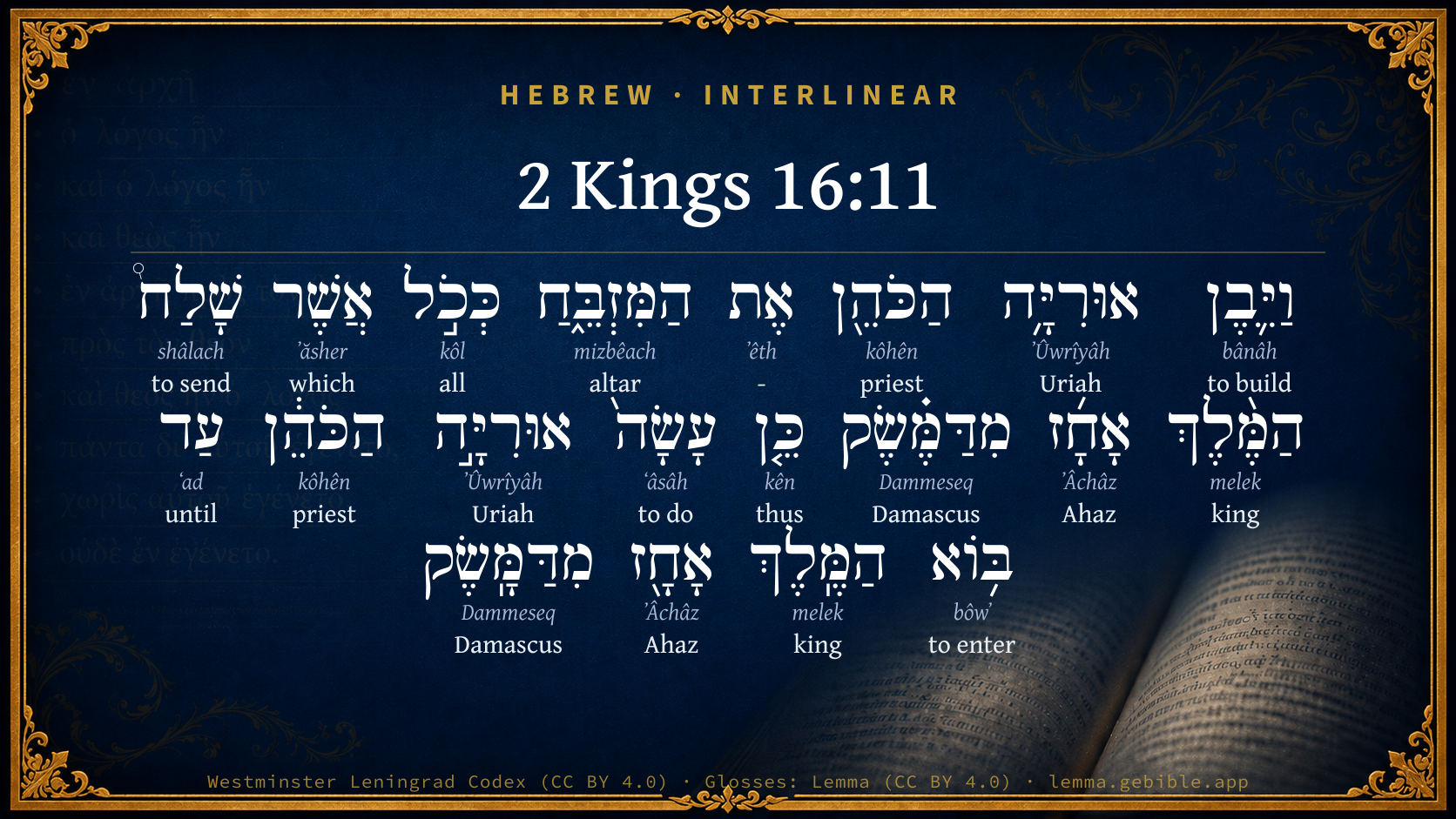
Hebrew (Westminster Leningrad Codex) 2 Kings 16:11 appears in the Hebrew Old Testament. The text above is from the Westminster Leningrad Codex. Each word links to its Strong’s number, a concise gloss, and parsing drawn from the Open Scriptures Hebrew Bible morphology. Click any word for its full Brown-Driver-Briggs (BDB) entry.
Download image
Cite this verse

2 Kings 16:11 (World English Bible). Public Domain. Lemma interlinear Bible study tool, https://lemma.gebible.app/v/2-kings/16/11.

Show BibTeX & RIS
BibTeX
RIS
English Translation
Urijah the priest built an altar: according to all that king Ahaz had sent from Damascus, so did Urijah the priest make it against the coming of king Ahaz from Damascus.
World English Bible · Public Domain
Download a study sheet

One document with this verse’s original text, its word-by-word gloss line, the meaning frame, cross-references with their text, attributed commentary, and full source and license credits — printable, and it pastes into notes with its structure intact.

This verse Autodidact and up

Study sheet (.html) Plain text (.txt)

A passage Seminary Student

Up to 50 verses in one chapter. A passage sheet keeps up to 6 commentary sources and 12 cross-references per verse, in the order this page ranks them, and says so on the sheet whenever that leaves anything out. Ask for a single verse and you get the Autodidact verse sheet above.

Everything on this page stays free to read, with no account — the sheet is a download of what is already on screen, not access to it.

Want to remove ads? Support Godless Engineer
Compare translations 3

The same verse in 3 English versions, stacked beneath the original-language interlinear above. Click any original word for its lexicon entry.

Each is an independent rendering of the whole verse — the interlinear is not word-aligned to these translations.

Highlighted words mark where these versions differ — a whole-verse word diff, not a word-by-word alignment.

  • World English Bible Public Domain
    Urijah the priest built an altar: according to all that king Ahaz had sent from Damascus, so did Urijah the priest make it against the coming of king Ahaz from Damascus.
  • King James Version Public Domain
    And Urijah the priest built an altar according to all that king Ahaz had sent from Damascus: so Urijah the priest made it against king Ahaz came from Damascus.
  • unfoldingWord Literal Text CC BY-SA 4.0
    And Uriah the priest built the altar according to all that King Ahaz sent from Damascus. Thus Uriah the priest did before King Ahaz came from Damascus.

unfoldingWord Literal Text — © unfoldingWord, licensed CC BY-SA 4.0. Word-aligned USFM3 via Door43 (git.door43.org/unfoldingWord/en_ult).

Versions to compare (up to 4)

3 of 4 selected

Show all 18 translations

Every available English version of this verse, each an independent rendering of the whole verse.

  • World English Bible Public Domain
    Urijah the priest built an altar: according to all that king Ahaz had sent from Damascus, so did Urijah the priest make it against the coming of king Ahaz from Damascus.
  • Berean Standard Bible Public Domain
    And Uriah the priest built the altar according to all the instructions King Ahaz had sent from Damascus, and he completed it by the time King Ahaz had returned.
  • Majority Standard Bible Public Domain
    And Uriah the priest built the altar according to all the instructions King Ahaz had sent from Damascus, and he completed it before King Ahaz returned.
  • King James Version Public Domain
    And Urijah the priest built an altar according to all that king Ahaz had sent from Damascus: so Urijah the priest made it against king Ahaz came from Damascus.
  • American Standard Version (1901) Public Domain
    And Urijah the priest built an altar: according to all that king Ahaz had sent from Damascus, so did Urijah the priest make it against the coming of king Ahaz from Damascus.
  • Revised Version (1885) Public Domain
    And Urijah the priest built an altar: according to all that king Ahaz had sent from Damascus, so did Urijah the priest make it against king Ahaz came from Damascus.
  • Geneva Bible (1599) Public Domain
    And Vriiah the Priest made an altar in al poyntes like to that which King Ahaz had sent from Damascus, so did Vriiah the Priest against King Ahaz came from Damascus.
  • Douay-Rheims (1899) Public Domain
    And Urias the priest built an altar according to all that king Achaz had commanded from Damascus, so did Urias the priest, until king Achaz came from Damascus.
  • Young's Literal Translation Public Domain
    and Urijah the priest buildeth the altar according to all that king Ahaz hath sent from Damascus; so did Urijah the priest till the coming in of king Ahaz from Damascus.
  • Literal Standard Version CC BY-SA 4.0
    and Urijah the priest builds the altar according to all that King Ahaz has sent from Damascus; so Urijah the priest did until the coming in of King Ahaz from Damascus.
  • Unlocked Literal Bible CC BY-SA 4.0
    So Uriah the priest built an altar to be just like the plans that King Ahaz had sent from Damascus. He finished it before King Ahaz arrived back from Damascus.
  • unfoldingWord Literal Text CC BY-SA 4.0
    And Uriah the priest built the altar according to all that King Ahaz sent from Damascus. Thus Uriah the priest did before King Ahaz came from Damascus.
  • Darby Bible Public Domain
    And Urijah the priest built an altar according to all that king Ahaz had sent from Damascus; thus Urijah the priest made [it], against king Ahaz came from Damascus.
  • World Messianic Bible Public Domain
    Urijah the priest built an altar. According to all that King Ahaz had sent from Damascus, so Urijah the priest made it for the coming of King Ahaz from Damascus.
  • Webster's Bible Public Domain
    And Urijah the priest built an altar according to all that king Ahaz had sent from Damascus: so Urijah the priest made it against king Ahaz came from Damascus.
  • Free Bible Version CC BY-SA 4.0
    So Uriah the priest built an altar following all the instructions King Ahaz had sent from Damascus, completing it before King Ahaz returned.
  • Bible in Basic English Public Domain
    And from the copy King Ahaz sent from Damascus, Urijah made an altar and had it ready by the time King Ahaz came back from Damascus.
  • JPS Tanakh (1917) Public Domain
    And Urijah the priest built an altar; according to all that king Ahaz had sent from Damascus, so did Urijah the priest make it against the coming of king Ahaz from Damascus.

Literal Standard Version (2020), Covenant Press — licensed CC BY-SA 4.0. Text via the HelloAO Bible API (eBible.org). Unlocked Literal Bible (unfoldingWord) — licensed CC BY-SA 4.0. Text via the HelloAO Bible API (eBible.org). unfoldingWord Literal Text — © unfoldingWord, licensed CC BY-SA 4.0. Word-aligned USFM3 via Door43 (git.door43.org/unfoldingWord/en_ult). Free Bible Version, Dr. Jonathan Gallagher — licensed CC BY-SA 4.0. Text via the HelloAO Bible API (eBible.org).

Word by word

More ways to search: Search by grammar → Find every occurrence → Compare this word →

Practice this passage: Drill this verse → Learn its vocabulary →

אוּרִיָּ֥ה
ʼÛwrîyâh
H223
“Uriah”
Noun, Proper
Part of Speech
Noun
Type
Proper
Full BDB Definition

Origin: from H217 and H3050

TWOT: None

Uriah or Urijah = "Jehovah (Yahweh) is my light (flame)" - Hittite husband of Bathsheba - a priest who built king Ahaz' heathen altar - a priest who rebuilt Jerusalem's wall - a prophet slain by Jehoiakim
  1. וַיִּ֛בֶן bânâh H1129 “and · to build” Conjunction + Verb, Qal, Sequential Imperfect, 3rd Person, Masculine, Singular
  2. הַכֹּהֵ֖ן kôhên H3548 “the · priest” Particle, Definite Article + Noun, Common, Masculine, Singular, Absolute
  3. אֶת ʼêth H853 “-” Particle, Direct Object
  4. הַמִּזְבֵּ֑חַ mizbêach H4196 “the · altar” Particle, Definite Article + Noun, Common, Masculine, Singular, Absolute
  5. כְּכֹ֣ל kôl H3605 “like/as · all” Preposition + Noun, Common, Masculine, Singular, Absolute
  6. אֲשֶׁר ʼăsher H834 “which” Particle, Relative
  7. שָׁלַח֩ shâlach H7971 “to send” Verb, Qal, Perfect, 3rd Person, Masculine, Singular
  8. הַמֶּ֨לֶךְ melek H4428 “the · king” Particle, Definite Article + Noun, Common, Masculine, Singular, Absolute
  9. אָחָ֜ז ʼÂchâz H271 “Ahaz” Noun, Proper
  10. מִדַּמֶּ֗שֶׂק Dammeseq H1834 “from · Damascus” Preposition + Noun, Proper
  11. כֵּ֤ן kên H3651 “thus” Particle, Demonstrative
  12. עָשָׂה֙ ʻâsâh H6213 “to do” Verb, Qal, Perfect, 3rd Person, Masculine, Singular
  13. אוּרִיָּ֣ה ʼÛwrîyâh H223 “Uriah” Noun, Proper
  14. הַכֹּהֵ֔ן kôhên H3548 “the · priest” Particle, Definite Article + Noun, Common, Masculine, Singular, Absolute
  15. עַד ʻad H5704 “until” Preposition
  16. בּ֥וֹא bôwʼ H935 “to enter” Verb, Qal, Infinitive Construct
  17. הַמֶּֽלֶךְ melek H4428 “the · king” Particle, Definite Article + Noun, Common, Masculine, Singular, Absolute
  18. אָחָ֖ז ʼÂchâz H271 “Ahaz” Noun, Proper
  19. מִדַּמָּֽשֶׂק Dammeseq H1834 “from · Damascus” Preposition + Noun, Proper

About this verse

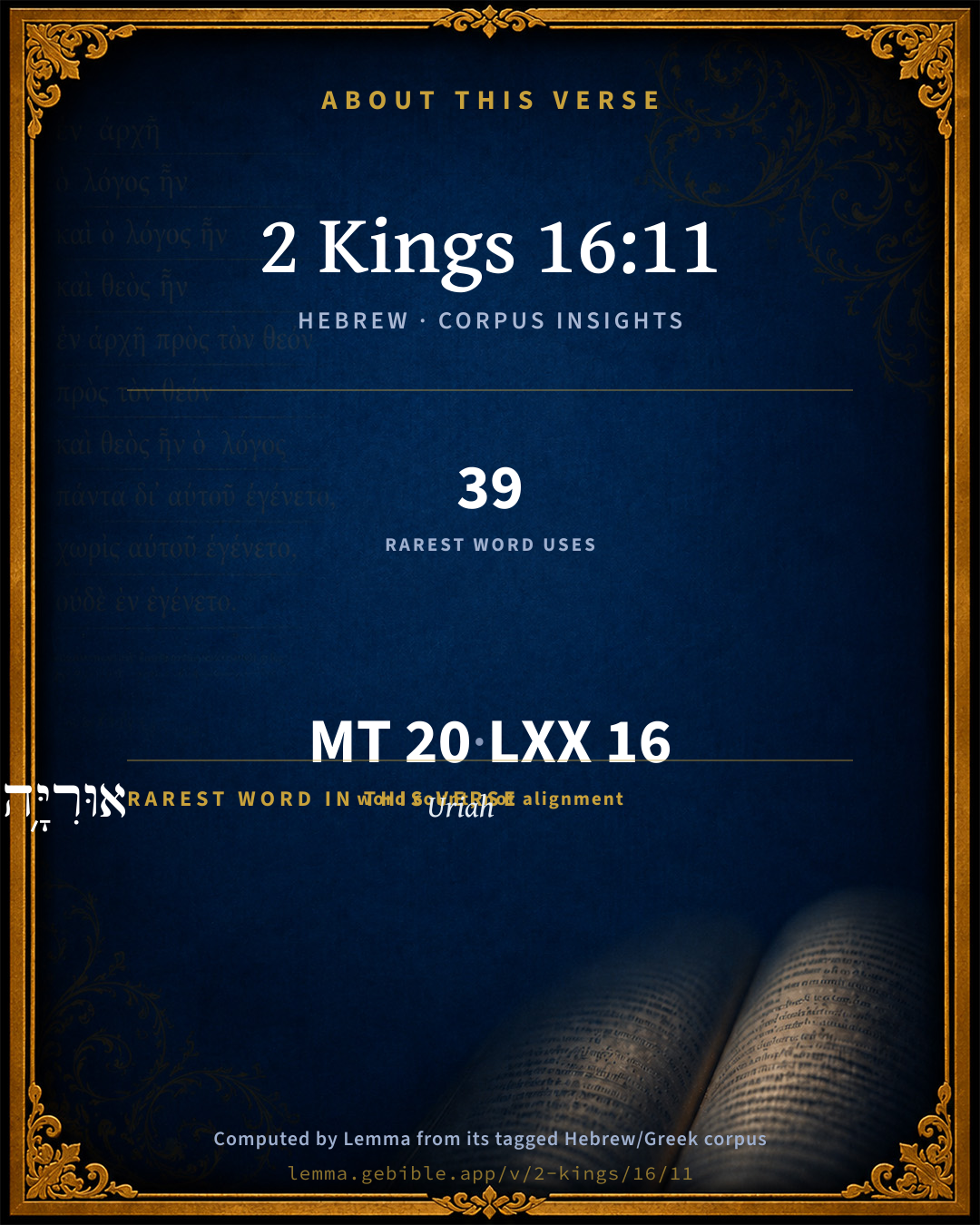
These counts appear in no published source. They are computed here, from the morphology-tagged text and Lemma’s own curated glosses. What Lemma adds →

20
words
15
distinct lemmas
Historical
section

Shared distinctive vocabulary

אוּרִיָּ֥ה Uriah H223 occurs in 33 verses of the Hebrew Bible. Also found in:

Grammatical profile

  • 4 verbs
  • 12 nouns
  • 1 preposition
  • 3 particles

Verb forms

  • וַיִּ֛בֶן Qal · Sequential Imperfect
  • שָׁלַח֩ Qal · Perfect
  • עָשָׂה֙ Qal · Perfect
  • בּ֥וֹא Qal · Infinitive Construct

Repetition

Words recur within this verse — often emphatic in Hebrew:

  • אוּרִיָּ֥ה Uriah H223 ×2
  • הַכֹּהֵ֖ן priest H3548 ×2
  • הַמֶּ֨לֶךְ king H4428 ×2
  • אָחָ֜ז Ahaz H271 ×2
  • מִדַּמֶּ֗שֶׂק Damascus H1834 ×2

Hebrew & Septuagint length

In English translation the verse runs 31 words from the Hebrew and 18 from the Septuagint (LXX English) — the Septuagint runs noticeably shorter here. See the side-by-side →

A rough comparison of the two English renderings, which tokenize alike — not a word-level alignment.

Word counts can differ between the Hebrew and the Greek without any difference in meaning — e.g. the Hebrew direct-object marker אֵת has no separate Greek word, and Greek often adds the article ὁ.

In the original languages it is 20 Hebrew tokens and 16 Greek tokens — but the two are counted differently (Hebrew bundles its prefixes and suffixes into one token; the Greek is in lemma form), so that isn’t a like-for-like length.

Cross-references

10

Topical passages linked to 2 Kings 16:11 in the Treasury of Scripture Knowledge — connected by theme and wording, ordered by reader-vote popularity; previews shown in the World English Bible.

  • 1 Kings 21:11–13 The men of his city, even the elders and the nobles who lived in his city, did as Jezebel had sent to them, according as it was written in the letters which she had sent to them.
  • 2 Chronicles 26:17–18 Azariah the priest went in after him, and with him eighty priests of Yahweh, who were valiant men:
  • Isaiah 8:2 and I will take to me faithful witnesses to record, Uriah the priest, and Zechariah the son of Jeberechiah.
  • Jeremiah 23:11 for both prophet and priest are profane; yes, in my house have I found their wickedness, says Yahweh.
  • Ezekiel 22:26 Her priests have done violence to my law, and have profaned my holy things: they have made no distinction between the holy and the common, neither have they caused men to discern between the unclean and the clean, and have hid their eyes from my Sabbaths, and I am profaned among them.
  • Daniel 3:7 Therefore at that time, when all the peoples heard the sound of the horn, flute, zither, lyre, harp, pipe, and all kinds of music, all the peoples, the nations, and the languages, fell down and worshiped the golden image that Nebuchadnezzar the king had set up.
  • Hosea 4:6 My people are destroyed for lack of knowledge. Because you have rejected knowledge, I will also reject you, That you may be no priest to me. Because you have your God's law, I will also forget your children.
  • Hosea 5:11 Ephraim is oppressed, He is crushed in judgment; Because he is intent in his pursuit of idols.
  • Malachi 2:7–9 For the priest's lips should keep knowledge, and they should seek the law at his mouth; for he is the messenger of Yahweh of Hosts.
  • Galatians 1:10 For am I now seeking the favor of men, or of God? Or am I striving to please men? For if I were still pleasing men, I wouldn't be a servant of Christ.

Cross-references courtesy of OpenBible.info (CC BY 4.0).

Hebrew and Greek witnesses Masoretic Hebrew ↔ Greek Septuagint

The same verse in the two great witnesses to the Old Testament, shown verse-for-verse.

Here the Septuagint runs noticeably shorter than the Hebrew — LXX2012 (modern English Septuagint) 18 words vs World English Bible 31. A rough length comparison of the two English translations, not a word-level alignment — read both below.

These are two independent witnesses, not word-aligned to each other, and the Septuagint is shown in lemma (dictionary) form.

Hebrew 2 Kings 16:11 Masoretic · Westminster Leningrad Codex

וַיִּ֛בֶן אוּרִיָּ֥ה הַכֹּהֵ֖ן אֶת הַמִּזְבֵּ֑חַ כְּכֹ֣ל אֲשֶׁר שָׁלַח֩ הַמֶּ֨לֶךְ אָחָ֜ז מִדַּמֶּ֗שֶׂק כֵּ֤ן עָשָׂה֙ אוּרִיָּ֣ה הַכֹּהֵ֔ן עַד בּ֥וֹא הַמֶּֽלֶךְ אָחָ֖ז מִדַּמָּֽשֶׂק

Urijah the priest built an altar: according to all that king Ahaz had sent from Damascus, so did Urijah the priest make it against the coming of king Ahaz from Damascus.

World English Bible · Public Domain

Greek LXX 2 Kings 16:11 Septuagint · lemma form

καί οἰκοδομέω ουριας ὁ ἱερεύς ὁ θυσιαστήριον κατά πᾶς ὅσος ἀποστέλλω ὁ βασιλεύς αχαζ ἐκ δαμασκός

And Urias the priest built the altar, according to all the directions which king Achaz sent from Damascus.

LXX2012 (modern English Septuagint) · Public Domain

On this verse, The Cambridge Bible for Schools and Colleges discusses the Septuagint’s reading. Read the note in Commentary ↓

Hebrew: Westminster Leningrad Codex (CC BY 4.0). Greek: Septuagint (public domain); English from LXX2012 (modern English Septuagint) (Public Domain). How the Septuagint differs from the Hebrew →

Targum (Aramaic paraphrase)

1

The Targum is the ancient Jewish Aramaic paraphrase of the Hebrew Scriptures — an interpretive translation, not the Hebrew text itself. Onkelos (literal) and Pseudo-Jonathan (expansive) render the Torah, and Jonathan the Prophets. Coverage is partial: where no permissively-licensed English translation exists for a verse, only the Aramaic is shown. This is verse-level text, not a word-by-word alignment to the Hebrew.

  1. Targum Jonathan Prophets (Joshua–Malachi)
    וּבְנָא אוּרִיָה כַהֲנָא יַת מַדְבְּחָא כְּכָל דִשְׁלַח מַלְכָּא אָחָז מִדַמֶשֶׂק כֵּן עֲבַד אוּרִיָה כַּהֲנָא עַד דַאֲתָא מַלְכָּא אָחָז מִדַמֶשֶׂק:

    (no public-domain English translation for this verse)

    Targum Jonathan — Aramaic: “Mikraot Gedolot” (public domain). English: “Sefaria Community Translation” (CC0 1.0 (public-domain dedication)); “London "Chaldee Paraphrase," 1871” (public domain). Text via Sefaria.

Commentary

Notes on 2 Kings 16:11 from classic Christian and Jewish commentators (each source and its license shown beneath its notes). The classic Christian expositions comment on the surrounding passage and are grouped to its opening verse, so a note may address several verses; the Jewish commentaries on the Tanakh (Rashi and others) are per-verse, so they appear only where the commentator wrote on this verse.

Lemma curates 59 commentaries, every one of them public domain or Creative Commons licensed, each selected and text-cleaned for this edition rather than reprinted as found. About our sources →

Trapp's Complete Commentary

John Trapp

2Ki 16:11 And Urijah the priest built an altar according to all that king Ahaz had sent from Damascus: so Urijah the priest made [it] against king Ahaz came from Damascus.

Ver. 11. And Urijah the priest built an altar.] So in the year of grace 610, Pope Boniface IV, after that he had by the Emperor’s appointment placed in the Pantheon at Rome the Virgin Mary, instead of Cybele the mother of the gods, he further ordained the feast of All Saints.

John Trapp, A Commentary or Exposition upon All the Books of the Old and New Testament (1647–1656) — public domain. Text from a community e-Sword module.

Joseph Benson's Commentary

2Ki 16:11-12. And Urijah built an altar, &c. — He complied with the king’s command against his own conscience, and against the express command of that great God to whom the king and he both were subject. The priest made it against Ahaz came from Damascus — He made haste and delayed not to do it, to please the king, and advance himself. The king approached to the altar, and offered thereon — Namely, a sacrifice, and that not unto God, but unto the Syrian idols, (2Ch 28:23-24,) to whom that altar was appropriated. A wonderful blindness, to worship those gods, and expect help from them, who could not preserve their own country from ruin! Whether Ahaz offered this sacrifice himself, or by a priest, is not certain.

Joseph Benson's Commentary on the Old and New Testaments (1811–1818) — public domain. Text from a community e-Sword module.

Geneva Bible (1599)

Geneva Bible translators

We see that there is no prince so wicked, be he shall find flatterers and false ministers to serve his turn.

Geneva Bible (1599) marginal notes — public domain. Text via Bolls.life.

The Cambridge Bible for Schools and Colleges

gen. ed. J. J. S. Perowne

11. so Urijah … Damascus] These words are omitted by the LXX. though not in all MSS. Perhaps because the preceding clause ends with the same word as this, the eye of a scribe may have been misled. The part played by Urijah in this business is not mentioned by the Chronicler. The R.V. renders this clause So did Urijah the priest make it. This is done to shew that the word ‘so’ refers to the previous phrase ‘according to all that king Ahaz had sent’.

The Cambridge Bible for Schools and Colleges (gen. ed. J. J. S. Perowne; Cambridge University Press, 1878–1918) — public domain. Text from a community e-Sword module.

John Gill's Exposition

And when the king was come from Damascus, the king saw the altar,.... Looked at it, and liked it, being exactly according to the pattern he had sent:

and the king approached the altar, and offered thereon; either by a priest, or it may be in his own person, having no regard to the laws and appointments of God, and especially as his sacrifices were not offered to him, but to the gods of Damascus and Syria, Ch2 28:23.

John Gill's Exposition of the Whole Bible (1746–1763) — public domain (CC PDM 1.0). Text via the HelloAO Bible API.

Haydock's Catholic Bible Commentary

Priest, or pontiff, as no other would have dared to make this innovation. (Salien) --- He was guilty of a great weakness; as the altar of Solomon had been so solemnly consecrated by God’s presence. All changes in religion are dangerous. The Machabees behaved with far greater respect, with regard to the altar which had been profaned, 1 Machabees iv. 45. (Calmet) --- Isaias (viii. 2.) calls this priest a faithful, or competent witness, (Haydock) on account of his dignity, not approving his conduct. (Salien) --- But he had not erected this altar when the prophet spoke thus to him. (Du Hamel)

George Leo Haydock (1774–1849), Haydock's Catholic Family Bible and Commentary, 1859 edition — public domain. Excludes Psalms (Douay-Rheims chapter numbering differs from Protestant) and Deuterocanonical books (Catholic canon only).

Matthew Poole's English Annotations

So he complied with the king’s command against his own conscience, and against the express command of that great God, to which the king and he both were subject. He made haste, and delayed not to do it, to please the king, and advance himself.

Matthew Poole's English Annotations on the Holy Bible (1683–1685) — public domain. Text from a community e-Sword/MySword module.

The Pulpit Commentary

And Urijah the priest. No doubt the Uriah of Isaiah, (Isa_8:2) who might be a "faithful witness" to the record of a fact,though a bad man, over-complaisant in carrying out the will of the king.

Built an altar according to all that King Ahaz had sent from Damascus: rather, built the altar, i.e. the altar commanded by the monarchso Urijah the priest made it against King Ahaz came from Damascus. A bold high priest like Azariah (2Ch_26:17) would have refused to work the king"s will in such a matter, which was certainly a desecration of the temple, and to some extent a compromise with idolatry.

But Urijah was a man of a weaker fiber, and does not seem to have thought even of remonstrance, much less of resistance.

The Pulpit Commentary (1880–1919), ed. H.D.M. Spence-Jones & Joseph S. Exell — public domain. Text from a community e-Sword module.

Rashi

Rabbi Shlomo Yitzchaki (Rashi)

Before [king Achaz] came. [He built the altar] before the king came from Damesek.

Rashi on the Tanakh — English translations: “The Judaica Press complete Tanach with Rashi, translated by A. J. Rosenberg” (CC BY 4.0); “Pentateuch with Rashi's commentary by M. Rosenbaum and A.M. Silbermann, 1929-1934” (public domain); “The Metsudah Tanach series, Lakewood, N.J” (CC BY 4.0); and “The Book of Joshua, Metsudah Publications, 1997” (CC BY 4.0). Text via Sefaria.

Lesson kit

Teaching starters — assembled from the data on this page, not authored interpretation. Every prompt links to the verse data it draws on. Edit before teaching.

2 Kings, in the Historical, opens this verse with 20 words (15 distinct Hebrew lemmas). Its most distinctive word is ʼÛwrîyâh (“Uriah”). The Greek Septuagint runs shorter here. A historical commentator’s framing appears above. Read the whole chapter for the surrounding context.

Discussion questions

  1. How does “Uriah” (ʼÛwrîyâh) shape what this verse is saying?
  2. How does 2 Samuel 11:3, which shares the word «Uriah», read alongside this verse?
  3. What does the repetition of “Uriah” (2× in this one verse) do in this verse?
  4. The Septuagint runs shorter here than the Hebrew. What might account for the difference?
  5. These translations render this verse differently. What is at stake in choosing one wording over another?
  6. «וַיִּ֛בֶן» is a Qal Sequential Imperfect verb. How does that grammatical form shape the action described?
  7. Compare how Trapp's Complete Commentary and Joseph Benson's Commentary read this verse. Where do they agree or differ?

Things to notice

Reading settings

Reading text

Shown beneath each verse's original-language words.

Old Testament
Old Testament edition

Read the OT as the Masoretic Hebrew (MT) or the Greek Septuagint (LXX).

English shown for the Greek Septuagint (in the Hebrew ↔ Greek comparison).

Comparing translations? Open the Compare panel on any verse page to stack up to four side by side.