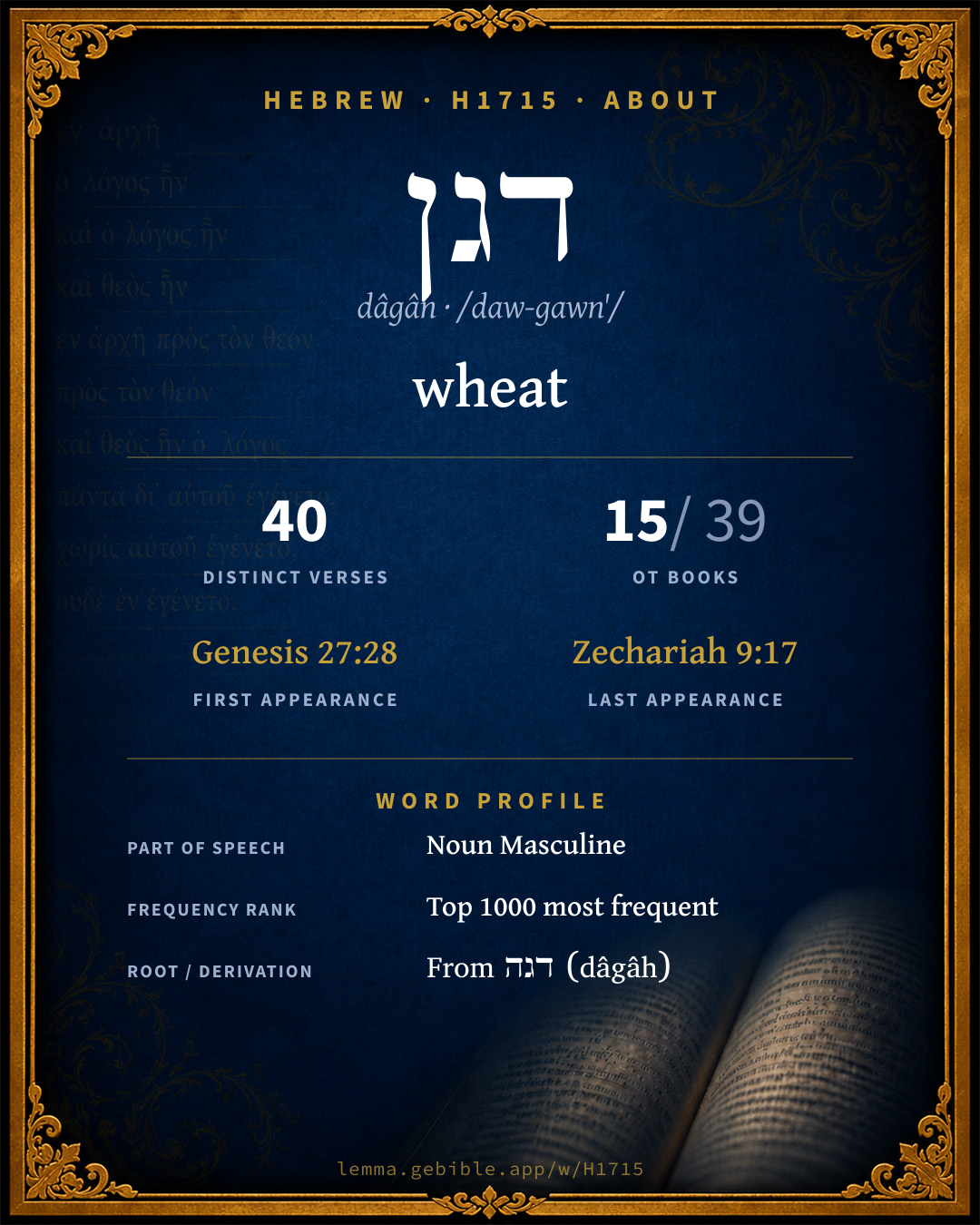
דָּגָן
wheat
Full lexicon entry — Brown-Driver-Briggs (BDB)
From Brown-Driver-Briggs (BDB)
Where this word appears
See every Absolute-state word in the Hebrew Bible →
Grammar key — what these labels mean
Part of speech
- Noun
- A naming word — a person, place, thing, or idea.
Noun type
- Common
- A common noun — a general class of person, place, or thing (“king,” “city,” “water”), not a specific name.
State
- Absolute
- The independent form of a noun, not bound to a following word.
- Construct
- A noun bound to a following noun in a possessive / “of” relationship (the construct chain).
Gender
- Masculine
- Grammatically masculine.
Number
- Singular
- One.
10 distinct verses where H1715 appears in the Construct state, across 4 books. Filtered view — show all forms. Click any verse to open its interlinear word-by-word view. Verse text shown in the World English Bible for context — . Each verse’s Hebrew form is shown with its reference; the English is not keyword-highlighted, since the data carries no word-level English alignment. Use “Compare translations” on any verse to read it across multiple English versions. This concordance covers the Hebrew Bible; Septuagint (Greek Old Testament) occurrences are not indexed here.
Deuteronomy 5 verses
- Deuteronomy 7:13 דְּגָ֨נְ/ךָ֜ n c ms cs + sfx pers 2ms and he will love you, and bless you, and multiply you; he will also bless the fruit of your body and the fruit of your ground, your grain and your new wine and your oil, the increase of your cattle and the young of your flock, in the land which he swore to your fathers to give you.
- Deuteronomy 11:14 דְגָנֶ֔/ךָ n c ms cs + sfx pers 2ms that I will give the rain of your land in its season, the former rain and the latter rain, that you may gather in your grain, and your new wine, and your oil.
- Deuteronomy 12:17 דְּגָֽנְ/ךָ֙ n c ms cs + sfx pers 2ms You may not eat within your gates the tithe of your grain, or of your new wine, or of your oil, or the firstborn of your herd or of your flock, nor any of your vows which you vow, nor your freewill-offerings, nor the heave-offering of your hand;
- Deuteronomy 14:23 דְּגָֽנְ/ךָ֙ n c ms cs + sfx pers 2ms You shall eat before Yahweh your God, in the place which he shall choose, to cause his name to dwell there, the tithe of your grain, of your new wine, and of your oil, and the firstborn of your herd and of your flock; that you may learn to fear Yahweh your God always.
- Deuteronomy 18:4 דְּגָֽנְ/ךָ֜ n c ms cs + sfx pers 2ms The first fruits of your grain, of your new wine, and of your oil, and the first of the fleece of your sheep, shall you give him.
Psalms 3 verses
- Psalms 4:7 דְּגָנָ֖/ם n c ms cs + sfx pers 3mp You have put gladness in my heart, More than when their grain and their new wine are increased.
- Psalms 65:9 דְּ֝גָנָ֗/ם n c ms cs + sfx pers 3mp You visit the earth, and water it. You greatly enrich it. The river of God is full of water. You provide them grain, for so you have ordained it.
- Psalms 78:24 וּ/דְגַן conj + n c ms cs He rained down manna on them to eat, And gave them food from the sky.
Isaiah 1 verse
Hosea 1 verse
About this entry
At a glance — auto-summarized from this page’s data, not written by a person. Every figure links to its source below. This summary describes the numbers; it doesn’t interpret them.
דגן (dâgân) is a Hebrew noun most often rendered “wheat.” Where the King James Version says “corn,” newer translations reach for “grain” (Berean Standard Bible); the renderings breakdown has the detail. The Hebrew Bible uses it across 40 verses — moderately common. Debuting at Genesis 27:28, it then recurs through the corpus. Related forms include דגה and דג. The sections below give every sense, occurrence, and version rendering.
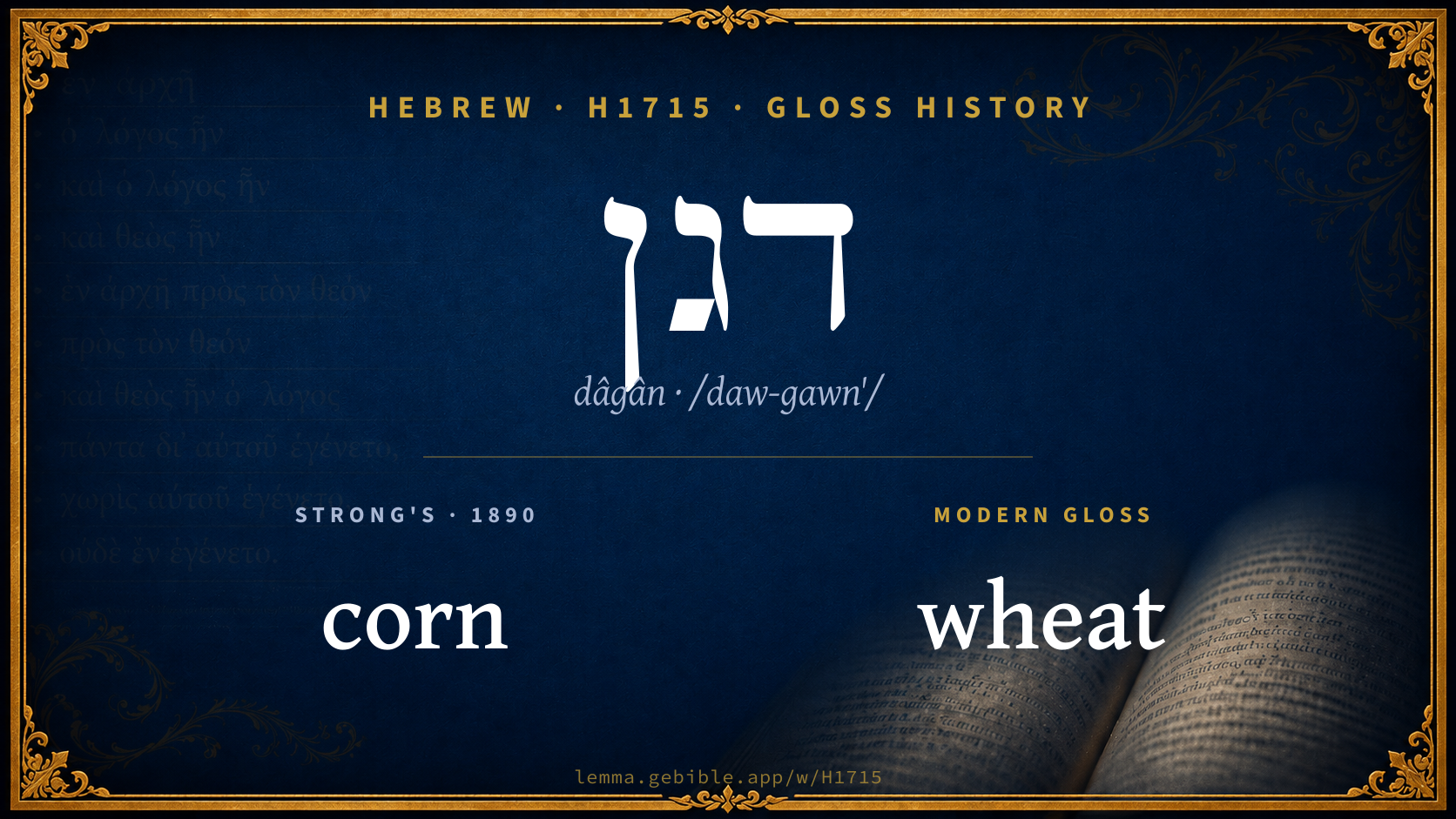
Gloss history
Strong's 1890 vs modern scholarship
About this word
Strong's H1715 catalogs a Hebrew word from the Hebrew Old Testament.
These counts are not copied from any lexicon or concordance. They are computed here, from the morphology-tagged Hebrew Old Testament. What Lemma adds →
- 40
- distinct verses
- The word appears in 40 distinct verses.
- 15 / 39
- OT books
- The word appears in 15 of 39 Old Testament books.
- #909
- by frequency
- Top 1000 most frequent Hebrew words (rank 909 of 8,640 Hebrew words by occurrence).
View all 40 occurrences in the concordance →
Most concentrated in
- Deuteronomy 7 verses 18%
- Nehemiah 7 verses 18%
- Hosea 6 verses 15%
By section of the Old Testament
By traditional corpus
Conventional, traditional groupings — biblical authorship is debated, so this is a traditional corpus grouping, not an authorship claim. Each share is this word’s portion of its verses in that division of the Hebrew canon. Each figure is a share of the word’s 40 distinct verses.
- Prophets (Nevi'im) 16 verses · 40%
- Writings (Ketuvim) 13 verses · 33%
- Torah (Pentateuch) 11 verses · 28%
How translations render this word
Counts come from each version’s own published word-to-Strong’s tagging or interlinear alignment — an approximate guide to how each version renders this word, not a word-level alignment the data otherwise carries. Because each total is that version’s own tagged count, the per-version totals vary from one another and need not match the appearance or distinct-verse counts above. These counts may also differ from a printed concordance because Lemma counts each distinctly tagged rendering and does not collapse phrase taggings into a single head-word total. This is a fixed set of word-tagged versions (KJV, ASV, BSB, ULT) and does not change with the reading translation you choose elsewhere. Each version’s license is shown beside its name below (and on Sources).
- King James Version: Corn 32×, Wheat 2×
- American Standard Version: Grain 32×
- Berean Standard Bible: Grain 38×
- unfoldingWord Literal Text: Grain 37×, And 2×
King James Version Public Domain
Renders H1715 across 39 tagged occurrences — most commonly:
Plus 5 renderings that appear only once — usually multi-word phrases or single function words the recovered tagging swept in, not distinct renderings. Not rendered by a distinct English word in 1 further occurrence.
American Standard Version Public Domain
Renders H1715 across 39 tagged occurrences — most commonly:
Plus 7 renderings that appear only once — usually multi-word phrases or single function words the recovered tagging swept in, not distinct renderings.
Berean Standard Bible Public Domain
Renders H1715 across 39 tagged occurrences — most commonly:
Plus 1 rendering that appears only once — usually multi-word phrases or single function words the recovered tagging swept in, not distinct renderings. Not rendered by a distinct English word in 1 further occurrence.
unfoldingWord Literal Text CC BY-SA 4.0
Renders H1715 across 41 tagged occurrences — most commonly:
Plus 2 renderings that appear only once — usually multi-word phrases or single function words the recovered tagging swept in, not distinct renderings.
Senses in BDB
The 1 sense BDB distinguishes for this word, in lexicon order (not ranked by frequency or importance). The full entry — with sub-senses — is in the Lexicon Entry tab.
- wheat, cereal, grain, corn
Word origin
n.m. corn, grain (of cereals) (NH id., Sam. ࠃࠂࠍ v. Thes.; cf. Ph. ארצת דגן)—דָּגָן Gn 27:28 + 29 times; cstr. דְּגַן ψ 78:24; sf. דְּגָנִי Ho 2:11, דְּגָֽנְךָ Dt 7:13; 12:17; 14:23; 18:4, דְּגָנֶ֑ךָ Dt 11:14, דְּגָנֵךְ Is 62:8, דְּגָנָם ψ 4:8; 65:10—corn, c. תִּירוֹשׁ must, q.v., Gn 27:28, 37 (both J) ψ 4:8 Is 62:8 Ho 2:11; 7:14; 9:1 Zc 9:17; cf. also Nu 18:27 (P; here, for תירושׁ, מְלֵאָה מִן־הַיָּ֑קֶב), La 2:12 (where יַיִן), Ho 14:8 (where גֶּפֶן & יֵין לְבָנוֹן); ארץ דגן ותירושׁ of land of Canaan Dt 33:28; of land of captiv. (words of the Rabshak) 2 K 18:32 = Is 36:17 (other products, also, named in both); usually c. תירושׁ & יצהר Nu 18:12 Dt 7:13; 11:14; 12:17; 14:23; 18:4; 28:51 2 Ch 31:5 (+ דבשׁ) 32:28 Ne 5:11; 10:40; 13:5, 12 Je 31:12 Ho 2:10, 24 Jo 1:10; 2:19 Hg 1:11; also Jo 1:17 Me; (cf. 2 K 18:32 Is 36:17 supr.); alone, rare and late Ne 5:2, 3, 10 ψ 65:10 Ez 36:29; דְּגַן־שָׁמַיִם ψ 78:24;—of the above the following refer to firstfruits offered to the priests Nu 18:12 (cf. v 27) Dt 18:4 2 Ch 31:5; to tithe Dt 12:17; 14:23 Ne 13:5, 12; to both generally Ne 10:40; to loaning on usury Ne 5:10, 11.
— Brown-Driver-Briggs (Oxford 1906, public domain), digitized via Sefaria, supplemented by the OpenScriptures HebrewLexicon (CC BY 4.0). See Sources.
Derived from דגה (dâgâh) (H1711) — to multiply.
Jastrow Dictionary
A second Hebrew/Aramaic lexicon for comparison, covering Aramaic and post-biblical (Talmudic, Targumic, Midrashic) usage that the biblical-Hebrew BDB does not. Matched by lemma rather than by Strong’s number, so a lemma may carry more than one Jastrow headword (shown separately below), and the entries cover usage well beyond the Bible.
דָּגָן
- v. next w.) pile; grain, bread, bread-stuff. Pesik. R. s. 10 דְּגָנוֹ של עולם are the store of the world. Tosef. Ber. IV, 15; Y. ib. VI, 10ᵇ הד׳ שהוא וכ׳ the more preferable kind of bread. Tosef. l. c. כל שהוא מין שבע ואינו מין ד׳ whatever belongs to the seven produces (Deut. VIII, 8) but not to breadstuffs; Bab. ib. 37ᵇ. Pes. III, 1; a. fr.—Ned. VII, 2 הנודר מן הד׳ וכ׳ he who vows abstinence from dagan, is forbidden dry Egyptian beans, v. next w.—Pl. דְּגָנִים. Pesik. R. s. 41 מנפף את הד׳ swells the grains; (Yalk. Ps. 755 מנפנף את רגליה, read דְּגָנֶיהָ). Tosef. Ber. VII (VI), 8 Var.—בֵּית דָּ׳ pr. n. pl. Beth-Dagan in Judea. Tosef. Ohol. III, 9. [Tosef. Sabb. VII (VIII), 2, v. דָּגוֹן.] e.g. Deuteronomy 8:8
דְּגַן
- , Ithpe. אִידְּגַן to be piled up, stored. Ned. 55ᵃ shall we judge (fr. R. Meir’s opinion VII, 2, v. preced.) כל דמִידְּגַן משמע dagan implies everything which is piled up?—Ber. 47ᵇ; Bets. 13ᵇ האי (אִדְּ׳) אי׳ וכ׳ the one (the piled up) has become dagan, the other (standing in the ears) is not yet dagan (with ref. to Num. XVIII, 27). e.g. Numbers 18:27
A Dictionary of the Targumim, the Talmud Babli and Yerushalmi, and the Midrashic Literature (Marcus Jastrow; London, Luzac, 1903) — Public Domain. Digitized via Sefaria. Digitized via Sefaria. Full attribution on Sources.
Forms in the corpus
The 26 distinct written forms H1715 takes in the Hebrew Bible, most frequent first — each parse links to that state’s occurrences in the concordance. Hebrew forms include their vowel points and cantillation, so a single lemma takes many written forms.
Same root — word family
Other BDB entries built from the same root as H1715, grouped by Strong’s listed origin. These share a root / origin per the lexicon — not necessarily a shared meaning. Each links to that word’s own entry.
Derives from
Shares the same root
Compare all same-root words → They share a root, not necessarily a meaning.
Septuagint verse parallels
This word appears in 32 verses that also exist in the Greek Old Testament (Septuagint), out of the 40 Hebrew verses it occurs in. You can read those verses in Greek by switching the Old Testament edition to the Septuagint.
Read these verses in the Septuagint
- Genesis 27:28
- Numbers 18:12
- Deuteronomy 7:13
- 2 Kings 18:32
- 2 Chronicles 31:5
- Psalms 4:7
- Isaiah 36:17
- Jeremiah 31:12
- Lamentations 2:12
- Ezekiel 36:29
- Hosea 2:8
- Joel 1:10
This is a verse-level parallel only — the same verses exist in both the Hebrew and Greek Old Testaments. No word-level Hebrew↔Greek correspondence is claimed: the data carries no such alignment, so no Greek word is shown as this Hebrew word’s translation. Coverage is not total — the Septuagint omits the deuterocanon and renumbers the Psalms, so some Hebrew verses have no direct Greek parallel.