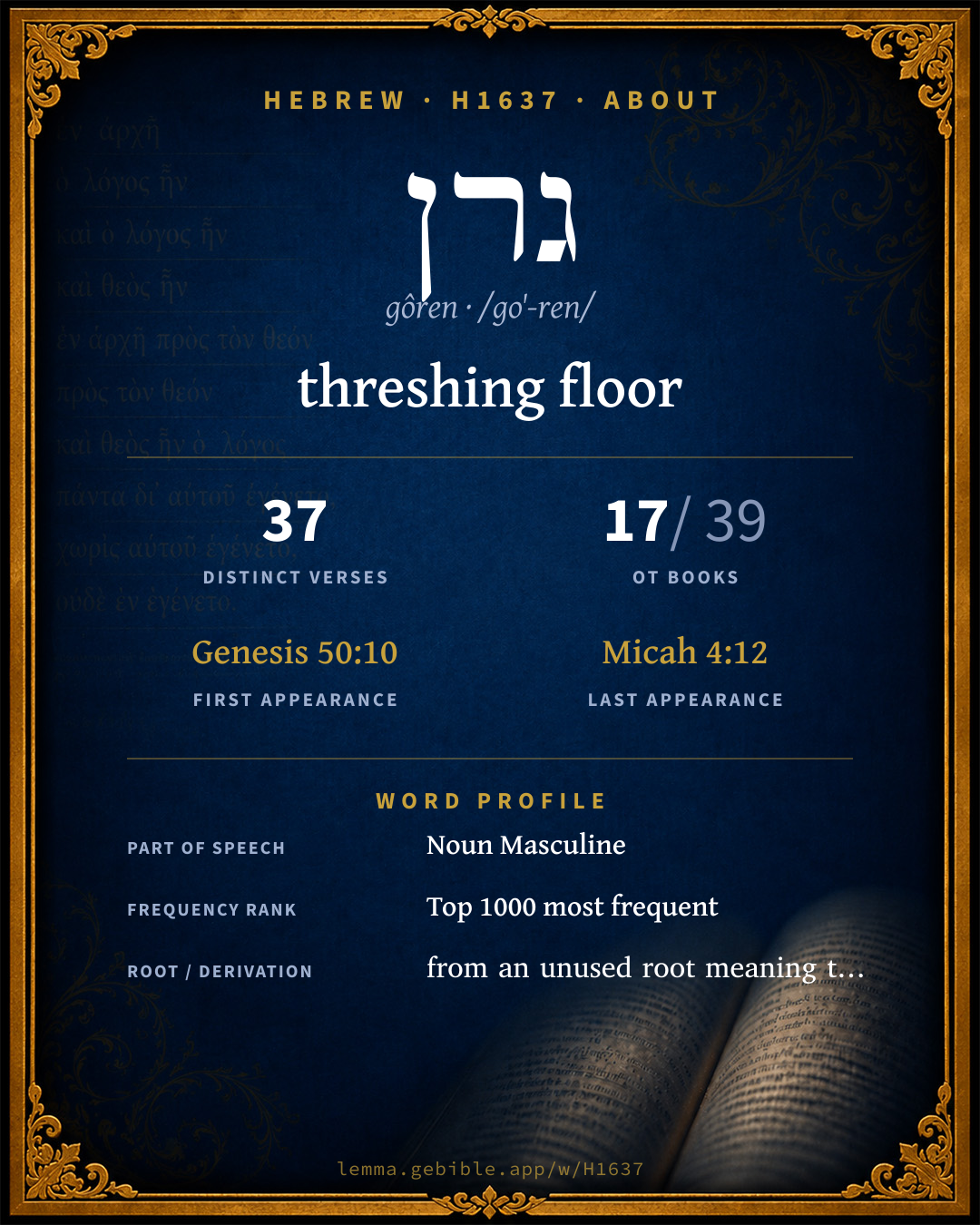
גֹּ֫רֶן
threshing floor
‘threshing floor’ is one of 2 main senses fuller range ↓
Full lexicon entry — Brown-Driver-Briggs (BDB)
From Brown-Driver-Briggs (BDB)
Where this word appears
See every Absolute-state word in the Hebrew Bible →
Grammar key — what these labels mean
Part of speech
- Noun
- A naming word — a person, place, thing, or idea.
Noun type
- Common
- A common noun — a general class of person, place, or thing (“king,” “city,” “water”), not a specific name.
State
- Absolute
- The independent form of a noun, not bound to a following word.
- Construct
- A noun bound to a following noun in a possessive / “of” relationship (the construct chain).
Gender
- Both
- Attested as both masculine and feminine.
Number
- Singular
- One.
- Plural
- More than one (in Hebrew, generally three or more).
Grammatical forms
- Noun, Common, Both, Singular, Absolute 17 times (46%)
- Noun, Common, Both, Singular, Construct 17 times (46%)
- Noun, Common, Both, Plural, Absolute 2 times (5%)
- Noun, Common, Both, Plural, Construct 1 time (3%)
Parsed forms decoded from the imported morphology (morphhb / Westminster Leningrad Codex — WLC text public domain, morphhb tagging CC BY 4.0), counted across 37 parsed occurrences — not distinct verses.
Every verse where H1637 appears — 37 distinct verses across 17 books. Click any verse to open its interlinear word-by-word view. Verse text shown in the World English Bible for context — . Each verse’s Hebrew form is shown with its reference; the English is not keyword-highlighted, since the data carries no word-level English alignment. Use “Compare translations” on any verse to read it across multiple English versions. This concordance covers the Hebrew Bible; Septuagint (Greek Old Testament) occurrences are not indexed here.
Genesis 2 verses
- Genesis 50:10 גֹּ֣רֶן n c bs cs They came to the threshing floor of Atad, which is beyond the Jordan, and there they lamented with a very great and sore lamentation. He mourned for his father seven days.
- Genesis 50:11 בְּ/גֹ֨רֶן֙ prep + n c bs cs When the inhabitants of the land, the Canaanites, saw the mourning in the floor of Atad, they said, "This is a grievous mourning by the Egyptians." Therefore, the name of it was called Abel Mizraim, which is beyond the Jordan.
Numbers 3 verses
- Numbers 15:20 גֹּ֔רֶן n c bs Of the first of your dough you shall offer up a cake for a heave-offering: as the heave-offering of the threshing floor, so shall you heave it.
- Numbers 18:27 הַ/גֹּ֔רֶן ptcl def.art + n c bs Your heave-offering shall be reckoned to you, as though it were the grain of the threshing floor, and as the fullness of the winepress.
- Numbers 18:30 גֹּ֖רֶן n c bs Therefore you shall tell them, When you heave the best of it from it, then it shall be reckoned to the Levites as the increase of the threshing floor, and as the increase of the wine-press.
Deuteronomy 2 verses
- Deuteronomy 15:14 וּ/מִֽ/גָּרְנְ/ךָ֖ conj + prep + n c bs cs + sfx pers 2ms you shall furnish him liberally out of your flock, and out of your threshing floor, and out of your winepress; as Yahweh your God has blessed you, you shall give to him.
- Deuteronomy 16:13 מִֽ/גָּרְנְ/ךָ֖ prep + n c bs cs + sfx pers 2ms You shall keep the feast of tents seven days, after that you have gathered in from your threshing floor and from your winepress:
Judges 1 verse
Ruth 4 verses
- Ruth 3:2 גֹּ֥רֶן n c bs cs Now isn't Boaz our kinsman, with whose maidens you were? Behold, he winnows barley tonight in the threshing floor.
- Ruth 3:3 הַ/גֹּ֑רֶן ptcl def.art + n c bs Wash yourself therefore, and anoint you, and put your clothing on you, and get you down to the threshing floor, but don't make yourself known to the man, until he shall have done eating and drinking.
- Ruth 3:6 הַ/גֹּ֑רֶן ptcl def.art + n c bs She went down to the threshing floor, and did according to all that her mother-in-law bade her.
- Ruth 3:14 הַ/גֹּֽרֶן ptcl def.art + n c bs She lay at his feet until the morning. She rose up before one could discern another. For he said, Let it not be known that the woman came to the threshing floor.
1 Samuel 1 verse
2 Samuel 5 verses
- 2 Samuel 6:6 גֹּ֣רֶן n c bs cs When they came to the threshing floor of Nacon, Uzzah put forth [his hand] to the ark of God, and took hold of it; for the oxen stumbled.
- 2 Samuel 24:16 גֹּ֖רֶן n c bs cs When the angel stretched out his hand toward Jerusalem to destroy it, Yahweh repented him of the evil, and said to the angel who destroyed the people, It is enough; now stay your hand. The angel of Yahweh was by the threshing floor of Araunah the Jebusite.
- 2 Samuel 24:18 בְּ/גֹ֖רֶן prep + n c bs cs Gad came that day to David, and said to him, Go up, rear an altar to Yahweh in the threshing floor of Araunah the Jebusite.
- 2 Samuel 24:21 הַ/גֹּ֗רֶן ptcl def.art + n c bs Araunah said, Why is my lord the king come to his servant? David said, To buy the threshing floor of you, to build an altar to Yahweh, that the plague may be stayed from the people.
- 2 Samuel 24:24 הַ/גֹּ֨רֶן֙ ptcl def.art + n c bs The king said to Araunah, No; but I will most assuredly buy it of you at a price. Neither will I offer burnt-offerings to Yahweh my God which cost me nothing. So David bought the threshing floor and the oxen for fifty shekels of silver.
1 Kings 1 verse
2 Kings 1 verse
1 Chronicles 6 verses
- 1 Chronicles 13:9 גֹּ֣רֶן n c bs cs When they came to the threshing floor of Chidon, Uzza put forth his hand to hold the ark; for the oxen stumbled.
- 1 Chronicles 21:15 גֹּ֖רֶן n c bs cs God sent an angel to Jerusalem to destroy it: and as he was about to destroy, Yahweh saw, and he repented him of the evil, and said to the destroying angel, It is enough; now stay your hand. The angel of Yahweh was standing by the threshing floor of Ornan the Jebusite.
- 1 Chronicles 21:18 בְּ/גֹ֖רֶן prep + n c bs cs Then the angel of Yahweh commanded Gad to tell David, that David should go up, and raise an altar to Yahweh in the threshing floor of Ornan the Jebusite.
- 1 Chronicles 21:21 הַ/גֹּ֔רֶן ptcl def.art + n c bs As David came to Ornan, Ornan looked and saw David, and went out of the threshing floor, and bowed himself to David with his face to the ground.
- 1 Chronicles 21:22 הַ/גֹּ֔רֶן ptcl def.art + n c bs Then David said to Ornan, Give me the place of this threshing floor, that I may build thereon an altar to Yahweh: for the full price shall you give it me, that the plague may be stayed from the people.
- 1 Chronicles 21:28 בְּ/גֹ֖רֶן prep + n c bs cs At that time, when David saw that Yahweh had answered him in the threshing floor of Ornan the Jebusite, then he sacrificed there.
2 Chronicles 2 verses
- 2 Chronicles 3:1 בְּ/גֹ֖רֶן prep + n c bs cs Then Solomon began to build the house of Yahweh at Jerusalem on Mount Moriah, where [Yahweh] appeared to David his father, which he made ready in the place that David had appointed, in the threshing floor of Ornan the Jebusite.
- 2 Chronicles 18:9 בְּ/גֹ֔רֶן prep + n c bs Now the king of Israel and Jehoshaphat the king of Judah sat each on his throne, arrayed in their robes, and they were sitting in an open place at the entrance of the gate of Samaria; and all the prophets were prophesying before them.
Job 1 verse
Isaiah 1 verse
Jeremiah 2 verses
- Jeremiah 2:25 ו/גורנ/ך conj + n c bs cs + sfx pers 2fs Withhold your foot from being unshod, and your throat from thirst: but you said, It is in vain; no, for I have loved strangers, and after them will I go.
- Jeremiah 51:33 כְּ/גֹ֖רֶן prep + n c bs For thus says Yahweh of hosts, the God of Israel: The daughter of Babylon is like a threshing floor at the time when it is trodden; yet a little while, and the time of harvest shall come for her.
Hosea 3 verses
- Hosea 9:1 גָּרְנ֥וֹת n c bp cs Don't rejoice, Israel, to jubilation like the nations; For you were unfaithful to your God. You love the wages of a prostitute at every grain threshing floor.
- Hosea 9:2 גֹּ֥רֶן n c bs The threshing floor and the winepress won't feed them, And the new wine will fail her.
- Hosea 13:3 מִ/גֹּ֔רֶן prep + n c bs Therefore they will be like the morning cloud, And like the dew that passes away early, Like the chaff that is driven with the whirlwind out of the threshing floor, And like the smoke out of the chimney.
Joel 1 verse
Micah 1 verse
About this entry
At a glance — auto-summarized from this page’s data, not written by a person. Every figure links to its source below. This summary describes the numbers; it doesn’t interpret them.
The Hebrew noun גרן centers on the idea of “threshing floor.” Older and newer Bibles part ways — “threshingfloor” in the King James Version, “threshing floor” (Berean Standard Bible) in modern versions. See the renderings breakdown. It appears 37 verses across 17 books of the Hebrew Bible, among its moderately common vocabulary. Its earliest occurrence is Genesis 50:10. Lexicons map it across 2 senses. Each statement above links to its evidence; the full detail follows below.
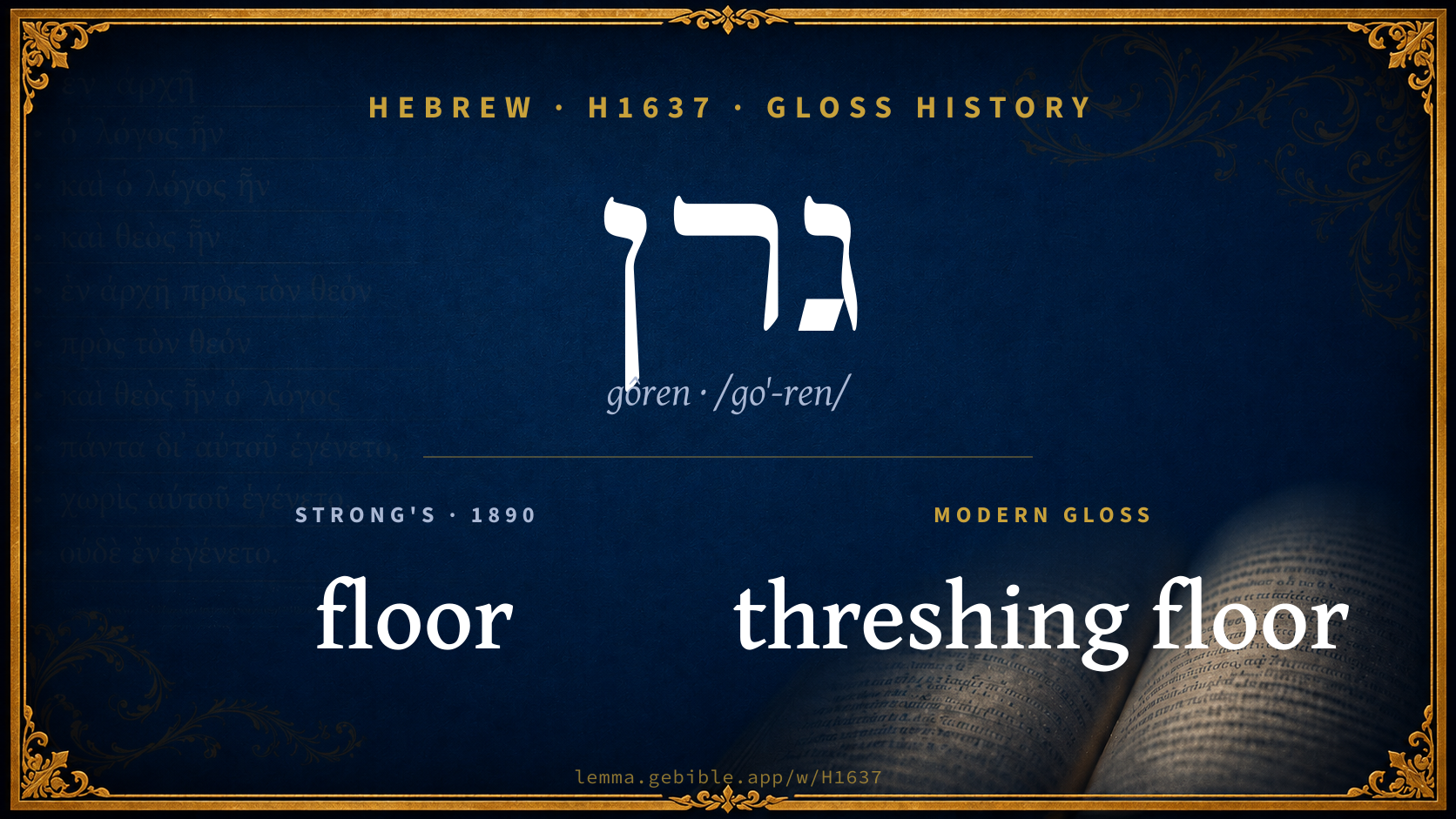
Gloss history
Strong's 1890 vs modern scholarship
About this word
Strong's H1637 catalogs a Hebrew word from the Hebrew Old Testament.
These counts are not copied from any lexicon or concordance. They are computed here, from the morphology-tagged Hebrew Old Testament. What Lemma adds →
- 37
- distinct verses
- The word appears in 37 distinct verses.
- 17 / 39
- OT books
- The word appears in 17 of 39 Old Testament books.
- #967
- by frequency
- Top 1000 most frequent Hebrew words (rank 967 of 8,640 Hebrew words by occurrence).
View all 37 occurrences in the concordance →
Most concentrated in
- 1 Chronicles 6 verses 16%
- 2 Samuel 5 verses 14%
- Ruth 4 verses 11%
By section of the Old Testament
By traditional corpus
Conventional, traditional groupings — biblical authorship is debated, so this is a traditional corpus grouping, not an authorship claim. Each share is this word’s portion of its verses in that division of the Hebrew canon. Each figure is a share of the word’s 37 distinct verses.
- Prophets (Nevi'im) 17 verses · 46%
- Writings (Ketuvim) 13 verses · 35%
- Torah (Pentateuch) 7 verses · 19%
How translations render this word
Counts come from each version’s own published word-to-Strong’s tagging or interlinear alignment — an approximate guide to how each version renders this word, not a word-level alignment the data otherwise carries. Because each total is that version’s own tagged count, the per-version totals vary from one another and need not match the appearance or distinct-verse counts above. These counts may also differ from a printed concordance because Lemma counts each distinctly tagged rendering and does not collapse phrase taggings into a single head-word total. This is a fixed set of word-tagged versions (KJV, ASV, BSB, ULT) and does not change with the reading translation you choose elsewhere. Each version’s license is shown beside its name below (and on Sources).
- King James Version: Threshingfloor 16×, Floor 10×, Void place 2×
- American Standard Version: Threshing-floor 23×, Floor 2×, Open place 2×
- Berean Standard Bible: Threshing floor 32×, Threshing floors 2×
- unfoldingWord Literal Text: Threshing floor 22×, Threshing floor of 10×, Threshing floors 2×
King James Version Public Domain
Renders H1637 across 36 tagged occurrences — most commonly:
Plus 8 renderings that appear only once — usually multi-word phrases or single function words the recovered tagging swept in, not distinct renderings.
American Standard Version Public Domain
Renders H1637 across 36 tagged occurrences — most commonly:
Plus 9 renderings that appear only once — usually multi-word phrases or single function words the recovered tagging swept in, not distinct renderings.
Berean Standard Bible Public Domain
Renders H1637 across 36 tagged occurrences — most commonly:
Plus 2 renderings that appear only once — usually multi-word phrases or single function words the recovered tagging swept in, not distinct renderings. Not rendered by a distinct English word in 1 further occurrence.
unfoldingWord Literal Text CC BY-SA 4.0
Renders H1637 across 37 tagged occurrences — most commonly:
Plus 3 renderings that appear only once — usually multi-word phrases or single function words the recovered tagging swept in, not distinct renderings.
Senses in BDB
The 2 senses BDB distinguishes for this word, in lexicon order (not ranked by frequency or importance). The full entry — with sub-senses — is in the Lexicon Entry tab.
- threshing-floor
- (TWOT) barn, barn floor, corn floor, void place
Word origin
n.m. threshing-floor (cf. further vulg. Ar. جُرْنٌ stone basin, trough, mortar, etc. Dozy Lane, v. Moḥiṭ243 b, 7)—גֹּרֶן Gn 50:10 + 27 times (cstr. e.g. Gn 50:10, 11 2 S 6:6); גֹּֽרְנָֽה ׃ Mi 4:12; sf. גָּרְנִי Is 21:10; גָּרְנְךָ Dt 15:14; 16:13; pl. הַגְּרָנוֹת 1 S 23:1, הַגֳּרָנוֹת Jo 2:24; cstr. גָּרְנוֹת Ho 9:1—threshing-floor, (on form. v. RobBR i. 550 cf. Fl NHWBi. 437) Gn 50:10, 11 (ג׳ האטד) Nu 18:27 (דָּגָן מן־הג׳) Dt 15:14; 16:13 Ju 6:37 Ru 3:2 (הוּא זֹרֶה ג׳ הַשְּׂעֹרִים) v 3, 6, 14 2 S 6:6; 24:16, 18, 21, 24 1 Ch 13:9; 21:15, 18, 21, 22, 28 2 Ch 3:1 Ho 9:1 (ג׳ דָּגָן) v 2 Mi 4:12 Jb 39:12 cf. Di; תְּרוּמַת ג׳ Nu 15:20; תְּבוּאַת ג׳ Nu 18:30; of these, three may be n.pr.loc.:—גֹּרֶן הָאָטָד Gn 50:10, 11; גֹּרֶן נָכוֹן 2 S 6:6 (cf. We Dr) = גֹּרֶן כִּידֹן 1 Ch 13:9; place of storing corn, etc. 1 S 23:1 2 K 6:27 Jo 2:24; open place at city-gate גֹּרֶן פֶּתַח שַׁעַר שֹׁמְרוֹן 1 K 22:10 = 2 Ch 18:9, where kings of Isr. & Jud. sat (but this peculiar & text dub.; 𝔊 (in K) ἔνοπλοι; We om.; 𝔖 Th Be בְּרֻדִּים, agreeing with בְּגָדִים preceding; yet this elsewhere in Heb. only of animals); in simile of daughter of Babylon, Je 51:33 (trodden smooth) cf. fig. of Israel בֶּן־גָּרְנִי (‖ מְדֻשָׁתִי) Is 21:10; מֹץ … מִגּ׳ Ho 13:8.
— Brown-Driver-Briggs (Oxford 1906, public domain), digitized via Sefaria, supplemented by the OpenScriptures HebrewLexicon (CC BY 4.0). See Sources.
Origin: from an unused root meaning to smooth
Jastrow Dictionary
A second Hebrew/Aramaic lexicon for comparison, covering Aramaic and post-biblical (Talmudic, Targumic, Midrashic) usage that the biblical-Hebrew BDB does not. Matched by lemma rather than by Strong’s number, so a lemma may carry more than one Jastrow headword (shown separately below), and the entries cover usage well beyond the Bible.
גֹּרֶן
- , v. גּוֹרֶן
גָּרַן
- , denom. of גּוֹרֶן q. v.
A Dictionary of the Targumim, the Talmud Babli and Yerushalmi, and the Midrashic Literature (Marcus Jastrow; London, Luzac, 1903) — Public Domain. Digitized via Sefaria. Digitized via Sefaria. Full attribution on Sources.
Forms in the corpus
The 25 distinct written forms H1637 takes in the Hebrew Bible, most frequent first — each parse links to that state’s occurrences in the concordance. Hebrew forms include their vowel points and cantillation, so a single lemma takes many written forms.
Septuagint verse parallels
This word appears in 37 verses that also exist in the Greek Old Testament (Septuagint), out of the 37 Hebrew verses it occurs in. You can read those verses in Greek by switching the Old Testament edition to the Septuagint.
Read these verses in the Septuagint
- Genesis 50:10
- Numbers 15:20
- Deuteronomy 15:14
- Judges 6:37
- Ruth 3:2
- 1 Samuel 23:1
- 2 Samuel 6:6
- 1 Kings 22:10
- 2 Kings 6:27
- 1 Chronicles 13:9
- 2 Chronicles 3:1
- Job 39:12
This is a verse-level parallel only — the same verses exist in both the Hebrew and Greek Old Testaments. No word-level Hebrew↔Greek correspondence is claimed: the data carries no such alignment, so no Greek word is shown as this Hebrew word’s translation. Coverage is not total — the Septuagint omits the deuterocanon and renumbers the Psalms, so some Hebrew verses have no direct Greek parallel.