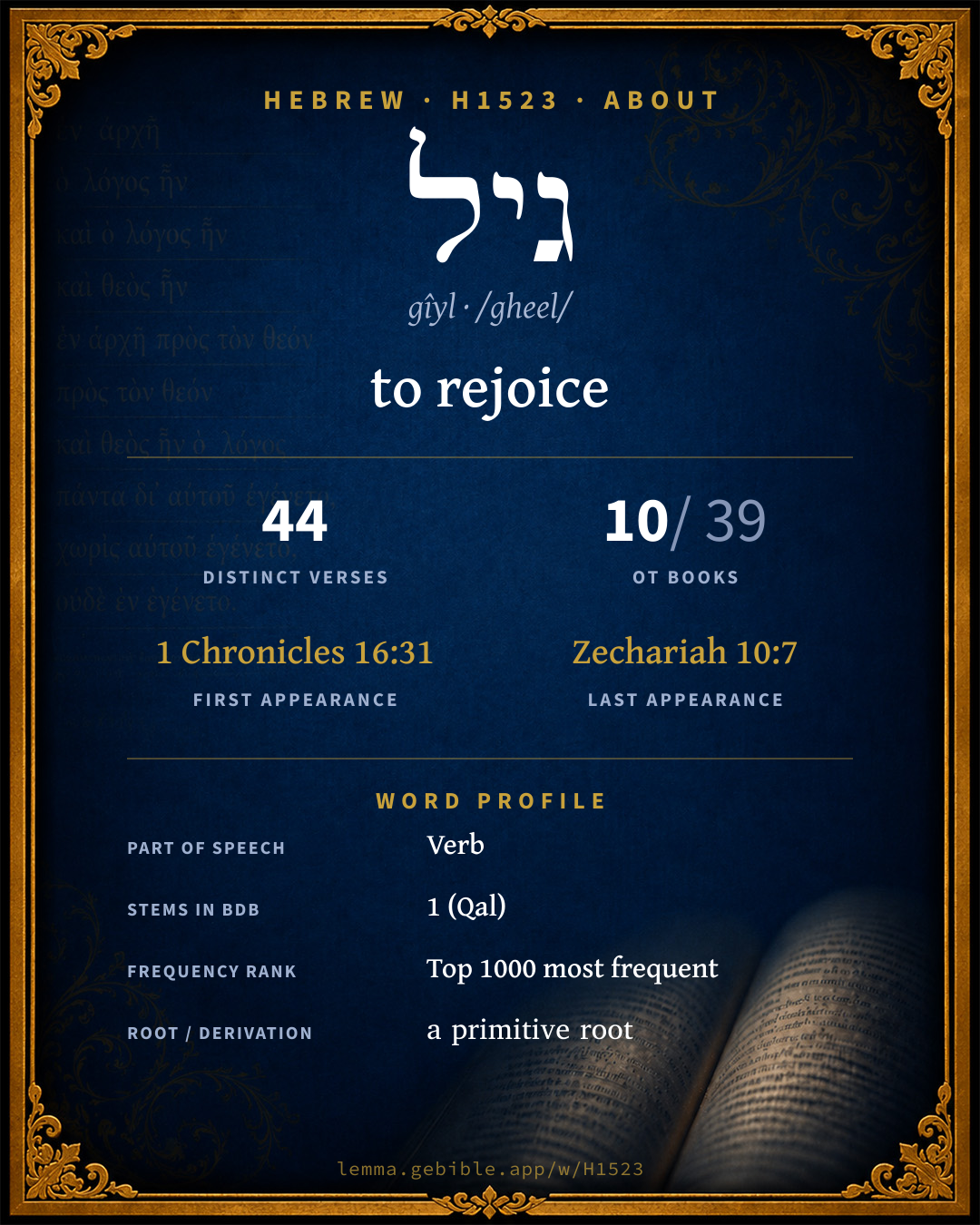
גִּיל
to rejoice
also: exult, be glad fuller range ↓
Full lexicon entry — Brown-Driver-Briggs (BDB)
From Brown-Driver-Briggs (BDB)
Where this word appears
Grammar key — what these labels mean
Part of speech
- Verb
- An action or state-of-being word.
Stem
- Qal
- The basic, simple active stem — the plain form of the verb (“he wrote”). Here: ‘rejoice’
Form
- Imperfect
- An incomplete, ongoing, or future action (“he will / would write”).
- Imperative
- A direct command (“write!”).
- Cohortative
- A first-person volitional form expressing wish or resolve (“let me / let us write”).
- Jussive
- A third- or second-person volitional form expressing wish or command (“let him write”).
- Sequential Perfect
- A perfect with prefixed waw continuing a preceding imperfect or command (waw-consecutive perfect).
- Sequential Imperfect
- An imperfect with prefixed waw — the standard past-narrative form (waw-consecutive imperfect).
Person
- 3rd Person
- The one spoken about (“he / she / it / they”).
- 2nd Person
- The one addressed (“you”).
- 1st Person
- The speaker (“I / we”).
Gender
- Masculine
- Grammatically masculine.
- Feminine
- Grammatically feminine.
- Common
- Either gender — not distinguished for this form.
Number
- Singular
- One.
- Plural
- More than one (in Hebrew, generally three or more).
Every verse where H1523 appears in the Book of 1 Chronicles — 1 distinct verse. Click any verse to open its interlinear word-by-word view. Verse text shown in the World English Bible for context — . Each verse’s Hebrew form is shown with its reference; the English is not keyword-highlighted, since the data carries no word-level English alignment. Use “Compare translations” on any verse to read it across multiple English versions. This concordance covers the Hebrew Bible; Septuagint (Greek Old Testament) occurrences are not indexed here.
1 Chronicles
About this entry
At a glance — auto-summarized from this page’s data, not written by a person. Every figure links to its source below. This summary describes the numbers; it doesn’t interpret them.
גיל — transliterated gîyl — is a Hebrew verb carrying the sense “to rejoice.” It first appears in 1 Chronicles 16:31. The Hebrew Bible uses it across 44 verses — moderately common. More than a third of its appearances fall in Psalms. It also covers “exult” and “be glad”, alongside “to rejoice” — see its full sense range. The sections below give every sense, occurrence, and version rendering.
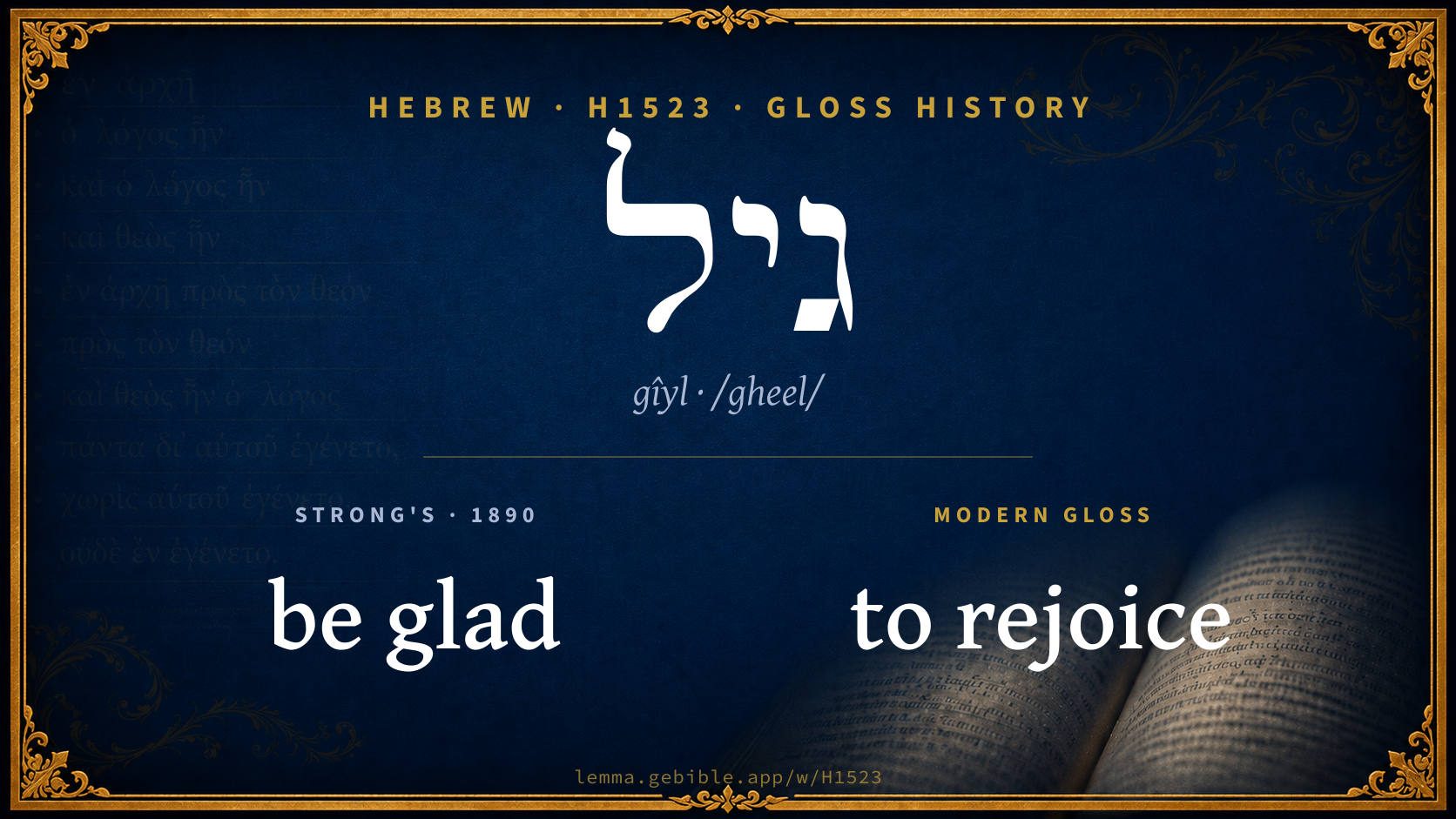
Gloss history
Strong's 1890 vs modern scholarship
About this word
Strong's H1523 catalogs a Hebrew word from the Hebrew Old Testament.
These counts are not copied from any lexicon or concordance. They are computed here, from the morphology-tagged Hebrew Old Testament. What Lemma adds →
- 44
- distinct verses
- The word appears in 44 distinct verses.
- 10 / 39
- OT books
- The word appears in 10 of 39 Old Testament books.
- #796
- by frequency
- Top 1000 most frequent Hebrew words (rank 796 of 8,640 Hebrew words by occurrence).
View all 44 occurrences in the concordance →
By section of the Old Testament
By traditional corpus
Conventional, traditional groupings — biblical authorship is debated, so this is a traditional corpus grouping, not an authorship claim. Each share is this word’s portion of its verses in that division of the Hebrew canon. Each figure is a share of the word’s 44 distinct verses.
- Writings (Ketuvim) 25 verses · 57%
- Prophets (Nevi'im) 19 verses · 43%
How translations render this word
Counts come from each version’s own published word-to-Strong’s tagging or interlinear alignment — an approximate guide to how each version renders this word, not a word-level alignment the data otherwise carries. Because each total is that version’s own tagged count, the per-version totals vary from one another and need not match the appearance or distinct-verse counts above. These counts may also differ from a printed concordance because Lemma counts each distinctly tagged rendering and does not collapse phrase taggings into a single head-word total. This is a fixed set of word-tagged versions (KJV, ASV, BSB, ULT) and does not change with the reading translation you choose elsewhere. Each version’s license is shown beside its name below (and on Sources).
BDB lists this Strong’s number as 3 distinct words (homographs). Each count above pools all of them and is not split by sense — see the Senses section below. A low-frequency rendering may belong to a different one of those words, not the primary meaning.
- King James Version†: Rejoice 9×, Be glad 6×, Shall rejoice 6×
- American Standard Version†: Rejoice 11×, Be glad 5×, Shall rejoice 3×
- Berean Standard Bible†: Rejoice 21×, Will rejoice 6×, I will rejoice 2×
- unfoldingWord Literal Text†: Rejoice 11×, Be glad 7×, Let 6×
King James Version Public Domain
Renders H1523 across 44† tagged occurrences — most commonly:
Plus 15 renderings that appear only once — usually multi-word phrases or single function words the recovered tagging swept in, not distinct renderings.
American Standard Version Public Domain
Renders H1523 across 46† tagged occurrences — most commonly:
Plus 21 renderings that appear only once — usually multi-word phrases or single function words the recovered tagging swept in, not distinct renderings.
Berean Standard Bible Public Domain
Renders H1523 across 43† tagged occurrences — most commonly:
Plus 12 renderings that appear only once — usually multi-word phrases or single function words the recovered tagging swept in, not distinct renderings. Not rendered by a distinct English word in 2 further occurrences.
unfoldingWord Literal Text CC BY-SA 4.0
Renders H1523 across 60† tagged occurrences — most commonly:
Plus 19 renderings that appear only once — usually multi-word phrases or single function words the recovered tagging swept in, not distinct renderings.
Senses in the full BDB
What do BDB’s symbols mean?
BDB uses these scholarly abbreviations:
| Symbol | Meaning |
|---|---|
| 𝔊 | the Septuagint (the ancient Greek translation, LXX) |
| 𝔙 | the Vulgate (the Latin translation) |
| 𝔖 | the Syriac version (the Peshitta) |
| 𝔗 | the Targum (the Aramaic translation) |
| ψ | the Psalms |
| √ | root (the underlying root or stem) |
| ‖ | parallel passage (a synonymous or contrasted parallel) |
| † | the dagger: every passage where the word occurs is cited |
The 6 senses and sub-senses the full Brown-Driver-Briggs lexicon distinguishes for this word, in lexicon order (not ranked by frequency), with BDB’s own verbatim wording and sub-sense lettering. Shown in Hebrew script with BDB’s own scholarly abbreviations. The condensed entry is in the Lexicon Entry tab. See also the Forms in the corpus table below.
גיל I rejoice (NöZMG 1883, 537
Qal
- Pf. גַּלְתִּי Is 65:19; Impf. יָגִיל, תָּגִיל ψ 21:2 + 4 times (ψ 21:2 Kt יגיל, Qr יָ֫גֶל with retracted tone); יָגֵל, תָּגֵל ψ 13:6 + 11 times, וַיָּגֶל ψ 16:9, אָגִילָה, נָגִילָה ψ 9:15 + 5 times, יָגִילוּ ψ 13:5 + 5 times, יְגִילוּן ψ 89:17, תָּגֵלְנָה ψ 48:12 + 2 times; יָגִו֯ל Pr 23:24; Imv. גִּילוּ ψ 2:11 + 4 times, גִּילִי Is 49:13 + 2 times; e.g. Isaiah 65:19
- 1. rejoice,
- a. abs. ψ 13:5; 51:10 Is 49:13 Zc 9:9; ‖ שׂמח ψ 14:7; 16:9; 32:11; 48:12; 53:7; 96:11; 97:1, 8 Pr 23:24, 25 1 Ch 16:31 Hb 1:15; ‖ שׂושׂ, שׂישׂ Is 35:1; 65:18. e.g. Psalms 13:5
- b. c. בְּ ψ 149:2 Pr 2:14; 24:17 Is 9:2; בירושׁלם Is 65:19; 66:10; בישׁועתך ψ 9:15; 13:6; 21:2; ביהוה ψ 35:9 Is 41:16 Zc 10:7; באלהים Is 61:10 Hb 3:18; בשׁם י׳ ψ 89:17; בקדושׁ ישׂראל Is 29:19; גיל ושׂמח ב׳ ψ 31:8; 118:24 Ct 1:4 Is 25:9 Jo 2:23; גילי ושׂמחי כי Jo 2:21. e.g. Psalms 149:2
- c. with עַל Zp 3:17. Besides persons the subj. is לֵב ψ 13:6 Pr 24:17 Zc 10:7; נפשׁ ψ 35:9 Is 61:10, כבוד (= נפשׁ) ψ 16:9, ארץ 1 Ch 16:31 ψ 96:11; 97:1 Is 49:13, ערבה Is 35:1, 2. e.g. Zephaniah 3:17
- 2. tremble (cf. Arabic وَجِلَ) ψ 2:11 ‖ עבד (Thes Ew Hi Che, but 𝔊 Hu De Pe AV RV rejoice), Ho 10:5 ‖ אבל (Thes and most mod., but AV RV that rejoiced over it), possibly error for חיל Ew Gr Che. e.g. Psalms 2:11
גיל II [m.] rejoicing
גיל III [m.] circle, age, מן הילדים אשׁר כְּגִלְכֶם of the youths which are of your age Dn 1
Senses from the full Brown-Driver-Briggs lexicon (Brown, Driver, Briggs; Oxford 1906 — public domain), digitized via Sefaria, supplemented by the OpenScriptures HebrewLexicon (CC BY 4.0). Full attribution on Sources.
Word origin
I. vb. rejoice (NöZMG 1883, 537; cf. Arabic جَالَ go round or about, be excited to levity, etc.)—
II. n.[m.] rejoicing—Jb 3:22 + 6times, גִּו֯ל Pr 23:24; sf. גִּילִי ψ 43:4;—rejoicing ψ 65:13 Pr 23:24; ‖ שׂמחה ψ 45:16 Is 16:10 Je 48:33 Jo 1:16, שִׂמְחַת גִילִי ψ 43:4, שׂמח אל גיל glad unto rejoicing Ho 9:1 Jb 3:22.
III. n.[m.] circle, age, מן הילדים אשׁר כְּגִלְכֶם of the youths which are of your age Dn 1:10 (cf. Arabic جِيلٌ, Sam. גיל = Heb. דור = γενεά, Talm בן גילו one born at the same time, a contemporary).
— Brown-Driver-Briggs (Oxford 1906, public domain), digitized via Sefaria, supplemented by the OpenScriptures HebrewLexicon (CC BY 4.0). See Sources.
Origin: a primitive root
Jastrow Dictionary
A second Hebrew/Aramaic lexicon for comparison, covering Aramaic and post-biblical (Talmudic, Targumic, Midrashic) usage that the biblical-Hebrew BDB does not. Matched by lemma rather than by Strong’s number, so a lemma may carry more than one Jastrow headword (shown separately below), and the entries cover usage well beyond the Bible.
גִּיל I
- v. גיל) to form a circle, to gather; to rejoice. Y. Ber. V, 8ᵈ bot. (ref. to Ps. II, 11) לכשיבוא יום רעדה תָּגִילוּ when the time of trembling comes (in a disposition of reverence) shall ye assemble (for prayer); cmp. גִּילָה. e.g. Psalms 2:11
גִּיל II
- preced.) circle, association of coevals. B. Mets. 27ᵇ; Yeb. 120ᵃ the same mark מצויה בבן גִּילוֹ is frequently found with those born at the same hour (under the same planetary influences, cmp. גַּלְגַּל). Meg. 11ᵃ בן גילו וכ׳ of the same character. Ned. 39ᵇ בן גילו (Ar. בני) of the same age; B. Bets. 30ᵇ. Ruth R. to I, 3 מת אחד מן הג׳ ידאג כל הג׳ if one of the circle (of the coevals) died, the whole circle must take it to heart.—Pl. גִּילִין. Ib.—v. גִּילָאֵי. [Y. Orl. II, 61ᵈ bot. גיל השבט, v. גָּזֵל.]
גִּיל III
- (גול) ball, clapper of a bell. Lev. R. s. 27, beg.; Tanḥ. Emor 5 גול; ed. Bub. ib. 7 גיל.
A Dictionary of the Targumim, the Talmud Babli and Yerushalmi, and the Midrashic Literature (Marcus Jastrow; London, Luzac, 1903) — Public Domain. Digitized via Sefaria. Digitized via Sefaria. Full attribution on Sources.
Forms in the corpus
The 40 distinct written forms H1523 takes in the Hebrew Bible, most frequent first — each parse links to that stem’s occurrences in the concordance. Hebrew forms include their vowel points and cantillation, so a single lemma takes many written forms.
| Form | Parsing | Example | Uses |
|---|---|---|---|
| יָגֵ֥ל | Verb, Qal, Imperfect, 3rd Person, Masculine, Singular | Psalms 14:7 | 4 |
| וְ/תָגֵ֣ל | Verb, Qal, Imperfect, 3rd Person, Feminine, Singular | Psalms 96:11 | 2 |
| תָּגִ֣יל | Verb, Qal, Imperfect, 2nd Person, Masculine, Singular | Isaiah 41:16 | 2 |
| יָ֝גִ֗ילוּ | Verb, Qal, Imperfect, 3rd Person, Masculine, Plural | Proverbs 2:14 | 2 |
| אָ֝גִ֗ילָה | Verb, Qal, Cohortative, 1st Person, Common, Singular | Psalms 9:14 | 1 |
| אָגִ֖ילָה | Verb, Qal, Cohortative, 1st Person, Common, Singular | Habakkuk 3:18 | 1 |
| אָגִ֥ילָה | Verb, Qal, Cohortative, 1st Person, Common, Singular | Psalms 31:7 | 1 |
| גִּ֣ילִי | Verb, Qal, Imperative, 2nd Person, Feminine, Singular | Joel 2:21 | 1 |
| גִּ֤ילוּ | Verb, Qal, Imperative, 2nd Person, Masculine, Plural | Joel 2:23 | 1 |
| גִּילִ֨י | Verb, Qal, Imperative, 2nd Person, Feminine, Singular | Zechariah 9:9 | 1 |
| וְ/גִ֣ילִי | Verb, Qal, Imperative, 2nd Person, Feminine, Singular | Isaiah 49:13 | 1 |
| וְ/גִ֥ילוּ | Verb, Qal, Imperative, 2nd Person, Masculine, Plural | Isaiah 66:10 | 1 |
| וְ/גִ֨ילוּ֙ | Verb, Qal, Imperative, 2nd Person, Masculine, Plural | Isaiah 65:18 | 1 |
| וְ/גַלְתִּ֥י | Verb, Qal, Sequential Perfect, 1st Person, Common, Singular | Isaiah 65:19 | 1 |
| וְ/יָגִֽיל | Verb, Qal, Imperfect, 3rd Person, Masculine, Singular | Habakkuk 1:15 | 1 |
| וְ/תָגֵ֗ל | Verb, Qal, Imperfect, 3rd Person, Feminine, Singular | Isaiah 35:2 | 1 |
| וְ/תָגֵ֧ל | Verb, Qal, Imperfect, 3rd Person, Feminine, Singular | Isaiah 35:1 | 1 |
| וְ֝/גִ֗ילוּ | Verb, Qal, Imperative, 2nd Person, Masculine, Plural | Psalms 2:11 | 1 |
| וְ֝/תָגֵ֗ל | Verb, Qal, Jussive, 3rd Person, Feminine, Singular | Proverbs 23:25 | 1 |
| וְ֭/גִילוּ | Verb, Qal, Imperative, 2nd Person, Masculine, Plural | Psalms 32:11 | 1 |
| וַ/יָּ֣גֶל | Verb, Qal, Sequential Imperfect, 3rd Person, Masculine, Singular | Psalms 16:9 | 1 |
| וַ֭/תָּגֵלְנָה | Verb, Qal, Sequential Imperfect, 3rd Person, Feminine, Plural | Psalms 97:8 | 1 |
| יְגִיל֣וּ/ן | Verb, Qal, Imperfect, 3rd Person, Masculine, Plural | Psalms 89:16 | 1 |
| יָ֤גֵ֥ל | Verb, Qal, Imperfect, 3rd Person, Masculine, Singular | Psalms 13:5 | 1 |
| יָ֭גִיל | Verb, Qal, Imperfect, 3rd Person, Masculine, Singular | Proverbs 23:24 | 1 |
| יָגִ֔ילוּ | Verb, Qal, Imperfect, 3rd Person, Masculine, Plural | Hosea 10:5 | 1 |
| יָגִ֖ילוּ | Verb, Qal, Imperfect, 3rd Person, Masculine, Plural | Isaiah 9:3 | 1 |
| יָגִ֥יל | Verb, Qal, Imperfect, 3rd Person, Masculine, Singular | Zephaniah 3:17 | 1 |
| יָגִ֥ילוּ | Verb, Qal, Imperfect, 3rd Person, Masculine, Plural | Psalms 149:2 | 1 |
| יָגִֽילוּ | Verb, Qal, Imperfect, 3rd Person, Masculine, Plural | Isaiah 29:19 | 1 |
| יָּ֥גֶל | Verb, Qal, Imperfect, 3rd Person, Masculine, Singular | Psalms 21:1 | 1 |
| יגול | Verb, Qal, Imperfect, 3rd Person, Masculine, Singular | Proverbs 23:24 | 1 |
| יגיל | Verb, Qal, Imperfect, 3rd Person, Masculine, Singular | Psalms 21:1 | 1 |
| נָגִ֖ילָה | Verb, Qal, Cohortative, 1st Person, Common, Plural | Psalms 118:24 | 1 |
| נָגִ֤ילָה | Verb, Qal, Cohortative, 1st Person, Common, Plural | Song of Solomon 1:4 | 1 |
| נָגִ֥ילָה | Verb, Qal, Cohortative, 1st Person, Common, Plural | Isaiah 25:9 | 1 |
| תָּ֝גֵ֗לְנָה | Verb, Qal, Imperfect, 3rd Person, Feminine, Plural | Psalms 51:8 | 1 |
| תָּ֭גֵלְנָה | Verb, Qal, Imperfect, 3rd Person, Feminine, Plural | Psalms 48:11 | 1 |
| תָּגֵ֣ל | Verb, Qal, Imperfect, 3rd Person, Feminine, Singular | Psalms 97:1 | 1 |
| תָּגֵ֤ל | Verb, Qal, Imperfect, 3rd Person, Feminine, Singular | Isaiah 61:10 | 1 |
Same root — word family
Other BDB entries built from the same root as H1523, grouped by Strong’s listed origin. These share a root / origin per the lexicon — not necessarily a shared meaning. Each links to that word’s own entry.
Derived from this word
Compare all same-root words → They share a root, not necessarily a meaning.
Septuagint verse parallels
This word appears in 43 verses that also exist in the Greek Old Testament (Septuagint), out of the 44 Hebrew verses it occurs in. You can read those verses in Greek by switching the Old Testament edition to the Septuagint.
Read these verses in the Septuagint
- 1 Chronicles 16:31
- Psalms 2:11
- Proverbs 2:14
- Song of Solomon 1:4
- Isaiah 9:3
- Hosea 10:5
- Joel 2:21
- Habakkuk 1:15
- Zephaniah 3:17
- Zechariah 9:9
This is a verse-level parallel only — the same verses exist in both the Hebrew and Greek Old Testaments. No word-level Hebrew↔Greek correspondence is claimed: the data carries no such alignment, so no Greek word is shown as this Hebrew word’s translation. Coverage is not total — the Septuagint omits the deuterocanon and renumbers the Psalms, so some Hebrew verses have no direct Greek parallel.