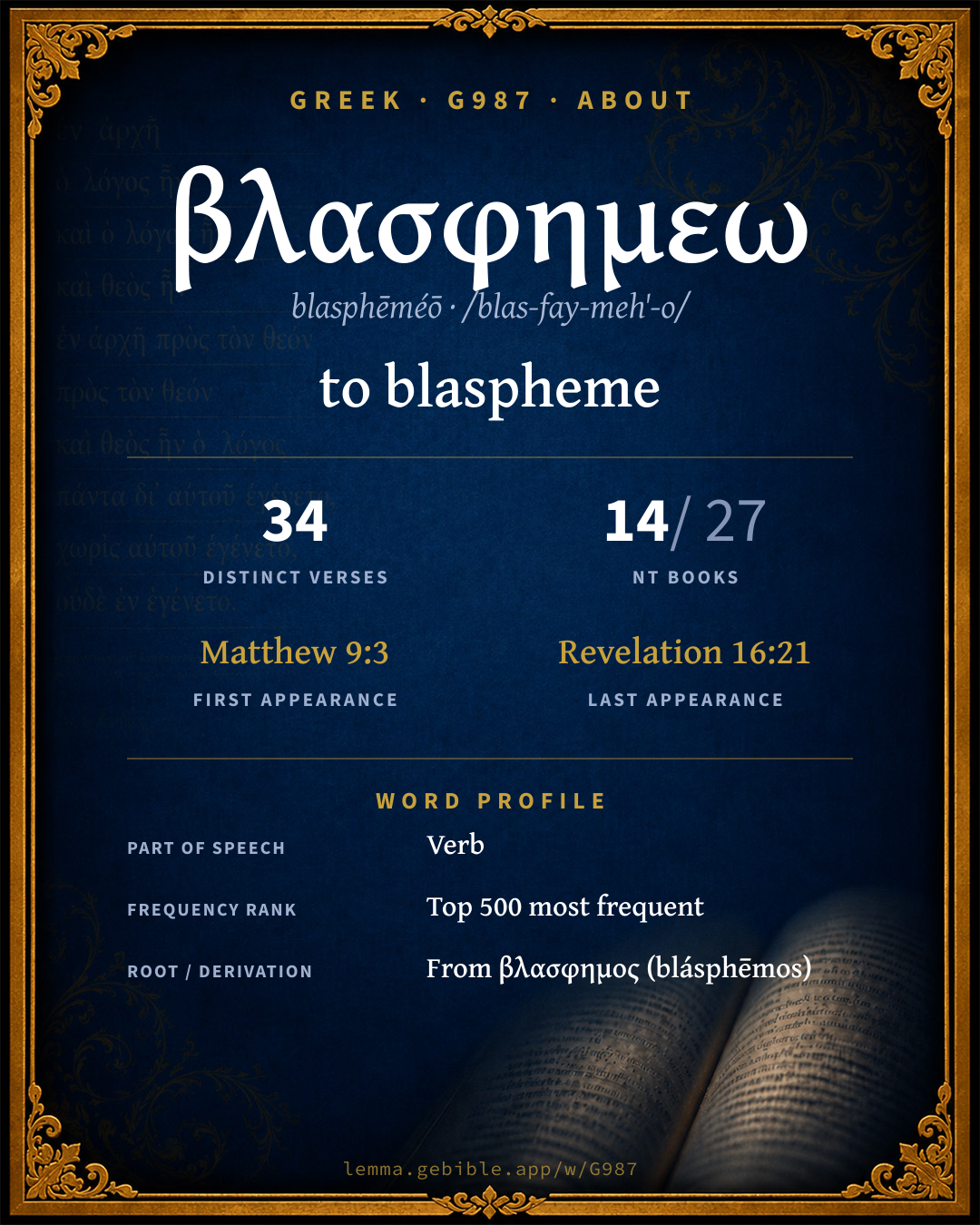
βλασφημέω
to blaspheme
‘to blaspheme’ is one of 2 main senses fuller range ↓
Full lexicon entry — Thayer's Greek Lexicon
From Thayer's Greek Lexicon
Where this word appears
See every Present-tense verb in the Greek New Testament →
Grammar key — what these labels mean
Part of speech
- Verb
- An action or state-of-being word.
Tense
- Present
- Ongoing or general action in present time (imperfective aspect).
- Aorist
- Action viewed as a simple whole, without regard to duration — often past (perfective aspect).
- Imperfect
- Continuous or repeated action in past time (“was writing”).
- Future
- Action expected in future time.
Voice
- Active
- The subject performs the action.
- Passive
- The subject receives the action.
Mood
- Participle
- A verbal adjective (“writing,” “having written”).
- Indicative
- States a fact or asks a factual question (the mood of reality).
- Infinitive
- A verbal noun (“to write”), unmarked for person or number.
- Subjunctive
- Expresses probability, purpose, or possibility (the mood of contingency).
- Imperative
- Expresses a command or request.
Case
- Nominative
- The case of the subject (and the predicate nominative).
- Dative
- The case of the indirect object, means, or location — “to / for / with / in.”
- Accusative
- The case of the direct object and of extent.
- Genitive
- The case of source, possession, or “of” — answers “whose / from what.”
Person
- 3rd person
- The one spoken about (“he / she / it / they”).
- 2nd person
- The one addressed (“you”).
- 1st person
- The speaker (“I / we”).
Gender
- Masculine
- Grammatically masculine.
Number
- Plural
- More than one.
- Singular
- One.
Grammatical forms 21 distinct
- Verb, Present, Active, Participle, Nominative, Plural, Masculine 5 times (15%)
- Verb, Aorist, Active, Indicative, 3rd person, Plural 3 times (9%)
- Verb, Present, Active, Indicative, 3rd person, Plural 3 times (9%)
- Verb, Present, Active, Infinitive 3 times (9%)
- Verb, Imperfect, Active, Indicative, 3rd person, Plural 2 times (6%)
- Verb, Present, Active, Indicative, 3rd person, Singular 2 times (6%)
- Verb, Present, Passive, Subjunctive, 3rd person, Singular 2 times (6%)
- Verb, Aorist, Active, Indicative, 3rd person, Singular 1 time (3%)
+13 more forms (13 occurrences)
Parsed forms decoded from the imported morphology (Robinson–Tischendorf, public domain), counted across 34 parsed occurrences — not distinct verses.
Every verse where G987 appears — 34 distinct verses across 14 books. Click any verse to open its interlinear word-by-word view. Verse text shown in the World English Bible for context — . Each verse’s Greek form is shown with its reference; the English is not keyword-highlighted, since the data carries no word-level English alignment. Use “Compare translations” on any verse to read it across multiple English versions. This concordance covers the Greek New Testament; Septuagint (Greek Old Testament) occurrences of this word are not indexed here.
Matthew 3 verses
- Matthew 9:3 βλασφημεῖ pres act ind 3sg Behold, some of the scribes said to themselves, "This man blasphemes."
- Matthew 26:65 ἐβλασφήμησεν aor act ind 3sg Then the high priest tore his clothing, saying, "He has spoken blasphemy! Why do we need any more witnesses? Behold, now you have heard his blasphemy.
- Matthew 27:39 ἐβλασφήμουν impf act ind 3pl Those who passed by blasphemed him, wagging their heads,
Mark 4 verses
- Mark 2:7 βλασφημεῖ pres act ind 3sg "Why does this man speak blasphemies like that? Who can forgive sins but God alone?"
- Mark 3:28 βλασφημήσωσιν aor act subj 3pl Most assuredly I tell you, all of the children of men's sins will be forgiven them, including their blasphemies with which they may blaspheme;
- Mark 3:29 βλασφημήσῃ aor act subj 3sg but whoever may blaspheme against the Holy Spirit never has forgiveness, but is guilty of an eternal sin"
- Mark 15:29 ἐβλασφήμουν impf act ind 3pl Those who passed by blasphemed him, wagging their heads, and saying, "Ha! You who destroy the temple, and build it in three days,
Luke 3 verses
- Luke 12:10 βλασφημήσαντι aor act ptcp dat sg masc Everyone who speaks a word against the Son of Man will be forgiven, but those who blaspheme against the Holy Spirit will not be forgiven.
- Luke 22:65 βλασφημοῦντες pres act ptcp nom pl masc They spoke many other things against him, insulting him.
- Luke 23:39 ἐβλασφήμει impf act ind 3sg One of the criminals who was hanged insulted him, saying, "If you are the Christ, save yourself and us!"
John 1 verse
Acts 4 verses
- Acts 13:45 βλασφημοῦντες pres act ptcp nom pl masc But when the Jews saw the multitudes, they were filled with jealousy, and contradicted the things which were spoken by Paul, and blasphemed.
- Acts 18:6 βλασφημούντων pres act ptcp gen pl masc When they opposed him and blasphemed, he shook out his clothing and said to them, "Your blood be on your own heads! I am clean. From now on, I will go to the Gentiles!"
- Acts 19:37 βλασφημοῦντας pres act ptcp acc pl masc For you have brought these men here, who are neither robbers of temples nor blasphemers of your goddess.
- Acts 26:11 βλασφημεῖν pres act inf Punishing them often in all the synagogues, I tried to make them blaspheme. Being exceedingly enraged against them, I persecuted them even to foreign cities.
Romans 3 verses
- Romans 2:24 βλασφημεῖται pres pass ind 3sg For "the name of God is blasphemed among the Gentiles because of you," just as it is written.
- Romans 3:8 βλασφημούμεθα pres pass ind 1pl Why not (as we are slanderously reported, and as some affirm that we say), "Let us do evil, that good may come?" Those who say so are justly condemned.
- Romans 14:16 βλασφημείσθω pres pass impv 3sg Then don't let your good be slandered,
1 Corinthians 1 verse
1 Timothy 2 verses
- 1 Timothy 1:20 βλασφημεῖν pres act inf of whom is Hymenaeus and Alexander; whom I delivered to Satan, that they might be taught not to blaspheme.
- 1 Timothy 6:1 βλασφημῆται pres pass subj 3sg Let as many as are bondservants under the yoke count their own masters worthy of all honor, that the name of God and the doctrine not be blasphemed.
Titus 2 verses
- Titus 2:5 βλασφημῆται pres pass subj 3sg to be sober-minded, chaste, workers at home, kind, being in subjection to their own husbands, that God's word may not be blasphemed.
- Titus 3:2 βλασφημεῖν pres act inf to speak evil of no one, not to be contentious, to be gentle, showing all humility toward all men.
James 1 verse
1 Peter 1 verse
2 Peter 3 verses
- 2 Peter 2:2 βλασφημηθήσεται fut pass ind 3sg Many will follow their immoral ways, and as a result, the way of the truth will be maligned.
- 2 Peter 2:10 βλασφημοῦντες pres act ptcp nom pl masc but chiefly those who walk after the flesh in the lust of defilement, and despise authority. Daring, self-willed, they are not afraid to speak evil of dignitaries;
- 2 Peter 2:12 βλασφημοῦντες pres act ptcp nom pl masc But these, as unreasoning creatures, born natural animals to be taken and destroyed, speaking evil in matters about which they are ignorant, will in their destroying surely be destroyed,
Jude 2 verses
- Jude 1:8 βλασφημοῦσιν pres act ind 3pl Yet in like manner these also in their dreaming defile the flesh, despise authority, and slander celestial beings.
- Jude 1:10 βλασφημοῦσιν pres act ind 3pl But these speak evil of whatever things they don't know. What they understand naturally, like the creatures without reason, in these things are they destroyed.
Revelation 4 verses
- Revelation 13:6 βλασφημῆσαι aor act inf He opened his mouth for blasphemy against God, to blaspheme his name, and his dwelling, those who dwell in heaven.
- Revelation 16:9 ἐβλασφήμησαν aor act ind 3pl People were scorched with great heat, and people blasphemed the name of God who has the power over these plagues. They didn't repent and give him glory.
- Revelation 16:11 ἐβλασφήμησαν aor act ind 3pl and they blasphemed the God of heaven because of their pains and their sores. They didn't repent of their works.
- Revelation 16:21 ἐβλασφήμησαν aor act ind 3pl Great hailstones, about the weight of a talent, came down out of the sky on people. People blasphemed God because of the plague of the hail, for this plague is exceedingly severe.
About this entry
At a glance — auto-summarized from this page’s data, not written by a person. Every figure links to its source below. This summary describes the numbers; it doesn’t interpret them.
βλασφημεω (blasphēméō) is a Greek verb most often rendered “to blaspheme.” It first appears in Matthew 9:3. It turns up in 34 verses across 14 books, a moderately common footprint. Its lexical range runs to 2 senses. From the same root come βλασφημος and βλασφημια. The sections below give every sense, occurrence, and version rendering.
Gloss history
Strong's 1890 vs modern scholarship
About this word
Strong's G987 catalogs a Greek word from the Greek New Testament.
These counts are not copied from any lexicon or concordance. They are computed here, from the morphology-tagged Greek New Testament. What Lemma adds →
- 34
- distinct verses
- The word appears in 34 distinct verses.
- 14 / 27
- NT books
- The word appears in 14 of 27 New Testament books.
- #424
- by frequency
- Top 500 most frequent Greek words (rank 424 of 5,347 Greek words by occurrence).
View all 34 occurrences in the concordance →
Most concentrated in
- Mark 4 verses 12%
- Acts 4 verses 12%
- Revelation 4 verses 12%
By section of the New Testament
By traditional corpus
Conventional, traditional groupings — biblical authorship is debated, so this is a traditional corpus grouping, not an authorship claim. Some books belong to more than one corpus (Luke is in both the Gospels and the Lukan corpus, and so on), so these shares overlap and need not total 100%. Each figure is a share of the word’s 34 distinct verses.
- Gospels 11 verses · 32%
- Pauline corpus 8 verses · 24%
- Lukan (Luke–Acts) 7 verses · 21%
- General (Catholic) Epistles 7 verses · 21%
- Johannine 5 verses · 15%
- Revelation 4 verses · 12%
How translations render this word
Counts come from each version’s own published word-to-Strong’s tagging or interlinear alignment — an approximate guide to how each version renders this word, not a word-level alignment the data otherwise carries. Because each total is that version’s own tagged count, the per-version totals vary from one another and need not match the appearance or distinct-verse counts above. These counts may also differ from a printed concordance because Lemma counts each distinctly tagged rendering and does not collapse phrase taggings into a single head-word total. This is a fixed set of word-tagged versions (KJV, ASV, BSB, ULT) and does not change with the reading translation you choose elsewhere. Each version’s license is shown beside its name below (and on Sources).
- King James Version: Blasphemed 6×, Blaspheme 4×, Speak evil 4×
- American Standard Version: Blaspheme 5×, Blasphemed 5×, Rail 3×
- Berean Standard Bible: Slander 4×, Heaped abuse on 3×, Blaspheme 2×
- unfoldingWord Literal Text: Blaspheme 4×, Be blasphemed 2×, Blasphemed 2×
King James Version Public Domain
Renders G987 across 39 tagged occurrences — most commonly:
Plus 21 renderings that appear only once — usually multi-word phrases or single function words the recovered tagging swept in, not distinct renderings.
American Standard Version Public Domain
Renders G987 across 38 tagged occurrences — most commonly:
Plus 19 renderings that appear only once — usually multi-word phrases or single function words the recovered tagging swept in, not distinct renderings.
Berean Standard Bible Public Domain
Renders G987 across 34 tagged occurrences — most commonly:
Plus 21 renderings that appear only once — usually multi-word phrases or single function words the recovered tagging swept in, not distinct renderings.
unfoldingWord Literal Text CC BY-SA 4.0
Renders G987 across 40 tagged occurrences — most commonly:
Plus 18 renderings that appear only once — usually multi-word phrases or single function words the recovered tagging swept in, not distinct renderings.
Senses in Thayer's
The 2 senses Thayer's distinguishes for this word, in lexicon order (not ranked by frequency or importance). The full entry — with sub-senses — is in the Lexicon Entry tab.
- to speak reproachfully, rail at, revile, calumniate, blaspheme
- to be evil spoken of, reviled, railed at
Word origin
Derived from βλασφημος (blásphēmos) (G989) — slanderous.
From G989 ; to vilify ; specifically to speak impiously : - (speak) blaspheme (-er -mously -my) defame rail on revile speak evil.
— Strong’s Exhaustive Concordance (1890), public domain.
Forms in the corpus
The 21 distinct written forms G987 takes in the Greek New Testament, most frequent first — each parse links to that tense’s occurrences in the concordance.
Same root — word family
Other Thayer's entries built from the same root as G987, grouped by Strong’s listed origin. These share a root / origin per the lexicon — not necessarily a shared meaning. Each links to that word’s own entry.
Derives from
Shares the same root
Compare all same-root words → They share a root, not necessarily a meaning.
Septuagint usage
The same Greek word βλασφημεω appears 5 times in the Greek Old Testament (Septuagint), across 5 verses in 3 books.
- 5
- LXX occurrences
- Tagged occurrences of this Greek word in the Septuagint.
- 5
- verses
- Distinct Septuagint verses containing this word.
- 3 / 39
- OT books
- The word appears in 3 of the 39 Old Testament books.
Sample Septuagint occurrences
- 2 Kings 19:4 βλασφημέω
- Isaiah 52:5 βλασφημέω
- Daniel 3:96 βλασφημέω
Septuagint occurrences (same lexeme)
Every verse where the same Strong’s number (G987) appears in the Greek Septuagint. Verse text shown in the World English Bible for context; the Greek form is the matched word — the English is not keyword-highlighted.
- 2 Kings 19:4 βλασφημέω It may be Yahweh your God will hear all the words of Rabshakeh, whom the king of Assyria his master has sent to defy the living God, and will rebuke the words which Yahweh your God has heard. Therefore lift up your prayer for the remnant that is left.
- 2 Kings 19:6 βλασφημέω Isaiah said to them, Thus shall you tell your master, Thus says Yahweh, Don't be afraid of the words that you have heard, with which the servants of the king of Assyria have blasphemed me.
- 2 Kings 19:22 βλασφημέω Whom have you defied and blasphemed? and against whom have you exalted your voice and lifted up your eyes on high? [even] against the Holy One of Israel.
- Isaiah 52:5 βλασφημέω Now therefore, what do I here, says Yahweh, seeing that my people is taken away for nothing? those who rule over them do howl, says Yahweh, and my name continually all the day is blasphemed.
- Daniel 3:96 βλασφημέω
These are occurrences of the same Greek lexeme (G987) in the Septuagint — not a translation of any one Hebrew word. The store carries no word-level Hebrew↔Greek alignment, so no Hebrew original is asserted here. Counts come from the recovered LXX Strong's tagging — high-frequency vocabulary is well covered, while rare or late forms may be untagged — so they reflect tagged occurrences and may slightly undercount.