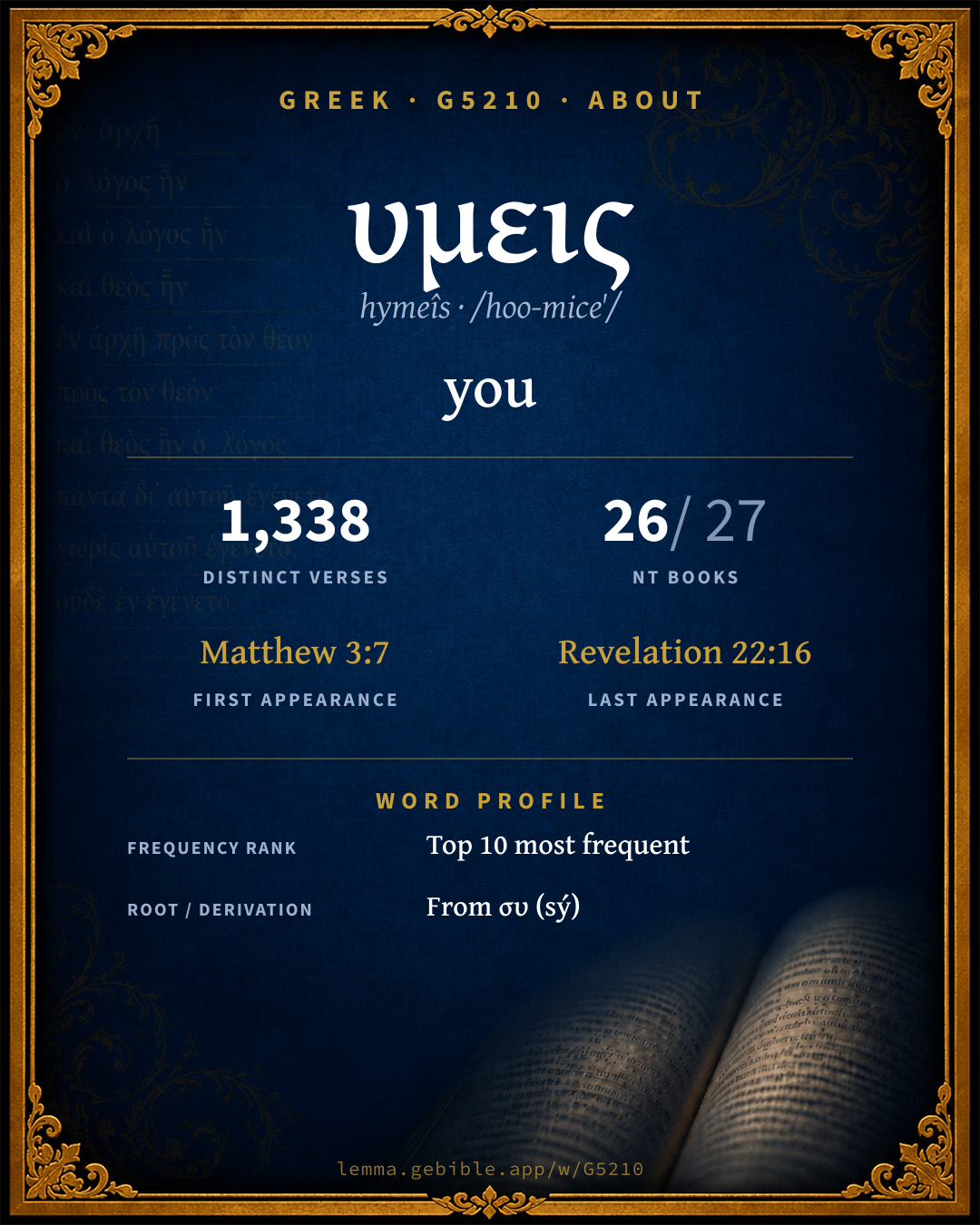
ὑμείς
you
Full lexicon entry — Thayer's Greek Lexicon
From Thayer's Greek Lexicon
Where this word appears
See every Genitive-case word in the Greek New Testament →
Grammar key — what these labels mean
Part of speech
- Personal pronoun
- Stands in for a person already named (“I,” “you,” “he”).
Case
- Dative
- The case of the indirect object, means, or location — “to / for / with / in.”
- Genitive
- The case of source, possession, or “of” — answers “whose / from what.”
- Accusative
- The case of the direct object and of extent.
- Nominative
- The case of the subject (and the predicate nominative).
Person
- 2nd person
- The one addressed (“you”).
Number
- Plural
- More than one.
20 verses where G5210 appears in the Genitive case in the Book of 1 Peter. Filtered view — show all forms. Click any verse to open its interlinear word-by-word view. Verse text shown in the World English Bible for context — . Each verse’s Greek form is shown with its reference; the English is not keyword-highlighted, since the data carries no word-level English alignment. Use “Compare translations” on any verse to read it across multiple English versions. This concordance covers the Greek New Testament; Septuagint (Greek Old Testament) occurrences of this word are not indexed here.
1 Peter
- 1 Peter 1:7 ὑμῶν pron 2 gen pl that the proof of your faith, which is more precious than gold that perishes even though it is tested by fire, may be found to result in praise, glory, and honor at the revelation of Jesus Christ--
- 1 Peter 1:9 ὑμῶν pron 2 gen pl receiving the result of your faith, the salvation of your souls.
- 1 Peter 1:13 ὑμῶν ὑμῖν pron 2 gen pl pron 2 dat pl Therefore, prepare your minds for action, be sober and set your hope fully on the grace that will be brought to you at the revelation of Jesus Christ--
- 1 Peter 1:14 ὑμῶν pron 2 gen pl as children of obedience, not conforming yourselves according to your former lusts as in your ignorance,
- 1 Peter 1:17 ὑμῶν pron 2 gen pl If you call on him as Father, who without respect of persons judges according to each man's work, pass the time of your living as strangers here in reverent fear:
- 1 Peter 1:18 ὑμῶν pron 2 gen pl knowing that you were redeemed, not with corruptible things, with silver or gold, from the useless way of life handed down from your fathers,
- 1 Peter 1:21 ὑμῶν pron 2 gen pl who through him are believers in God, who raised him from the dead, and gave him glory; so that your faith and hope might be in God.
- 1 Peter 1:22 ὑμῶν pron 2 gen pl Seeing you have purified your souls in your obedience to the truth through the Spirit in sincere brotherly affection, love one another from the heart fervently:
- 1 Peter 2:12 ὑμῶν ὑμῶν pron 2 gen pl pron 2 gen pl having good behavior among the nations, so in that which they speak against you as evil-doers, they may by your good works, which they see, glorify God in the day of visitation.
- 1 Peter 2:21 ὑμῶν ὑμῖν pron 2 gen pl pron 2 dat pl For to this you were called, because Christ also suffered for us, leaving you an example, that you should follow his steps,
- 1 Peter 2:25 ὑμῶν pron 2 gen pl For you were going astray like sheep; but are now returned to the Shepherd and Overseer of your souls.
- 1 Peter 3:2 ὑμῶν pron 2 gen pl seeing your pure behavior in fear.
- 1 Peter 3:7 ὑμῶν pron 2 gen pl You husbands, in like manner, live with your wives according to knowledge, giving honor to the woman, as to the weaker vessel, as being also joint heirs of the grace of life; that your prayers may not be hindered.
- 1 Peter 3:15 ὑμῶν ὑμᾶς ὑμῖν pron 2 gen pl pron 2 acc pl pron 2 dat pl But sanctify the Lord God in your hearts; and always be ready to give an answer to everyone who asks you a reason concerning the hope that is in you, with humility and fear:
- 1 Peter 3:16 ὑμῶν pron 2 gen pl having a good conscience; that, while you are spoken against as evildoers, they may be disappointed who curse your good manner of life in Christ.
- 1 Peter 4:4 ὑμῶν pron 2 gen pl They think it is strange that you don't run with them into the same excess of riot, blaspheming:
- 1 Peter 4:15 ὑμῶν pron 2 gen pl For let none of you suffer as a murderer, or a thief, or an evil doer, or as a meddler in other men's matters.
- 1 Peter 5:7 ὑμῶν ὑμῶν pron 2 gen pl pron 2 gen pl casting all your worries on him, because he cares for you.
- 1 Peter 5:8 ὑμῶν pron 2 gen pl Be sober and self-controlled. Be watchful. Your adversary the devil, walks around like a roaring lion, seeking whom he may devour.
- 1 Peter 5:9 ὑμῶν pron 2 gen pl Withstand him steadfast in your faith, knowing that your brothers who are in the world are undergoing the same sufferings.
About this entry
At a glance — auto-summarized from this page’s data, not written by a person. Every figure links to its source below. This summary describes the numbers; it doesn’t interpret them.
υμεις (hymeîs) is a Greek word most often rendered “you.” It first appears in Matthew 3:7. It turns up in 1,338 verses across 26 books, one of the most common footprint. From the same root come συ, σε and σοι. For the data behind this summary, explore the sense tree and the renderings breakdown below.
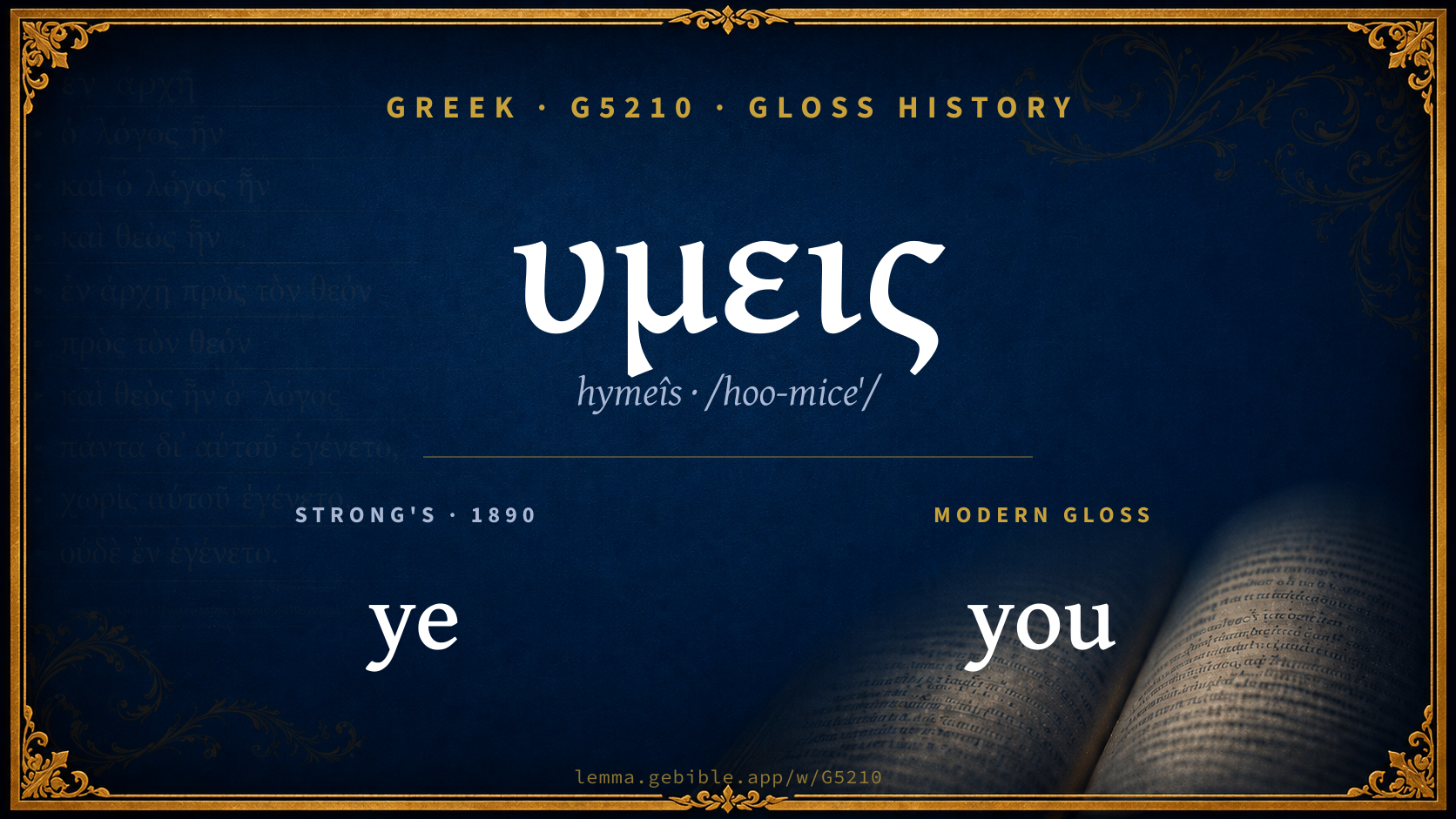
Gloss history
Strong's 1890 vs modern scholarship
About this word
Strong's G5210 catalogs a Greek word from the Greek New Testament.
These counts are not copied from any lexicon or concordance. They are computed here, from the morphology-tagged Greek New Testament. What Lemma adds →
- 1,338
- distinct verses
- The word appears in 1,338 distinct verses.
- 26 / 27
- NT books
- The word appears in 26 of 27 New Testament books.
- #8
- by frequency
- Top 10 most frequent Greek words (rank 8 of 5,347 Greek words by occurrence).
View all 1,338 occurrences in the concordance →
By section of the New Testament
By traditional corpus
Conventional, traditional groupings — biblical authorship is debated, so this is a traditional corpus grouping, not an authorship claim. Some books belong to more than one corpus (Luke is in both the Gospels and the Lukan corpus, and so on), so these shares overlap and need not total 100%. Each figure is a share of the word’s 1,338 distinct verses.
- Gospels 566 verses · 42%
- Pauline corpus 525 verses · 39%
- Lukan (Luke–Acts) 256 verses · 19%
- Johannine 194 verses · 14%
- General (Catholic) Epistles 121 verses · 9%
- Hebrews 28 verses · 2%
- Revelation 9 verses · 1%
How translations render this word
Counts come from each version’s own published word-to-Strong’s tagging or interlinear alignment — an approximate guide to how each version renders this word, not a word-level alignment the data otherwise carries. Because each total is that version’s own tagged count, the per-version totals vary from one another and need not match the appearance or distinct-verse counts above. These counts may also differ from a printed concordance because Lemma counts each distinctly tagged rendering and does not collapse phrase taggings into a single head-word total. This is a fixed set of word-tagged versions (KJV, ASV, BSB, ULT) and does not change with the reading translation you choose elsewhere. Each version’s license is shown beside its name below (and on Sources).
- King James Version: Ye 229×, Do ye 3×, Thither ye 2×
- American Standard Version: Ye 220×, Do ye 4×
King James Version Public Domain
Renders G5210 across 242 tagged occurrences — most commonly:
Plus 8 renderings that appear only once — usually multi-word phrases or single function words the recovered tagging swept in, not distinct renderings.
American Standard Version Public Domain
Renders G5210 across 237 tagged occurrences — most commonly:
Plus 13 renderings that appear only once — usually multi-word phrases or single function words the recovered tagging swept in, not distinct renderings.
Senses in Thayer's
The 1 sense Thayer's distinguishes for this word, in lexicon order (not ranked by frequency or importance). The full entry — with sub-senses — is in the Lexicon Entry tab.
- you
Word origin
Derived from συ (sý) (G4771) — you.
Irregular plural of G4771 ; you (as subject of verb): - ye (yourselves) you.
— Strong’s Exhaustive Concordance (1890), public domain.
Forms in the corpus
The 5 distinct written forms G5210 takes in the Greek New Testament, most frequent first — each parse links to that case’s occurrences in the concordance.
| Form | Parsing | Example | Uses |
|---|---|---|---|
| ὑμῖν hymîn | Personal pronoun, 2nd person, Dative, Plural | Matthew 3:7 | 601 |
| ὑμῶν hymō̂n | Personal pronoun, 2nd person, Genitive, Plural | Matthew 5:11 | 560 |
| ὑμᾶς hymâs | Personal pronoun, 2nd person, Accusative, Plural | Matthew 3:11 | 432 |
| ὑμεῖς hymeîs | Personal pronoun, 2nd person, Nominative, Plural | Matthew 5:48 | 230 |
| Ὑμεῖς Hymeîs | Personal pronoun, 2nd person, Nominative, Plural | Matthew 5:13 | 5 |
Same root — word family
Other Thayer's entries built from the same root as G5210, grouped by Strong’s listed origin. These share a root / origin per the lexicon — not necessarily a shared meaning. Each links to that word’s own entry.
Derives from
Shares the same root
Derived from this word
Compare all same-root words → Showing 4 of 10 — not the complete family. They share a root, not necessarily a meaning.
Septuagint usage
The same Greek word υμεις appears 3 times in the Greek Old Testament (Septuagint), across 3 verses in 1 book.
- 3
- LXX occurrences
- Tagged occurrences of this Greek word in the Septuagint.
- 3
- verses
- Distinct Septuagint verses containing this word.
- 1 / 39
- OT books
- The word appears in 1 of the 39 Old Testament books.
Sample Septuagint occurrences
- Jeremiah 41:17 ὑμεῖς
Septuagint occurrences (same lexeme)
Every verse where the same Strong’s number (G5210) appears in the Greek Septuagint. Verse text shown in the World English Bible for context; the Greek form is the matched word — the English is not keyword-highlighted.
- Jeremiah 41:17 ὑμεῖς and they departed, and lived in Geruth Chimham, which is by Bethlehem, to go to enter into Egypt,
- Jeremiah 51:2 ὑμεῖς I will send to Babylon strangers, who shall winnow her; and they shall empty her land: for in the day of trouble they shall be against her round about.
- Jeremiah 51:25 ὑμεῖς Behold, I am against you, destroying mountain, says Yahweh, which destroy all the earth; and I will stretch out my hand on you, and roll you down from the rocks, and will make you a burnt mountain.
These are occurrences of the same Greek lexeme (G5210) in the Septuagint — not a translation of any one Hebrew word. The store carries no word-level Hebrew↔Greek alignment, so no Hebrew original is asserted here. Counts come from the recovered LXX Strong's tagging — high-frequency vocabulary is well covered, while rare or late forms may be untagged — so they reflect tagged occurrences and may slightly undercount.