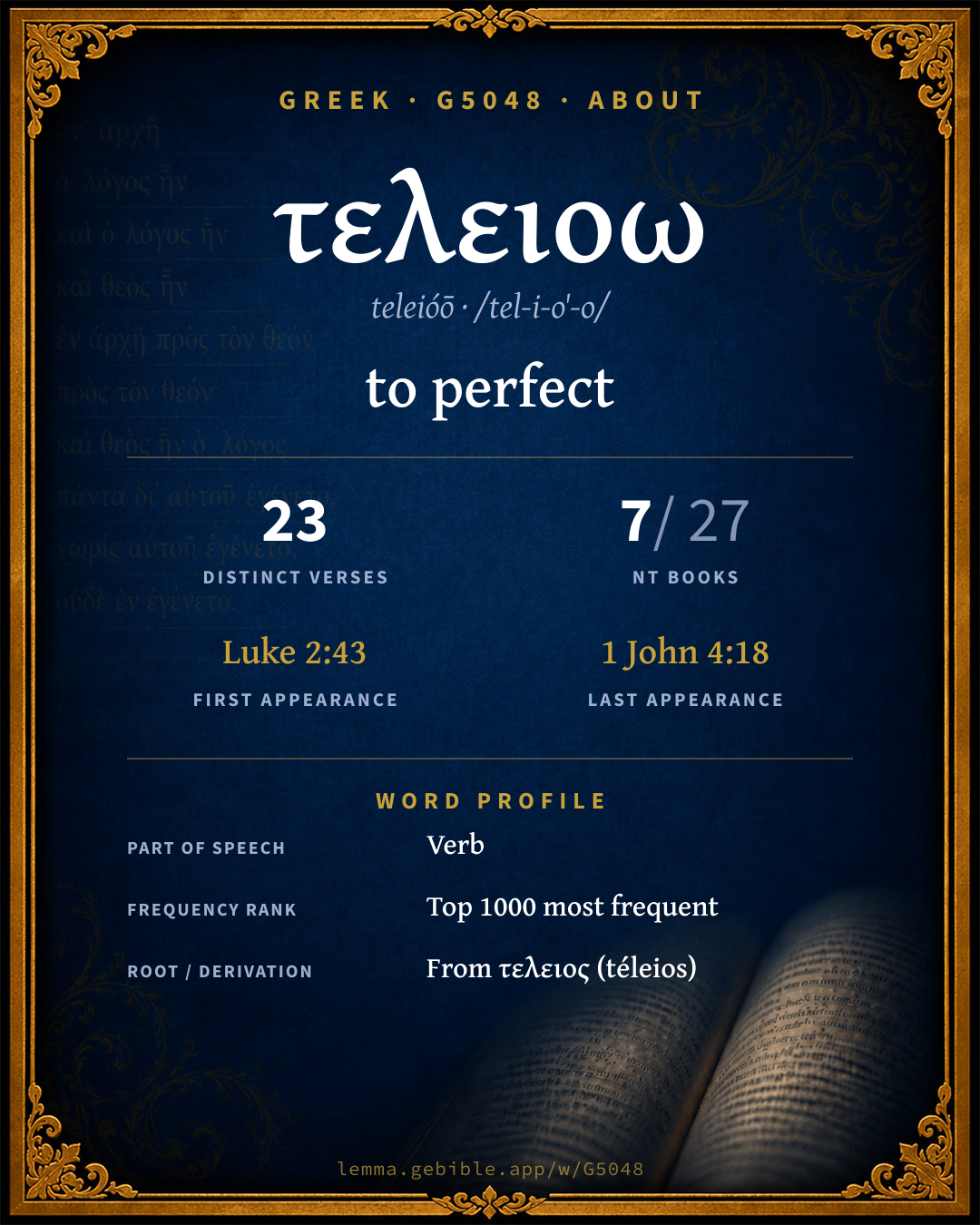
τελειόω
to perfect
‘to perfect’ is one of 5 main senses fuller range ↓
Full lexicon entry — Thayer's Greek Lexicon
From Thayer's Greek Lexicon
Where this word appears
See every Aorist-tense verb in the Greek New Testament →
Grammar key — what these labels mean
Part of speech
- Verb
- An action or state-of-being word.
Tense
- Aorist
- Action viewed as a simple whole, without regard to duration — often past (perfective aspect).
- Perfect
- A completed past action with continuing present results.
- Present
- Ongoing or general action in present time (imperfective aspect).
Voice
- Active
- The subject performs the action.
- Passive
- The subject receives the action.
Mood
- Infinitive
- A verbal noun (“to write”), unmarked for person or number.
- Indicative
- States a fact or asks a factual question (the mood of reality).
- Subjunctive
- Expresses probability, purpose, or possibility (the mood of contingency).
- Participle
- A verbal adjective (“writing,” “having written”).
Case
- Genitive
- The case of source, possession, or “of” — answers “whose / from what.”
- Nominative
- The case of the subject (and the predicate nominative).
- Accusative
- The case of the direct object and of extent.
Person
- 3rd person
- The one spoken about (“he / she / it / they”).
- 1st person
- The speaker (“I / we”).
Gender
- Masculine
- Grammatically masculine.
- Feminine
- Grammatically feminine.
Number
- Singular
- One.
- Plural
- More than one.
Grammatical forms 17 distinct
- Verb, Aorist, Active, Infinitive 4 times (17%)
- Verb, Perfect, Passive, Indicative, 3rd person, Singular 3 times (13%)
- Verb, Aorist, Active, Subjunctive, 1st person, Singular 2 times (9%)
- Verb, Aorist, Active, Indicative, 3rd person, Singular 1 time (4%)
- Verb, Aorist, Active, Participle, Genitive, Plural, Masculine 1 time (4%)
- Verb, Aorist, Active, Participle, Nominative, Singular, Masculine 1 time (4%)
- Verb, Aorist, Passive, Indicative, 3rd person, Singular 1 time (4%)
- Verb, Aorist, Passive, Participle, Nominative, Singular, Masculine 1 time (4%)
+9 more forms (9 occurrences)
Parsed forms decoded from the imported morphology (Robinson–Tischendorf, public domain), counted across 23 parsed occurrences — not distinct verses.
Every verse where G5048 appears — 23 distinct verses across 7 books. Click any verse to open its interlinear word-by-word view. Verse text shown in the World English Bible for context — . Each verse’s Greek form is shown with its reference; the English is not keyword-highlighted, since the data carries no word-level English alignment. Use “Compare translations” on any verse to read it across multiple English versions. This concordance covers the Greek New Testament; Septuagint (Greek Old Testament) occurrences of this word are not indexed here.
Luke 2 verses
- Luke 2:43 τελειωσάντων aor act ptcp gen pl masc and when they had fulfilled the days, as they were returning, the boy Jesus stayed behind in Jerusalem. Joseph and his mother didn't know it,
- Luke 13:32 τελειοῦμαι pres pass ind 1sg He said to them, "Go and tell that fox, 'Behold, I cast out demons and perform cures today and tomorrow, and the third day I complete my mission.
John 5 verses
- John 4:34 τελειώσω aor act subj 1sg Jesus said to them, "My food is to do the will of him who sent me, and to accomplish his work.
- John 5:36 τελειώσω aor act subj 1sg But the testimony which I have is greater than that of John, for the works which the Father gave me to accomplish, the very works that I do, testify about me, that the Father has sent me.
- John 17:4 τελειώσας aor act ptcp nom sg masc I glorified you on the earth. I have accomplished the work which you have given me to do.
- John 17:23 τετελειωμένοι perf pass ptcp nom pl masc I in them, and you in me, that they may be perfected into one; that the world may know that you sent me, and loved them, even as you loved me.
- John 19:28 τελειωθῇ aor pass subj 3sg After this, Jesus, seeing that all things were now finished, that the Scripture might be fulfilled, said, "I am thirsty."
Acts 1 verse
Philippians 1 verse
Hebrews 9 verses
- Hebrews 2:10 τελειῶσαι aor act inf For it became him, for whom are all things, and through whom are all things, in bringing many children to glory, to make the author of their salvation perfect through sufferings.
- Hebrews 5:9 τελειωθεὶς aor pass ptcp nom sg masc Having been made perfect, he became to all of those who obey him the author of eternal salvation,
- Hebrews 7:19 ἐτελείωσεν aor act ind 3sg (for the law made nothing perfect), and a bringing in thereupon of a better hope, through which we draw near to God.
- Hebrews 7:28 τετελειωμένον perf pass ptcp acc sg masc For the law appoints men as high priests who have weakness, but the word of the oath which came after the law appoints a Son forever who has been perfected.
- Hebrews 9:9 τελειῶσαι aor act inf which is a symbol of the present age, where gifts and sacrifices are offered that are incapable, concerning the conscience, of making the worshipper perfect;
- Hebrews 10:1 τελειῶσαι aor act inf For the law, having a shadow of the good to come, not the very image of the things, can never with the same sacrifices year by year, which they offer continually, make perfect those who draw near.
- Hebrews 10:14 τετελείωκεν perf act ind 3sg For by one offering he has perfected forever those who are being sanctified.
- Hebrews 11:40 τελειωθῶσιν aor pass subj 3pl God having provided some better thing concerning us, so that apart from us they should not be made perfect.
- Hebrews 12:23 τετελειωμένων perf pass ptcp gen pl masc to the general assembly and assembly of the firstborn who are enrolled in heaven, to God the Judge of all, to the spirits of just men made perfect,
James 1 verse
1 John 4 verses
- 1 John 2:5 τετελείωται perf pass ind 3sg But whoever keeps his word, God's love has most assuredly been perfected in him. This is how we know that we are in him:
- 1 John 4:12 τετελειωμένη perf pass ptcp nom sg fem No one has seen God at any time. If we love one another, God remains in us, and his love has been perfected in us.
- 1 John 4:17 τετελείωται perf pass ind 3sg In this love has been made perfect among us, that we may have boldness in the day of judgment, because as he is, even so are we in this world.
- 1 John 4:18 τετελείωται perf pass ind 3sg There is no fear in love; but perfect love casts out fear, because fear has punishment. He who fears is not made perfect in love.
About this entry
At a glance — auto-summarized from this page’s data, not written by a person. Every figure links to its source below. This summary describes the numbers; it doesn’t interpret them.
The Greek verb τελειοω centers on the idea of “to perfect.” Lexicons map it across 5 senses. The Greek New Testament uses it across 23 verses — uncommon. Hebrews dominates its distribution — 9 of 23 verses. First canonically at Luke 2:43, it enters the text early. Dig into 23-verse concordance and the renderings breakdown below.
Gloss history
Strong's 1890 vs modern scholarship

About this word
Strong's G5048 catalogs a Greek word from the Greek New Testament.
These counts are not copied from any lexicon or concordance. They are computed here, from the morphology-tagged Greek New Testament. What Lemma adds →
- 23
- distinct verses
- The word appears in 23 distinct verses.
- 7 / 27
- NT books
- The word appears in 7 of 27 New Testament books.
- #563
- by frequency
- Top 1000 most frequent Greek words (rank 563 of 5,347 Greek words by occurrence).
View all 23 occurrences in the concordance →
By section of the New Testament
By traditional corpus
Conventional, traditional groupings — biblical authorship is debated, so this is a traditional corpus grouping, not an authorship claim. Some books belong to more than one corpus (Luke is in both the Gospels and the Lukan corpus, and so on), so these shares overlap and need not total 100%. Each figure is a share of the word’s 23 distinct verses.
- Johannine 9 verses · 39%
- Hebrews 9 verses · 39%
- Gospels 7 verses · 30%
- General (Catholic) Epistles 5 verses · 22%
- Lukan (Luke–Acts) 3 verses · 13%
- Pauline corpus 1 verse · 4%
How translations render this word
Counts come from each version’s own published word-to-Strong’s tagging or interlinear alignment — an approximate guide to how each version renders this word, not a word-level alignment the data otherwise carries. Because each total is that version’s own tagged count, the per-version totals vary from one another and need not match the appearance or distinct-verse counts above. These counts may also differ from a printed concordance because Lemma counts each distinctly tagged rendering and does not collapse phrase taggings into a single head-word total. This is a fixed set of word-tagged versions (KJV, ASV, BSB, ULT) and does not change with the reading translation you choose elsewhere. Each version’s license is shown beside its name below (and on Sources).
- King James Version: Made perfect 5×, Perfect 5×, Make 3×
- American Standard Version: Made perfect 5×, Perfect 4×, Make 3×
- Berean Standard Bible: Accomplish 1×, Accomplishing 1×, Cleanse 1×
- unfoldingWord Literal Text: Has been perfected 2×, Having been made perfect 2×, Perfect 2×
King James Version Public Domain
Renders G5048 across 33 tagged occurrences — most commonly:
Plus 14 renderings that appear only once — usually multi-word phrases or single function words the recovered tagging swept in, not distinct renderings.
American Standard Version Public Domain
Renders G5048 across 34 tagged occurrences — most commonly:
Plus 17 renderings that appear only once — usually multi-word phrases or single function words the recovered tagging swept in, not distinct renderings.
Berean Standard Bible Public Domain
Renders G5048 across 23 tagged occurrences — most commonly:
Plus other, less common renderings.
unfoldingWord Literal Text CC BY-SA 4.0
Renders G5048 across 26 tagged occurrences — most commonly:
Plus 18 renderings that appear only once — usually multi-word phrases or single function words the recovered tagging swept in, not distinct renderings.
Senses in Thayer's
The 5 senses Thayer's distinguishes for this word, in lexicon order (not ranked by frequency or importance). The full entry — with sub-senses — is in the Lexicon Entry tab.
- to make perfect, complete
- add what is yet wanting in order to render a thing full
- to be found perfect
- to bring to the end (goal) proposed
- bring to a close or fulfilment by event
Word origin
Derived from τελειος (téleios) (G5046) — perfect.
From G5046 ; to complete that is (literally) accomplish or (figuratively) consummate (in character): - consecrate finish fulfil (make) perfect.
— Strong’s Exhaustive Concordance (1890), public domain.
Forms in the corpus
The 17 distinct written forms G5048 takes in the Greek New Testament, most frequent first — each parse links to that tense’s occurrences in the concordance.
Same root — word family
Other Thayer's entries built from the same root as G5048, grouped by Strong’s listed origin. These share a root / origin per the lexicon — not necessarily a shared meaning. Each links to that word’s own entry.
Derives from
Shares the same root
Derived from this word
Compare all same-root words → Showing 4 of 5 — not the complete family. They share a root, not necessarily a meaning.
Septuagint usage
The same Greek word τελειοω appears 15 times in the Greek Old Testament (Septuagint), across 15 verses in 8 books.
- 15
- LXX occurrences
- Tagged occurrences of this Greek word in the Septuagint.
- 15
- verses
- Distinct Septuagint verses containing this word.
- 8 / 39
- OT books
- The word appears in 8 of the 39 Old Testament books.
Sample Septuagint occurrences
- Exodus 29:9 τελειόω
- Leviticus 4:5 τελειόω
- Numbers 3:3 τελειόω
- 2 Samuel 22:26 τελειόω
- 2 Chronicles 8:16 τελειόω
- Ezra 16:3 τελειόω
- Ezekiel 27:11 τελειόω
- Daniel 3:40 τελειόω
Septuagint occurrences (same lexeme)
Every verse where the same Strong’s number (G5048) appears in the Greek Septuagint. Verse text shown in the World English Bible for context; the Greek form is the matched word — the English is not keyword-highlighted.
- Exodus 29:9 τελειόω You shall dress them with belts, Aaron and his sons, and bind headbands on them: and they shall have the priesthood by a perpetual statute: and you shall consecrate Aaron and his sons.
- Exodus 29:29 τελειόω "The holy garments of Aaron shall be for his sons after him, to be anointed in them, and to be consecrated in them.
- Exodus 29:33 τελειόω They shall eat those things with which atonement was made, to consecrate and sanctify them: but a stranger shall not eat of it, because they are holy.
- Exodus 29:35 τελειόω "Thus shall you do to Aaron, and to his sons, according to all that I have commanded you. Seven days shall you consecrate them.
- Leviticus 4:5 τελειόω The anointed priest shall take some of the blood of the bull, and bring it to the Tent of Meeting.
- Leviticus 8:33 τελειόω You shall not go out from the door of the Tent of Meeting seven days, until the days of your consecration are fulfilled: for he shall consecrate you seven days.
- Leviticus 16:32 τελειόω The priest, who is anointed and who is consecrated to be priest in his father's place, shall make the atonement, and shall put on the linen garments, even the holy garments.
- Leviticus 21:10 τελειόω "'He who is the high priest among his brothers, upon whose head the anointing oil is poured, and that is consecrated to put on the garments, shall not let the hair of his head hang loose, nor tear his clothes;
- Numbers 3:3 τελειόω These are the names of the sons of Aaron, the priests who were anointed, whom he consecrated to minister in the priest's office.
- 2 Samuel 22:26 τελειόω With the merciful you will show yourself merciful; With the perfect man you will show yourself perfect;
- 2 Chronicles 8:16 τελειόω Now all the work of Solomon was prepared to the day of the foundation of the house of Yahweh, and until it was finished. [So] the house of Yahweh was completed.
- Ezra 16:3 τελειόω
- Ezra 16:16 τελειόω
- Ezekiel 27:11 τελειόω The men of Arvad with your army were on your walls round about, and valorous men were in your towers; they hanged their shields on your walls round about; they have perfected your beauty.
- Daniel 3:40 τελειόω
These are occurrences of the same Greek lexeme (G5048) in the Septuagint — not a translation of any one Hebrew word. The store carries no word-level Hebrew↔Greek alignment, so no Hebrew original is asserted here. Counts come from the recovered LXX Strong's tagging — high-frequency vocabulary is well covered, while rare or late forms may be untagged — so they reflect tagged occurrences and may slightly undercount.