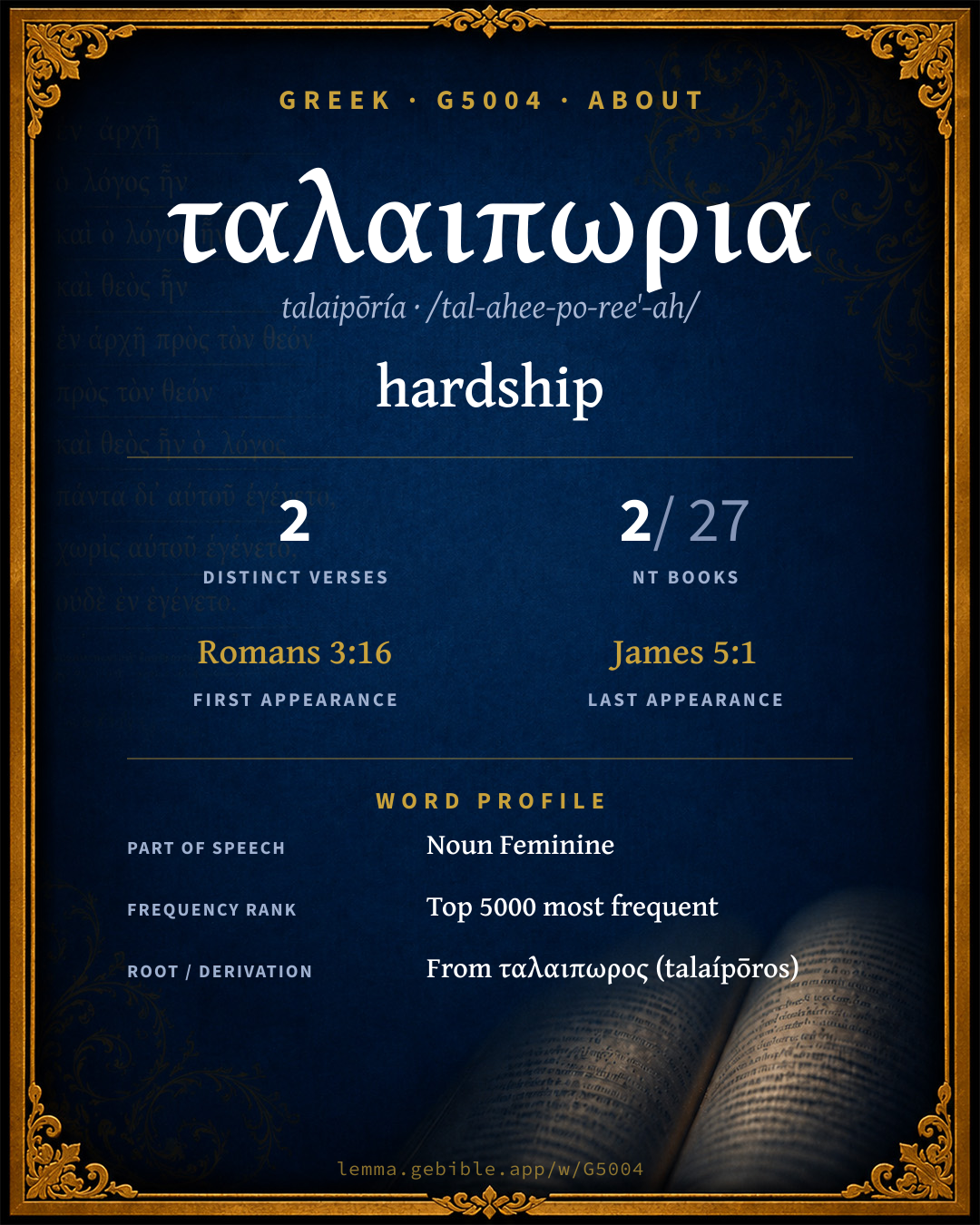
ταλαιπωρία
hardship
Full lexicon entry — Thayer's Greek Lexicon
From Thayer's Greek Lexicon
Where this word appears
See every Dative-case word in the Greek New Testament →
Grammar key — what these labels mean
Part of speech
- Noun
- A naming word — a person, place, thing, or idea.
Case
- Dative
- The case of the indirect object, means, or location — “to / for / with / in.”
- Nominative
- The case of the subject (and the predicate nominative).
Gender
- Feminine
- Grammatically feminine.
Number
- Plural
- More than one.
- Singular
- One.
1 distinct verse where G5004 appears in the Nominative case, across 1 book. Filtered view — show all forms. Click any verse to open its interlinear word-by-word view. Verse text shown in the World English Bible for context — . Each verse’s Greek form is shown with its reference; the English is not keyword-highlighted, since the data carries no word-level English alignment. Use “Compare translations” on any verse to read it across multiple English versions. This concordance covers the Greek New Testament; Septuagint (Greek Old Testament) occurrences of this word are not indexed here.
Romans 1 verse
About this entry
At a glance — auto-summarized from this page’s data, not written by a person. Every figure links to its source below. This summary describes the numbers; it doesn’t interpret them.
“hardship” is the headline sense of the Greek noun ταλαιπωρια (talaipōría). It is rare — just 2 verses in the entire Greek New Testament. More than half of its appearances fall in Romans. Scripture first uses it in Romans 3:16. It shares a root with ταλαιπωρος and ταλαιπωρεω. The sections below give every sense, occurrence, and version rendering.
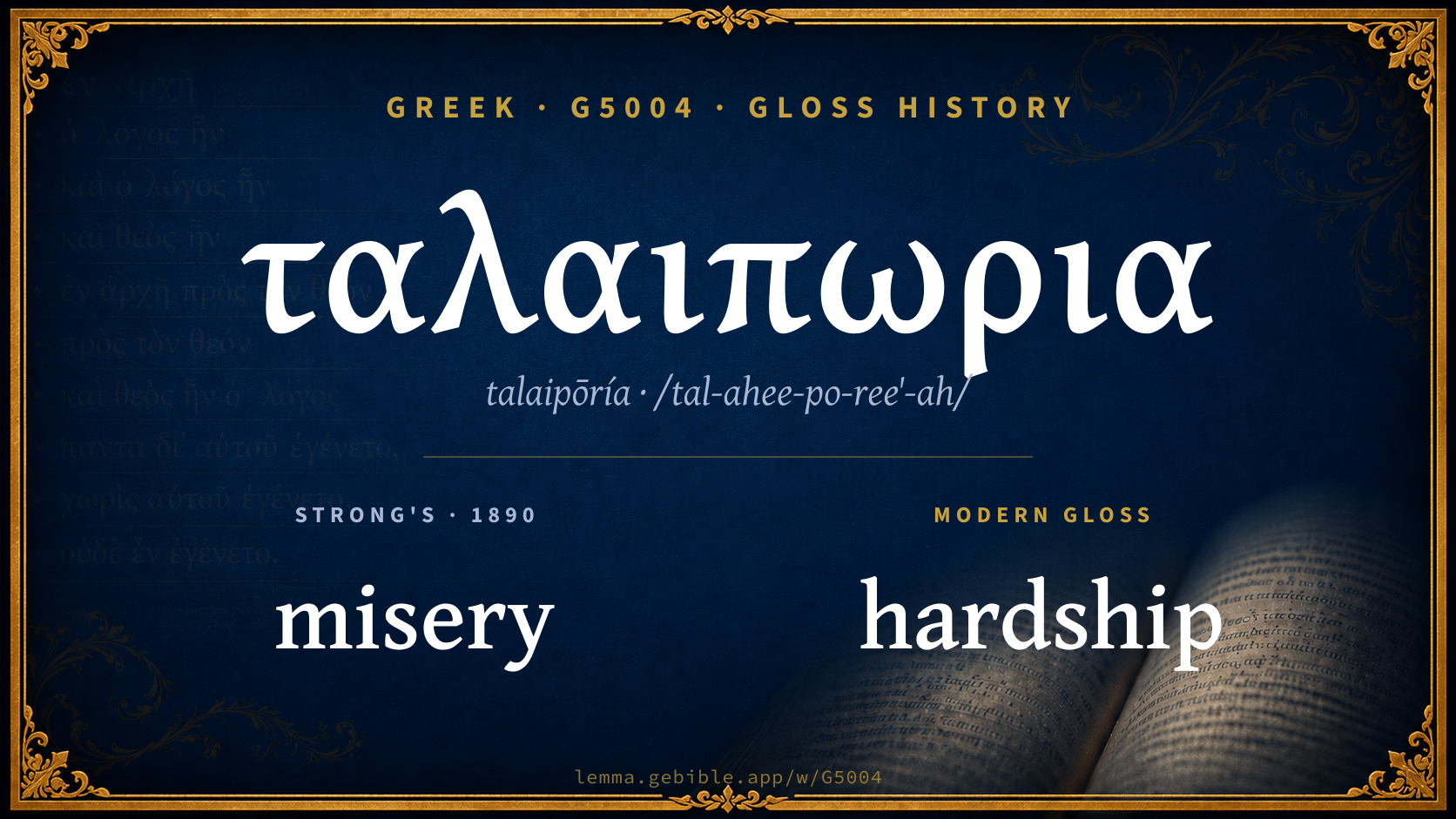
Gloss history
Strong's 1890 vs modern scholarship
About this word
Strong's G5004 catalogs a Greek word from the Greek New Testament.
These counts are not copied from any lexicon or concordance. They are computed here, from the morphology-tagged Greek New Testament. What Lemma adds →
- 2
- distinct verses
- The word appears in 2 distinct verses.
- 2 / 27
- NT books
- The word appears in 2 of 27 New Testament books.
- #2,678
- by frequency
- Top 5000 most frequent Greek words (rank 2,678 of 5,347 Greek words by occurrence).
View all 2 occurrences in the concordance →
By traditional corpus
Conventional, traditional groupings — biblical authorship is debated, so this is a traditional corpus grouping, not an authorship claim. Some books belong to more than one corpus (Luke is in both the Gospels and the Lukan corpus, and so on), so these shares overlap and need not total 100%. Each figure is a share of the word’s 2 distinct verses.
- Pauline corpus 1 verse · 50%
- General (Catholic) Epistles 1 verse · 50%
How translations render this word
Counts come from each version’s own published word-to-Strong’s tagging or interlinear alignment — an approximate guide to how each version renders this word, not a word-level alignment the data otherwise carries. Because each total is that version’s own tagged count, the per-version totals vary from one another and need not match the appearance or distinct-verse counts above. These counts may also differ from a printed concordance because Lemma counts each distinctly tagged rendering and does not collapse phrase taggings into a single head-word total. This is a fixed set of word-tagged versions (KJV, ASV, BSB, ULT) and does not change with the reading translation you choose elsewhere. Each version’s license is shown beside its name below (and on Sources).
- King James Version: Miseries 1×, Misery 1×
- American Standard Version: Miseries 1×, Misery 1×
- Berean Standard Bible: Misery 2×
- unfoldingWord Literal Text: Miseries 1×, Suffering 1×
King James Version Public Domain
Renders G5004 across 2 tagged occurrences — most commonly:
American Standard Version Public Domain
Renders G5004 across 2 tagged occurrences — most commonly:
Berean Standard Bible Public Domain
Renders G5004 across 2 tagged occurrences — most commonly:
unfoldingWord Literal Text CC BY-SA 4.0
Renders G5004 across 2 tagged occurrences — most commonly:
Senses in Thayer's
The 1 sense Thayer's distinguishes for this word, in lexicon order (not ranked by frequency or importance). The full entry — with sub-senses — is in the Lexicon Entry tab.
- hardship, trouble, calamity, misery
Word origin
Derived from ταλαιπωρος (talaípōros) (G5005) — distressed.
From G5005 ; wretchedness that is calamity : - misery.
— Strong’s Exhaustive Concordance (1890), public domain.
Forms in the corpus
The 2 distinct written forms G5004 takes in the Greek New Testament, most frequent first — each parse links to that case’s occurrences in the concordance.
| Form | Parsing | Example | Uses |
|---|---|---|---|
| ταλαιπωρία talaipōría | Noun, Nominative, Singular, Feminine | Romans 3:16 | 1 |
| ταλαιπωρίαις talaipōríais | Noun, Dative, Plural, Feminine | James 5:1 | 1 |
Same root — word family
Other Thayer's entries built from the same root as G5004, grouped by Strong’s listed origin. These share a root / origin per the lexicon — not necessarily a shared meaning. Each links to that word’s own entry.
Derives from
Shares the same root
Compare all same-root words → They share a root, not necessarily a meaning.
Septuagint usage
The same Greek word ταλαιπωρια appears 27 times in the Greek Old Testament (Septuagint), across 26 verses in 10 books.
- 27
- LXX occurrences
- Tagged occurrences of this Greek word in the Septuagint.
- 26
- verses
- Distinct Septuagint verses containing this word.
- 10 / 39
- OT books
- The word appears in 10 of the 39 Old Testament books.
Sample Septuagint occurrences
- Job 30:3 ταλαιπωρία
- Psalms 11:6 ταλαιπωρία
- Isaiah 47:11 ταλαιπωρία
- Jeremiah 4:20 ταλαιπωρία
- Ezekiel 45:9 ταλαιπωρία
- Hosea 9:6 ταλαιπωρία
- Joel 1:15 ταλαιπωρία
- Amos 3:10 ταλαιπωρία
- Micah 2:4 ταλαιπωρία
- Habakkuk 1:3 ταλαιπωρία
Septuagint occurrences (same lexeme)
Every verse where the same Strong’s number (G5004) appears in the Greek Septuagint. Verse text shown in the World English Bible for context; the Greek form is the matched word — the English is not keyword-highlighted.
- Job 30:3 ταλαιπωρία They are gaunt from lack and famine. They gnaw the dry ground, in the gloom of waste and desolation.
- Psalms 11:6 ταλαιπωρία On the wicked he will rain blazing coals; Fire, sulfur, and scorching wind shall be the portion of their cup.
- Psalms 13:3 ταλαιπωρία Behold, and answer me, Yahweh, my God. Give light to my eyes, lest I sleep in death;
- Psalms 31:4 ταλαιπωρία Pluck me out of the net that they have laid secretly for me, For you are my stronghold.
- Psalms 39:3 ταλαιπωρία My heart was hot within me. While I meditated, the fire burned: I spoke with my tongue:
- Psalms 68:21 ταλαιπωρία But God will strike through the head of his enemies, The hairy scalp of such a one as still continues in his guiltiness.
- Psalms 87:19 ταλαιπωρία
- Psalms 139:11 ταλαιπωρία If I say, "Surely the darkness will overwhelm me; The light around me will be night;"
- Isaiah 47:11 ταλαιπωρία Therefore shall evil come on you; you shall not know the dawning of it: and mischief shall fall on you; you shall not be able to put it away: and desolation shall come on you suddenly, which you don't know.
- Isaiah 59:7 ταλαιπωρία Their feet run to evil, and they make haste to shed innocent blood: their thoughts are thoughts of iniquity; desolation and destruction are in their paths.
- Isaiah 60:18 ταλαιπωρία Violence shall no more be heard in your land, desolation nor destruction within your borders; but you shall call your walls Salvation, and your gates Praise.
- Jeremiah 4:20 ταλαιπωρία Destruction on destruction is cried; for the whole land is laid waste: suddenly are my tents destroyed, [and] my curtains in a moment.
- Jeremiah 6:7 ταλαιπωρία As a well casts forth its waters, so she casts forth her wickedness: violence and destruction is heard in her; before me continually is sickness and wounds.
- Jeremiah 6:26 ταλαιπωρία Daughter of my people, gird you with sackcloth, and wallow yourself in ashes: make you mourning, as for an only son, most bitter lamentation; for the destroyer shall suddenly come on us.
- Jeremiah 15:8 ταλαιπωρία Their widows are increased to me above the sand of the seas; I have brought on them against the mother of the young men a destroyer at noonday: I have caused anguish and terrors to fall on her suddenly.
- Jeremiah 20:8 ταλαιπωρία For as often as I speak, I cry out; I cry, Violence and destruction! because the word of Yahweh is made a reproach to me, and a derision, all the day.
- Jeremiah 28:35 ταλαιπωρία
- Jeremiah 28:56 ταλαιπωρία
- Ezekiel 45:9 ταλαιπωρία Thus says the Lord Yahweh: Let it suffice you, princes of Israel: remove violence and spoil, and execute justice and righteousness; dispossessing my people, says the Lord Yahweh.
- Hosea 9:6 ταλαιπωρία For, behold, they have gone away from destruction. Egypt will gather them up. Memphis will bury them. Nettles will possess their pleasant things of silver. Thorns will be in their tents.
- Joel 1:15 ταλαιπωρία Alas for the day! For the day of Yahweh is at hand, And it will come as destruction from the Almighty.
- Amos 3:10 ταλαιπωρία "Indeed they don't know to do right," says Yahweh, "Who hoard plunder and loot in their palaces."
- Amos 5:9 ταλαιπωρία Who brings sudden destruction on the strong, So that destruction comes on the fortress.
- Micah 2:4 ταλαιπωρία In that day they will take up a parable against you, And lament with a doleful lamentation, saying, 'We are utterly ruined! My people's possession is divided up. Indeed he takes it from me and assigns our fields to traitors!'"
- Habakkuk 1:3 ταλαιπωρία Why do you show me iniquity, and look at perversity? For destruction and violence are before me. There is strife, and contention rises up.
- Habakkuk 2:17 ταλαιπωρία For the violence done to Lebanon will overwhelm you, and the destruction of the animals, which made them afraid; because of men's blood, and for the violence done to the land, to every city and to those who dwell in them.
These are occurrences of the same Greek lexeme (G5004) in the Septuagint — not a translation of any one Hebrew word. The store carries no word-level Hebrew↔Greek alignment, so no Hebrew original is asserted here. Counts come from the recovered LXX Strong's tagging — high-frequency vocabulary is well covered, while rare or late forms may be untagged — so they reflect tagged occurrences and may slightly undercount.