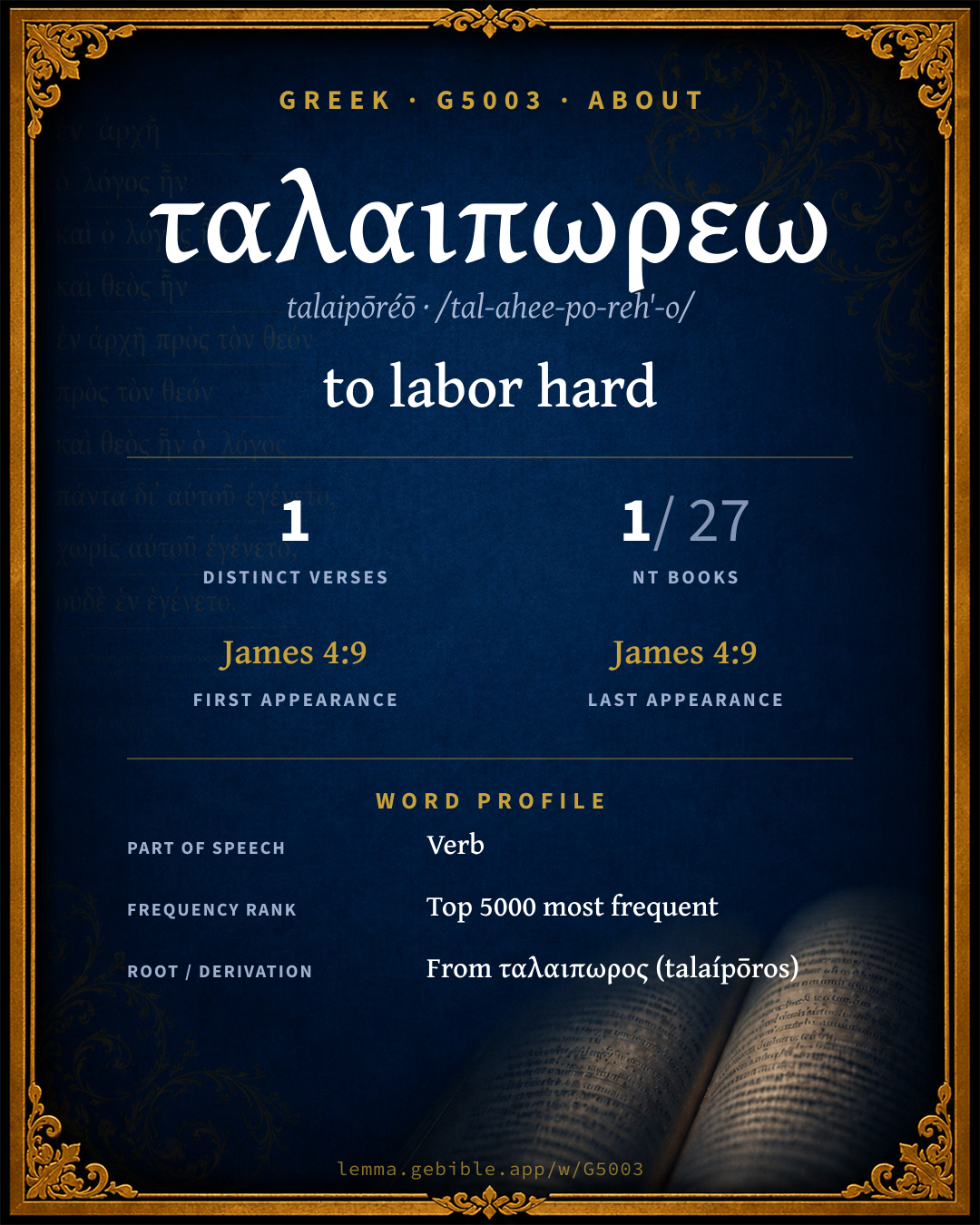
ταλαιπωρέω
to labor hard
‘to labor hard’ is one of 4 main senses fuller range ↓
Full lexicon entry — Thayer's Greek Lexicon
From Thayer's Greek Lexicon
Where this word appears
Grammar key — what these labels mean
Part of speech
- Verb
- An action or state-of-being word.
Tense
- Aorist
- Action viewed as a simple whole, without regard to duration — often past (perfective aspect).
Voice
- Active
- The subject performs the action.
Mood
- Imperative
- Expresses a command or request.
Person
- 2nd person
- The one addressed (“you”).
Number
- Plural
- More than one.
Every verse where G5003 appears — 1 distinct verse across 1 book. Click any verse to open its interlinear word-by-word view. Verse text shown in the World English Bible for context — . Each verse’s Greek form is shown with its reference; the English is not keyword-highlighted, since the data carries no word-level English alignment. Use “Compare translations” on any verse to read it across multiple English versions. This concordance covers the Greek New Testament; Septuagint (Greek Old Testament) occurrences of this word are not indexed here.
James 1 verse
About this entry
At a glance — auto-summarized from this page’s data, not written by a person. Every figure links to its source below. This summary describes the numbers; it doesn’t interpret them.
At its core, ταλαιπωρεω (talaipōréō) means “to labor hard.” With only 1 verse it sits in the long tail of Greek New Testament vocabulary. Its uses cluster heavily in James (100% of all occurrences). Scripture uses it exactly once, at James 4:9. Ranging over 4 senses, it is not a single-sense word. Dig into 1-verse concordance and the renderings breakdown below.
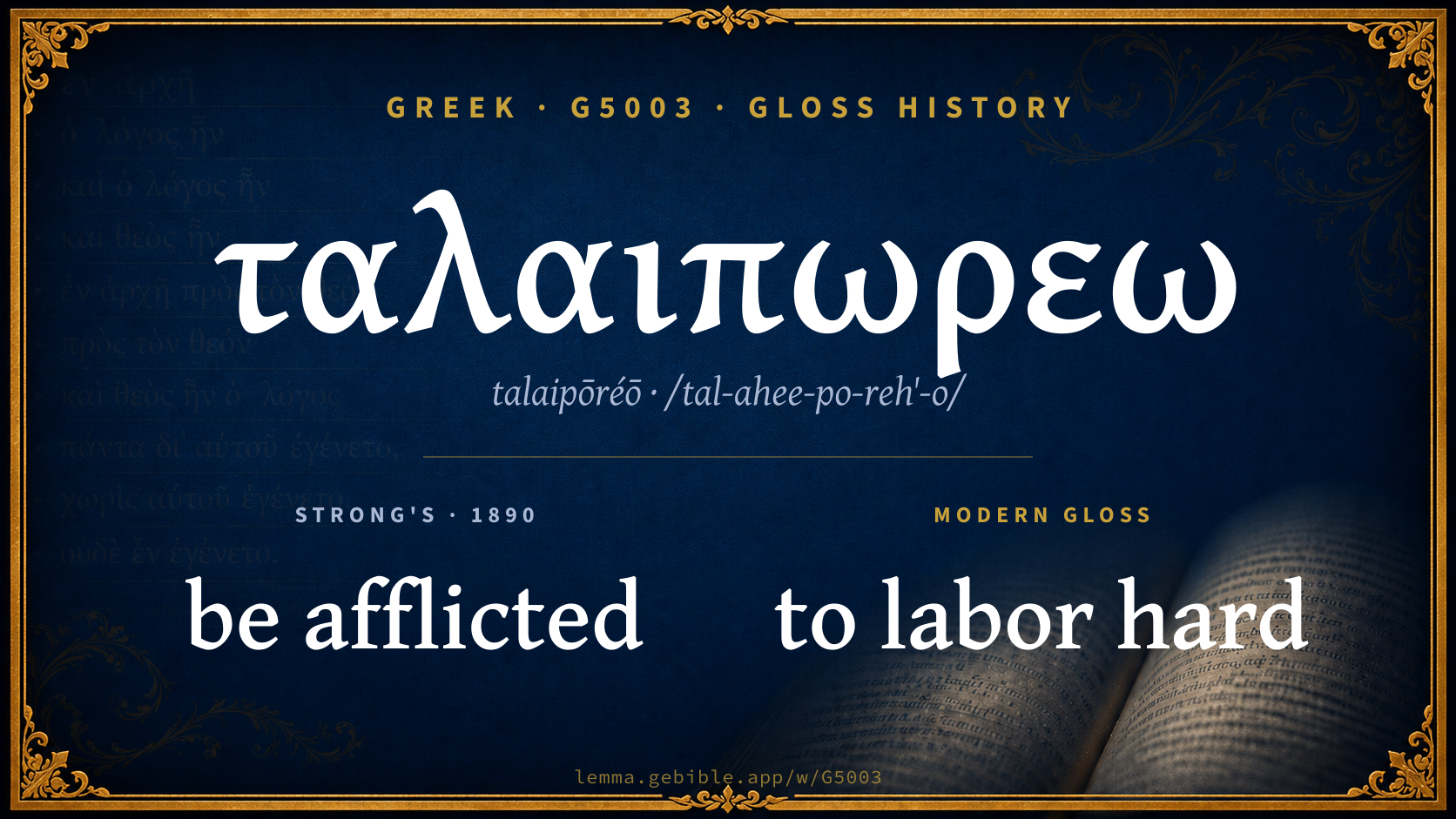
Gloss history
Strong's 1890 vs modern scholarship
About this word
Strong's G5003 catalogs a Greek word from the Greek New Testament.
These counts are not copied from any lexicon or concordance. They are computed here, from the morphology-tagged Greek New Testament. What Lemma adds →
- 1
- distinct verses
- The word appears in 1 distinct verse.
- 1 / 27
- NT books
- The word appears in 1 of 27 New Testament books.
- #3,503
- by frequency
- Top 5000 most frequent Greek words (rank 3,503 of 5,347 Greek words by occurrence).
View all 1 occurrence in the concordance →
Most concentrated in
- James 1 verse 100%
By section of the New Testament
By traditional corpus
Conventional, traditional groupings — biblical authorship is debated, so this is a traditional corpus grouping, not an authorship claim. Some books belong to more than one corpus (Luke is in both the Gospels and the Lukan corpus, and so on), so these shares overlap and need not total 100%. Each figure is a share of the word’s 1 distinct verse.
- General (Catholic) Epistles 1 verse · 100%
How translations render this word
Counts come from each version’s own published word-to-Strong’s tagging or interlinear alignment — an approximate guide to how each version renders this word, not a word-level alignment the data otherwise carries. Because each total is that version’s own tagged count, the per-version totals vary from one another and need not match the appearance or distinct-verse counts above. These counts may also differ from a printed concordance because Lemma counts each distinctly tagged rendering and does not collapse phrase taggings into a single head-word total. This is a fixed set of word-tagged versions (KJV, ASV, BSB, ULT) and does not change with the reading translation you choose elsewhere. Each version’s license is shown beside its name below (and on Sources).
- King James Version: Be afflicted 1×
- American Standard Version: Be afflicted 1×
- Berean Standard Bible: Grieve 1×
- unfoldingWord Literal Text: Be miserable 1×
King James Version Public Domain
Renders G5003 across 1 tagged occurrence — most commonly:
American Standard Version Public Domain
Renders G5003 across 1 tagged occurrence — most commonly:
Berean Standard Bible Public Domain
Renders G5003 across 1 tagged occurrence — most commonly:
unfoldingWord Literal Text CC BY-SA 4.0
Renders G5003 across 1 tagged occurrence — most commonly:
Senses in Thayer's
The 4 senses Thayer's distinguishes for this word, in lexicon order (not ranked by frequency or importance). The full entry — with sub-senses — is in the Lexicon Entry tab.
- to toil heavily, to endure labours and hardships
- to be afflicted
- to feel afflicted and miserable
- to afflict
Word origin
Derived from ταλαιπωρος (talaípōros) (G5005) — distressed.
From G5005 ; to be wretched that is realize one´ s own misery : - be afflicted.
— Strong’s Exhaustive Concordance (1890), public domain.
Same root — word family
Other Thayer's entries built from the same root as G5003, grouped by Strong’s listed origin. These share a root / origin per the lexicon — not necessarily a shared meaning. Each links to that word’s own entry.
Derives from
Shares the same root
Compare all same-root words → They share a root, not necessarily a meaning.
Septuagint usage
The same Greek word ταλαιπωρεω appears 16 times in the Greek Old Testament (Septuagint), across 13 verses in 7 books.
- 16
- LXX occurrences
- Tagged occurrences of this Greek word in the Septuagint.
- 13
- verses
- Distinct Septuagint verses containing this word.
- 7 / 39
- OT books
- The word appears in 7 of the 39 Old Testament books.
Sample Septuagint occurrences
- Psalms 16:9 ταλαιπωρέω
- Isaiah 33:1 ταλαιπωρέω
- Jeremiah 4:13 ταλαιπωρέω
- Hosea 10:2 ταλαιπωρέω
- Joel 1:10 ταλαιπωρέω
- Micah 2:4 ταλαιπωρέω
- Zechariah 11:2 ταλαιπωρέω
Septuagint occurrences (same lexeme)
Every verse where the same Strong’s number (G5003) appears in the Greek Septuagint. Verse text shown in the World English Bible for context; the Greek form is the matched word — the English is not keyword-highlighted.
- Psalms 16:9 ταλαιπωρέω Therefore my heart is glad, and my tongue rejoices. My body shall also dwell in safety.
- Psalms 37:7 ταλαιπωρέω Rest in Yahweh, and wait patiently for him. Don't fret because of him who prospers in his way, Because of the man who makes wicked plots happen.
- Isaiah 33:1 ταλαιπωρέω Woe to you who destroy, and you weren't destroyed; and deal treacherously, and they didn't deal treacherously with you! When you have ceased to destroy, you shall be destroyed; and when you have made an end of dealing treacherously, they shall deal treacherously with you.
- Jeremiah 4:13 ταλαιπωρέω Behold, he shall come up as clouds, and his chariots [shall be] as the whirlwind: his horses are swifter than eagles. Woe to us! for we are ruined.
- Jeremiah 4:20 ταλαιπωρέω Destruction on destruction is cried; for the whole land is laid waste: suddenly are my tents destroyed, [and] my curtains in a moment.
- Jeremiah 9:18 ταλαιπωρέω and let them make haste, and take up a wailing for us, that our eyes may run down with tears, and our eyelids gush out with waters.
- Jeremiah 10:20 ταλαιπωρέω My tent is destroyed, and all my cords are broken: my children are gone forth from me, and they are no more: there is none to spread my tent any more, and to set up my curtains.
- Jeremiah 12:12 ταλαιπωρέω Destroyers are come on all the bare heights in the wilderness; for the sword of Yahweh devours from the one end of the land even to the other end of the land: no flesh has peace.
- Hosea 10:2 ταλαιπωρέω Their heart is divided. Now they will be found guilty. He will demolish their altars. He will destroy their sacred stones.
- Joel 1:10 ταλαιπωρέω The field is laid waste. The land mourns, for the grain is destroyed, The new wine has dried up, And the oil languishes.
- Micah 2:4 ταλαιπωρέω In that day they will take up a parable against you, And lament with a doleful lamentation, saying, 'We are utterly ruined! My people's possession is divided up. Indeed he takes it from me and assigns our fields to traitors!'"
- Zechariah 11:2 ταλαιπωρέω Wail, fir tree, for the cedar has fallen, Because the stately ones are destroyed. Wail, you oaks of Bashan, For the strong forest has come down.
- Zechariah 11:3 ταλαιπωρέω A voice of the wailing of the shepherds! For their glory is destroyed: a voice of the roaring of young lions! For the pride of the Jordan is ruined.
These are occurrences of the same Greek lexeme (G5003) in the Septuagint — not a translation of any one Hebrew word. The store carries no word-level Hebrew↔Greek alignment, so no Hebrew original is asserted here. Counts come from the recovered LXX Strong's tagging — high-frequency vocabulary is well covered, while rare or late forms may be untagged — so they reflect tagged occurrences and may slightly undercount.