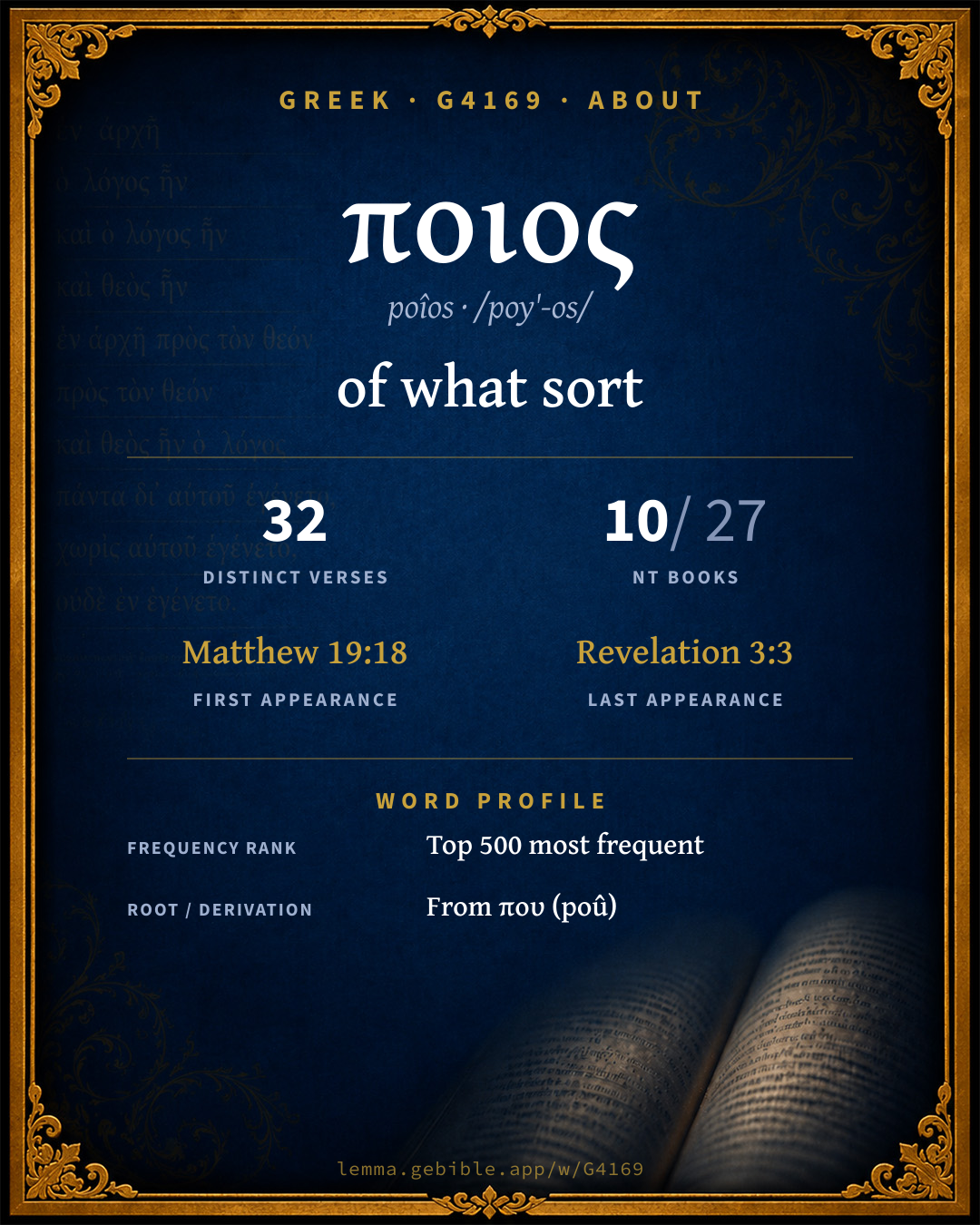
ποῖος
of what sort
Full lexicon entry — Thayer's Greek Lexicon
From Thayer's Greek Lexicon
Where this word appears
See every Dative-case word in the Greek New Testament →
Grammar key — what these labels mean
Part of speech
- Interrogative pronoun
- Asks a question (“who?”, “what?”).
Case
- Dative
- The case of the indirect object, means, or location — “to / for / with / in.”
- Nominative
- The case of the subject (and the predicate nominative).
- Accusative
- The case of the direct object and of extent.
- Genitive
- The case of source, possession, or “of” — answers “whose / from what.”
Gender
- Feminine
- Grammatically feminine.
- Masculine
- Grammatically masculine.
- Neuter
- Grammatically neuter.
Number
- Singular
- One.
- Plural
- More than one.
1 verse where G4169 appears in the Accusative case in the Book of John. Filtered view — show all forms. Click any verse to open its interlinear word-by-word view. Verse text shown in the World English Bible for context — . Each verse’s Greek form is shown with its reference; the English is not keyword-highlighted, since the data carries no word-level English alignment. Use “Compare translations” on any verse to read it across multiple English versions. This concordance covers the Greek New Testament; Septuagint (Greek Old Testament) occurrences of this word are not indexed here.
John
About this entry
At a glance — auto-summarized from this page’s data, not written by a person. Every figure links to its source below. This summary describes the numbers; it doesn’t interpret them.
ποιος — transliterated poîos — is a Greek word carrying the sense “of what sort.” Debuting at Matthew 19:18, it then recurs through the corpus. With 32 verses in 10 books, it is a moderately common word in the Greek New Testament. Its uses concentrate in Luke (25% of all occurrences). Sharing its root, it stands alongside που, ποτε and ποτερον. See the sense tree, 32-verse concordance, and the renderings breakdown below.
Gloss history
Strong's 1890 vs modern scholarship
About this word
Strong's G4169 catalogs a Greek word from the Greek New Testament.
These counts are not copied from any lexicon or concordance. They are computed here, from the morphology-tagged Greek New Testament. What Lemma adds →
- 32
- distinct verses
- The word appears in 32 distinct verses.
- 10 / 27
- NT books
- The word appears in 10 of 27 New Testament books.
- #433
- by frequency
- Top 500 most frequent Greek words (rank 433 of 5,347 Greek words by occurrence).
View all 32 occurrences in the concordance →
By section of the New Testament
By traditional corpus
Conventional, traditional groupings — biblical authorship is debated, so this is a traditional corpus grouping, not an authorship claim. Some books belong to more than one corpus (Luke is in both the Gospels and the Lukan corpus, and so on), so these shares overlap and need not total 100%. Each figure is a share of the word’s 32 distinct verses.
- Gospels 23 verses · 72%
- Lukan (Luke–Acts) 11 verses · 34%
- Johannine 5 verses · 16%
- General (Catholic) Epistles 3 verses · 9%
- Pauline corpus 2 verses · 6%
- Revelation 1 verse · 3%
How translations render this word
Counts come from each version’s own published word-to-Strong’s tagging or interlinear alignment — an approximate guide to how each version renders this word, not a word-level alignment the data otherwise carries. Because each total is that version’s own tagged count, the per-version totals vary from one another and need not match the appearance or distinct-verse counts above. These counts may also differ from a printed concordance because Lemma counts each distinctly tagged rendering and does not collapse phrase taggings into a single head-word total. This is a fixed set of word-tagged versions (KJV, ASV, BSB, ULT) and does not change with the reading translation you choose elsewhere. Each version’s license is shown beside its name below (and on Sources).
- King James Version: What 28×, Which 4×
- American Standard Version: What 26×, Which 2×
- Berean Standard Bible: What 17×, Which 7×, Kind of 3×
- unfoldingWord Literal Text: What 18×, Kind 6×, Which 5×
King James Version Public Domain
Renders G4169 across 34 tagged occurrences — most commonly:
Plus 2 renderings that appear only once — usually multi-word phrases or single function words the recovered tagging swept in, not distinct renderings.
American Standard Version Public Domain
Renders G4169 across 32 tagged occurrences — most commonly:
Plus 4 renderings that appear only once — usually multi-word phrases or single function words the recovered tagging swept in, not distinct renderings.
Berean Standard Bible Public Domain
Renders G4169 across 32 tagged occurrences — most commonly:
Plus 5 renderings that appear only once — usually multi-word phrases or single function words the recovered tagging swept in, not distinct renderings. Not rendered by a distinct English word in 1 further occurrence.
unfoldingWord Literal Text CC BY-SA 4.0
Renders G4169 across 35 tagged occurrences — most commonly:
Plus 4 renderings that appear only once — usually multi-word phrases or single function words the recovered tagging swept in, not distinct renderings.
Senses in Thayer's
The 1 sense Thayer's distinguishes for this word, in lexicon order (not ranked by frequency or importance). The full entry — with sub-senses — is in the Lexicon Entry tab.
- of what sort or nature
Word origin
Derived from που (poû) (G4226) — somewhere.
Forms in the corpus
The 8 distinct written forms G4169 takes in the Greek New Testament, most frequent first — each parse links to that case’s occurrences in the concordance.
| Form | Parsing | Example | Uses |
|---|---|---|---|
| ποίᾳ poía | Interrogative pronoun, Dative, Singular, Feminine | Matthew 21:23 | 12 |
| ποία poía | Interrogative pronoun, Nominative, Singular, Feminine | Matthew 22:36 | 6 |
| ποίῳ poíō | Interrogative pronoun, Dative, Singular, Masculine | John 12:33 | 5 |
| ποῖον poîon | Interrogative pronoun, Accusative, Singular, Masculine | Acts 7:49 | 4 |
| ποίας poías | Interrogative pronoun, Genitive, Singular, Feminine | Luke 5:19 | 3 |
| ποίαν poían | Interrogative pronoun, Accusative, Singular, Feminine | Revelation 3:3 | 1 |
| ποίου poíou | Interrogative pronoun, Genitive, Singular, Masculine | Romans 3:27 | 1 |
| ποῖα poîa | Interrogative pronoun, Nominative, Singular, Feminine | Luke 24:19 | 1 |
Same root — word family
Other Thayer's entries built from the same root as G4169, grouped by Strong’s listed origin. These share a root / origin per the lexicon — not necessarily a shared meaning. Each links to that word’s own entry.
Derives from
Shares the same root
Compare all same-root words → Showing 4 of 5 — not the complete family. They share a root, not necessarily a meaning.
Septuagint usage
The same Greek word ποιος appears 27 times in the Greek Old Testament (Septuagint), across 24 verses in 13 books.
- 27
- LXX occurrences
- Tagged occurrences of this Greek word in the Septuagint.
- 24
- verses
- Distinct Septuagint verses containing this word.
- 13 / 39
- OT books
- The word appears in 13 of the 39 Old Testament books.
Sample Septuagint occurrences
- Deuteronomy 4:7 ποῖος
- 1 Samuel 9:18 ποῖος
- 2 Samuel 15:2 ποῖος
- 1 Kings 7:26 ποῖος
- 2 Kings 3:8 ποῖος
- 1 Chronicles 18:14 ποῖος
- 2 Chronicles 18:23 ποῖος
- Job 28:12 ποῖος
- Ecclesiastes 2:3 ποῖος
- Isaiah 10:12 ποῖος
- Jeremiah 5:7 ποῖος
- Daniel 3:15 ποῖος
Septuagint occurrences (same lexeme)
Every verse where the same Strong’s number (G4169) appears in the Greek Septuagint. Verse text shown in the World English Bible for context; the Greek form is the matched word — the English is not keyword-highlighted.
- Deuteronomy 4:7 ποῖος For what great nation is there, that has a god so near to them, as Yahweh our God is whenever we call on him?
- Deuteronomy 4:8 ποῖος What great nation is there, that has statutes and ordinances so righteous as all this law, which I set before you this day?
- 1 Samuel 9:18 ποῖος Then Saul drew near to Samuel in the gate, and said, Tell me, Please, where the seer's house is.
- 2 Samuel 15:2 ποῖος Absalom rose up early, and stood beside the way of the gate: and it was so, that when any man had a suit which should come to the king for judgment, then Absalom called to him, and said, Of what city are you? He said, Your servant is of one of the tribes of Israel.
- 1 Kings 7:26 ποῖος It was a handbreadth thick: and the brim of it was worked like the brim of a cup, like the flower of a lily: it held two thousand baths.
- 1 Kings 13:12 ποῖος Their father said to them, Which way did he go? Now his sons had seen which way the man of God went, who came from Judah.
- 1 Kings 22:24 ποῖος Then Zedekiah the son of Chenaanah came near, and struck Micaiah on the cheek, and said, Which way went the Spirit of Yahweh from me to speak to you?
- 2 Kings 3:8 ποῖος He said, Which way shall we go up? He answered, The way of the wilderness of Edom.
- 2 Kings 10:25 ποῖος It happened, as soon as he had made an end of offering the burnt offering, that Jehu said to the guard and to the captains, Go in, and kill them; let none come forth. They struck them with the edge of the sword; and the guard and the captains cast them out, and went to the city of the house of Baal.
- 1 Chronicles 18:14 ποῖος David reigned over all Israel; and he executed justice and righteousness to all his people.
- 2 Chronicles 18:23 ποῖος Then Zedekiah the son of Chenaanah came near, and struck Micaiah on the cheek, and said, Which way went the Spirit of Yahweh from me to speak to you?
- Job 28:12 ποῖος "But where shall wisdom be found? Where is the place of understanding?
- Job 28:20 ποῖος Whence then comes wisdom? Where is the place of understanding?
- Job 38:19 ποῖος "What is the way to the dwelling of light? As for darkness, where is the place of it,
- Ecclesiastes 2:3 ποῖος I searched in my heart how to cheer my flesh with wine, my heart yet guiding me with wisdom, and how to lay hold of folly, until I might see what it was good for the sons of men that they should do under heaven all the days of their lives.
- Ecclesiastes 11:6 ποῖος In the morning sow your seed, And in the evening don't withhold your hand; For you don't know which will prosper, whether this or that, Or whether they both will be equally good.
- Isaiah 10:12 ποῖος Therefore it shall happen that, when the Lord has performed his whole work on Mount Zion and on Jerusalem, I will punish the fruit of the stout heart of the king of Assyria, and the glory of his high looks.
- Isaiah 45:9 ποῖος Woe to him who strives with his Maker--a potsherd among the potsherds of the earth! Shall the clay ask him who fashions it, "What are you making?" or your work, "He has no hands?"
- Isaiah 50:1 ποῖος Thus says Yahweh, Where is the bill of your mother's divorce, with which I have put her away? or which of my creditors is it to whom I have sold you? Behold, for your iniquities were you sold, and for your transgressions was your mother put away.
- Isaiah 66:1 ποῖος Thus says Yahweh, heaven is my throne, and the earth is my footstool: what manner of house will you build to me? and what place shall be my rest?
- Jeremiah 5:7 ποῖος How can I pardon you? your children have forsaken me, and sworn by them that are no gods: when I had fed them to the full, they committed adultery, and assembled themselves in troops at the prostitutes' houses.
- Jeremiah 6:16 ποῖος Thus says Yahweh, Stand you in the ways and see, and ask for the old paths, where is the good way; and walk therein, and you shall find rest for your souls: but they said, We will not walk [therein].
- Daniel 3:15 ποῖος Now if you are ready whenever you hear the sound of the horn, flute, zither, lyre, harp, pipe, and all kinds of music to you fall down and worship the image which I have made, [well]: but if you don't worship, you shall be cast the same hour into the midst of a burning fiery furnace; and who is that god that shall deliver you out of my hands?
- Jonah 1:8 ποῖος Then they asked him, "Tell us, please, for whose cause this evil is on us. What is your occupation? Where do you come from? What is your country? Of what people are you?"
These are occurrences of the same Greek lexeme (G4169) in the Septuagint — not a translation of any one Hebrew word. The store carries no word-level Hebrew↔Greek alignment, so no Hebrew original is asserted here. Counts come from the recovered LXX Strong's tagging — high-frequency vocabulary is well covered, while rare or late forms may be untagged — so they reflect tagged occurrences and may slightly undercount.