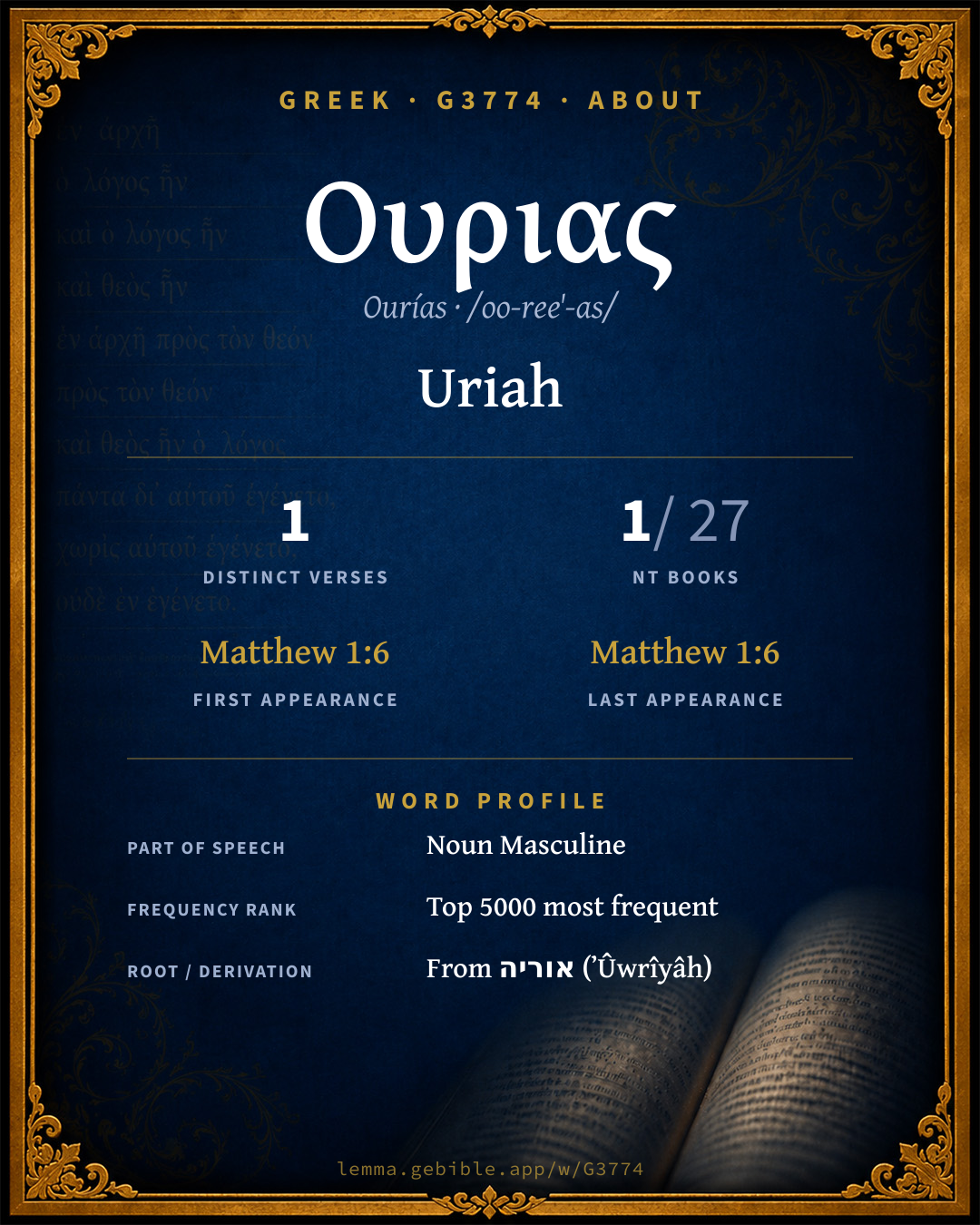
Οὐρίας
Uriah
Thayer's lists 2 entries for ‘Uriah’ fuller range ↓
Full lexicon entry — Thayer's Greek Lexicon
From Thayer's Greek Lexicon
Where this word appears
Grammar key — what these labels mean
Part of speech
- Noun
- A naming word — a person, place, thing, or idea.
Case
- Genitive
- The case of source, possession, or “of” — answers “whose / from what.”
Gender
- Masculine
- Grammatically masculine.
Number
- Singular
- One.
Every verse where G3774 appears — 1 distinct verse across 1 book. Click any verse to open its interlinear word-by-word view. Verse text shown in the World English Bible for context — . Each verse’s Greek form is shown with its reference; the English is not keyword-highlighted, since the data carries no word-level English alignment. Use “Compare translations” on any verse to read it across multiple English versions. This concordance covers the Greek New Testament; Septuagint (Greek Old Testament) occurrences of this word are not indexed here.
Matthew 1 verse
About this entry
At a glance — auto-summarized from this page’s data, not written by a person. Every figure links to its source below. This summary describes the numbers; it doesn’t interpret them.
“Uriah” is the headline sense of the Greek name Ουριας (Ourías). The Greek New Testament uses it only 1 verse. More than three-quarters of its appearances fall in Matthew. Its lone occurrence is Matthew 1:6. See 1-verse concordance and the renderings breakdown below.
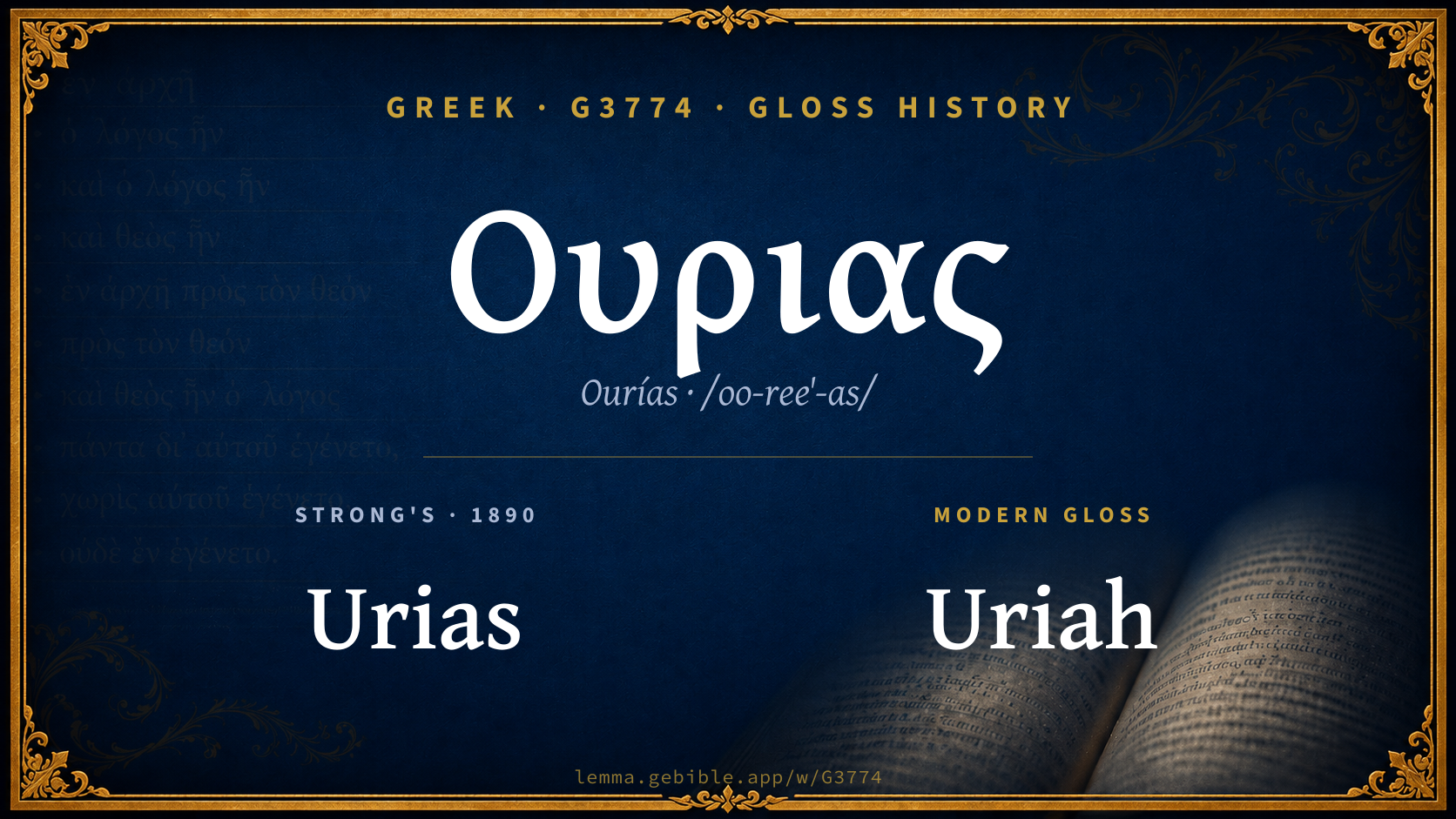
Gloss history
Strong's 1890 vs modern scholarship
About this word
Strong's G3774 catalogs a Greek word from the Greek New Testament.
These counts are not copied from any lexicon or concordance. They are computed here, from the morphology-tagged Greek New Testament. What Lemma adds →
- 1
- distinct verses
- The word appears in 1 distinct verse.
- 1 / 27
- NT books
- The word appears in 1 of 27 New Testament books.
- #3,503
- by frequency
- Top 5000 most frequent Greek words (rank 3,503 of 5,347 Greek words by occurrence).
View all 1 occurrence in the concordance →
Most concentrated in
- Matthew 1 verse 100%
By section of the New Testament
By traditional corpus
Conventional, traditional groupings — biblical authorship is debated, so this is a traditional corpus grouping, not an authorship claim. Some books belong to more than one corpus (Luke is in both the Gospels and the Lukan corpus, and so on), so these shares overlap and need not total 100%. Each figure is a share of the word’s 1 distinct verse.
- Gospels 1 verse · 100%
How translations render this word
Counts come from each version’s own published word-to-Strong’s tagging or interlinear alignment — an approximate guide to how each version renders this word, not a word-level alignment the data otherwise carries. Because each total is that version’s own tagged count, the per-version totals vary from one another and need not match the appearance or distinct-verse counts above. These counts may also differ from a printed concordance because Lemma counts each distinctly tagged rendering and does not collapse phrase taggings into a single head-word total. This is a fixed set of word-tagged versions (KJV, ASV, BSB, ULT) and does not change with the reading translation you choose elsewhere. Each version’s license is shown beside its name below (and on Sources).
- King James Version: Had been the wife of urias 1×
- American Standard Version: Uriah 1×
- Berean Standard Bible: Uriah’s 1×
- unfoldingWord Literal Text: Uriah 1×
King James Version Public Domain
Renders G3774 across 1 tagged occurrence — most commonly:
American Standard Version Public Domain
Renders G3774 across 1 tagged occurrence — most commonly:
Berean Standard Bible Public Domain
Renders G3774 across 1 tagged occurrence — most commonly:
unfoldingWord Literal Text CC BY-SA 4.0
Renders G3774 across 1 tagged occurrence — most commonly:
Senses in Thayer's
The 2 senses Thayer's distinguishes for this word, in lexicon order (not ranked by frequency or importance). The full entry — with sub-senses — is in the Lexicon Entry tab.
- Uriah = "light of Jehovah"
- the husband of Bathsheba, one of David's mighty men
Word origin
Derived from אוריה (ʼÛwrîyâh) (H223) — Uriah.
Of hebrew origin [ H223 ]; Urias (that is Urijah ) a Hittite : - Urias.
— Strong’s Exhaustive Concordance (1890), public domain.
Bible dictionary
Public-domain dictionary articles matched to this entry by name (Uriah). A biblical name can be shared by more than one person or place, so an article may treat several.
Easton's Bible Dictionary · M. G. Easton, 1897
The Lord is my light. (1.) A Hittite, the husband of Bathsheba, whom David first seduced, and then after Uriah's death married. He was one of the band of David's "mighty men." The sad story of the curel wrongs inflicted upon him by David and of his mournful death are simply told in the sacred record (2 Sam. 11:2-12:26). (See BATHSHEBA; DAVID.)
(2.) A priest of the house of Ahaz (Isa. 8:2).
(3.) The father of Meremoth, mentioned in Ezra 8:33.
Smith's Bible Dictionary · William Smith, 1863
(light of Jehovah).
+ One of the thirty commanders of the thirty bands into which the Israelite army of David was divided. (1 Chronicles 11:41; 2 Samuel 23:39) Like others of David's officers he was a foreigner--a Hittite. His name, however and his manner of speech (2 Samuel 11:11) indicate that he had adopted the Jewish religion. He married Bath-sheba a woman of extraordinary beauty, the daughter of Eliam--possibly the same as the son of Ahithophel, and one of his brother officers, (2 Samuel 23:34) and hence, perhaps, Uriah's first acquaintance with Bath-sheba. It may be inferred from Nathan's parable, (2 Samuel 12:3) that he was passionately devoted to his wife, and that their union was celebrated in Jerusalem as one of peculiar tenderness. In the first war with Ammon, B.C. 1035, he followed Joab to the siege, and with him remained encamped in the open field. (2 Samuel 12:11) He returned to Jerusalem, at an order from the king on the pretext of asking news of the war--really in the hope that his return to his wife might cover the shame of his own crime. The king met with an unexpected obstacle in the austere, soldier-like spirit which guided all Uriah's conduct, and which gives us a high notion of the character and discipline of David's officers. On the morning of the third day David sent him back to the camp with a letter containing the command to Joab to cause his destruction in the battle. The device of Joab was to observe the part of the wall of Rabbath-ammon where the greatest force of the besieged was congregated, and thither, as a kind of forlorn hope to send Uriah. A sally took place. Uriah and the officers with him advanced as far as the gate of the city, and were there shot down by the archers on the wall. Just as Joab had forewarned the messenger, the king broke into a furious passion on hearing of the loss. The messenger, as instructed by Joab, calmly continued, and ended the story with the words, "Thy servant also Uriah the Hittite, is dead." In a moment David's anger is appeased. It is one of the touching parts of the story that Uriah falls unconscious of his wife's dishonor. + High priest in the reign of Ahaz. (Isaiah 8:2; 2 Kings 16:10-16) He is probably the same as Urijah the priest, who built the altar for Ahaz. (2 Kings 16:10) (B.C. about 738.) + A priest of the family of Hakkoz, the head of the seventh course of priests. (Ezra 8:33; Nehemiah 3:4,21) (B.C. 458.)
Hitchcock's Bible Names Dictionary · Roswell D. Hitchcock, 1869
or Urijah, the Lord is my light or fire
Classic public-domain reference works; full attribution on Sources.
Septuagint usage
The same Greek word Ουριας appears 36 times in the Greek Old Testament (Septuagint), across 32 verses in 7 books.
- 36
- LXX occurrences
- Tagged occurrences of this Greek word in the Septuagint.
- 32
- verses
- Distinct Septuagint verses containing this word.
- 7 / 39
- OT books
- The word appears in 7 of the 39 Old Testament books.
Sample Septuagint occurrences
- Exodus 31:2 ουριας
- 2 Samuel 11:3 ουριας
- 2 Kings 16:10 ουριας
- 1 Chronicles 11:41 ουριας
- 2 Chronicles 1:5 ουριας
- Isaiah 8:2 οὐρίας
- Jeremiah 33:20 ουριας
Septuagint occurrences (same lexeme)
Every verse where the same Strong’s number (G3774) appears in the Greek Septuagint. Verse text shown in the World English Bible for context; the Greek form is the matched word — the English is not keyword-highlighted.
- Exodus 31:2 ουριας "Behold, I have called by name Bezalel the son of Uri, the son of Hur, of the tribe of Judah:
- Exodus 35:30 ουριας Moses said to the children of Israel, "Behold, Yahweh has called by name Bezalel the son of Uri, the son of Hur, of the tribe of Judah.
- Exodus 37:20 ουριας In the lampstand were four cups made like almond-blossoms, its buds and its flowers;
- 2 Samuel 11:3 ουριας David send and inquired after the woman. One said, Is not this Bathsheba, the daughter of Eliam, the wife of Uriah the Hittite?
- 2 Samuel 11:6 ουριας David sent to Joab, [saying], Send me Uriah the Hittite. Joab sent Uriah to David.
- 2 Samuel 11:7 ουριας When Uriah was come to him, David asked of him how Joab did, and how the people fared, and how the war prospered.
- 2 Samuel 11:8 ουριας David said to Uriah, Go down to your house, and wash your feet. Uriah departed out of the king's house, and there followed him a mess [of food] from the king.
- 2 Samuel 11:9 ουριας But Uriah slept at the door of the king's house with all the servants of his lord, and didn't go down to his house.
- 2 Samuel 11:10 ουριας When they had told David, saying, Uriah didn't go down to his house, David said to Uriah, Haven't you come from a journey? why did you not go down to your house?
- 2 Samuel 11:11 ουριας Uriah said to David, The ark, and Israel, and Judah, abide in booths; and my lord Joab, and the servants of my lord, are encamped in the open field; shall I then go into my house, to eat and to drink, and to lie with my wife? as you live, and as your soul lives, I will not do this thing.
- 2 Samuel 11:12 ουριας David said to Uriah, Stay here today also, and tomorrow I will let you depart. So Uriah abode in Jerusalem that day, and the next day.
- 2 Samuel 11:14 ουριας It happened in the morning, that David wrote a letter to Joab, and sent it by the hand of Uriah.
- 2 Samuel 11:15 ουριας He wrote in the letter, saying, Set Uriah in the forefront of the hottest battle, and retire you from him, that he may be struck, and die.
- 2 Samuel 11:16 ουριας It happened, when Joab kept watch on the city, that he assigned Uriah to the place where he knew that valiant men were.
- 2 Samuel 11:17 ουριας The men of the city went out, and fought with Joab: and there fell some of the people, even of the servants of David; and Uriah the Hittite died also.
- 2 Samuel 11:21 ουριας who struck Abimelech the son of Jerubbesheth? Didn't a woman cast an upper millstone on him from the wall, so that he died at Thebez? Why did you go so near the wall?' then shall you say, 'Your servant Uriah the Hittite is dead also.'"
- 2 Samuel 11:24 ουριας The shooters shot at your servants from off the wall; and some of the king's servants are dead, and your servant Uriah the Hittite is dead also.
- 2 Samuel 11:26 ουριας When the wife of Uriah heard that Uriah her husband was dead, she made lamentation for her husband.
- 2 Samuel 12:9 ουριας Why have you despised the word of Yahweh, to do that which is evil in his sight? You have struck Uriah the Hittite with the sword, and have taken his wife to be your wife, and have slain him with the sword of the children of Ammon.
- 2 Samuel 12:10 ουριας Now therefore the sword will never depart from your house, because you have despised me, and have taken the wife of Uriah the Hittite to be your wife.'
- 2 Samuel 12:15 ουριας Nathan departed to his house. Yahweh struck the child that Uriah's wife bore to David, and it was very sick.
- 2 Samuel 23:39 ουριας Uriah the Hittite: thirty-seven in all.
- 2 Kings 16:10 ουριας King Ahaz went to Damascus to meet Tiglath Pileser king of Assyria, and saw the altar that was at Damascus; and king Ahaz sent to Urijah the priest the fashion of the altar, and the pattern of it, according to all the workmanship of it.
- 2 Kings 16:11 ουριας Urijah the priest built an altar: according to all that king Ahaz had sent from Damascus, so did Urijah the priest make it against the coming of king Ahaz from Damascus.
- 2 Kings 16:15 ουριας King Ahaz commanded Urijah the priest, saying, On the great altar burn the morning burnt offering, and the evening meal-offering, and the king's burnt offering, and his meal-offering, with the burnt offering of all the people of the land, and their meal-offering, and their drink-offerings; and sprinkle on it all the blood of the burnt offering, and all the blood of the sacrifice: but the brazen altar shall be for me to inquire by.
- 2 Kings 16:16 ουριας Thus did Urijah the priest, according to all that king Ahaz commanded.
- 1 Chronicles 11:41 ουριας Uriah the Hittite, Zabad the son of Ahlai,
- 2 Chronicles 1:5 ουριας Moreover the brazen altar, that Bezalel the son of Uri, the son of Hur, had made, was there before the tent of Yahweh: and Solomon and the assembly sought to it.
- Isaiah 8:2 οὐρίας and I will take to me faithful witnesses to record, Uriah the priest, and Zechariah the son of Jeberechiah.
- Isaiah 21:8 ουριας He cried as a lion: Lord, I stand continually on the watch-tower in the day-time, and am set in my ward whole nights;
- Jeremiah 33:20 ουριας Thus says Yahweh: If you can break my covenant of the day, and my covenant of the night, so that there shall not be day and night in their season;
- Jeremiah 33:21 ουριας then may also my covenant be broken with David my servant, that he shall not have a son to reign on his throne; and with the Levites the priests, my ministers.
These are occurrences of the same Greek lexeme (G3774) in the Septuagint — not a translation of any one Hebrew word. The store carries no word-level Hebrew↔Greek alignment, so no Hebrew original is asserted here. Counts come from the recovered LXX Strong's tagging — high-frequency vocabulary is well covered, while rare or late forms may be untagged — so they reflect tagged occurrences and may slightly undercount.