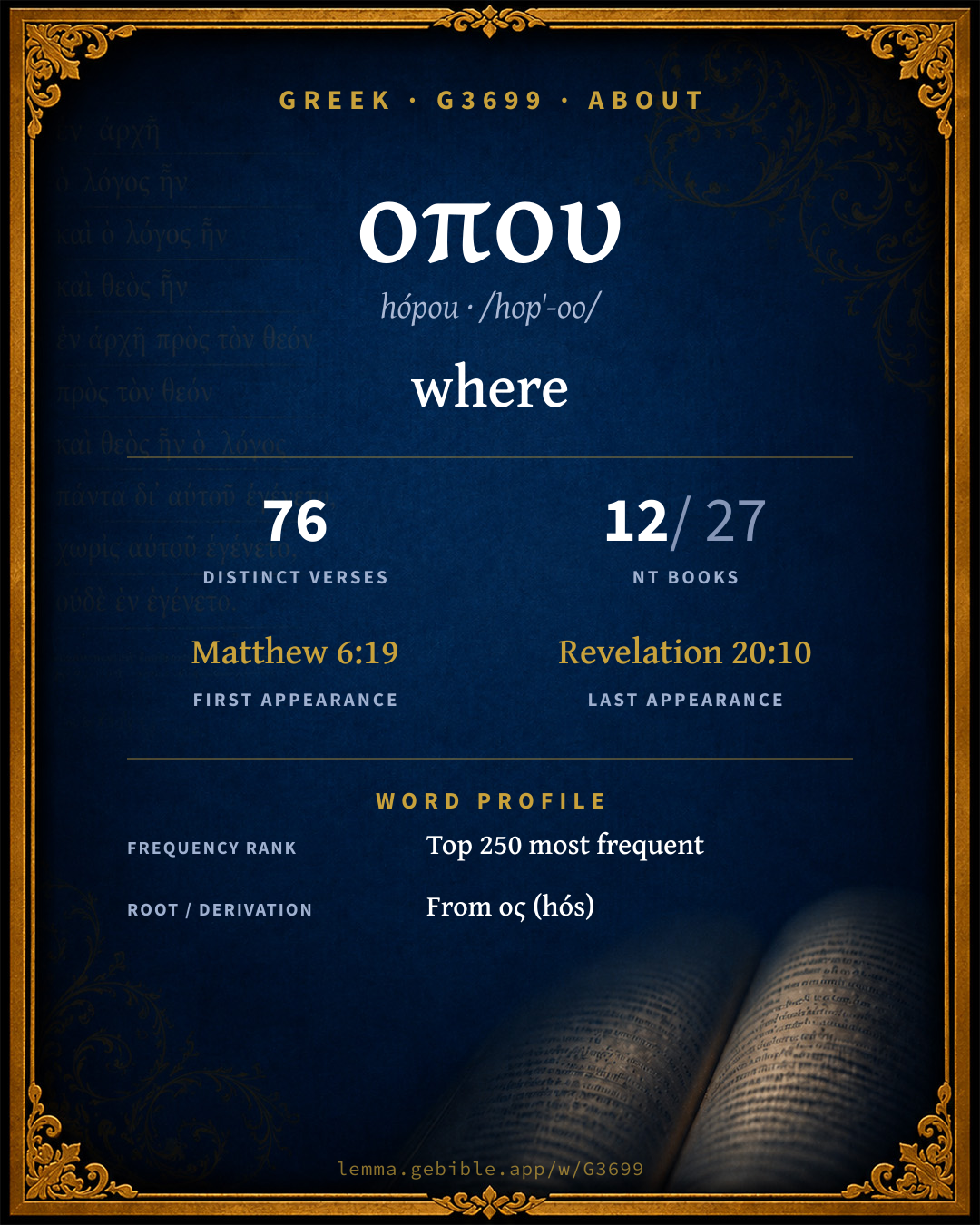
ὅπου
where
Full lexicon entry — Thayer's Greek Lexicon
From Thayer's Greek Lexicon
Where this word appears
Grammar key — what these labels mean
Part of speech
- Adverb
- A word that modifies a verb, adjective, or other adverb.
Every verse where G3699 appears in the Book of John — 29 distinct verses. Click any verse to open its interlinear word-by-word view. Verse text shown in the World English Bible for context — . Each verse’s Greek form is shown with its reference; the English is not keyword-highlighted, since the data carries no word-level English alignment. Use “Compare translations” on any verse to read it across multiple English versions. This concordance covers the Greek New Testament; Septuagint (Greek Old Testament) occurrences of this word are not indexed here.
John
- John 1:28 ὅπου adv These things were done in Bethany beyond the Jordan, where John was baptizing.
- John 3:8 ὅπου adv The wind blows where it wants to, and you hear its sound, but don't know where it comes from and where it is going. So is everyone who is born of the Spirit."
- John 4:20 ὅπου adv Our fathers worshiped in this mountain, and you Jews say that in Jerusalem is the place where people ought to worship."
- John 4:46 ὅπου adv Jesus came therefore again to Cana of Galilee, where he made the water into wine. There was a certain nobleman whose son was sick at Capernaum.
- John 6:23 ὅπου adv However boats from Tiberias came near to the place where they ate the bread after the Lord had given thanks.
- John 6:62 ὅπου adv Then what if you would see the Son of Man ascending to where he was before?
- John 7:34 ὅπου adv You will seek me, and won't find me; and where I am, you can't come."
- John 7:36 ὅπου adv What is this word that he said, 'You will seek me, and won't find me; and where I am, you can't come?'"
- John 7:42 ὅπου adv Hasn't the Scripture said that the Christ comes of the seed of David, and from Bethlehem, the village where David was?"
- John 8:21 ὅπου adv Jesus said therefore again to them, "I am going away, and you will seek me, and you will die in your sins. Where I go, you can't come."
- John 8:22 ὅπου adv The Jews therefore said, "Will he kill himself, that he says, 'Where I am going, you can't come?'"
- John 10:40 ὅπου adv He went away again beyond the Jordan into the place where John was baptizing at first, and there he stayed.
- John 11:30 ὅπου adv Now Jesus had not yet come into the village, but was in the place where Martha met him.
- John 11:32 ὅπου adv Therefore when Mary came to where Jesus was, and saw him, she fell down at his feet, saying to him, "Lord, if you would have been here, my brother wouldn't have died."
- John 12:1 ὅπου adv Then six days before the Passover, Jesus came to Bethany, where Lazarus was, who had been dead, whom he raised from the dead.
- John 12:26 ὅπου adv If anyone serves me, let him follow me. Where I am, there will my servant also be. If anyone serves me, the Father will honor him.
- John 13:33 ὅπου adv Little children, I will be with you a little while longer. You will seek me, and as I said to the Jews, 'Where I am going, you can't come,' so now I tell you.
- John 13:36 ὅπου adv Simon Peter said to him, "Lord, where are you going?" Jesus answered, "Where I am going, you can't follow now, but you will follow afterwards."
- John 14:3 ὅπου adv If I go and prepare a place for you, I will come again, and will receive you to myself; that where I am, you may be there also.
- John 14:4 ὅπου adv Where I go, you know, and you know the way."
- John 17:24 ὅπου adv Father, I desire that they also whom you have given me be with me where I am, that they may see my glory, which you have given me, for you loved me before the foundation of the world.
- John 18:1 ὅπου adv When Jesus had spoken these words, he went out with his disciples over the brook Kidron, where was a garden, into which he and his disciples entered.
- John 18:20 ὅπου adv Jesus answered him, "I spoke openly to the world. I always taught in synagogues, and in the temple, where the Jews always meet. I said nothing in secret.
- John 19:18 ὅπου adv where they crucified him, and with him two others, on either side one, and Jesus in the middle.
- John 19:20 ὅπου adv Therefore many of the Jews read this title, for the place where Jesus was crucified was near the city; and it was written in Hebrew, in Latin, and in Greek.
- John 19:41 ὅπου adv Now in the place where he was crucified there was a garden. In the garden a new tomb in which no man had ever yet been laid.
- John 20:12 ὅπου adv and she saw two angels in white sitting, one at the head, and one at the feet, where the body of Jesus had lain.
- John 20:19 ὅπου adv When therefore it was evening, on that day, the first day of the week, and when the doors were locked where the disciples were assembled, for fear of the Jews, Jesus came and stood in the midst, and said to them, "Peace be to you."
- John 21:18 ὅπου ὅπου adv adv Most assuredly I tell you, when you were young, you dressed yourself, and walked where you wanted to. But when you are old, you will stretch out your hands, and another will dress you, and carry you where you don't want to go."
About this entry
At a glance — auto-summarized from this page’s data, not written by a person. Every figure links to its source below. This summary describes the numbers; it doesn’t interpret them.
At its core, οπου (hópou) means “where.” It first appears in Matthew 6:19. Spanning 76 verses in 12 books, it ranks among the moderately common words of the Greek New Testament. Its uses concentrate in John (38% of all occurrences). Sharing its root, it stands alongside ος, ο εστι and οθεν. Dig into 76-verse concordance and the renderings breakdown below.
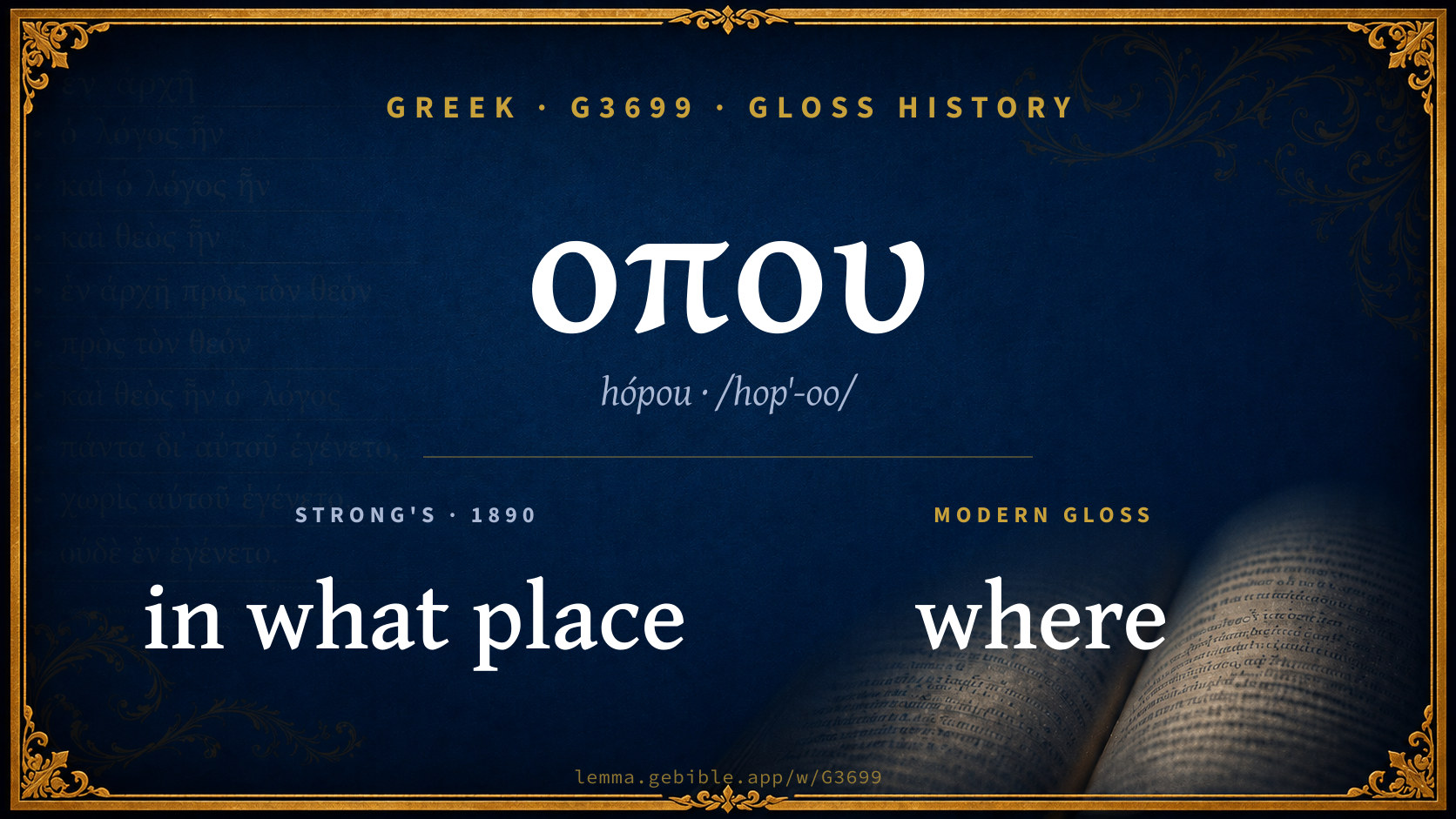
Gloss history
Strong's 1890 vs modern scholarship
About this word
Strong's G3699 catalogs a Greek word from the Greek New Testament.
These counts are not copied from any lexicon or concordance. They are computed here, from the morphology-tagged Greek New Testament. What Lemma adds →
- 76
- distinct verses
- The word appears in 76 distinct verses.
- 12 / 27
- NT books
- The word appears in 12 of 27 New Testament books.
- #207
- by frequency
- Top 250 most frequent Greek words (rank 207 of 5,347 Greek words by occurrence).
View all 76 occurrences in the concordance →
By section of the New Testament
By traditional corpus
Conventional, traditional groupings — biblical authorship is debated, so this is a traditional corpus grouping, not an authorship claim. Some books belong to more than one corpus (Luke is in both the Gospels and the Lukan corpus, and so on), so these shares overlap and need not total 100%. Each figure is a share of the word’s 76 distinct verses.
- Gospels 58 verses · 76%
- Johannine 36 verses · 47%
- Lukan (Luke–Acts) 7 verses · 9%
- Revelation 7 verses · 9%
- Pauline corpus 3 verses · 4%
- Hebrews 3 verses · 4%
- General (Catholic) Epistles 3 verses · 4%
How translations render this word
Counts come from each version’s own published word-to-Strong’s tagging or interlinear alignment — an approximate guide to how each version renders this word, not a word-level alignment the data otherwise carries. Because each total is that version’s own tagged count, the per-version totals vary from one another and need not match the appearance or distinct-verse counts above. These counts may also differ from a printed concordance because Lemma counts each distinctly tagged rendering and does not collapse phrase taggings into a single head-word total. This is a fixed set of word-tagged versions (KJV, ASV, BSB, ULT) and does not change with the reading translation you choose elsewhere. Each version’s license is shown beside its name below (and on Sources).
- King James Version: Where 58×, Whither 8×, Wheresoever 5×
- American Standard Version: Where 58×, Whither 7×, Wheresoever 4×
- Berean Standard Bible: Where 55×, Wherever 10×, Which 2×
- unfoldingWord Literal Text: Where 69×, Wherever 10×, Is 2×
King James Version Public Domain
Renders G3699 across 79 tagged occurrences — most commonly:
Plus 2 renderings that appear only once — usually multi-word phrases or single function words the recovered tagging swept in, not distinct renderings. Not rendered by a distinct English word in 3 further occurrences.
American Standard Version Public Domain
Renders G3699 across 74 tagged occurrences — most commonly:
Plus 3 renderings that appear only once — usually multi-word phrases or single function words the recovered tagging swept in, not distinct renderings.
Berean Standard Bible Public Domain
Renders G3699 across 78 tagged occurrences — most commonly:
Plus 11 renderings that appear only once — usually multi-word phrases or single function words the recovered tagging swept in, not distinct renderings. Not rendered by a distinct English word in 4 further occurrences.
unfoldingWord Literal Text CC BY-SA 4.0
Renders G3699 across 86 tagged occurrences — most commonly:
Plus 5 renderings that appear only once — usually multi-word phrases or single function words the recovered tagging swept in, not distinct renderings.
Senses in Thayer's
The 1 sense Thayer's distinguishes for this word, in lexicon order (not ranked by frequency or importance). The full entry — with sub-senses — is in the Lexicon Entry tab.
- where, whereas
Word origin
Derived from ος (hós) (G3739) — who.
Same root — word family
Other Thayer's entries built from the same root as G3699, grouped by Strong’s listed origin. These share a root / origin per the lexicon — not necessarily a shared meaning. Each links to that word’s own entry.
Derives from
Shares the same root
- ο εστι hó esti G3603 which is
- οθεν hóthen G3606 from which
- οποιος hopoîos G3697 what sort
- οποτε hopóte G3698 when
- οπως hópōs G3704 how
- οσακις hosákis G3740 as often as
- οσος hósos G3745 how much
- οσπερ hósper G3746 whomever
- οστις hóstis G3748 whoever
- οτε hóte G3753 when
- ου hoû G3757 where
- ποσος pósos G4214 how much
- ως hōs G5613 as
Compare all same-root words → Showing 4 of 15 — not the complete family. They share a root, not necessarily a meaning.
Septuagint usage
The same Greek word οπου appears 9 times in the Greek Old Testament (Septuagint), across 9 verses in 7 books.
- 9
- LXX occurrences
- Tagged occurrences of this Greek word in the Septuagint.
- 9
- verses
- Distinct Septuagint verses containing this word.
- 7 / 39
- OT books
- The word appears in 7 of the 39 Old Testament books.
Sample Septuagint occurrences
- Judges 18:10 ὅπου
- Ruth 1:16 ὅπου
- Ezra 6:1 ὅπου
- Esther 1:9 ὅπου
- Proverbs 26:20 ὅπου
- Ecclesiastes 9:10 ὅπου
- Isaiah 42:22 ὅπου
Septuagint occurrences (same lexeme)
Every verse where the same Strong’s number (G3699) appears in the Greek Septuagint. Verse text shown in the World English Bible for context; the Greek form is the matched word — the English is not keyword-highlighted.
- Judges 18:10 ὅπου When you go, you shall come to a people secure, and the land is large; for God has given it into your hand, a place where there is no want of anything that is in the earth.
- Judges 20:22 ὅπου The people, the men of Israel, encouraged themselves, and set the battle again in array in the place where they set themselves in array the first day.
- Ruth 1:16 ὅπου Ruth said, "Don't entreat me to leave you, and to return from following after you, for where you go, I will go; and where you lodge, I will lodge; your people shall be my people, and your God my God;
- Ruth 3:4 ὅπου It shall be, when he lies down, that you shall mark the place where he shall lie, and you shall go in, and uncover his feet, and lay you down; and he will tell you what you shall do.
- Ezra 6:1 ὅπου Then Darius the king made a decree, and search was made in the house of the archives, where the treasures were laid up in Babylon.
- Esther 1:9 ὅπου Also Vashti the queen made a feast for the women in the royal house which belonged to king Ahasuerus.
- Proverbs 26:20 ὅπου For lack of wood a fire goes out; Without gossip, a quarrel dies down.
- Ecclesiastes 9:10 ὅπου Whatever your hand finds to do, do it with your might; for there is no work, nor device, nor knowledge, nor wisdom, in Sheol, where you are going.
- Isaiah 42:22 ὅπου But this is a people robbed and plundered; they are all of them snared in holes, and they are hid in prison-houses: they are for a prey, and none delivers; for a spoil, and none says, Restore.
These are occurrences of the same Greek lexeme (G3699) in the Septuagint — not a translation of any one Hebrew word. The store carries no word-level Hebrew↔Greek alignment, so no Hebrew original is asserted here. Counts come from the recovered LXX Strong's tagging — high-frequency vocabulary is well covered, while rare or late forms may be untagged — so they reflect tagged occurrences and may slightly undercount.