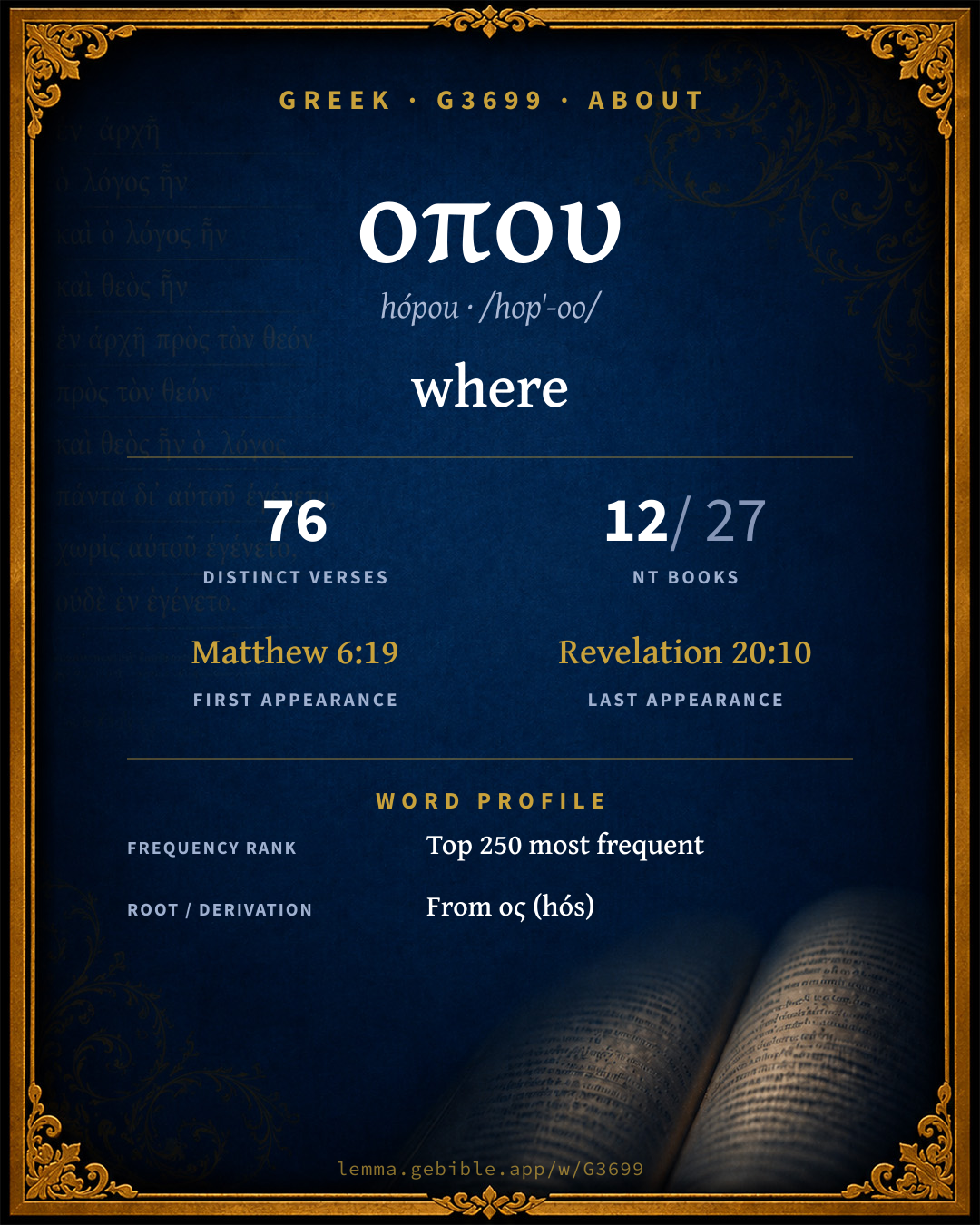
ὅπου
where
Full lexicon entry — Thayer's Greek Lexicon
From Thayer's Greek Lexicon
Where this word appears
Grammar key — what these labels mean
Part of speech
- Adverb
- A word that modifies a verb, adjective, or other adverb.
Every verse where G3699 appears in the Book of Revelation — 7 distinct verses. Click any verse to open its interlinear word-by-word view. Verse text shown in the World English Bible for context — . Each verse’s Greek form is shown with its reference; the English is not keyword-highlighted, since the data carries no word-level English alignment. Use “Compare translations” on any verse to read it across multiple English versions. This concordance covers the Greek New Testament; Septuagint (Greek Old Testament) occurrences of this word are not indexed here.
Revelation
- Revelation 2:13 ὅπου ὅπου adv adv "I know your works and where you dwell, where Satan's throne is. You hold firmly to my name, and didn't deny my faith in the days of Antipas my witness, my faithful one, who was killed among you, where Satan dwells.
- Revelation 11:8 ὅπου adv Their dead bodies will be in the street of the great city, which spiritually is called Sodom and Egypt, where also their Lord was crucified.
- Revelation 12:6 ὅπου adv The woman fled into the wilderness, where she has a place prepared by God, that there they may nourish her one thousand two hundred sixty days.
- Revelation 12:14 ὅπου adv Two wings of the great eagle were given to the woman, that she might fly into the wilderness to her place, so that she might be nourished for a time, and times, and half a time, from the face of the serpent.
- Revelation 14:4 ὅπου adv These are those who were not defiled with women, for they are virgins. These are those who follow the Lamb wherever he goes. These were redeemed by Jesus from among men, the first fruits to God and to the Lamb.
- Revelation 17:9 ὅπου adv Here is the mind that has wisdom. The seven heads are seven mountains, on which the woman sits.
- Revelation 20:10 ὅπου adv The devil who deceived them was thrown into the lake of fire and sulfur, where the beast and the false prophet are also. They will be tormented day and night forever and ever.
About this entry
At a glance — auto-summarized from this page’s data, not written by a person. Every figure links to its source below. This summary describes the numbers; it doesn’t interpret them.
At its core, οπου (hópou) means “where.” It first appears in Matthew 6:19. Spanning 76 verses in 12 books, it ranks among the moderately common words of the Greek New Testament. Its uses concentrate in John (38% of all occurrences). Sharing its root, it stands alongside ος, ο εστι and οθεν. Dig into 76-verse concordance and the renderings breakdown below.
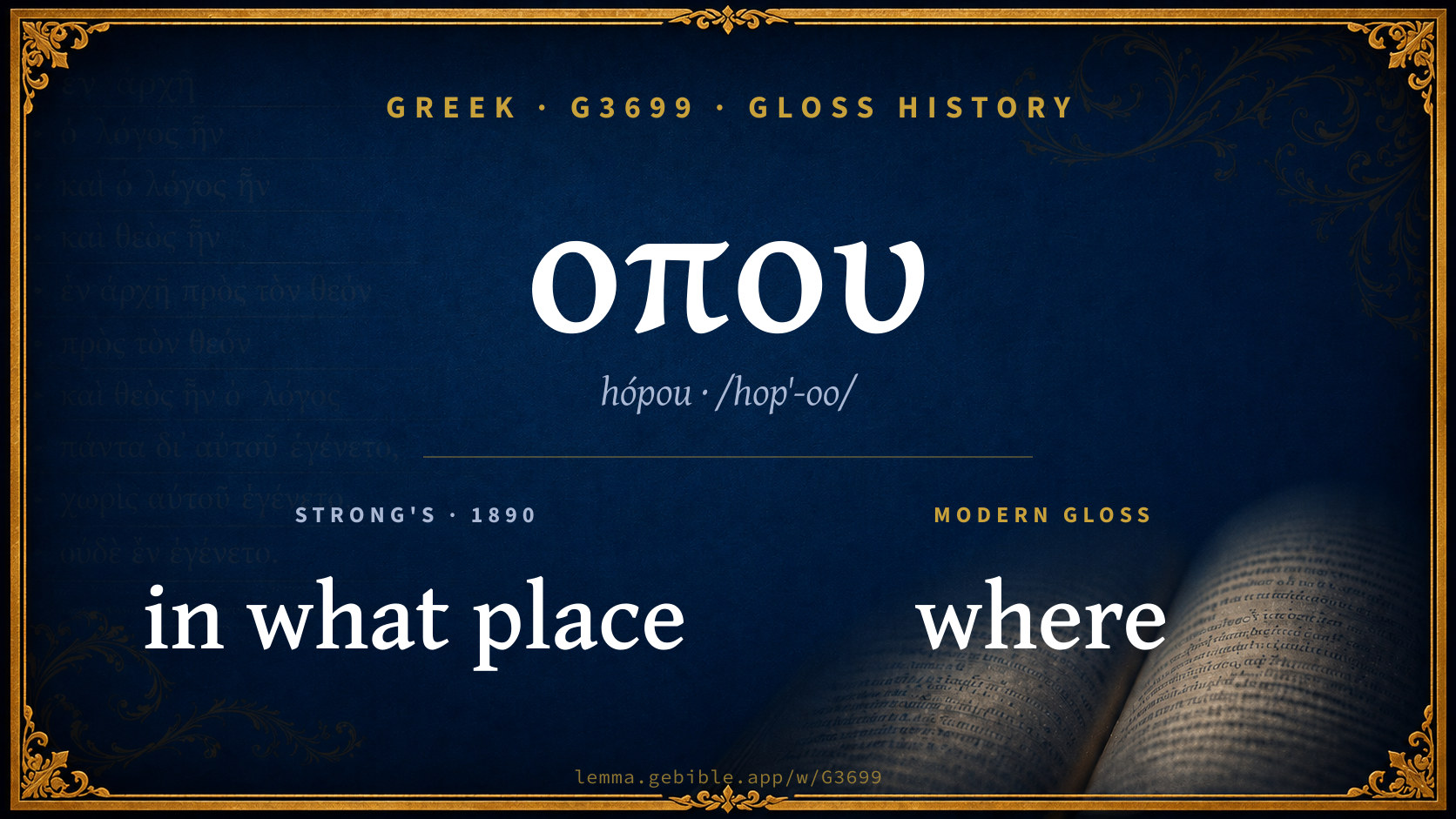
Gloss history
Strong's 1890 vs modern scholarship
About this word
Strong's G3699 catalogs a Greek word from the Greek New Testament.
These counts are not copied from any lexicon or concordance. They are computed here, from the morphology-tagged Greek New Testament. What Lemma adds →
- 76
- distinct verses
- The word appears in 76 distinct verses.
- 12 / 27
- NT books
- The word appears in 12 of 27 New Testament books.
- #207
- by frequency
- Top 250 most frequent Greek words (rank 207 of 5,347 Greek words by occurrence).
View all 76 occurrences in the concordance →
By section of the New Testament
By traditional corpus
Conventional, traditional groupings — biblical authorship is debated, so this is a traditional corpus grouping, not an authorship claim. Some books belong to more than one corpus (Luke is in both the Gospels and the Lukan corpus, and so on), so these shares overlap and need not total 100%. Each figure is a share of the word’s 76 distinct verses.
- Gospels 58 verses · 76%
- Johannine 36 verses · 47%
- Lukan (Luke–Acts) 7 verses · 9%
- Revelation 7 verses · 9%
- Pauline corpus 3 verses · 4%
- Hebrews 3 verses · 4%
- General (Catholic) Epistles 3 verses · 4%
How translations render this word
Counts come from each version’s own published word-to-Strong’s tagging or interlinear alignment — an approximate guide to how each version renders this word, not a word-level alignment the data otherwise carries. Because each total is that version’s own tagged count, the per-version totals vary from one another and need not match the appearance or distinct-verse counts above. These counts may also differ from a printed concordance because Lemma counts each distinctly tagged rendering and does not collapse phrase taggings into a single head-word total. This is a fixed set of word-tagged versions (KJV, ASV, BSB, ULT) and does not change with the reading translation you choose elsewhere. Each version’s license is shown beside its name below (and on Sources).
- King James Version: Where 58×, Whither 8×, Wheresoever 5×
- American Standard Version: Where 58×, Whither 7×, Wheresoever 4×
- Berean Standard Bible: Where 55×, Wherever 10×, Which 2×
- unfoldingWord Literal Text: Where 69×, Wherever 10×, Is 2×
King James Version Public Domain
Renders G3699 across 79 tagged occurrences — most commonly:
Plus 2 renderings that appear only once — usually multi-word phrases or single function words the recovered tagging swept in, not distinct renderings. Not rendered by a distinct English word in 3 further occurrences.
American Standard Version Public Domain
Renders G3699 across 74 tagged occurrences — most commonly:
Plus 3 renderings that appear only once — usually multi-word phrases or single function words the recovered tagging swept in, not distinct renderings.
Berean Standard Bible Public Domain
Renders G3699 across 78 tagged occurrences — most commonly:
Plus 11 renderings that appear only once — usually multi-word phrases or single function words the recovered tagging swept in, not distinct renderings. Not rendered by a distinct English word in 4 further occurrences.
unfoldingWord Literal Text CC BY-SA 4.0
Renders G3699 across 86 tagged occurrences — most commonly:
Plus 5 renderings that appear only once — usually multi-word phrases or single function words the recovered tagging swept in, not distinct renderings.
Senses in Thayer's
The 1 sense Thayer's distinguishes for this word, in lexicon order (not ranked by frequency or importance). The full entry — with sub-senses — is in the Lexicon Entry tab.
- where, whereas
Word origin
Derived from ος (hós) (G3739) — who.
Same root — word family
Other Thayer's entries built from the same root as G3699, grouped by Strong’s listed origin. These share a root / origin per the lexicon — not necessarily a shared meaning. Each links to that word’s own entry.
Derives from
Shares the same root
- ο εστι hó esti G3603 which is
- οθεν hóthen G3606 from which
- οποιος hopoîos G3697 what sort
- οποτε hopóte G3698 when
- οπως hópōs G3704 how
- οσακις hosákis G3740 as often as
- οσος hósos G3745 how much
- οσπερ hósper G3746 whomever
- οστις hóstis G3748 whoever
- οτε hóte G3753 when
- ου hoû G3757 where
- ποσος pósos G4214 how much
- ως hōs G5613 as
Compare all same-root words → Showing 4 of 15 — not the complete family. They share a root, not necessarily a meaning.
Septuagint usage
The same Greek word οπου appears 9 times in the Greek Old Testament (Septuagint), across 9 verses in 7 books.
- 9
- LXX occurrences
- Tagged occurrences of this Greek word in the Septuagint.
- 9
- verses
- Distinct Septuagint verses containing this word.
- 7 / 39
- OT books
- The word appears in 7 of the 39 Old Testament books.
Sample Septuagint occurrences
- Judges 18:10 ὅπου
- Ruth 1:16 ὅπου
- Ezra 6:1 ὅπου
- Esther 1:9 ὅπου
- Proverbs 26:20 ὅπου
- Ecclesiastes 9:10 ὅπου
- Isaiah 42:22 ὅπου
Septuagint occurrences (same lexeme)
Every verse where the same Strong’s number (G3699) appears in the Greek Septuagint. Verse text shown in the World English Bible for context; the Greek form is the matched word — the English is not keyword-highlighted.
- Judges 18:10 ὅπου When you go, you shall come to a people secure, and the land is large; for God has given it into your hand, a place where there is no want of anything that is in the earth.
- Judges 20:22 ὅπου The people, the men of Israel, encouraged themselves, and set the battle again in array in the place where they set themselves in array the first day.
- Ruth 1:16 ὅπου Ruth said, "Don't entreat me to leave you, and to return from following after you, for where you go, I will go; and where you lodge, I will lodge; your people shall be my people, and your God my God;
- Ruth 3:4 ὅπου It shall be, when he lies down, that you shall mark the place where he shall lie, and you shall go in, and uncover his feet, and lay you down; and he will tell you what you shall do.
- Ezra 6:1 ὅπου Then Darius the king made a decree, and search was made in the house of the archives, where the treasures were laid up in Babylon.
- Esther 1:9 ὅπου Also Vashti the queen made a feast for the women in the royal house which belonged to king Ahasuerus.
- Proverbs 26:20 ὅπου For lack of wood a fire goes out; Without gossip, a quarrel dies down.
- Ecclesiastes 9:10 ὅπου Whatever your hand finds to do, do it with your might; for there is no work, nor device, nor knowledge, nor wisdom, in Sheol, where you are going.
- Isaiah 42:22 ὅπου But this is a people robbed and plundered; they are all of them snared in holes, and they are hid in prison-houses: they are for a prey, and none delivers; for a spoil, and none says, Restore.
These are occurrences of the same Greek lexeme (G3699) in the Septuagint — not a translation of any one Hebrew word. The store carries no word-level Hebrew↔Greek alignment, so no Hebrew original is asserted here. Counts come from the recovered LXX Strong's tagging — high-frequency vocabulary is well covered, while rare or late forms may be untagged — so they reflect tagged occurrences and may slightly undercount.