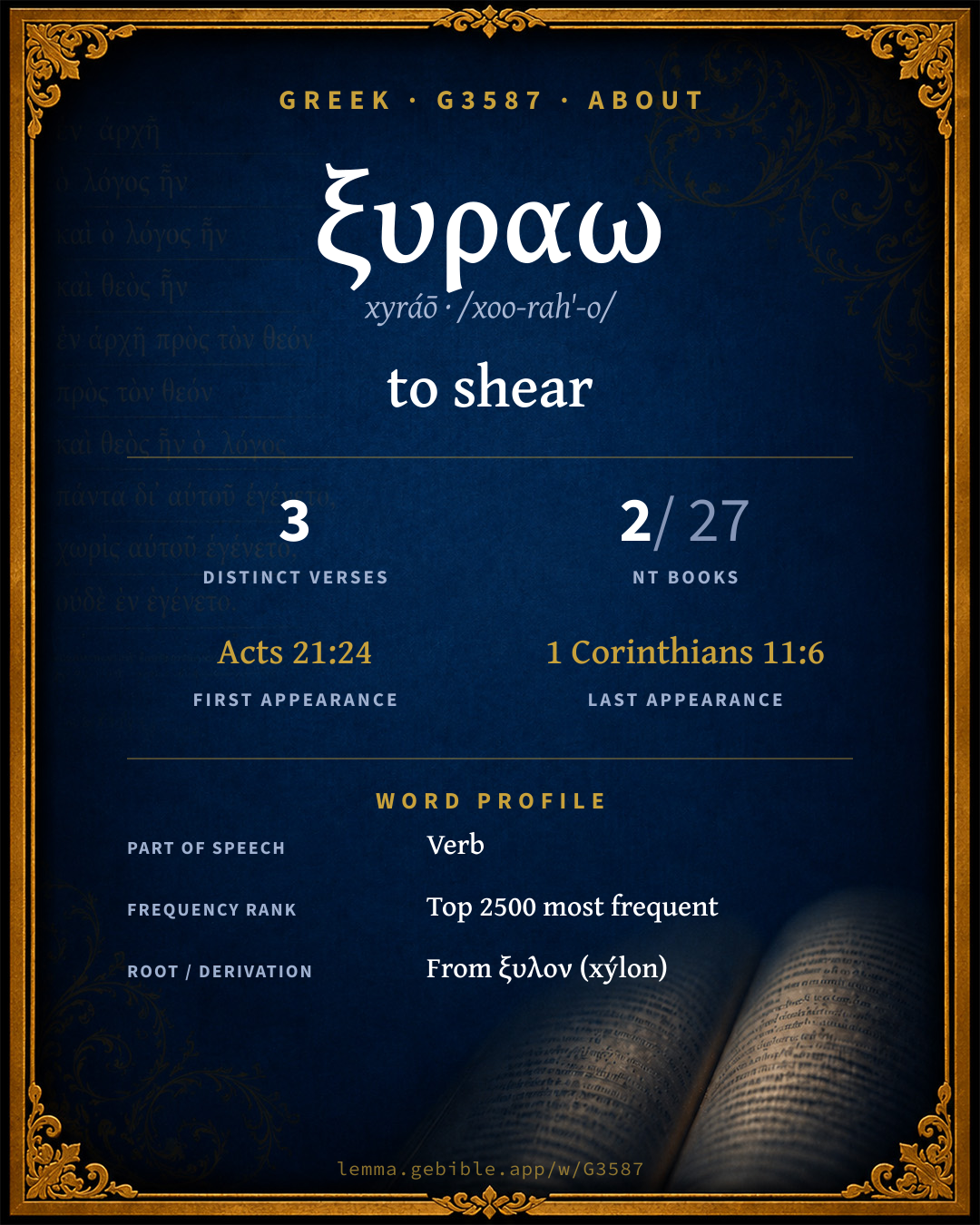
ξυράω
to shear
‘to shear’ is one of 2 main senses fuller range ↓
Full lexicon entry — Thayer's Greek Lexicon
From Thayer's Greek Lexicon
Where this word appears
See every Future-tense verb in the Greek New Testament →
Grammar key — what these labels mean
Part of speech
- Verb
- An action or state-of-being word.
Tense
- Future
- Action expected in future time.
- Present
- Ongoing or general action in present time (imperfective aspect).
- Perfect
- A completed past action with continuing present results.
Voice
- Middle deponent
- Middle in form but active in meaning.
- Passive
- The subject receives the action.
Mood
- Indicative
- States a fact or asks a factual question (the mood of reality).
- Infinitive
- A verbal noun (“to write”), unmarked for person or number.
- Participle
- A verbal adjective (“writing,” “having written”).
Case
- Dative
- The case of the indirect object, means, or location — “to / for / with / in.”
Person
- 3rd person
- The one spoken about (“he / she / it / they”).
Gender
- Feminine
- Grammatically feminine.
Number
- Plural
- More than one.
- Singular
- One.
1 distinct verse where G3587 appears in the Perfect tense, across 1 book. Filtered view — show all forms. Click any verse to open its interlinear word-by-word view. Verse text shown in the World English Bible for context — . Each verse’s Greek form is shown with its reference; the English is not keyword-highlighted, since the data carries no word-level English alignment. Use “Compare translations” on any verse to read it across multiple English versions. This concordance covers the Greek New Testament; Septuagint (Greek Old Testament) occurrences of this word are not indexed here.
1 Corinthians 1 verse
About this entry
At a glance — auto-summarized from this page’s data, not written by a person. Every figure links to its source below. This summary describes the numbers; it doesn’t interpret them.
The Greek verb ξυραω centers on the idea of “to shear.” It occurs a mere 3 verses across Scripture. 1 Corinthians dominates its distribution — 2 of 3 verses. First canonically at Acts 21:24, it enters the text early. Lexicons map it across 2 senses. Dig into 3-verse concordance and the renderings breakdown below.
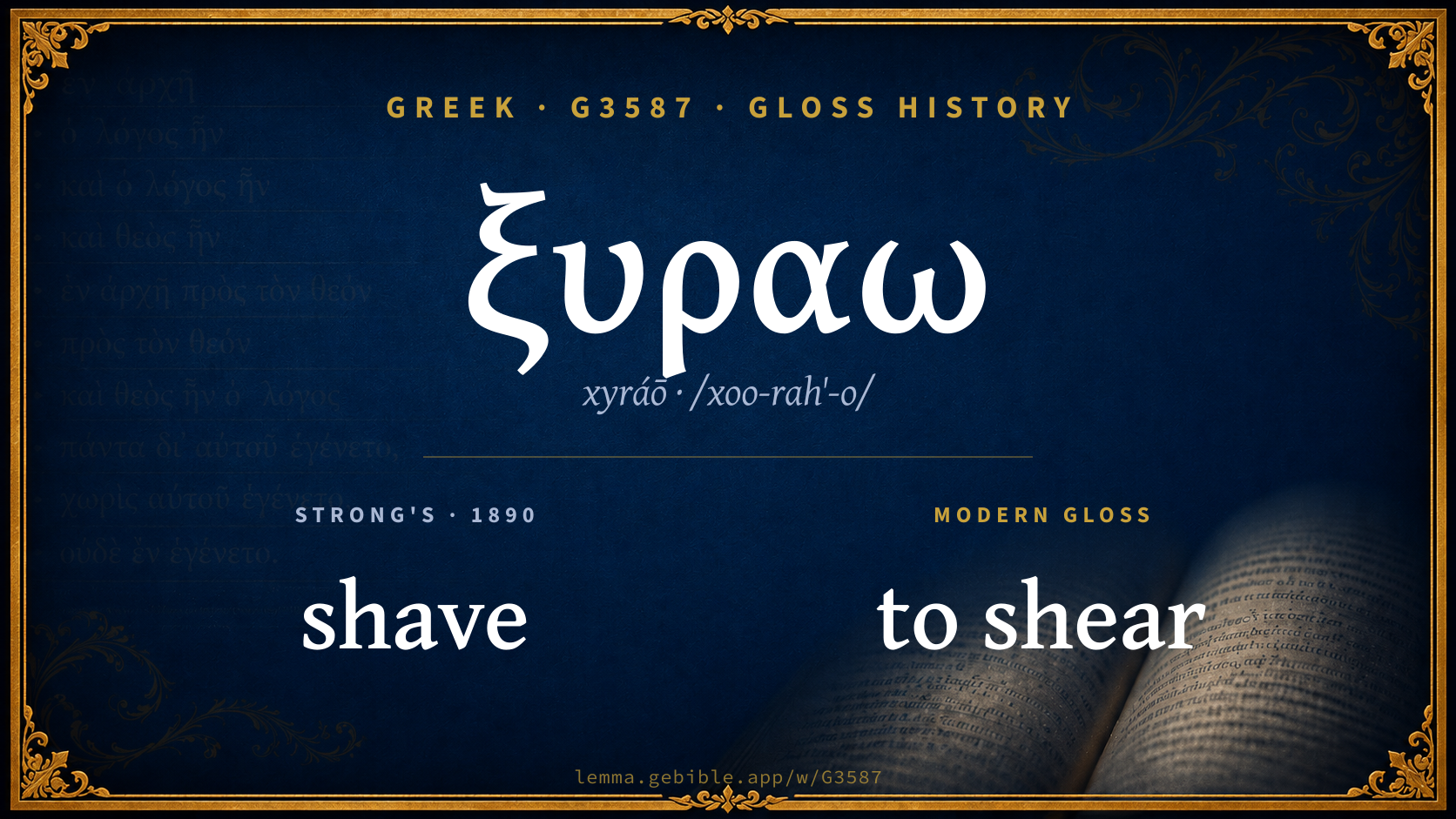
Gloss history
Strong's 1890 vs modern scholarship
About this word
Strong's G3587 catalogs a Greek word from the Greek New Testament.
These counts are not copied from any lexicon or concordance. They are computed here, from the morphology-tagged Greek New Testament. What Lemma adds →
- 3
- distinct verses
- The word appears in 3 distinct verses.
- 2 / 27
- NT books
- The word appears in 2 of 27 New Testament books.
- #2,203
- by frequency
- Top 2500 most frequent Greek words (rank 2,203 of 5,347 Greek words by occurrence).
View all 3 occurrences in the concordance →
Most concentrated in
- 1 Corinthians 2 verses 67%
- Acts 1 verse 33%
By section of the New Testament
By traditional corpus
Conventional, traditional groupings — biblical authorship is debated, so this is a traditional corpus grouping, not an authorship claim. Some books belong to more than one corpus (Luke is in both the Gospels and the Lukan corpus, and so on), so these shares overlap and need not total 100%. Each figure is a share of the word’s 3 distinct verses.
- Pauline corpus 2 verses · 67%
- Lukan (Luke–Acts) 1 verse · 33%
How translations render this word
Counts come from each version’s own published word-to-Strong’s tagging or interlinear alignment — an approximate guide to how each version renders this word, not a word-level alignment the data otherwise carries. Because each total is that version’s own tagged count, the per-version totals vary from one another and need not match the appearance or distinct-verse counts above. These counts may also differ from a printed concordance because Lemma counts each distinctly tagged rendering and does not collapse phrase taggings into a single head-word total. This is a fixed set of word-tagged versions (KJV, ASV, BSB, ULT) and does not change with the reading translation you choose elsewhere. Each version’s license is shown beside its name below (and on Sources).
- King James Version: Shaven 1×, She were shaven 1×, They may shave 1×
- American Standard Version: If 1×, Shaven 1×, They may shave 1×
- Berean Standard Bible: Head were shaved 1×, Shaved 1×, Shaved off 1×
- unfoldingWord Literal Text: Be shaved 1×, Having been shaved 1×, They will shear 1×
King James Version Public Domain
Renders G3587 across 3 tagged occurrences — most commonly:
American Standard Version Public Domain
Renders G3587 across 4 tagged occurrences — most commonly:
Berean Standard Bible Public Domain
Renders G3587 across 3 tagged occurrences — most commonly:
unfoldingWord Literal Text CC BY-SA 4.0
Renders G3587 across 3 tagged occurrences — most commonly:
Senses in Thayer's
The 2 senses Thayer's distinguishes for this word, in lexicon order (not ranked by frequency or importance). The full entry — with sub-senses — is in the Lexicon Entry tab.
- to shear, shave
- to get one's self shaved
Word origin
Derived from ξυλον (xýlon) (G3586) — wood.
From a derivative of the same as G3586 (meaning a razor ); to shave or shear the hair : - shave.
— Strong’s Exhaustive Concordance (1890), public domain.
Forms in the corpus
The 3 distinct written forms G3587 takes in the Greek New Testament, most frequent first — each parse links to that tense’s occurrences in the concordance.
| Form | Parsing | Example | Uses |
|---|---|---|---|
| ξυρήσονται xyrḗsontai | Verb, Future, Middle deponent, Indicative, 3rd person, Plural | Acts 21:24 | 1 |
| ξυρᾶσθαι xyrâsthai | Verb, Present, Passive, Infinitive | 1 Corinthians 11:6 | 1 |
| ἐξυρημένῃ exyrēménē | Verb, Perfect, Passive, Participle, Dative, Singular, Feminine | 1 Corinthians 11:5 | 1 |
Same root — word family
Other Thayer's entries built from the same root as G3587, grouped by Strong’s listed origin. These share a root / origin per the lexicon — not necessarily a shared meaning. Each links to that word’s own entry.
Derives from
Shares the same root
Compare all same-root words → They share a root, not necessarily a meaning.
Septuagint usage
The same Greek word ξυραω appears 26 times in the Greek Old Testament (Septuagint), across 21 verses in 11 books.
- 26
- LXX occurrences
- Tagged occurrences of this Greek word in the Septuagint.
- 21
- verses
- Distinct Septuagint verses containing this word.
- 11 / 39
- OT books
- The word appears in 11 of the 39 Old Testament books.
Sample Septuagint occurrences
- Genesis 41:14 ξυράω
- Leviticus 13:33 ξυράω
- Numbers 6:9 ξυράω
- Deuteronomy 21:12 ξυράω
- Judges 16:17 ξυράω
- 2 Samuel 10:4 ξυράω
- 1 Chronicles 19:4 ξυράω
- Isaiah 7:20 ξυράω
- Jeremiah 16:6 ξυράω
- Ezekiel 44:20 ξυράω
- Micah 1:16 ξυράω
Septuagint occurrences (same lexeme)
Every verse where the same Strong’s number (G3587) appears in the Greek Septuagint. Verse text shown in the World English Bible for context; the Greek form is the matched word — the English is not keyword-highlighted.
- Genesis 41:14 ξυράω Then Pharaoh sent and called Joseph, and they brought him hastily out of the dungeon. He shaved himself, changed his clothing, and came in to Pharaoh.
- Leviticus 13:33 ξυράω then he shall be shaved, but he shall not shave the itch; and the priest shall shut him up who has the itch seven more days.
- Leviticus 13:34 ξυράω On the seventh day, the priest shall examine the itch; and, behold, if the itch hasn't spread in the skin, and its appearance isn't deeper than the skin, then the priest shall pronounce him clean. He shall wash his clothes, and be clean.
- Leviticus 14:8 ξυράω "He who is to be cleansed shall wash his clothes, and shave off all his hair, and bathe himself in water; and he shall be clean. After that he shall come into the camp, but shall dwell outside his tent seven days.
- Leviticus 14:9 ξυράω It shall be on the seventh day, that he shall shave all his hair off his head and his beard and his eyebrows, even all his hair he shall shave off. He shall wash his clothes, and he shall bathe his body in water, then he shall be clean.
- Leviticus 21:5 ξυράω "'They shall not shave their heads, neither shall they shave off the corners of their beards, nor make any cuttings in their flesh.
- Numbers 6:9 ξυράω "If any man dies very suddenly beside him, and he defiles the head of his separation; then he shall shave his head in the day of his cleansing. On the seventh day he shall shave it.
- Numbers 6:18 ξυράω The Nazirite shall shave the head of his separation at the door of the Tent of Meeting, and shall take the hair of the head of his separation, and put it on the fire which is under the sacrifice of peace offerings.
- Numbers 6:19 ξυράω The priest shall take the boiled shoulder of the ram, and one unleavened cake out of the basket, and one unleavened wafer, and shall put them on the hands of the Nazirite, after he has shaved the head of his separation;
- Deuteronomy 21:12 ξυράω then you shall bring her home to your house; and she shall shave her head, and pare her nails;
- Judges 16:17 ξυράω He told her all his heart, and said to her, "No razor has ever come on my head; for I have been a Nazirite to God from my mother's womb. If I am shaved, then my strength will go from me, and I will become weak, and be like any other man."
- Judges 16:19 ξυράω She made him sleep on her knees; and she called for a man, and shaved off the seven locks of his head; and she began to afflict him, and his strength went from him.
- Judges 16:22 ξυράω However the hair of his head began to grow again after he was shaved.
- 2 Samuel 10:4 ξυράω So Hanun took David's servants, and shaved off the one half of their beards, and cut off their garments in the middle, even to their buttocks, and sent them away.
- 1 Chronicles 19:4 ξυράω So Hanun took David's servants, and shaved them, and cut off their garments in the middle, even to their buttocks, and sent them away.
- Isaiah 7:20 ξυράω In that day the Lord will shave with a razor that is hired in the parts beyond the River, even with the king of Assyria, the head and the hair of the feet; and it shall also consume the beard.
- Jeremiah 16:6 ξυράω Both great and small shall die in this land; they shall not be buried, neither shall men lament for them, nor cut themselves, nor make themselves bald for them;
- Jeremiah 31:37 ξυράω Thus says Yahweh: If heaven above can be measured, and the foundations of the earth searched out beneath, then will I also cast off all the seed of Israel for all that they have done, says Yahweh.
- Jeremiah 48:5 ξυράω For by the ascent of Luhith with continual weeping shall they go up; for at the descent of Horonaim they have heard the distress of the cry of destruction.
- Ezekiel 44:20 ξυράω Neither shall they shave their heads, nor allow their locks to grow long; they shall only cut off the hair of their heads.
- Micah 1:16 ξυράω Shave your heads, And cut off your hair for the children of your delight. Enlarge your baldness like the vulture; For they have gone into captivity from you!
These are occurrences of the same Greek lexeme (G3587) in the Septuagint — not a translation of any one Hebrew word. The store carries no word-level Hebrew↔Greek alignment, so no Hebrew original is asserted here. Counts come from the recovered LXX Strong's tagging — high-frequency vocabulary is well covered, while rare or late forms may be untagged — so they reflect tagged occurrences and may slightly undercount.