Ezekiel 44:20

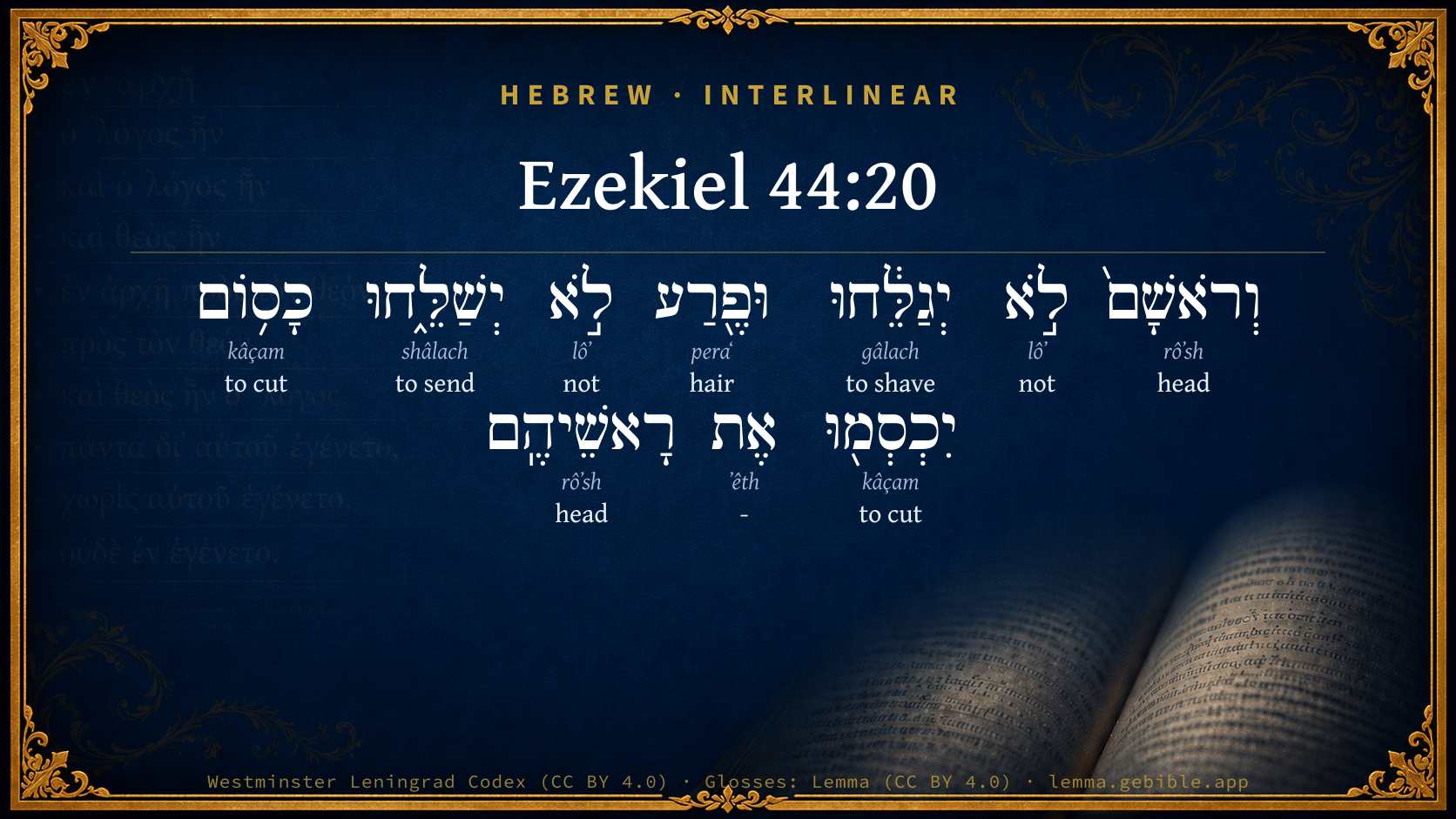
Hebrew (Westminster Leningrad Codex) Ezekiel 44:20 appears in the Hebrew Old Testament. The text above is from the Westminster Leningrad Codex. Each word links to its Strong’s number, a concise gloss, and parsing drawn from the Open Scriptures Hebrew Bible morphology. Click any word for its full Brown-Driver-Briggs (BDB) entry.
Download image
Cite this verse

Ezekiel 44:20 (World English Bible). Public Domain. Lemma interlinear Bible study tool, https://lemma.gebible.app/v/ezekiel/44/20.

Show BibTeX & RIS
BibTeX
RIS
English Translation
Neither shall they shave their heads, nor allow their locks to grow long; they shall only cut off the hair of their heads.
World English Bible · Public Domain
Highlights
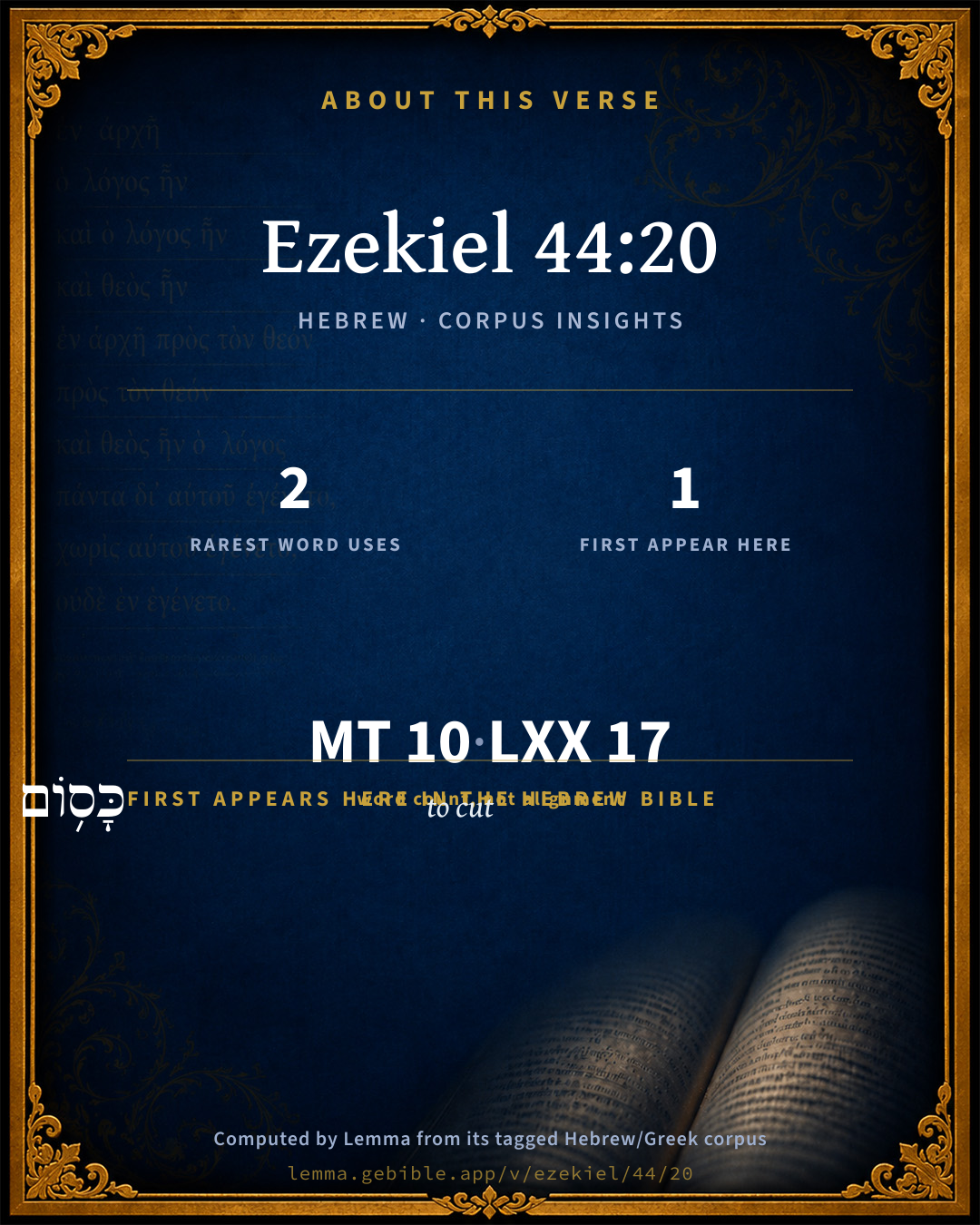
  • 1 first appearance in the Hebrew Bible
Full analysis ↓
Download a study sheet

One document with this verse’s original text, its word-by-word gloss line, the meaning frame, cross-references with their text, attributed commentary, and full source and license credits — printable, and it pastes into notes with its structure intact.

This verse Autodidact and up

Study sheet (.html) Plain text (.txt)

A passage Seminary Student

Up to 50 verses in one chapter. A passage sheet keeps up to 6 commentary sources and 12 cross-references per verse, in the order this page ranks them, and says so on the sheet whenever that leaves anything out. Ask for a single verse and you get the Autodidact verse sheet above.

Everything on this page stays free to read, with no account — the sheet is a download of what is already on screen, not access to it.

Want to remove ads? Support Godless Engineer
Compare translations 3

The same verse in 3 English versions, stacked beneath the original-language interlinear above. Click any original word for its lexicon entry.

Each is an independent rendering of the whole verse — the interlinear is not word-aligned to these translations.

Highlighted words mark where these versions differ — a whole-verse word diff, not a word-by-word alignment.

  • World English Bible Public Domain
    Neither shall they shave their heads, nor allow their locks to grow long; they shall only cut off the hair of their heads.
  • King James Version Public Domain
    Neither shall they shave their heads, nor suffer their locks to grow long; they shall only poll their heads.
  • unfoldingWord Literal Text CC BY-SA 4.0
    Also they must neither shave their heads nor allow their hair to hang loosely, but they must trim the hair of their heads.

unfoldingWord Literal Text — © unfoldingWord, licensed CC BY-SA 4.0. Word-aligned USFM3 via Door43 (git.door43.org/unfoldingWord/en_ult).

Versions to compare (up to 4)

3 of 4 selected

Show all 18 translations

Every available English version of this verse, each an independent rendering of the whole verse.

  • World English Bible Public Domain
    Neither shall they shave their heads, nor allow their locks to grow long; they shall only cut off the hair of their heads.
  • Berean Standard Bible Public Domain
    They must not shave their heads or let their hair grow long, but must carefully trim their hair.
  • Majority Standard Bible Public Domain
    They must not shave their heads or let their hair grow long, but must carefully trim their hair.
  • King James Version Public Domain
    Neither shall they shave their heads, nor suffer their locks to grow long; they shall only poll their heads.
  • American Standard Version (1901) Public Domain
    Neither shall they shave their heads, nor suffer their locks to grow long; they shall only cut off the hair of their heads.
  • Revised Version (1885) Public Domain
    Neither shall they shave their heads, nor suffer their locks to grow long; they shall only poll their heads.
  • Geneva Bible (1599) Public Domain
    They shall not also shaue their heades, nor suffer their lockes to growe long, but rounde their heades.
  • Douay-Rheims (1899) Public Domain
    Neither shall they shave their heads, nor wear long heir: but they shall only poll their heads.
  • Young's Literal Translation Public Domain
    And their head they do not shave, and the lock they do not send forth; they certainly poll their heads.
  • Literal Standard Version CC BY-SA 4.0
    And they do not shave their head, and they do not send forth the lock; they certainly trim their heads.
  • Unlocked Literal Bible CC BY-SA 4.0
    Also they must neither shave their heads nor allow their hair to hang loosely, but they must trim the hair of their heads.
  • unfoldingWord Literal Text CC BY-SA 4.0
    Also they must neither shave their heads nor allow their hair to hang loosely, but they must trim the hair of their heads.
  • Darby Bible Public Domain
    Neither shall they shave their heads, nor suffer their locks to grow long: they shall duly poll their heads.
  • World Messianic Bible Public Domain
    “‘“They shall not shave their heads, or allow their locks to grow long. They shall only cut off the hair of their heads.
  • Webster's Bible Public Domain
    Neither shall they shave their heads, nor suffer their locks to grow long; they shall only poll their heads.
  • Free Bible Version CC BY-SA 4.0
    They are not permitted to shave their heads or let their hair grow long; they must have a proper haircut.
  • Bible in Basic English Public Domain
    They are not to have all the hair cut off their heads, and they are not to let their hair get long, but they are to have the ends of their hair cut.
  • JPS Tanakh (1917) Public Domain
    Neither shall they shave their heads, nor suffer their locks to grow long; they shall only poll their heads.

Literal Standard Version (2020), Covenant Press — licensed CC BY-SA 4.0. Text via the HelloAO Bible API (eBible.org). Unlocked Literal Bible (unfoldingWord) — licensed CC BY-SA 4.0. Text via the HelloAO Bible API (eBible.org). unfoldingWord Literal Text — © unfoldingWord, licensed CC BY-SA 4.0. Word-aligned USFM3 via Door43 (git.door43.org/unfoldingWord/en_ult). Free Bible Version, Dr. Jonathan Gallagher — licensed CC BY-SA 4.0. Text via the HelloAO Bible API (eBible.org).

Word by word

More ways to search: Search by grammar → Find every occurrence → Compare this word →

Practice this passage: Drill this verse → Learn its vocabulary →

וּפֶ֖רַע
peraʻ
H6545
“and · hair”
Conjunction + Noun, Common, Masculine, Singular, Absolute
Part of Speech
Conjunction + Noun
Type
Common
Gender
Masculine
Number
Singular
State
Absolute
Full BDB Definition

Origin: from H6544

TWOT: 1823a , 1822a

hair, long hair (of head), locks - leader
  1. וְרֹאשָׁם֙ rôʼsh H7218 “and · head · their” Conjunction + Noun, Common, Masculine, Singular, Construct + Suffix, Personal, 3rd Person, Masculine, Plural
  2. לֹ֣א lôʼ H3808 “not” Particle, Negative
  3. יְגַלֵּ֔חוּ gâlach H1548 “to shave” Verb, Piel, Imperfect, 3rd Person, Masculine, Plural
  4. לֹ֣א lôʼ H3808 “not” Particle, Negative
  5. יְשַׁלֵּ֑חוּ shâlach H7971 “to send” Verb, Piel, Imperfect, 3rd Person, Masculine, Plural
  6. כָּס֥וֹם kâçam H3697 “to cut” Verb, Qal, Infinitive Absolute
  7. יִכְסְמ֖וּ kâçam H3697 “to cut” Verb, Qal, Imperfect, 3rd Person, Masculine, Plural
  8. אֶת ʼêth H853 “-” Particle, Direct Object
  9. רָאשֵׁיהֶֽם rôʼsh H7218 “heads · their” Noun, Common, Masculine, Plural, Construct + Suffix, Personal, 3rd Person, Masculine, Plural

About this verse

These counts appear in no published source. They are computed here, from the morphology-tagged text and Lemma’s own curated glosses. What Lemma adds →

10
words
7
distinct lemmas
Prophets
section

Notable vocabulary

The rarest word here is וּפֶ֖רַע hair H6545 — appearing just 2 times in the whole Hebrew Bible.

First appearance in Scripture

This word makes its first canonical appearance in the Hebrew Bible here:

  • כָּס֥וֹם to cut H3697

Shared distinctive vocabulary

וּפֶ֖רַע hair H6545 occurs in 2 verses of the Hebrew Bible. Also found in:

Grammatical profile

  • 4 verbs
  • 3 nouns
  • 3 particles

Verb forms

  • יְגַלֵּ֔חוּ Piel · Imperfect
  • יְשַׁלֵּ֑חוּ Piel · Imperfect
  • כָּס֥וֹם Qal · Infinitive Absolute
  • יִכְסְמ֖וּ Qal · Imperfect

Repetition

Words recur within this verse — often emphatic in Hebrew:

  • וְרֹאשָׁם֙ head H7218 ×2
  • כָּס֥וֹם to cut H3697 ×2
  • לֹ֣א not H3808 ×2

Hebrew & Septuagint length

In English translation the verse runs 23 words from the Hebrew and 20 from the Septuagint (LXX English) — closely comparable.

A rough comparison of the two English renderings, which tokenize alike — not a word-level alignment.

Word counts can differ between the Hebrew and the Greek without any difference in meaning — e.g. the Hebrew direct-object marker אֵת has no separate Greek word, and Greek often adds the article ὁ.

In the original languages it is 10 Hebrew tokens and 17 Greek tokens — but the two are counted differently (Hebrew bundles its prefixes and suffixes into one token; the Greek is in lemma form), so that isn’t a like-for-like length.

Cross-references

4

Topical passages linked to Ezekiel 44:20 in the Treasury of Scripture Knowledge — connected by theme and wording, ordered by reader-vote popularity; previews shown in the World English Bible.

  • 1 Corinthians 11:14 Doesn't even nature itself teach you that if a man has long hair, it is a dishonor to him?
  • Leviticus 21:5–24 "'They shall not shave their heads, neither shall they shave off the corners of their beards, nor make any cuttings in their flesh.
  • Numbers 6:5 "All the days of his vow of separation there shall no razor come on his head, until the days are fulfilled, in which he separates himself to Yahweh. He shall be holy. He shall let the locks of the hair of his head grow long.
  • Deuteronomy 14:1 You are the children of Yahweh your God: you shall not cut yourselves, nor make any baldness between your eyes for the dead.

Cross-references courtesy of OpenBible.info (CC BY 4.0).

Hebrew and Greek witnesses Masoretic Hebrew ↔ Greek Septuagint

The same verse in the two great witnesses to the Old Testament, shown verse-for-verse.

These are two independent witnesses, not word-aligned to each other, and the Septuagint is shown in lemma (dictionary) form.

Hebrew Ezekiel 44:20 Masoretic · Westminster Leningrad Codex

וְרֹאשָׁם֙ לֹ֣א יְגַלֵּ֔חוּ וּפֶ֖רַע לֹ֣א יְשַׁלֵּ֑חוּ כָּס֥וֹם יִכְסְמ֖וּ אֶת רָאשֵׁיהֶֽם

Neither shall they shave their heads, nor allow their locks to grow long; they shall only cut off the hair of their heads.

World English Bible · Public Domain

Greek LXX Ezekiel 44:20 Septuagint · lemma form

καί ὁ κεφαλή αὐτός οὐ ξυράω καί ὁ κόμη αὐτός οὐ ψιλόω καλύπτω καλύπτω ὁ κεφαλή αὐτός

And they shall not shave their heads, nor shall they pluck off their hair; they shall carefully cover their heads.

LXX2012 (modern English Septuagint) · Public Domain

Hebrew: Westminster Leningrad Codex (CC BY 4.0). Greek: Septuagint (public domain); English from LXX2012 (modern English Septuagint) (Public Domain). How the Septuagint differs from the Hebrew →

Targum (Aramaic paraphrase)

1

The Targum is the ancient Jewish Aramaic paraphrase of the Hebrew Scriptures — an interpretive translation, not the Hebrew text itself. Onkelos (literal) and Pseudo-Jonathan (expansive) render the Torah, and Jonathan the Prophets. Coverage is partial: where no permissively-licensed English translation exists for a verse, only the Aramaic is shown. This is verse-level text, not a word-by-word alignment to the Hebrew.

  1. Targum Jonathan Prophets (Joshua–Malachi)
    וְרֵישֵׁיהוֹן לָא יְגִלְחוּן וּפֵירוּעַ לָא יִרְבּוּן סַפָּרָא יִסְפְּרוּן יַת שְׂעַר רֵישֵׁיהוֹן:

    (no public-domain English translation for this verse)

    Targum Jonathan — Aramaic: “Mikraot Gedolot” (public domain). English: “Sefaria Community Translation” (CC0 1.0 (public-domain dedication)); “London "Chaldee Paraphrase," 1871” (public domain). Text via Sefaria.

Commentary

Notes on Ezekiel 44:20 from classic Christian and Jewish commentators (each source and its license shown beneath its notes). The classic Christian expositions comment on the surrounding passage and are grouped to its opening verse, so a note may address several verses; the Jewish commentaries on the Tanakh (Rashi and others) are per-verse, so they appear only where the commentator wrote on this verse.

Lemma curates 59 commentaries, every one of them public domain or Creative Commons licensed, each selected and text-cleaned for this edition rather than reprinted as found. About our sources →

Trapp's Complete Commentary

John Trapp

Eze 44:20 Neither shall they shave their heads, nor suffer their locks to grow long; they shall only poll their heads.

Ver. 20. Neither shall they shave their heads.] What can the Popish shavelings say to this, qui ne pilum ullum viri bona habere videntur, as Cicero {a} saith of Fannins Chaereas? noting it to be a sign of crafty malice to be shaven. And indeed is so bald and heathenish a ceremony that some priests in France are ashamed of the mark, and few of them have it that can handsomely avoid it. {b}

Nor suffer their locks to grow long.] As women’s: some heathen priests nourished their hair to a great length. A shag-haired minister is an ugly sight: bushes of vanity become not such, of any men.

They shall only poll their heads.] Or, Round them. Certainly, saith one, {c} the devil had forgotten this text when he raised up that reproach of Roundheads. To have hairy scalps is the garb of God’s enemies. {Psa 68:21}

{a} In Orat. pro Rosc. Comaedo.

{b} Spec. Eur.

{c} Mr Burroughs.

John Trapp, A Commentary or Exposition upon All the Books of the Old and New Testament (1647–1656) — public domain. Text from a community e-Sword module.

Tyndale Open Study Notes

Tyndale Open Resources

44:20-27 The priests were to avoid contact with death, either by being in the presence of a dead person or through the ritual mourning practices in which they would shave their heads or let their hair grow completely free. They must not drink wine before entering the inner courtyard to avoid the risk of potentially fatal alcohol-induced errors (see Lev 10:9). The priests were restricted in marriage to virgins of Israel or to widows of the priests to ensure the continuing purity of the priestly line. In all of these ways, the priests were to model the radical distinction between holy and common and between the ceremonially clean and unclean for the people.

Tyndale Open Study Notes — © Tyndale Open Resources, licensed CC BY-SA 4.0. Text via the HelloAO Bible API.

Geneva Bible (1599)

Geneva Bible translators

As did the infidels and heathen.

Geneva Bible (1599) marginal notes — public domain. Text via Bolls.life.

Jamieson, Fausset & Brown

Robert Jamieson, A. R. Fausset & David Brown

Neither . . . shave . . . heads--as mourners do (Lev 21:1-5). The worshippers of the Egyptian idols Serapis and Isis shaved their heads; another reason why Jehovah's priests are not to do so.

nor suffer . . . locks to grow long--as the luxurious, barbarians, and soldiers in warfare did [JEROME].

Jamieson, Fausset & Brown — Commentary Critical and Explanatory on the Whole Bible (1871) — public domain (CC PDM 1.0). Text via the HelloAO Bible API.

Adam Clarke's Commentary

Verse 20. Neither shall they shave their heads] The priests of Isis shaved their heads close to the skin; the priests of Budhoo do so still, their ordinances oblige them to shave their heads every tenth day. To let the hair grow long would have been improper; therefore the Lord commands them to poll-cut the hair short, but not to shave.

Adam Clarke's Commentary on the Bible (1810–1826) — public domain. Text from a community e-Sword/MySword module.

Ellicott's Commentary for English Readers

(20) Their locks to grow long.—The law forbade the shaving of the head (Lev_21:5), but only condemned letting the hair grow long by implication, providing for it in the exceptional case of the vow of the Nazarite. The prohibition of Eze_44:21 is given in Lev_10:9.

A Bible Commentary for English Readers, edited by Charles John Ellicott (1878–1897) — public domain. Text from a community e-Sword module.

The Cambridge Bible for Schools and Colleges

gen. ed. J. J. S. Perowne

20. The priests shall poll or cut the hair of their heads, and neither shave their heads bald nor let the hair flow loose. Shaving the head bald was a sign of mourning (Lev_21:5; Lev_21:10, cf. Eze_24:17), and forbidden both to priests and people as a practice of the heathen (Deu_14:1); though the prophets frequently refer to it as a token of disaster and mourning; Isa_3:24; Isa_22:12; Jer_16:6; Amo_8:10; Mic_1:16. Lev_10:6 indicates that letting the hair flow loose and dishevelled was also a sign of grief. The phrase appears used both of this practice and of the Nazirite custom of allowing the hair to remain uncut (Num_6:5, cf. Num_5:18).

The Cambridge Bible for Schools and Colleges (gen. ed. J. J. S. Perowne; Cambridge University Press, 1878–1918) — public domain. Text from a community e-Sword module.

John Gill's Exposition

Neither shall they shave their heads,.... As the priests and worshippers of Isis and Serapis did, as Jerom on the text observes; and as the Romish priests now do, from whom the Lord's faithful ministers must be distinguished:

nor suffer their locks to grow long; as the Nazarites, that a distinction might be preserved between those who were and were not such; or rather, after the manner of women, their locks hanging down, and flowing about their shoulders, as a token of levity, wantonness, effeminacy, pride, and vanity; see Co1 11:14,

they shall only poll their heads; observe a medium between both; neither shave their heads close, nor let their hair grow long, but keep it in an even moderate length; for which reason godly men of the last age among us were called "round heads".

John Gill's Exposition of the Whole Bible (1746–1763) — public domain (CC PDM 1.0). Text via the HelloAO Bible API.

Haydock's Catholic Bible Commentary

Shave, like the priests of Isis. (Juvenal vi.)

George Leo Haydock (1774–1849), Haydock's Catholic Family Bible and Commentary, 1859 edition — public domain. Excludes Psalms (Douay-Rheims chapter numbering differs from Protestant) and Deuterocanonical books (Catholic canon only).

Matthew Poole's English Annotations

To shave their heads was forbidden, Lev 19:27; 21:5. Hair is given for an ornament, and the priests should not disfigure themselves, nor imitate idolatrous heathens.

Nor suffer their locks to grow long; priding themselves in it, as Absalom, giving ill example by such excess. Shall only poll their heads; when the hair is grown somewhat, they shall trim, cut the ends of their hair, and keep it in moderate size; beside, long hair was a token of a Nazarite’s vow, and God would have all holy things and persons kept unmixed and distinguished from other common things.

Matthew Poole's English Annotations on the Holy Bible (1683–1685) — public domain. Text from a community e-Sword/MySword module.

Whedon's Commentary on the Bible

Daniel D. Whedon

20. The hair was regarded as the seat of life by every ancient nation (note Eze_5:14), and very probably when the hair was shaved off it was offered to the deity (compare Num_6:18), involving, as Toy suggests, temporary uncleanness, or taboo, and therefore to be avoided by priests. (Compare Eze_44:25.) Letting the hair grow without polling (cutting) was also often connected with a vow (compare Num_6:5; Act_18:18), and entailed the same inconvenience. It may be added that certainly the shaved head (Lev_21:5; Lev_21:10), and probably the flowing hair (Lev_10:6, R.V.), was a sign of mourning among the Jews, and therefore to be prohibited in those who lived constantly in the joy of Jehovah’s presence.

Daniel D. Whedon (gen. ed.), Commentary on the Old and New Testaments (1874–1909) — public domain. Text from a community e-Sword module.

The Pulpit Commentary

The next rubric concerned the mode in which the priests should wear their hair. It should neither be shaved nor worn long, thus avoiding excess on either side (compare for the first, Lev_21:5; and for the second, Lev_10:6 Lev_21:10, Revised Version) but should merely be polled. The obligation to let the hair grow freely was imposed upon the Nazarite only during the period of his vow. (Num_6:5) The verb "to poll," or "cut" ( occurs nowhere else. Smend thinks what is hero denied to the priests collectively is in the priest-code denied solely to the high priest, (Lev_21:10, Revised Version; compare, however, Lev_10:6, Revised Version) and discovers in this a sign of the later origin of Leviticus. Ezekiel"s raising the priesthood as a body to the rank of the high priest, of whom in connection with this temple is no trace, rather proves Ezekiel to have been later than Leviticus.

The Pulpit Commentary (1880–1919), ed. H.D.M. Spence-Jones & Joseph S. Exell — public domain. Text from a community e-Sword module.

John Wesley's Explanatory Notes

To grow long - Priding themselves in it, as Absalom. Shall only poll - When the hair is grown, they shall cut the ends of their hair, and keep it in moderate size.

John Wesley, Explanatory Notes Upon the Whole Bible (1754–1765) — public domain. Text via the GEBible commentary corpus.

unfoldingWord translationNotes

Door43 World Missions Community

General Information:

Yahweh continues giving Ezekiel his message to the house of Israel about the descendants of Zadok who serve as priests.

must trim the hair of their heads

must keep their hair neat

widow

a woman whose husband has died

from the line of the house of Israel

"who is a descendant of the people of Israel"

the house of Israel

The word "house" is a metonym for the family that lives in the house, in this case the Israelites, the descendants of Jacob over many years. See how you translated this in Ezekiel 3:1. AT: "the Israelites" or "the Israelite people group" (See: Metonymy)

translationWords

wine

divorce

virgin

unfoldingWord translationNotes — © Distant Shores Media and the Door43 World Missions Community, licensed CC BY-SA 4.0. Source: git.door43.org/Door43/en_tn.

Rashi

Rabbi Shlomo Yitzchaki (Rashi)

And [the hair of] their heads they are not to shave to remove all the hair.

but also not to let it grow wild They may not let their hair grow very long.

they must be careful to trim [Heb. כָּסוּם יִכְסְמוּ, (to cut the hair so that it appears)] like spelt (כֻּסֶמֶת), which is arranged on the ear [with] the end of one beside the root of another. So I heard in the name of Rabbi Menahem of blessed memory. It is possible to explain it as an expression for a measure of a medium thing, neither shearing [all the hair of] the head nor letting the hair grow long, but a medium amount, amo(d)ler in O.F., to cut to medium length.

Rashi on the Tanakh — English translations: “The Judaica Press complete Tanach with Rashi, translated by A. J. Rosenberg” (CC BY 4.0); “Pentateuch with Rashi's commentary by M. Rosenbaum and A.M. Silbermann, 1929-1934” (public domain); “The Metsudah Tanach series, Lakewood, N.J” (CC BY 4.0); and “The Book of Joshua, Metsudah Publications, 1997” (CC BY 4.0). Text via Sefaria.

Lesson kit

Teaching starters — assembled from the data on this page, not authored interpretation. Every prompt links to the verse data it draws on. Edit before teaching.

Ezekiel, in the Prophets, opens this verse with 10 words (7 distinct Hebrew lemmas). Its most distinctive word is peraʻ (“hair”). A historical commentator’s framing appears above. Read the whole chapter for the surrounding context.

Discussion questions

  1. The word peraʻ carries the sense “hair.” How does it shape the verse?
  2. This is the first place “to cut” appears in Scripture (first appears here). What does its debut here establish?
  3. How does Numbers 6:5, which shares the word «hair», read alongside this verse?
  4. What does the repetition of “head” (2× in this one verse) do in this verse?
  5. These translations render this verse differently; the difference is in the English rendering, not the original. What questions does that raise?
  6. «יְגַלֵּ֔חוּ» is a Piel Imperfect verb. How does that grammatical form shape the action described?
  7. Compare how Trapp's Complete Commentary and Tyndale Open Study Notes read this verse. Where do they agree or differ?

Things to notice

Reading settings

Reading text

Shown beneath each verse's original-language words.

Old Testament
Old Testament edition

Read the OT as the Masoretic Hebrew (MT) or the Greek Septuagint (LXX).

English shown for the Greek Septuagint (in the Hebrew ↔ Greek comparison).

Comparing translations? Open the Compare panel on any verse page to stack up to four side by side.