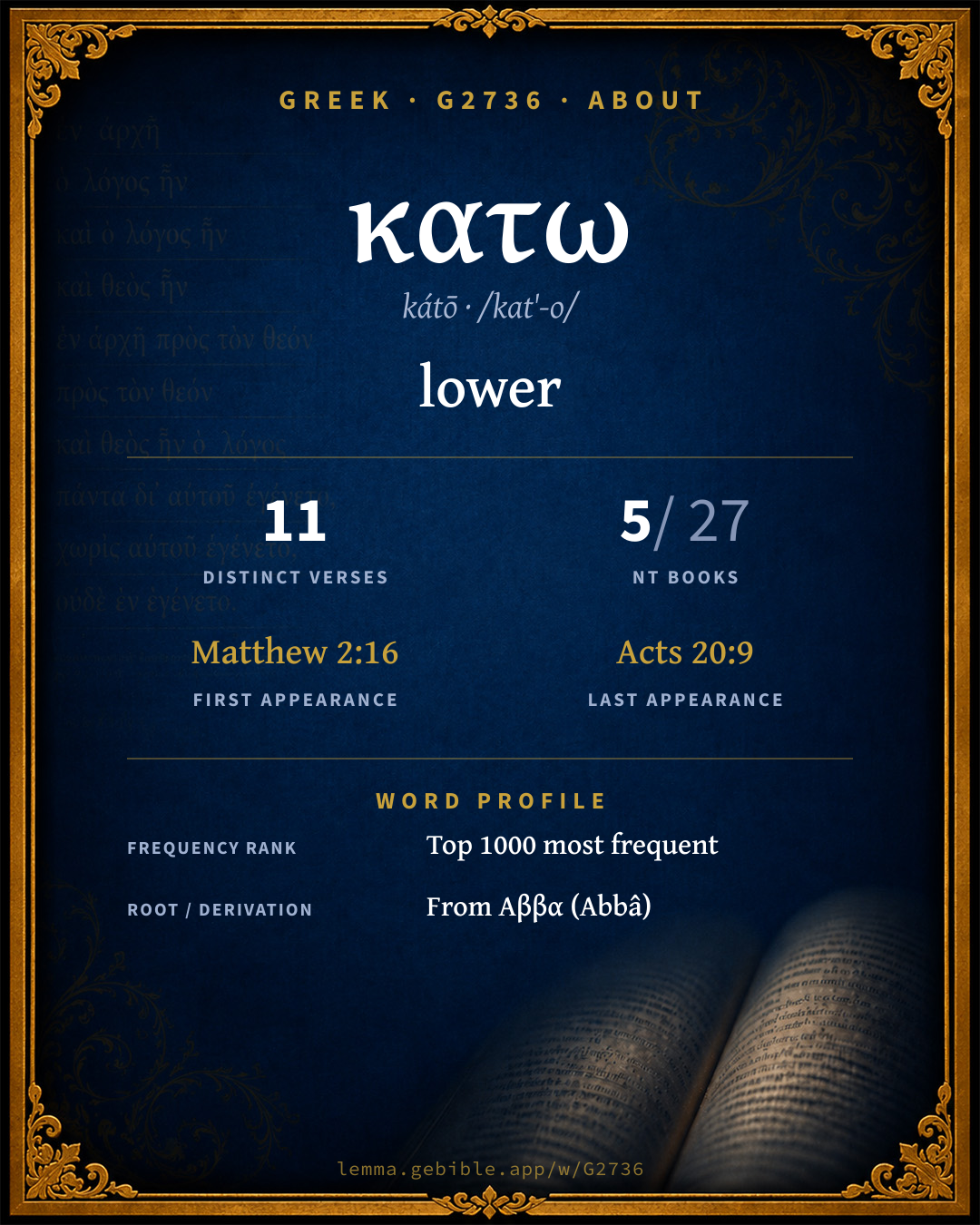
κατω
lower
Full lexicon entry — Thayer's Greek Lexicon
From Thayer's Greek Lexicon
Where this word appears
Grammar key — what these labels mean
Part of speech
- Adverb
- A word that modifies a verb, adjective, or other adverb.
Degree
- Comparative
- Expresses a greater degree (“greater,” “more”).
Every verse where G2736 appears in the Book of Mark — 2 distinct verses. Click any verse to open its interlinear word-by-word view. Verse text shown in the World English Bible for context — . Each verse’s Greek form is shown with its reference; the English is not keyword-highlighted, since the data carries no word-level English alignment. Use “Compare translations” on any verse to read it across multiple English versions. This concordance covers the Greek New Testament; Septuagint (Greek Old Testament) occurrences of this word are not indexed here.
Mark
About this entry
At a glance — auto-summarized from this page’s data, not written by a person. Every figure links to its source below. This summary describes the numbers; it doesn’t interpret them.
The Greek word κατω centers on the idea of “lower.” Its earliest occurrence is Matthew 2:16. Spanning 11 verses in 5 books, it ranks among the uncommon words of the Greek New Testament. Matthew dominates its distribution — 3 of 11 verses. Related forms include Αββα and κατωτερος. Dig into 11-verse concordance and the renderings breakdown below.
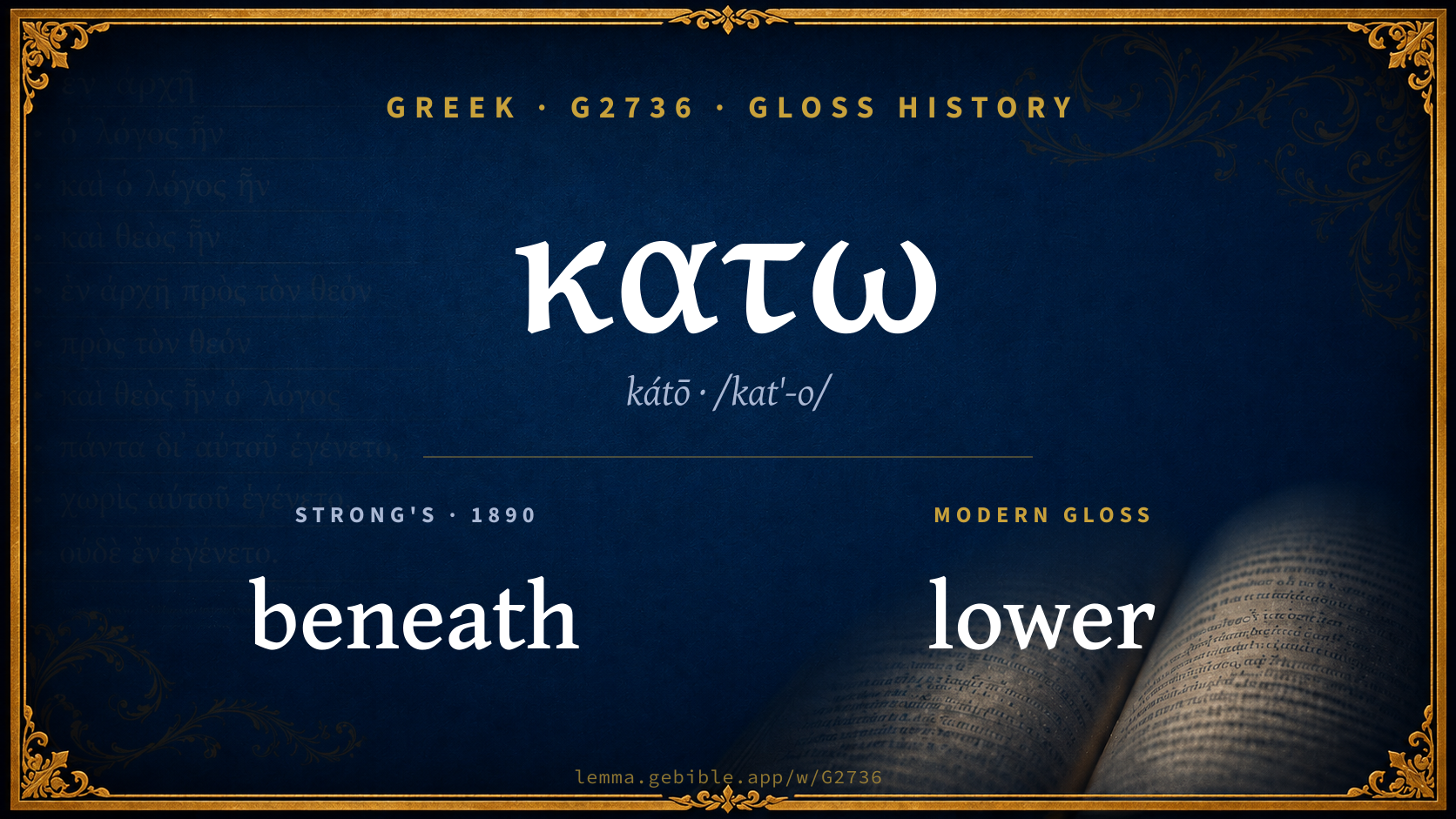
Gloss history
Strong's 1890 vs modern scholarship
About this word
Strong's G2736 catalogs a Greek word from the Greek New Testament.
These counts are not copied from any lexicon or concordance. They are computed here, from the morphology-tagged Greek New Testament. What Lemma adds →
- 11
- distinct verses
- The word appears in 11 distinct verses.
- 5 / 27
- NT books
- The word appears in 5 of 27 New Testament books.
- #978
- by frequency
- Top 1000 most frequent Greek words (rank 978 of 5,347 Greek words by occurrence).
View all 11 occurrences in the concordance →
By section of the New Testament
By traditional corpus
Conventional, traditional groupings — biblical authorship is debated, so this is a traditional corpus grouping, not an authorship claim. Some books belong to more than one corpus (Luke is in both the Gospels and the Lukan corpus, and so on), so these shares overlap and need not total 100%. Each figure is a share of the word’s 11 distinct verses.
- Gospels 9 verses · 82%
- Lukan (Luke–Acts) 3 verses · 27%
- Johannine 3 verses · 27%
How translations render this word
Counts come from each version’s own published word-to-Strong’s tagging or interlinear alignment — an approximate guide to how each version renders this word, not a word-level alignment the data otherwise carries. Because each total is that version’s own tagged count, the per-version totals vary from one another and need not match the appearance or distinct-verse counts above. These counts may also differ from a printed concordance because Lemma counts each distinctly tagged rendering and does not collapse phrase taggings into a single head-word total. This is a fixed set of word-tagged versions (KJV, ASV, BSB, ULT) and does not change with the reading translation you choose elsewhere. Each version’s license is shown beside its name below (and on Sources).
- King James Version: Down 4×, Beneath 3×, Bottom 2×
- American Standard Version: Down 4×, Beneath 3×, Bottom 2×
- Berean Standard Bible: Below 3×, Down 3×, Bottom 2×
- unfoldingWord Literal Text: Down 4×, Below 3×, Bottom 2×
King James Version Public Domain
Renders G2736 across 11 tagged occurrences — most commonly:
Plus 2 renderings that appear only once — usually multi-word phrases or single function words the recovered tagging swept in, not distinct renderings.
American Standard Version Public Domain
Renders G2736 across 11 tagged occurrences — most commonly:
Plus 2 renderings that appear only once — usually multi-word phrases or single function words the recovered tagging swept in, not distinct renderings.
Berean Standard Bible Public Domain
Renders G2736 across 9 tagged occurrences — most commonly:
Plus 1 rendering that appears only once — usually multi-word phrases or single function words the recovered tagging swept in, not distinct renderings. Not rendered by a distinct English word in 1 further occurrence.
unfoldingWord Literal Text CC BY-SA 4.0
Renders G2736 across 9 tagged occurrences — most commonly:
Word origin
Derived from Αββα (Abbâ) (G5) — father.
Forms in the corpus
The 2 distinct written forms G2736 takes in the Greek New Testament, most frequent first — each parse links to that case’s occurrences in the concordance.
| Form | Parsing | Example | Uses |
|---|---|---|---|
| κάτω kátō | Adverb | Matthew 4:6 | 10 |
| κατωτέρω katōtérō | Adverb, Comparative | Matthew 2:16 | 1 |
Same root — word family
Other Thayer's entries built from the same root as G2736, grouped by Strong’s listed origin. These share a root / origin per the lexicon — not necessarily a shared meaning. Each links to that word’s own entry.
Derives from
Derived from this word
Compare all same-root words → They share a root, not necessarily a meaning.
Septuagint usage
The same Greek word κατω appears 24 times in the Greek Old Testament (Septuagint), across 23 verses in 12 books.
- 24
- LXX occurrences
- Tagged occurrences of this Greek word in the Septuagint.
- 23
- verses
- Distinct Septuagint verses containing this word.
- 12 / 39
- OT books
- The word appears in 12 of the 39 Old Testament books.
Sample Septuagint occurrences
- Genesis 35:8 κατώ
- Exodus 20:4 κάτω
- Deuteronomy 4:39 κάτω
- Joshua 2:11 κάτω
- 1 Kings 8:23 κάτω
- 2 Kings 19:30 κάτω
- 1 Chronicles 7:24 κάτω
- 2 Chronicles 8:5 κάτω
- Ecclesiastes 3:21 κάτω
- Isaiah 8:22 κάτω
- Jeremiah 38:35 κάτω
- Ezekiel 1:27 κάτω
Septuagint occurrences (same lexeme)
Every verse where the same Strong’s number (G2736) appears in the Greek Septuagint. Verse text shown in the World English Bible for context; the Greek form is the matched word — the English is not keyword-highlighted.
- Genesis 35:8 κατώ Deborah, Rebekah's nurse, died, and she was buried below Bethel under the oak; and the name of it was called Allon Bacuth.
- Exodus 20:4 κάτω "You shall not make for yourselves an idol, nor any image of anything that is in the heavens above, or that is in the earth beneath, or that is in the water under the earth:
- Deuteronomy 4:39 κάτω Know therefore this day, and lay it to your heart, that Yahweh he is God in heaven above and on the earth beneath; there is none else.
- Deuteronomy 5:8 κάτω "You shall not make an engraved image for yourself, [nor] any likeness [of anything] that is in heaven above, or that is in the earth beneath, or that is in the water under the earth:
- Deuteronomy 28:43 κάτω The foreigner who is in the midst of you shall mount up above you higher and higher; and you shall come down lower and lower.
- Deuteronomy 32:22 κάτω For a fire is kindled in my anger, Burns to the lowest Sheol, Devours the earth with its increase, Sets on fire the foundations of the mountains.
- Joshua 2:11 κάτω As soon as we had heard it, our hearts did melt, neither did there remain any more spirit in any man, because of you: for Yahweh your God, he is God in heaven above, and on earth beneath.
- Joshua 15:19 κάτω She said, Give me a blessing; for that you have set me in the land of the South, give me also springs of water. He gave her the upper springs and the lower springs.
- Joshua 16:3 κάτω and it went down westward to the border of the Japhletites, to the border of Beth Horon the lower, even to Gezer; and the goings out of it were at the sea.
- Joshua 18:13 κάτω The border passed along from there to Luz, to the side of Luz (the same is Bethel), southward; and the border went down to Ataroth Addar, by the mountain that lies on the south of Beth Horon the lower.
- 1 Kings 8:23 κάτω and he said, Yahweh, the God of Israel, there is no God like you, in heaven above, or on earth beneath; who keep covenant and loving kindness with your servants, who walk before you with all their heart;
- 2 Kings 19:30 κάτω The remnant that has escaped of the house of Judah shall again take root downward, and bear fruit upward.
- 1 Chronicles 7:24 κάτω His daughter was Sheerah, who built Beth Horon the lower and the upper, and Uzzen Sheerah.
- 1 Chronicles 27:23 κάτω But David didn't take the number of them from twenty years old and under, because Yahweh had said he would increase Israel like the stars of the sky.
- 2 Chronicles 8:5 κάτω Also he built Beth Horon the upper, and Beth Horon the lower, fortified cities, with walls, gates, and bars;
- 2 Chronicles 32:30 κάτω This same Hezekiah also stopped the upper spring of the waters of Gihon, and brought them straight down on the west side of the city of David. Hezekiah prospered in all his works.
- Ecclesiastes 3:21 κάτω Who knows the spirit of man, whether it goes upward, and the spirit of the animal, whether it goes downward to the earth?"
- Isaiah 8:22 κάτω and they shall look to the earth, and see, distress and darkness, the gloom of anguish; and into thick darkness [they shall be] driven away.
- Isaiah 37:31 κάτω The remnant that is escaped of the house of Judah shall again take root downward, and bear fruit upward.
- Isaiah 51:6 κάτω Lift up your eyes to the heavens, and look on the earth beneath; for the heavens shall vanish away like smoke, and the earth shall wax old like a garment; and those who dwell therein shall die in like manner: but my salvation shall be forever, and my righteousness shall not be abolished.
- Jeremiah 38:35 κάτω
- Ezekiel 1:27 κάτω I saw as it were glowing metal, as the appearance of fire within it round about, from the appearance of his loins and upward; and from the appearance of his loins and downward I saw as it were the appearance of fire, and there was brightness round about him.
- Ezekiel 8:2 κάτω Then I saw, and, behold, a likeness as the appearance of fire; from the appearance of his loins and downward, fire; and from his loins and upward, as the appearance of brightness, as it were glowing metal.
These are occurrences of the same Greek lexeme (G2736) in the Septuagint — not a translation of any one Hebrew word. The store carries no word-level Hebrew↔Greek alignment, so no Hebrew original is asserted here. Counts come from the recovered LXX Strong's tagging — high-frequency vocabulary is well covered, while rare or late forms may be untagged — so they reflect tagged occurrences and may slightly undercount.