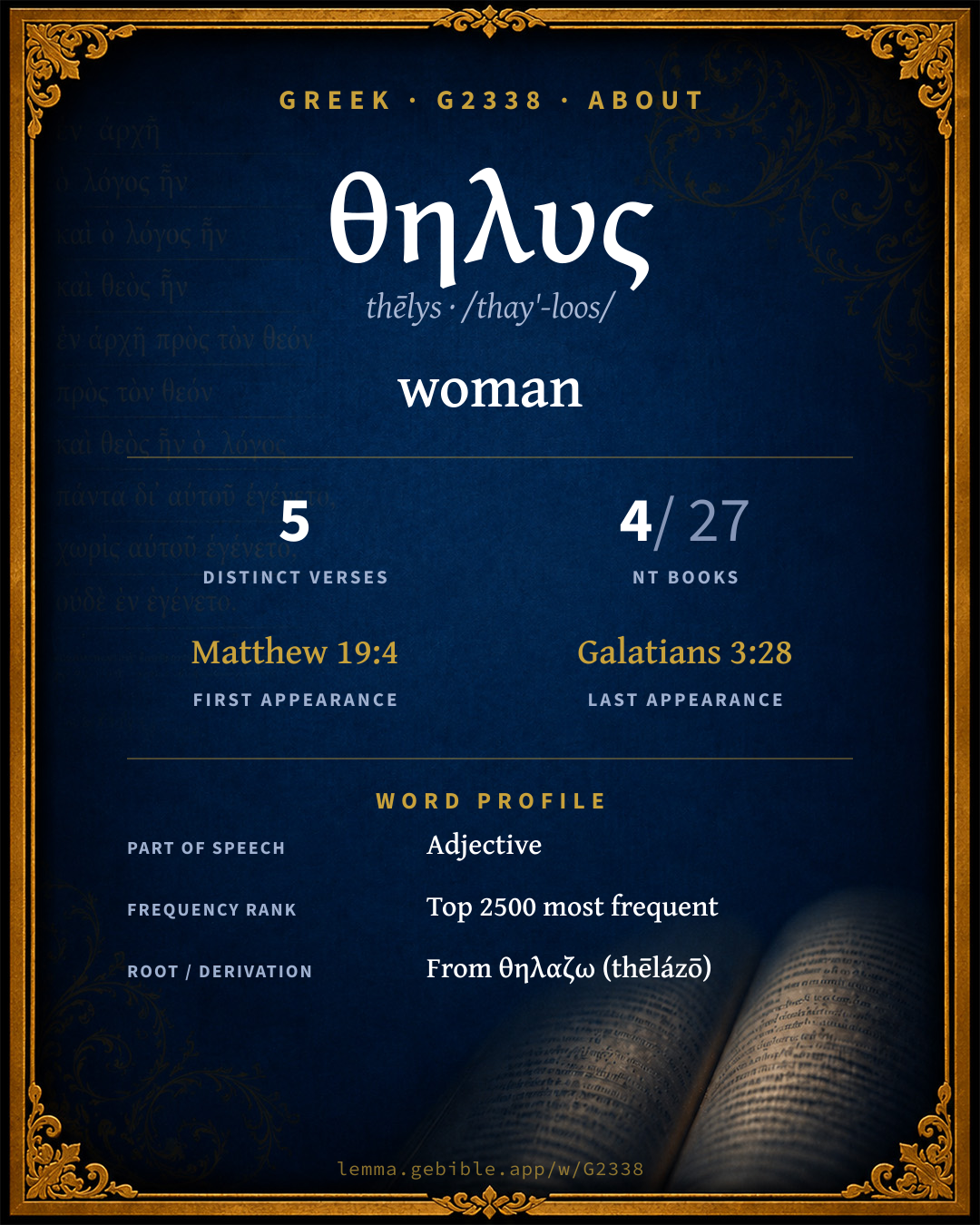
θῆλυς
woman
‘woman’ is one of 2 main senses fuller range ↓
Full lexicon entry — Thayer's Greek Lexicon
From Thayer's Greek Lexicon
Where this word appears
Grammar key — what these labels mean
Part of speech
- Adjective
- A word that describes or qualifies a noun.
Case
- Accusative
- The case of the direct object and of extent.
- Genitive
- The case of source, possession, or “of” — answers “whose / from what.”
- Nominative
- The case of the subject (and the predicate nominative).
Gender
- Neuter
- Grammatically neuter.
- Feminine
- Grammatically feminine.
Number
- Singular
- One.
- Plural
- More than one.
Every verse where G2338 appears in the Book of Mark — 1 distinct verse. Click any verse to open its interlinear word-by-word view. Verse text shown in the World English Bible for context — . Each verse’s Greek form is shown with its reference; the English is not keyword-highlighted, since the data carries no word-level English alignment. Use “Compare translations” on any verse to read it across multiple English versions. This concordance covers the Greek New Testament; Septuagint (Greek Old Testament) occurrences of this word are not indexed here.
Mark
About this entry
At a glance — auto-summarized from this page’s data, not written by a person. Every figure links to its source below. This summary describes the numbers; it doesn’t interpret them.
θηλυς (thēlys) is a Greek adjective most often rendered “woman.” A scarce word — 5 verses in all of the Greek New Testament. Romans dominates its distribution — 2 of 5 verses. It first appears in Matthew 19:4. Its lexical range runs to 2 senses. The sections below give every sense, occurrence, and version rendering.
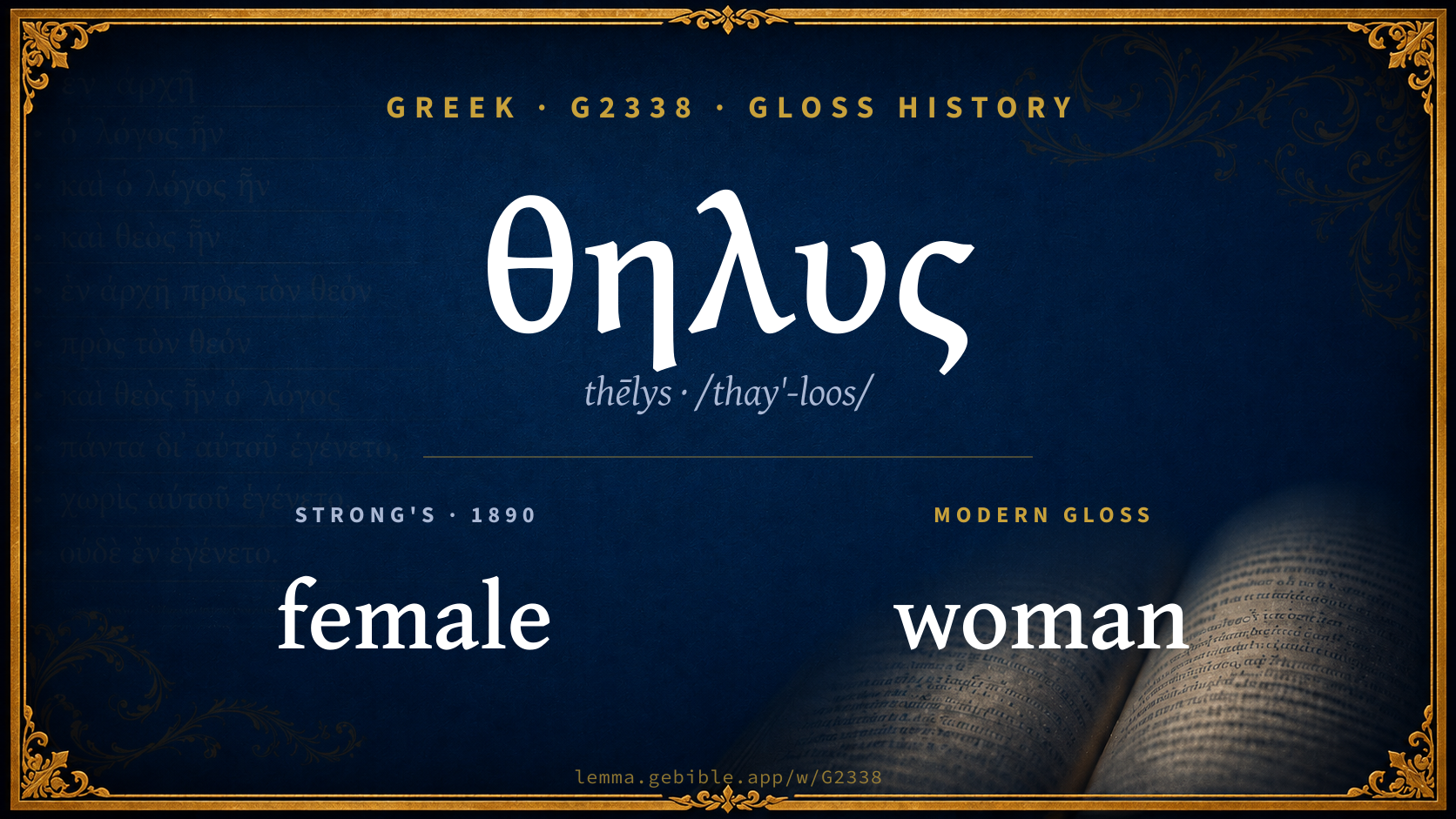
Gloss history
Strong's 1890 vs modern scholarship
About this word
Strong's G2338 catalogs a Greek word from the Greek New Testament.
These counts are not copied from any lexicon or concordance. They are computed here, from the morphology-tagged Greek New Testament. What Lemma adds →
- 5
- distinct verses
- The word appears in 5 distinct verses.
- 4 / 27
- NT books
- The word appears in 4 of 27 New Testament books.
- #1,648
- by frequency
- Top 2500 most frequent Greek words (rank 1,648 of 5,347 Greek words by occurrence).
View all 5 occurrences in the concordance →
By section of the New Testament
By traditional corpus
Conventional, traditional groupings — biblical authorship is debated, so this is a traditional corpus grouping, not an authorship claim. Some books belong to more than one corpus (Luke is in both the Gospels and the Lukan corpus, and so on), so these shares overlap and need not total 100%. Each figure is a share of the word’s 5 distinct verses.
- Pauline corpus 3 verses · 60%
- Gospels 2 verses · 40%
How translations render this word
Counts come from each version’s own published word-to-Strong’s tagging or interlinear alignment — an approximate guide to how each version renders this word, not a word-level alignment the data otherwise carries. Because each total is that version’s own tagged count, the per-version totals vary from one another and need not match the appearance or distinct-verse counts above. These counts may also differ from a printed concordance because Lemma counts each distinctly tagged rendering and does not collapse phrase taggings into a single head-word total. This is a fixed set of word-tagged versions (KJV, ASV, BSB, ULT) and does not change with the reading translation you choose elsewhere. Each version’s license is shown beside its name below (and on Sources).
- King James Version: Female 3×
- American Standard Version: Female 3×
- Berean Standard Bible: Female 3×, Women 2×
- unfoldingWord Literal Text: Female 4×
King James Version Public Domain
Renders G2338 across 5 tagged occurrences — most commonly:
Plus 2 renderings that appear only once — usually multi-word phrases or single function words the recovered tagging swept in, not distinct renderings.
American Standard Version Public Domain
Renders G2338 across 5 tagged occurrences — most commonly:
Plus 2 renderings that appear only once — usually multi-word phrases or single function words the recovered tagging swept in, not distinct renderings.
Berean Standard Bible Public Domain
Renders G2338 across 5 tagged occurrences — most commonly:
unfoldingWord Literal Text CC BY-SA 4.0
Renders G2338 across 6 tagged occurrences — most commonly:
Plus 2 renderings that appear only once — usually multi-word phrases or single function words the recovered tagging swept in, not distinct renderings.
Senses in Thayer's
The 2 senses Thayer's distinguishes for this word, in lexicon order (not ranked by frequency or importance). The full entry — with sub-senses — is in the Lexicon Entry tab.
- of the female sex
- a woman, a female
Word origin
Derived from θηλαζω (thēlázō) (G2337) — to suckle.
From the same as G2337 ; female : - female woman.
— Strong’s Exhaustive Concordance (1890), public domain.
Forms in the corpus
The 3 distinct written forms G2338 takes in the Greek New Testament, most frequent first — each parse links to that case’s occurrences in the concordance.
| Form | Parsing | Example | Uses |
|---|---|---|---|
| θῆλυ thē̂ly | Adjective, Accusative, Singular, Neuter | Matthew 19:4 | 3 |
| θήλειαι thḗleiai | Adjective, Nominative, Plural, Feminine | Romans 1:26 | 1 |
| θηλείας thēleías | Adjective, Genitive, Singular, Feminine | Romans 1:27 | 1 |
Septuagint usage
The same Greek word θηλυς appears 33 times in the Greek Old Testament (Septuagint), across 31 verses in 10 books.
- 33
- LXX occurrences
- Tagged occurrences of this Greek word in the Septuagint.
- 31
- verses
- Distinct Septuagint verses containing this word.
- 10 / 39
- OT books
- The word appears in 10 of the 39 Old Testament books.
Sample Septuagint occurrences
- Genesis 1:27 θῆλυς
- Exodus 1:16 θῆλυς
- Leviticus 3:1 θῆλυς
- Numbers 31:15 θῆλυς
- Judges 5:10 θῆλυς
- 1 Kings 10:26 θῆλυς
- 2 Chronicles 9:25 θῆλυς
- Job 1:3 θῆλυς
- Proverbs 30:31 θῆλυς
- Amos 6:12 θῆλυς
Septuagint occurrences (same lexeme)
Every verse where the same Strong’s number (G2338) appears in the Greek Septuagint. Verse text shown in the World English Bible for context; the Greek form is the matched word — the English is not keyword-highlighted.
- Genesis 1:27 θῆλυς God created man in his own image. In God's image he created him; male and female he created them.
- Genesis 5:2 θῆλυς He created them male and female, and blessed them, and called their name Adam, in the day when they were created.
- Genesis 6:19 θῆλυς Of every living thing of all flesh, you shall bring two of every sort into the ark, to keep them alive with you. They shall be male and female.
- Genesis 6:20 θῆλυς Of the birds after their kind, of the cattle after their kind, of every creeping thing of the ground after its kind, two of every sort shall come to you, to keep them alive.
- Genesis 7:2 θῆλυς You shall take seven pairs of every clean animal with you, the male and his female. Of the animals that are not clean, take two, the male and his female.
- Genesis 7:3 θῆλυς Also of the birds of the sky, seven and seven, male and female, to keep seed alive on the surface of all the earth.
- Genesis 7:9 θῆλυς went by pairs to Noah into the ark, male and female, as God commanded Noah.
- Genesis 7:16 θῆλυς Those who went in, went in male and female of all flesh, as God commanded him; and Yahweh shut him in.
- Exodus 1:16 θῆλυς and he said, "When you perform the duty of a midwife to the Hebrew women, and see them on the birth stool; if it is a son, then you shall kill him; but if it is a daughter, then she shall live."
- Exodus 1:22 θῆλυς Pharaoh charged all his people, saying, "You shall cast every son who is born into the river, and every daughter you shall save alive."
- Leviticus 3:1 θῆλυς "'If his offering is a sacrifice of peace offerings; if he offers it from the herd, whether male or female, he shall offer it without blemish before Yahweh.
- Leviticus 3:6 θῆλυς "'If his offering for a sacrifice of peace offerings to Yahweh is from the flock; male or female, he shall offer it without blemish.
- Leviticus 4:28 θῆλυς if his sin, which he has sinned, is made known to him, then he shall bring for his offering a goat, a female without blemish, for his sin which he has sinned.
- Leviticus 4:32 θῆλυς "'If he brings a lamb as his offering for a sin offering, he shall bring a female without blemish.
- Leviticus 5:6 θῆλυς and he shall bring his trespass offering to Yahweh for his sin which he has sinned, a female from the flock, a lamb or a goat, for a sin offering; and the priest shall make atonement for him concerning his sin.
- Leviticus 12:5 θῆλυς But if she bears a female child, then she shall be unclean two weeks, as in her period; and she shall continue in the blood of purification sixty-six days.
- Leviticus 12:7 θῆλυς and he shall offer it before Yahweh, and make atonement for her; and she shall be cleansed from the fountain of her blood. "'This is the law for her who bears, whether a male or a female.
- Leviticus 15:33 θῆλυς and of her who has her period, and of a man or woman who has a discharge, and of him who lies with her who is unclean.
- Leviticus 27:4 θῆλυς If it is a female, then your valuation shall be thirty shekels.
- Leviticus 27:5 θῆλυς If the person is from five years old even to twenty years old, then your valuation shall be for a male twenty shekels, and for a female ten shekels.
- Leviticus 27:6 θῆλυς If the person is from a month old even to five years old, then your valuation shall be for a male five shekels of silver, and for a female your valuation shall be three shekels of silver.
- Leviticus 27:7 θῆλυς If the person is from sixty years old and upward; if it is a male, then your valuation shall be fifteen shekels, and for a female ten shekels.
- Numbers 31:15 θῆλυς Moses said to them, Have you saved all the women alive?
- Judges 5:10 θῆλυς Tell [of it], you who ride on white donkeys, You who sit on rich carpets, You who walk by the way.
- 1 Kings 10:26 θῆλυς Solomon gathered together chariots and horsemen: and he had a thousand and four hundred chariots, and twelve thousand horsemen, that he bestowed in the chariot cities, and with the king at Jerusalem.
- 2 Chronicles 9:25 θῆλυς Solomon had four thousand stalls for horses and chariots, and twelve thousand horsemen, that he bestowed in the chariot cities, and with the king at Jerusalem.
- Job 1:3 θῆλυς His possessions also were seven thousand sheep, three thousand camels, five hundred yoke of oxen, five hundred she-donkeys, and a very great household; so that this man was the greatest of all the children of the east.
- Job 1:14 θῆλυς that there came a messenger to Job, and said, "The oxen were plowing, and the donkeys feeding beside them,
- Job 42:12 θῆλυς So Yahweh blessed the latter end of Job more than his beginning. He had fourteen thousand sheep, six thousand camels, one thousand yoke of oxen, and a thousand female donkeys.
- Proverbs 30:31 θῆλυς The greyhound, The male goat also; And the king against whom there is no rising up.
- Amos 6:12 θῆλυς Do horses run on the rocky crags? Does one plow there with oxen? But you have turned justice into poison, And the fruit of righteousness into bitterness;
These are occurrences of the same Greek lexeme (G2338) in the Septuagint — not a translation of any one Hebrew word. The store carries no word-level Hebrew↔Greek alignment, so no Hebrew original is asserted here. Counts come from the recovered LXX Strong's tagging — high-frequency vocabulary is well covered, while rare or late forms may be untagged — so they reflect tagged occurrences and may slightly undercount.