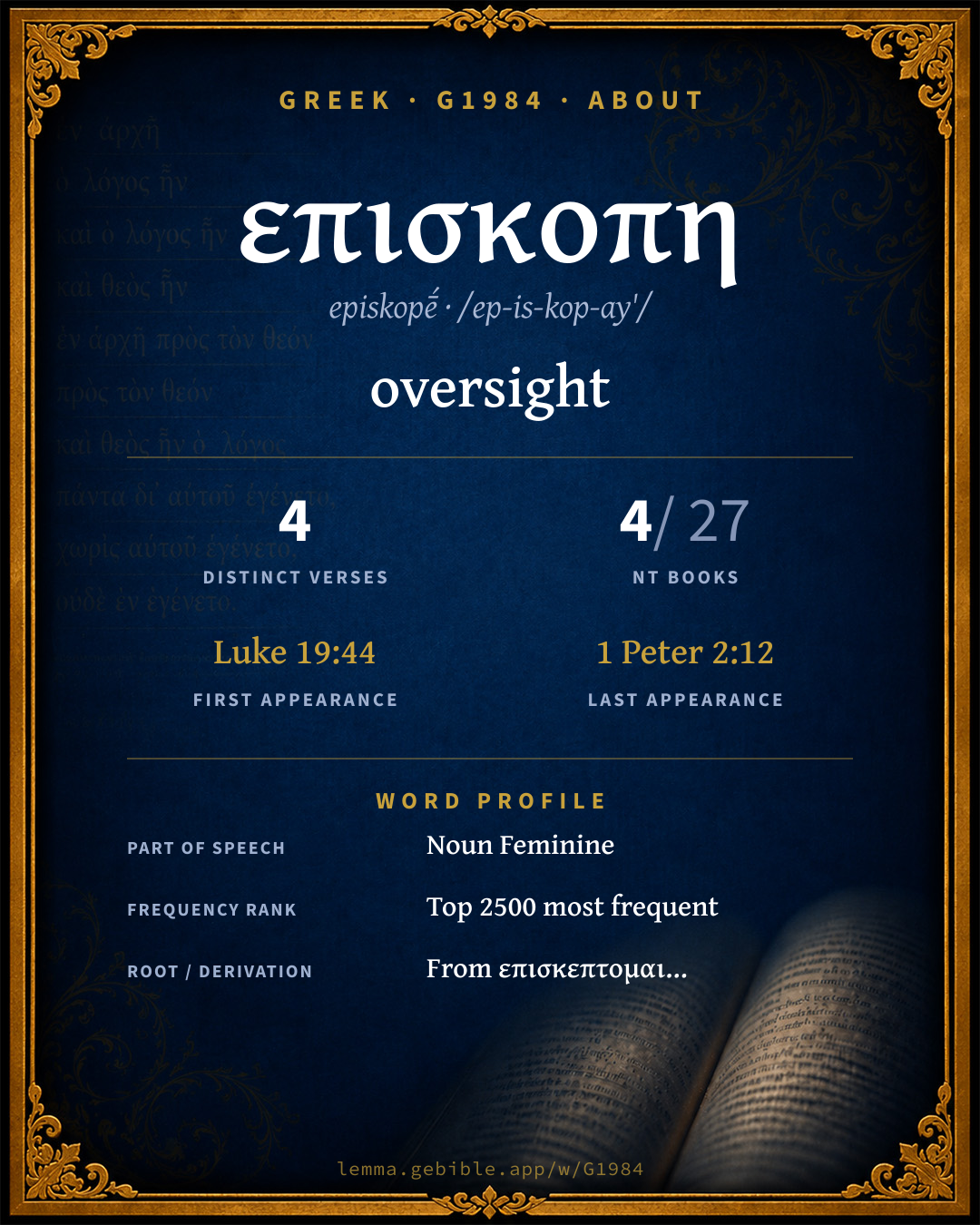
ἐπισκοπή
oversight
Full lexicon entry — Thayer's Greek Lexicon
From Thayer's Greek Lexicon
Where this word appears
See every Genitive-case word in the Greek New Testament →
Grammar key — what these labels mean
Part of speech
- Noun
- A naming word — a person, place, thing, or idea.
Case
- Genitive
- The case of source, possession, or “of” — answers “whose / from what.”
- Accusative
- The case of the direct object and of extent.
Gender
- Feminine
- Grammatically feminine.
Number
- Singular
- One.
Grammatical forms
- Noun, Genitive, Singular, Feminine 3 times (75%)
- Noun, Accusative, Singular, Feminine 1 time (25%)
Parsed forms decoded from the imported morphology (Robinson–Tischendorf, public domain), counted across 4 parsed occurrences — not distinct verses.
Every verse where G1984 appears — 4 distinct verses across 4 books. Click any verse to open its interlinear word-by-word view. Verse text shown in the World English Bible for context — . Each verse’s Greek form is shown with its reference; the English is not keyword-highlighted, since the data carries no word-level English alignment. Use “Compare translations” on any verse to read it across multiple English versions. This concordance covers the Greek New Testament; Septuagint (Greek Old Testament) occurrences of this word are not indexed here.
Luke 1 verse
Acts 1 verse
1 Timothy 1 verse
1 Peter 1 verse
About this entry
At a glance — auto-summarized from this page’s data, not written by a person. Every figure links to its source below. This summary describes the numbers; it doesn’t interpret them.
“oversight” is the headline sense of the Greek noun επισκοπη (episkopḗ). A scarce word — 4 verses in all of the Greek New Testament. More than a quarter of its appearances fall in Luke. First canonically at Luke 19:44, it enters the text early. It shares a root with επισκεπτομαι and αλληλουια. The sections below give every sense, occurrence, and version rendering.
Gloss history
Strong's 1890 vs modern scholarship

About this word
Strong's G1984 catalogs a Greek word from the Greek New Testament.
These counts are not copied from any lexicon or concordance. They are computed here, from the morphology-tagged Greek New Testament. What Lemma adds →
- 4
- distinct verses
- The word appears in 4 distinct verses.
- 4 / 27
- NT books
- The word appears in 4 of 27 New Testament books.
- #1,877
- by frequency
- Top 2500 most frequent Greek words (rank 1,877 of 5,347 Greek words by occurrence).
View all 4 occurrences in the concordance →
By section of the New Testament
By traditional corpus
Conventional, traditional groupings — biblical authorship is debated, so this is a traditional corpus grouping, not an authorship claim. Some books belong to more than one corpus (Luke is in both the Gospels and the Lukan corpus, and so on), so these shares overlap and need not total 100%. Each figure is a share of the word’s 4 distinct verses.
- Lukan (Luke–Acts) 2 verses · 50%
- Gospels 1 verse · 25%
- Pauline corpus 1 verse · 25%
- General (Catholic) Epistles 1 verse · 25%
How translations render this word
Counts come from each version’s own published word-to-Strong’s tagging or interlinear alignment — an approximate guide to how each version renders this word, not a word-level alignment the data otherwise carries. Because each total is that version’s own tagged count, the per-version totals vary from one another and need not match the appearance or distinct-verse counts above. These counts may also differ from a printed concordance because Lemma counts each distinctly tagged rendering and does not collapse phrase taggings into a single head-word total. This is a fixed set of word-tagged versions (KJV, ASV, BSB, ULT) and does not change with the reading translation you choose elsewhere. Each version’s license is shown beside its name below (and on Sources).
- King James Version: Visitation 2×
- American Standard Version: Visitation 2×
- Berean Standard Bible: He visits us 1×, Overseer 1×, Position 1×
- unfoldingWord Literal Text: Overseership 2×, Visitation 2×
King James Version Public Domain
Renders G1984 across 4 tagged occurrences — most commonly:
Plus 2 renderings that appear only once — usually multi-word phrases or single function words the recovered tagging swept in, not distinct renderings.
American Standard Version Public Domain
Renders G1984 across 4 tagged occurrences — most commonly:
Plus 2 renderings that appear only once — usually multi-word phrases or single function words the recovered tagging swept in, not distinct renderings.
Berean Standard Bible Public Domain
Renders G1984 across 4 tagged occurrences — most commonly:
unfoldingWord Literal Text CC BY-SA 4.0
Renders G1984 across 4 tagged occurrences — most commonly:
Senses in Thayer's
The 1 sense Thayer's distinguishes for this word, in lexicon order (not ranked by frequency or importance). The full entry — with sub-senses — is in the Lexicon Entry tab.
- investigation, inspection, visitation
Word origin
Derived from επισκεπτομαι (episképtomai) (G1980) — to look after.
From G1980 ; inspection (for relief); by implication superintendence ; specifically the Christian episcopate : - the office of a bishop bishoprick visitation.
— Strong’s Exhaustive Concordance (1890), public domain.
Forms in the corpus
The 2 distinct written forms G1984 takes in the Greek New Testament, most frequent first — each parse links to that case’s occurrences in the concordance.
| Form | Parsing | Example | Uses |
|---|---|---|---|
| ἐπισκοπῆς episkopē̂s | Noun, Genitive, Singular, Feminine | Luke 19:44 | 3 |
| ἐπισκοπὴν episkopḕn | Noun, Accusative, Singular, Feminine | Acts 1:20 | 1 |
Same root — word family
Other Thayer's entries built from the same root as G1984, grouped by Strong’s listed origin. These share a root / origin per the lexicon — not necessarily a shared meaning. Each links to that word’s own entry.
Derives from
Proper names from this root
People and places named from this root — a name, not an additional meaning of the word.
Compare all same-root words → 1 of the same-root words is a proper name (a person or place). They share a root, not necessarily a meaning.
Septuagint usage
The same Greek word επισκοπη appears 30 times in the Greek Old Testament (Septuagint), across 28 verses in 10 books.
- 30
- LXX occurrences
- Tagged occurrences of this Greek word in the Septuagint.
- 28
- verses
- Distinct Septuagint verses containing this word.
- 10 / 39
- OT books
- The word appears in 10 of the 39 Old Testament books.
Sample Septuagint occurrences
- Genesis 50:24 ἐπισκοπή
- Exodus 3:16 ἐπισκοπή
- Leviticus 19:20 ἐπισκοπή
- Numbers 4:16 ἐπισκοπή
- Job 6:14 ἐπισκοπή
- Psalms 108:8 ἐπισκοπή
- Proverbs 29:13 ἐπισκοπή
- Isaiah 10:3 ἐπισκοπή
- Jeremiah 6:15 ἐπισκοπή
- Ezekiel 7:22 ἐπισκοπή
Septuagint occurrences (same lexeme)
Every verse where the same Strong’s number (G1984) appears in the Greek Septuagint. Verse text shown in the World English Bible for context; the Greek form is the matched word — the English is not keyword-highlighted.
- Genesis 50:24 ἐπισκοπή Joseph said to his brothers, "I am dying, but God will surely visit you, and bring you up out of this land to the land which he swore to Abraham, to Isaac, and to Jacob."
- Genesis 50:25 ἐπισκοπή Joseph took an oath of the children of Israel, saying, "God will surely visit you, and you shall carry up my bones from here."
- Exodus 3:16 ἐπισκοπή Go, and gather the elders of Israel together, and tell them, 'Yahweh, the God of your fathers, the God of Abraham, of Isaac, and of Jacob, has appeared to me, saying, "I have surely visited you, and seen that which is done to you in Egypt;
- Exodus 13:19 ἐπισκοπή Moses took the bones of Joseph with him, for he had made the children of Israel swear, saying, "God will surely visit you, and you shall carry up my bones away from here with you."
- Exodus 30:12 ἐπισκοπή "When you take a census of the children of Israel, according to those who are numbered among them, then each man shall give a ransom for his soul to Yahweh, when you number them; that there be no plague among them when you number them.
- Leviticus 19:20 ἐπισκοπή "'If a man lies carnally with a woman who is a slave girl, pledged to be married to another man, and not ransomed, or given her freedom; they shall be punished. They shall not be put to death, because she was not free.
- Numbers 4:16 ἐπισκοπή "The charge of Eleazar the son of Aaron the priest shall be the oil for the light, the sweet incense, the continual meal offering, and the anointing oil, the charge of all the tabernacle, and of all that is in it, the sanctuary, and its furnishings."
- Numbers 7:2 ἐπισκοπή that the princes of Israel, the heads of their fathers' houses, offered. These were the princes of the tribes. These are they who were over those who were numbered:
- Numbers 14:29 ἐπισκοπή your dead bodies shall fall in this wilderness; and all who were numbered of you, according to your whole number, from twenty years old and upward, who have murmured against me,
- Numbers 16:29 ἐπισκοπή If these men die the common death of all men, or if they be visited after the visitation of all men; then Yahweh hasn't sent me.
- Numbers 26:18 ἐπισκοπή These are the families of the sons of Gad according to those who were numbered of them, forty thousand and five hundred.
- Numbers 26:47 ἐπισκοπή These are the families of the sons of Asher according to those who were numbered of them, fifty-three thousand and four hundred.
- Job 6:14 ἐπισκοπή "To him who is ready to faint, kindness should be shown from his friend; Even to him who forsakes the fear of the Almighty.
- Job 7:18 ἐπισκοπή That you should visit him every morning, And test him every moment?
- Job 10:12 ἐπισκοπή You have granted me life and loving kindness. Your visitation has preserved my spirit.
- Job 24:12 ἐπισκοπή From out of the populous city, men groan. The soul of the wounded cries out, Yet God doesn't regard the folly.
- Job 29:4 ἐπισκοπή As I was in the ripeness of my days, When the friendship of God was in my tent;
- Job 31:14 ἐπισκοπή What then shall I do when God rises up? When he visits, what shall I answer him?
- Job 34:9 ἐπισκοπή For he has said, 'It profits a man nothing That he should delight himself with God.'
- Psalms 108:8 ἐπισκοπή Gilead is mine. Manasseh is mine. Ephraim also is my helmet. Judah is my scepter.
- Proverbs 29:13 ἐπισκοπή The poor man and the oppressor have this in common: Yahweh gives sight to the eyes of both.
- Isaiah 10:3 ἐπισκοπή What will you do in the day of visitation, and in the desolation which shall come from far? to whom will you flee for help? and where will you leave your glory?
- Isaiah 23:17 ἐπισκοπή It shall happen after the end of seventy years, that Yahweh will visit Tyre, and she shall return to her hire, and shall play the prostitute with all the kingdoms of the world on the surface of the earth.
- Isaiah 24:22 ἐπισκοπή They shall be gathered together, as prisoners are gathered in the pit, and shall be shut up in the prison; and after many days shall they be visited.
- Isaiah 29:6 ἐπισκοπή She shall be visited of Yahweh of Hosts with thunder, and with earthquake, and great noise, with whirlwind and tempest, and the flame of a devouring fire.
- Jeremiah 6:15 ἐπισκοπή Were they ashamed when they had committed abomination? nay, they were not at all ashamed, neither could they blush: therefore they shall fall among those who fall; at the time that I visit them they shall be cast down, says Yahweh.
- Jeremiah 10:15 ἐπισκοπή They are vanity, a work of delusion: in the time of their visitation they shall perish.
- Ezekiel 7:22 ἐπισκοπή My face will I turn also from them, and they shall profane my secret [place]; and robbers shall enter into it, and profane it.
These are occurrences of the same Greek lexeme (G1984) in the Septuagint — not a translation of any one Hebrew word. The store carries no word-level Hebrew↔Greek alignment, so no Hebrew original is asserted here. Counts come from the recovered LXX Strong's tagging — high-frequency vocabulary is well covered, while rare or late forms may be untagged — so they reflect tagged occurrences and may slightly undercount.