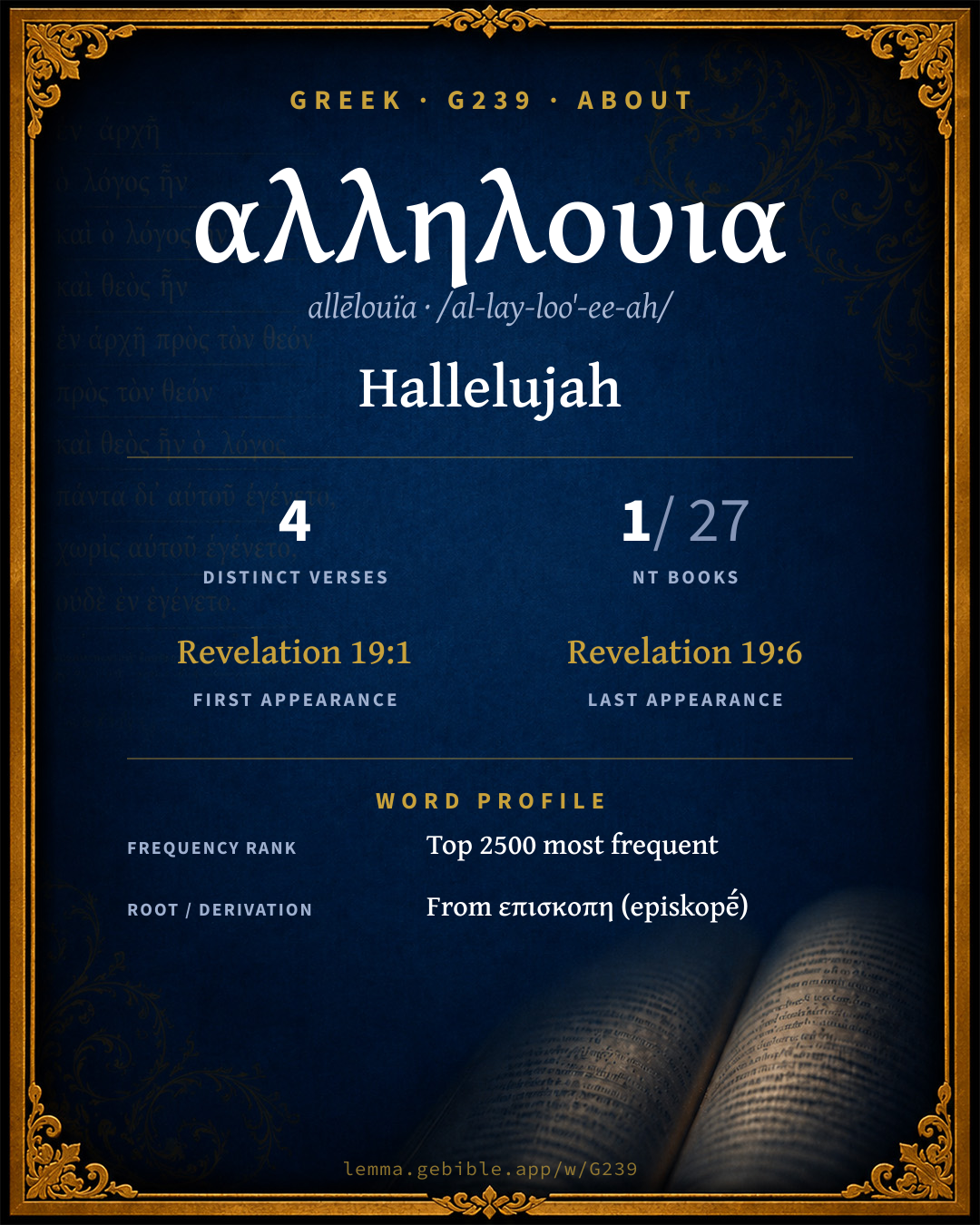
ἀλληλούΐα
Hallelujah
Full lexicon entry — Thayer's Greek Lexicon
From Thayer's Greek Lexicon
Where this word appears
Grammar key — what these labels mean
Part of speech
- Hebrew transliteration
- A Hebrew word carried over into Greek letters (e.g. ἀμήν, ἀλληλουϊά).
Every verse where G239 appears — 4 distinct verses across 1 book. Click any verse to open its interlinear word-by-word view. Verse text shown in the World English Bible for context — . Each verse’s Greek form is shown with its reference; the English is not keyword-highlighted, since the data carries no word-level English alignment. Use “Compare translations” on any verse to read it across multiple English versions. This concordance covers the Greek New Testament; Septuagint (Greek Old Testament) occurrences of this word are not indexed here.
Revelation 4 verses
- Revelation 19:1 ἁλληλουϊά hebr After these things I heard something like a loud voice of a great multitude in heaven, saying, "Hallelujah! Salvation, power, and glory belong to our God:
- Revelation 19:3 ἁλληλουϊά hebr A second said, "Hallelujah! Her smoke goes up forever and ever."
- Revelation 19:4 ἁλληλουϊά hebr The twenty-four elders and the four living creatures fell down and worshiped God who sits on the throne, saying, "Amen! Hallelujah!"
- Revelation 19:6 ἁλληλουϊά hebr I heard something like the voice of a great multitude, and like the voice of many waters, and like the voice of mighty thunders, saying, "Hallelujah! For the Lord our God, the Almighty, reigns!
About this entry
At a glance — auto-summarized from this page’s data, not written by a person. Every figure links to its source below. This summary describes the numbers; it doesn’t interpret them.
The Greek name αλληλουια centers on the idea of “Hallelujah.” It is rare — just 4 verses in the entire Greek New Testament. Revelation dominates its distribution — 4 of 4 verses. Debuting at Revelation 19:1, it then recurs through the corpus. For the data behind this summary, explore 4-verse concordance and the renderings breakdown below.
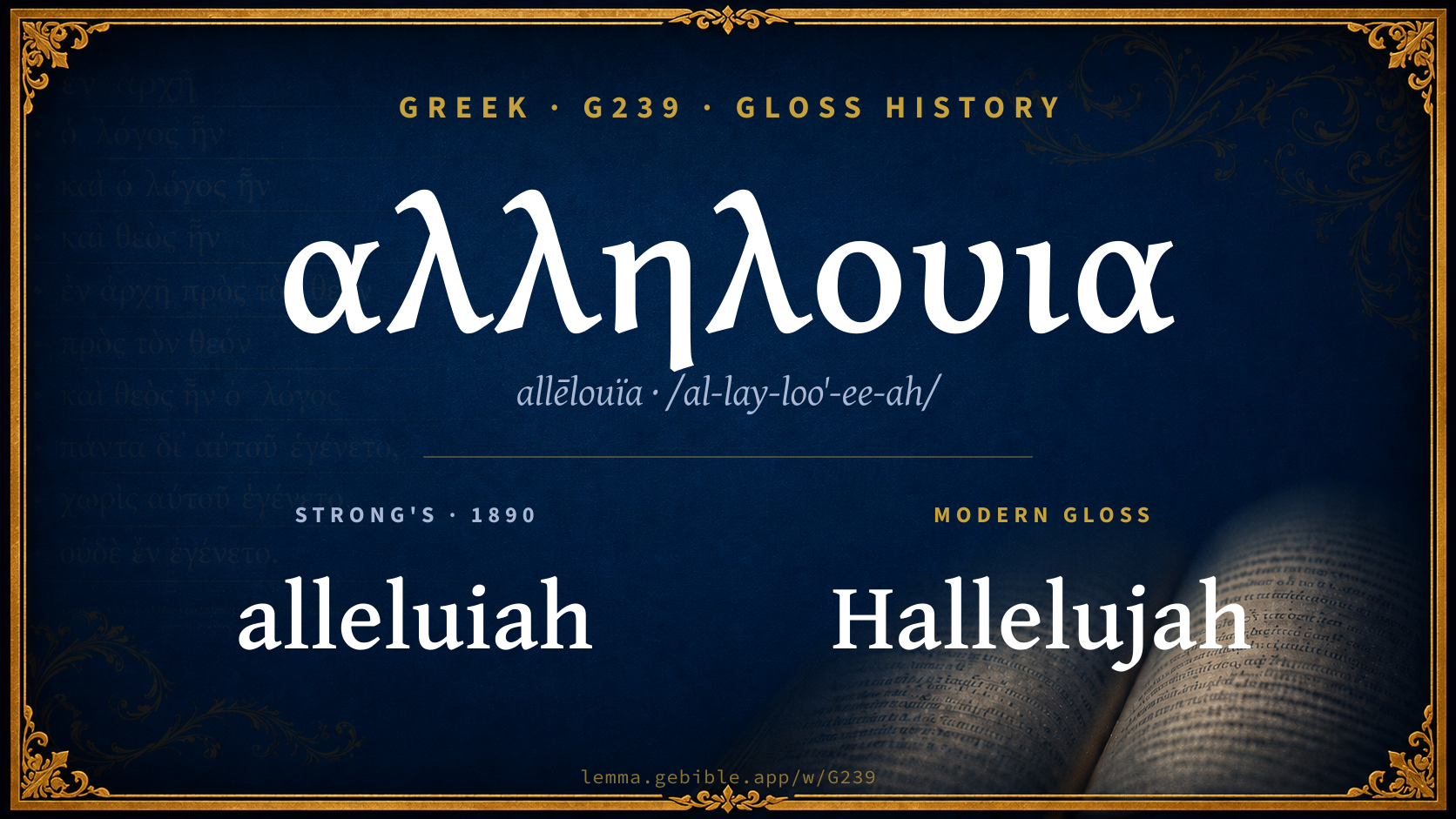
Gloss history
Strong's 1890 vs modern scholarship
About this word
Strong's G239 catalogs a Greek word from the Greek New Testament.
These counts are not copied from any lexicon or concordance. They are computed here, from the morphology-tagged Greek New Testament. What Lemma adds →
- 4
- distinct verses
- The word appears in 4 distinct verses.
- 1 / 27
- NT books
- The word appears in 1 of 27 New Testament books.
- #1,877
- by frequency
- Top 2500 most frequent Greek words (rank 1,877 of 5,347 Greek words by occurrence).
View all 4 occurrences in the concordance →
Most concentrated in
- Revelation 4 verses 100%
By section of the New Testament
By traditional corpus
Conventional, traditional groupings — biblical authorship is debated, so this is a traditional corpus grouping, not an authorship claim. Some books belong to more than one corpus (Luke is in both the Gospels and the Lukan corpus, and so on), so these shares overlap and need not total 100%. Each figure is a share of the word’s 4 distinct verses.
- Johannine 4 verses · 100%
- Revelation 4 verses · 100%
How translations render this word
Counts come from each version’s own published word-to-Strong’s tagging or interlinear alignment — an approximate guide to how each version renders this word, not a word-level alignment the data otherwise carries. Because each total is that version’s own tagged count, the per-version totals vary from one another and need not match the appearance or distinct-verse counts above. These counts may also differ from a printed concordance because Lemma counts each distinctly tagged rendering and does not collapse phrase taggings into a single head-word total. This is a fixed set of word-tagged versions (KJV, ASV, BSB, ULT) and does not change with the reading translation you choose elsewhere. Each version’s license is shown beside its name below (and on Sources).
- King James Version: Alleluia 4×
- American Standard Version: Hallelujah 4×
- Berean Standard Bible: Hallelujah 4×
- unfoldingWord Literal Text: Hallelujah 4×
King James Version Public Domain
Renders G239 across 4 tagged occurrences — most commonly:
American Standard Version Public Domain
Renders G239 across 4 tagged occurrences — most commonly:
Berean Standard Bible Public Domain
Renders G239 across 4 tagged occurrences — most commonly:
unfoldingWord Literal Text CC BY-SA 4.0
Renders G239 across 4 tagged occurrences — most commonly:
Senses in Thayer's
The 1 sense Thayer's distinguishes for this word, in lexicon order (not ranked by frequency or importance). The full entry — with sub-senses — is in the Lexicon Entry tab.
- praise ye the Lord, Hallelujah
Word origin
Derived from επισκοπη (episkopḗ) (G1984) — oversight.
Bible dictionary
Public-domain dictionary articles matched to this entry by name (Hallelujah). A biblical name can be shared by more than one person or place, so an article may treat several.
Easton's Bible Dictionary · M. G. Easton, 1897
Praise ye Jehovah, frequently rendered "Praise ye the LORD," stands at the beginning of ten of the psalms (106, 111-113, 135, 146-150), hence called "hallelujah psalms." From its frequent occurrence it grew into a formula of praise. The Greek form of the word (alleluia) is found in Rev. 19:1, 3, 4, 6.
Smith's Bible Dictionary · William Smith, 1863
(praise ye the Lord). [Alleluia]
Hitchcock's Bible Names Dictionary · Roswell D. Hitchcock, 1869
praise the Lord
Classic public-domain reference works; full attribution on Sources.
Septuagint usage
The same Greek word αλληλουια appears 21 times in the Greek Old Testament (Septuagint), across 21 verses in 1 book.
- 21
- LXX occurrences
- Tagged occurrences of this Greek word in the Septuagint.
- 21
- verses
- Distinct Septuagint verses containing this word.
- 1 / 39
- OT books
- The word appears in 1 of the 39 Old Testament books.
Sample Septuagint occurrences
- Psalms 104:1 αλληλουια
Septuagint occurrences (same lexeme)
Every verse where the same Strong’s number (G239) appears in the Greek Septuagint. Verse text shown in the World English Bible for context; the Greek form is the matched word — the English is not keyword-highlighted.
- Psalms 104:1 αλληλουια Bless Yahweh, my soul. Yahweh, my God, you are very great. You are clothed with honor and majesty.
- Psalms 105:1 αλληλουια Give thanks to Yahweh! Call on his name! Make his doings known among the peoples.
- Psalms 106:1 αλληλουια Praise Yahweh! Give thanks to Yahweh, for he is good, For his loving kindness endures forever.
- Psalms 110:1 αλληλουια Yahweh says to my Lord, "Sit at my right hand, Until I make your enemies your footstool for your feet."
- Psalms 111:1 αλληλουια Praise Yah! I will give thanks to Yahweh with my whole heart, In the council of the upright, and in the congregation.
- Psalms 112:1 αλληλουια Praise Yah! Blessed is the man who fears Yahweh, Who delights greatly in his commandments.
- Psalms 113:1 αλληλουια Praise Yah! Praise, you servants of Yahweh, Praise the name of Yahweh.
- Psalms 114:1 αλληλουια When Israel went forth out of Egypt, The house of Jacob from a people of foreign language;
- Psalms 115:1 αλληλουια Not to us, Yahweh, not to us, But to your name give glory, For your loving kindness, and for your truth's sake.
- Psalms 116:1 αλληλουια I love Yahweh, because he listens to my voice, And my cries for mercy.
- Psalms 117:1 αλληλουια Praise Yahweh, all you nations! Extol him, all you peoples!
- Psalms 118:1 αλληλουια Give thanks to Yahweh, for he is good, For his loving kindness endures forever.
- Psalms 134:1 αλληλουια Look! Praise Yahweh, all you servants of Yahweh, Who stand by night in Yahweh's house!
- Psalms 135:1 αλληλουια Praise Yah! Praise the name of Yahweh! Praise him, you servants of Yahweh,
- Psalms 145:1 αλληλουια I will exalt you, my God, the King. I will praise your name forever and ever.
- Psalms 146:1 αλληλουια Praise Yah! Praise Yahweh, my soul.
- Psalms 147:1 αλληλουια Praise Yah, For it is good to sing praises to our God; For it is pleasant and fitting to praise him.
- Psalms 148:1 αλληλουια Praise Yah! Praise Yahweh from the heavens! Praise him in the heights!
- Psalms 149:1 αλληλουια Praise Yahweh! Sing to Yahweh a new song, His praise in the assembly of the saints.
- Psalms 150:1 αλληλουια Praise Yah! Praise God in his sanctuary! Praise him in his heavens for his acts of power!
- Psalms 150:6 αλληλουια Let everything that has breath praise Yah! Praise Yah!
These are occurrences of the same Greek lexeme (G239) in the Septuagint — not a translation of any one Hebrew word. The store carries no word-level Hebrew↔Greek alignment, so no Hebrew original is asserted here. Counts come from the recovered LXX Strong's tagging — high-frequency vocabulary is well covered, while rare or late forms may be untagged — so they reflect tagged occurrences and may slightly undercount.