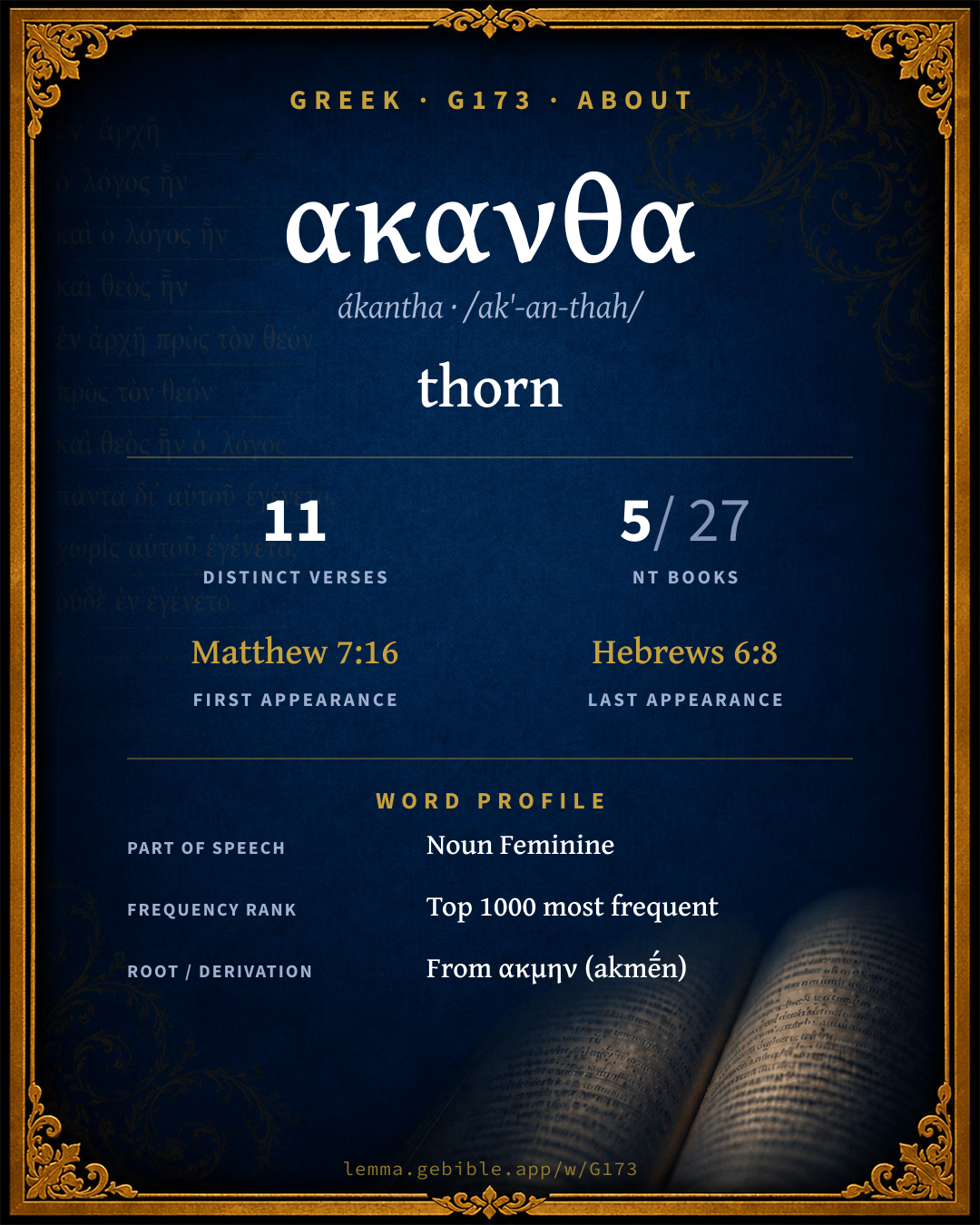
ἄκανθα
thorn
‘thorn’ is one of 2 main senses fuller range ↓
Full lexicon entry — Thayer's Greek Lexicon
From Thayer's Greek Lexicon
Where this word appears
See every Accusative-case word in the Greek New Testament →
Grammar key — what these labels mean
Part of speech
- Noun
- A naming word — a person, place, thing, or idea.
Case
- Accusative
- The case of the direct object and of extent.
- Genitive
- The case of source, possession, or “of” — answers “whose / from what.”
- Nominative
- The case of the subject (and the predicate nominative).
Gender
- Feminine
- Grammatically feminine.
Number
- Plural
- More than one.
Grammatical forms
- Noun, Accusative, Plural, Feminine 6 times (43%)
- Noun, Genitive, Plural, Feminine 5 times (36%)
- Noun, Nominative, Plural, Feminine 3 times (21%)
Parsed forms decoded from the imported morphology (Robinson–Tischendorf, public domain), counted across 14 parsed occurrences — not distinct verses.
Every verse where G173 appears — 11 distinct verses across 5 books. Click any verse to open its interlinear word-by-word view. Verse text shown in the World English Bible for context — . Each verse’s Greek form is shown with its reference; the English is not keyword-highlighted, since the data carries no word-level English alignment. Use “Compare translations” on any verse to read it across multiple English versions. This concordance covers the Greek New Testament; Septuagint (Greek Old Testament) occurrences of this word are not indexed here.
Matthew 4 verses
- Matthew 7:16 ἀκανθῶν n gen pl fem By their fruits you will know them. Do you gather grapes from thorns, or figs from thistles?
- Matthew 13:7 ἀκάνθας ἄκανθαι n acc pl fem n nom pl fem Others fell among thorns. The thorns grew up and choked them:
- Matthew 13:22 ἀκάνθας n acc pl fem What was sown among the thorns, this is he who hears the word, but the cares of this age and the deceitfulness of riches choke the word, and he becomes unfruitful.
- Matthew 27:29 ἀκανθῶν n gen pl fem They braided a crown of thorns and put it on his head, and a reed in his right hand; and they kneeled down before him, and mocked him, saying, "Hail, King of the Jews!"
Mark 2 verses
Luke 3 verses
- Luke 6:44 ἀκανθῶν n gen pl fem For each tree is known by its own fruit. For people don't gather figs from thorns, nor do they gather grapes from a bramble bush.
- Luke 8:7 ἀκανθῶν ἄκανθαι n gen pl fem n nom pl fem Other fell amid the thorns, and the thorns grew with it, and choked it.
- Luke 8:14 ἀκάνθας n acc pl fem That which fell among the thorns, these are those who have heard, and as they go on their way they are choked with cares, riches, and pleasures of life, and bring no fruit to maturity.
John 1 verse
Hebrews 1 verse
About this entry
At a glance — auto-summarized from this page’s data, not written by a person. Every figure links to its source below. This summary describes the numbers; it doesn’t interpret them.
At its core, ακανθα (ákantha) means “thorn.” It first appears in Matthew 7:16. It turns up in 11 verses across 5 books, an uncommon footprint. The word gravitates to Matthew (36%), then Luke and Mark. Ranging over 2 senses, it is not a single-sense word. Each statement above links to its evidence; the full detail follows below.
Gloss history
Strong's 1890 vs modern scholarship
About this word
Strong's G173 catalogs a Greek word from the Greek New Testament.
These counts are not copied from any lexicon or concordance. They are computed here, from the morphology-tagged Greek New Testament. What Lemma adds →
- 11
- distinct verses
- The word appears in 11 distinct verses.
- 5 / 27
- NT books
- The word appears in 5 of 27 New Testament books.
- #814
- by frequency
- Top 1000 most frequent Greek words (rank 814 of 5,347 Greek words by occurrence).
View all 11 occurrences in the concordance →
By section of the New Testament
By traditional corpus
Conventional, traditional groupings — biblical authorship is debated, so this is a traditional corpus grouping, not an authorship claim. Some books belong to more than one corpus (Luke is in both the Gospels and the Lukan corpus, and so on), so these shares overlap and need not total 100%. Each figure is a share of the word’s 11 distinct verses.
- Gospels 10 verses · 91%
- Lukan (Luke–Acts) 3 verses · 27%
- Johannine 1 verse · 9%
- Hebrews 1 verse · 9%
How translations render this word
Counts come from each version’s own published word-to-Strong’s tagging or interlinear alignment — an approximate guide to how each version renders this word, not a word-level alignment the data otherwise carries. Because each total is that version’s own tagged count, the per-version totals vary from one another and need not match the appearance or distinct-verse counts above. These counts may also differ from a printed concordance because Lemma counts each distinctly tagged rendering and does not collapse phrase taggings into a single head-word total. This is a fixed set of word-tagged versions (KJV, ASV, BSB, ULT) and does not change with the reading translation you choose elsewhere. Each version’s license is shown beside its name below (and on Sources).
- King James Version: Thorns 14×
- American Standard Version: Thorns 14×
- Berean Standard Bible: Thorns 9×, Thornbushes 2×
- unfoldingWord Literal Text: Thorns 12×, Thornbush 2×
King James Version Public Domain
Renders G173 across 14 tagged occurrences — most commonly:
American Standard Version Public Domain
Renders G173 across 14 tagged occurrences — most commonly:
Berean Standard Bible Public Domain
Renders G173 across 11 tagged occurrences — most commonly:
Not rendered by a distinct English word in 3 further occurrences.
unfoldingWord Literal Text CC BY-SA 4.0
Renders G173 across 14 tagged occurrences — most commonly:
Senses in Thayer's
The 2 senses Thayer's distinguishes for this word, in lexicon order (not ranked by frequency or importance). The full entry — with sub-senses — is in the Lexicon Entry tab.
- thorn, bramble
- bush, brier, a thorny plant
Word origin
Derived from ακμην (akmḗn) (G188) — acme.
Probably from the same as G188 ; a thorn : - thorn.
— Strong’s Exhaustive Concordance (1890), public domain.
Forms in the corpus
The 3 distinct written forms G173 takes in the Greek New Testament, most frequent first — each parse links to that case’s occurrences in the concordance.
| Form | Parsing | Example | Uses |
|---|---|---|---|
| ἀκάνθας akánthas | Noun, Accusative, Plural, Feminine | Matthew 13:7 | 6 |
| ἀκανθῶν akanthō̂n | Noun, Genitive, Plural, Feminine | Matthew 7:16 | 5 |
| ἄκανθαι ákanthai | Noun, Nominative, Plural, Feminine | Matthew 13:7 | 3 |
Same root — word family
Other Thayer's entries built from the same root as G173, grouped by Strong’s listed origin. These share a root / origin per the lexicon — not necessarily a shared meaning. Each links to that word’s own entry.
Derives from
Shares the same root
Derived from this word
Compare all same-root words → Showing 4 of 6 — not the complete family. They share a root, not necessarily a meaning.
Septuagint usage
The same Greek word ακανθα appears 25 times in the Greek Old Testament (Septuagint), across 25 verses in 12 books.
- 25
- LXX occurrences
- Tagged occurrences of this Greek word in the Septuagint.
- 25
- verses
- Distinct Septuagint verses containing this word.
- 12 / 39
- OT books
- The word appears in 12 of the 39 Old Testament books.
Sample Septuagint occurrences
- Genesis 3:18 ἄκανθα
- Exodus 22:5 ἄκανθα
- Judges 8:7 ἄκανθα
- 2 Samuel 23:6 ἄκανθα
- Psalms 31:4 ἄκανθα
- Proverbs 15:19 ἄκανθα
- Ecclesiastes 7:6 ἄκανθα
- Song of Solomon 2:2 ἄκανθα
- Isaiah 5:2 ἄκανθα
- Jeremiah 4:3 ἄκανθα
- Ezekiel 28:24 ἄκανθα
- Hosea 9:6 ἄκανθα
Septuagint occurrences (same lexeme)
Every verse where the same Strong’s number (G173) appears in the Greek Septuagint. Verse text shown in the World English Bible for context; the Greek form is the matched word — the English is not keyword-highlighted.
- Genesis 3:18 ἄκανθα Thorns also and thistles will it bring forth to you; and you will eat the herb of the field.
- Exodus 22:5 ἄκανθα "If a man causes a field or vineyard to be eaten, and lets his animal loose, and it grazes in another man's field, he shall make restitution from the best of his own field, and from the best of his own vineyard.
- Judges 8:7 ἄκανθα Gideon said, Therefore when Yahweh has delivered Zebah and Zalmunna into my hand, then I will tear your flesh with the thorns of the wilderness and with briers.
- Judges 8:16 ἄκανθα He took the elders of the city, and thorns of the wilderness and briers, and with them he taught the men of Succoth.
- 2 Samuel 23:6 ἄκανθα But the ungodly shall be all of them as thorns to be thrust away, Because they can't be taken with the hand
- Psalms 31:4 ἄκανθα Pluck me out of the net that they have laid secretly for me, For you are my stronghold.
- Psalms 57:10 ἄκανθα For your great loving kindness reaches to the heavens, And your truth to the skies.
- Psalms 117:12 ἄκανθα
- Proverbs 15:19 ἄκανθα The way of the sluggard is like a thorn patch, But the path of the upright is a highway.
- Proverbs 26:9 ἄκανθα Like a thornbush that goes into the hand of a drunkard, So is a parable in the mouth of fools.
- Ecclesiastes 7:6 ἄκανθα For as the crackling of thorns under a pot, so is the laughter of the fool. This also is vanity.
- Song of Solomon 2:2 ἄκανθα As a lily among thorns, So is my love among the daughters. Beloved
- Isaiah 5:2 ἄκανθα He dug it up, Gathered out its stones, Planted it with the choicest vine, Built a tower in its midst, And also cut out a winepress therein. He looked for it to yield grapes, But it yielded wild grapes.
- Isaiah 5:4 ἄκανθα What could have been done more to my vineyard, that I have not done in it? Why, when I looked for it to yield grapes, did it yield wild grapes?
- Isaiah 5:6 ἄκανθα I will lay it a wasteland. It won't be pruned nor hoed, But it will grow briers and thorns. I will also command the clouds that they rain no rain on it."
- Isaiah 7:23 ἄκανθα It will happen in that day that every place where there were a thousand vines at a thousand silver shekels, shall be for briers and thorns.
- Isaiah 7:24 ἄκανθα People will go there with arrows and with bow, because all the land will be briers and thorns.
- Isaiah 7:25 ἄκανθα All the hills that were cultivated with the hoe, you shall not come there for fear of briers and thorns; but it shall be for the sending forth of oxen, and for the treading of sheep."
- Isaiah 32:13 ἄκανθα On the land of my people shall come up thorns and briers; yes, on all the houses of joy in the joyous city.
- Isaiah 33:12 ἄκανθα The peoples shall be as the burning of lime, as thorns cut down, that are burned in the fire.
- Jeremiah 4:3 ἄκανθα For thus says Yahweh to the men of Judah and to Jerusalem, Break up your fallow ground, and don't sow among thorns.
- Jeremiah 12:13 ἄκανθα They have sown wheat, and have reaped thorns; they have put themselves to pain, and profit nothing: and you shall be ashamed of your fruits, because of the fierce anger of Yahweh.
- Ezekiel 28:24 ἄκανθα There shall be no more a pricking brier to the house of Israel, nor a hurting thorn of any that are round about them, that did despite to them; and they shall know that I am the Lord Yahweh.
- Hosea 9:6 ἄκανθα For, behold, they have gone away from destruction. Egypt will gather them up. Memphis will bury them. Nettles will possess their pleasant things of silver. Thorns will be in their tents.
- Hosea 10:8 ἄκανθα The high places also of Aven, the sin of Israel, will be destroyed. The thorn and the thistle will come up on their altars. They will tell the mountains, "Cover us!" and the hills, "Fall on us!"
These are occurrences of the same Greek lexeme (G173) in the Septuagint — not a translation of any one Hebrew word. The store carries no word-level Hebrew↔Greek alignment, so no Hebrew original is asserted here. Counts come from the recovered LXX Strong's tagging — high-frequency vocabulary is well covered, while rare or late forms may be untagged — so they reflect tagged occurrences and may slightly undercount.