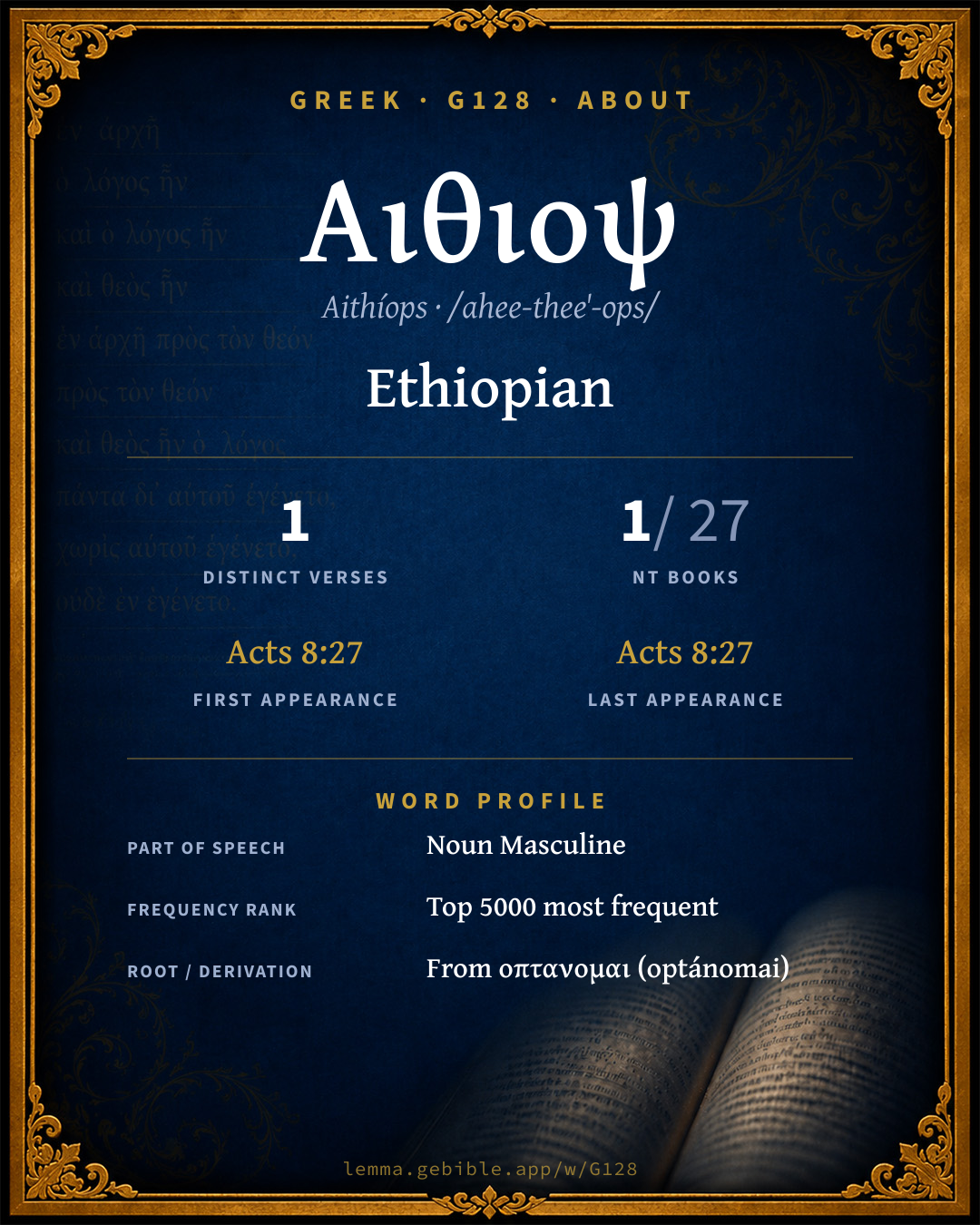
Αἰθίοψ
Ethiopian
Thayer's lists 2 entries for ‘Ethiopian’ fuller range ↓
Full lexicon entry — Thayer's Greek Lexicon
From Thayer's Greek Lexicon
Where this word appears
See every Genitive-case word in the Greek New Testament →
Grammar key — what these labels mean
Part of speech
- Noun
- A naming word — a person, place, thing, or idea.
Case
- Genitive
- The case of source, possession, or “of” — answers “whose / from what.”
- Nominative
- The case of the subject (and the predicate nominative).
Gender
- Masculine
- Grammatically masculine.
Number
- Plural
- More than one.
- Singular
- One.
1 distinct verse where G128 appears in the Nominative case, across 1 book. Filtered view — show all forms. Click any verse to open its interlinear word-by-word view. Verse text shown in the World English Bible for context — . Each verse’s Greek form is shown with its reference; the English is not keyword-highlighted, since the data carries no word-level English alignment. Use “Compare translations” on any verse to read it across multiple English versions. This concordance covers the Greek New Testament; Septuagint (Greek Old Testament) occurrences of this word are not indexed here.
Acts 1 verse
About this entry
At a glance — auto-summarized from this page’s data, not written by a person. Every figure links to its source below. This summary describes the numbers; it doesn’t interpret them.
At its core, Αιθιοψ (Aithíops) means “Ethiopian.” A scarce word — 1 verse in all of the Greek New Testament. The word gravitates to Acts (100%). It occurs only once, in Acts 8:27. Dig into 1-verse concordance and the renderings breakdown below.
Gloss history
Strong's 1890 vs modern scholarship
About this word
Strong's G128 catalogs a Greek word from the Greek New Testament.
These counts are not copied from any lexicon or concordance. They are computed here, from the morphology-tagged Greek New Testament. What Lemma adds →
- 1
- distinct verses
- The word appears in 1 distinct verse.
- 1 / 27
- NT books
- The word appears in 1 of 27 New Testament books.
- #2,678
- by frequency
- Top 5000 most frequent Greek words (rank 2,678 of 5,347 Greek words by occurrence).
View all 1 occurrence in the concordance →
Most concentrated in
- Acts 1 verse 100%
By section of the New Testament
By traditional corpus
Conventional, traditional groupings — biblical authorship is debated, so this is a traditional corpus grouping, not an authorship claim. Some books belong to more than one corpus (Luke is in both the Gospels and the Lukan corpus, and so on), so these shares overlap and need not total 100%. Each figure is a share of the word’s 1 distinct verse.
- Lukan (Luke–Acts) 1 verse · 100%
How translations render this word
Counts come from each version’s own published word-to-Strong’s tagging or interlinear alignment — an approximate guide to how each version renders this word, not a word-level alignment the data otherwise carries. Because each total is that version’s own tagged count, the per-version totals vary from one another and need not match the appearance or distinct-verse counts above. These counts may also differ from a printed concordance because Lemma counts each distinctly tagged rendering and does not collapse phrase taggings into a single head-word total. This is a fixed set of word-tagged versions (KJV, ASV, BSB, ULT) and does not change with the reading translation you choose elsewhere. Each version’s license is shown beside its name below (and on Sources).
- King James Version: Ethiopia 1×, Ethiopians 1×
- American Standard Version: Ethiopia 1×, Ethiopians 1×
- Berean Standard Bible: Ethiopian 1×, Ethiopians 1×
- unfoldingWord Literal Text: Ethiopian 1×, Ethiopians 1×
King James Version Public Domain
Renders G128 across 2 tagged occurrences — most commonly:
American Standard Version Public Domain
Renders G128 across 2 tagged occurrences — most commonly:
Berean Standard Bible Public Domain
Renders G128 across 2 tagged occurrences — most commonly:
unfoldingWord Literal Text CC BY-SA 4.0
Renders G128 across 2 tagged occurrences — most commonly:
Senses in Thayer's
The 2 senses Thayer's distinguishes for this word, in lexicon order (not ranked by frequency or importance). The full entry — with sub-senses — is in the Lexicon Entry tab.
- Ethiopian = "black"
- an Ethiopian
Word origin
Derived from οπτανομαι (optánomai) (G3700) — to look at.
From αἴθω aithō (to scorch ) and ὤψ ō ps (the face from G3700 ); an Ethiopian (as a blackamoor ): - Ethiopian.
— Strong’s Exhaustive Concordance (1890), public domain.
Forms in the corpus
The 2 distinct written forms G128 takes in the Greek New Testament, most frequent first — each parse links to that case’s occurrences in the concordance.
| Form | Parsing | Example | Uses |
|---|---|---|---|
| Αἰθίοψ Aithíops | Noun, Nominative, Singular, Masculine | Acts 8:27 | 1 |
| Αἰθιόπων Aithiópōn | Noun, Genitive, Plural, Masculine | Acts 8:27 | 1 |
Same root — word family
Other Thayer's entries built from the same root as G128, grouped by Strong’s listed origin. These share a root / origin per the lexicon — not necessarily a shared meaning. Each links to that word’s own entry.
Derives from
Shares the same root
- ομμα ómma G3659 eye
- οπη opḗ G3692 opening
- οπισθεν ópisthen G3693 behind
- οπτασια optasía G3701 vision
- οραω horáō G3708 to see
- οφθαλμος ophthalmós G3788 eye
- οφις óphis G3789 serpent
- οφρυς ophrŷs G3790 eyebrow
- οψις ópsis G3799 face
- σκυθρωπος skythrōpós G4659 sad-faced
Compare all same-root words → Showing 4 of 12 — not the complete family. They share a root, not necessarily a meaning.
Bible dictionary
Public-domain dictionary articles matched to this entry by name (Ethiopian). A biblical name can be shared by more than one person or place, so an article may treat several.
Smith's Bible Dictionary · William Smith, 1863
properly "Cushite," (Jeremiah 13:23) used of Zerah, (2 Chronicles 14:9) (8), and Ebed-melech. (Jeremiah 38:7,10,12; 39:16)
Classic public-domain reference works; full attribution on Sources.
Septuagint usage
The same Greek word Αιθιοψ appears 27 times in the Greek Old Testament (Septuagint), across 26 verses in 10 books.
- 27
- LXX occurrences
- Tagged occurrences of this Greek word in the Septuagint.
- 26
- verses
- Distinct Septuagint verses containing this word.
- 10 / 39
- OT books
- The word appears in 10 of the 39 Old Testament books.
Sample Septuagint occurrences
- 2 Kings 19:9 αἰθίοψ
- 2 Chronicles 12:3 αἰθίοψ
- Psalms 71:9 αἰθίοψ
- Isaiah 20:3 αἰθίοψ
- Jeremiah 13:23 αἰθίοψ
- Ezekiel 29:10 αἰθίοψ
- Daniel 11:43 αἰθίοψ
- Amos 9:7 αἰθίοψ
- Habakkuk 3:7 αἰθίοψ
- Zephaniah 2:12 αἰθίοψ
Septuagint occurrences (same lexeme)
Every verse where the same Strong’s number (G128) appears in the Greek Septuagint. Verse text shown in the World English Bible for context; the Greek form is the matched word — the English is not keyword-highlighted.
- 2 Kings 19:9 αἰθίοψ When he heard say of Tirhakah king of Ethiopia, Behold, he is come out to fight against you, he sent messengers again to Hezekiah, saying,
- 2 Chronicles 12:3 αἰθίοψ with twelve hundred chariots, and sixty thousand horsemen. The people were without number who came with him out of Egypt: the Lubim, the Sukkiim, and the Ethiopians.
- 2 Chronicles 14:8 αἰθίοψ Asa had an army that bore bucklers and spears, out of Judah three hundred thousand; and out of Benjamin, that bore shields and drew bows, two hundred eighty thousand: all these were mighty men of valor.
- 2 Chronicles 14:11 αἰθίοψ Asa cried to Yahweh his God, and said, Yahweh, there is none besides you to help, between the mighty and him who has no strength: help us, Yahweh our God; for we rely on you, and in your name are we come against this multitude. Yahweh, you are our God; don't let man prevail against you.
- 2 Chronicles 14:12 αἰθίοψ So Yahweh struck the Ethiopians before Asa, and before Judah; and the Ethiopians fled.
- 2 Chronicles 16:8 αἰθίοψ Weren't the Ethiopians and the Lubim a huge host, with chariots and horsemen exceeding many? yet, because you did rely on Yahweh, he delivered them into your hand.
- 2 Chronicles 21:16 αἰθίοψ Yahweh stirred up against Jehoram the spirit of the Philistines, and of the Arabians who are beside the Ethiopians:
- Psalms 71:9 αἰθίοψ Don't reject me in my old age. Don't forsake me when my strength fails.
- Psalms 73:14 αἰθίοψ For all day long have I been plagued, And punished every morning.
- Psalms 86:4 αἰθίοψ Bring joy to the soul of your servant, For to you, Lord, do I lift up my soul.
- Isaiah 20:3 αἰθίοψ Yahweh said, Like as my servant Isaiah has walked naked and barefoot three years for a sign and a wonder concerning Egypt and concerning Ethiopia;
- Isaiah 20:4 αἰθίοψ so shall the king of Assyria lead away the captives of Egypt, and the exiles of Ethiopia, young and old, naked and barefoot, and with buttocks uncovered, to the shame of Egypt.
- Isaiah 20:5 αἰθίοψ They shall be dismayed and confounded, because of Ethiopia their expectation, and of Egypt their glory.
- Isaiah 37:9 αἰθίοψ He heard say concerning Tirhakah king of Ethiopia, He is come out to fight against you. When he heard it, he sent messengers to Hezekiah, saying,
- Isaiah 45:14 αἰθίοψ Thus says Yahweh: "The labor of Egypt, and the merchandise of Ethiopia, and the Sabeans, men of stature, shall come over to you, and they shall be yours. They shall go after you. In chains they shall come over; and they shall fall down to you. They shall make supplication to you: 'Surely God is in you; and there is none else, there is no other god.
- Jeremiah 13:23 αἰθίοψ Can the Ethiopian change his skin, or the leopard his spots? then may you also do good, who are accustomed to do evil.
- Jeremiah 26:9 αἰθίοψ Why have you prophesied in the name of Yahweh, saying, This house shall be like Shiloh, and this city shall be desolate, without inhabitant? All the people were gathered to Jeremiah in the house of Yahweh.
- Jeremiah 45:7 αἰθίοψ
- Jeremiah 46:6 αἰθίοψ Don't let the swift flee away, nor the mighty man escape; in the north by the river Euphrates have they stumbled and fallen.
- Ezekiel 29:10 αἰθίοψ therefore, behold, I am against you, and against your rivers, and I will make the land of Egypt an utter waste and desolation, from the tower of Seveneh even to the border of Ethiopia.
- Ezekiel 38:5 αἰθίοψ Persia, Cush, and Put with them, all of them with shield and helmet;
- Daniel 11:43 αἰθίοψ But he shall have power over the treasures of gold and of silver, and over all the precious things of Egypt; and the Libyans and the Ethiopians shall be at his steps.
- Amos 9:7 αἰθίοψ Are you not like the children of the Ethiopians to me, children of Israel?" says Yahweh. "Haven't I brought up Israel out of the land of Egypt, and the Philistines from Caphtor, and the Syrians from Kir?
- Habakkuk 3:7 αἰθίοψ I saw the tents of Cushan in affliction. The dwellings of the land of Midian trembled.
- Zephaniah 2:12 αἰθίοψ You Cushites also, you will be killed by my sword.
- Zephaniah 3:10 αἰθίοψ From beyond the rivers of Cush, my worshipers, even the daughter of my dispersed people, will bring my offering.
These are occurrences of the same Greek lexeme (G128) in the Septuagint — not a translation of any one Hebrew word. The store carries no word-level Hebrew↔Greek alignment, so no Hebrew original is asserted here. Counts come from the recovered LXX Strong's tagging — high-frequency vocabulary is well covered, while rare or late forms may be untagged — so they reflect tagged occurrences and may slightly undercount.