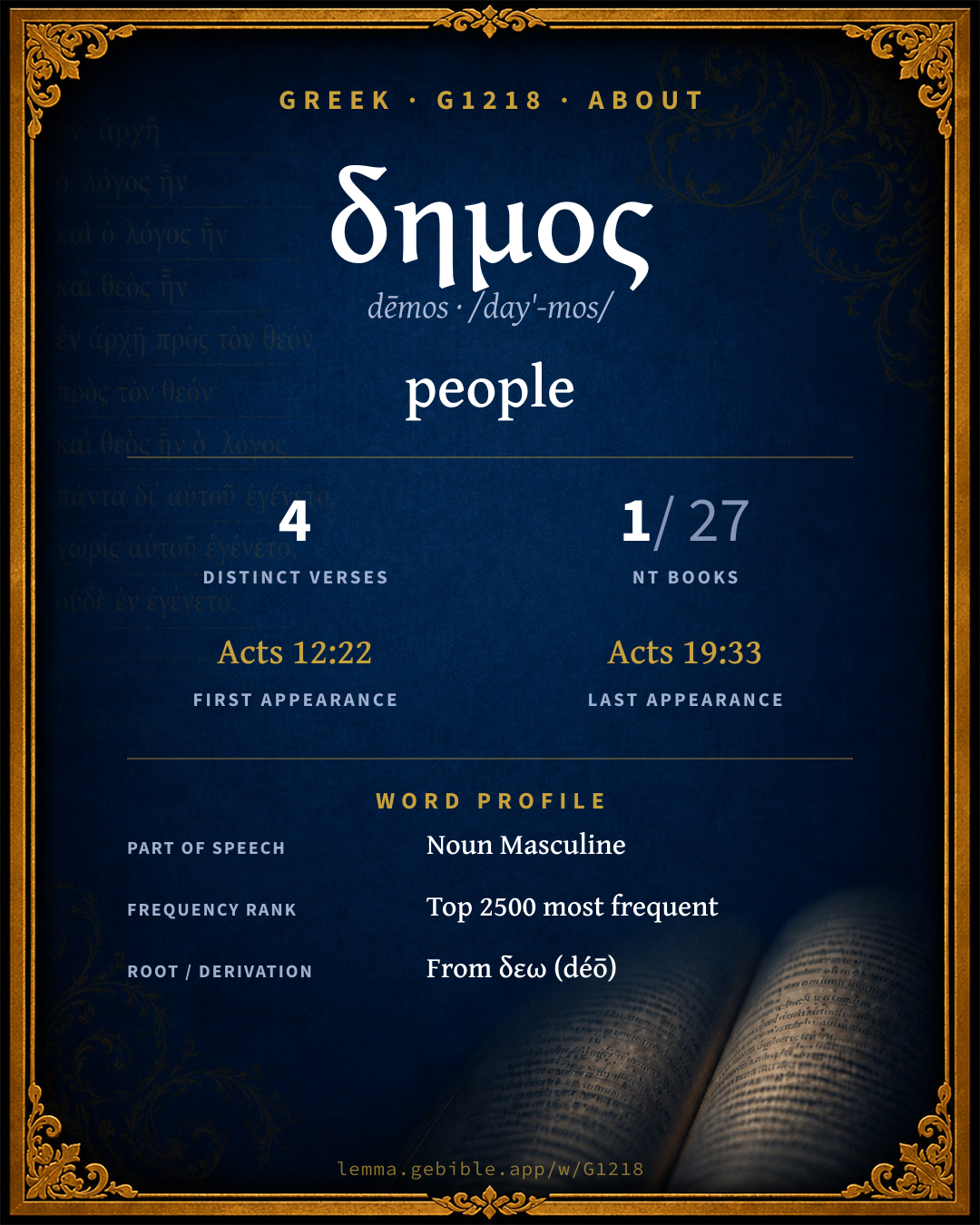
δῆμος
people
Full lexicon entry — Thayer's Greek Lexicon
From Thayer's Greek Lexicon
Where this word appears
See every Accusative-case word in the Greek New Testament →
Grammar key — what these labels mean
Part of speech
- Noun
- A naming word — a person, place, thing, or idea.
Case
- Accusative
- The case of the direct object and of extent.
- Dative
- The case of the indirect object, means, or location — “to / for / with / in.”
- Nominative
- The case of the subject (and the predicate nominative).
Gender
- Masculine
- Grammatically masculine.
Number
- Singular
- One.
2 distinct verses where G1218 appears in the Accusative case, across 1 book. Filtered view — show all forms. Click any verse to open its interlinear word-by-word view. Verse text shown in the World English Bible for context — . Each verse’s Greek form is shown with its reference; the English is not keyword-highlighted, since the data carries no word-level English alignment. Use “Compare translations” on any verse to read it across multiple English versions. This concordance covers the Greek New Testament; Septuagint (Greek Old Testament) occurrences of this word are not indexed here.
Acts 2 verses
- Acts 17:5 δῆμον n acc sg masc But the unpersuaded Jews took along some wicked men from the marketplace, and gathering a crowd, set the city in an uproar. Assaulting the house of Jason, they sought to bring them out to the people.
- Acts 19:30 δῆμον n acc sg masc When Paul wanted to enter in to the people, the disciples didn't allow him.
About this entry
At a glance — auto-summarized from this page’s data, not written by a person. Every figure links to its source below. This summary describes the numbers; it doesn’t interpret them.
δημος (dēmos) is a Greek noun most often rendered “people.” It is rare — just 4 verses in the entire Greek New Testament. It clusters heavily in Acts, which alone accounts for 100% of its uses. Scripture first uses it in Acts 12:22. It clusters with δεω, δει and δεομαι under a shared root. The sections below give every sense, occurrence, and version rendering.
Gloss history
Strong's 1890 vs modern scholarship
About this word
Strong's G1218 catalogs a Greek word from the Greek New Testament.
These counts are not copied from any lexicon or concordance. They are computed here, from the morphology-tagged Greek New Testament. What Lemma adds →
- 4
- distinct verses
- The word appears in 4 distinct verses.
- 1 / 27
- NT books
- The word appears in 1 of 27 New Testament books.
- #1,877
- by frequency
- Top 2500 most frequent Greek words (rank 1,877 of 5,347 Greek words by occurrence).
View all 4 occurrences in the concordance →
Most concentrated in
- Acts 4 verses 100%
By section of the New Testament
By traditional corpus
Conventional, traditional groupings — biblical authorship is debated, so this is a traditional corpus grouping, not an authorship claim. Some books belong to more than one corpus (Luke is in both the Gospels and the Lukan corpus, and so on), so these shares overlap and need not total 100%. Each figure is a share of the word’s 4 distinct verses.
- Lukan (Luke–Acts) 4 verses · 100%
How translations render this word
Counts come from each version’s own published word-to-Strong’s tagging or interlinear alignment — an approximate guide to how each version renders this word, not a word-level alignment the data otherwise carries. Because each total is that version’s own tagged count, the per-version totals vary from one another and need not match the appearance or distinct-verse counts above. These counts may also differ from a printed concordance because Lemma counts each distinctly tagged rendering and does not collapse phrase taggings into a single head-word total. This is a fixed set of word-tagged versions (KJV, ASV, BSB, ULT) and does not change with the reading translation you choose elsewhere. Each version’s license is shown beside its name below (and on Sources).
- King James Version: People 4×
- American Standard Version: People 4×
- Berean Standard Bible: People 2×
- unfoldingWord Literal Text: People 4×
King James Version Public Domain
Renders G1218 across 4 tagged occurrences — most commonly:
American Standard Version Public Domain
Renders G1218 across 4 tagged occurrences — most commonly:
Berean Standard Bible Public Domain
Renders G1218 across 3 tagged occurrences — most commonly:
Plus 1 rendering that appears only once — usually multi-word phrases or single function words the recovered tagging swept in, not distinct renderings. Not rendered by a distinct English word in 1 further occurrence.
unfoldingWord Literal Text CC BY-SA 4.0
Renders G1218 across 4 tagged occurrences — most commonly:
Senses in Thayer's
The 1 sense Thayer's distinguishes for this word, in lexicon order (not ranked by frequency or importance). The full entry — with sub-senses — is in the Lexicon Entry tab.
- the people, the mass of people assembled in a public place
Word origin
Derived from δεω (déō) (G1210) — to bind.
From G1210 ; the public (as bound together socially): - people.
— Strong’s Exhaustive Concordance (1890), public domain.
Forms in the corpus
The 3 distinct written forms G1218 takes in the Greek New Testament, most frequent first — each parse links to that case’s occurrences in the concordance.
| Form | Parsing | Example | Uses |
|---|---|---|---|
| δῆμον dē̂mon | Noun, Accusative, Singular, Masculine | Acts 17:5 | 2 |
| δήμῳ dḗmō | Noun, Dative, Singular, Masculine | Acts 19:33 | 1 |
| δῆμος dē̂mos | Noun, Nominative, Singular, Masculine | Acts 12:22 | 1 |
Same root — word family
Other Thayer's entries built from the same root as G1218, grouped by Strong’s listed origin. These share a root / origin per the lexicon — not necessarily a shared meaning. Each links to that word’s own entry.
Derives from
Shares the same root
- δει deî G1163 it is necessary
- δεομαι déomai G1189 to ask
- δεσμον desmón G1199 bond
- δεσποτης despótēs G1203 master
- δουλος doûlos G1401 slave
Derived from this word
- δημηγορεω dēmēgoréō G1215 to address
- δημιουργος dēmiourgós G1217 craftsman
- δημοσιος dēmósios G1219 public
Compare all same-root words → Showing 4 of 10 — not the complete family. They share a root, not necessarily a meaning.
Septuagint usage
The same Greek word δημος appears 195 times in the Greek Old Testament (Septuagint), across 132 verses in 5 books.
- 195
- LXX occurrences
- Tagged occurrences of this Greek word in the Septuagint.
- 132
- verses
- Distinct Septuagint verses containing this word.
- 5 / 39
- OT books
- The word appears in 5 of the 39 Old Testament books.
Sample Septuagint occurrences
- Numbers 1:20 δῆμος
- Joshua 7:14 δῆμος
- Judges 13:2 δῆμος
- Ezra 14:7 δῆμος
- Daniel 8:24 δῆμος
Septuagint occurrences (same lexeme)
Every verse where the same Strong’s number (G1218) appears in the Greek Septuagint — showing the first 50 of 132. Verse text shown in the World English Bible for context; the Greek form is the matched word — the English is not keyword-highlighted.
- Numbers 1:20 δῆμος The children of Reuben, Israel's firstborn, their generations, by their families, by their fathers' houses, according to the number of the names, one by one, every male from twenty years old and upward, all who were able to go out to war;
- Numbers 1:22 δῆμος Of the children of Simeon, their generations, by their families, by their fathers' houses, those who were numbered of it, according to the number of the names, one by one, every male from twenty years old and upward, all who were able to go out to war;
- Numbers 1:24 δῆμος Of the children of Gad, their generations, by their families, by their fathers' houses, according to the number of the names, from twenty years old and upward, all who were able to go out to war;
- Numbers 1:26 δῆμος Of the children of Judah, their generations, by their families, by their fathers' houses, according to the number of the names, from twenty years old and upward, all who were able to go out to war;
- Numbers 1:28 δῆμος Of the children of Issachar, their generations, by their families, by their fathers' houses, according to the number of the names, from twenty years old and upward, all who were able to go out to war;
- Numbers 1:30 δῆμος Of the children of Zebulun, their generations, by their families, by their fathers' houses, according to the number of the names, from twenty years old and upward, all who were able to go out to war;
- Numbers 1:32 δῆμος Of the children of Joseph, of the children of Ephraim, their generations, by thir families, by their fathers' houses, according to the number of the names, from twenty years old and upward, all who were able to go out to war;
- Numbers 1:34 δῆμος Of the children of Manasseh, their generations, by their families, by their fathers' houses, according to the number of the names, from twenty years old and upward, all who were able to go out to war;
- Numbers 1:36 δῆμος Of the children of Benjamin, their generations, by their families, by their fathers' houses, according to the number of the names, from twenty years old and upward, all who were able to go out to war;
- Numbers 1:38 δῆμος Of the children of Dan, their generations, by their families, by their fathers' houses, according to the number of the names, from twenty years old and upward, all who were able to go forth to war;
- Numbers 1:40 δῆμος Of the children of Asher, their generations, by their families, by their fathers' houses, according to the number of the names, from twenty years old and upward, all who were able to go forth to war;
- Numbers 1:42 δῆμος Of the children of Naphtali, their generations, by their families, by their fathers' houses, according to the number of the names, from twenty years old and upward, all who were able to go forth to war;
- Numbers 2:34 δῆμος Thus the children of Israel did. According to all that Yahweh commanded Moses, so they encamped by their standards, and so they set out, everyone by their families, according to their fathers' houses.
- Numbers 3:15 δῆμος "Number the children of Levi by their fathers' houses, by their families: every male from a month old and upward shall you number."
- Numbers 3:18 δῆμος These are the names of the sons of Gershon by their families: Libni and Shimei.
- Numbers 3:19 δῆμος The sons of Kohath by their families: Amram, and Izhar, Hebron, and Uzziel.
- Numbers 3:20 δῆμος The sons of Merari by their families: Mahli and Mushi. These are the families of the Levites according to their fathers' houses.
- Numbers 3:21 δῆμος Of Gershon was the family of the Libnites, and the family of the Shimeites: these are the families of the Gershonites.
- Numbers 3:24 δῆμος The prince of the fathers' house of the Gershonites shall be Eliasaph the son of Lael.
- Numbers 3:27 δῆμος Of Kohath was the family of the Amramites, and the family of the Izharites, and the family of the Hebronites, and the family of the Uzzielites: these are the families of the Kohathites.
- Numbers 3:29 δῆμος The families of the sons of Kohath shall encamp on the south side of the tabernacle.
- Numbers 3:30 δῆμος The prince of the fathers' house of the families of the Kohathites shall be Elizaphan the son of Uzziel.
- Numbers 3:33 δῆμος Of Merari was the family of the Mahlites, and the family of the Mushites. These are the families of Merari.
- Numbers 3:35 δῆμος The prince of the fathers' house of the families of Merari was Zuriel the son of Abihail. They shall encamp on the north side of the tabernacle.
- Numbers 3:39 δῆμος All who were numbered of the Levites, whom Moses and Aaron numbered at the commandment of Yahweh, by their families, all the males from a month old and upward, were twenty-two thousand.
- Numbers 4:2 δῆμος "Take a census of the sons of Kohath from among the sons of Levi, by their families, by their fathers' houses,
- Numbers 4:18 δῆμος "Don't cut off the tribe of the families of the Kohathites from among the Levites;
- Numbers 4:22 δῆμος "Take a census of the sons of Gershon also, by their fathers' houses, by their families;
- Numbers 4:24 δῆμος This is the service of the families of the Gershonites, in serving and in bearing burdens:
- Numbers 4:29 δῆμος "As for the sons of Merari, you shall number them by their families, by their fathers' houses;
- Numbers 4:33 δῆμος This is the service of the families of the sons of Merari, according to all their service, in the Tent of Meeting, under the hand of Ithamar the son of Aaron the priest."
- Numbers 4:34 δῆμος Moses and Aaron and the princes of the congregation numbered the sons of the Kohathites by their families, and by their fathers' houses,
- Numbers 4:36 δῆμος Those who were numbered of them by their families were two thousand seven hundred fifty.
- Numbers 4:37 δῆμος These are those who were numbered of the families of the Kohathites, all who served in the Tent of Meeting, whom Moses and Aaron numbered according to the commandment of Yahweh by Moses.
- Numbers 4:38 δῆμος Those who were numbered of the sons of Gershon, their families, and by their fathers' houses,
- Numbers 4:40 δῆμος even those who were numbered of them, by their families, by their fathers' houses, were two thousand six hundred thirty.
- Numbers 4:41 δῆμος These are those who were numbered of the families of the sons of Gershon, all who served in the Tent of Meeting, whom Moses and Aaron numbered according to the commandment of Yahweh.
- Numbers 4:42 δῆμος Those who were numbered of the families of the sons of Merari, by their families, by their fathers' houses,
- Numbers 4:44 δῆμος even those who were numbered of them by their families, were three thousand two hundred.
- Numbers 4:45 δῆμος These are those who were numbered of the families of the sons of Merari, whom Moses and Aaron numbered according to the commandment of Yahweh by Moses.
- Numbers 4:46 δῆμος All those who were numbered of the Levites, whom Moses and Aaron and the princes of Israel numbered, by their families, and by their fathers' houses,
- Numbers 11:10 δῆμος Moses heard the people weeping throughout their families, every man at the door of his tent: and the anger of Yahweh was kindled greatly; and Moses was displeased.
- Numbers 13:2 δῆμος Send you men, that they may spy out the land of Canaan, which I give to the children of Israel: of every tribe of their fathers shall you send a man, everyone a prince among them.
- Numbers 18:2 δῆμος Your brothers also, the tribe of Levi, the tribe of your father, bring you near with you, that they may be joined to you, and minister to you: but you and your sons with you shall be before the tent of the testimony.
- Numbers 23:10 δῆμος Who can count the dust of Jacob, Or number the fourth part of Israel? Let me die the death of the righteous, Let my last end be like his!
- Numbers 26:5 δῆμος Reuben, the firstborn of Israel; the sons of Reuben: [of] Hanoch, the family of the Hanochites; of Pallu, the family of the Palluites;
- Numbers 26:6 δῆμος of Hezron, the family of the Hezronites; of Carmi, the family of the Carmites.
- Numbers 26:7 δῆμος These are the families of the Reubenites; and those who were numbered of them were forty-three thousand seven hundred thirty.
- Numbers 26:12 δῆμος The sons of Simeon after their families: of Nemuel, the family of the Nemuelites; of Jamin, the family of the Jaminites; of Jachin, the family of the Jachinites;
- Numbers 26:13 δῆμος of Zerah, the family of the Zerahites; of Shaul, the family of the Shaulites.
These are occurrences of the same Greek lexeme (G1218) in the Septuagint — not a translation of any one Hebrew word. The store carries no word-level Hebrew↔Greek alignment, so no Hebrew original is asserted here. Counts come from the recovered LXX Strong's tagging — high-frequency vocabulary is well covered, while rare or late forms may be untagged — so they reflect tagged occurrences and may slightly undercount.