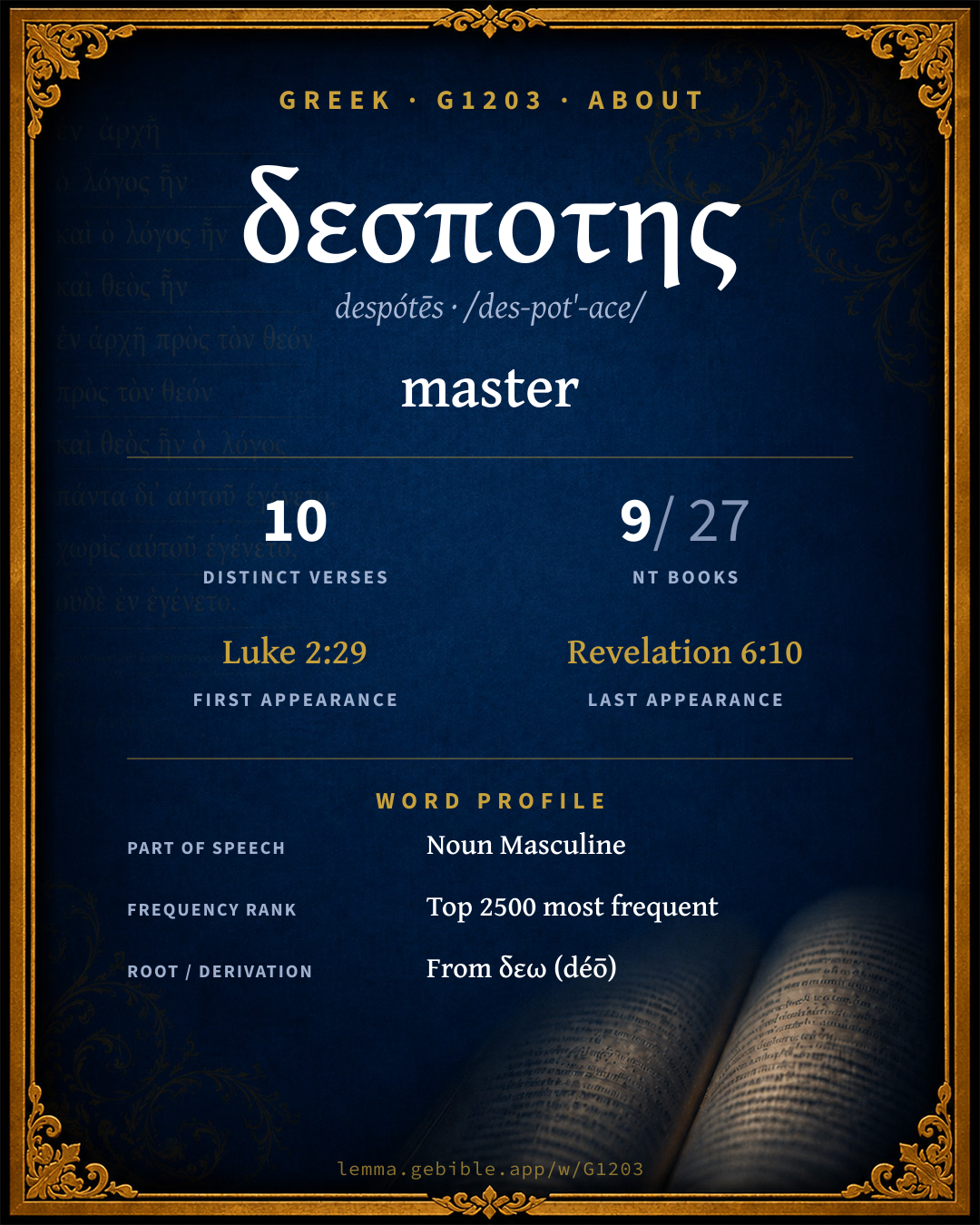
δεσπότης
master
Full lexicon entry — Thayer's Greek Lexicon
From Thayer's Greek Lexicon
Where this word appears
Grammar key — what these labels mean
Part of speech
- Noun
- A naming word — a person, place, thing, or idea.
Case
- Accusative
- The case of the direct object and of extent.
- Dative
- The case of the indirect object, means, or location — “to / for / with / in.”
- Vocative
- The case of direct address (“O Lord”).
- Nominative
- The case of the subject (and the predicate nominative).
Gender
- Masculine
- Grammatically masculine.
Number
- Plural
- More than one.
- Singular
- One.
Every verse where G1203 appears in the Book of Acts — 1 distinct verse. Click any verse to open its interlinear word-by-word view. Verse text shown in the World English Bible for context — . Each verse’s Greek form is shown with its reference; the English is not keyword-highlighted, since the data carries no word-level English alignment. Use “Compare translations” on any verse to read it across multiple English versions. This concordance covers the Greek New Testament; Septuagint (Greek Old Testament) occurrences of this word are not indexed here.
Acts
About this entry
At a glance — auto-summarized from this page’s data, not written by a person. Every figure links to its source below. This summary describes the numbers; it doesn’t interpret them.
“master” is the headline sense of the Greek noun δεσποτης (despótēs). Its earliest occurrence is Luke 2:29. The Greek New Testament uses it across 10 verses — uncommon. Related forms include δεω, δει and δεομαι. The sections below give every sense, occurrence, and version rendering.
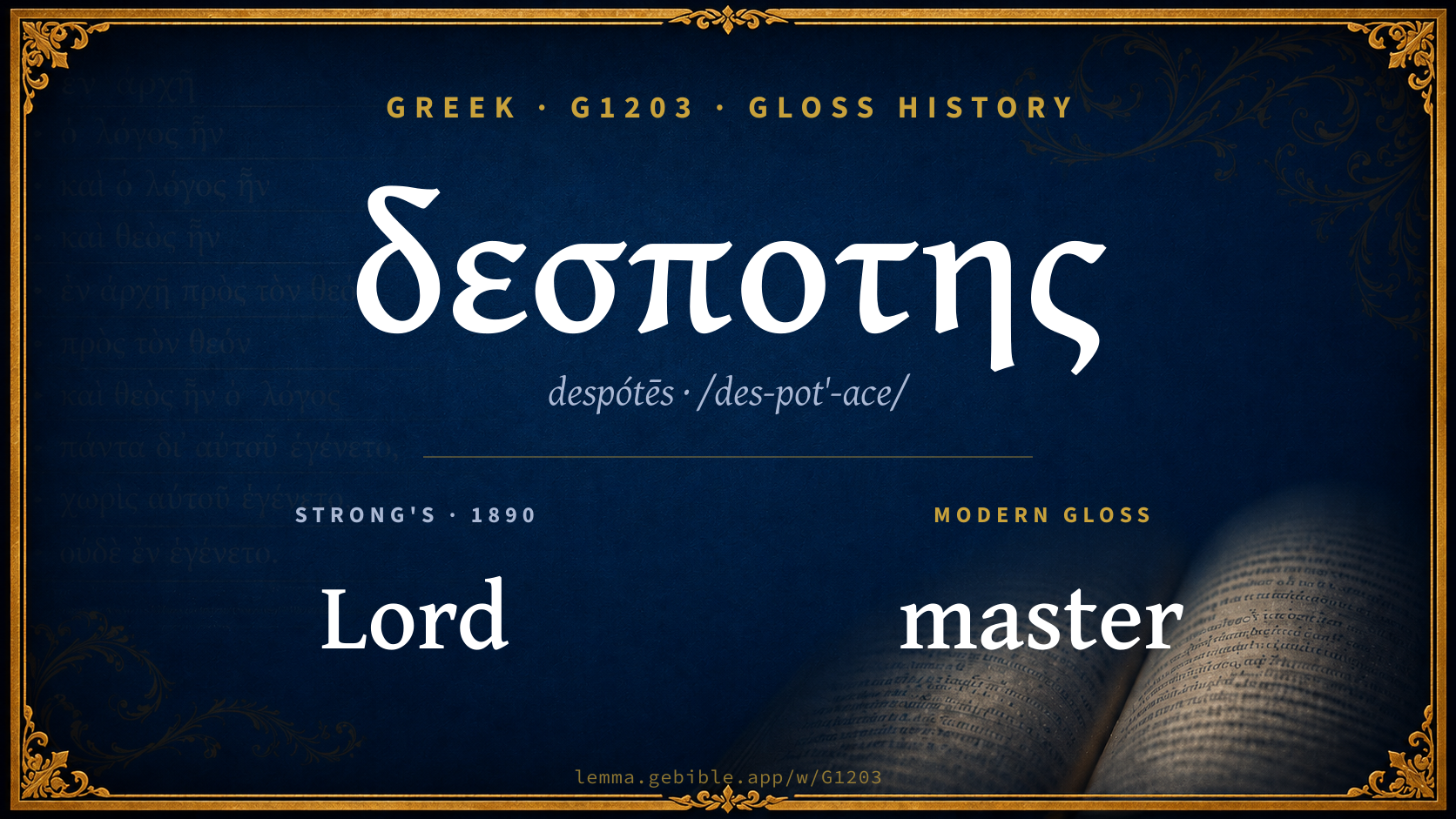
Gloss history
Strong's 1890 vs modern scholarship
About this word
Strong's G1203 catalogs a Greek word from the Greek New Testament.
These counts are not copied from any lexicon or concordance. They are computed here, from the morphology-tagged Greek New Testament. What Lemma adds →
- 10
- distinct verses
- The word appears in 10 distinct verses.
- 9 / 27
- NT books
- The word appears in 9 of 27 New Testament books.
- #1,056
- by frequency
- Top 2500 most frequent Greek words (rank 1,056 of 5,347 Greek words by occurrence).
View all 10 occurrences in the concordance →
By section of the New Testament
By traditional corpus
Conventional, traditional groupings — biblical authorship is debated, so this is a traditional corpus grouping, not an authorship claim. Some books belong to more than one corpus (Luke is in both the Gospels and the Lukan corpus, and so on), so these shares overlap and need not total 100%. Each figure is a share of the word’s 10 distinct verses.
- Pauline corpus 4 verses · 40%
- General (Catholic) Epistles 3 verses · 30%
- Lukan (Luke–Acts) 2 verses · 20%
- Gospels 1 verse · 10%
- Johannine 1 verse · 10%
- Revelation 1 verse · 10%
How translations render this word
Counts come from each version’s own published word-to-Strong’s tagging or interlinear alignment — an approximate guide to how each version renders this word, not a word-level alignment the data otherwise carries. Because each total is that version’s own tagged count, the per-version totals vary from one another and need not match the appearance or distinct-verse counts above. These counts may also differ from a printed concordance because Lemma counts each distinctly tagged rendering and does not collapse phrase taggings into a single head-word total. This is a fixed set of word-tagged versions (KJV, ASV, BSB, ULT) and does not change with the reading translation you choose elsewhere. Each version’s license is shown beside its name below (and on Sources).
- King James Version: Lord 5×, Masters 4×
- American Standard Version: Masters 4×, Master 3×, Lord 2×
- Berean Standard Bible: Masters 4×, Master 3×, Sovereign lord 2×
- unfoldingWord Literal Text: Masters 4×, Master 3×, Lord 2×
King James Version Public Domain
Renders G1203 across 10 tagged occurrences — most commonly:
Plus 1 rendering that appears only once — usually multi-word phrases or single function words the recovered tagging swept in, not distinct renderings.
American Standard Version Public Domain
Renders G1203 across 11 tagged occurrences — most commonly:
Plus 2 renderings that appear only once — usually multi-word phrases or single function words the recovered tagging swept in, not distinct renderings.
Berean Standard Bible Public Domain
Renders G1203 across 10 tagged occurrences — most commonly:
Plus 1 rendering that appears only once — usually multi-word phrases or single function words the recovered tagging swept in, not distinct renderings.
unfoldingWord Literal Text CC BY-SA 4.0
Renders G1203 across 12 tagged occurrences — most commonly:
Plus 1 rendering that appears only once — usually multi-word phrases or single function words the recovered tagging swept in, not distinct renderings.
Senses in Thayer's
The 1 sense Thayer's distinguishes for this word, in lexicon order (not ranked by frequency or importance). The full entry — with sub-senses — is in the Lexicon Entry tab.
- a master, Lord
Word origin
Derived from δεω (déō) (G1210) — to bind.
Perhaps from G1210 and πόσις posis (a husband ); an absolute ruler (despot): - Lord master.
— Strong’s Exhaustive Concordance (1890), public domain.
Forms in the corpus
The 6 distinct written forms G1203 takes in the Greek New Testament, most frequent first — each parse links to that case’s occurrences in the concordance.
| Form | Parsing | Example | Uses |
|---|---|---|---|
| δέσποτα déspota | Noun, Vocative, Singular, Masculine | Luke 2:29 | 2 |
| δεσπόταις despótais | Noun, Dative, Plural, Masculine | Titus 2:9 | 2 |
| δεσπότας despótas | Noun, Accusative, Plural, Masculine | 1 Timothy 6:1 | 2 |
| δεσπότην despótēn | Noun, Accusative, Singular, Masculine | 2 Peter 2:1 | 2 |
| δεσπότης despótēs | Noun, Nominative, Singular, Masculine | Revelation 6:10 | 1 |
| δεσπότῃ despótē | Noun, Dative, Singular, Masculine | 2 Timothy 2:21 | 1 |
Same root — word family
Other Thayer's entries built from the same root as G1203, grouped by Strong’s listed origin. These share a root / origin per the lexicon — not necessarily a shared meaning. Each links to that word’s own entry.
Derives from
Shares the same root
- δει deî G1163 it is necessary
- δεομαι déomai G1189 to ask
- δεσμον desmón G1199 bond
- δημος dēmos G1218 people
- δουλος doûlos G1401 slave
Compare all same-root words → Showing 4 of 7 — not the complete family. They share a root, not necessarily a meaning.
Septuagint usage
The same Greek word δεσποτης appears 23 times in the Greek Old Testament (Septuagint), across 22 verses in 8 books.
- 23
- LXX occurrences
- Tagged occurrences of this Greek word in the Septuagint.
- 22
- verses
- Distinct Septuagint verses containing this word.
- 8 / 39
- OT books
- The word appears in 8 of the 39 Old Testament books.
Sample Septuagint occurrences
- Genesis 15:2 δεσπότης
- Joshua 5:14 δεσπότης
- Job 5:8 δεσπότης
- Proverbs 6:7 δεσπότης
- Isaiah 1:24 δεσπότης
- Jeremiah 1:6 δεσπότης
- Daniel 3:37 δεσπότης
- Jonah 4:3 δεσπότης
Septuagint occurrences (same lexeme)
Every verse where the same Strong’s number (G1203) appears in the Greek Septuagint. Verse text shown in the World English Bible for context; the Greek form is the matched word — the English is not keyword-highlighted.
- Genesis 15:2 δεσπότης Abram said, "Lord Yahweh, what will you give me, seeing I go childless, and he who will inherit my estate is Eliezer of Damascus?"
- Genesis 15:8 δεσπότης He said, "Lord Yahweh, how will I know that I will inherit it?"
- Joshua 5:14 δεσπότης He said, No; but [as] prince of the host of Yahweh am I now come. Joshua fell on his face to the earth, and did worship, and said to him, What says my lord to his servant?
- Job 5:8 δεσπότης "But as for me, I would seek God, To God would I commit my cause;
- Proverbs 6:7 δεσπότης Which having no chief, overseer, or ruler,
- Proverbs 17:2 δεσπότης A servant who deals wisely will rule over a son who causes shame, And shall have a part in the inheritance among the brothers.
- Proverbs 22:7 δεσπότης The rich rule over the poor. The borrower is servant to the lender.
- Proverbs 29:25 δεσπότης The fear of man proves to be a snare, But whoever puts his trust in Yahweh is kept safe.
- Proverbs 30:10 δεσπότης "Don't slander a servant to his master, Lest he curse you, and you be held guilty.
- Isaiah 1:24 δεσπότης Therefore the Lord, Yahweh of Hosts, The Mighty One of Israel, says: "Ah, I will get relief from my adversaries, And avenge myself of my enemies;
- Isaiah 3:1 δεσπότης For, behold, the Lord, Yahweh of Hosts, takes away from Jerusalem and from Judah supply and support, The whole supply of bread, And the whole supply of water;
- Isaiah 10:33 δεσπότης Behold, the Lord, Yahweh of Hosts, will lop the boughs with terror: and the high of stature shall be hewn down, and the lofty shall be brought low.
- Jeremiah 1:6 δεσπότης Then said I, Ah, Lord Yahweh! behold, I don't know how to speak; for I am a child.
- Jeremiah 4:10 δεσπότης Then said I, Ah, Lord Yahweh! surely you have greatly deceived this people and Jerusalem, saying, You shall have peace; whereas the sword reaches to the life.
- Jeremiah 15:11 δεσπότης Yahweh said, Most assuredly I will strengthen you for good; most assuredly I will cause the enemy to make supplication to you in the time of evil and in the time of affliction.
- Daniel 3:37 δεσπότης
- Daniel 9:8 δεσπότης Lord, to us belongs confusion of face, to our kings, to our princes, and to our fathers, because we have sinned against you.
- Daniel 9:15 δεσπότης Now, Lord our God, who has brought your people forth out of the land of Egypt with a mighty hand, and have gotten you renown, as at this day; we have sinned, we have done wickedly.
- Daniel 9:16 δεσπότης Lord, according to all your righteousness, let your anger and please let your wrath be turned away from your city Jerusalem, your holy mountain; because for our sins, and for the iniquities of our fathers, Jerusalem and your people are become a reproach to all who are round about us.
- Daniel 9:17 δεσπότης Now therefore, our God, listen to the prayer of your servant, and to his petitions, and cause your face to shine on your sanctuary that is desolate, for the Lord's sake.
- Daniel 9:19 δεσπότης Lord, hear; Lord, forgive; Lord, listen and do; don't defer, for your own sake, my God, because your city and your people are called by your name.
- Jonah 4:3 δεσπότης Therefore now, Yahweh, take, I beg you, my life from me; for it is better for me to die than to live."
These are occurrences of the same Greek lexeme (G1203) in the Septuagint — not a translation of any one Hebrew word. The store carries no word-level Hebrew↔Greek alignment, so no Hebrew original is asserted here. Counts come from the recovered LXX Strong's tagging — high-frequency vocabulary is well covered, while rare or late forms may be untagged — so they reflect tagged occurrences and may slightly undercount.