
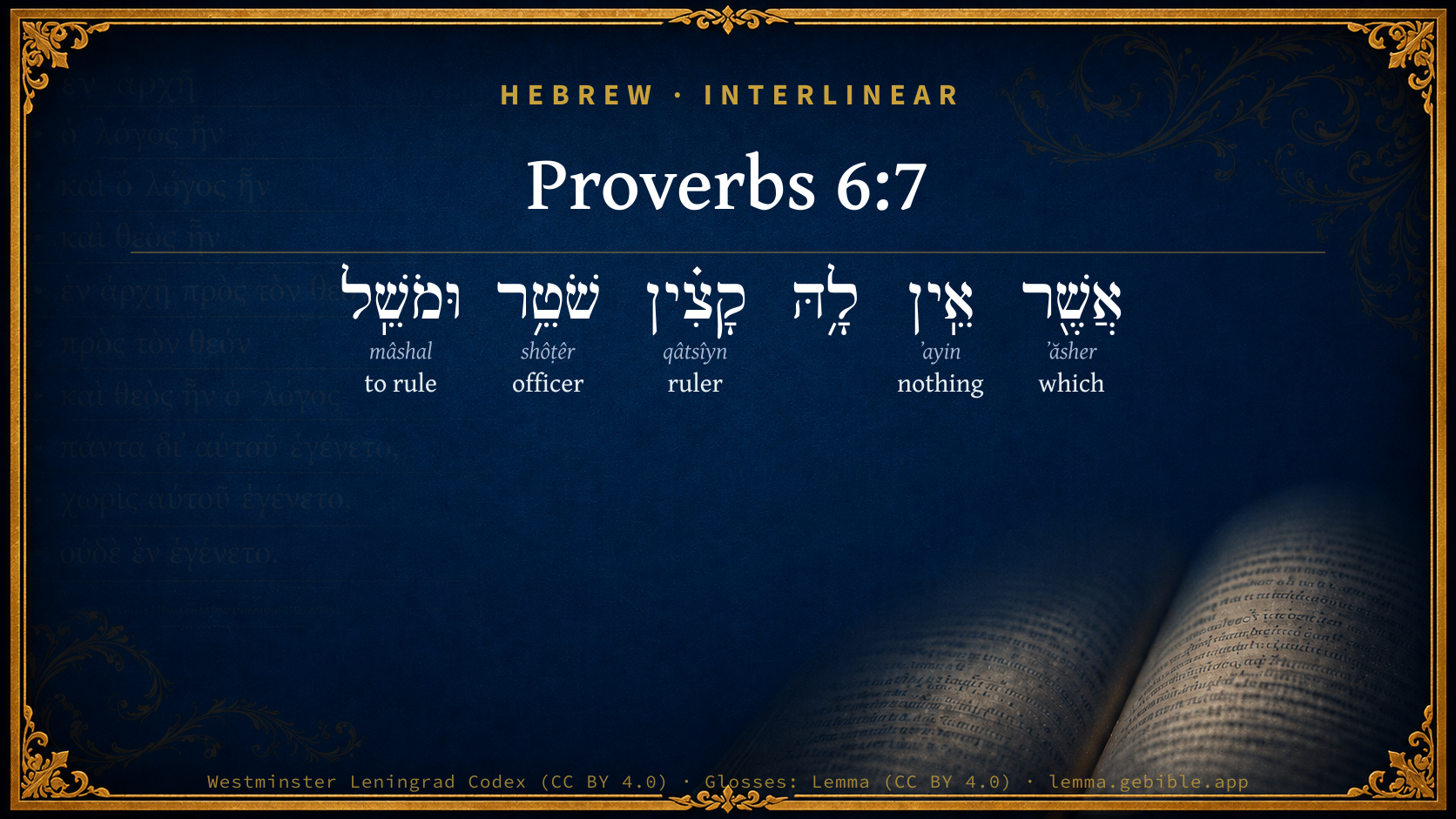
Proverbs 6:7

Hebrew (Westminster Leningrad Codex) Proverbs 6:7 appears in the Hebrew Old Testament. The text above is from the Westminster Leningrad Codex. Each word links to its Strong’s number, a concise gloss, and parsing drawn from the Open Scriptures Hebrew Bible morphology. Click any word for its full Brown-Driver-Briggs (BDB) entry.
Download image
Cite this verse

Proverbs 6:7 (World English Bible). Public Domain. Lemma interlinear Bible study tool, https://lemma.gebible.app/v/proverbs/6/7.

Show BibTeX & RIS
BibTeX
RIS
English Translation
Which having no chief, overseer, or ruler,
World English Bible · Public Domain
Download a study sheet

One document with this verse’s original text, its word-by-word gloss line, the meaning frame, cross-references with their text, attributed commentary, and full source and license credits — printable, and it pastes into notes with its structure intact.

This verse Autodidact and up

Study sheet (.html) Plain text (.txt)

A passage Seminary Student

Up to 50 verses in one chapter. A passage sheet keeps up to 6 commentary sources and 12 cross-references per verse, in the order this page ranks them, and says so on the sheet whenever that leaves anything out. Ask for a single verse and you get the Autodidact verse sheet above.

Everything on this page stays free to read, with no account — the sheet is a download of what is already on screen, not access to it.

Want to remove ads? Support Godless Engineer
Compare translations 3

The same verse in 3 English versions, stacked beneath the original-language interlinear above. Click any original word for its lexicon entry.

Each is an independent rendering of the whole verse — the interlinear is not word-aligned to these translations.

Highlighted words mark where these versions differ — a whole-verse word diff, not a word-by-word alignment.

  • World English Bible Public Domain
    Which having no chief, overseer, or ruler,
  • King James Version Public Domain
    Which having no guide, overseer, or ruler,
  • unfoldingWord Literal Text CC BY-SA 4.0
    which, without a commander, officer, or ruler for it,

unfoldingWord Literal Text — © unfoldingWord, licensed CC BY-SA 4.0. Word-aligned USFM3 via Door43 (git.door43.org/unfoldingWord/en_ult).

Versions to compare (up to 4)

3 of 4 selected

Show all 18 translations

Every available English version of this verse, each an independent rendering of the whole verse.

  • World English Bible Public Domain
    Which having no chief, overseer, or ruler,
  • Berean Standard Bible Public Domain
    Without a commander, without an overseer or ruler,
  • Majority Standard Bible Public Domain
    Without a commander, without an overseer or ruler,
  • King James Version Public Domain
    Which having no guide, overseer, or ruler,
  • American Standard Version (1901) Public Domain
    Which having no chief, Overseer, or ruler,
  • Revised Version (1885) Public Domain
    Which having no chief, overseer, or ruler,
  • Geneva Bible (1599) Public Domain
    For shee hauing no guide, gouernour, nor ruler,
  • Douay-Rheims (1899) Public Domain
    Which, although she hath no guide, nor master, nor captain,
  • Young's Literal Translation Public Domain
    Which hath not captain, overseer, and ruler,
  • Literal Standard Version CC BY-SA 4.0
    Which has no captain, overseer, and ruler,
  • Unlocked Literal Bible CC BY-SA 4.0
    It has no commander, officer, or ruler,
  • unfoldingWord Literal Text CC BY-SA 4.0
    which, without a commander, officer, or ruler for it,
  • Darby Bible Public Domain
    which having no chief, overseer, or ruler,
  • World Messianic Bible Public Domain
    which having no chief, overseer, or ruler,
  • Webster's Bible Public Domain
    Which having no guide, overseer, or ruler,
  • Free Bible Version CC BY-SA 4.0
    They don't have a leader, an officer, or a ruler,
  • Bible in Basic English Public Domain
    Having no chief, overseer, or ruler,
  • JPS Tanakh (1917) Public Domain
    Which having no chief, overseer, or ruler,

Literal Standard Version (2020), Covenant Press — licensed CC BY-SA 4.0. Text via the HelloAO Bible API (eBible.org). Unlocked Literal Bible (unfoldingWord) — licensed CC BY-SA 4.0. Text via the HelloAO Bible API (eBible.org). unfoldingWord Literal Text — © unfoldingWord, licensed CC BY-SA 4.0. Word-aligned USFM3 via Door43 (git.door43.org/unfoldingWord/en_ult). Free Bible Version, Dr. Jonathan Gallagher — licensed CC BY-SA 4.0. Text via the HelloAO Bible API (eBible.org).

Word by word

More ways to search: Search by grammar → Find every occurrence → Compare this word →

Practice this passage: Drill this verse → Learn its vocabulary →

About this verse

These counts appear in no published source. They are computed here, from the morphology-tagged text and Lemma’s own curated glosses. What Lemma adds →

6
words
5
distinct lemmas
Wisdom
section

Notable vocabulary

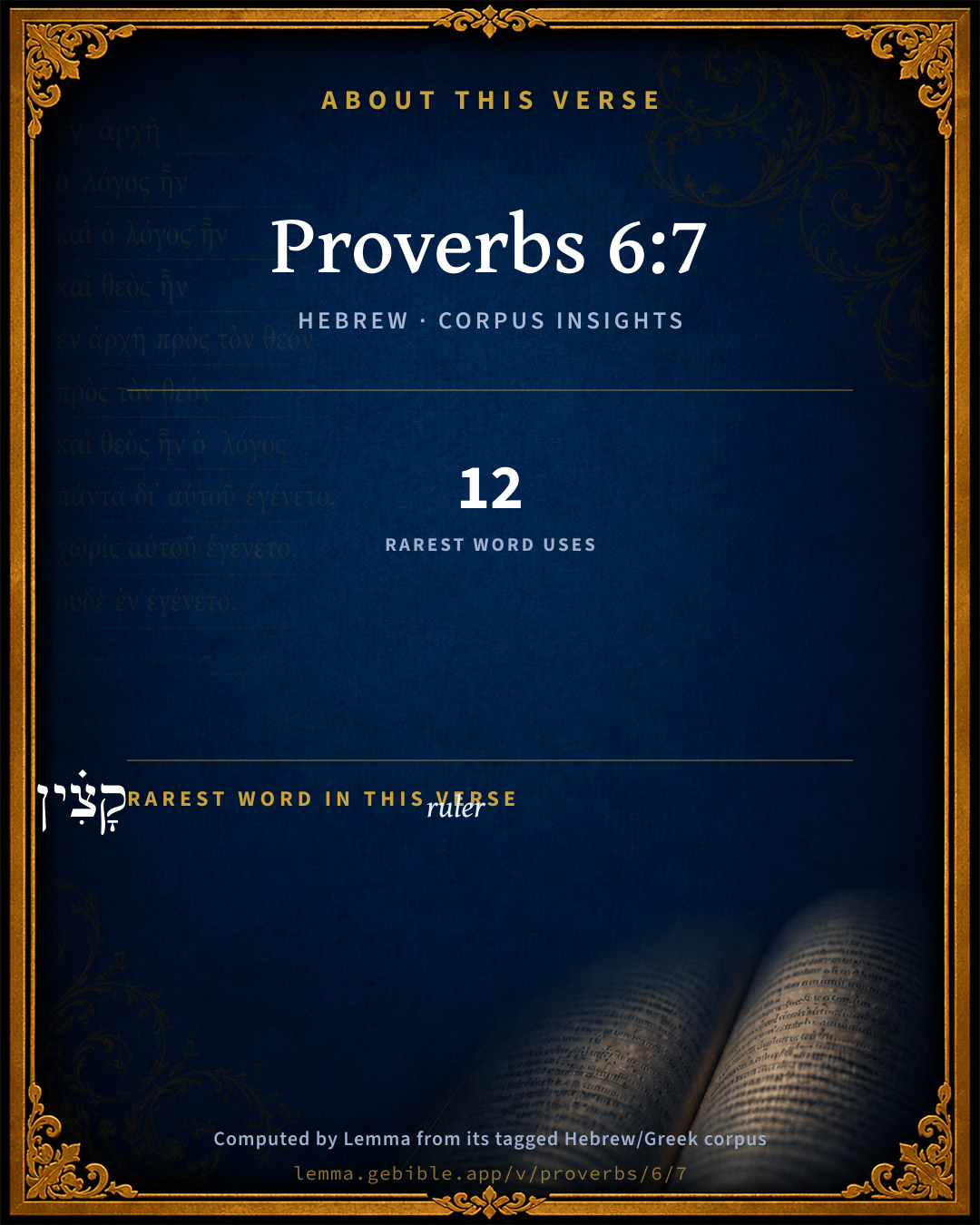
The rarest word here is קָצִ֗ין ruler H7101 — appearing just 12 times in the whole Hebrew Bible.

Shared distinctive vocabulary

קָצִ֗ין ruler H7101 occurs in 12 verses of the Hebrew Bible. Also found in:

Grammatical profile

  • 2 verbs
  • 1 noun
  • 1 preposition
  • 2 particles

Verb forms

  • שֹׁטֵ֥ר Qal · Participle Active
  • וּמֹשֵֽׁל Qal · Participle Active

Hebrew & Septuagint length

In English translation the verse runs 7 words from the Hebrew and 17 from the Septuagint (LXX English) — the Septuagint runs noticeably longer here. See the side-by-side →

A rough comparison of the two English renderings, which tokenize alike — not a word-level alignment.

Word counts can differ between the Hebrew and the Greek without any difference in meaning — e.g. the Hebrew direct-object marker אֵת has no separate Greek word, and Greek often adds the article ὁ.

Cross-references

4

Topical passages linked to Proverbs 6:7 in the Treasury of Scripture Knowledge — connected by theme and wording, ordered by reader-vote popularity; previews shown in the World English Bible.

  • Job 38:39–39:12 "Can you hunt the prey for the lioness, Or satisfy the appetite of the young lions,
  • Proverbs 30:27 The locusts have no king, Yet they advance in ranks;
  • Job 39:26–30 "Is it by your wisdom that the hawk soars, And stretches her wings toward the south?
  • Job 41:4–34 Will he make a covenant with you, That you should take him for a servant forever?

Cross-references courtesy of OpenBible.info (CC BY 4.0).

Hebrew and Greek witnesses Masoretic Hebrew ↔ Greek Septuagint

The same verse in the two great witnesses to the Old Testament, shown verse-for-verse.

Here the Septuagint runs noticeably longer than the Hebrew — LXX2012 (modern English Septuagint) 17 words vs World English Bible 7. A rough length comparison of the two English translations, not a word-level alignment — read both below.

These are two independent witnesses, not word-aligned to each other, and the Septuagint is shown in lemma (dictionary) form.

Hebrew Proverbs 6:7 Masoretic · Westminster Leningrad Codex

אֲשֶׁ֖ר אֵֽין לָ֥הּ קָצִ֗ין שֹׁטֵ֥ר וּמֹשֵֽׁל

Which having no chief, overseer, or ruler,

World English Bible · Public Domain

Greek LXX Proverbs 6:7 Septuagint · lemma form

ἐκεῖνος γάρ γεώργιον μή ὑποἄρχω μηδέ ὁ ἀναἀγκάζω ἔχω μηδέ ὑπό δεσπότης εἰμί

For whereas he has no husbandry, nor any one to compel him, and is under no master,

LXX2012 (modern English Septuagint) · Public Domain

On this verse, The Cambridge Bible for Schools and Colleges discusses the Septuagint’s reading. Read the note in Commentary ↓

Hebrew: Westminster Leningrad Codex (CC BY 4.0). Greek: Septuagint (public domain); English from LXX2012 (modern English Septuagint) (Public Domain). How the Septuagint differs from the Hebrew →

Commentary

Notes on Proverbs 6:7 from classic Christian and Jewish commentators (each source and its license shown beneath its notes). The classic Christian expositions comment on the surrounding passage and are grouped to its opening verse, so a note may address several verses; the Jewish commentaries on the Tanakh (Rashi and others) are per-verse, so they appear only where the commentator wrote on this verse.

Lemma curates 59 commentaries, every one of them public domain or Creative Commons licensed, each selected and text-cleaned for this edition rather than reprinted as found. About our sources →

Trapp's Complete Commentary

John Trapp

Pro 6:7 Which having no guide, overseer, or ruler,

Ver. 7. Which having no guide, overseer, &c.] How much more then should man, who hath all these, and is both ad laborem natus, et ratione ornatus, born to labour, and hath reason to guide him. Only he must take heed that he be not antlike, wholly taken up about What shall we eat, or what shall we drink? &c.

John Trapp, A Commentary or Exposition upon All the Books of the Old and New Testament (1647–1656) — public domain. Text from a community e-Sword module.

The Biblical Illustrator

Joseph S. Exell

Pro_6:7

Which having no guide, overseer, or ruler.

Overseers needed

When I began to employ workmen in this country (Palestine), nothing annoyed me more than the necessity to hire also an overseer, or to fulfil this office myself. But I soon found that this was universal and strictly necessary. Without an overseer very little work would be done, and nothing as it should be. The workmen, every way unlike the ant, will not work at all unless kept to it, and directed in it by an overseer, who is himself a perfect specimen of laziness. He does absolutely nothing but smoke his pipe, order this, scold that one, and discuss the how and the why with the men themselves, or with idle passers by. The ants manage far better. Every one attends to his own business and does it well. (W. Thomson.)

The Biblical Illustrator, edited by Joseph S. Exell (c. 1880s–1900s) — public domain. Text from a community e-Sword module.

Ellicott's Commentary for English Readers

(j). Tenth Discourse:—Against Sloth (Pro_6:6-11)

(7) Guide.—Properly, judge (the Arabic cadi), then leader, prince.

A Bible Commentary for English Readers, edited by Charles John Ellicott (1878–1897) — public domain. Text from a community e-Sword module.

The Cambridge Bible for Schools and Colleges

gen. ed. J. J. S. Perowne

7. guide] Rather, chief, R.V. (judge, marg.) to appoint its work. LXX. ἐκείνῳ γὰρ γεωργίου μὴ ὑπάρχοντος, in keeping with “the summer” and “the harvest” of the next verse.

overseer] The Heb. word is used of the Hebrew “officers,” whom the Egyptian “taskmasters” set over the Israelites in Egypt, Exo_5:6; Exo_5:10; Exo_5:14.

The Cambridge Bible for Schools and Colleges (gen. ed. J. J. S. Perowne; Cambridge University Press, 1878–1918) — public domain. Text from a community e-Sword module.

John Gill's Exposition

Provideth her meat in the summer,.... Against the winter, of which it is mindful, when it never comes out of its place, having in the summer time got a sufficiency laid up in cells for its use: she toils in the heat of summer to get in her provision for the winter, being sensible that nothing is to be gotten then; she works at it night and day while the season lasts; so diligent is it in laying up its stores at the proper opportunity (l);

and gathereth her food in the harvest; the time when corn is ripe, and is shed on the earth; this it gathereth, and lays up in its repositories against a time of need. The seeds it gathers and lays up; it bites off the chit or bud end of them, that they may not grow, as Pliny (m) and others observe, but be a winter store; hence its name in Hebrew is "nemalah", from "namal", "to cut off"; it being done by biting. Yea, according to Aelianus (n), it seems to have some sense of futurity with respect to famine, which being near, it will work exceeding hard to lay up food, fruits, and seed; and, according to Virgil (o) and others, it seems to presage old age, and therefore provides against it. An instruction this to work, while persons are in health, and have youth on their side; that they may have not only a sufficiency for present use, but to lay up against a time of sickness and old age. The Septuagint and Arabic versions add,

"or go to the bee, and learn what a worker she is, and what an admirable work she performs; whose labours kings and private persons use for health: she is desirable to all, and famous; and though weak in strength, honouring wisdom is advanced.''

But this is not in the Hebrew text; but perhaps being written in the margin of some copy of the Septuagint as a parallel instance, was by some unskilful copier put into the text of the Greek version, from whence the Arabic version has taken it; it crept in very early, for Clemens of Alexandria makes mention of it (p).

(l) "Ac veluti ingentem formicae farris acervum", &c. Virgil. Aeneid. l. 4. v. 402, &c. So Horat. Satyr. 1. v. 36. (m) Nat. Hist. l. 11. c. 30. Plutarch. vol. 2. de Solert. Animal. p. 968. (n) Vat. Hist. l. 1. c. 12. (o) "Inopi metuens formica senectae", Georgic. l. 1. v. 186. So Horace, ut supra. Juvenal. Satyr. 6. v. 360. (p) Stromat. l. 1. p. 286.

John Gill's Exposition of the Whole Bible (1746–1763) — public domain (CC PDM 1.0). Text via the HelloAO Bible API.

Albert Barnes' Notes on the Bible

The words express the wonder with which the Hebrew observer looked on the phenomena of insect life. “Guide,” better captain, as in Jos 10:24. The Septuagint introduces here a corresponding reference to the industry of the bee.

Albert Barnes' Notes on the Bible (1834–1885) — public domain. Text from a community e-Sword/MySword module.

Matthew Poole's English Annotations

Which might direct them in or quicken them to the work, as the bees have their kings, and many other creatures have their leaders. This heightens their commendation.

Matthew Poole's English Annotations on the Holy Bible (1683–1685) — public domain. Text from a community e-Sword/MySword module.

The Pulpit Commentary

Which having no guide, overseer, or ruler. This statement is substantially correct, for though the most recent observations made by modern naturalists have discovered various classes of ants occupying the same ant hill, yet there appears to be a total want of that gradation and subordination in ant life which is noticeable among bees. The three terms used here, katsa, shoter, moshel, all refer to government, and correspond respectively with the modern, Arabic terms, kadi, wall, and emir (Zockler). The first refers to the judicial office, and should rather be rendered "judge," the root katsah being "to decide". (see Isa_1:10 Isa_3:6, 7 Mic_3:9) The word, however, is used of a military commander in Jos_10:24 Jud 2:6-11, and in this sense it is understood by the Vulgate, which has dux. Shoter, rendered "overseer," is literally "a scribe," and appears as the general designation for any official In Exo_5:6, 19 the shoter is the person employed by the Egyptian taskmasters to urge on the Israelites in their forced labour; in Num_11:16 the shoter is one of the seventy elders; and in 1Ch_23:4 he is a municipal magistrate. The meaning assigned to the word in the Authorized Version seems to be the correct one. The ant has no overseer; there is none to regulate or see that the work is done. Each ant apparently works independently of the rest, though guided by a common instinct to add to the common store. In moshel we have the highest title of dignity and power, the word signifying a lord, prince, or ruler, from mashal, "to rule."

The Pulpit Commentary (1880–1919), ed. H.D.M. Spence-Jones & Joseph S. Exell — public domain. Text from a community e-Sword module.

Rashi

Rabbi Shlomo Yitzchaki (Rashi)

for she has no chief who would reprove her and alert her and take out of her hand if she steals anything from her companion, nevertheless...

Rashi on the Tanakh — English translations: “The Judaica Press complete Tanach with Rashi, translated by A. J. Rosenberg” (CC BY 4.0); “Pentateuch with Rashi's commentary by M. Rosenbaum and A.M. Silbermann, 1929-1934” (public domain); “The Metsudah Tanach series, Lakewood, N.J” (CC BY 4.0); and “The Book of Joshua, Metsudah Publications, 1997” (CC BY 4.0). Text via Sefaria.

Lesson kit

Teaching starters — assembled from the data on this page, not authored interpretation. Every prompt links to the verse data it draws on. Edit before teaching.

Proverbs, in the Wisdom, opens this verse with 6 words (5 distinct Hebrew lemmas). Its most distinctive word is qâtsîyn (“ruler”). The Greek Septuagint runs longer here. A historical commentator’s framing appears above. Read the whole chapter for the surrounding context.

Discussion questions

  1. What does “ruler” (qâtsîyn) contribute to the verse as a whole?
  2. Joshua 10:24 shares the word «ruler» with this verse. How do the two illuminate each other?
  3. Compared with the Hebrew, the Septuagint runs longer here. What questions does that raise?
  4. The translations on this page render this verse differently — a whole-verse word diff, not a word-by-word alignment. What might account for the different wordings?
  5. The verb «שֹׁטֵ֥ר» is Qal Participle Active. How does its form color the action?
  6. Reading how Trapp's Complete Commentary and The Biblical Illustrator read this verse, where do the two commentators agree and where do they part?

Things to notice

Reading settings

Reading text

Shown beneath each verse's original-language words.

Old Testament
Old Testament edition

Read the OT as the Masoretic Hebrew (MT) or the Greek Septuagint (LXX).

English shown for the Greek Septuagint (in the Hebrew ↔ Greek comparison).

Comparing translations? Open the Compare panel on any verse page to stack up to four side by side.