Song of Solomon 7:9

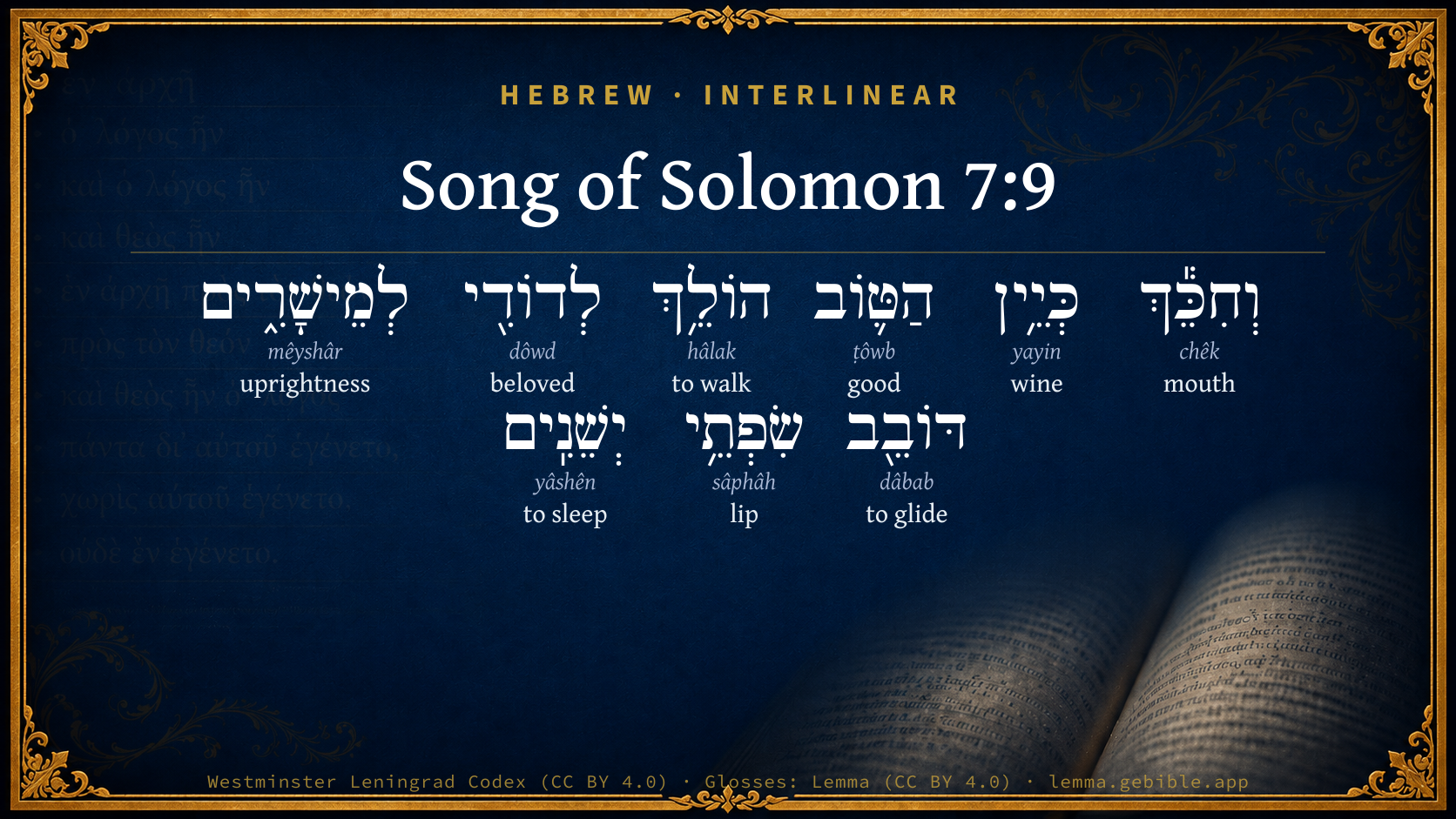
Hebrew (Westminster Leningrad Codex) Song of Solomon 7:9 appears in the Hebrew Old Testament. The text above is from the Westminster Leningrad Codex. Each word links to its Strong’s number, a concise gloss, and parsing drawn from the Open Scriptures Hebrew Bible morphology. Click any word for its full Brown-Driver-Briggs (BDB) entry.
Download image
Cite this verse

Song of Solomon 7:9 (World English Bible). Public Domain. Lemma interlinear Bible study tool, https://lemma.gebible.app/v/song-of-solomon/7/9.

Show BibTeX & RIS
BibTeX
RIS
English Translation
Your mouth like the best wine, That goes down smoothly for my beloved, Gliding through the lips of those who are asleep.
World English Bible · Public Domain
Highlights
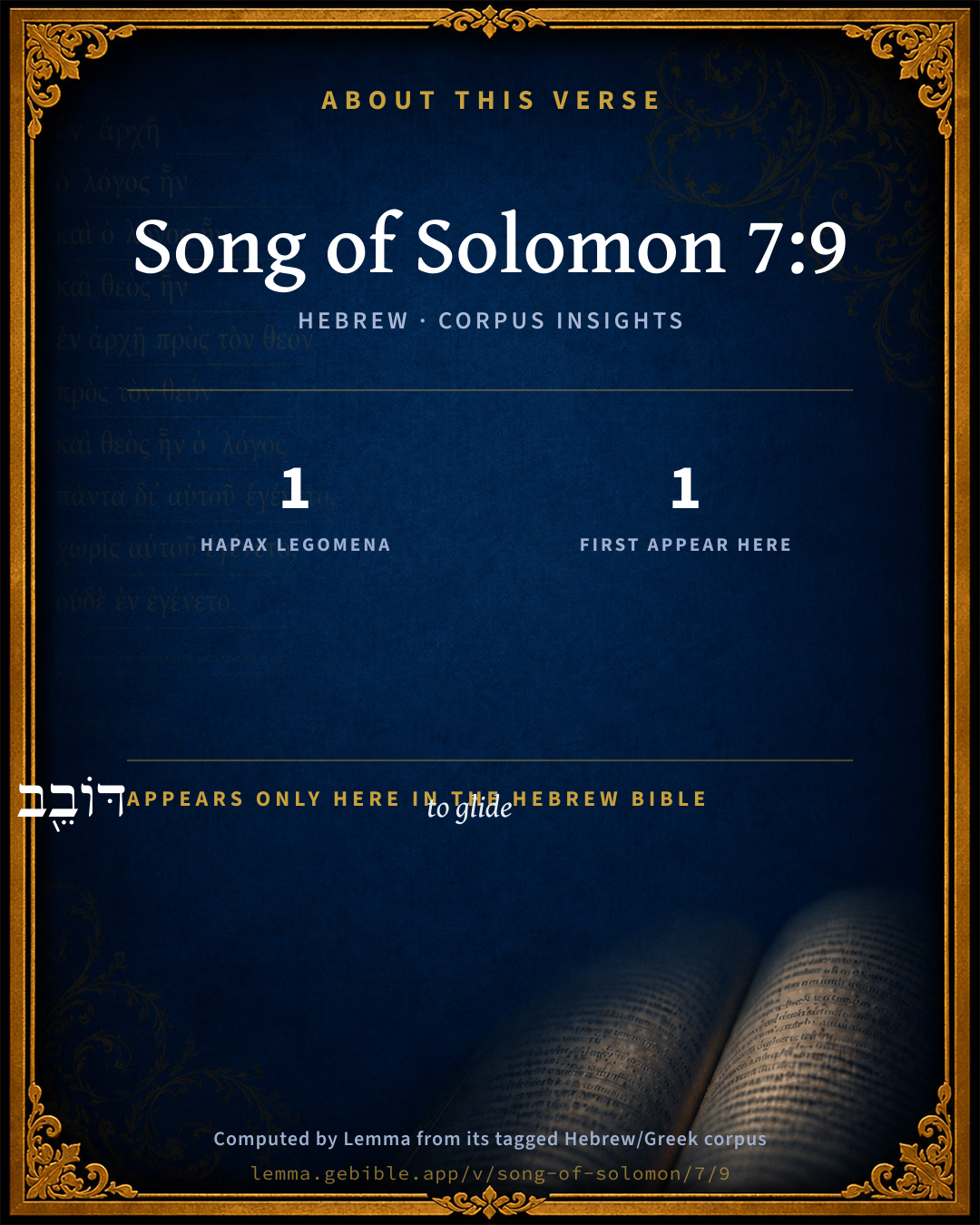
  • 1 hapax legomenon — only here in the Hebrew Bible
  • 1 first appearance in the Hebrew Bible
Full analysis ↓
Download a study sheet

One document with this verse’s original text, its word-by-word gloss line, the meaning frame, cross-references with their text, attributed commentary, and full source and license credits — printable, and it pastes into notes with its structure intact.

This verse Autodidact and up

Study sheet (.html) Plain text (.txt)

A passage Seminary Student

Up to 50 verses in one chapter. A passage sheet keeps up to 6 commentary sources and 12 cross-references per verse, in the order this page ranks them, and says so on the sheet whenever that leaves anything out. Ask for a single verse and you get the Autodidact verse sheet above.

Everything on this page stays free to read, with no account — the sheet is a download of what is already on screen, not access to it.

Want to remove ads? Support Godless Engineer
Compare translations 3

The same verse in 3 English versions, stacked beneath the original-language interlinear above. Click any original word for its lexicon entry.

Each is an independent rendering of the whole verse — the interlinear is not word-aligned to these translations.

Highlighted words mark where these versions differ — a whole-verse word diff, not a word-by-word alignment.

  • World English Bible Public Domain
    Your mouth like the best wine, That goes down smoothly for my beloved, Gliding through the lips of those who are asleep.
  • King James Version Public Domain
    And the roof of thy mouth like the best wine for my beloved, that goeth down sweetly, causing the lips of those that are asleep to speak.
  • unfoldingWord Literal Text CC BY-SA 4.0
    and your mouth like the best wine. Going down for my beloved smoothly, gliding over the lips of those who sleep.

unfoldingWord Literal Text — © unfoldingWord, licensed CC BY-SA 4.0. Word-aligned USFM3 via Door43 (git.door43.org/unfoldingWord/en_ult).

Versions to compare (up to 4)

3 of 4 selected

Show all 18 translations

Every available English version of this verse, each an independent rendering of the whole verse.

  • World English Bible Public Domain
    Your mouth like the best wine, That goes down smoothly for my beloved, Gliding through the lips of those who are asleep.
  • Berean Standard Bible Public Domain
    and your mouth like the finest wine. May it flow smoothly to my beloved, gliding gently over lips and teeth.
  • Majority Standard Bible Public Domain
    and your mouth like the finest wine. May it flow smoothly to my beloved, gliding gently over lips and teeth.
  • King James Version Public Domain
    And the roof of thy mouth like the best wine for my beloved, that goeth down sweetly, causing the lips of those that are asleep to speak.
  • American Standard Version (1901) Public Domain
    And thy mouth like the best wine, That goeth down smoothly for my beloved, Gliding through the lips of those that are asleep.
  • Revised Version (1885) Public Domain
    And thy mouth like the best wine, that goeth down smoothly for my beloved, gliding through the lips of those that are asleep.
  • Geneva Bible (1599) Public Domain
    And the roufe of thy mouth like good wine, which goeth straight to my welbeloued, and causeth the lippes of the ancient to speake.
  • Douay-Rheims (1899) Public Domain
    Thy throat like the best wine, worthy for my beloved to drink, and for his lips and his teeth to ruminate.
  • Young's Literal Translation Public Domain
    And thy palate as the good wine --' Flowing to my beloved in uprightness, Strengthening the lips of the aged!
  • Literal Standard Version CC BY-SA 4.0
    And your palate as the good wine—Flowing to my beloved in uprightness, || Strengthening the lips of the aged!
  • Unlocked Literal Bible CC BY-SA 4.0
    May your palate be like the best wine, flowing smoothly for my beloved, gliding over the lips of those who sleep. The woman speaking to the man
  • unfoldingWord Literal Text CC BY-SA 4.0
    and your mouth like the best wine. Going down for my beloved smoothly, gliding over the lips of those who sleep.
  • Darby Bible Public Domain
    And the roof of thy mouth like the best wine,... That goeth down smoothly for my beloved, And stealeth over the lips of them that are asleep.
  • World Messianic Bible Public Domain
    Your mouth is like the best wine, that goes down smoothly for my beloved, gliding through the lips of those who are asleep.
  • Webster's Bible Public Domain
    And the roof of thy mouth like the best wine for my beloved, that goeth down sweetly, causing the lips of those that are asleep to speak.
  • Free Bible Version CC BY-SA 4.0
    May your kisses be like the best wine, going down smoothly, gliding over lips and teeth.
  • Bible in Basic English Public Domain
    And the roof of your mouth like good wine flowing down smoothly for my loved one, moving gently over my lips and my teeth.
  • JPS Tanakh (1917) Public Domain
    (7-10) And the roof of thy mouth like the best wine, that glideth down smoothly for my beloved, moving gently the lips of those that are asleep.'

Literal Standard Version (2020), Covenant Press — licensed CC BY-SA 4.0. Text via the HelloAO Bible API (eBible.org). Unlocked Literal Bible (unfoldingWord) — licensed CC BY-SA 4.0. Text via the HelloAO Bible API (eBible.org). unfoldingWord Literal Text — © unfoldingWord, licensed CC BY-SA 4.0. Word-aligned USFM3 via Door43 (git.door43.org/unfoldingWord/en_ult). Free Bible Version, Dr. Jonathan Gallagher — licensed CC BY-SA 4.0. Text via the HelloAO Bible API (eBible.org).

Word by word

More ways to search: Search by grammar → Find every occurrence → Compare this word →

Practice this passage: Drill this verse → Learn its vocabulary →

דּוֹבֵ֖ב
dâbab
H1680
“gliding”
Verb, Qal, Participle Active, Masculine, Singular, Absolute
Part of Speech
Verb
Stem
Qal
Form
Participle Active
Gender
Masculine
Number
Singular
State
Absolute
Full BDB Definition

Origin: a primitive root (compare H1679 )

TWOT: 396

to move gently, glide, glide over - (Qal) glide over (participle)
  1. וְחִכֵּ֕ךְ chêk H2441 “and · mouth · your” Conjunction + Noun, Common, Masculine, Singular, Construct + Suffix, Personal, 2nd Person, Feminine, Singular
  2. כְּיֵ֥ין yayin H3196 “like/as · wine of” Preposition + Noun, Common, Masculine, Singular, Construct
  3. הַטּ֛וֹב ṭôwb H2896 “the · good” Particle, Definite Article + Adjective, Adjective, Masculine, Singular, Absolute
  4. הוֹלֵ֥ךְ hâlak H1980 “walking” Verb, Qal, Participle Active, Masculine, Singular, Absolute
  5. לְדוֹדִ֖י dôwd H1730 “to/for · beloved · my” Preposition + Noun, Common, Masculine, Singular, Construct + Suffix, Personal, 1st Person, Common, Singular
  6. לְמֵישָׁרִ֑ים mêyshâr H4339 “to/for · uprightness” Preposition + Noun, Common, Masculine, Plural, Absolute
  7. שִׂפְתֵ֥י sâphâh H8193 “lips of” Noun, Common, Feminine, Dual, Construct
  8. יְשֵׁנִֽים yâshên H3462 “asleep” Adjective, Adjective, Masculine, Plural, Absolute

About this verse

These counts appear in no published source. They are computed here, from the morphology-tagged text and Lemma’s own curated glosses. What Lemma adds →

9
words
9
distinct lemmas
Wisdom
section

Notable vocabulary

1 hapax legomenon — a word that appears only here in the entire Hebrew Bible:

  • דּוֹבֵ֖ב to glide H1680

First appearance in Scripture

This word makes its first canonical appearance in the Hebrew Bible here:

  • דּוֹבֵ֖ב to glide H1680

Shared distinctive vocabulary

וְחִכֵּ֕ךְ mouth H2441 occurs in 18 verses of the Hebrew Bible. Also found in:

Grammatical profile

  • 2 verbs
  • 5 nouns
  • 2 adjectives

Verb forms

  • הוֹלֵ֥ךְ Qal · Participle Active
  • דּוֹבֵ֖ב Qal · Participle Active

Hebrew & Septuagint length

In English translation the verse runs 22 words from the Hebrew and 16 from the Septuagint (LXX English) — closely comparable.

A rough comparison of the two English renderings, which tokenize alike — not a word-level alignment.

Word counts can differ between the Hebrew and the Greek without any difference in meaning — e.g. the Hebrew direct-object marker אֵת has no separate Greek word, and Greek often adds the article ὁ.

Cross-references

17

Topical passages linked to Song of Solomon 7:9 in the Treasury of Scripture Knowledge — connected by theme and wording, ordered by reader-vote popularity; previews shown in the World English Bible.

  • Song of Solomon 5:16 His mouth is sweetness; Yes, he is altogether lovely. This is my beloved, and this is my friend, Daughters of Jerusalem. Friends
  • Proverbs 16:24 Pleasant words are a honeycomb, Sweet to the soul, and health to the bones.
  • Song of Solomon 2:14 My dove in the clefts of the rock, In the hiding places of the mountainside, Let me see your face. Let me hear your voice; For your voice is sweet, and your face is lovely.
  • Song of Solomon 5:2 I was asleep, but my heart was awake. It is the voice of my beloved who knocks: Open to me, my sister, my love, my dove, my undefiled; For my head is filled with dew, My hair with the dampness of the night.
  • Isaiah 62:8–9 Yahweh has sworn by his right hand, and by the arm of his strength, Surely I will no more give your grain to be food for your enemies; and foreigners shall not drink your new wine, for which you have labored:
  • Zechariah 9:15–17 Yahweh of Hosts will defend them; And they will destroy and overcome with sling-stones; And they will drink, and roar as through wine; And they will be filled like bowls, Like the corners of the altar.
  • Acts 2:11–13 Cretans and Arabians: we hear them speaking in our languages the mighty works of God!"
  • Acts 4:31–32 When they had prayed, the place was shaken where they were gathered together. They were all filled with the Holy Spirit, and they spoke the word of God with boldness.
  • Acts 16:30–34 and brought them out and said, "Sirs, what must I do to be saved?"
  • Romans 13:11 Do this, knowing the time, that it is already time for you to awaken out of sleep, for salvation is now nearer to us than when we first believed.
  • Ephesians 4:29 Let no corrupt speech proceed out of your mouth, but such as is good for building up as the need may be, that it may give grace to those who hear.
  • Colossians 3:16–17 Let the word of Christ dwell in you richly; in all wisdom teaching and admonishing one another with psalms, hymns, and spiritual songs, singing with grace in your heart to the Lord.
  • Colossians 4:6 Let your speech always be with grace, seasoned with salt, that you may know how you ought to answer each one.
  • 1 Thessalonians 4:13–14 But we don't want you to be ignorant, brothers, concerning those who have fallen asleep, so that you don't grieve like the rest, who have no hope.
  • Hebrews 13:15 Through him, then, let us offer up a sacrifice of praise to God continually, that is, the fruit of lips which make confession to his name.
  • Acts 2:46–47 Day by day, continuing steadfastly with one accord in the temple, and breaking bread at home, they took their food with gladness and singleness of heart,
  • Revelation 14:13 I heard the voice from heaven saying, "Write, 'Blessed are the dead who die in the Lord from now on.'" "Yes," says the Spirit, "that they may rest from their labors; for their works follow with them."

Cross-references courtesy of OpenBible.info (CC BY 4.0).

Hebrew and Greek witnesses Masoretic Hebrew ↔ Greek Septuagint

The same verse in the two great witnesses to the Old Testament, shown verse-for-verse.

These are two independent witnesses, not word-aligned to each other, and the Septuagint is shown in lemma (dictionary) form.

Hebrew Song of Solomon 7:9 Masoretic · Westminster Leningrad Codex

וְחִכֵּ֕ךְ כְּיֵ֥ין הַטּ֛וֹב הוֹלֵ֥ךְ לְדוֹדִ֖י לְמֵישָׁרִ֑ים דּוֹבֵ֖ב שִׂפְתֵ֥י יְשֵׁנִֽים

Your mouth like the best wine, That goes down smoothly for my beloved, Gliding through the lips of those who are asleep.

World English Bible · Public Domain

Greek LXX Song of Solomon 7:9 Septuagint · lemma form

εἶπον ἀναβαίνω ἐν ὁ φοῖνιξ κρατέω ὁ ὕψος αὐτός καί εἰμί δή μαστός σύ ὡς βότρυς ὁ ἄμπελος καί ὀσμή ῥίς σύ ὡς μῆλον

and your throat as good wine, going well with my kinsman, suiting my lips and teeth.

LXX2012 (modern English Septuagint) · Public Domain

On this verse, Ellicott's Commentary for English Readers discusses the Septuagint’s reading. Read the note in Commentary ↓

Hebrew: Westminster Leningrad Codex (CC BY 4.0). Greek: Septuagint (public domain); English from LXX2012 (modern English Septuagint) (Public Domain). How the Septuagint differs from the Hebrew →

Commentary

Notes on Song of Solomon 7:9 from classic Christian and Jewish commentators (each source and its license shown beneath its notes). The classic Christian expositions comment on the surrounding passage and are grouped to its opening verse, so a note may address several verses; the Jewish commentaries on the Tanakh (Rashi and others) are per-verse, so they appear only where the commentator wrote on this verse.

Lemma curates 59 commentaries, every one of them public domain or Creative Commons licensed, each selected and text-cleaned for this edition rather than reprinted as found. About our sources →

Trapp's Complete Commentary

John Trapp

Son 7:9 And the roof of thy mouth like the best wine for my beloved, that goeth [down] sweetly, causing the lips of those that are asleep to speak.

Ver. 9. And the roof of thy mouth like the best wine.] Her word and doctrine (for the palate is an instrument of speech), often before commended by Christ, and here again, like as she comes over it in him the second time. {Son 4:13; Son 4:16} {See Trapp on "Son 4:13"} {See Trapp on "Son 4:16"} This he resembleth to the best and most generous wine. Such the word of God’s grace is to those that have spiritual palates, that do not carry fel in aure, - their galls in their ears (as some creatures are said to do), that have their ears healed (as Demosthenes said of his Athenians), and their inward senses habitually exercised to discern good and evil. The doctrine of the Church seems to some bitter and grievous; it goeth down like the waters of Marah, or that water that caused the curse in case of jealousy. {Num 5:12-31} It becomes a savour of death unto them, as the viper is killed with palm branches, and vultures with oil of roses. {a} But this is merely their own fault; for "doth not my word do good to them that are good?" saith the Lord. {Mic 2:6} Excellently St Augustine, Adversarius est nobis, quamdiu sumus et ipsi nobis: quamdiu tu tibi inimicus es, inimicum habebis sermonem Dei, - God’s Word is an enemy to none but to such as are enemies to themselves, and sinners against their own souls. This holy word in the mouths of God’s ministers is like Moses’s rod, which, while held in his hand, flourished, and brought forth almonds; but, being cast to the ground, it became a serpent. The application is easy. {See Trapp on "Son 1:2"}

For my beloved.] These are Christ’s words; but he speaks as if the Church spake, to show her great affection, that had dedicated all her good things to him. Some read it thus, which "goeth straight to my well beloved"; q.d., It is such excellent wine as I would wish it, or send it even to the dearest and best friend I have, even to her that I love as myself, if not before myself. Or thus, "which springs and sparkles in the cup." See Pro 23:31.

Causing the lips of those that are asleep to speak.] "Utterance" is called a "gift," {1Co 1:5; 1Co 1:7} and dumb Christians are blame worthy as well as dumb ministers. We should all strive to a holy ability and dexterity of savoury discourse. And for this end the word of Christ should dwell richly in us in all wisdom: our hearts should indite a good matter, that our tongues might be as the pen of a ready writer. Let there be a good treasure within our hearts, and the law of kindness will soon be in our lips; for out of the abundance of the heart the mouth speaketh. Graceless men are gagged by the devil; they cannot so much as lisp out one syllable of good language; if they attempt it, they show themselves but bunglers, and say Sibboleth for Shibboleth; you may soon see they speak by rote, and not by experience. But those that have well drunk of this wine of the Word, made effectual by the Spirit, talk lustily, yea, their tongues never cease talking and preaching forth the praises of him who hath drawn them out of darkness into his marvellous light: they speak "as the Spirit gives them utterance." {Act 2:4; Act 2:11; Act 2:14} Those that were in a dead sleep of sin, are soon set to work to "awake and sing." {Isa 26:19} This should stir us up to study the Word of God, and therehence to learn language. The ll9th Psalm is by David set before it as a poem of commendation, mentioning it in every verse, testimonies, laws, statutes, &c. Like as when a book is set forth, verses of commendation are oft prefixed. Such another, but far shorter, is that in Psa 19:7-11. The Holy Ghost doth so much the more highly there extol it, because men are wont to have it in very light account, and to hold it a disparagement to be eloquent and mighty in the Scriptures.

{a} Pausanias, Aristot.

John Trapp, A Commentary or Exposition upon All the Books of the Old and New Testament (1647–1656) — public domain. Text from a community e-Sword module.

Joseph Benson's Commentary

Son 7:9. The roof of thy mouth — Thy speech, the palate being one of the principal instruments of speech; like the best wine — Grateful and refreshing; for my beloved — Who reapest the comfort and benefit of that pleasure which I take in thee. Causing the lips, &c., to speak — The most dull, and stupid, and sleepy persons to speak.

Joseph Benson's Commentary on the Old and New Testaments (1811–1818) — public domain. Text from a community e-Sword module.

Tyndale Open Study Notes

Tyndale Open Resources

7:9 The man compares the woman’s love and her kisses to wine in that they are delightful and make one light-headed (see 1:2).

Tyndale Open Study Notes — © Tyndale Open Resources, licensed CC BY-SA 4.0. Text via the HelloAO Bible API.

Adam Clarke's Commentary

Verse 9. The roof of thy mouth like the best wine] The voice or conversation of the spouse is most probably what is meant.

Causing the lips of those that are asleep to speak.] As good wine has a tendency to cause the most backward to speak fluently when taken in moderation; so a sight of thee, and hearing the charms of thy conversation, is sufficient to excite the most taciturn to speak, and even to become eloquent in thy praises.

Adam Clarke's Commentary on the Bible (1810–1826) — public domain. Text from a community e-Sword/MySword module.

Ellicott's Commentary for English Readers

(9) Causing the lips.—The text in this verse has evidently undergone some change. The LXX., in stead of siphtheî yesheynîm, lips of sleepers, read sephathaîm veshinnayîm, χέιλεσί μου καὶ ὸδοῦσι. The Marg., instead of yesheynîm, sleepers, reads yeshanîm, the ancient, which Luther adopts, translating “of the previous year.” Ledôdî, for my beloved, is evidently either an accidental insertion of the copyist, the eye having caught dôdî in the next verse, or more probably is wrongly vowelled. The verse is untranslatable as it stands; but by reading ledôdaî, “to my caresses” (comp. Son_1:2; Son_4:10; Son_7:12), we get a sense entirely harmonious with the context, and this is a change less violent than to reject ledôdî altogether. It is the old figure, comparing kisses to wine (comp. Son_1:2; Son_2:4; Son_5:1). “The roof of the mouth” (comp. Son_5:16), or palate, is put by metonymy for the mouth generally. Dôbeb is either from the root dôb, cognate with zôb = flow gently, and means suffusing, in which case we translate “Thy mouth pours out an exquisite wine, which runs sweetly down in answer to my caresses, and suffuses (LXX. ἱκανούμενος, accommodating itself to) our lips as we fall asleep”—or, according to the Rabbinical interpretation, followed by the Authorised Version (which connects dôbeb with dabab, a Talmudic word = speaking), there may be in it the idea of a dream making the lips move as in speech. In this case the lines of Shelley suggest the meaning:—

“Like lips murmuring in their sleep

Of the sweet kisses which had lulled them there.”

Epipsychidion.

A Bible Commentary for English Readers, edited by Charles John Ellicott (1878–1897) — public domain. Text from a community e-Sword module.

The Cambridge Bible for Schools and Colleges

gen. ed. J. J. S. Perowne

9. and the roof of thy mouth] Better, as R.V., and thy mouth. Chçkh is the palate, but it is used for the mouth. Cp. ch. Son_5:16; Hos_8:1. The reference here as in Son_5:16 is to the sweet words of love which she whispers, they intoxicate like wine.

for my beloved, that goeth down sweetly] This should be, as in R.V., that goeth down smoothly for my beloved. Instead of smoothly, R.V. marg. gives ‘aright.’ Cp. for the phrase Pro_23:31, R.V. and margin. Budde would read lìchikkî, ‘for my palate,’ instead or lìdhôdhî, ‘for my beloved,’ but there is no support for such a change in any version or MS. The translation of the A.V. is according to the accents, but most recent commentators, who take the dramatic or semi-dramatic view of the whole, assign these words to the bride, supposing that she interrupts the king and turns off the simile to her beloved.

causing the lips of those that are asleep to speak] Better, as R.V., gliding through the lips of those that are asleep. The A.V. may, following Jerome and Kimchi, have connected the word dôbhçbh with dibbâh, a calumny or evil rumour, or they may have read dôbhçr or medhabbçr. But dôbhçbh has no connexion with dibbâh, but is rather related to zâbh, and means ‘to go softly,’ hence the translation ‘going softly’ or ‘gliding’ over the lips of sleepers, or of those about to sleep. The whole clause would then mean that this wine was such that men drank it till they were rendered slumberous by it. But this is not very satisfactory, and the suggestion that, following the LXX, Aq., Syr., Vulg., we should read ‘gliding over my lips and teeth,’ or ‘over his lips and teeth,’ might perhaps be adopted.

The Cambridge Bible for Schools and Colleges (gen. ed. J. J. S. Perowne; Cambridge University Press, 1878–1918) — public domain. Text from a community e-Sword module.

Haydock's Catholic Bible Commentary

Lips. Septuagint, "sufficient for my lips and teeth." (Haydock) --- The wine in that country was very thick, when kept a long time. It here denotes charity, or the gospel truths, Luke v. 37., and Acts ii. 13. Hebrew, "causing the lips of them who sleep to speak," (Calmet) as the apostles did, in transports of zeal. (Theodoret) --- Yet the reading of the Septuagint, Aquila, &c., seems preferable. (Calmet)

George Leo Haydock (1774–1849), Haydock's Catholic Family Bible and Commentary, 1859 edition — public domain. Excludes Psalms (Douay-Rheims chapter numbering differs from Protestant) and Deuterocanonical books (Catholic canon only).

Matthew Poole's English Annotations

The roof of thy mouth; either,

1. Thy speech, the palate being one of the principal instruments of speech; or rather,

2. Thy taste, whereof the palate or roof of the mouth is the most proper and principal instrument, Job 34:3. But then this is not to be understood actively of her taste, but passively of the taste or relish which her Beloved had of her; as in the foregoing clause, the smell of her nose was not meant subjectively or actively of that sense of smelling which was seated in her nose, but objectively or passively of the breath of her nostrils, which was sweet to the smell of her Beloved.

Like the best wine, grateful and refreshing. For my beloved; either,

1. For thee my beloved, who reapest the comfort and benefit of that pleasure which I take in time; or,

2. For me thy Beloved, or, according to thy usual expression,

for my Beloved; which words Christ takes as it were out of her mouth, and repeats them emphatically; which agrees very well to the style and usage of these dramatical and amaropious writings. And this clause further intimates the church’s loyalty or faithfulness to Christ, that she reserves herself and all her loves for Christ alone.

That goeth down sweetly; whereas bad wine either goeth down slowly and tediously, or is not permitted to go down at all; Heb. that walketh directly; or, that moveth itself aright; which is given as the character of good wine, Pro 23:31.

Causing the lips of those that are asleep to speak; causing the most dull, and stupid, and sleepy-headed persons to speak, and that fluently and eloquently, which is a common effect of good wine.

Matthew Poole's English Annotations on the Holy Bible (1683–1685) — public domain. Text from a community e-Sword/MySword module.

Whedon's Commentary on the Bible

Daniel D. Whedon

9. The roof of thy mouth — Hebrew, thy palate; that is, thy speech.

For my beloved — That is, Such wine as I would offer to a dear friend. Causing the lips, etc. — It so quickens the blood that even silent lips grow talkative under its influence.

Into these few verses is thrown a faithful display of the character of Solomon, confirmed by his other Scriptural portraitures. We have seen the splendour of his pavilion and his train, the gorgeousness of his palace, the throngs of beautiful women that, like stars, adorn his court. We see the proud owner of all this, arrayed in all his glory and with arts of address, compress temptation to its intensest form by declaring his passionate attachment and preference for this Shulamite. But her bearing is firm, independent, and something more. She has placed her affection on one whose love is to her a vital need.

“The mind has a thousand eyes,

And the heart but one,

And the light of a whole life dies

When love is done.”

Daniel D. Whedon (gen. ed.), Commentary on the Old and New Testaments (1874–1909) — public domain. Text from a community e-Sword module.

The Pulpit Commentary

The sweetness of speech.

The figurative language here employed by the royal lover to eulogize the voice and the utterances of the bride is to our colder and more measured habits of thought Oriental extravagance. Yet it is in harmony with the highly coloured character of the book as a whole. And human speech does often awaken within the heart emotions not easily expressed in cool and justifiable panegyric. The human voice is of all music the sweetest, and speech is sweeter even than song, uttering as it does, not the studied and artificial sentiment of the musical composer, but the spontaneous and natural emotions of the speaker"s heart.

I CHRISTIAN SPEECH IS SWEET AS TESTIFYING TO THE CHARACTER OF THE SPEAKER.

1. Sincerity is the first condition of all acceptable speech; it is above all things desirable that there should be no discordance between the utterance and the heart. The flatterer at court and in general society speaks only to please; and in the case of those who know his aim and his motives, he fails of the very object he has in view. The Church is bound to speak "words of truth and soberness," as remembering the sacredness of the gift of utterance, and the responsibility attaching to its exercise. To a just mind sincere words are welcome, even though they be less honeyed than the words of the time server and men pleaser.

2. Love prompts to words which are a delight to hear. Whilst the tones of hatred are harsh, and the utterances of coldness are repugnant, kindness, sympathy, affection, give a sweetness to every utterance. Welcome as the words which come from the heart of the beloved, telling of the depth of unchangeable affection, are those Christian declarations in which the Church gives expression to her love for her Saviour and her pity for the world.

II CHRISTIAN SPEECH IS SWEET WHEN IT TESTIFIES TO THE LOVE AND FAITHFULNESS OF THE LORD. There is no exercise more congenial to Christ"s people, more acceptable to Christ himself, than this. The powers of speech cannot be more holily and honourably employed than in uttering forth the high praises of God, in lauding and magnifying the redeeming love of Christ. The hymn which is lisped by the little child, the anthem which rings through the cathedral aisles, the quiet word of witness in which the friend commends the Saviour to him who is dear to his heart, these are but some of the forms in which language may show forth the greatness, the goodness, the wisdom, of the Eternal. What theme so worthy of the tongue, "the glory of the frame," as this? The voice of praise and thanksgiving is dear to the heart alike of God and man.

III CHRISTIAN SPEECH IS SWEET WHEN UTTERING TESTIMONY TO THE GOSPEL OF GOD"S LOVE. Men"s hearts have to be reached and to be affected by the tidings of Divine mercy and compassion. It is most condescending and gracious on God"s part that he deigns to employ human agency in the service of his own Divine beneficence. If men avail themselves of all the resources of human rhetoric in order to obtain earthly ends power, wealth, and fame how much more ready should they be to use all the faculties they possess, all the arts and means they can acquire, to bring before their fellow men the tidings of heavenly and immortal love! Well may every preacher and. every teacher of Divine truth put up the prayer "Jesus, confirm my heart"s desire, To work, to think, to speak for thee: Still let me guard the holy fire, And still stir up thy gift in me! T.

The Pulpit Commentary (1880–1919), ed. H.D.M. Spence-Jones & Joseph S. Exell — public domain. Text from a community e-Sword module.

John Wesley's Explanatory Notes

Thy mouth - Thy speech, the palate being one of the principal instruments of speech. Wine - Grateful and refreshing for thee my beloved, who reapest the comfort and benefit of that pleasure which I take in thee. Causing - The most dull, and stupid, and sleepy persons to speak.

John Wesley, Explanatory Notes Upon the Whole Bible (1754–1765) — public domain. Text via the GEBible commentary corpus.

unfoldingWord translationNotes

Door43 World Missions Community

General Information:

The man continues describing what he would like to do with the woman.

May your palate be like the best wine

The palate is a metonym for the lips. Wine tastes good. The man wants to kiss the woman's lips. (See: Metonymy and Simile)

flowing smoothly for my beloved

"that flows smoothly for the one I love." The man enjoys the smooth kisses of the woman.

gliding over the lips of those who sleep

"that flows over our lips as we sleep"

translationWords

wine

beloved

unfoldingWord translationNotes — © Distant Shores Media and the Door43 World Missions Community, licensed CC BY-SA 4.0. Source: git.door43.org/Door43/en_tn.

Rashi

Rabbi Shlomo Yitzchaki (Rashi)

I said: Let me climb up the palm tree I boast of you among the heavenly hosts, that I should be exalted and hallowed through you in the lower realms, for you will hallow My name among the nations.

let me seize its boughs and I will seize and cleave to you. סַנְסִנִים are boughs.

and let your breasts be now And now, cause my words to be realized, that you will not be seduced after the nations, and may the good and wise among you be steadfast in their faith, to retort to those who seduce them, so that the small ones among you will learn from them.

Rashi on the Tanakh — English translations: “The Judaica Press complete Tanach with Rashi, translated by A. J. Rosenberg” (CC BY 4.0); “Pentateuch with Rashi's commentary by M. Rosenbaum and A.M. Silbermann, 1929-1934” (public domain); “The Metsudah Tanach series, Lakewood, N.J” (CC BY 4.0); and “The Book of Joshua, Metsudah Publications, 1997” (CC BY 4.0). Text via Sefaria.

Lesson kit

Teaching starters — assembled from the data on this page, not authored interpretation. Every prompt links to the verse data it draws on. Edit before teaching.

Song of Solomon, in the Wisdom, opens this verse with 9 words (9 distinct Hebrew lemmas). Its most distinctive word is dâbab (“to glide”). A historical commentator’s framing appears above. Read the whole chapter for the surrounding context.

Discussion questions

  1. What does “to glide” (dâbab) contribute to the verse as a whole?
  2. 1 word here appears nowhere else in the Hebrew Bible. Why might the author reach for such rare wording?
  3. This is the first place “to glide” appears in Scripture (first appears here). What does its debut here establish?
  4. How does Job 6:30, which shares the word «mouth», read alongside this verse?
  5. The translations on this page render this verse differently — a whole-verse word diff, not a word-by-word alignment. What might account for the different wordings?
  6. «הוֹלֵ֥ךְ» is a Qal Participle Active verb. How does that grammatical form shape the action described?
  7. Compare how Trapp's Complete Commentary and Joseph Benson's Commentary read this verse. Where do they agree or differ?

Things to notice

  • 1 word in this verse appears nowhere else in the Hebrew Bible.
  • 1 word makes its first canonical appearance in Scripture here.
  • These translations choose different wording for 14 words in this verse.
  • 9 distinct Hebrew lemmas span 9 words in this verse.

Reading settings

Reading text

Shown beneath each verse's original-language words.

Old Testament
Old Testament edition

Read the OT as the Masoretic Hebrew (MT) or the Greek Septuagint (LXX).

English shown for the Greek Septuagint (in the Hebrew ↔ Greek comparison).

Comparing translations? Open the Compare panel on any verse page to stack up to four side by side.